Static - Dynamic
Anna Maria Sri Asih
Department of Mechanical & Industrial Engineering
Gadjah Mada University
Introduction
 Deterministic models:
 expressed in terms of differential equations
 can exactly predict the development of a system based
on initial and boundary conditions
 Stochastic models
 use random variables
 outcomes are uncertain
 can only compute the probabilities of possible outcomes
Example:
throwing dice ( random experiment)
 outcome of a toss: initial conditions & external forces
 uncertain ?
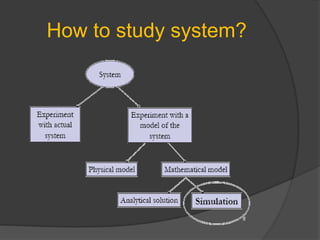
How to study system?
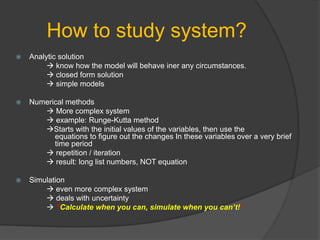
 Analytic solution
 know how the model will behave iner any circumstances.
 closed form solution
 simple models
 Numerical methods
 More complex system
 example: Runge-Kutta method
Starts with the initial values of the variables, then use the
equations to figure out the changes In these variables over a very brief
time period
 repetition / iteration
 result: long list numbers, NOT equation
 Simulation
 even more complex system
 deals with uncertainty
 ”Calculate when you can, simulate when you can’t!”
Simulation models
 Model of the real system
 Faster, cheaper, or safer to perform
experiments on the model
 Computer simulation may use formulas,,
programming statements, or other means
to express math relationships between
inputs and outputs.
 Dealing with uncertainty  include
uncertain variables  random values from
a distribution.
 Simulation run includes many trials
Advantages of simulation
 Allows the study of complex, real-world systems (which
otherwise cannot be studied)
 Estimates performance of existing system under ‘projected’ /
different operating conditions
 Compares alternative proposed system designs
 Better control over experimental conditions
 Compress time, expand time
 Overall, if done correctly, simulation gives planners unlimited
freedom to try out different ideas for design and improvement
Disadvantages and pitfalls of
simulation
 Failure to produce exact results (only estimates)
 Costs of developing simulation models can be
expensive and time consuming
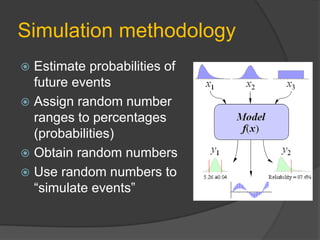
Simulation methodology
 Estimate probabilities of
future events
 Assign random number
ranges to percentages
(probabilities)
 Obtain random numbers
 Use random numbers to
“simulate events”
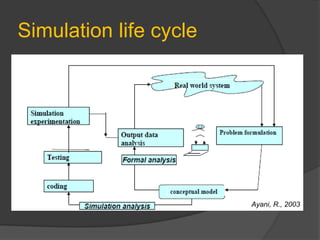
Simulation life cycle
Ayani, R., 2003
Building a valid and credible
simulation model
 Picture
verification asks “ Was the model made right? ”
validation asks “ Was the right model made? ”
accreditation asks “ Is the model the right one for the job? ”
Simulation methods – Monte Carlo
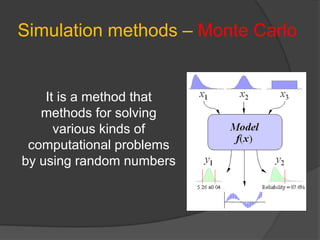
It is a method that
methods for solving
various kinds of
computational problems
by using random numbers
Simulation methods – Monte Carlo
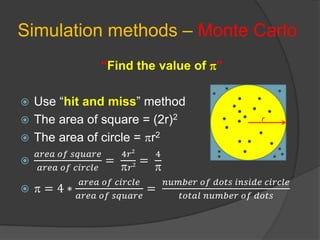
“Find the value of ”
 Use “hit and miss” method
 The area of square = (2r)2
 The area of circle = r2

𝑎𝑟𝑒𝑎 𝑜𝑓 𝑠𝑞𝑢𝑎𝑟𝑒
𝑎𝑟𝑒𝑎 𝑜𝑓 𝑐𝑖𝑟𝑐𝑙𝑒
=
4𝑟2
𝑟2 =
4

  = 4 ∗
𝑎𝑟𝑒𝑎 𝑜𝑓 𝑐𝑖𝑟𝑐𝑙𝑒
𝑎𝑟𝑒𝑎 𝑜𝑓 𝑠𝑞𝑢𝑎𝑟𝑒
=
𝑛𝑢𝑚𝑏𝑒𝑟 𝑜𝑓 𝑑𝑜𝑡𝑠 𝑖𝑛𝑠𝑖𝑑𝑒 𝑐𝑖𝑟𝑐𝑙𝑒
𝑡𝑜𝑡𝑎𝑙 𝑛𝑢𝑚𝑏𝑒𝑟 𝑜𝑓 𝑑𝑜𝑡𝑠
r
Simulation methods – Monte Carlo
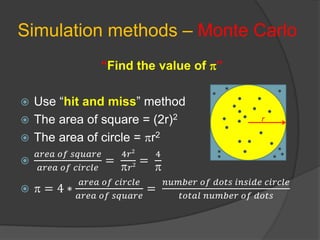
“Find the value of ”
 Use “hit and miss” method
 The area of square = (2r)2
 The area of circle = r2

𝑎𝑟𝑒𝑎 𝑜𝑓 𝑠𝑞𝑢𝑎𝑟𝑒
𝑎𝑟𝑒𝑎 𝑜𝑓 𝑐𝑖𝑟𝑐𝑙𝑒
=
4𝑟2
𝑟2 =
4

  = 4 ∗
𝑎𝑟𝑒𝑎 𝑜𝑓 𝑐𝑖𝑟𝑐𝑙𝑒
𝑎𝑟𝑒𝑎 𝑜𝑓 𝑠𝑞𝑢𝑎𝑟𝑒
=
𝑛𝑢𝑚𝑏𝑒𝑟 𝑜𝑓 𝑑𝑜𝑡𝑠 𝑖𝑛𝑠𝑖𝑑𝑒 𝑐𝑖𝑟𝑐𝑙𝑒
𝑡𝑜𝑡𝑎𝑙 𝑛𝑢𝑚𝑏𝑒𝑟 𝑜𝑓 𝑑𝑜𝑡𝑠
r
Simulation methods – Monte Carlo
“Birthday problem”
 Out of a group of 100 people, 2 people share a brithday
 Use “hit and miss” method
1. Pick 30 random numbers in the rang [1,365], each number
represent a day in a year
2. Check to see if any of the 30 random numbers are equal
3. Go back to step [1] and repeat 10,000 times
4. Report the fraction of trials that have matching birthdays
Simulation methods – Monte Carlo
“Birthday problem”
 Out of a group of 100 people, 2 people share a brithday
 Use “sampling from distribution” method
1. Suppose we have the cdf of people’s birthday, F(x)
2. People’s birthday is represented as x = [1, 365]
3. Generate a random values, z, from U [0,1]
4. Compute x = F-1(z)
5. Check to see if any of the 30 random numbers are equal
6. Go back to step [3,4] and repeat 10,000 times
7. Report the fraction of trials that have matching birthdays
Many kinds of sampling, e.g.:
• Simple sampling
• Importance sampling
• Stratified sampling
• Non-stratified sampling
• Cluster sampling
• Latin hypercube
Output from Monte Carlo
can form a distribution too !
Simulation methods –
Discrete event Simulation (DES)
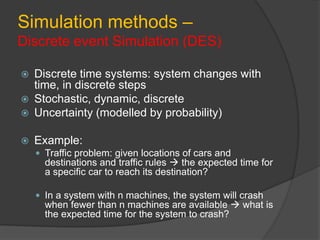
 Discrete time systems: system changes with
time, in discrete steps
 Stochastic, dynamic, discrete
 Uncertainty (modelled by probability)
 Example:
 Traffic problem: given locations of cars and
destinations and traffic rules  the expected time for
a specific car to reach its destination?
 In a system with n machines, the system will crash
when fewer than n machines are available  what is
the expected time for the system to crash?
Simulation methods –
Discrete event Simulation (DES)
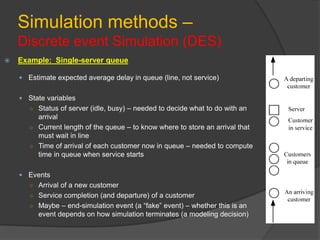
 Example: Single-server queue
 Estimate expected average delay in queue (line, not service)
 State variables
○ Status of server (idle, busy) – needed to decide what to do with an
arrival
○ Current length of the queue – to know where to store an arrival that
must wait in line
○ Time of arrival of each customer now in queue – needed to compute
time in queue when service starts
 Events
○ Arrival of a new customer
○ Service completion (and departure) of a customer
○ Maybe – end-simulation event (a “fake” event) – whether this is an
event depends on how simulation terminates (a modeling decision)
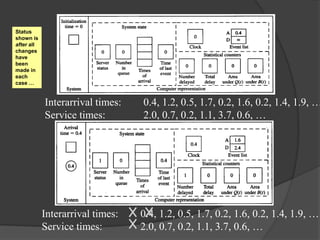
Status
shown is
after all
changes
have
been
made in
each
case …
Interarrival times: 0.4, 1.2, 0.5, 1.7, 0.2, 1.6, 0.2, 1.4, 1.9, …
Service times: 2.0, 0.7, 0.2, 1.1, 3.7, 0.6, …
Interarrival times: 0.4, 1.2, 0.5, 1.7, 0.2, 1.6, 0.2, 1.4, 1.9, …
Service times: 2.0, 0.7, 0.2, 1.1, 3.7, 0.6, …
Interarrival times: 0.4, 1.2, 0.5, 1.7, 0.2, 1.6, 0.2, 1.4, 1.9, …
Service times: 2.0, 0.7, 0.2, 1.1, 3.7, 0.6, …
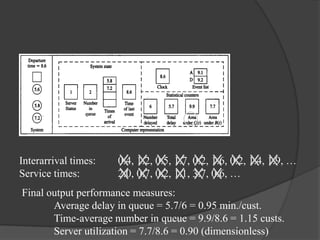
Final output performance measures:
Average delay in queue = 5.7/6 = 0.95 min./cust.
Time-average number in queue = 9.9/8.6 = 1.15 custs.
Server utilization = 7.7/8.6 = 0.90 (dimensionless)
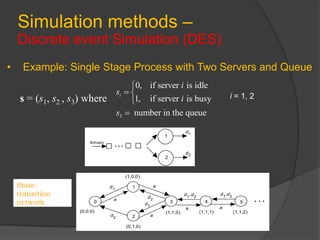
• Example: Single Stage Process with Two Servers and Queue
1
2
Arrivals
…
d1
d2
s = (s1, s2 , s3) where
0
1
2
3 4 5
(0,0,0)
(0,1,0)
(1,1,0) (1,1,1) (1,1,2)
(1,0,0)
• • •
a
a
a
a a
d1
d2
d2
d2
d2
d1
d1
d1
, ,
State-
transition
network
3
0, if server is idle
1, if server is busy
number in the queue
i
i
s
i
s

 


i = 1, 2
Simulation methods –
Discrete event Simulation (DES)
Simulation methods –
Discrete event Simulation (DES)
 Example: repair problem
n machines are needed to keep an operation.
There are s spare machines.
The machines in operation fail according to some unknown distribution
(e.g. exponential, Poisson, uniform, etc., with a known mean).
When a machine fails it is sent to repair shop and the time to fix is a
random variable that follows a known distribution.
System crashes when fewer than n machines are available
What is the expected time for the system to crash?
Simulation methods –
Discrete event Simulation (DES)
n = number of working machines needed
S = number of spares available
Simulation methods – Continuous
 Continuous time model:
 state variables may change
continuously, e.g. temperature in a class
room, the level of water in a tank
 used extensively in mechanical, chemical,
and electrical engineering
 Example:
 the level of temperature of a liquid
 the level of temperature in a classroom
 the level of water in a tank
 the level of drug concentration in body
Simulation methods – Hybrid
 Hybrid : combined discrete / continuous
model
 Some variables in the system model are
discrete and some continuous
 Example: unloading dock where tankers
queue up to unload their oil through a
pipeline:
 discrete : tanker arrivals
 continuous : flow of oil
Random variables
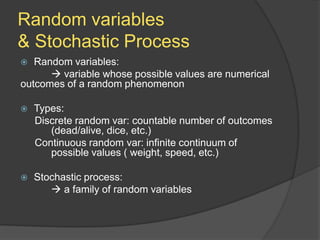
& Stochastic Process
 Random variables:
 variable whose possible values are numerical
outcomes of a random phenomenon
 Types:
Discrete random var: countable number of outcomes
(dead/alive, dice, etc.)
Continuous random var: infinite continuum of
possible values ( weight, speed, etc.)
 Stochastic process:
 a family of random variables
Probability functions
 A probability function maps the possible
values x against their respective
probabilities of occurrence, p(x)
 p(x)  [0,1]
 The area under a probability function is
always 1
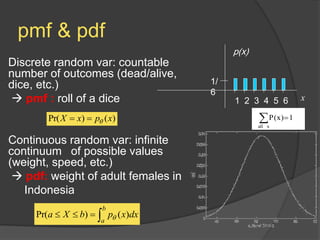
pmf & pdf
Discrete random var: countable
number of outcomes (dead/alive,
dice, etc.)
 pmf : roll of a dice
Continuous random var: infinite
continuum of possible values
(weight, speed, etc.)
 pdf: weight of adult females in
Indonesia
x
p(x)
1/
6
1 4 5 6
2 3
 
x
all
1
P(x)
Pr( ) ( )
X x p x

 
Pr( ) ( )
b
a
a X b p x dx

   
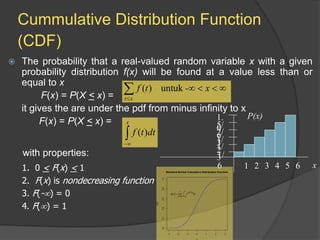
 The probability that a real-valued random variable x with a given
probability distribution f(x) will be found at a value less than or
equal to x
F(x) = P(X < x) =
it gives the are under the pdf from minus infinity to x
F(x) = P(X < x) =
with properties:






x
t
x
-
t
f untuk
)
(
1. 0 < F(x) < 1
2. F(x) is nondecreasing function
3. F(-) = 0
4. F() = 1
Cummulative Distribution Function
(CDF)


x
dt
t
f )
(
x
P(x)
1/
6 1 4 5 6
2 3
1/
3
1/
2
2/
3
5/
6
1.
0
Stochastic process
 The process has a strong element of
random behaviour
 If the time set T is countable  discrete
time process : {Xn, n=0,1,2,…}
 If the time set T is an interval of the real
line  continuous time process: {X(t),
t0}
Types of formulations
 Static formulations
 involves functions with one or
more variables being random
 Dynamic formulations
 involves stochastic process with
independent var t (time) to model
uncertain dynamic systems

Week08.pdf

  • 1.
    Static - Dynamic AnnaMaria Sri Asih Department of Mechanical & Industrial Engineering Gadjah Mada University
  • 2.
    Introduction  Deterministic models: expressed in terms of differential equations  can exactly predict the development of a system based on initial and boundary conditions  Stochastic models  use random variables  outcomes are uncertain  can only compute the probabilities of possible outcomes Example: throwing dice ( random experiment)  outcome of a toss: initial conditions & external forces  uncertain ?
  • 3.
    How to studysystem?
  • 4.
    How to studysystem?  Analytic solution  know how the model will behave iner any circumstances.  closed form solution  simple models  Numerical methods  More complex system  example: Runge-Kutta method Starts with the initial values of the variables, then use the equations to figure out the changes In these variables over a very brief time period  repetition / iteration  result: long list numbers, NOT equation  Simulation  even more complex system  deals with uncertainty  ”Calculate when you can, simulate when you can’t!”
  • 5.
    Simulation models  Modelof the real system  Faster, cheaper, or safer to perform experiments on the model  Computer simulation may use formulas,, programming statements, or other means to express math relationships between inputs and outputs.  Dealing with uncertainty  include uncertain variables  random values from a distribution.  Simulation run includes many trials
  • 6.
    Advantages of simulation Allows the study of complex, real-world systems (which otherwise cannot be studied)  Estimates performance of existing system under ‘projected’ / different operating conditions  Compares alternative proposed system designs  Better control over experimental conditions  Compress time, expand time  Overall, if done correctly, simulation gives planners unlimited freedom to try out different ideas for design and improvement Disadvantages and pitfalls of simulation  Failure to produce exact results (only estimates)  Costs of developing simulation models can be expensive and time consuming
  • 7.
    Simulation methodology  Estimateprobabilities of future events  Assign random number ranges to percentages (probabilities)  Obtain random numbers  Use random numbers to “simulate events”
  • 8.
  • 9.
    Building a validand credible simulation model  Picture verification asks “ Was the model made right? ” validation asks “ Was the right model made? ” accreditation asks “ Is the model the right one for the job? ”
  • 10.
    Simulation methods –Monte Carlo It is a method that methods for solving various kinds of computational problems by using random numbers
  • 11.
    Simulation methods –Monte Carlo “Find the value of ”  Use “hit and miss” method  The area of square = (2r)2  The area of circle = r2  𝑎𝑟𝑒𝑎 𝑜𝑓 𝑠𝑞𝑢𝑎𝑟𝑒 𝑎𝑟𝑒𝑎 𝑜𝑓 𝑐𝑖𝑟𝑐𝑙𝑒 = 4𝑟2 𝑟2 = 4    = 4 ∗ 𝑎𝑟𝑒𝑎 𝑜𝑓 𝑐𝑖𝑟𝑐𝑙𝑒 𝑎𝑟𝑒𝑎 𝑜𝑓 𝑠𝑞𝑢𝑎𝑟𝑒 = 𝑛𝑢𝑚𝑏𝑒𝑟 𝑜𝑓 𝑑𝑜𝑡𝑠 𝑖𝑛𝑠𝑖𝑑𝑒 𝑐𝑖𝑟𝑐𝑙𝑒 𝑡𝑜𝑡𝑎𝑙 𝑛𝑢𝑚𝑏𝑒𝑟 𝑜𝑓 𝑑𝑜𝑡𝑠 r
  • 12.
    Simulation methods –Monte Carlo “Find the value of ”  Use “hit and miss” method  The area of square = (2r)2  The area of circle = r2  𝑎𝑟𝑒𝑎 𝑜𝑓 𝑠𝑞𝑢𝑎𝑟𝑒 𝑎𝑟𝑒𝑎 𝑜𝑓 𝑐𝑖𝑟𝑐𝑙𝑒 = 4𝑟2 𝑟2 = 4    = 4 ∗ 𝑎𝑟𝑒𝑎 𝑜𝑓 𝑐𝑖𝑟𝑐𝑙𝑒 𝑎𝑟𝑒𝑎 𝑜𝑓 𝑠𝑞𝑢𝑎𝑟𝑒 = 𝑛𝑢𝑚𝑏𝑒𝑟 𝑜𝑓 𝑑𝑜𝑡𝑠 𝑖𝑛𝑠𝑖𝑑𝑒 𝑐𝑖𝑟𝑐𝑙𝑒 𝑡𝑜𝑡𝑎𝑙 𝑛𝑢𝑚𝑏𝑒𝑟 𝑜𝑓 𝑑𝑜𝑡𝑠 r
  • 13.
    Simulation methods –Monte Carlo “Birthday problem”  Out of a group of 100 people, 2 people share a brithday  Use “hit and miss” method 1. Pick 30 random numbers in the rang [1,365], each number represent a day in a year 2. Check to see if any of the 30 random numbers are equal 3. Go back to step [1] and repeat 10,000 times 4. Report the fraction of trials that have matching birthdays
  • 14.
    Simulation methods –Monte Carlo “Birthday problem”  Out of a group of 100 people, 2 people share a brithday  Use “sampling from distribution” method 1. Suppose we have the cdf of people’s birthday, F(x) 2. People’s birthday is represented as x = [1, 365] 3. Generate a random values, z, from U [0,1] 4. Compute x = F-1(z) 5. Check to see if any of the 30 random numbers are equal 6. Go back to step [3,4] and repeat 10,000 times 7. Report the fraction of trials that have matching birthdays Many kinds of sampling, e.g.: • Simple sampling • Importance sampling • Stratified sampling • Non-stratified sampling • Cluster sampling • Latin hypercube Output from Monte Carlo can form a distribution too !
  • 15.
    Simulation methods – Discreteevent Simulation (DES)  Discrete time systems: system changes with time, in discrete steps  Stochastic, dynamic, discrete  Uncertainty (modelled by probability)  Example:  Traffic problem: given locations of cars and destinations and traffic rules  the expected time for a specific car to reach its destination?  In a system with n machines, the system will crash when fewer than n machines are available  what is the expected time for the system to crash?
  • 16.
    Simulation methods – Discreteevent Simulation (DES)  Example: Single-server queue  Estimate expected average delay in queue (line, not service)  State variables ○ Status of server (idle, busy) – needed to decide what to do with an arrival ○ Current length of the queue – to know where to store an arrival that must wait in line ○ Time of arrival of each customer now in queue – needed to compute time in queue when service starts  Events ○ Arrival of a new customer ○ Service completion (and departure) of a customer ○ Maybe – end-simulation event (a “fake” event) – whether this is an event depends on how simulation terminates (a modeling decision)
  • 17.
    Status shown is after all changes have been madein each case … Interarrival times: 0.4, 1.2, 0.5, 1.7, 0.2, 1.6, 0.2, 1.4, 1.9, … Service times: 2.0, 0.7, 0.2, 1.1, 3.7, 0.6, … Interarrival times: 0.4, 1.2, 0.5, 1.7, 0.2, 1.6, 0.2, 1.4, 1.9, … Service times: 2.0, 0.7, 0.2, 1.1, 3.7, 0.6, …
  • 18.
    Interarrival times: 0.4,1.2, 0.5, 1.7, 0.2, 1.6, 0.2, 1.4, 1.9, … Service times: 2.0, 0.7, 0.2, 1.1, 3.7, 0.6, … Final output performance measures: Average delay in queue = 5.7/6 = 0.95 min./cust. Time-average number in queue = 9.9/8.6 = 1.15 custs. Server utilization = 7.7/8.6 = 0.90 (dimensionless)
  • 19.
    • Example: SingleStage Process with Two Servers and Queue 1 2 Arrivals … d1 d2 s = (s1, s2 , s3) where 0 1 2 3 4 5 (0,0,0) (0,1,0) (1,1,0) (1,1,1) (1,1,2) (1,0,0) • • • a a a a a d1 d2 d2 d2 d2 d1 d1 d1 , , State- transition network 3 0, if server is idle 1, if server is busy number in the queue i i s i s      i = 1, 2 Simulation methods – Discrete event Simulation (DES)
  • 20.
    Simulation methods – Discreteevent Simulation (DES)  Example: repair problem n machines are needed to keep an operation. There are s spare machines. The machines in operation fail according to some unknown distribution (e.g. exponential, Poisson, uniform, etc., with a known mean). When a machine fails it is sent to repair shop and the time to fix is a random variable that follows a known distribution. System crashes when fewer than n machines are available What is the expected time for the system to crash?
  • 21.
    Simulation methods – Discreteevent Simulation (DES) n = number of working machines needed S = number of spares available
  • 22.
    Simulation methods –Continuous  Continuous time model:  state variables may change continuously, e.g. temperature in a class room, the level of water in a tank  used extensively in mechanical, chemical, and electrical engineering  Example:  the level of temperature of a liquid  the level of temperature in a classroom  the level of water in a tank  the level of drug concentration in body
  • 23.
    Simulation methods –Hybrid  Hybrid : combined discrete / continuous model  Some variables in the system model are discrete and some continuous  Example: unloading dock where tankers queue up to unload their oil through a pipeline:  discrete : tanker arrivals  continuous : flow of oil
  • 24.
    Random variables & StochasticProcess  Random variables:  variable whose possible values are numerical outcomes of a random phenomenon  Types: Discrete random var: countable number of outcomes (dead/alive, dice, etc.) Continuous random var: infinite continuum of possible values ( weight, speed, etc.)  Stochastic process:  a family of random variables
  • 25.
    Probability functions  Aprobability function maps the possible values x against their respective probabilities of occurrence, p(x)  p(x)  [0,1]  The area under a probability function is always 1
  • 26.
    pmf & pdf Discreterandom var: countable number of outcomes (dead/alive, dice, etc.)  pmf : roll of a dice Continuous random var: infinite continuum of possible values (weight, speed, etc.)  pdf: weight of adult females in Indonesia x p(x) 1/ 6 1 4 5 6 2 3   x all 1 P(x) Pr( ) ( ) X x p x    Pr( ) ( ) b a a X b p x dx     
  • 27.
     The probabilitythat a real-valued random variable x with a given probability distribution f(x) will be found at a value less than or equal to x F(x) = P(X < x) = it gives the are under the pdf from minus infinity to x F(x) = P(X < x) = with properties:       x t x - t f untuk ) ( 1. 0 < F(x) < 1 2. F(x) is nondecreasing function 3. F(-) = 0 4. F() = 1 Cummulative Distribution Function (CDF)   x dt t f ) ( x P(x) 1/ 6 1 4 5 6 2 3 1/ 3 1/ 2 2/ 3 5/ 6 1. 0
  • 28.
    Stochastic process  Theprocess has a strong element of random behaviour  If the time set T is countable  discrete time process : {Xn, n=0,1,2,…}  If the time set T is an interval of the real line  continuous time process: {X(t), t0}
  • 29.
    Types of formulations Static formulations  involves functions with one or more variables being random  Dynamic formulations  involves stochastic process with independent var t (time) to model uncertain dynamic systems