DIGITAL 
TEXTBOOK 
Submitted by , 
CLASS 
VIII 
GANESH KRISHNAN G 
B.Ed MATHEMATICS 
N.S.S. T.C PANDALAM
contents 
Chapter 1 EXPONENTS AND POWERS 
1.1 INTRODUCTION 
1.2 EXPONENTS 
1.3 LAWS OF EXPONENTS 
1.3.1 Multiplying Powers with the same Base 
1.3.2 Dividing powers with the same base 
1.3.3 Taking power of a power 
1.3.4 Multiplying powers with the same 
exponents 
1.3.5 Dividing powers with the same 
exponents 
1.4 MISCELLANEOUS EXAMPLES USING THE 
LAWS OF EXPONENTS 
1.5 VIDEO LINK 
1.6 WHAT WE HAVE DISCUSSED? 
1.7 SOME RELATED WEBSITES
1.1 INTRODUCTION 
Do you know what the means of earth is ? It is 
5,970,000,000,000,000,000,000,000 kg! Can you read this 
number? 
Mass of Uranus is 86,800,000,000,000,000,000,000,000 kg. 
Which has greater mass, Earth or Uranus? 
Distance between sun and Saturn is 1,433,500,000,000 m 
and distance between Saturn and Uranus is 
1,439,000,000,000.can you read these numbers? Which distance 
is less? 
These very large numbers are difficult to read, understand 
and compare. To make these numbers easy to read, understand 
and compare, we use exponents. In this chapter , we shall learn 
about exponents and also learn how to use them. 
1.2 EXPONENTS 
We can write large numbers in a shorter form using 
exponents. 
Chapter 1 
Exponents and Powers
Observe 10,000=10×10×10×10=104 
The short notation 104 stands for the product 10×10×10×10 . 
here 10 is called the base and 4 is called the exponent. 
The number 104 is read as the 10 raised to the power of 4 or 
simply as fourth power of 10.104 is called the exponential for of 
10,000. 
We can similarly express 1,000 as power of 10. Since 1,000 is 
10 multiplied by itself three times. 
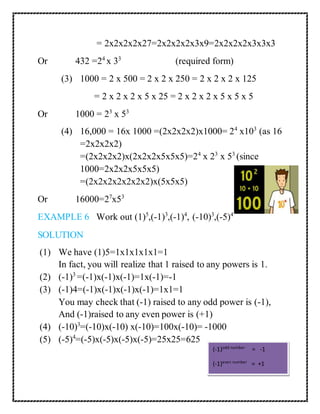
1000=10×10×10=103 
Here again 103 is the exponential form of 1,000 
Similarly 1, 00,000=10×10×10×10×10=105 
105 is the exponential form of 1,00,000 
In both these examples , the base is 10; in case of 103 , the 
exponent is 3and in case of 105 the exponent is 5. 
In all the above given examples, we have seen numbers whose 
base is 10.However the base can be any other number also.For 
example: 
81=3×3×3×3 can be written as 81=34 , here 3 is the base and 4 is 
the exponent. 
25 =2×2×2×2×2=32, which is the fifth power of 2. 
In 25 2 is the base and 5 is the exponent.
In the same way. 243=3×3×3×3×3=35 
64= 2×2×2×2×2×2=26 
625=5×5×5×5=54 
TRY THESE 
Find five more such examples, where a number is expressed in exponential form.Also identify the base and 
the exponent in each case. 
EXAMPLE 1 Express 256 as a power 2. 
SOLUTION we have 256=2×2×2×2×2×2×2×2=28 
So we can say that 256=28 
EXAMPLE 2 which one is greater23 or 32 ? 
SOLUTION we have ,23 =2×2×2=8, 
And 32 =3×3=9 
Since 9>8,so 32 is greater than 23 
EXAMPLE 3 which one is greater 82 or28 ? 
SOLUTION 82 =8×8=64 
28 =2×2×2×2×2×2×2×2=256 
Clearly, 28 >82 
EXAMPLE 4 Expand a3 b2 ,a2 b3, b2 a3 ,b3 a2, are they all 
same? 
SOLUTION a3 b2 = a3 x b2 
TRY THESE 
Express: 
1. 729 as a power of 3 
2. 128 as a power of 2
= (a x a x a) x (b x b) 
= a x a x a x b x b 
a2 b3 =a2 x b3 
=a x a x b x b x b 
b2 a3 =b2 x a3 
=b x b x a x a x a 
b3 a2 =b3 x a2 
=b x b x b x a x a 
EXAMPLE 5 Express the following numbers as a product of 
powers of prime factors: 
(1) 72 (2) 432 (3) 1000 (4) 16000 
SOLUTION 
(1) 72 = 2x36 = 2x2x18 2 72 
= 2x2x2x9 2 36 
= 2x2x2x3x3 2 18 
= 23x32 3 9 
3 
Thus , 72 =23x32 (required prime factor product form) 
(2) 432 = 2x216=2x2x108=2x2x2x54
= 2x2x2x2x27=2x2x2x2x3x9=2x2x2x2x3x3x3 
Or 432 =24 x 33 (required form) 
(3) 1000 = 2 x 500 = 2 x 2 x 250 = 2 x 2 x 2 x 125 
= 2 x 2 x 2 x 5 x 25 = 2 x 2 x 2 x 5 x 5 x 5 
Or 1000 = 23 x 53 
(4) 16,000 = 16x 1000 =(2x2x2x2)x1000= 24 x103 (as 16 
=2x2x2x2) 
=(2x2x2x2)x(2x2x2x5x5x5)=24 x 23 x 53 (since 
1000=2x2x2x5x5x5) 
=(2x2x2x2x2x2x2)x(5x5x5) 
Or 16000=27x53 
EXAMPLE 6 Work out (1)5,(-1)3,(-1)4, (-10)3,(-5)4 
SOLUTION 
(1) We have (1)5=1x1x1x1x1=1 
In fact, you will realize that 1 raised to any powers is 1. 
(2) (-1)3 =(-1)x(-1)x(-1)=1x(-1)=-1 
(3) (-1)4=(-1)x(-1)x(-1)x(-1)=1x1=1 
You may check that (-1) raised to any odd power is (-1), 
And (-1)raised to any even power is (+1) 
(4) (-10)3=(-10)x(-10) x(-10)=100x(-10)= -1000 
(5) (-5)4=(-5)x(-5)x(-5)x(-5)=25x25=625 
(-1)odd number = -1 
(-1)even number = +1
Exercise 1.1 
1. Find the value of 
(i) 26 (ii) 93 (iii) 112 (iv) 54 
2. Express the following in exponential form: 
(i) 6 x 6 x 6 x 6 (ii) t x t (iii) b x b x b x b 
(iv) 5 x 5 x 7 x 7 x 7 (v) 2 x 2 x a x a (vi) a x a x a 
x c x c x c x c x d 
3. Express each of the following numbers using exponential 
notation: 
(i) 512 (ii) 343 (iii) 729 (iv) 3125 
4. Identify the greater number, wherever possible, in each of 
the following? 
(i) 43 or 34 (ii) 53 or 35 (iii) 28 or 82 
(iv) 1002 or 2100 (v) 210 or 102 
5. Express each of the following as product of powers of their 
prime factors: 
(i) 648 (ii) 405 (iii) 540 (iv) 3600 
6. Simplify : 
(i) 2 x 10 (ii) 72 x 22 (iii) 23 x 5 (iv)3 x 44 
(v)0 x 102 (vi) 52 x 33 (vii) 24 x 32 (viii) 32 x 104 
7. Simplify : 
(i) (-4)3 (ii) (-3)x(-2)3 (iii) (-3)2 x (-5)2
1.3 LAWS OF EXPONENTS 
1.3.1 Multiplying Powers with the Same Base 
(i) Let us calculate 22 x 23 
22 x 23 = (2x2) x (2x2x2) 
= 2x2x2x2x2 =25=22+3 
Note that the base in 22 and 23 is same and the sum of the 
exponents, i.e., 2 and 3 is 5 
(ii) (-3)4 x (-3)3= [(-3) x (-3) x (-3) x (-3)] x [(-3) x (-3) x (-3)] 
= (-3) x (-3) x (-3) x (-3) x (-3) x (-3) x (-3) 
= (-3)7 
= (-3)4+3 
Again, note that the base is same and the sum of exponents, 
4 and 3, is 7 
(iii) a2 x a4= (a x a ) x (a x a x ax a) 
= a x a x a x a x a x a = a6 
(Note: the base is the same and the sum of exponents is 2+4 
= 6) 
From this we can generalize that for any non-zero integer a, 
where m and n are whole numbers, 
TRY THESE 
Simplify and write in exponential form 
i) 25x23 ii) p3x p2 iii)43x 42 iv) a3xa2xa7 
am x an = am+n
1.3.2 Dividing Powers with the Same Base 
Let us simplify 37 ÷ 34 ? 
37 ÷ 34 = 37/34=3 x 3 x 3 x 3 x 3 x 3 x 3 / 3 x 3 x 3 x 3 
= 3 x 3 x 3 = 33 = 3 7-4 
Thus 37 ÷ 34 = 3 7-4 
Similarly, 
56 ÷ 52 = 56 / 52 =5 x 5 x 5 x 5 x 5 x 5 / 5 x 5 
= 5 x 5 x 5 x 5 = 54 = 5 6-2 
Or 56 ÷ 52 = 5 6-2 
Let a be a non-zero integer, then, 
a4 ÷a2=a4/a2 =a x a x a x a / a x a = a x a = a2 = a4-2 
Or a4 ÷a2 = a4-2 
In general, for any non-zero integer a, 
am ÷ an = am-n 
Where m and n are whole numbers and m>n. 
1.3.3 Taking Power of a Power 
Consider the following 
T RY THESE 
Simplify and write in exponential form: 
1. 29 ÷23 
2. 108÷104 
3. 911÷97 
4. 4
Simplify (23)2 ; (32)4 
Now,(23)2 means 23 is multiplied two times with itself. 
(23) = 23 x 23 
= 23+3(Since am x an = am+n) 
= 26 = 23x2 
Thus (23)2=23x2 
Similarly (32)4 = 32x 32x 32x 32 
= 32+2+2+2 
= 38 (Observe 8 is the product of 2 and 4) 
= 32x4 
Can you tell what would (72)10 would be equal to ? 
So (23)2 = 23 x 2 = 26 
(32)4 = 32x4 = 38 
(72)10 = 72 x10 =720 
(a2)3 = a2 x 3 = a6 
(am)3 = amx3 = a3m 
From this we can generalize for any non-zero integer ‘a’, where 
‘m’ and ‘n’ are whole numbers, 
(am)n = amn 
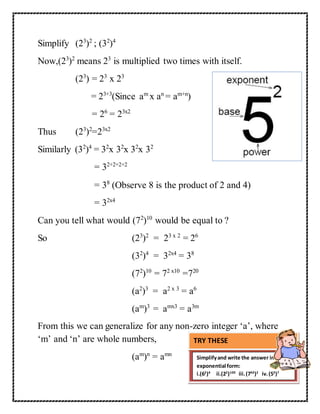
TRY THESE 
Simplify and write the answer in 
exponential form: 
i.(62)4 ii.(22)100 iii. (750)2 iv. (53)7
1.3.4 Multiplying Powers With The Same Exponents 
Can you simplify 23x33? Notice that here the two terms 23 and 
33 have different bases, but the same exponents. 
Now, 23 x 33 = (2x2x2)x(3x3x3) 
= (2x3)x(2x3)x(2x3) 
= 6x6x6 
= 63 (Observe 6 is the product of bases 2 and 3) 
Consider 44 x 34 = (4 x 4 x 4 x 4) x (3 x 3 x 3 x 3) 
= (4 x 3) x (4 x 3) x (4 x 3) x (4 x 3) 
= 12 x 12 x 12 x 12 
= 124 
Similarly, a4 x b4 = (a x a x a x a) x (b x b x b x b) 
= (a x b) x (a x b) x (a x b) x (a x b) 
= (a x b)4 (Note a x b =ab) 
In general, for any non-zero integer a 
(Where m is any whole number) 
am x bm= (ab)m 
TRY THESE 
Put into another 
form using 
am x bn= (ab)m. 
i.43 x 23 
ii.25 x b5 
iii.a2 x t2 
iv.56x(-2)6 
v.(-2)4x(-3)4
EXAMPLE 8. Express the following terms in the 
exponential form: 
(i). (2 x 3)5 (ii). (2a)4 (iii). (-4m)3 
SOLUTION 
(i) (2 x 3)5 = (2 x 3) x (2 x 3) x(2 x 3) x(2 x 3) x(2 x 3) 
= (2 x 2 x 2 x 2 x 2 x 2) x (3 x 3 x 3 x 3 x 3) 
= 25 x 35 
(ii) (2a)4 = 2a x 2a x 2a x 2a 
= (2 x 2 x 2 x 2) x (a x a x a x a) 
= 24 x a4 
(iii) (-4m)2 = (- 4 x m)3 
= (-4 x m) x (- 4 x m) x (- 4 x m) 
= (- 4) x (- 4) x (- 4) x (m x m x m) = (-4)3 x 
(m)3 
1. 3.5 Dividing Powers with the same Exponents 
Observe the following simplifications: 
(i) 24/34 = (2x2x2x2) ÷ (3x3x3x3) 
= (2/3) x (2/3) x (2/3) x(2/3) = (2/3)4 
(ii) a3/b3 = a x a x a / b x b x b 
= a/b x a/b x a/b = (a/b)3 
From these examples we may generalise 
am ÷ bm = am/bm =(a/b)m where a and b are any 
non integers and m is a whole number. 
TRY THESE 
Put into another 
form using 
am ÷ bm=(a/b)m 
1. 45÷35 
2. 25÷b5 
3. (-2)3÷b3 
4. p4÷q4 
5. 56÷(-2)6
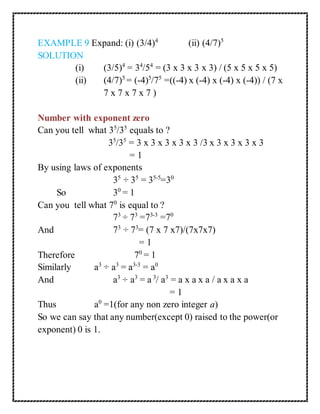
EXAMPLE 9 Expand: (i) (3/4)4 (ii) (4/7)5 
SOLUTION 
(i) (3/5)4 = 34/54 = (3 x 3 x 3 x 3) / (5 x 5 x 5 x 5) 
(ii) (4/7)5 = (-4)5/75 =((-4) x (-4) x (-4) x (-4)) / (7 x 
7 x 7 x 7 x 7 ) 
Number with exponent zero 
Can you tell what 35/35 equals to ? 
35/35 = 3 x 3 x 3 x 3 x 3 /3 x 3 x 3 x 3 x 3 
= 1 
By using laws of exponents 
35 ÷ 35 = 35-5=30 
So 30 = 1 
Can you tell what 70 is equal to ? 
73 ÷ 73 =73-3 =70 
And 73 ÷ 73= (7 x 7 x7)/(7x7x7) 
= 1 
Therefore 70 = 1 
Similarly a3 ÷ a3 = a3-3 = a0 
And a3 ÷ a3 = a 3/ a3 = a x a x a / a x a x a 
= 1 
Thus a0 =1(for any non zero integer a) 
So we can say that any number(except 0) raised to the power(or 
exponent) 0 is 1.
1. 4 MISCELLANEOUS EXAMPLES USING THE 
LAWS OF EXPONENTS 
Let us solve some examples using rules of exponents 
developed. 
EXAMPLE 10 Write exponential form for 8 x 8 x 8 x 8 
taking base as 2. 
SOLUTION: 
We have 8x8x8x8 =84 
But we know that 8= 2 x 2 x 2 =23 
Therefore 84=(23)4 =23 x 23 x 23 x 23 
= 23x4 (You may also use (am)n= amn ) 
= 212 
EXAMPLE 11 Simplify and write the answer in the 
exponential form. 
(i) 23 x 22 x 55 (ii) (62x64) ÷ 63 
(iii) [(22)3 x 36]x 56 (iv) 82 ÷ 23 
SOLUTION 
(i) 23 x 22 x 55=23+2 x 55 
= 25 x 55=(2 x 5)5=105 
(ii) (62x64) ÷ 63 = 62+4 ÷ 63 
= 66/63= 66-3= 63 
(iii) [(22)3 x 36]x 56 =[26 x 36] x 56 
= (2x3)6 x 56 
= (2x3x5)6 = 306
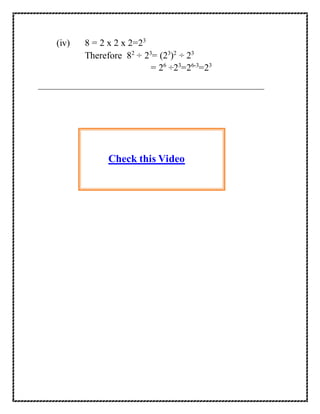
(iv) 8 = 2 x 2 x 2=23 
Therefore 82 ÷ 23= (23)2 ÷ 23 
= 26 ÷23=26-3=23 
Check this Video
WHAT HAVE WE DISCUSSED ? 
1. Very large numbers are difficult to read, 
understand , compare and operate upon. To make 
all these easier, we use exponents, converting 
many of the large numbers in a shorter form. 
2. The following are exponential forms of some 
numbers? 
10,000 =104(read as 10 raised to 4) 
243 =35 , 128 =27. 
Here, 10 ,3 and 2 are the bases, whereas 4,5 and 7 
are their respective exponents . we also say, 10,000 is 
the 4th power of 10, 243 is the 5th power of 3, etc… 
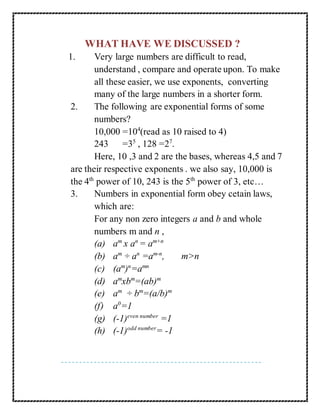
3. Numbers in exponential form obey cetain laws, 
which are: 
For any non zero integers a and b and whole 
numbers m and n , 
(a) am x an = am+n 
(b) am ÷ an =am-n, m>n 
(c) (am)n=amn 
(d) amxbm=(ab)m 
(e) am ÷ bm=(a/b)m 
(f) a0=1 
(g) (-1)even number =1 
(h) (-1)odd number= -1
Some Related Websites 
http://www.purplemath.com/modules/exponent.htm 
http://www.mathsisfun.com/exponent.html 
http://mentorminutes.com/ 
http://www.mathgoodies.com/lessons/vol3/exponents.html 
http://www.platinumgmat.com/

Digital textbook -EXPONENTS AND POWERS

  • 1.
    DIGITAL TEXTBOOK Submittedby , CLASS VIII GANESH KRISHNAN G B.Ed MATHEMATICS N.S.S. T.C PANDALAM
  • 2.
    contents Chapter 1EXPONENTS AND POWERS 1.1 INTRODUCTION 1.2 EXPONENTS 1.3 LAWS OF EXPONENTS 1.3.1 Multiplying Powers with the same Base 1.3.2 Dividing powers with the same base 1.3.3 Taking power of a power 1.3.4 Multiplying powers with the same exponents 1.3.5 Dividing powers with the same exponents 1.4 MISCELLANEOUS EXAMPLES USING THE LAWS OF EXPONENTS 1.5 VIDEO LINK 1.6 WHAT WE HAVE DISCUSSED? 1.7 SOME RELATED WEBSITES
  • 3.
    1.1 INTRODUCTION Doyou know what the means of earth is ? It is 5,970,000,000,000,000,000,000,000 kg! Can you read this number? Mass of Uranus is 86,800,000,000,000,000,000,000,000 kg. Which has greater mass, Earth or Uranus? Distance between sun and Saturn is 1,433,500,000,000 m and distance between Saturn and Uranus is 1,439,000,000,000.can you read these numbers? Which distance is less? These very large numbers are difficult to read, understand and compare. To make these numbers easy to read, understand and compare, we use exponents. In this chapter , we shall learn about exponents and also learn how to use them. 1.2 EXPONENTS We can write large numbers in a shorter form using exponents. Chapter 1 Exponents and Powers
  • 4.
    Observe 10,000=10×10×10×10=104 Theshort notation 104 stands for the product 10×10×10×10 . here 10 is called the base and 4 is called the exponent. The number 104 is read as the 10 raised to the power of 4 or simply as fourth power of 10.104 is called the exponential for of 10,000. We can similarly express 1,000 as power of 10. Since 1,000 is 10 multiplied by itself three times. 1000=10×10×10=103 Here again 103 is the exponential form of 1,000 Similarly 1, 00,000=10×10×10×10×10=105 105 is the exponential form of 1,00,000 In both these examples , the base is 10; in case of 103 , the exponent is 3and in case of 105 the exponent is 5. In all the above given examples, we have seen numbers whose base is 10.However the base can be any other number also.For example: 81=3×3×3×3 can be written as 81=34 , here 3 is the base and 4 is the exponent. 25 =2×2×2×2×2=32, which is the fifth power of 2. In 25 2 is the base and 5 is the exponent.
  • 5.
    In the sameway. 243=3×3×3×3×3=35 64= 2×2×2×2×2×2=26 625=5×5×5×5=54 TRY THESE Find five more such examples, where a number is expressed in exponential form.Also identify the base and the exponent in each case. EXAMPLE 1 Express 256 as a power 2. SOLUTION we have 256=2×2×2×2×2×2×2×2=28 So we can say that 256=28 EXAMPLE 2 which one is greater23 or 32 ? SOLUTION we have ,23 =2×2×2=8, And 32 =3×3=9 Since 9>8,so 32 is greater than 23 EXAMPLE 3 which one is greater 82 or28 ? SOLUTION 82 =8×8=64 28 =2×2×2×2×2×2×2×2=256 Clearly, 28 >82 EXAMPLE 4 Expand a3 b2 ,a2 b3, b2 a3 ,b3 a2, are they all same? SOLUTION a3 b2 = a3 x b2 TRY THESE Express: 1. 729 as a power of 3 2. 128 as a power of 2
  • 6.
    = (a xa x a) x (b x b) = a x a x a x b x b a2 b3 =a2 x b3 =a x a x b x b x b b2 a3 =b2 x a3 =b x b x a x a x a b3 a2 =b3 x a2 =b x b x b x a x a EXAMPLE 5 Express the following numbers as a product of powers of prime factors: (1) 72 (2) 432 (3) 1000 (4) 16000 SOLUTION (1) 72 = 2x36 = 2x2x18 2 72 = 2x2x2x9 2 36 = 2x2x2x3x3 2 18 = 23x32 3 9 3 Thus , 72 =23x32 (required prime factor product form) (2) 432 = 2x216=2x2x108=2x2x2x54
  • 7.
    = 2x2x2x2x27=2x2x2x2x3x9=2x2x2x2x3x3x3 Or432 =24 x 33 (required form) (3) 1000 = 2 x 500 = 2 x 2 x 250 = 2 x 2 x 2 x 125 = 2 x 2 x 2 x 5 x 25 = 2 x 2 x 2 x 5 x 5 x 5 Or 1000 = 23 x 53 (4) 16,000 = 16x 1000 =(2x2x2x2)x1000= 24 x103 (as 16 =2x2x2x2) =(2x2x2x2)x(2x2x2x5x5x5)=24 x 23 x 53 (since 1000=2x2x2x5x5x5) =(2x2x2x2x2x2x2)x(5x5x5) Or 16000=27x53 EXAMPLE 6 Work out (1)5,(-1)3,(-1)4, (-10)3,(-5)4 SOLUTION (1) We have (1)5=1x1x1x1x1=1 In fact, you will realize that 1 raised to any powers is 1. (2) (-1)3 =(-1)x(-1)x(-1)=1x(-1)=-1 (3) (-1)4=(-1)x(-1)x(-1)x(-1)=1x1=1 You may check that (-1) raised to any odd power is (-1), And (-1)raised to any even power is (+1) (4) (-10)3=(-10)x(-10) x(-10)=100x(-10)= -1000 (5) (-5)4=(-5)x(-5)x(-5)x(-5)=25x25=625 (-1)odd number = -1 (-1)even number = +1
  • 8.
    Exercise 1.1 1.Find the value of (i) 26 (ii) 93 (iii) 112 (iv) 54 2. Express the following in exponential form: (i) 6 x 6 x 6 x 6 (ii) t x t (iii) b x b x b x b (iv) 5 x 5 x 7 x 7 x 7 (v) 2 x 2 x a x a (vi) a x a x a x c x c x c x c x d 3. Express each of the following numbers using exponential notation: (i) 512 (ii) 343 (iii) 729 (iv) 3125 4. Identify the greater number, wherever possible, in each of the following? (i) 43 or 34 (ii) 53 or 35 (iii) 28 or 82 (iv) 1002 or 2100 (v) 210 or 102 5. Express each of the following as product of powers of their prime factors: (i) 648 (ii) 405 (iii) 540 (iv) 3600 6. Simplify : (i) 2 x 10 (ii) 72 x 22 (iii) 23 x 5 (iv)3 x 44 (v)0 x 102 (vi) 52 x 33 (vii) 24 x 32 (viii) 32 x 104 7. Simplify : (i) (-4)3 (ii) (-3)x(-2)3 (iii) (-3)2 x (-5)2
  • 9.
    1.3 LAWS OFEXPONENTS 1.3.1 Multiplying Powers with the Same Base (i) Let us calculate 22 x 23 22 x 23 = (2x2) x (2x2x2) = 2x2x2x2x2 =25=22+3 Note that the base in 22 and 23 is same and the sum of the exponents, i.e., 2 and 3 is 5 (ii) (-3)4 x (-3)3= [(-3) x (-3) x (-3) x (-3)] x [(-3) x (-3) x (-3)] = (-3) x (-3) x (-3) x (-3) x (-3) x (-3) x (-3) = (-3)7 = (-3)4+3 Again, note that the base is same and the sum of exponents, 4 and 3, is 7 (iii) a2 x a4= (a x a ) x (a x a x ax a) = a x a x a x a x a x a = a6 (Note: the base is the same and the sum of exponents is 2+4 = 6) From this we can generalize that for any non-zero integer a, where m and n are whole numbers, TRY THESE Simplify and write in exponential form i) 25x23 ii) p3x p2 iii)43x 42 iv) a3xa2xa7 am x an = am+n
  • 10.
    1.3.2 Dividing Powerswith the Same Base Let us simplify 37 ÷ 34 ? 37 ÷ 34 = 37/34=3 x 3 x 3 x 3 x 3 x 3 x 3 / 3 x 3 x 3 x 3 = 3 x 3 x 3 = 33 = 3 7-4 Thus 37 ÷ 34 = 3 7-4 Similarly, 56 ÷ 52 = 56 / 52 =5 x 5 x 5 x 5 x 5 x 5 / 5 x 5 = 5 x 5 x 5 x 5 = 54 = 5 6-2 Or 56 ÷ 52 = 5 6-2 Let a be a non-zero integer, then, a4 ÷a2=a4/a2 =a x a x a x a / a x a = a x a = a2 = a4-2 Or a4 ÷a2 = a4-2 In general, for any non-zero integer a, am ÷ an = am-n Where m and n are whole numbers and m>n. 1.3.3 Taking Power of a Power Consider the following T RY THESE Simplify and write in exponential form: 1. 29 ÷23 2. 108÷104 3. 911÷97 4. 4
  • 11.
    Simplify (23)2 ;(32)4 Now,(23)2 means 23 is multiplied two times with itself. (23) = 23 x 23 = 23+3(Since am x an = am+n) = 26 = 23x2 Thus (23)2=23x2 Similarly (32)4 = 32x 32x 32x 32 = 32+2+2+2 = 38 (Observe 8 is the product of 2 and 4) = 32x4 Can you tell what would (72)10 would be equal to ? So (23)2 = 23 x 2 = 26 (32)4 = 32x4 = 38 (72)10 = 72 x10 =720 (a2)3 = a2 x 3 = a6 (am)3 = amx3 = a3m From this we can generalize for any non-zero integer ‘a’, where ‘m’ and ‘n’ are whole numbers, (am)n = amn TRY THESE Simplify and write the answer in exponential form: i.(62)4 ii.(22)100 iii. (750)2 iv. (53)7
  • 12.
    1.3.4 Multiplying PowersWith The Same Exponents Can you simplify 23x33? Notice that here the two terms 23 and 33 have different bases, but the same exponents. Now, 23 x 33 = (2x2x2)x(3x3x3) = (2x3)x(2x3)x(2x3) = 6x6x6 = 63 (Observe 6 is the product of bases 2 and 3) Consider 44 x 34 = (4 x 4 x 4 x 4) x (3 x 3 x 3 x 3) = (4 x 3) x (4 x 3) x (4 x 3) x (4 x 3) = 12 x 12 x 12 x 12 = 124 Similarly, a4 x b4 = (a x a x a x a) x (b x b x b x b) = (a x b) x (a x b) x (a x b) x (a x b) = (a x b)4 (Note a x b =ab) In general, for any non-zero integer a (Where m is any whole number) am x bm= (ab)m TRY THESE Put into another form using am x bn= (ab)m. i.43 x 23 ii.25 x b5 iii.a2 x t2 iv.56x(-2)6 v.(-2)4x(-3)4
  • 13.
    EXAMPLE 8. Expressthe following terms in the exponential form: (i). (2 x 3)5 (ii). (2a)4 (iii). (-4m)3 SOLUTION (i) (2 x 3)5 = (2 x 3) x (2 x 3) x(2 x 3) x(2 x 3) x(2 x 3) = (2 x 2 x 2 x 2 x 2 x 2) x (3 x 3 x 3 x 3 x 3) = 25 x 35 (ii) (2a)4 = 2a x 2a x 2a x 2a = (2 x 2 x 2 x 2) x (a x a x a x a) = 24 x a4 (iii) (-4m)2 = (- 4 x m)3 = (-4 x m) x (- 4 x m) x (- 4 x m) = (- 4) x (- 4) x (- 4) x (m x m x m) = (-4)3 x (m)3 1. 3.5 Dividing Powers with the same Exponents Observe the following simplifications: (i) 24/34 = (2x2x2x2) ÷ (3x3x3x3) = (2/3) x (2/3) x (2/3) x(2/3) = (2/3)4 (ii) a3/b3 = a x a x a / b x b x b = a/b x a/b x a/b = (a/b)3 From these examples we may generalise am ÷ bm = am/bm =(a/b)m where a and b are any non integers and m is a whole number. TRY THESE Put into another form using am ÷ bm=(a/b)m 1. 45÷35 2. 25÷b5 3. (-2)3÷b3 4. p4÷q4 5. 56÷(-2)6
  • 14.
    EXAMPLE 9 Expand:(i) (3/4)4 (ii) (4/7)5 SOLUTION (i) (3/5)4 = 34/54 = (3 x 3 x 3 x 3) / (5 x 5 x 5 x 5) (ii) (4/7)5 = (-4)5/75 =((-4) x (-4) x (-4) x (-4)) / (7 x 7 x 7 x 7 x 7 ) Number with exponent zero Can you tell what 35/35 equals to ? 35/35 = 3 x 3 x 3 x 3 x 3 /3 x 3 x 3 x 3 x 3 = 1 By using laws of exponents 35 ÷ 35 = 35-5=30 So 30 = 1 Can you tell what 70 is equal to ? 73 ÷ 73 =73-3 =70 And 73 ÷ 73= (7 x 7 x7)/(7x7x7) = 1 Therefore 70 = 1 Similarly a3 ÷ a3 = a3-3 = a0 And a3 ÷ a3 = a 3/ a3 = a x a x a / a x a x a = 1 Thus a0 =1(for any non zero integer a) So we can say that any number(except 0) raised to the power(or exponent) 0 is 1.
  • 15.
    1. 4 MISCELLANEOUSEXAMPLES USING THE LAWS OF EXPONENTS Let us solve some examples using rules of exponents developed. EXAMPLE 10 Write exponential form for 8 x 8 x 8 x 8 taking base as 2. SOLUTION: We have 8x8x8x8 =84 But we know that 8= 2 x 2 x 2 =23 Therefore 84=(23)4 =23 x 23 x 23 x 23 = 23x4 (You may also use (am)n= amn ) = 212 EXAMPLE 11 Simplify and write the answer in the exponential form. (i) 23 x 22 x 55 (ii) (62x64) ÷ 63 (iii) [(22)3 x 36]x 56 (iv) 82 ÷ 23 SOLUTION (i) 23 x 22 x 55=23+2 x 55 = 25 x 55=(2 x 5)5=105 (ii) (62x64) ÷ 63 = 62+4 ÷ 63 = 66/63= 66-3= 63 (iii) [(22)3 x 36]x 56 =[26 x 36] x 56 = (2x3)6 x 56 = (2x3x5)6 = 306
  • 16.
    (iv) 8 =2 x 2 x 2=23 Therefore 82 ÷ 23= (23)2 ÷ 23 = 26 ÷23=26-3=23 Check this Video
  • 17.
    WHAT HAVE WEDISCUSSED ? 1. Very large numbers are difficult to read, understand , compare and operate upon. To make all these easier, we use exponents, converting many of the large numbers in a shorter form. 2. The following are exponential forms of some numbers? 10,000 =104(read as 10 raised to 4) 243 =35 , 128 =27. Here, 10 ,3 and 2 are the bases, whereas 4,5 and 7 are their respective exponents . we also say, 10,000 is the 4th power of 10, 243 is the 5th power of 3, etc… 3. Numbers in exponential form obey cetain laws, which are: For any non zero integers a and b and whole numbers m and n , (a) am x an = am+n (b) am ÷ an =am-n, m>n (c) (am)n=amn (d) amxbm=(ab)m (e) am ÷ bm=(a/b)m (f) a0=1 (g) (-1)even number =1 (h) (-1)odd number= -1
  • 18.
    Some Related Websites http://www.purplemath.com/modules/exponent.htm http://www.mathsisfun.com/exponent.html http://mentorminutes.com/ http://www.mathgoodies.com/lessons/vol3/exponents.html http://www.platinumgmat.com/