Sections
1 – Introduction to Radicals
2 – Simplifying Radicals
3 – Adding and Subtracting Radicals
4 – Multiplying and Dividing Radicals
5 – Solving Equations Containing Radicals
6 – Radical Equations and Problem Solving
Square Roots
Opposite of squaring a number is taking the square
root of a number.
A number b is a square root of a number a if b2 = a.
In order to find a square root of a, you need a # that,
when squared, equals a.
Principal Square Roots
The principal (positive) square root is noted as


                     a
   The negative square root is noted as

                         a
Radicands
Radical expression is an expression containing a
radical sign.
Radicand is the expression under a radical sign.
Note that if the radicand of a square root is a negative
number, the radical is NOT a real number.
Radicands
Example
      49      7
      25      5
      16      4
          4       2
Perfect Squares
Square roots of perfect square radicands simplify to
rational numbers (numbers that can be written as a
quotient of integers).
Square roots of numbers that are not perfect squares
(like 7, 10, etc.) are irrational numbers.
IF REQUESTED, you can find a decimal
approximation for these irrational numbers.
   Otherwise, leave them in radical form.
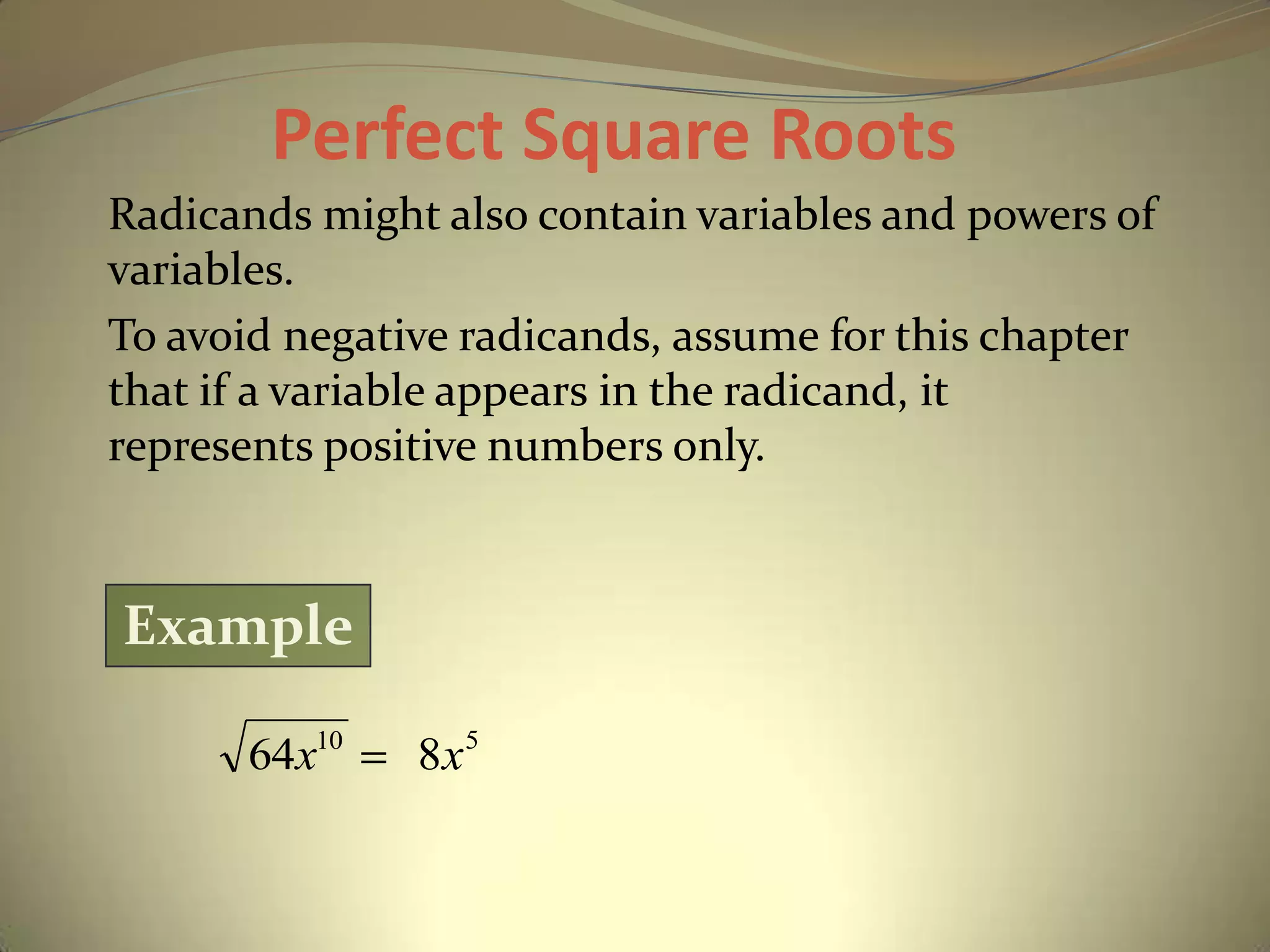
Perfect Square Roots
Radicands might also contain variables and powers of
variables.
To avoid negative radicands, assume for this chapter
that if a variable appears in the radicand, it
represents positive numbers only.


Example

      64x10    8x5
Cube Roots
The cube root of a real number a
          3
              a   b only if b 3   a

Note: a is not restricted to non-
negative numbers for cubes.
Cube Roots
Example
      3
          27     3

      3
           8x6       2x 2
nth Roots
Other roots can be found, as well.
The nth root of a is defined as

             n
                 a   b only if b n   a

If the index, n, is even, the root is
NOT a real number when a is negative.

If the index is odd, the root will be a
real number.
Example

 Simplify the following.


            25a b  2 20
                           5ab10


              3
                  64a 3      4a
                   b9        b3
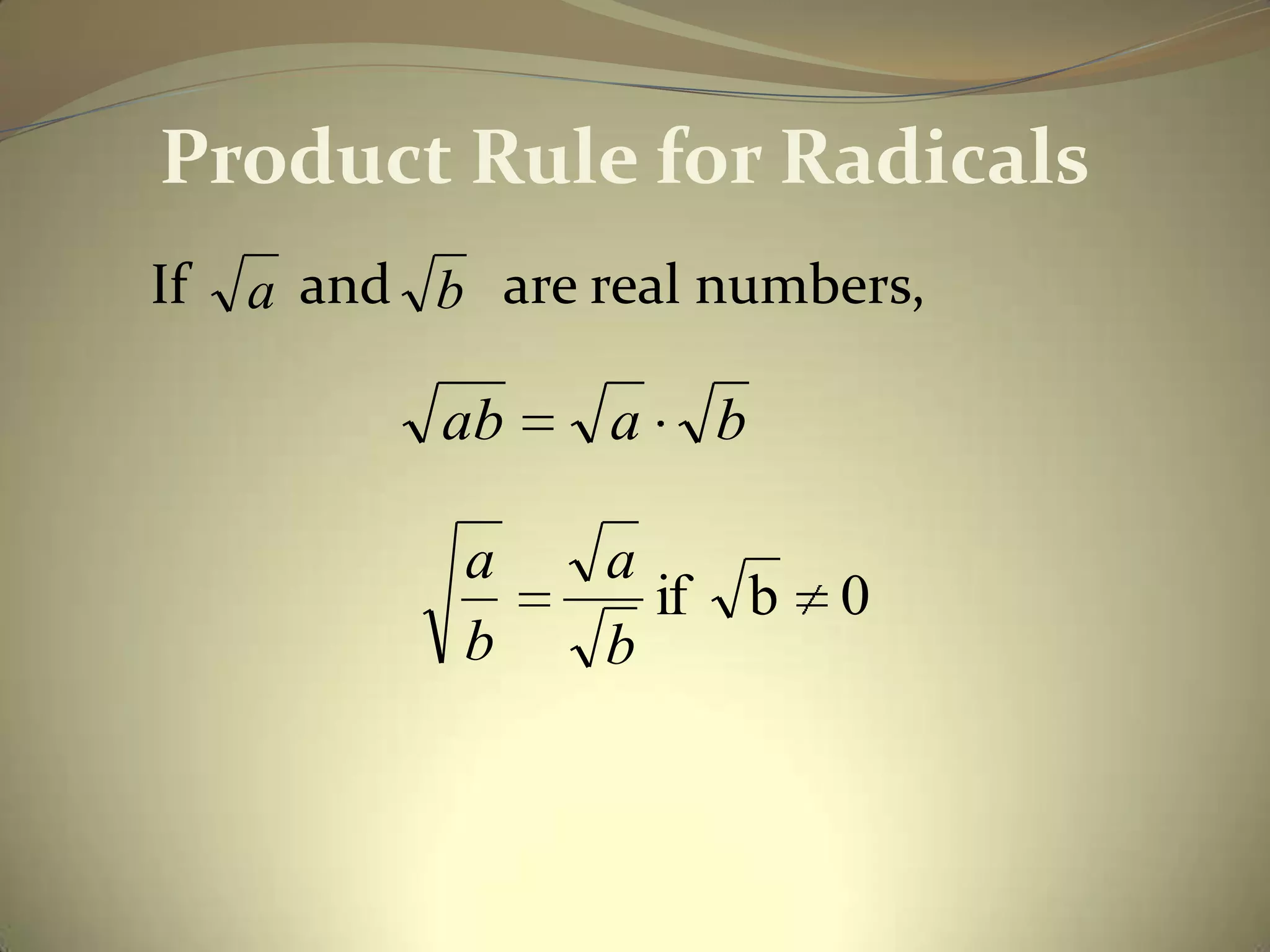
Product Rule for Radicals
If   a and b are real numbers,

            ab    a      b

             a    a
                    if       b   0
             b    b
Simplifying Radicals
Example
 Simplify the following radical expressions.

          40      4     10        2 10

           5        5         5
          16       16        4

                No perfect square factor, so
          15
                the radical is already
                simplified.
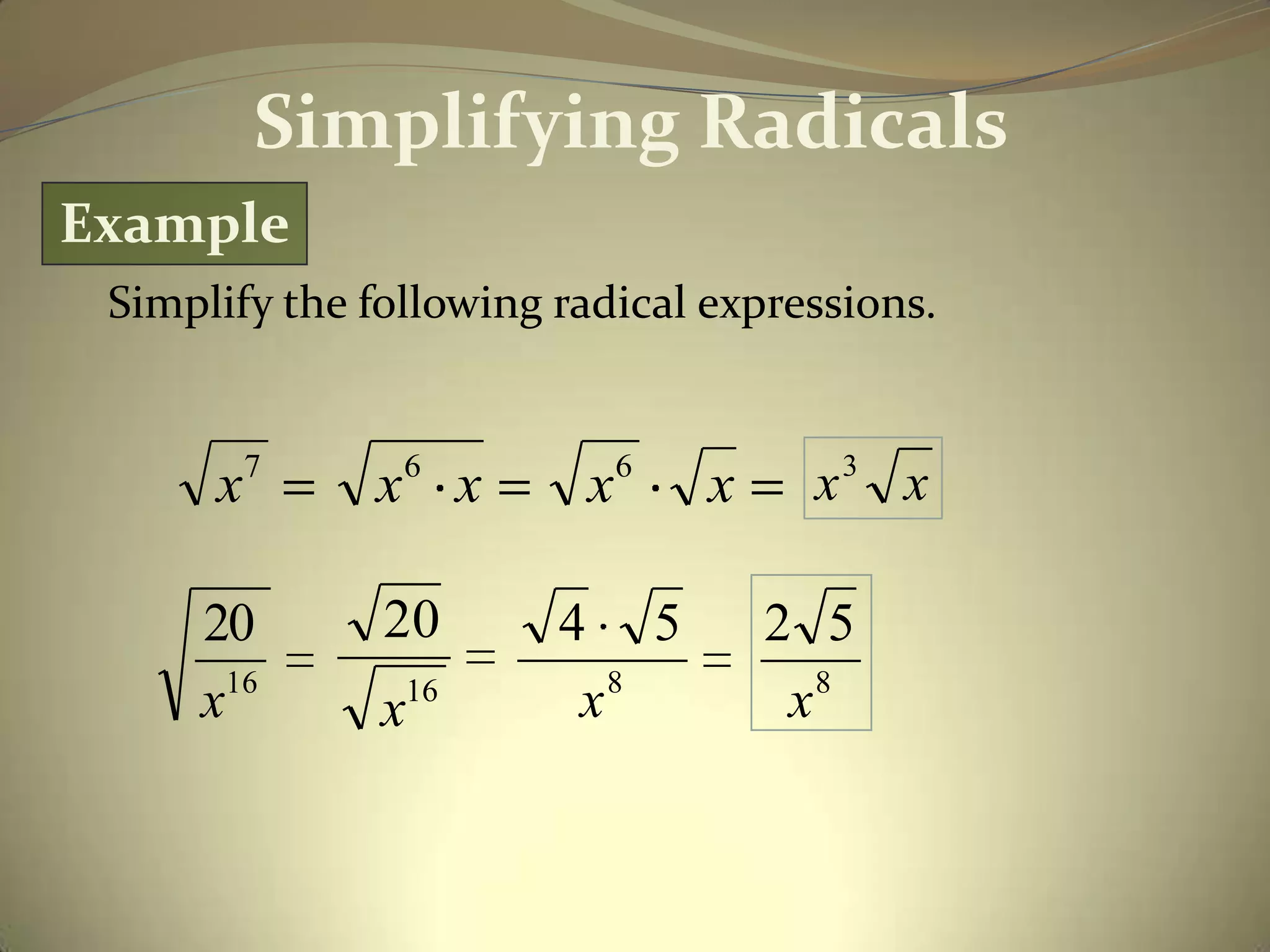
Simplifying Radicals
Example
 Simplify the following radical expressions.


          7     6            6
      x       x x        x       x    x3 x

     20        20       4 5          2 5
     x16       x16       x8           x8
Quotient Rule for Radicals
If n a andn b are real numbers,

           n            n       n
               ab           a       b

                    n
               a        a       n
       n
                    n
                          if        b   0
               b        b
Simplifying Radicals
Example
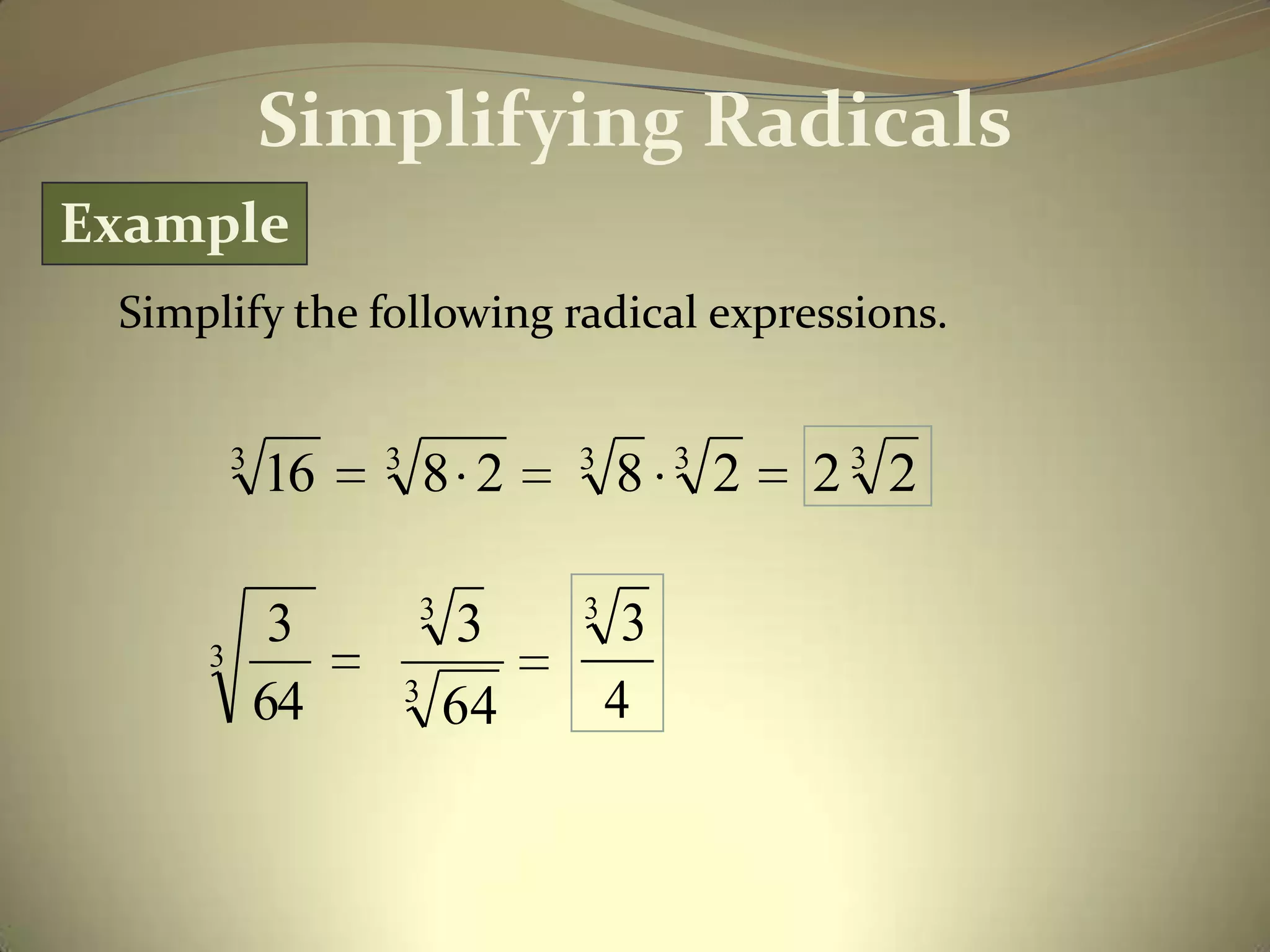
 Simplify the following radical expressions.


         3
             16   3
                          8 2   3
                                    8    3
                                             2   23 2

                      3         3
     3
              3            3         3
                      3             4
             64           64
Sums and Differences
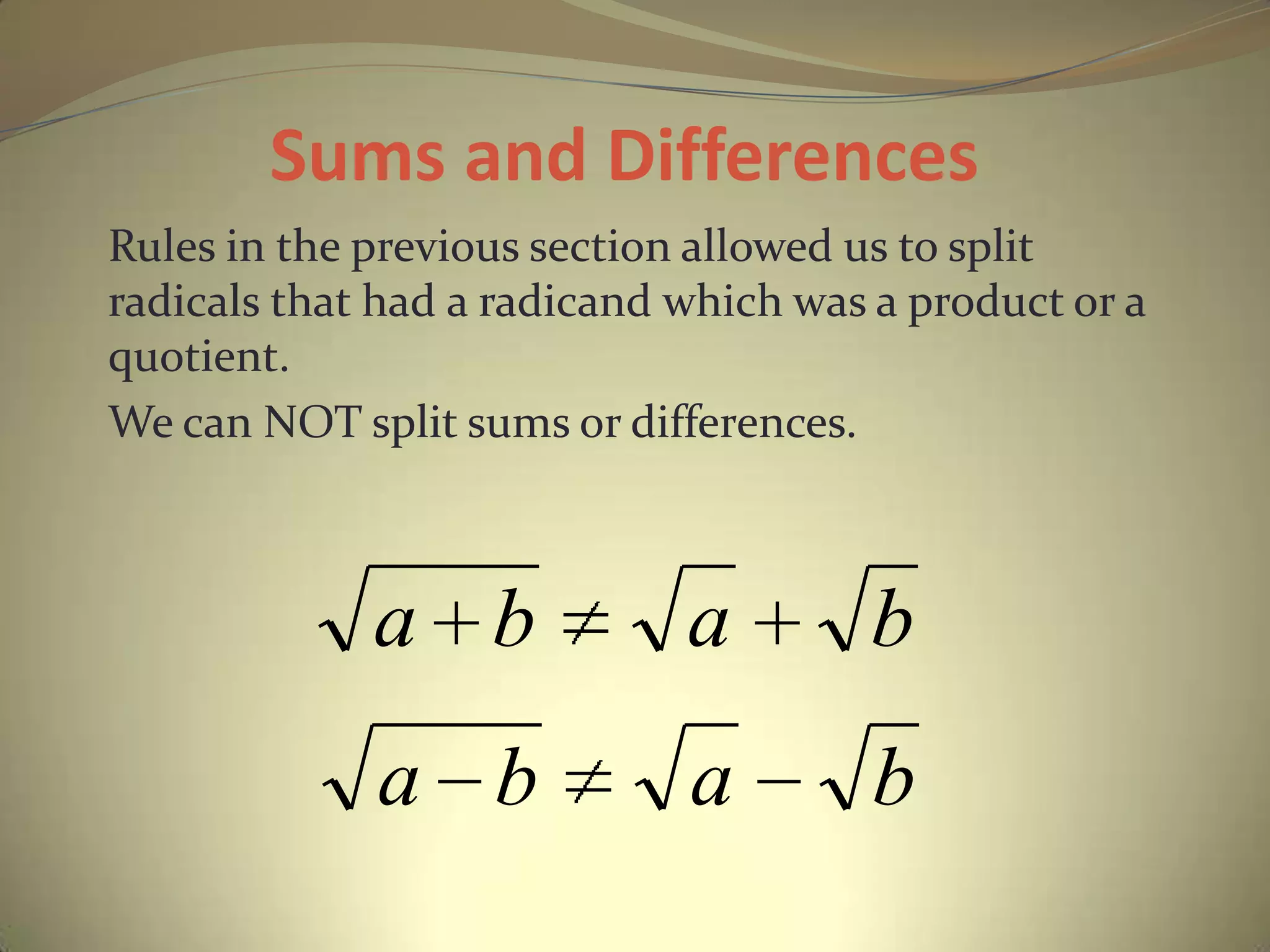
Rules in the previous section allowed us to split
radicals that had a radicand which was a product or a
quotient.
We can NOT split sums or differences.


             a b             a        b
             a b             a        b
Like Radicals
In previous chapters, we’ve discussed the concept of “like”
terms.
These are terms with the same variables raised to the
same powers.
They can be combined through addition and subtraction.
Similarly, we can work with the concept of “like” radicals
to combine radicals with the same radicand.
Like radicals are radicals with the same index and the same radicand.
Like radicals can also be combined with addition or subtraction by using the
distributive property.
Adding and Subtracting Radical Expressions
Example
     3 7 3     8 3

   10 2 4 2       6 2

     2 43 2      Can not simplify

     5    3      Can not simplify
Example
 Simplify the following radical expression.
                       75       12 3 3

                  25 3          4 3 3 3

             25    3        4    3 3 3

                   5 3 2 3 3 3

                            5 2 3 3           6 3
Example
 Simplify the following radical expression.

                3        3
                    64       14 9
                         3                    3
                     4       14 9       5         14
Example
 Simplify the following radical expression.
 Assume that variables represent positive real
 numbers.
       3                  2
 3 45x     x 5x    3 9 x 5x x 5x
                         2
                  3 9x       5x x 5x
                    3 3x 5 x    x 5x
                       9 x 5x    x 5x
                             9x x   5x     10 x 5 x
Multiplying and Dividing Radical
          Expressions
If   n
         a and n b are real numbers,
              n       n         n
                  a       b         ab
              n
                  a           a
              n
                          n     if b 0
                  b           b
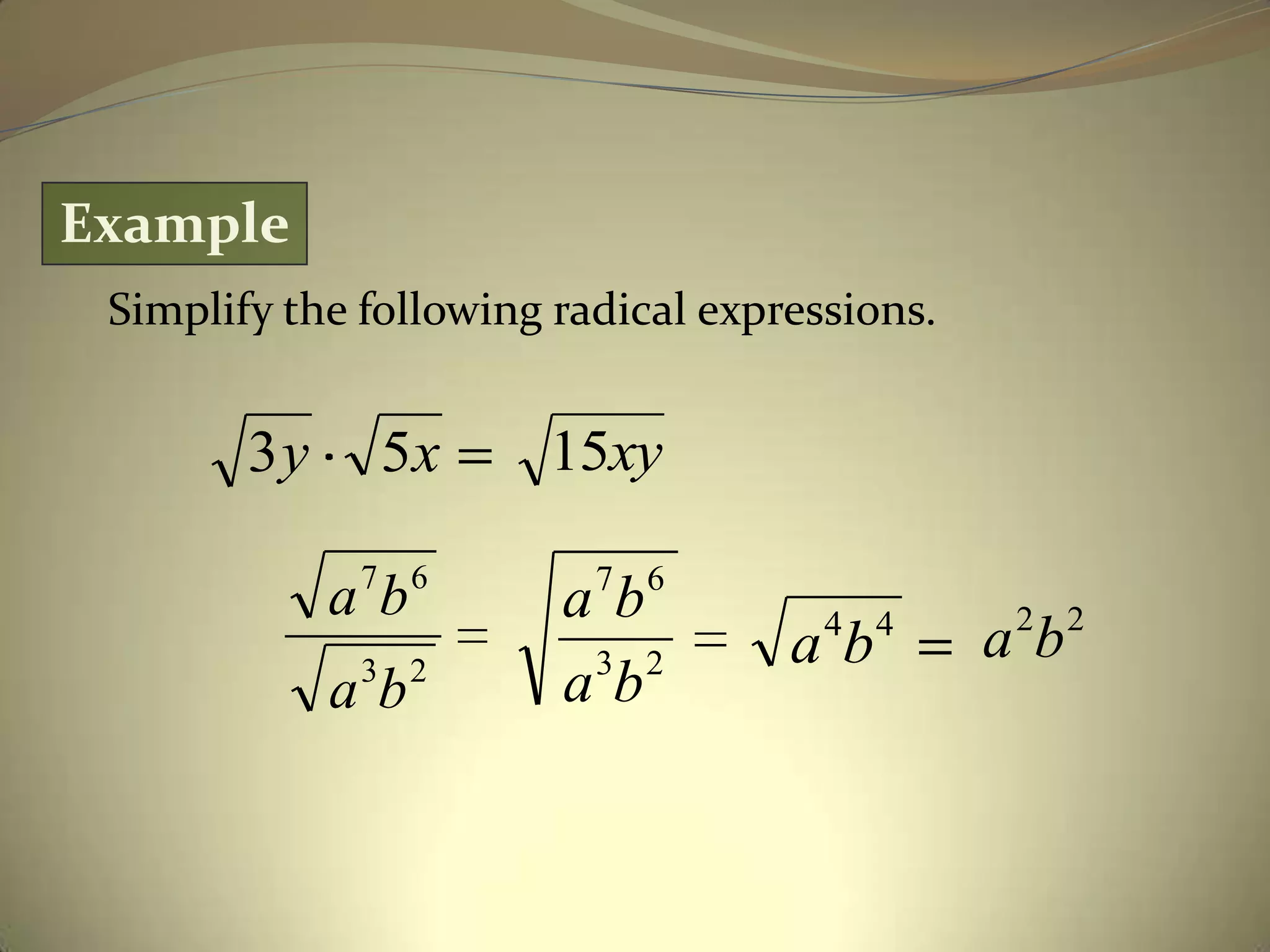
Example
 Simplify the following radical expressions.


        3y     5x      15xy

              7 6         7 6
             ab         ab            4 4      2 2
              3 2        3 2        ab         ab
             ab         ab
Rationalizing the Denominator
 Many times it is helpful to rewrite a radical
 quotient with the radical confined to ONLY the
 numerator.
 If we rewrite the expression so that there is no
 radical in the denominator, it is called
 rationalizing the denominator.
 This process involves multiplying the quotient by
 a form of 1 that will eliminate the radical in the
 denominator.
Example
 Rationalize the denominator.

    3        2    3   2      6
    2        2    2   2     2

         3
    6        3     63 3     63 3    3
                                   6 3
  3      3       3          3
                                         23 3
     9       3     9 33       27    3
Conjugates
Many rational quotients have a sum or difference of
terms in a denominator, rather than a single radical.
In that case, we need to multiply by the conjugate of
the numerator or denominator (which ever one we
are rationalizing).
The conjugate uses the same terms, but the opposite
operation (+ or ).
Rationalizing the Denominator
Example
 Rationalize the denominator.
   3 2       2    3        3    2 3 2 2 2 3
  2   3      2    3    2       2 3   2 3 3
                                6 3 2 2 2 3
                                   2 3
                                6 3 2 2 2 3
                                     1
                                6 3 2 2 2 3
Extraneous Solutions
Power Rule (text only talks about squaring, but
applies to other powers, as well).
   If both sides of an equation are raised to the same
   power, solutions of the new equation contain all the
   solutions of the original equation, but might also
   contain additional solutions.
A proposed solution of the new equation that is NOT
a solution of the original equation is an extraneous
solution.
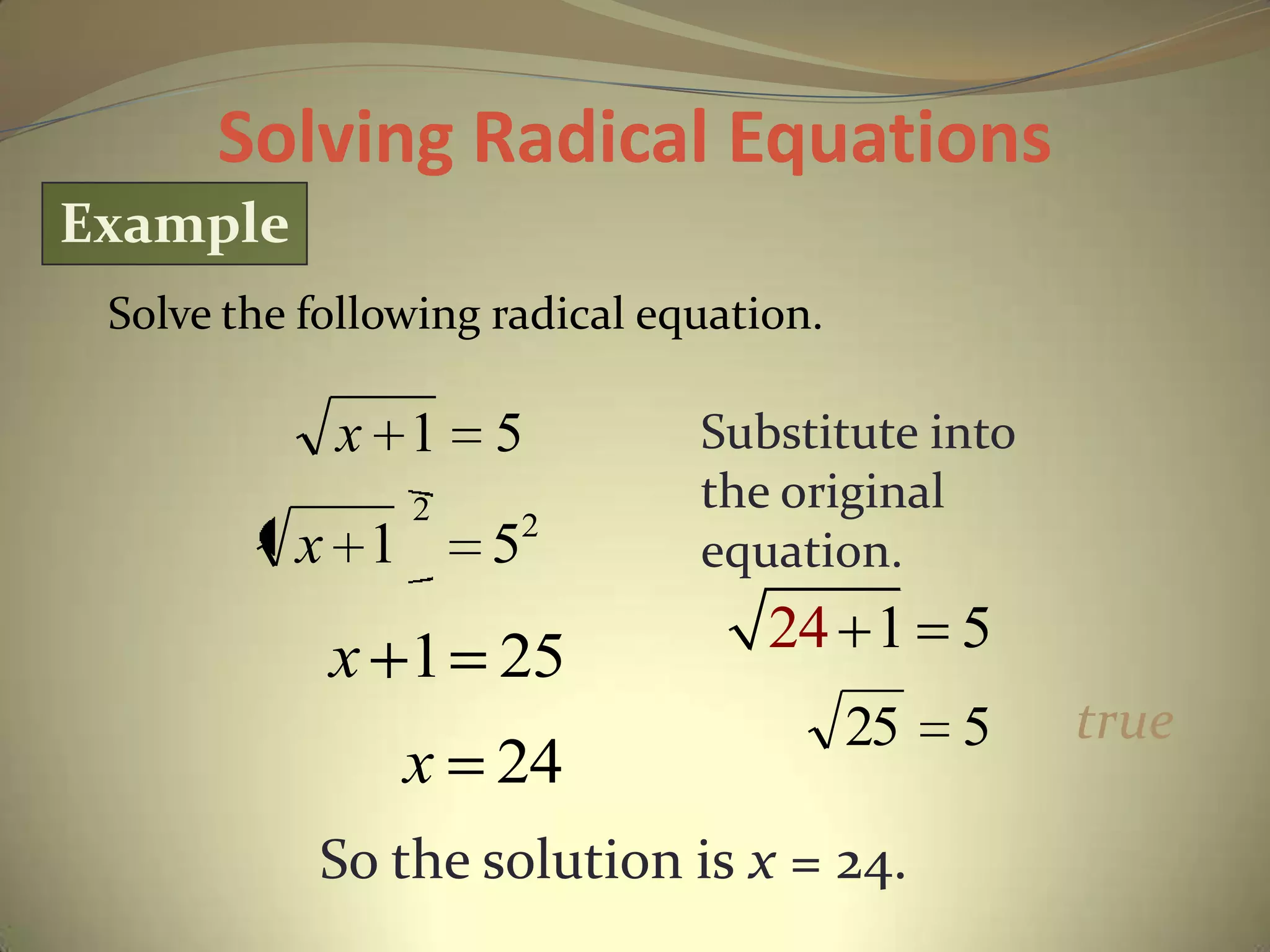
Solving Radical Equations
Example
 Solve the following radical equation.

            x 1      5         Substitute into
                2              the original
          x 1       52         equation.

            x 1 25                 24 1 5
                                         25   5   true
                x 24
           So the solution is x = 24.
Example
  Solve the following radical equation.
                          Substitute into the
         5x     5         original equation.
           2
      5x         5
                     2          5 5     5
                                 25     5
        5x 25
                      Does NOT check, since the left
           x 5        side of the equation is asking for
                      the principal square root.
           So the solution is .
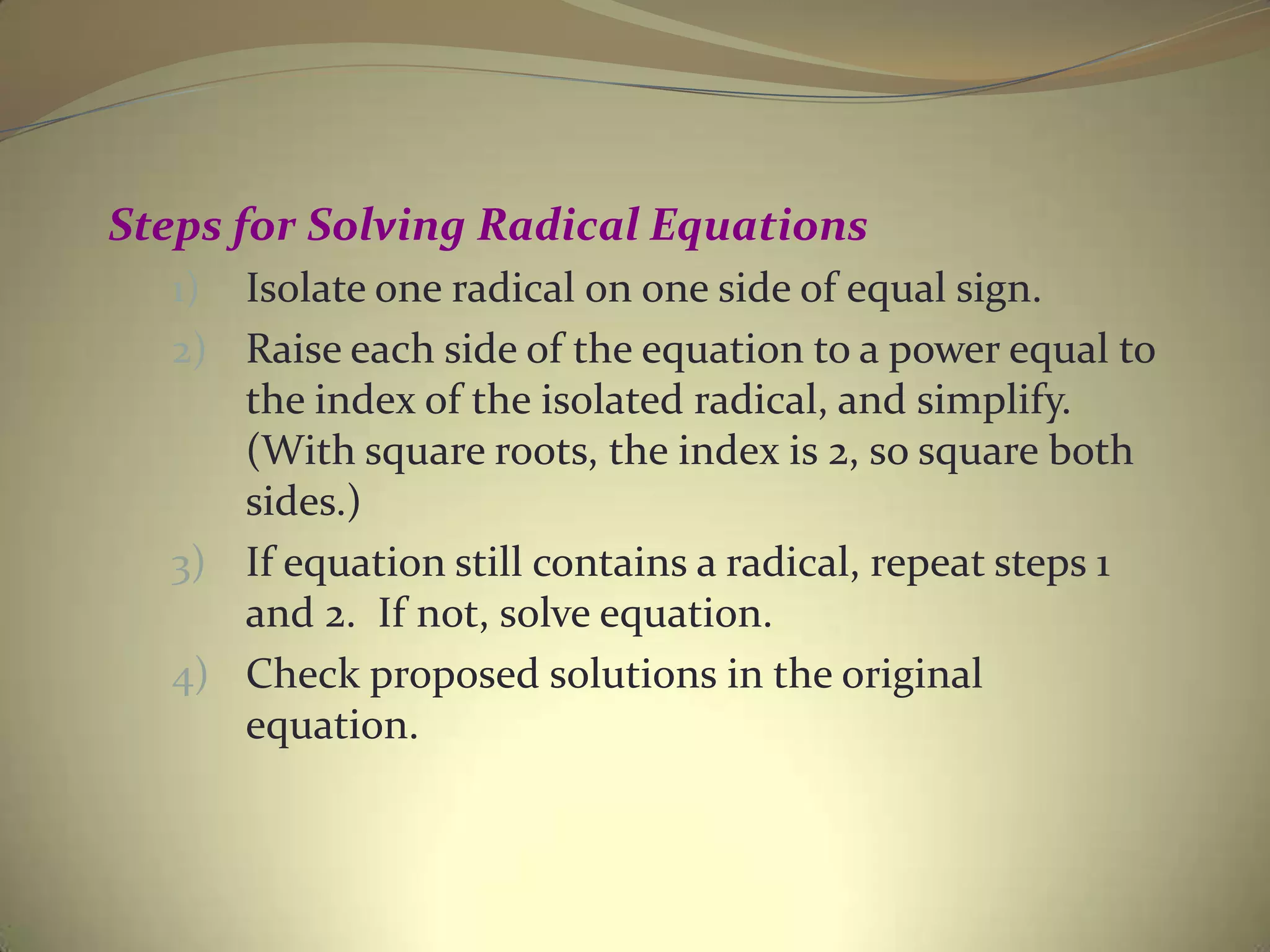
Steps for Solving Radical Equations
  1) Isolate one radical on one side of equal sign.
  2) Raise each side of the equation to a power equal to
     the index of the isolated radical, and simplify.
     (With square roots, the index is 2, so square both
     sides.)
  3) If equation still contains a radical, repeat steps 1
     and 2. If not, solve equation.
  4) Check proposed solutions in the original
     equation.
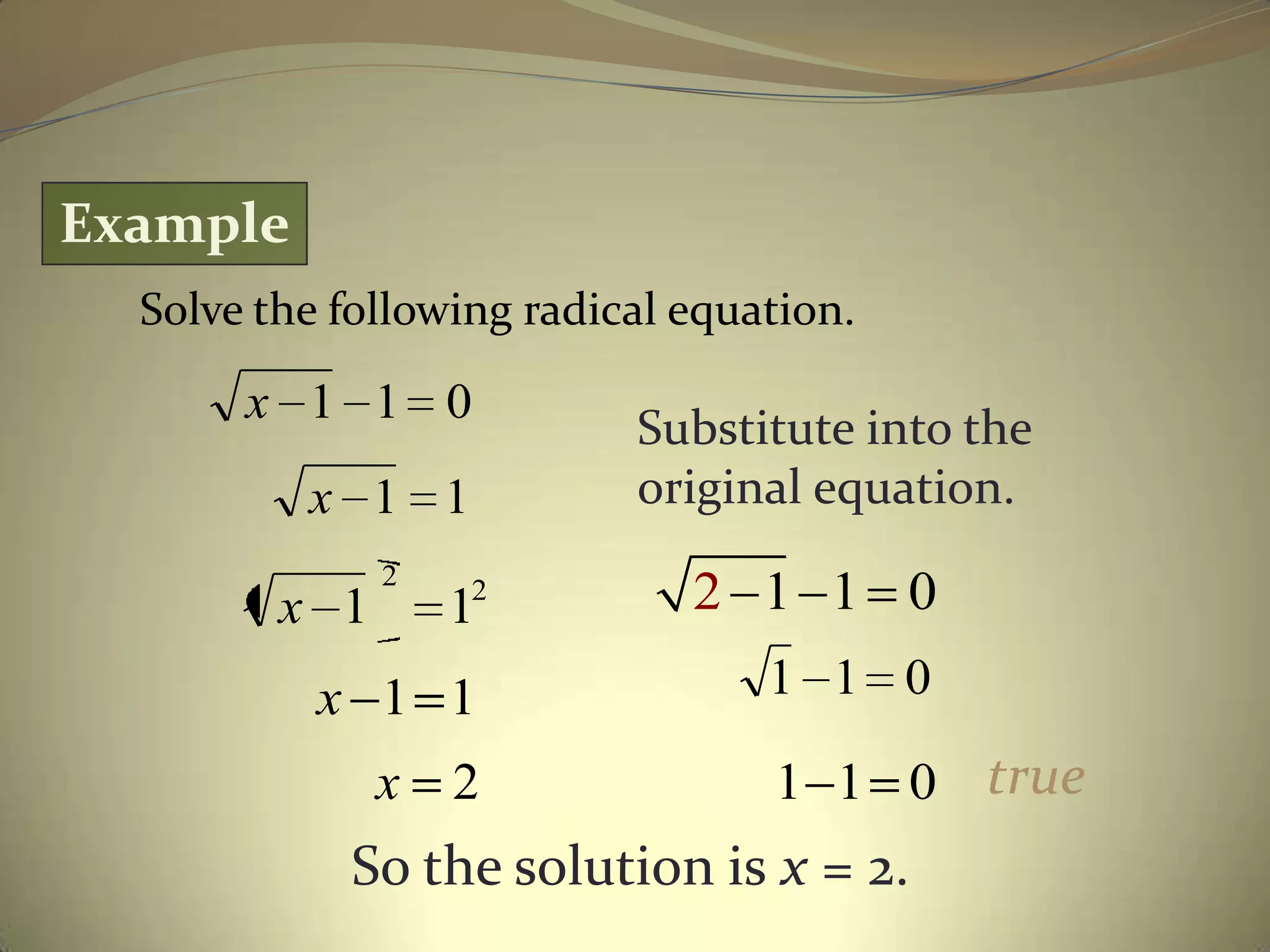
Example
  Solve the following radical equation.

       x 1 1 0
                           Substitute into the
          x 1 1            original equation.
               2
         x 1       12         2 1 1 0
           x 1 1                  1 1 0

               x   2              1 1 0 true
            So the solution is x = 2.
Example
  Solve the following radical equation.
           2x    x 1 8
                 x 1 8 2x
                      2          2
                x 1       8 2x
                  x 1 64 32x 4 x 2
                                 2
                    0 63 33x 4 x
                      0 (3 x)(21 4 x)
                               21
                      x   3 or
                               4
Solving Radical Equations
Example continued
 Substitute the value for x into the original
 equation, to check the solution.
                                  21       21
 2(3)       3 1 8               2             1 8
                                  4        4
        6    4   8 true
                                    21     25
                                              8
                                    2       4
                                         21 5
                                              8
                                         2 2
  So the solution is x = 3.                26
                                              8     false
                                            2
Example
 Solve the following radical equation.
  y 5      2     y 4
       2                 2
 y 5       2     y 4
   y 5 4 4 y 4               y 4         25
                                              y 4
                                         16
       5   4 y 4
       5                                 25   89
               y 4                 y   4
       4                                 16   16
       2
   5                 2
               y 4
   4
Solving Radical Equations
Example continued
 Substitute the value for x into the original equation,
 to check the solution.
         89               89
            5     2          4
         16               16
            169       25
                  2
             16       16
             13       5
                  2
              4       4

             13   3
                           false   So the solution is     .
              4   4
Example
Solve the following radical equation.
2x 4     3x 4     2
         2x 4     2    3x 4
              2                   2
       2x 4        2    3x 4
         2x 4     4 4 3x 4 3x 4
  2 x 4 8 3x       4 3x 4               x 2 24 x 80 0
          x 12     4 3x 4               x 20 x 4      0
              2               2
         x 12        4 3x 4               x 4 or 20
  x2   24 x 144   16 (3x 4) 48 x 64
Solving Radical Equations
Example continued
Substitute the value for x into the original
equation, to check the solution.

 2(4) 4     3(4) 4      2      2(20) 4     3(20) 4     2
            4     16    2                  36     64   2
                 2 4    2                       6 8    2

          true                             true

           So the solution is x = 4 or 20.
The Pythagorean Theorem
Pythagorean Theorem
In a right triangle, the sum of the squares of the
lengths of the two legs is equal to the square of
the length of the hypotenuse.
              (leg a)2 + (leg b)2 = (hypotenuse)2


                         hypotenuse
         leg a

                    leg b
Using the Pythagorean Theorem
Example
 Find the length of the hypotenuse of a right
 triangle when the length of the two legs are 2
 inches and 7 inches.


          c2 = 22 + 72 = 4 + 49 = 53

            c=    53 inches
The Distance Formula
By using the Pythagorean Theorem, we can derive a
formula for finding the distance between two points
with coordinates (x1,y1) and (x2,y2).


                         2             2
        d      x2   x1       y2   y1
The Distance Formula
Example
 Find the distance between ( 5, 8) and ( 2, 2).
                                 2                  2
           d      x2        x1           y2    y1
                                     2              2
           d        5 ( 2)                    8 2
                        2            2
           d        3            6
           d     9 36                45       3 5

Roots and Radicals

  • 2.
    Sections 1 – Introductionto Radicals 2 – Simplifying Radicals 3 – Adding and Subtracting Radicals 4 – Multiplying and Dividing Radicals 5 – Solving Equations Containing Radicals 6 – Radical Equations and Problem Solving
  • 3.
    Square Roots Opposite ofsquaring a number is taking the square root of a number. A number b is a square root of a number a if b2 = a. In order to find a square root of a, you need a # that, when squared, equals a.
  • 4.
    Principal Square Roots Theprincipal (positive) square root is noted as a The negative square root is noted as a
  • 5.
    Radicands Radical expression isan expression containing a radical sign. Radicand is the expression under a radical sign. Note that if the radicand of a square root is a negative number, the radical is NOT a real number.
  • 6.
    Radicands Example 49 7 25 5 16 4 4 2
  • 7.
    Perfect Squares Square rootsof perfect square radicands simplify to rational numbers (numbers that can be written as a quotient of integers). Square roots of numbers that are not perfect squares (like 7, 10, etc.) are irrational numbers. IF REQUESTED, you can find a decimal approximation for these irrational numbers. Otherwise, leave them in radical form.
  • 8.
    Perfect Square Roots Radicandsmight also contain variables and powers of variables. To avoid negative radicands, assume for this chapter that if a variable appears in the radicand, it represents positive numbers only. Example 64x10 8x5
  • 9.
    Cube Roots The cuberoot of a real number a 3 a b only if b 3 a Note: a is not restricted to non- negative numbers for cubes.
  • 10.
    Cube Roots Example 3 27 3 3 8x6 2x 2
  • 11.
    nth Roots Other rootscan be found, as well. The nth root of a is defined as n a b only if b n a If the index, n, is even, the root is NOT a real number when a is negative. If the index is odd, the root will be a real number.
  • 12.
    Example Simplify thefollowing. 25a b 2 20 5ab10 3 64a 3 4a b9 b3
  • 14.
    Product Rule forRadicals If a and b are real numbers, ab a b a a if b 0 b b
  • 15.
    Simplifying Radicals Example Simplifythe following radical expressions. 40 4 10 2 10 5 5 5 16 16 4 No perfect square factor, so 15 the radical is already simplified.
  • 16.
    Simplifying Radicals Example Simplifythe following radical expressions. 7 6 6 x x x x x x3 x 20 20 4 5 2 5 x16 x16 x8 x8
  • 17.
    Quotient Rule forRadicals If n a andn b are real numbers, n n n ab a b n a a n n n if b 0 b b
  • 18.
    Simplifying Radicals Example Simplifythe following radical expressions. 3 16 3 8 2 3 8 3 2 23 2 3 3 3 3 3 3 3 4 64 64
  • 20.
    Sums and Differences Rulesin the previous section allowed us to split radicals that had a radicand which was a product or a quotient. We can NOT split sums or differences. a b a b a b a b
  • 21.
    Like Radicals In previouschapters, we’ve discussed the concept of “like” terms. These are terms with the same variables raised to the same powers. They can be combined through addition and subtraction. Similarly, we can work with the concept of “like” radicals to combine radicals with the same radicand. Like radicals are radicals with the same index and the same radicand. Like radicals can also be combined with addition or subtraction by using the distributive property.
  • 22.
    Adding and SubtractingRadical Expressions Example 3 7 3 8 3 10 2 4 2 6 2 2 43 2 Can not simplify 5 3 Can not simplify
  • 23.
    Example Simplify thefollowing radical expression. 75 12 3 3 25 3 4 3 3 3 25 3 4 3 3 3 5 3 2 3 3 3 5 2 3 3 6 3
  • 24.
    Example Simplify thefollowing radical expression. 3 3 64 14 9 3 3 4 14 9 5 14
  • 25.
    Example Simplify thefollowing radical expression. Assume that variables represent positive real numbers. 3 2 3 45x x 5x 3 9 x 5x x 5x 2 3 9x 5x x 5x 3 3x 5 x x 5x 9 x 5x x 5x 9x x 5x 10 x 5 x
  • 27.
    Multiplying and DividingRadical Expressions If n a and n b are real numbers, n n n a b ab n a a n n if b 0 b b
  • 28.
    Example Simplify thefollowing radical expressions. 3y 5x 15xy 7 6 7 6 ab ab 4 4 2 2 3 2 3 2 ab ab ab ab
  • 29.
    Rationalizing the Denominator Many times it is helpful to rewrite a radical quotient with the radical confined to ONLY the numerator. If we rewrite the expression so that there is no radical in the denominator, it is called rationalizing the denominator. This process involves multiplying the quotient by a form of 1 that will eliminate the radical in the denominator.
  • 30.
    Example Rationalize thedenominator. 3 2 3 2 6 2 2 2 2 2 3 6 3 63 3 63 3 3 6 3 3 3 3 3 23 3 9 3 9 33 27 3
  • 31.
    Conjugates Many rational quotientshave a sum or difference of terms in a denominator, rather than a single radical. In that case, we need to multiply by the conjugate of the numerator or denominator (which ever one we are rationalizing). The conjugate uses the same terms, but the opposite operation (+ or ).
  • 32.
    Rationalizing the Denominator Example Rationalize the denominator. 3 2 2 3 3 2 3 2 2 2 3 2 3 2 3 2 2 3 2 3 3 6 3 2 2 2 3 2 3 6 3 2 2 2 3 1 6 3 2 2 2 3
  • 34.
    Extraneous Solutions Power Rule(text only talks about squaring, but applies to other powers, as well). If both sides of an equation are raised to the same power, solutions of the new equation contain all the solutions of the original equation, but might also contain additional solutions. A proposed solution of the new equation that is NOT a solution of the original equation is an extraneous solution.
  • 35.
    Solving Radical Equations Example Solve the following radical equation. x 1 5 Substitute into 2 the original x 1 52 equation. x 1 25 24 1 5 25 5 true x 24 So the solution is x = 24.
  • 36.
    Example Solvethe following radical equation. Substitute into the 5x 5 original equation. 2 5x 5 2 5 5 5 25 5 5x 25 Does NOT check, since the left x 5 side of the equation is asking for the principal square root. So the solution is .
  • 37.
    Steps for SolvingRadical Equations 1) Isolate one radical on one side of equal sign. 2) Raise each side of the equation to a power equal to the index of the isolated radical, and simplify. (With square roots, the index is 2, so square both sides.) 3) If equation still contains a radical, repeat steps 1 and 2. If not, solve equation. 4) Check proposed solutions in the original equation.
  • 38.
    Example Solvethe following radical equation. x 1 1 0 Substitute into the x 1 1 original equation. 2 x 1 12 2 1 1 0 x 1 1 1 1 0 x 2 1 1 0 true So the solution is x = 2.
  • 39.
    Example Solvethe following radical equation. 2x x 1 8 x 1 8 2x 2 2 x 1 8 2x x 1 64 32x 4 x 2 2 0 63 33x 4 x 0 (3 x)(21 4 x) 21 x 3 or 4
  • 40.
    Solving Radical Equations Examplecontinued Substitute the value for x into the original equation, to check the solution. 21 21 2(3) 3 1 8 2 1 8 4 4 6 4 8 true 21 25 8 2 4 21 5 8 2 2 So the solution is x = 3. 26 8 false 2
  • 41.
    Example Solve thefollowing radical equation. y 5 2 y 4 2 2 y 5 2 y 4 y 5 4 4 y 4 y 4 25 y 4 16 5 4 y 4 5 25 89 y 4 y 4 4 16 16 2 5 2 y 4 4
  • 42.
    Solving Radical Equations Examplecontinued Substitute the value for x into the original equation, to check the solution. 89 89 5 2 4 16 16 169 25 2 16 16 13 5 2 4 4 13 3 false So the solution is . 4 4
  • 43.
    Example Solve the followingradical equation. 2x 4 3x 4 2 2x 4 2 3x 4 2 2 2x 4 2 3x 4 2x 4 4 4 3x 4 3x 4 2 x 4 8 3x 4 3x 4 x 2 24 x 80 0 x 12 4 3x 4 x 20 x 4 0 2 2 x 12 4 3x 4 x 4 or 20 x2 24 x 144 16 (3x 4) 48 x 64
  • 44.
    Solving Radical Equations Examplecontinued Substitute the value for x into the original equation, to check the solution. 2(4) 4 3(4) 4 2 2(20) 4 3(20) 4 2 4 16 2 36 64 2 2 4 2 6 8 2 true true So the solution is x = 4 or 20.
  • 46.
    The Pythagorean Theorem PythagoreanTheorem In a right triangle, the sum of the squares of the lengths of the two legs is equal to the square of the length of the hypotenuse. (leg a)2 + (leg b)2 = (hypotenuse)2 hypotenuse leg a leg b
  • 47.
    Using the PythagoreanTheorem Example Find the length of the hypotenuse of a right triangle when the length of the two legs are 2 inches and 7 inches. c2 = 22 + 72 = 4 + 49 = 53 c= 53 inches
  • 48.
    The Distance Formula Byusing the Pythagorean Theorem, we can derive a formula for finding the distance between two points with coordinates (x1,y1) and (x2,y2). 2 2 d x2 x1 y2 y1
  • 49.
    The Distance Formula Example Find the distance between ( 5, 8) and ( 2, 2). 2 2 d x2 x1 y2 y1 2 2 d 5 ( 2) 8 2 2 2 d 3 6 d 9 36 45 3 5