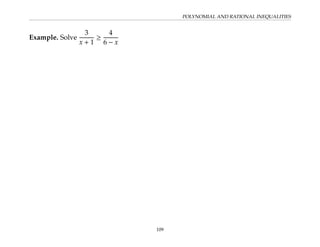
Math 110 Algebra - Fall 2018
EXPONENTS
Exponents
After completing this section, students should be able to:
• Explain the product rule, quotient rule, and power rule for exponentiation by
writing out powers of a variable as repeated multiplication.
• Rewrite expressions with negative exponents so that all exponents are positive.
• Use the product rule, quotient rule, and power rule to simplify exponential ex-
pressions.
• Decide whether equations involving exponents are always true or not by testing
examples.
• Rewrite fractional exponents in terms of radicals.
• Calcuate numbers raised to fractional exponents without a calculator.
2
EXPONENTS
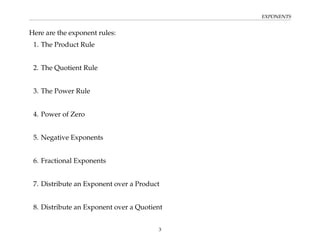
Here are the exponent rules:
1. The Product Rule
2. The Quotient Rule
3. The Power Rule
4. Power of Zero
5. Negative Exponents
6. Fractional Exponents
7. Distribute an Exponent over a Product
8. Distribute an Exponent over a Quotient
3
EXPONENTS
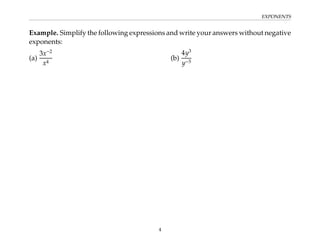
Example. Simplify the following expressions and write your answers without negative
exponents:
(a)
3x−2
x4
(b)
4y3
y−5
4
EXPONENTS
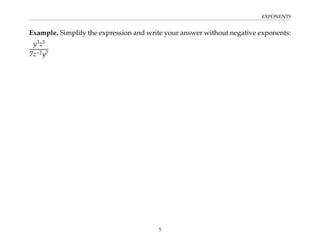
Example. Simplify the expression and write your answer without negative exponents:
y3
z5
7z−2y7
5
EXPONENTS
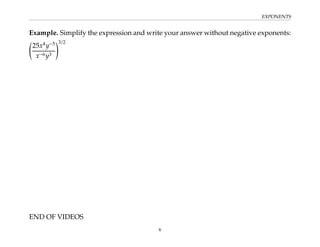
Example. Simplify the expression and write your answer without negative exponents:
25x4
y−5
x−6y3
!3/2
END OF VIDEOS
6
EXPONENTS
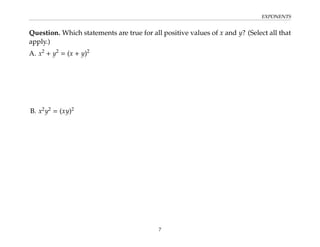
Question. Which statements are true for all positive values of x and y? (Select all that
apply.)
A. x2
+ y2
= (x + y)2
B. x2
y2
= (xy)2
7
EXPONENTS
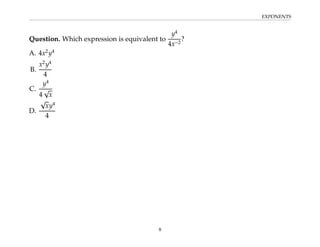
Question. Which expression is equivalent to
y4
4x−2
?
A. 4x2
y4
B.
x2
y4
4
C.
y4
4
√
x
D.
√
xy4
4
8
EXPONENTS
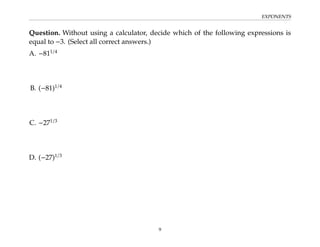
Question. Without using a calculator, decide which of the following expressions is
equal to −3. (Select all correct answers.)
A. −811/4
B. (−81)1/4
C. −271/3
D. (−27)1/3
9
EXPONENTS
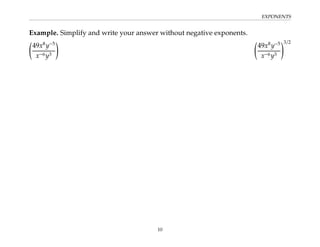
Example. Simplify and write your answer without negative exponents.
49x8
y−5
x−6y3
!
49x8
y−5
x−6y3
!3/2
10
EXPONENTS
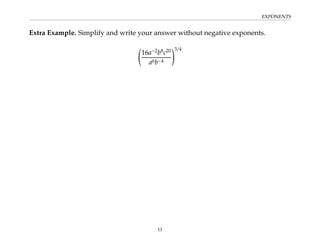
Extra Example. Simplify and write your answer without negative exponents.
16a−2
b8
c20
a6b−4
!3/4
11
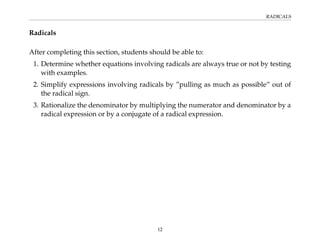
RADICALS
Radicals
After completing this section, students should be able to:
1. Determine whether equations involving radicals are always true or not by testing
with examples.
2. Simplify expressions involving radicals by ”pulling as much as possible” out of
the radical sign.
3. Rationalize the denominator by multiplying the numerator and denominator by a
radical expression or by a conjugate of a radical expression.
12
RADICALS
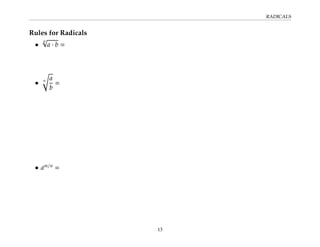
Rules for Radicals
•
n
√
a · b =
• n
r
a
b
=
• am/n
=
13
RADICALS
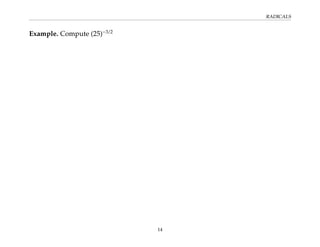
Example. Compute (25)−3/2
14
RADICALS
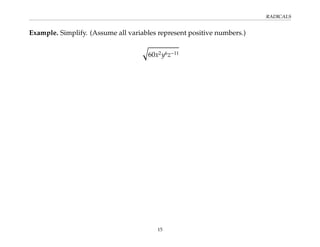
Example. Simplify. (Assume all variables represent positive numbers.)
q
60x2y6z−11
15
RADICALS
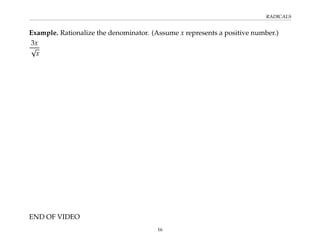
Example. Rationalize the denominator. (Assume x represents a positive number.)
3x
√
x
END OF VIDEO
16
RADICALS
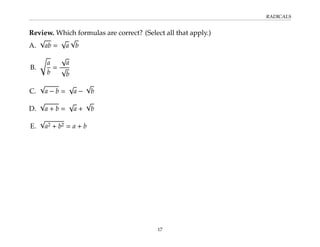
Review. Which formulas are correct? (Select all that apply.)
A.
√
ab =
√
a
√
b
B.
r
a
b
=
√
a
√
b
C.
√
a − b =
√
a −
√
b
D.
√
a + b =
√
a +
√
b
E.
√
a2 + b2 = a + b
17
RADICALS
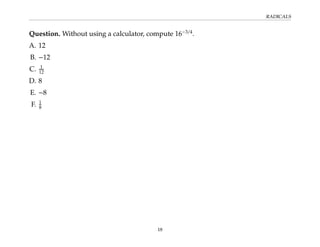
Question. Without using a calculator, compute 16−3/4
.
A. 12
B. −12
C. 1
12
D. 8
E. −8
F. 1
8
18
RADICALS
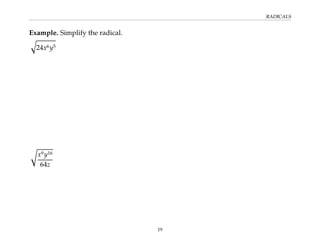
Example. Simplify the radical.
q
24x6y5
r
x9y16
64z
19
RADICALS
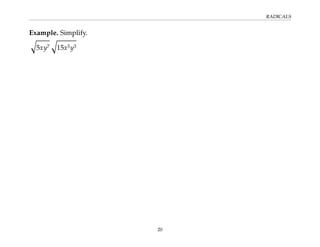
Example. Simplify.
q
5xy7
q
15x3y3
20
RADICALS
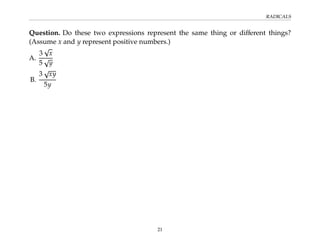
Question. Do these two expressions represent the same thing or different things?
(Assume x and y represent positive numbers.)
A.
3
√
x
5
√
y
B.
3
√
xy
5y
21
RADICALS
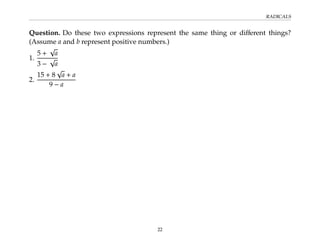
Question. Do these two expressions represent the same thing or different things?
(Assume a and b represent positive numbers.)
1.
5 +
√
a
3 −
√
a
2.
15 + 8
√
a + a
9 − a
22
RADICALS
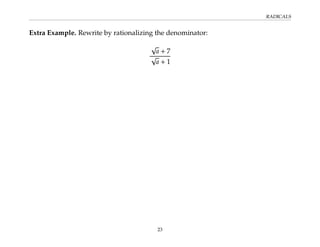
Extra Example. Rewrite by rationalizing the denominator:
√
a + 7
√
a + 1
23
RADICALS
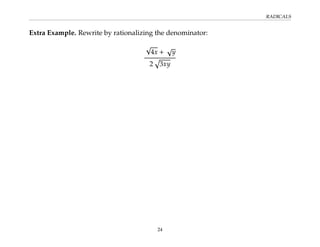
Extra Example. Rewrite by rationalizing the denominator:
√
4x +
√
y
2
p
3xy
24
RADICALS
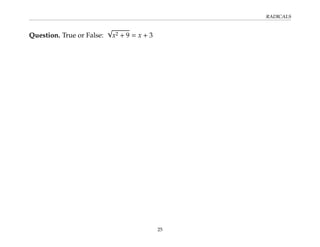
Question. True or False:
√
x2 + 9 = x + 3
25
FACTORING
Factoring
After completing this section, students should be able to:
• Factor an expression by pulling out common factors from each term.
• Factor a difference of two squares.
• Factor a sum or difference of two cubes.
• Factor some expressions with four terms by grouping.
• Factor quadratics when possible.
• Combine these factoring methods to factor a complex expression several times.
26
FACTORING
1. Pull out the greatest common factor
Example. Factor 15 + 25x
Example. Factor x2
y + y2
x3
27
FACTORING
2. Factor by grouping
Example. Factor x3
+ 3x2
+ 4x + 12
28
FACTORING
3. Factor quadratics
Example. Factor x2
− 6x + 8
Example. Factor 10x2
+ 11x − 6
29
FACTORING
4. Difference of squares
a2
− b2
Example. Factor x2
− 16
Example. Factor 9p2
− 1
30
FACTORING
5. Difference or sum of cubes
a3
− b3
=
a3
+ b3
=
Example. Factor y3
+ 27
END OF VIDEO
31
FACTORING
Question. Which of these expressions DOES NOT factor?
A. x2
+ x
NEXT TIME MAKE THIS ONE HARDER LIKE 9x2
− 25
B. x2
− 25
C. x2
+ 4
D. x3
+ 2x2
+ 3x + 6
E. 5x2
− 14x + 8
32
FACTORING
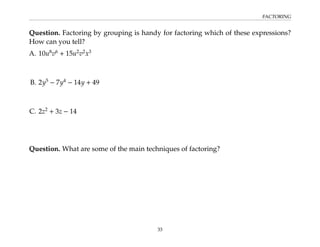
Question. Factoring by grouping is handy for factoring which of these expressions?
How can you tell?
A. 10u8
v6
+ 15u2
v2
x3
B. 2y5
− 7y4
− 14y + 49
C. 2z2
+ 3z − 14
Question. What are some of the main techniques of factoring?
33
FACTORING
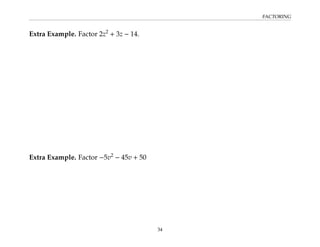
Extra Example. Factor 2z2
+ 3z − 14.
Extra Example. Factor −5v2
− 45v + 50
34
RATIONAL EXPRESSIONS
Rational Expressions
After completing this section, students should be able to:
• Simplify rational expressions by factoring and cancelling common factors.
• Find the least common denominator for two or more rational expressions.
• Add and subtract rational expressions.
• Multiply and divide rational expressions.
• Simplify complex rational expressions that involve sums or differences of rational
expressions divided by sums or differences of rational expressions.
• Recoginze common errors in simplifying rational expressions such as cancelling
across a plus or minus sign.
35
RATIONAL EXPRESSIONS
Reduce to lowest terms
Example. Simplify
21
45
by reducing to lowest terms.
Example. Simplify
3x + 6
x2 + 4x + 4
by reducing to lowest terms.
36
RATIONAL EXPRESSIONS
Multiplying and Dividing
Example. Compute
a)
4
3
·
2
5
b)
4
5
2
3
Example. Compute
x2
+ x
x + 4
x + 1
x2 − 16
37
RATIONAL EXPRESSIONS
Adding and Subracting
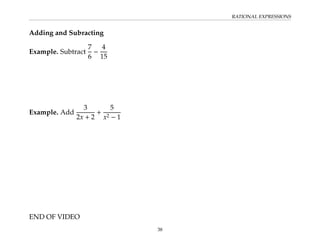
Example. Subtract
7
6
−
4
15
Example. Add
3
2x + 2
+
5
x2 − 1
END OF VIDEO
38
RATIONAL EXPRESSIONS
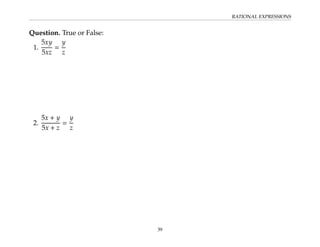
Question. True or False:
1.
5xy
5xz
=
y
z
2.
5x + y
5x + z
=
y
z
39
RATIONAL EXPRESSIONS
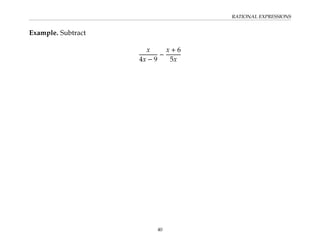
Example. Subtract
x
4x − 9
−
x + 6
5x
40
RATIONAL EXPRESSIONS
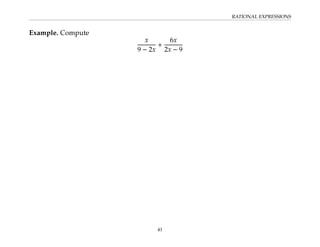
Example. Compute
x
9 − 2x
+
6x
2x − 9
41
RATIONAL EXPRESSIONS
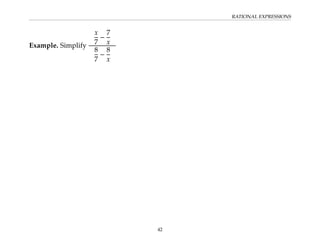
Example. Simplify
x
7
−
7
x
8
7
−
8
x
42
RATIONAL EXPRESSIONS
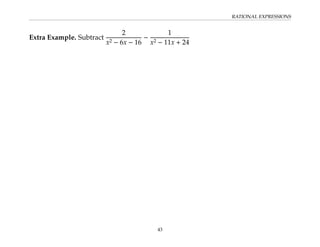
Extra Example. Subtract
2
x2 − 6x − 16
−
1
x2 − 11x + 24
43
RATIONAL EXPRESSIONS
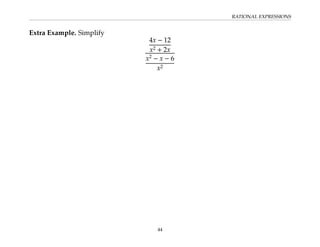
Extra Example. Simplify
4x − 12
x2 + 2x
x2
− x − 6
x2
44
SOLVING QUADRATIC EQUATIONS
Solving Quadratic Equations
After completing this section, students should be able to:
• Rewrite a quadratic equation in standard form
• Solve a quadratic equation by factoring
• Solve a quadratic equation using the quadratic formula
• Recognize when a quadratic equation has no real roots
• Solve a linear or quadratic equation in which the coefficients are themselves vari-
ables, to get solutions in terms of the other variables.
45
SOLVING QUADRATIC EQUATIONS
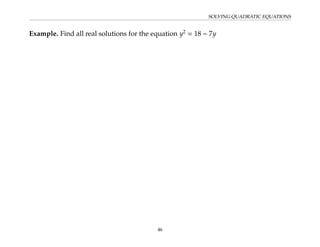
Example. Find all real solutions for the equation y2
= 18 − 7y
46
SOLVING QUADRATIC EQUATIONS
Example. w2
= 121
47
SOLVING QUADRATIC EQUATIONS
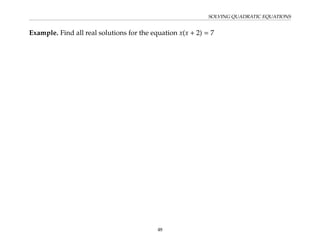
Example. Find all real solutions for the equation x(x + 2) = 7
48
SOLVING QUADRATIC EQUATIONS
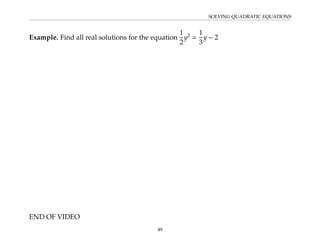
Example. Find all real solutions for the equation
1
2
y2
=
1
3
y − 2
END OF VIDEO
49
SOLVING QUADRATIC EQUATIONS
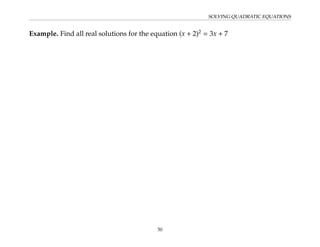
Example. Find all real solutions for the equation (x + 2)2
= 3x + 7
50
SOLVING QUADRATIC EQUATIONS
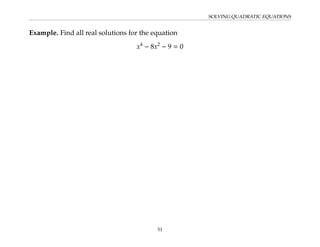
Example. Find all real solutions for the equation
x4
− 8x2
− 9 = 0
51
SOLVING QUADRATIC EQUATIONS
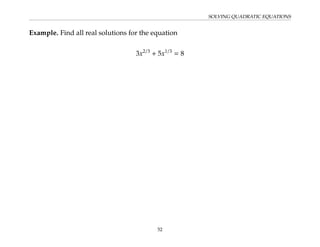
Example. Find all real solutions for the equation
3x2/3
+ 5x1/3
= 8
52
SOLVING QUADRATIC EQUATIONS
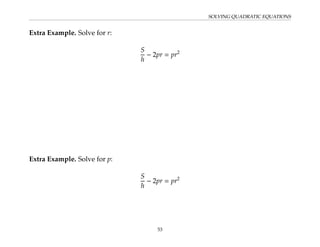
Extra Example. Solve for r:
S
h
− 2pr = pr2
Extra Example. Solve for p:
S
h
− 2pr = pr2
53
SOLVING RATIONAL EQUATIONS
Solving Rational Equations
By the end of this section, students should be able to:
• Solve rational equations by clearing the denominator
• Recognize and exclude extraneous solutions to rational equations
• Solve rational equations with several variables for one of the variables
54
SOLVING RATIONAL EQUATIONS
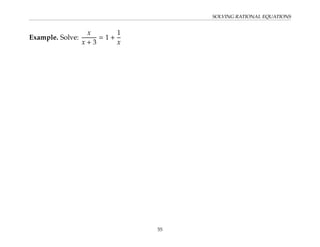
Example. Solve:
x
x + 3
= 1 +
1
x
55
SOLVING RATIONAL EQUATIONS
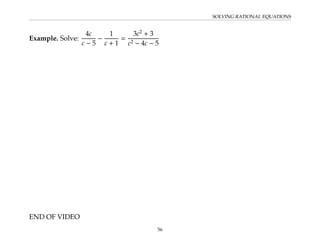
Example. Solve:
4c
c − 5
−
1
c + 1
=
3c2
+ 3
c2 − 4c − 5
END OF VIDEO
56
SOLVING RATIONAL EQUATIONS
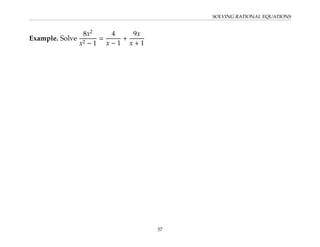
Example. Solve
8x2
x2 − 1
=
4
x − 1
+
9x
x + 1
57
SOLVING RATIONAL EQUATIONS
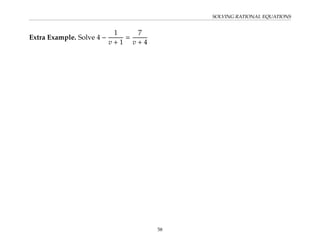
Extra Example. Solve 4 −
1
v + 1
=
7
v + 4
58
SOLVING RATIONAL EQUATIONS
Review. What are the main steps to solving a rational equation?
Question. What is an extraneous solution?
59
SOLVING RATIONAL EQUATIONS
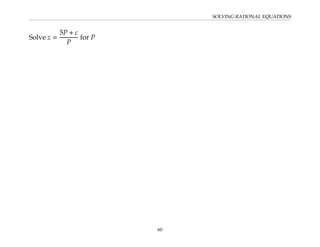
Solve z =
5P + c
P
for P
60
SOLVING RATIONAL EQUATIONS
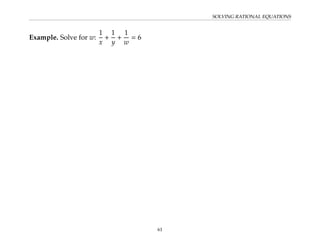
Example. Solve for w:
1
x
+
1
y
+
1
w
= 6
61
SOLVING RATIONAL EQUATIONS
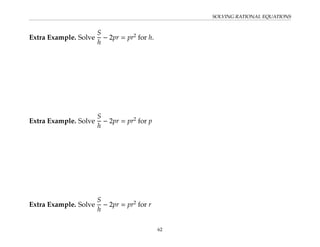
Extra Example. Solve
S
h
− 2pr = pr2
for h.
Extra Example. Solve
S
h
− 2pr = pr2
for p
Extra Example. Solve
S
h
− 2pr = pr2
for r
62
SOLVING RATIONAL EQUATIONS
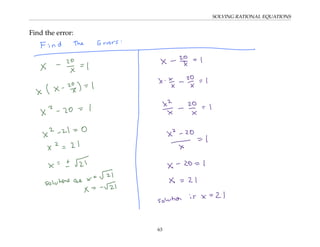
Find the error:
63
RADICAL EQUATIONS
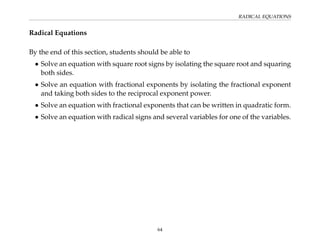
Radical Equations
By the end of this section, students should be able to
• Solve an equation with square root signs by isolating the square root and squaring
both sides.
• Solve an equation with fractional exponents by isolating the fractional exponent
and taking both sides to the reciprocal exponent power.
• Solve an equation with fractional exponents that can be written in quadratic form.
• Solve an equation with radical signs and several variables for one of the variables.
64
RADICAL EQUATIONS
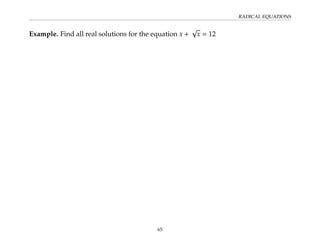
Example. Find all real solutions for the equation x +
√
x = 12
65
RADICAL EQUATIONS
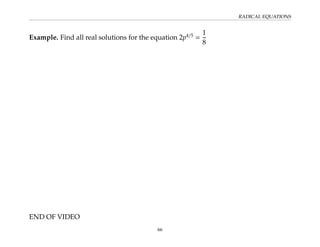
Example. Find all real solutions for the equation 2p4/5
=
1
8
END OF VIDEO
66
RADICAL EQUATIONS
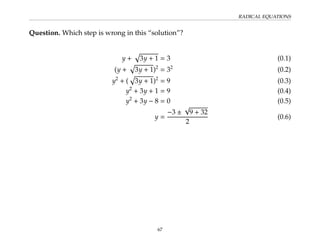
Question. Which step is wrong in this “solution”?
y +
p
3y + 1 = 3 (0.1)
(y +
p
3y + 1)2
= 32
(0.2)
y2
+ (
p
3y + 1)2
= 9 (0.3)
y2
+ 3y + 1 = 9 (0.4)
y2
+ 3y − 8 = 0 (0.5)
y =
−3 ±
√
9 + 32
2
(0.6)
67
RADICAL EQUATIONS
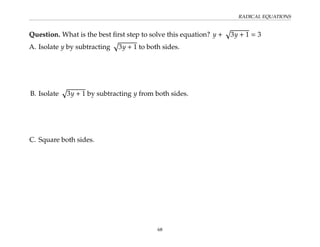
Question. What is the best first step to solve this equation? y +
p
3y + 1 = 3
A. Isolate y by subtracting
p
3y + 1 to both sides.
B. Isolate
p
3y + 1 by subtracting y from both sides.
C. Square both sides.
68
RADICAL EQUATIONS
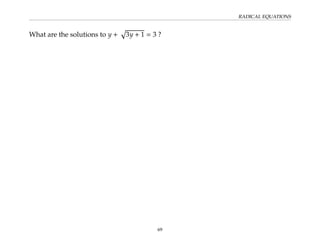
What are the solutions to y +
p
3y + 1 = 3 ?
69
RADICAL EQUATIONS
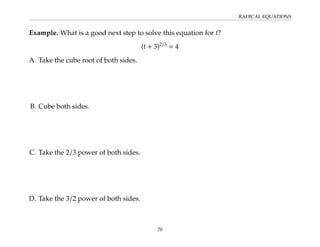
Example. What is a good next step to solve this equation for t?
(t + 3)2/3
= 4
A. Take the cube root of both sides.
B. Cube both sides.
C. Take the 2/3 power of both sides.
D. Take the 3/2 power of both sides.
70
RADICAL EQUATIONS
Solve (t + 3)2/3
= 4.
71
RADICAL EQUATIONS
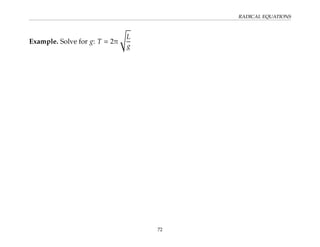
Example. Solve for g: T = 2π
s
L
g
72
RADICAL EQUATIONS
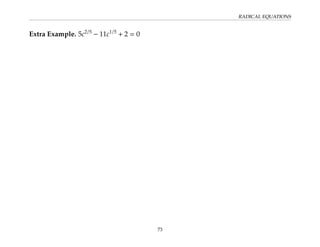
Extra Example. 5c2/5
− 11c1/5
+ 2 = 0
73
RADICAL EQUATIONS
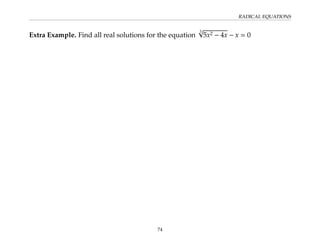
Extra Example. Find all real solutions for the equation
3
√
5x2 − 4x − x = 0
74
ABSOLUTE VALUE EQUATIONS
Absolute Value Equations
After completing this section, students should be able to
• Solve equations with absolute value signs and linear expressions inside the abso-
lute value signs.
• Recognize when absolute value equations have no solutions.
75
ABSOLUTE VALUE EQUATIONS
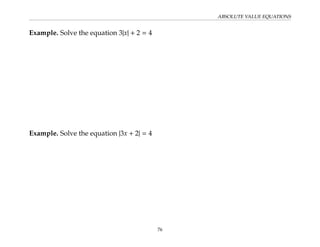
Example. Solve the equation 3|x| + 2 = 4
Example. Solve the equation |3x + 2| = 4
76
ABSOLUTE VALUE EQUATIONS
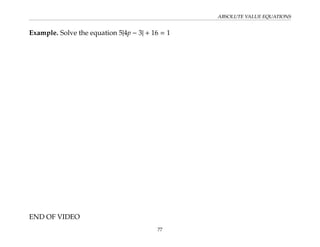
Example. Solve the equation 5|4p − 3| + 16 = 1
END OF VIDEO
77
ABSOLUTE VALUE EQUATIONS
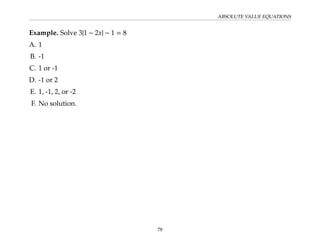
Example. Solve 3|1 − 2x| − 1 = 8
A. 1
B. -1
C. 1 or -1
D. -1 or 2
E. 1, -1, 2, or -2
F. No solution.
78
ABSOLUTE VALUE EQUATIONS
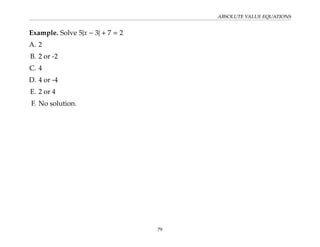
Example. Solve 5|x − 3| + 7 = 2
A. 2
B. 2 or -2
C. 4
D. 4 or -4
E. 2 or 4
F. No solution.
79
REVIEW FOR TEST 1
Review for Test 1
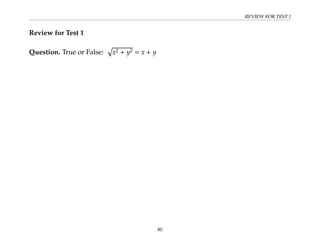
Question. True or False:
p
x2 + y2 = x + y
80
REVIEW FOR TEST 1
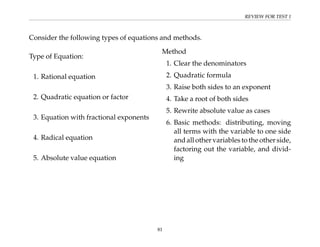
Consider the following types of equations and methods.
Type of Equation:
1. Rational equation
2. Quadratic equation or factor
3. Equation with fractional exponents
4. Radical equation
5. Absolute value equation
Method
1. Clear the denominators
2. Quadratic formula
3. Raise both sides to an exponent
4. Take a root of both sides
5. Rewrite absolute value as cases
6. Basic methods: distributing, moving
all terms with the variable to one side
and all other variables to the other side,
factoring out the variable, and divid-
ing
81
REVIEW FOR TEST 1
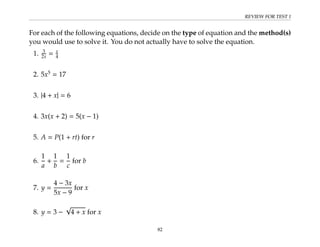
For each of the following equations, decide on the type of equation and the method(s)
you would use to solve it. You do not actually have to solve the equation.
1. 3
2x = x
4
2. 5x5
= 17
3. |4 + x| = 6
4. 3x(x + 2) = 5(x − 1)
5. A = P(1 + rt) for r
6.
1
a
+
1
b
=
1
c
for b
7. y =
4 − 3x
5x − 9
for x
8. y = 3 −
√
4 + x for x
82
ABSOLUTE VALUE INEQUALITIES
Absolute Value Inequalities
After completing this section, students should be able to:
• Solve inequalaties involving absolute value signs with linear expressions inside
the absolute value signs.
• Recognize when absolute value inequalities have no solutions.
• Recognize when absolute vale inequalities have all real numbers as solutions.
83
ABSOLUTE VALUE INEQUALITIES
Example. What x-values satisfy |x| < 5?
Example. What x-values satisfy |x| ≥ 5?
84
ABSOLUTE VALUE INEQUALITIES
Example. Solve |3 − 2t| < 4
85
ABSOLUTE VALUE INEQUALITIES
Example. Solve |3 − 2t| > 4
86
ABSOLUTE VALUE INEQUALITIES
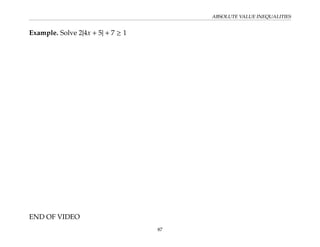
Example. Solve 2|4x + 5| + 7 ≥ 1
END OF VIDEO
87
ABSOLUTE VALUE INEQUALITIES
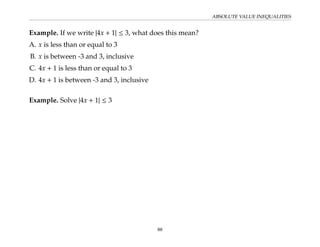
Example. If we write |4x + 1| ≤ 3, what does this mean?
A. x is less than or equal to 3
B. x is between -3 and 3, inclusive
C. 4x + 1 is less than or equal to 3
D. 4x + 1 is between -3 and 3, inclusive
Example. Solve |4x + 1| ≤ 3
88
ABSOLUTE VALUE INEQUALITIES
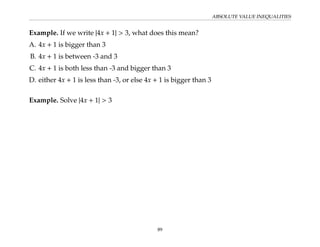
Example. If we write |4x + 1| > 3, what does this mean?
A. 4x + 1 is bigger than 3
B. 4x + 1 is between -3 and 3
C. 4x + 1 is both less than -3 and bigger than 3
D. either 4x + 1 is less than -3, or else 4x + 1 is bigger than 3
Example. Solve |4x + 1| > 3
89
ABSOLUTE VALUE INEQUALITIES
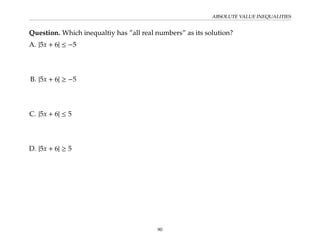
Question. Which inequaltiy has ”all real numbers” as its solution?
A. |5x + 6| ≤ −5
B. |5x + 6| ≥ −5
C. |5x + 6| ≤ 5
D. |5x + 6| ≥ 5
90
COMPOUND LINEAR INEQUALITIES
Compound Linear Inequalities
After completing this section, students should be able to:
• Solve compound linear inequalities connected by an ”AND” statement or an ”OR”
statement, or written in the form     
• Graph solutions of inequalities on a number line.
• Write solutions to inequalities in interval notation.
• Recognize when compound linear inequalities have no solutions or have all real
numbers as solutions.
91
COMPOUND LINEAR INEQUALITIES
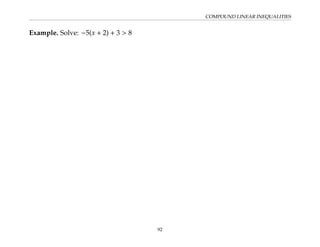
Example. Solve: −5(x + 2) + 3  8
92
COMPOUND LINEAR INEQUALITIES
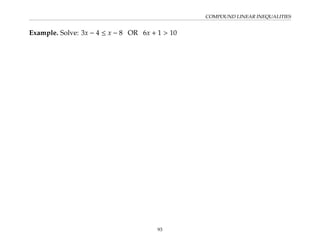
Example. Solve: 3x − 4 ≤ x − 8 OR 6x + 1  10
93
COMPOUND LINEAR INEQUALITIES
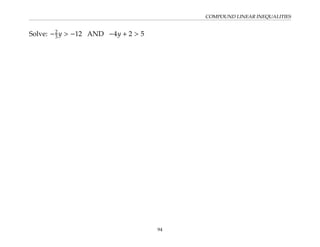
Solve: −2
3 y  −12 AND −4y + 2  5
94
COMPOUND LINEAR INEQUALITIES
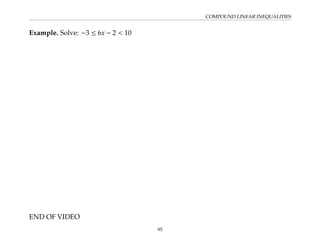
Example. Solve: −3 ≤ 6x − 2  10
END OF VIDEO
95
COMPOUND LINEAR INEQUALITIES
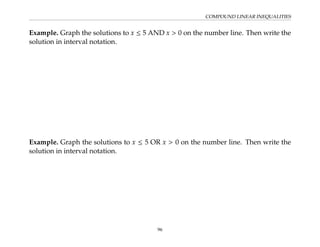
Example. Graph the solutions to x ≤ 5 AND x  0 on the number line. Then write the
solution in interval notation.
Example. Graph the solutions to x ≤ 5 OR x  0 on the number line. Then write the
solution in interval notation.
96
COMPOUND LINEAR INEQUALITIES
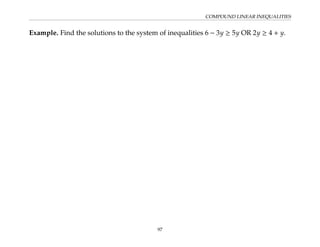
Example. Find the solutions to the system of inequalities 6 − 3y ≥ 5y OR 2y ≥ 4 + y.
97
COMPOUND LINEAR INEQUALITIES
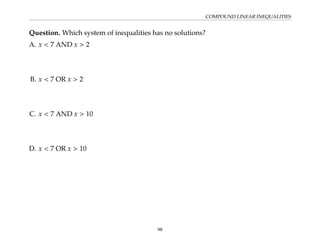
Question. Which system of inequalities has no solutions?
A. x  7 AND x  2
B. x  7 OR x  2
C. x  7 AND x  10
D. x  7 OR x  10
98
COMPOUND LINEAR INEQUALITIES
Example. Which of the following expressions are equivalent to: ”x ≤ 1 OR x  3”
(select all that apply)
A. 1 ≥ x  3
B. 3  x ≤ 1
C. [1, 3)
D. (−∞, 1] ∪ (3, ∞)
E. x ≤ 1 AND x  3
99
COMPOUND LINEAR INEQUALITIES
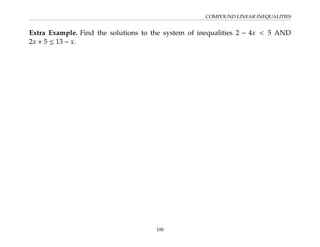
Extra Example. Find the solutions to the system of inequalities 2 − 4x  5 AND
2x + 5 ≤ 13 − x.
100
POLYNOMIAL AND RATIONAL INEQUALITIES
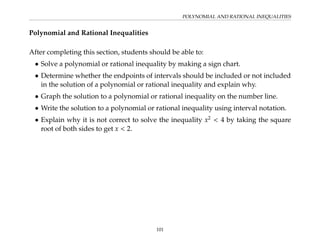
Polynomial and Rational Inequalities
After completing this section, students should be able to:
• Solve a polynomial or rational inequality by making a sign chart.
• Determine whether the endpoints of intervals should be included or not included
in the solution of a polynomial or rational inequality and explain why.
• Graph the solution to a polynomial or rational inequality on the number line.
• Write the solution to a polynomial or rational inequality using interval notation.
• Explain why it is not correct to solve the inequality x2
 4 by taking the square
root of both sides to get x  2.
101
POLYNOMIAL AND RATIONAL INEQUALITIES
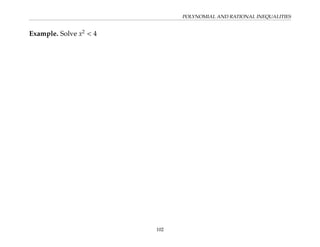
Example. Solve x2
 4
102
POLYNOMIAL AND RATIONAL INEQUALITIES
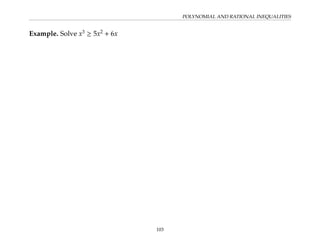
Example. Solve x3
≥ 5x2
+ 6x
103
POLYNOMIAL AND RATIONAL INEQUALITIES
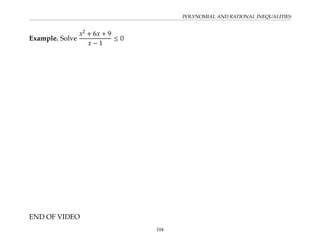
Example. Solve
x2
+ 6x + 9
x − 1
≤ 0
END OF VIDEO
104
POLYNOMIAL AND RATIONAL INEQUALITIES
Example. The solution to (x + 2)(x + 1) ≤ 0 is
A. (−∞, −1]
B. (−∞, −2]
C. [−2, ∞)
D. [−2, −1]
E. (−∞, −2] ∪ [−1, ∞)
105
POLYNOMIAL AND RATIONAL INEQUALITIES
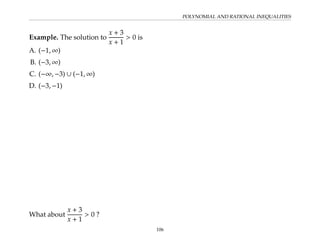
Example. The solution to
x + 3
x + 1
 0 is
A. (−1, ∞)
B. (−3, ∞)
C. (−∞, −3) ∪ (−1, ∞)
D. (−3, −1)
What about
x + 3
x + 1
 0 ?
106
POLYNOMIAL AND RATIONAL INEQUALITIES
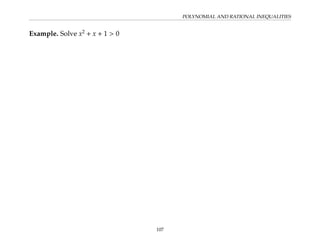
Example. Solve x2
+ x + 1  0
107
POLYNOMIAL AND RATIONAL INEQUALITIES
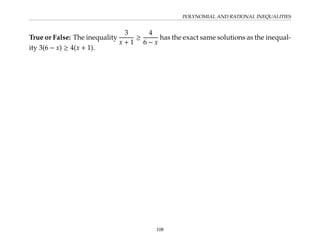
True or False: The inequality
3
x + 1
≥
4
6 − x
has the exact same solutions as the inequal-
ity 3(6 − x) ≥ 4(x + 1).
108
POLYNOMIAL AND RATIONAL INEQUALITIES
Example. Solve
3
x + 1
≥
4
6 − x
109
DISTANCE FORMULA
Distance Formula
After competing this section, students should be able to:
• Find the distance between two points on the plane.
• Explain how the distance formula is related to the Pythagorean Theorem for trian-
gles.
110
DISTANCE FORMULA
Example. Find the distance between the points P(−1, 5) and Q(4, 2).
111
MIDPOINT FORMULA
Midpoint Formula
After competing this section, students should be able to:
• Explain the midpoint formula in terms of average values.
• Find the midpoint of a line segment, given the coordinates of the endpoints.
112
MIDPOINT FORMULA
Example. Find the midpoint of the segment between the points P(−1, 5) and Q(4, 2).
113
CIRCLES
Circles
After competing this section, students should be able to:
• Find the equation for a circle given its center and radius.
• Find the center and radius of a circle, given its equation in standard form.
• Complete the square to rewrite the equation for a circle in standard form.
• Find the equation of a circle given two points at the end of a diameter, or given its
center and one point on the circle.
• Explain how the equation for a circle is related to the distance formula or the
Pythagorean Theorem for triangles.
114
CIRCLES
Example. Find the equation of a circle of radius 5 centered at the point (3, 2).
Note. The equation of a circle with radius r centered at the point (h, k) is given by:
115
CIRCLES
Example. Does this equation represent a circle? If so, what is the center and what is
the radius?
(x − 5)2
+ (y + 6)2
= 5
116
CIRCLES
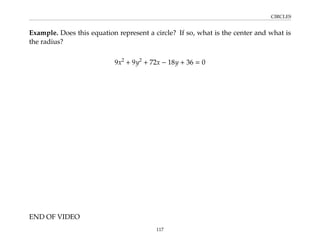
Example. Does this equation represent a circle? If so, what is the center and what is
the radius?
9x2
+ 9y2
+ 72x − 18y + 36 = 0
END OF VIDEO
117
CIRCLES
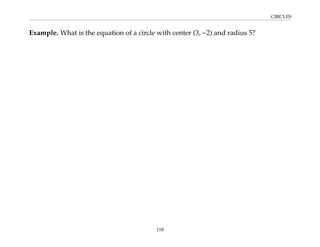
Example. What is the equation of a circle with center (3, −2) and radius 5?
118
CIRCLES
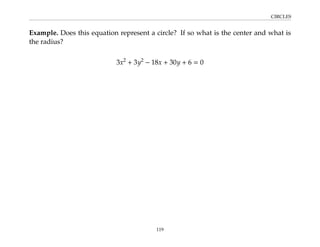
Example. Does this equation represent a circle? If so what is the center and what is
the radius?
3x2
+ 3y2
− 18x + 30y + 6 = 0
119
CIRCLES
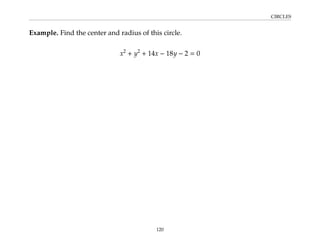
Example. Find the center and radius of this circle.
x2
+ y2
+ 14x − 18y − 2 = 0
120
CIRCLES
Example. Find the equation of a circle whose diameter has endpoints (−3, −6) and
(5, 4).
121
CIRCLES
Extra Example. Given the point P(1, 5), find all points whose y-coordinate is 3 that are
a distance of 7 units from point P.
122
LINES
Lines
After finishing this section, students should be able to:
• Find the equation of a line given a slope and a y-intercept, or a slope and one point,
or two points.
• Determine the equation of a line in an applied context, such as given a table of
values for two variables, or given an initial value and a rate of change.
• Interpret the slope and y-intercept in the equation of a line in an applied context.
• Use the equation of a line to make predictions in an applied context.
• Find the equations of vertical and horizontal lines.
123
LINES
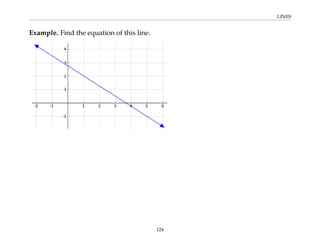
Example. Find the equation of this line.
124
LINES
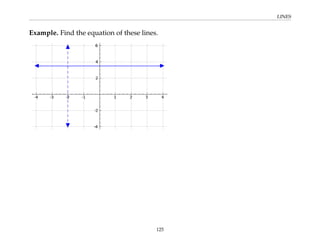
Example. Find the equation of these lines.
125
LINES
Example. Find the equation of the line through the points (1, 2) and (4, −3).
END OF VIDEO
126
LINES
Example. A line has slope 1
5 and passes through the point P(3, 1). The equation for this
line is y = 1
5x + . Fill in the box.
127
LINES
Example. A company sells hats. If the selling price is $8, they sell 300. If the selling
price is $6, they sell 420. The relationship between the selling price and the number
sold is linear. Which pair of points can be used to construct the equation of this line?
(Choose all that apply.)
A. (8, 6) and (300, 420)
B. (8, 300) and (6, 420)
C. (8, 420) and (6, 300)
D. (300, 8) and (420, 6)
128
LINES
How many hats would the company be able to give away if it offered them for free?
At what price would the company not be able to sell ANY hats?
129
LINES
Example. Write the equation for a line through the points P(4, 2) and Q(4, −1).
A. x = 4
B. y = 4
C. x = 2
D. y = 2
E. Undefined.
130
LINES
Example. Which of the following pieces of information is enough to find the equation
for a line? (Select all that apply.)
A. the slope and the y-intercept
B. the slope and the x-intercept
C. the x-intercept and the y-intercept
D. the slope and a point on the line that is not an intercept
E. two points on the line
131
LINES
Extra Example. The deer population in Farrington village is growing at a constant rate
of 60 deer per year. Two years after Mark McCombs moved there, the population was
340. What was the population 10 years after he moved in?
132
LINES
Extra Example. Snow is falling at a rate of
3
4
inch per hour. How long will it take for
the snow height to increase by 6 inches?
133
PARALLEL ANAD PERPENDICULAR LINES
Parallel anad Perpendicular Lines
After completing this section, students should be able to:
• Determine if two lines are parallel, perpendicular, or neither based on their equa-
tions.
• Given an equation for a line and a point not on the line, find the equation of a line
parallel to the given line that goes through a given point.
• Given an equation for a line and a point, find the equation of a line perpendicular
to the given line that goes through a given point.
134
PARALLEL ANAD PERPENDICULAR LINES
Example. Find the equation of a line that is parallel to the line 3y − 4x + 6 = 0 and goes
through the point (−3, 2) .
135
PARALLEL ANAD PERPENDICULAR LINES
Example. Find the equation of a line that is perpendicular to the line 6x + 3y = 4 and
goes through the point (4, 1).
136
PARALLEL ANAD PERPENDICULAR LINES
Example. Find the equation of the line that is parallel to y = 3 and goes through the
point (−2, 1).
Example. Find the equation of the line that is perpendicular to y = 4 and goes through
the point (3, 4).
END OF VIDEO
137
PARALLEL ANAD PERPENDICULAR LINES
Example. Which of these lines is perpendicular to 4x − 5y = 7?
A. y =
4
5
x +
4
7
B. y = −
4
5
x + 3
C. y =
5
4
x +
6
4
D. y = −
5
4
x − 1
E. None of them.
138
PARALLEL ANAD PERPENDICULAR LINES
Example. Find an equation for a line PARALLEL to the line 4x − 6y + 1 = 0 through
the point P(1, −5).
139
PARALLEL ANAD PERPENDICULAR LINES
Example. Find an equation for a line PERPENDICULAR to the line 4x − 6y + 1 = 0
through the point P(1, −5).
140
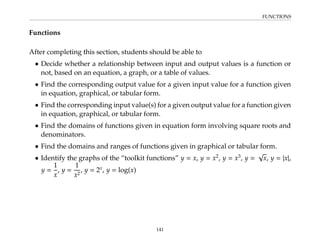
FUNCTIONS
Functions
After completing this section, students should be able to
• Decide whether a relationship between input and output values is a function or
not, based on an equation, a graph, or a table of values.
• Find the corresponding output value for a given input value for a function given
in equation, graphical, or tabular form.
• Find the corresponding input value(s) for a given output value for a function given
in equation, graphical, or tabular form.
• Find the domains of functions given in equation form involving square roots and
denominators.
• Find the domains and ranges of functions given in graphical or tabular form.
• Identify the graphs of the “toolkit functions” y = x, y = x2
, y = x3
, y =
√
x, y = |x|,
y =
1
x
, y =
1
x2
, y = 2x
, y = log(x)
141
FUNCTIONS
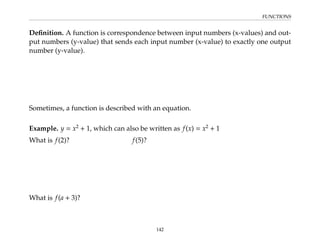
Definition. A function is correspondence between input numbers (x-values) and out-
put numbers (y-value) that sends each input number (x-value) to exactly one output
number (y-value).
Sometimes, a function is described with an equation.
Example. y = x2
+ 1, which can also be written as f(x) = x2
+ 1
What is f(2)? f(5)?
What is f(a + 3)?
142
FUNCTIONS
Sometimes, a function is described with a graph.
Example. The graph of y = g(x) is shown below
What is g(2)? g(5)?
143
FUNCTIONS
Definition. The domain of a function is all possible x-values. The range is the y-values.
Example. What is the domain and range of the function g(x) graphed below?
144
FUNCTIONS
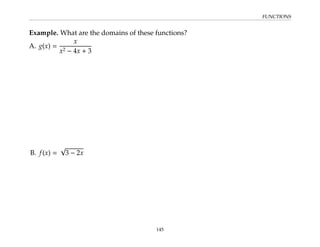
Example. What are the domains of these functions?
A. g(x) =
x
x2 − 4x + 3
B. f(x) =
√
3 − 2x
145
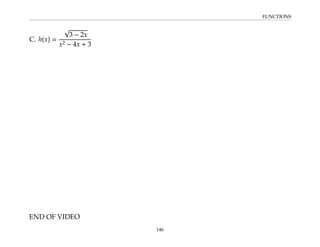
FUNCTIONS
C. h(x) =
√
3 − 2x
x2 − 4x + 3
END OF VIDEO
146
FUNCTIONS
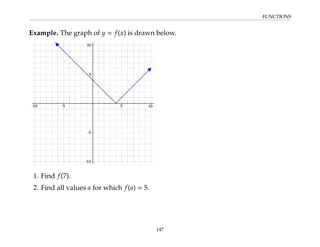
Example. The graph of y = f(x) is drawn below.
1. Find f(7).
2. Find all values a for which f(a) = 5.
147
FUNCTIONS
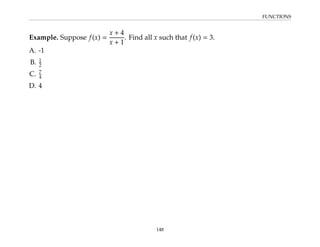
Example. Suppose f(x) =
x + 4
x + 1
. Find all x such that f(x) = 3.
A. -1
B. 1
2
C. 7
4
D. 4
148
FUNCTIONS
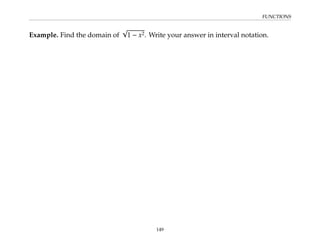
Example. Find the domain of
√
1 − x2. Write your answer in interval notation.
149
FUNCTIONS
Example. Find the domain of g(x) =
√
3 − x
x + 1
A. (−∞, 3)
B. (−∞, 3]
C. (−1, 3]
D. (−∞, −1) ∪ (−1, 3)
E. (−∞, −1) ∪ (−1, 3]
150
TOOLKIT FUNCTIONS
Toolkit Functions
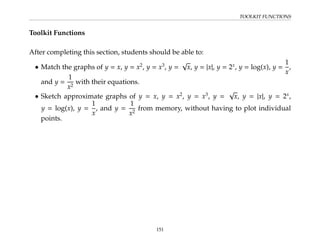
After completing this section, students should be able to:
• Match the graphs of y = x, y = x2
, y = x3
, y =
√
x, y = |x|, y = 2x
, y = log(x), y =
1
x
,
and y =
1
x2
with their equations.
• Sketch approximate graphs of y = x, y = x2
, y = x3
, y =
√
x, y = |x|, y = 2x
,
y = log(x), y =
1
x
, and y =
1
x2
from memory, without having to plot individual
points.
151
TOOLKIT FUNCTIONS
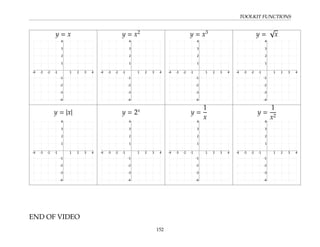
y = x y = x2
y = x3
y =
√
x
y = |x| y = 2x
y =
1
x
y =
1
x2
END OF VIDEO
152
TOOLKIT FUNCTIONS
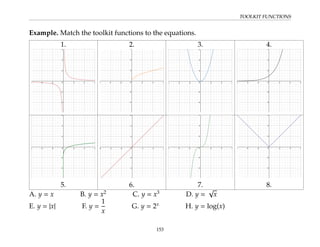
Example. Match the toolkit functions to the equations.
1. 2. 3. 4.
5. 6. 7. 8.
A. y = x B. y = x2
C. y = x3
D. y =
√
x
E. y = |x| F. y =
1
x
G. y = 2x
H. y = log(x)
153
TRANSFORMING FUNCTIONS
Transforming Functions
After completing this section, students should be able to
• Identify the motions corresponding to adding or multiplying numbers or intro-
ducing a negative sign on the inside or the outside of a function.
• Draw the transformed graph, given an original graph of y = f(x) and an equation
like y = −3f(x + 2), using a point by point analysis or a wholistic approach.
• Identify the equation for transformed graphs of toolkit functions like y = |x| and
y = x2
• Identify a point on a transformed graph, given a point on the original graph and
the equation of the transformed graph.
154
TRANSFORMING FUNCTIONS
Review of Function Notation
Example. Rewrite the following, if g(x) =
√
x.
a) g(x) − 2 =
b) g(x − 2) =
c) g(3x) =
d) 3g(x) =
e) g(−x) =
Example. Rewrite the following in terms of g(x), if g(x) =
√
x.
f)
√
x + 17 =
g)
√
x + 12 =
h) −36 ·
√
x =
i)
q
1
4x =
155
TRANSFORMING FUNCTIONS
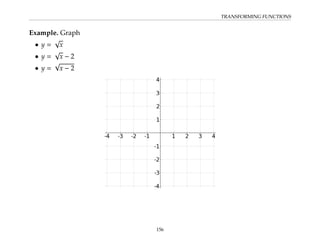
Example. Graph
• y =
√
x
• y =
√
x − 2
• y =
√
x − 2
156
TRANSFORMING FUNCTIONS
Rules for transformations:
• Numbers on the outside of the function affect the y-values and result in vertical
motions. These motions are in the direction you expect.
• Numbers on the inside of the function affect the x-values and result in horizontal
motions. These motions go in the opposite direction from what you expect.
• Adding results in a shift (translations)
• Multiplying results in a stretch or shrink
• A negative sign results in a reflection
157
TRANSFORMING FUNCTIONS
Example. Consider g(x) =
√
x. How do the graphs of the following functions compare
to the graph of y =
√
x?
a) y =
√
x − 4
b) y =
√
x + 12
c) y = −3 ·
√
x
d) y =
q
1
4x
END OF VIDEO
158
TRANSFORMING FUNCTIONS
Rules of Function Transformations (see graph animations involving y =
√
x and y =
sin(x))
• A number added on the OUTSIDE of a function ...
• A number added on the INSIDE of a function ....
• A number multiplied on the OUTSIDE of a function ....
• A number mulitplied on the INSIDE of a function ....
• A negative sign on the OUTSIDE of a function ....
• A negative sign on the INSIDE of a function ....
159
TRANSFORMING FUNCTIONS
Example. Consider h(x) = x2
. How do the graphs of the following functions compare
to the graph of y = x2
?
a) y = 3x2
b) y = (x − 7
2)2
c) y = x2
+ 5
d) y = (5x)2
e) y = −3(x − 2)2
+ 7
160
TRANSFORMING FUNCTIONS
Note. There are two approaches to graphing transformed functions:
161
TRANSFORMING FUNCTIONS
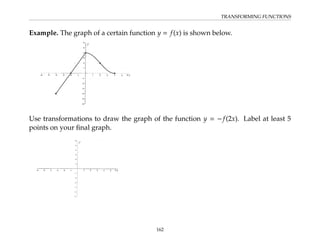
Example. The graph of a certain function y = f(x) is shown below.
Use transformations to draw the graph of the function y = − f(2x). Label at least 5
points on your final graph.
162
TRANSFORMING FUNCTIONS
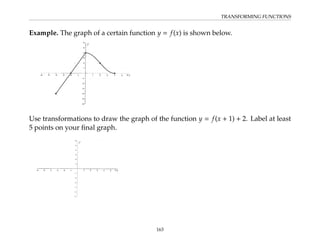
Example. The graph of a certain function y = f(x) is shown below.
Use transformations to draw the graph of the function y = f(x + 1) + 2. Label at least
5 points on your final graph.
163
TRANSFORMING FUNCTIONS
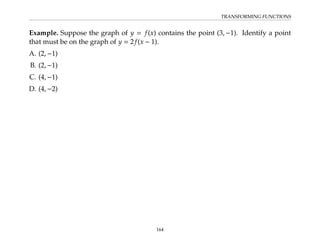
Example. Suppose the graph of y = f(x) contains the point (3, −1). Identify a point
that must be on the graph of y = 2f(x − 1).
A. (2, −1)
B. (2, −1)
C. (4, −1)
D. (4, −2)
164
QUADRATIC FUNCTIONS
Quadratic Functions
After completing this section, students should be able to:
• Find the x-intercepts and y-intercept or a quadratic function.
• Find the vertex of a quadratic function.
• Determine from the equation of a quadratic function if the graph will be pointing
up or down.
• Graph a quadratic function from its equation.
• Convert a quadratic function from standard form to vertex form and vice versa.
165
QUADRATIC FUNCTIONS
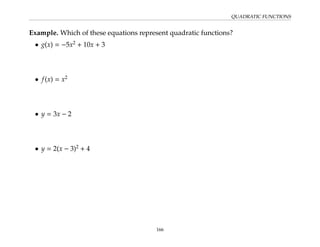
Example. Which of these equations represent quadratic functions?
• g(x) = −5x2
+ 10x + 3
• f(x) = x2
• y = 3x − 2
• y = 2(x − 3)2
+ 4
166
QUADRATIC FUNCTIONS
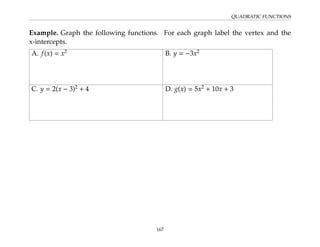
Example. Graph the following functions. For each graph label the vertex and the
x-intercepts.
A. f(x) = x2
B. y = −3x2
C. y = 2(x − 3)2
+ 4 D. g(x) = 5x2
+ 10x + 3
167
QUADRATIC FUNCTIONS
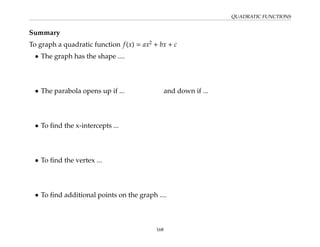
Summary
To graph a quadratic function f(x) = ax2
+ bx + c
• The graph has the shape ....
• The parabola opens up if ... and down if ...
• To find the x-intercepts ...
• To find the vertex ...
• To find additional points on the graph ....
168
QUADRATIC FUNCTIONS
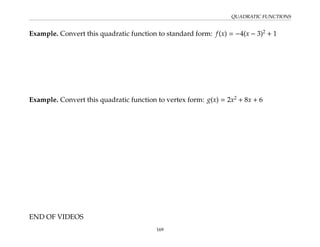
Example. Convert this quadratic function to standard form: f(x) = −4(x − 3)2
+ 1
Example. Convert this quadratic function to vertex form: g(x) = 2x2
+ 8x + 6
END OF VIDEOS
169
QUADRATIC FUNCTIONS
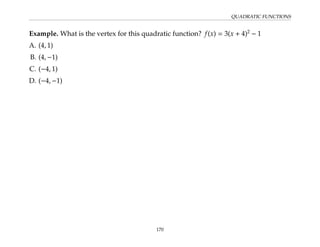
Example. What is the vertex for this quadratic function? f(x) = 3(x + 4)2
− 1
A. (4, 1)
B. (4, −1)
C. (−4, 1)
D. (−4, −1)
170
QUADRATIC FUNCTIONS
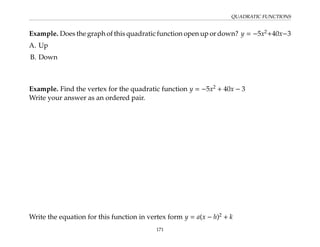
Example. Does the graph of this quadratic function open up or down? y = −5x2
+40x−3
A. Up
B. Down
Example. Find the vertex for the quadratic function y = −5x2
+ 40x − 3
Write your answer as an ordered pair.
Write the equation for this function in vertex form y = a(x − h)2
+ k
171
QUADRATIC FUNCTIONS
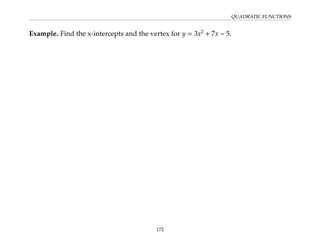
Example. Find the x-intercepts and the vertex for y = 3x2
+ 7x − 5.
172
QUADRATIC FUNCTIONS
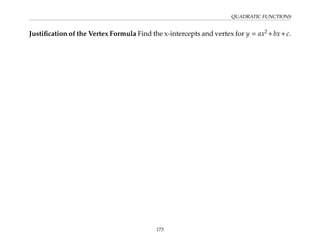
Justification of the Vertex Formula Find the x-intercepts and vertex for y = ax2
+bx+c.
173
APPLICATIONS OF QUADRATIC FUNCTIONS
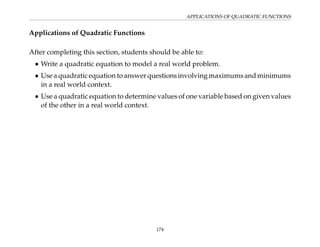
Applications of Quadratic Functions
After completing this section, students should be able to:
• Write a quadratic equation to model a real world problem.
• Use a quadratic equation to answer questions involving maximums and minimums
in a real world context.
• Use a quadratic equation to determine values of one variable based on given values
of the other in a real world context.
174
APPLICATIONS OF QUADRATIC FUNCTIONS
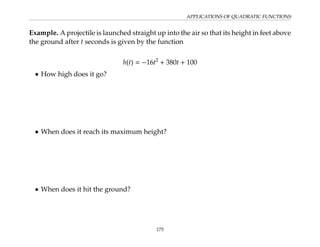
Example. A projectile is launched straight up into the air so that its height in feet above
the ground after t seconds is given by the function
h(t) = −16t2
+ 380t + 100
• How high does it go?
• When does it reach its maximum height?
• When does it hit the ground?
175
APPLICATIONS OF QUADRATIC FUNCTIONS
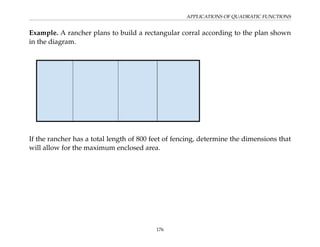
Example. A rancher plans to build a rectangular corral according to the plan shown
in the diagram.
If the rancher has a total length of 800 feet of fencing, determine the dimensions that
will allow for the maximum enclosed area.
176
APPLICATIONS OF QUADRATIC FUNCTIONS
Example. A rain gutter is formed by bending up the sides of a 30-inch wide and very
long rectangular metal sheet. Where should we put the bends to maximize the amount
of rain the gutter can carry?
177
POLYNOMIALS
Polynomials
After completing this section, students should be able to:
• Find the leading term, leading coefficient, and degree of a polynomial.
• Describe the relationship between the degree of the polynomial and the number
of turning points.
• Predict the end behavior of the graph of a polynomial from the degree and the
leading coefficient.
• Use the graph of a polynomial to determine what are all the possible options for
degree and what the sign of the leading coefficient must be.
• Find the x- and y-intercepts of a rational function.
• Use the graph of a function to determine if a zero has multiplicity one or two.
• Write down the equation of polynomial from its graph.
• Match graphs of polynomials to equations.
178
POLYNOMIALS
Definition. The degree of the polynomial is
The leading term is
Definition. The leading coefficient is
Definition. The constant term is
Example. For p(x) = 5x3
− 3x2
− 7x4
+ 2x + 18, what is the
• degree?
• leading term?
• leading coefficient?
• constant term?
179
POLYNOMIALS
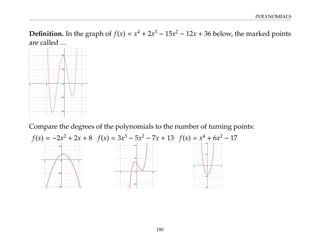
Definition. In the graph of f(x) = x4
+ 2x3
− 15x2
− 12x + 36 below, the marked points
are called ...
Compare the degrees of the polynomials to the number of turning points:
f(x) = −2x2
+ 2x + 8 f(x) = 3x3
− 5x2
− 7x + 13 f(x) = x4
+ 6x2
− 17
180
POLYNOMIALS
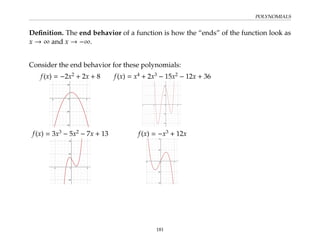
Definition. The end behavior of a function is how the “ends” of the function look as
x → ∞ and x → −∞.
Consider the end behavior for these polynomials:
f(x) = −2x2
+ 2x + 8 f(x) = x4
+ 2x3
− 15x2
− 12x + 36
f(x) = 3x3
− 5x2
− 7x + 13 f(x) = −x3
+ 12x
181
POLYNOMIALS
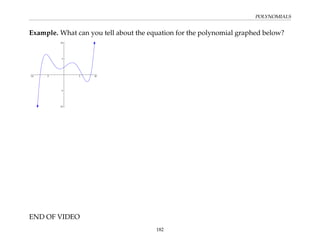
Example. What can you tell about the equation for the polynomial graphed below?
END OF VIDEO
182
POLYNOMIALS
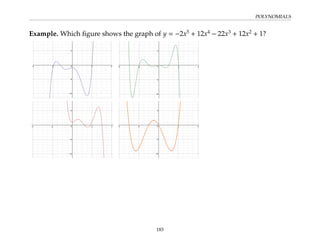
Example. Which figure shows the graph of y = −2x5
+ 12x4
− 22x3
+ 12x2
+ 1?
183
POLYNOMIALS
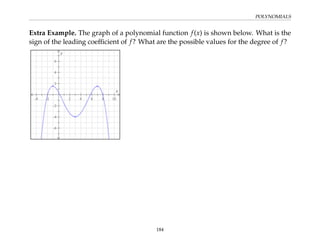
Extra Example. The graph of a polynomial function f(x) is shown below. What is the
sign of the leading coefficient of f? What are the possible values for the degree of f?
184
POLYNOMIALS
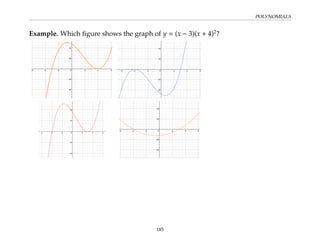
Example. Which figure shows the graph of y = (x − 3)(x + 4)2
?
185
POLYNOMIALS
Note. It is possible to use a number line to show that the graph of y = (x − 3)(x + 4)2
”bounces” off the x-axis at x = −4 but not at x = 3.
186
POLYNOMIALS
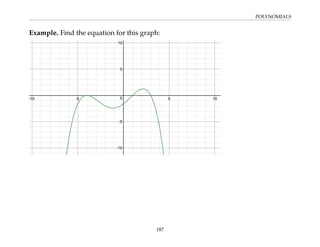
Example. Find the equation for this graph:
187
EXPONENTIAL FUNCTIONS AND GRAPHS
Exponential Functions and Graphs
After completing this section, students should be able to
• Identify the domain, range, and horizontal asymptote of an exponential function
from its graph or from its equation.
• For a function of the form, y = a · bx
, explain how the values of a and b determine
whether the graph is increasing or decreasing, how steeply it is increasing or
decreasing, and what the value of its y-intercept is.
• Graph exponential functions and their transformations.
• Match the graphs of exponential functions to their equations.
188
EXPONENTIAL FUNCTIONS AND GRAPHS
Definition. An exponential function is a function that can be written in the form
f(x) = a · bx
where a and b are real numbers, a , 0, and b  0.
Note. We require that a , 0 because ...
Note. We require that b  0 because ...
The number a is called the ...
and the number b is called the ...
189
EXPONENTIAL FUNCTIONS AND GRAPHS
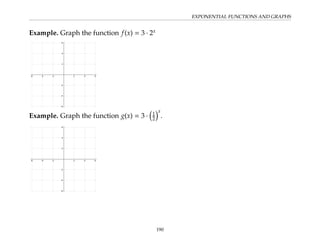
Example. Graph the function f(x) = 3 · 2x
Example. Graph the function g(x) = 3 ·

1
2
x
.
190
EXPONENTIAL FUNCTIONS AND GRAPHS
Example. Graph the function y = a · bx
for different values of a and b simultaneously.
191
EXPONENTIAL FUNCTIONS AND GRAPHS
Fact. In the graph of y = a · bx
:
• The parameter gives the y-intercept.
• The parameter tells how the graph is increasing or decreasing.
• If b  1, the graph is .
• The closer b is to the number , the flatter the graph.
So, for example, the graph of y = 0.25x
is (circle one) flatter / more steep than the graph
of y = 0.4x
.
Fact. The graph of an exponential function y = a · bx
• has a horizontal asymptote at the line .
• has domain .
• has range .
Note. The most famous exponential function in the world is f(x) = ex
. This func-
tion is sometimes written as f(x) = exp(x). The number e is Euler’s number, and is
approximately 2.71828182845904523...
192
EXPONENTIAL FUNCTIONS AND GRAPHS
END OF VIDEO
Question. What are some examples of exponential functions in the real world? Hint:
what quantities have ”exponential growth” or ”exponential decay”?
193
EXPONENTIAL FUNCTIONS AND GRAPHS
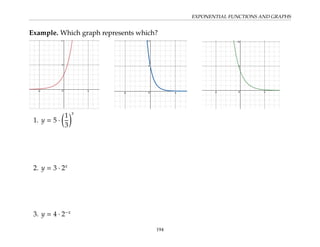
Example. Which graph represents which?
1. y = 5 ·

1
3
x
2. y = 3 · 2x
3. y = 4 · 2−x
194
EXPONENTIAL FUNCTIONS AND GRAPHS
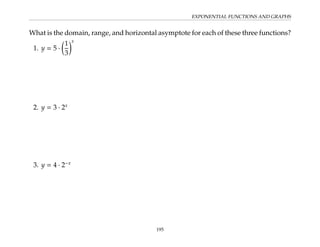
What is the domain, range, and horizontal asymptote for each of these three functions?
1. y = 5 ·

1
3
x
2. y = 3 · 2x
3. y = 4 · 2−x
195
EXPONENTIAL FUNCTIONS AND GRAPHS
Summary: In the equation y. = a · bx
, how do a and b affect the graph ? Consider:
• y-intercept
• x-intercept
• Increasing / decreasing
• Steepness
• Domain
• Range
• Horizontal asymptote(s)
• Vertical asymptote(s)
196
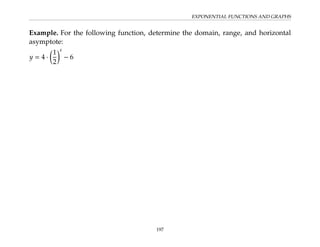
EXPONENTIAL FUNCTIONS AND GRAPHS
Example. For the following function, determine the domain, range, and horizontal
asymptote:
y = 4 ·

1
2
x
− 6
197
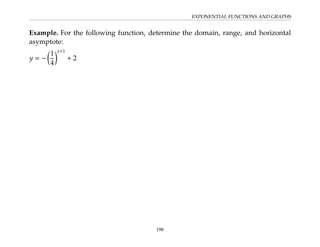
EXPONENTIAL FUNCTIONS AND GRAPHS
Example. For the following function, determine the domain, range, and horizontal
asymptote:
y = −

1
4
x+1
+ 2
198
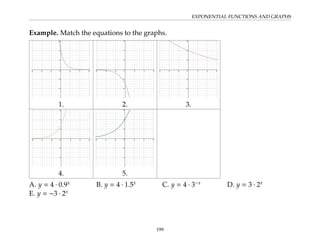
EXPONENTIAL FUNCTIONS AND GRAPHS
Example. Match the equations to the graphs.
1. 2. 3.
4. 5.
A. y = 4 · 0.9x
B. y = 4 · 1.5x
C. y = 4 · 3−x
D. y = 3 · 2x
E. y = −3 · 2x
199
APPLICATIONS OF EXPONENTIAL FUNCTIONS
Applications of Exponential Functions
After completing this section, students should be able to:
• Write an exponential function to model exponential growth or decay.
• Given the equation of an exponential function, determine the initial value, the
growth factor, and the percent by which the quantity is increasing or decreasing
during each time unit.
200
APPLICATIONS OF EXPONENTIAL FUNCTIONS
Example. You are hired for a job and the starting salary is $40,000 with an annual raise
of 3% per year. How much will your salary be after 1 year? 2 years? 5 years? t years?
201
APPLICATIONS OF EXPONENTIAL FUNCTIONS
Example. The United Nations estimated the world population in 2010 was 6.79 billion,
growing at a rate of 1.1% per year. Assume that the growth rate stays the same. Write
an equation for the population at t years after the year 2010.
202
APPLICATIONS OF EXPONENTIAL FUNCTIONS
Example. Seroquel is metabolized and eliminated from the body at a rate of 11% per
hour. If 400 mg are given, how much remains in the body after 24 hours?
END OF VIDEO
203
APPLICATIONS OF EXPONENTIAL FUNCTIONS
Example. During the Ebola epidemic in 2014, the total number of Ebola cases in Guinea,
Sierra Leone, and Liberia was increasing by 25% every week. By June 1, there were
528 reported cases. Which of the following functions represents the total number of
Ebola cases t weeks after June 1?
A. f(t) = 528 + 25t
B. f(t) = 528 + 0.25t
C. f(t) = 528 · 25t
D. f(t) = 528 · (0.25)t
E. f(t) = 528 · (1.25)t
Based on this model, how many cases do you expect 32 weeks after June 1?
204
APPLICATIONS OF EXPONENTIAL FUNCTIONS
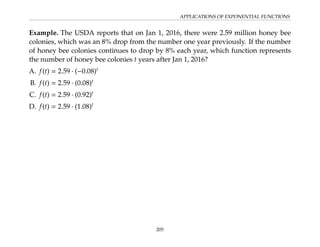
Example. The USDA reports that on Jan 1, 2016, there were 2.59 million honey bee
colonies, which was an 8% drop from the number one year previously. If the number
of honey bee colonies continues to drop by 8% each year, which function represents
the number of honey bee colonies t years after Jan 1, 2016?
A. f(t) = 2.59 · (−0.08)t
B. f(t) = 2.59 · (0.08)t
C. f(t) = 2.59 · (0.92)t
D. f(t) = 2.59 · (1.08)t
205
APPLICATIONS OF EXPONENTIAL FUNCTIONS
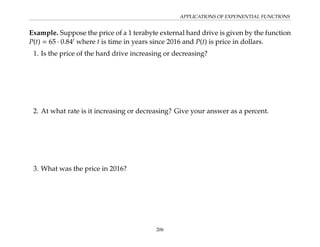
Example. Suppose the price of a 1 terabyte external hard drive is given by the function
P(t) = 65 · 0.84t
where t is time in years since 2016 and P(t) is price in dollars.
1. Is the price of the hard drive increasing or decreasing?
2. At what rate is it increasing or decreasing? Give your answer as a percent.
3. What was the price in 2016?
206
APPLICATIONS OF EXPONENTIAL FUNCTIONS
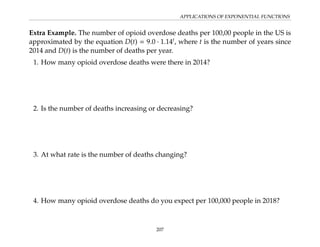
Extra Example. The number of opioid overdose deaths per 100,00 people in the US is
approximated by the equation D(t) = 9.0 · 1.14t
, where t is the number of years since
2014 and D(t) is the number of deaths per year.
1. How many opioid overdose deaths were there in 2014?
2. Is the number of deaths increasing or decreasing?
3. At what rate is the number of deaths changing?
4. How many opioid overdose deaths do you expect per 100,000 people in 2018?
207
COMPOUND INTEREST
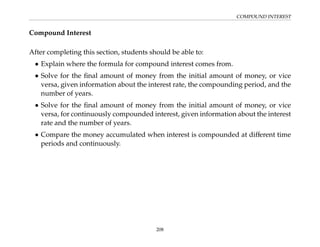
Compound Interest
After completing this section, students should be able to:
• Explain where the formula for compound interest comes from.
• Solve for the final amount of money from the initial amount of money, or vice
versa, given information about the interest rate, the compounding period, and the
number of years.
• Solve for the final amount of money from the initial amount of money, or vice
versa, for continuously compounded interest, given information about the interest
rate and the number of years.
• Compare the money accumulated when interest is compounded at different time
periods and continuously.
208
COMPOUND INTEREST
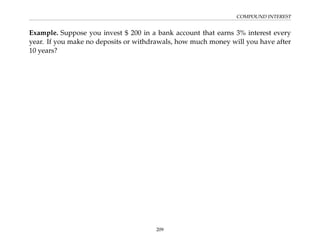
Example. Suppose you invest $ 200 in a bank account that earns 3% interest every
year. If you make no deposits or withdrawals, how much money will you have after
10 years?
209
COMPOUND INTEREST
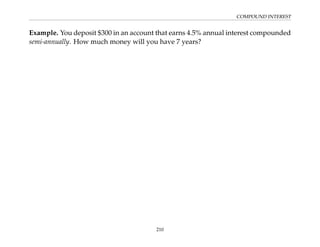
Example. You deposit $300 in an account that earns 4.5% annual interest compounded
semi-annually. How much money will you have 7 years?
210
COMPOUND INTEREST
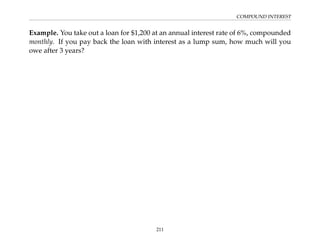
Example. You take out a loan for $1,200 at an annual interest rate of 6%, compounded
monthly. If you pay back the loan with interest as a lump sum, how much will you
owe after 3 years?
211
COMPOUND INTEREST
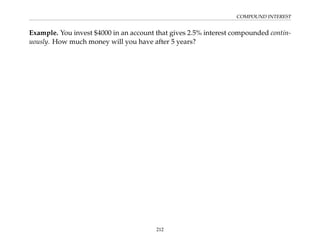
Example. You invest $4000 in an account that gives 2.5% interest compounded contin-
uously. How much money will you have after 5 years?
212
COMPOUND INTEREST
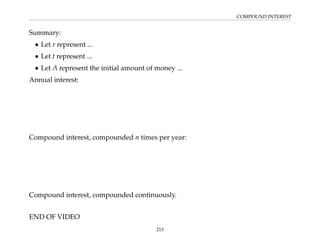
Summary:
• Let r represent ...
• Let t represent ...
• Let A represent the initial amount of money ...
Annual interest:
Compound interest, compounded n times per year:
Compound interest, compounded continuously.
END OF VIDEO
213
COMPOUND INTEREST
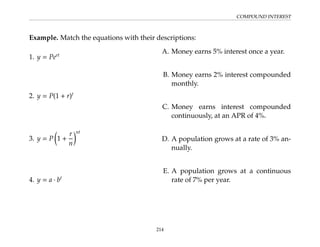
Example. Match the equations with their descriptions:
1. y = Pert
2. y = P(1 + r)t
3. y = P

1 +
r
n
nt
4. y = a · bt
A. Money earns 5% interest once a year.
B. Money earns 2% interest compounded
monthly.
C. Money earns interest compounded
continuously, at an APR of 4%.
D. A population grows at a rate of 3% an-
nually.
E. A population grows at a continuous
rate of 7% per year.
214
COMPOUND INTEREST
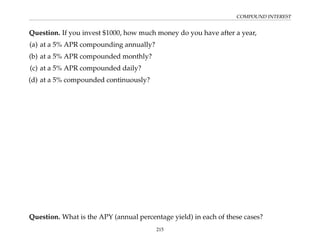
Question. If you invest $1000, how much money do you have after a year,
(a) at a 5% APR compounding annually?
(b) at a 5% APR compounded monthly?
(c) at a 5% APR compounded daily?
(d) at a 5% compounded continuously?
Question. What is the APY (annual percentage yield) in each of these cases?
215
COMPOUND INTEREST
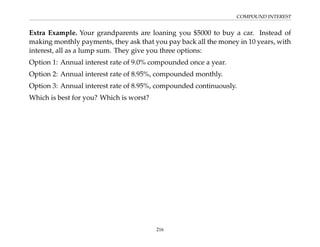
Extra Example. Your grandparents are loaning you $5000 to buy a car. Instead of
making monthly payments, they ask that you pay back all the money in 10 years, with
interest, all as a lump sum. They give you three options:
Option 1: Annual interest rate of 9.0% compounded once a year.
Option 2: Annual interest rate of 8.95%, compounded monthly.
Option 3: Annual interest rate of 8.95%, compounded continuously.
Which is best for you? Which is worst?
216
CONTINUOUS GROWTH
Continuous Growth
After completing this section, students should be able to:
• Write an equation to describe other quantities, like population, that grow or shrink
continuously.
• Compare and contrast the formulas y = a · bt
and a · (1 + r)t
for exponential growth
and the formula y = a · ert
for continuous exponential growth and explain why the
two formulas yield different results when the same value of a and r is used in both.
217
CONTINUOUS GROWTH
Example. Write equations to describe each of the following populations:
a) A population grows at a continuous rate of 6% per year.
b) A population shrinks at a continuous rate of 10.5% per year.
218
CONTINUOUS GROWTH
Example. Which population is growing fastest?
a) A population that grows at a continuous rate of 19% per year.
b) A population that grows at a rate of 19% per year.
For the population that grows at a continuous rate of 19% per year, by what percent
does it actually increase at the end of each year?
219
CONTINUOUS GROWTH
Compare and contrast the formulas for:
Exponential Growth Continuous Exponential Growth
220
CONTINUOUS GROWTH
Example. Rewrite the equation y = 40e0.17t
in the form y = a · bt
and in the form
y = P(1 + r)t
.
Question. Could we rewrite the equation y = 88 · 1.07t
in the form y = Pert
?
221
LOGARITHMS
Logarithms
After completing this section, students should be able to:
• Rewrite a log equation as an exponential equation and vice versa.
• Compute simple logarithms by hand by expressing the logarithm expression as a
question about exponents.
• Explain how to simplify expressions like log4 4z
and 5log5 t
and why this makes
sense.
• Explain why logs are useful.
222
LOGARITHMS
Definition. loga b = c means ac
= b .
You can think of logarithms as exponents: logab is the exponent (or “power”) that you
have to raise a to, in order to get b. The number a is called the base of the logarithm.
The base is required to be a positive number.
Example.
log2 8 = 3 because 23
= 8
log2 y =  means 2
= y
Example. Evaluate the following expressions by hand by rewriting them using expo-
nents instead of logs:
a) log2 16 =
b) log2 2 =
c) log2
1
2 =
d) log2
1
8 =
e) log2 1 =
223
LOGARITHMS
Example. Evaluate the following expressions by hand by rewriting them using expo-
nents instead of logs:
a) log10 1, 000, 000 =
b) log10 0.001 =
c) log10 0 =
d) log10 −100 =
Note. It is possible to take the log of numbers that are but not of numbers
that are . In other words, the domain of the function f(x) = loga(x) is:
.
Note. ln x means loge x, and is called the natural log.
log x, with no base, means log10 x and is called the common log.
You can find ln x and log x for various values of x using the buttons on your calculator.
224
LOGARITHMS
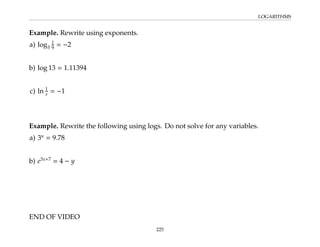
Example. Rewrite using exponents.
a) log3
1
9 = −2
b) log 13 = 1.11394
c) ln 1
e = −1
Example. Rewrite the following using logs. Do not solve for any variables.
a) 3u
= 9.78
b) e3x+7
= 4 − y
END OF VIDEO
225
LOGARITHMS
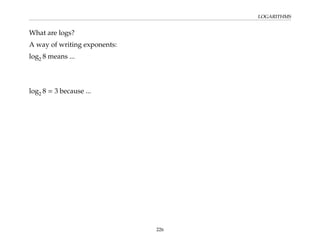
What are logs?
A way of writing exponents:
log2 8 means ...
log2 8 = 3 because ...
226
LOGARITHMS
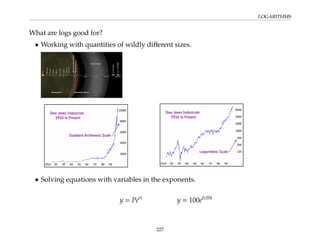
What are logs good for?
• Working with quantities of wildly different sizes.
• Solving equations with variables in the exponents.
y = Pert
y = 100e0.05t
227
LOGARITHMS
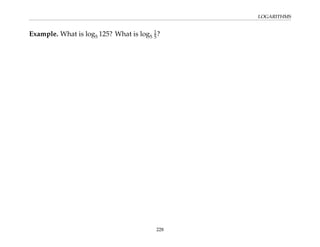
Example. What is log5 125? What is log5
1
5?
228
LOGARITHMS
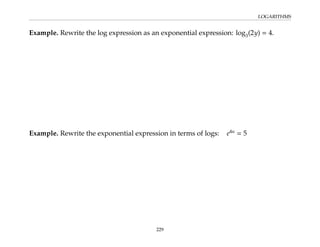
Example. Rewrite the log expression as an exponential expression: log3(2y) = 4.
Example. Rewrite the exponential expression in terms of logs: e4u
= 5
229
LOGARITHMS
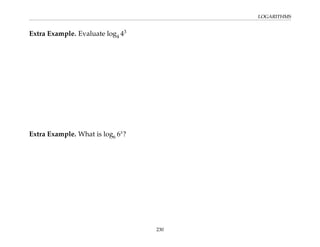
Extra Example. Evaluate log4 43
Extra Example. What is log6 6x
?
230
LOGARITHMS
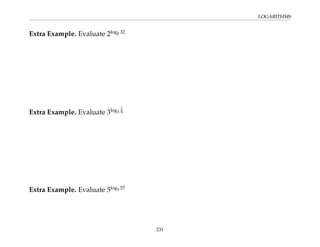
Extra Example. Evaluate 2log2 32
Extra Example. Evaluate 3log3
1
9
Extra Example. Evaluate 5log5 57
231
LOGARITHMS
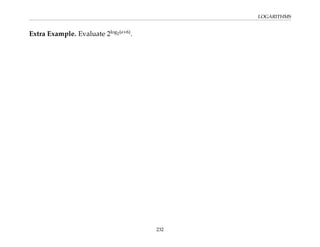
Extra Example. Evaluate 2log2(a+6)
.
232
LOGARITHMS
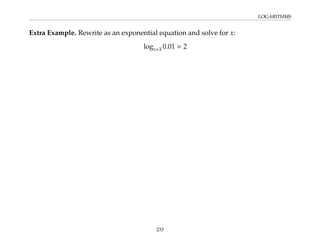
Extra Example. Rewrite as an exponential equation and solve for x:
logx+3 0.01 = 2
233
LOG FUNCTIONS AND GRAPHS
Log Functions and Graphs
After completing this section, students should be able to:
• Recognize the graphs of log functions.
• Graph a basic log function by hand.
• Find the asymptote and intercepts of log functions like y = log2(x) and transformed
log functions like y = log(x + 3).
• Find the domains of functions involving logs.
234
LOG FUNCTIONS AND GRAPHS
Example. Graph y = log2(x) by plotting points.
235
LOG FUNCTIONS AND GRAPHS
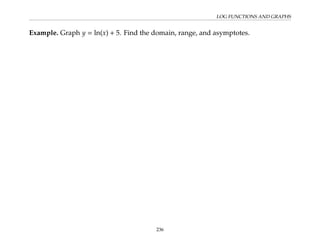
Example. Graph y = ln(x) + 5. Find the domain, range, and asymptotes.
236
LOG FUNCTIONS AND GRAPHS
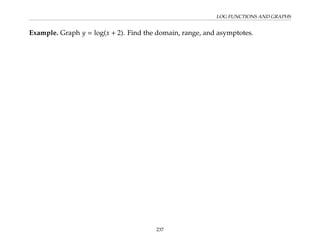
Example. Graph y = log(x + 2). Find the domain, range, and asymptotes.
237
LOG FUNCTIONS AND GRAPHS
Find the domain of f(x) = ln(2 − 3x).
END OF VIDEO
238
LOG FUNCTIONS AND GRAPHS
Example. Graph
y = log2(x) y = log2(x) y = ln(x)
What is the
• domain
• range
• asymptote(s)
• intercept(s)
239
LOG FUNCTIONS AND GRAPHS
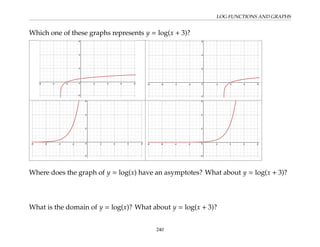
Which one of these graphs represents y = log(x + 3)?
Where does the graph of y = log(x) have an asymptotes? What about y = log(x + 3)?
What is the domain of y = log(x)? What about y = log(x + 3)?
240
LOG FUNCTIONS AND GRAPHS
What is the domain of f(x) = log(x2
− 1)?
241
COMBINING LOGS AND EXPONENTS
Combining Logs and Exponents
After completing this section, students should be able to:
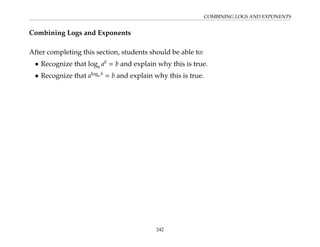
• Recognize that loga ab
= b and explain why this is true.
• Recognize that aloga b
= b and explain why this is true.
242
COMBINING LOGS AND EXPONENTS
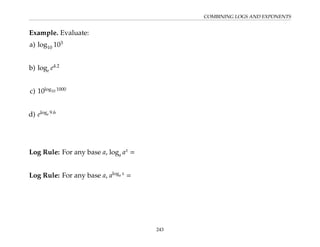
Example. Evaluate:
a) log10 103
b) loge e4.2
c) 10log10 1000
d) eloge 9.6
Log Rule: For any base a, loga ax
=
Log Rule: For any base a, aloga x
=
243
COMBINING LOGS AND EXPONENTS
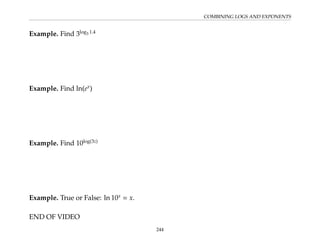
Example. Find 3log3 1.4
Example. Find ln(ex
)
Example. Find 10log(3z)
Example. True or False: ln 10x
= x.
END OF VIDEO
244
COMBINING LOGS AND EXPONENTS
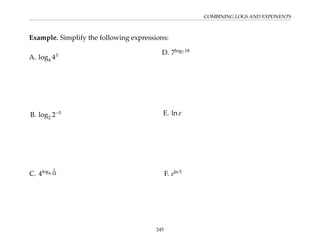
Example. Simplify the following expressions:
A. log4 43
B. log2 2−5
C. 4log4
1
64
D. 7log7 18
E. ln e
F. eln 5
245
COMBINING LOGS AND EXPONENTS
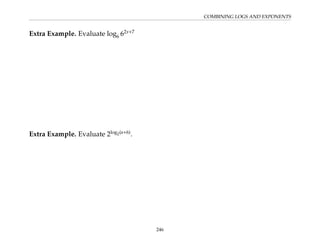
Extra Example. Evaluate log6 62x+7
Extra Example. Evaluate 2log2(a+6)
.
246
LOG RULES
Log Rules
After completing this section, students should be able to:
• Write down the product, quotient, and power rules for logs as equations, and
describe them in words.
• Explain how the product, quotient, and power rules for logs are related to the
corresponding rules for exponents.
• Use the log rules to expand the log of a complicated expression into a sum or
difference of multiplies of logs.
• Use the log rules to condense an expression involving a sum or difference of
multiples of logs into a single log.
247
LOG RULES
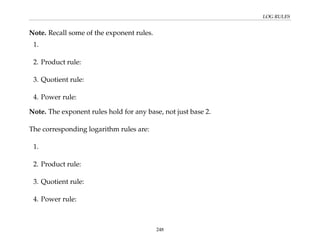
Note. Recall some of the exponent rules.
1.
2. Product rule:
3. Quotient rule:
4. Power rule:
Note. The exponent rules hold for any base, not just base 2.
The corresponding logarithm rules are:
1.
2. Product rule:
3. Quotient rule:
4. Power rule:
248
LOG RULES
Note. The logarithm rules hold for any base, not just base 2.
Exponent Rule Log Rule Name of Log Rule
a0
= 1 –
am
· an
= am+n
am
an = am−n
(am
)n
= amn
249
LOG RULES
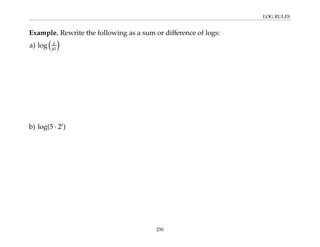
Example. Rewrite the following as a sum or difference of logs:
a) log

x
yz

b) log(5 · 2t
)
250
LOG RULES
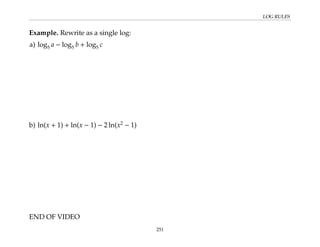
Example. Rewrite as a single log:
a) log5 a − log5 b + log5 c
b) ln(x + 1) + ln(x − 1) − 2 ln(x2
− 1)
END OF VIDEO
251
LOG RULES
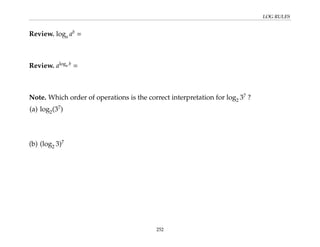
Review. loga ab
=
Review. aloga b
=
Note. Which order of operations is the correct interpretation for log2 37
?
(a) log2(37
)
(b) (log2 3)7
252
LOG RULES
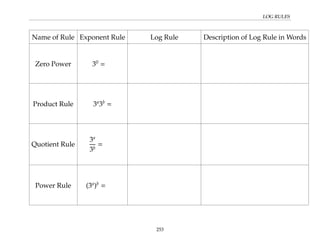
Name of Rule Exponent Rule Log Rule Description of Log Rule in Words
Zero Power 30
=
Product Rule 3a
3b
=
Quotient Rule
3a
3b
=
Power Rule (3a
)b
=
253
LOG RULES
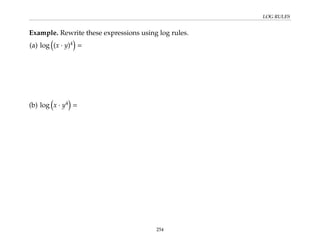
Example. Rewrite these expressions using log rules.
(a) log

(x · y)4

=
(b) log

x · y4

=
254
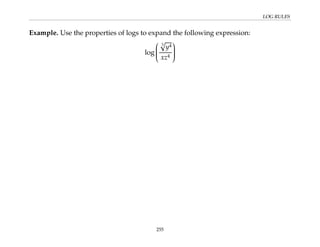
LOG RULES
Example. Use the properties of logs to expand the following expression:
log






3
p
y4
xz4






255
LOG RULES
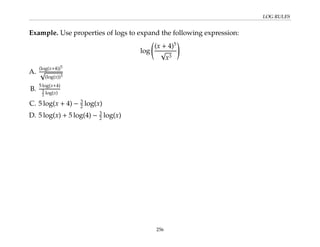
Example. Use properties of logs to expand the following expression:
log
(x + 4)5
√
x3
!
A.
(log(x+4))5
√
(log(x))3
B.
5 log(x+4)
3
2 log(x)
C. 5 log(x + 4) − 3
2 log(x)
D. 5 log(x) + 5 log(4) − 3
2 log(x)
256
LOG RULES
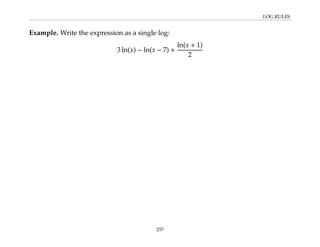
Example. Write the expression as a single log:
3 ln(x) − ln(x − 7) +
ln(x + 1)
2
257
LOG RULES
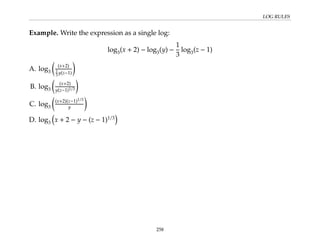
Example. Write the expression as a single log:
log3(x + 2) − log3(y) −
1
3
log3(z − 1)
A. log3

(x+2)
1
3 y(z−1)

B. log3

(x+2)
y(z−1)1/3

C. log3

(x+2)(z−1)1/3
y

D. log3

x + 2 − y − (z − 1)1/3

258
LOG RULES
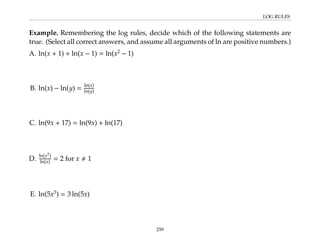
Example. Remembering the log rules, decide which of the following statements are
true. (Select all correct answers, and assume all arguments of ln are positive numbers.)
A. ln(x + 1) + ln(x − 1) = ln(x2
− 1)
B. ln(x) − ln(y) =
ln(x)
ln(y)
C. ln(9x + 17) = ln(9x) + ln(17)
D.
ln(x2)
ln(x) = 2 for x , 1
E. ln(5x3
) = 3 ln(5x)
259
LOG RULES
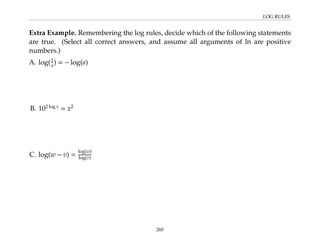
Extra Example. Remembering the log rules, decide which of the following statements
are true. (Select all correct answers, and assume all arguments of ln are positive
numbers.)
A. log(1
a) = − log(a)
B. 102 log x
= x2
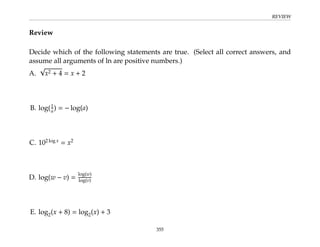
C. log(w − v) =
log(w)
log(v)
260
SOLVING EXPONENTIAL EQUATIONS
Solving Exponential Equations
After completing this section students should be able to:
1. Use logs to solve equations with variables in the exponent.
261
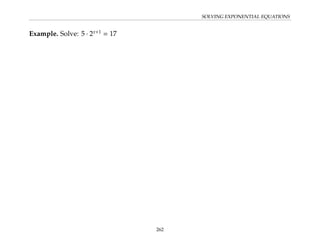
SOLVING EXPONENTIAL EQUATIONS
Example. Solve: 5 · 2x+1
= 17
262
SOLVING EXPONENTIAL EQUATIONS
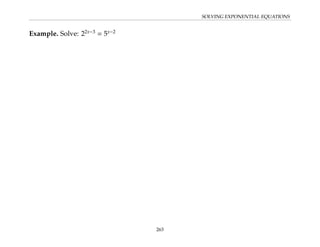
Example. Solve: 22x−3
= 5x−2
263
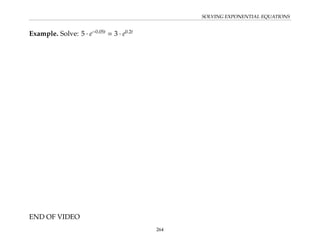
SOLVING EXPONENTIAL EQUATIONS
Example. Solve: 5 · e−0.05t
= 3 · e0.2t
END OF VIDEO
264
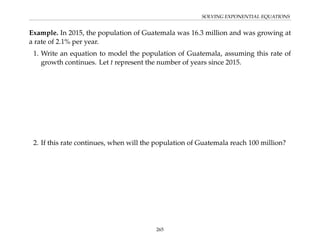
SOLVING EXPONENTIAL EQUATIONS
Example. In 2015, the population of Guatemala was 16.3 million and was growing at
a rate of 2.1% per year.
1. Write an equation to model the population of Guatemala, assuming this rate of
growth continues. Let t represent the number of years since 2015.
2. If this rate continues, when will the population of Guatemala reach 100 million?
265
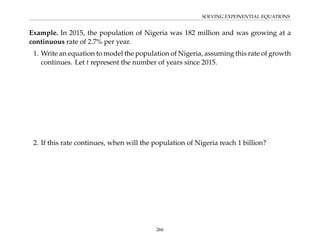
SOLVING EXPONENTIAL EQUATIONS
Example. In 2015, the population of Nigeria was 182 million and was growing at a
continuous rate of 2.7% per year.
1. Write an equation to model the population of Nigeria, assuming this rate of growth
continues. Let t represent the number of years since 2015.
2. If this rate continues, when will the population of Nigeria reach 1 billion?
266
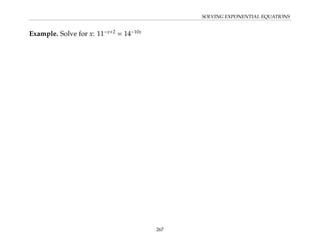
SOLVING EXPONENTIAL EQUATIONS
Example. Solve for x: 11−x+2
= 14−10x
267
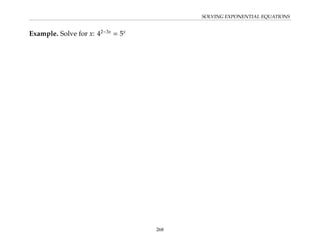
SOLVING EXPONENTIAL EQUATIONS
Example. Solve for x: 42−3x
= 5x
268
SOLVING LOG EQUATIONS
Solving Log Equations
After completing this sections, students should be able to:
• Solve equations with log expressions in them.
269
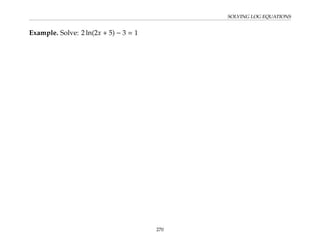
SOLVING LOG EQUATIONS
Example. Solve: 2 ln(2x + 5) − 3 = 1
270
SOLVING LOG EQUATIONS
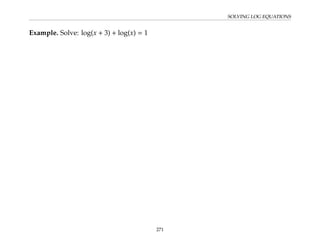
Example. Solve: log(x + 3) + log(x) = 1
271
SOLVING LOG EQUATIONS
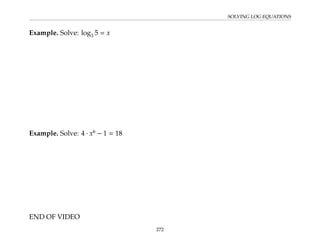
Example. Solve: log3 5 = x
Example. Solve: 4 · x6
− 1 = 18
END OF VIDEO
272
SOLVING LOG EQUATIONS
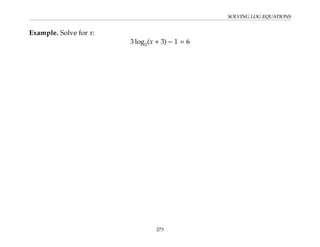
Example. Solve for x:
3 log2(x + 3) − 1 = 6
273
SOLVING LOG EQUATIONS
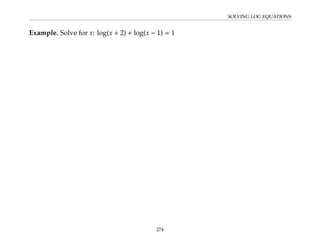
Example. Solve for x: log(x + 2) + log(x − 1) = 1
274
DOUBLING TIME AND HALF LIFE
Doubling Time and Half Life
After completing this section, students should be able to:
• Define doubling time and half life.
• Calculate doubling time of half life from an equation for exponential growth or
decay or from a growth or decay rate.
• Use double time or half life to write an equation to model exponential growth or
decay in a real world applications.
275
DOUBLING TIME AND HALF LIFE
Example. Suppose you invest $1600 in a bank account that earns 6.5% annual interest,
compounded monthly. How many years will it take until the account has $2000 in it,
assuming you make no further deposits or withdrawals?
276
DOUBLING TIME AND HALF LIFE
Example. A population of bacteria contains 1.5 million bacteria and is growing by 12%
per day. What is its doubling time?
277
DOUBLING TIME AND HALF LIFE
Example. Suppose a bacteria population doubles every 15 minutes. Write an equation
for its growth using the exponential equation y = a · bt
, where t represents time in
minutes.
278
DOUBLING TIME AND HALF LIFE
Example. The half life of radioactive Carbon-14 is 5750 years. A sample of bone that
originally contained 200 grams of C-14 now contains only 40 grams. How old is the
sample?
END OF VIDEO
279
DOUBLING TIME AND HALF LIFE
Example. Suppose today, your grandparents put $10,000 in a bank account in your
name, earning 4.5% annual interest, compounded monthly. How long will it take for
that money to double (assuming no money is added or withdrawn)?
What if the original deposit is $20,000 ?
280
DOUBLING TIME AND HALF LIFE
Example. The doubling time of a bacteria population is 18 hours. How long will it
take for the bacteria culture to grow from 5 grams to 12 grams?
281
DOUBLING TIME AND HALF LIFE
Example. Tylenol has a half life of approximately 2.5 hours. If you take Tylenol once
and then repeat the dose again after 4 hours, how much of the original dose is still in
your system when you take the second dose?
282
DOUBLING TIME AND HALF LIFE
Summary:
• What are the equations we use to model exponential growth and decay (including
interest rate problems)?
• In what situations do we use each type?
• In what situations can we freely choose between two or more equations?
283
DOUBLING TIME AND HALF LIFE
Example. A car that was worth $15,000 in 2015 is now worth $11,000.
A. Assuming an exponential decay model, what will the car be worth in 2025?
B. Assuming a linear model, what will the car be worth in 2025?
284
DOUBLING TIME AND HALF LIFE
Example. Write an equations to model the following situations:
1. In the year 2000, the population of raccoons on Island A was 70 thousand and
increasing at a rate of 5% per year. Write an equation to model the raccoon
population over time, where t represents years since 2000.
2. In the year 2000, the population of raccoons on Island B was 70 thousand and
increasing at a rate of 5 thousand raccoons per year. Write an equation to model
the raccoon population over time, where t represents years since 2000.
285
DOUBLING TIME AND HALF LIFE
Extra Example. In 1991 hikers found the preserved body of a man partially frozen in
a glacier in the Austrian Alps. It was found that the body of Otzi (as the iceman came
to be called) contained 53% as much Carbon-14 as the body of a living person. What
is the approximate date of his death?
286
SOLVING SYSTEMS OF EQUATIONS
Solving Systems of Equations
After completing this section, students should be able to:
• Determine if an (x, y) pair is the solution to a system of equations in two variables.
• Use substitution to solve a system of linear equations in two variables.
• Use elimination to solve a system of linear equations in two variables.
• Determine algebraically if a system of linear equations has one solution, no solu-
tions, or infinitely many solutions.
• Explain how graphing the two linear equations in a system of equations can
show whether the system will have one solution, no solutions, or infinitely many
solutions.
• Use substitution or elimination to solve a system of non-linear equations in two
variables.
287
SOLVING SYSTEMS OF EQUATIONS
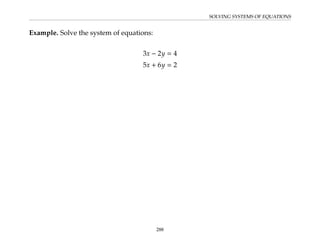
Example. Solve the system of equations:
3x − 2y = 4
5x + 6y = 2
288
SOLVING SYSTEMS OF EQUATIONS
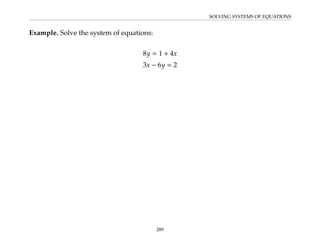
Example. Solve the system of equations:
8y = 1 + 4x
3x − 6y = 2
289
SOLVING SYSTEMS OF EQUATIONS
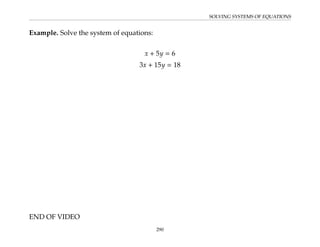
Example. Solve the system of equations:
x + 5y = 6
3x + 15y = 18
END OF VIDEO
290
SOLVING SYSTEMS OF EQUATIONS
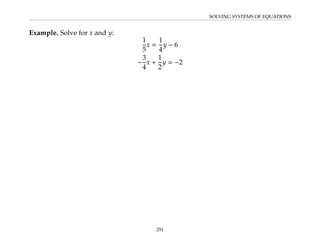
Example. Solve for x and y:
1
5
x =
1
4
y − 6
−
3
4
x +
1
2
y = −2
291
SOLVING SYSTEMS OF EQUATIONS
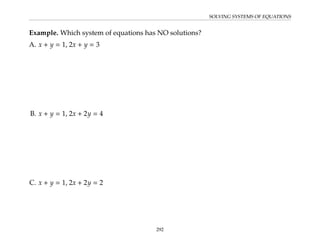
Example. Which system of equations has NO solutions?
A. x + y = 1, 2x + y = 3
B. x + y = 1, 2x + 2y = 4
C. x + y = 1, 2x + 2y = 2
292
SOLVING SYSTEMS OF EQUATIONS
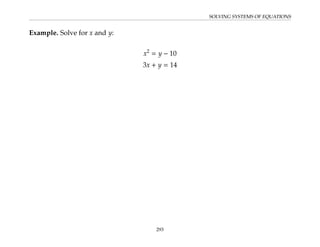
Example. Solve for x and y:
x2
= y − 10
3x + y = 14
293
SOLVING SYSTEMS OF EQUATIONS
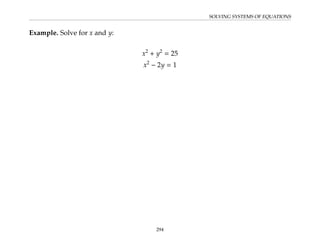
Example. Solve for x and y:
x2
+ y2
= 25
x2
− 2y = 1
294
APPLICATIONS OF SYSTEMS OF EQUATIONS
Applications of Systems of Equations
After completing this section, students should be able to:
• Set up and solve systems of equations involving distance, rate, and time.
• Set up and solve systems of equations involving mixtures and percents.
• Set up and solve systems of equations involving costs, perimeters and areas, and
other applications.
295
APPLICATIONS OF SYSTEMS OF EQUATIONS
Distance, Rate, and Time
Example. Elsa’s boat has a top speed of 6 miles per hour in still water. While traveling
on a river at top speed, she went 10 miles upstream in the same amount of time she
went 30 miles downstream. Find the rate of the river current.
296
APPLICATIONS OF SYSTEMS OF EQUATIONS
Mixtures
Example. Household bleach contains 6% sodium hypochlorite. How much household
bleach should be combined with 70 liters of a weaker 1% sodium hypochlorite solution
to form a solution that is 2.5% sodium hypochlorite?
END OF VIDEOS
297
APPLICATIONS OF SYSTEMS OF EQUATIONS
Example. Two factory plants are making TV panels. Yesterday, Plant A produced 7000
fewer panels than Plant B did. Five percent of the panels from Plant A and 3% of the
panels from Plant B were defective. If the two plants together produced 1090 defective
panels, how many panels did Plant A produce?
298
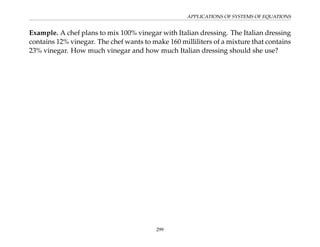
APPLICATIONS OF SYSTEMS OF EQUATIONS
Example. A chef plans to mix 100% vinegar with Italian dressing. The Italian dressing
contains 12% vinegar. The chef wants to make 160 milliliters of a mixture that contains
23% vinegar. How much vinegar and how much Italian dressing should she use?
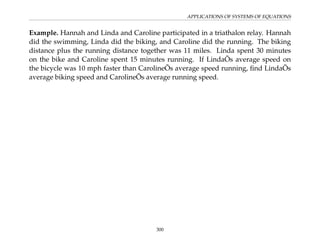
299
APPLICATIONS OF SYSTEMS OF EQUATIONS
Example. Hannah and Linda and Caroline participated in a triathalon relay. Hannah
did the swimming, Linda did the biking, and Caroline did the running. The biking
distance plus the running distance together was 11 miles. Linda spent 30 minutes
on the bike and Caroline spent 15 minutes running. If LindaÕs average speed on
the bicycle was 10 mph faster than CarolineÕs average speed running, find LindaÕs
average biking speed and CarolineÕs average running speed.
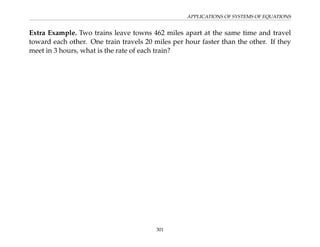
300
APPLICATIONS OF SYSTEMS OF EQUATIONS
Extra Example. Two trains leave towns 462 miles apart at the same time and travel
toward each other. One train travels 20 miles per hour faster than the other. If they
meet in 3 hours, what is the rate of each train?
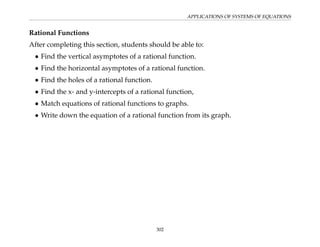
301
APPLICATIONS OF SYSTEMS OF EQUATIONS
Rational Functions
After completing this section, students should be able to:
• Find the vertical asymptotes of a rational function.
• Find the horizontal asymptotes of a rational function.
• Find the holes of a rational function.
• Find the x- and y-intercepts of a rational function,
• Match equations of rational functions to graphs.
• Write down the equation of a rational function from its graph.
302
APPLICATIONS OF SYSTEMS OF EQUATIONS
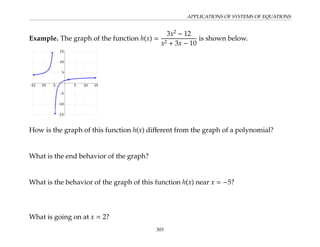
Example. The graph of the function h(x) =
3x2
− 12
x2 + 3x − 10
is shown below.
How is the graph of this function h(x) different from the graph of a polynomial?
What is the end behavior of the graph?
What is the behavior of the graph of this function h(x) near x = −5?
What is going on at x = 2?
303
APPLICATIONS OF SYSTEMS OF EQUATIONS
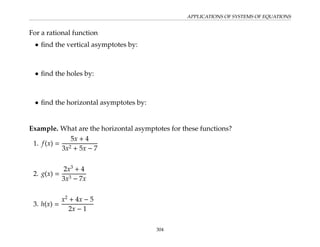
For a rational function
• find the vertical asymptotes by:
• find the holes by:
• find the horizontal asymptotes by:
Example. What are the horizontal asymptotes for these functions?
1. f(x) =
5x + 4
3x2 + 5x − 7
2. g(x) =
2x3
+ 4
3x3 − 7x
3. h(x) =
x2
+ 4x − 5
2x − 1
304
APPLICATIONS OF SYSTEMS OF EQUATIONS
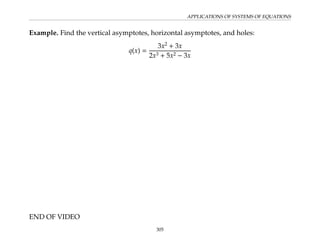
Example. Find the vertical asymptotes, horizontal asymptotes, and holes:
q(x) =
3x2
+ 3x
2x3 + 5x2 − 3x
END OF VIDEO
305
APPLICATIONS OF SYSTEMS OF EQUATIONS
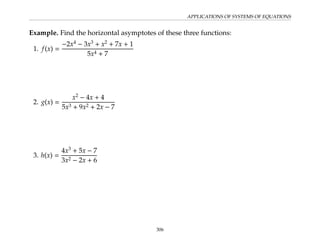
Example. Find the horizontal asymptotes of these three functions:
1. f(x) =
−2x4
− 3x3
+ x2
+ 7x + 1
5x4 + 7
2. g(x) =
x2
− 4x + 4
5x3 + 9x2 + 2x − 7
3. h(x) =
4x3
+ 5x − 7
3x2 − 2x + 6
306
APPLICATIONS OF SYSTEMS OF EQUATIONS
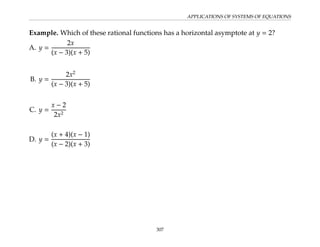
Example. Which of these rational functions has a horizontal asymptote at y = 2?
A. y =
2x
(x − 3)(x + 5)
B. y =
2x2
(x − 3)(x + 5)
C. y =
x − 2
2x2
D. y =
(x + 4)(x − 1)
(x − 2)(x + 3)
307
APPLICATIONS OF SYSTEMS OF EQUATIONS
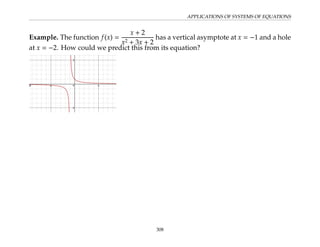
Example. The function f(x) =
x + 2
x2 + 3x + 2
has a vertical asymptote at x = −1 and a hole
at x = −2. How could we predict this from its equation?
308
APPLICATIONS OF SYSTEMS OF EQUATIONS
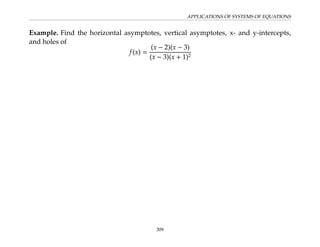
Example. Find the horizontal asymptotes, vertical asymptotes, x- and y-intercepts,
and holes of
f(x) =
(x − 2)(x − 3)
(x − 3)(x + 1)2
309
APPLICATIONS OF SYSTEMS OF EQUATIONS
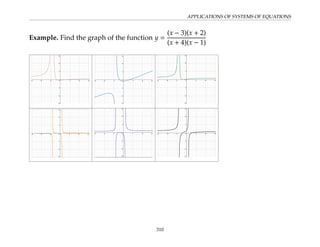
Example. Find the graph of the function y =
(x − 3)(x + 2)
(x + 4)(x − 1)
310
APPLICATIONS OF SYSTEMS OF EQUATIONS
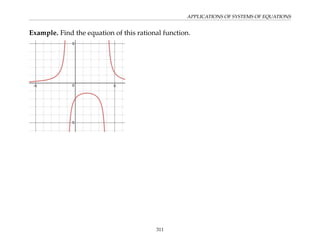
Example. Find the equation of this rational function.
311
COMBINING FUNCTIONS
Combining Functions
After completing this section, students should be able to:
• Find equations for the sum, difference, product, and quotient of two functions,
given their equations.
• Use graphs or tables of values to find the sum, difference product, or quotient of
two functions, evaluated at a number.
312
COMBINING FUNCTIONS
We can combine functions, such as f(x) = x + 1 and g(x) = x2
in the following ways.
• Add them together: (f + g)(x) =
• Subtract them: (f − g)(x) =
• Multiply them: (f · g)(x) =
• Divide them:
f
g
!
(x) =
313
COMBINING FUNCTIONS
Example. The following graphs represent two functions h and p.
Find
a) (h − p)(0)
b) (ph)(−3)
END OF VIDEO
314
COMBINING FUNCTIONS
Example. Suppose f(x) = x2
and g(x) = 3x − 2. Find
(a) (f + g)(2)
(b) (f − g)(x)
(c) (f g)(−1)
(d)
f
g
(x)
315
COMBINING FUNCTIONS
Example. Let t represent the number of years since 2010 and consider the following:
• f(t) is the number of tickets sold per week by Mission X Escape at time t.
• g(t) is the number of tickets sold per week by Bull City Escape at time t.
• p(t) is the cost of a ticket at Mission X as a function of time t.
• q(t) is the cost of a ticket at Bull City Escape as a function of time t.
• d(t) is the population of Durham in thousands of people at time t.
How could you represent the following quantities as functions of t?
1. The total number of escape room tickets sold per week in Durham as a function of
time? (Assume there are only the two venues: Mission X and Bull City.)
2. The weekly revenue at of Mission X Escape as a function of time?
3. The total weekly revenue from escape room tickets in Durham, as a function of
time?
4. The total per capita weekly revenue from escape room tickets in Durham, as a
function of time?
316
COMPOSITION OF FUNCTIONS
Composition of Functions
After completing this section, students should be able to:
• Find the composition of two functions given as equations.
• Use graphs or tables of values to find the composition of two functions, evaluated
at a point.
• Decompose a function into the composition of two other functions.
317
COMPOSITION OF FUNCTIONS
The composition of two functions: g ◦ f(x) is defined by:
I J
J䌬㻌㼒
318
COMPOSITION OF FUNCTIONS
Example. The tables below define the functions f and g.
x 1 2 3 4 5
f(x) 8 3 6 7 4
x 4 5 6 7 8 9
g(x) 1 3 8 10 2 2
Find:
a) g ◦ f(4)
b) f ◦ g(4)
c) f ◦ f(2)
d) f ◦ g(6)
319
COMPOSITION OF FUNCTIONS
Example. Let p(x) = x2
+ x. Let q(x) = −2x. Find:
a) q ◦ p(1)
b) q ◦ p(x)
c) p ◦ q(x)
d) p ◦ p(x)
Note. In general, f ◦ g , g ◦ f!
320
COMPOSITION OF FUNCTIONS
Example. h(x) =
√
x2 + 7. Find functions f and g so that h(x) = f ◦ g(x).
Example. r(x) = (7x + 2)3
. Find f and g such that r(x) = f ◦ g(x).
END OF VIDEO
321
COMPOSITION OF FUNCTIONS
Example. Two children decided to run a lemonade and hot chocolate stand. The
function
f(x) = 3|x − 65| + 10
represents the number of drinks sold as a function of the day’s high temperature in
degrees Fahrenheit. The function
g(x) = 0.5x − 5
represents the profit in dollars as a function of the number of drinks sold.
The kids want to know how much they’ll make if the day’s high temperature is 75◦
degrees. Find the answer for them.
In general, how much money will they make as a function of the temperature in
degrees Fahrneheit?
322
COMPOSITION OF FUNCTIONS
Example. Let f(x) = 1
x and g(x) = x2
+ 3x. Find
a) f ◦ g(x)
b) g ◦ f(x)
c) g ◦ g(x)
d) f ◦ f(x)
323
COMPOSITION OF FUNCTIONS
Example. Consider the function H(x) =
3
r
1
x + 1
. Find two function f and g such that
H(x) = f ◦ g(x).
324
COMPOSITION OF FUNCTIONS
Example. Consider the function P(x) = 4e3x−7
. Find two function f and g such that
H(x) = f ◦ g(x).
325
INVERSE FUNCTIONS
Inverse functions
After completing this section, students should be able to:
• Based on the graph of a function, determine if the function has an inverse that is a
function.
• Draw the graph of an inverse function, given the graph of the original.
• Use a table of values for a function to write a table of values for its inverse.
• Determine if two given functions are inverses of each other by computing their
compositions.
• Use a formula for a function to find a formula for its inverse.
• Find the range of the inverse function from the domain of the original function.
• Find the domain of the inverse function from the range of the original function.
326
INVERSE FUNCTIONS
Example. Suppose f(x) is the function defined by the chart below:
x 2 3 4 5
f(x) 3 5 6 1
In other words,
• f(2) = 3
• f(3) = 5
• f(4) = 6
• f(5) = 1
Definition. The inverse function for f, written f−1
(x), undoes what f does.
I [
¦A í [
• f−1
( 3 ) = 2
• f−1
( ) =
• f−1
( ) =
• f−1
( ) =
x 3
f−1
(x) 2
Key Fact 1. Inverse functions reverse the roles of y and x.
327
INVERSE FUNCTIONS
Graph y = f(x) and y = f−1
(x) on the same axes below. What do you notice about the
points on the graph of y = f(x) and the points on the graph of y = f−1
?
Key Fact 2. The graph of y = f−1
(x) is obtained from the graph of y = f(x) by reflecting
over the line .
328
INVERSE FUNCTIONS
In our same example, compute:
f−1
◦ f(2) = f ◦ f−1
(3) =
f−1
◦ f(3) = f ◦ f−1
(5) =
f−1
◦ f(4) = f ◦ f−1
(6) =
f−1
◦ f(5) = f ◦ f−1
(1) =
Key Fact 3. f−1
◦ f(x) = and f ◦ f−1
(x) = . This is the mathematical
way of saying that f and f−1
undo each other.
Example. f(x) = x3
. Guess what the inverse of f should be. Remember, f−1
undoes
the work that f does.
329
INVERSE FUNCTIONS
Example. Find the inverse of the function:
f(x) =
5 − x
3x
Note. f−1
(x) means the inverse function for f(x). Note that f−1
(x) , 1
f(x).
330
INVERSE FUNCTIONS
Question. Do all functions have inverse functions? That is, for any function that you
might encounter, is there always a function that is its inverse?
Try to find an example of a function that does not have an inverse function.
331
INVERSE FUNCTIONS
Key Fact 4. A function f has an inverse function if and only if the graph of f satisfies
the horizontal line test (i.e. every horizontal line intersects the graph of y = f(x) in at
most one point.)
Definition. A function is one-to-one if it passes the horizontal line test. Equivalently,
a function is one-to-one if for any two different x-values x1 and x2, f(x1) and f(x2) are
different numbers. Sometimes, this is said: f is one-to-one if, whenever f(x1) = f(x2),
then x1 = x2.
332
INVERSE FUNCTIONS
Example. (Tricky) Find p−1
(x), where p(x) =
√
x − 2 drawn above. Graph p−1
(x) on the
same axes as p(x).
For the function p(x) =
√
x − 2, what is:
• the domain of p?
• the range of p?
• the domain of p−1
?
• the range of p−1
?
Key Fact 5. For any invertible function f, the domain of f−1
(x) is and
the range of f−1
(x) is .
333
INVERSE FUNCTIONS
END OF VIDEO
What are some facts about inverse functions?
334
INVERSE FUNCTIONS
Example. The graph of f(x) is show below. Find the graph of f−1
(x).
335
INVERSE FUNCTIONS
Example. For each function graph, determine whether it has an inverse function.
A. B.
C. D.
336
INVERSE FUNCTIONS
Example. Consider the function g(x) =
5 − x
x + 2
. What is the RANGE of g−1
(x)?
Hint: you do not need to compute a formula for g−1
(x) to answer this question.
337
INVERSE FUNCTIONS
Example. If f(x) =
x
2
− 1, what is the inverse function f−1
(x)?
A) p(x) =
1
x
2 − 1
B) r(x) =
2
x
+ 1
C) v(x) = 2(x + 1)
D) w(x) = 2x + 1
338
INVERSE FUNCTIONS
Example. Find the inverse function for the exponential function f(x) = 10x
.
Example. Find the inverse function for the exponential function g(x) = ex
.
339
INVERSE FUNCTIONS
Example. Graph g(x) = 10x
and its inverse g−1
(x) = log10 x on the same axes.
List the properties of the graphs, including domain, range, and asymptotes.
y = 10x y = log10(x)
340
INVERSE FUNCTIONS
Example. Find the inverse of the function:
f(x) =
3x + 1
x − 6
341
INVERSE FUNCTIONS
Example. Find the inverse of the function: f(x) =
7 − x
2x + 3
Find the domain and range of f(x) and f−1
(x).
342
INVERSE FUNCTIONS
Example. According to math lore, if you are age x, the oldest person that it is okay for
you to date is given by the formula d(x) = 2x − 14. Plug in your own age for x and see
how old a person you can date.
Suppose you want to date a younger person instead of an older person. Invert the
formula to find out how young a person someone of a given age can date.
Plug in your own age for x into d−1
(x) and see how young a person you can date.
343
INVERSE FUNCTIONS
Extra Example. h(x) = 7 − x3
. Find h−1
(x) by reversing the roles of y and x and solving
for y.
344
INVERSE FUNCTIONS
Extra Example. Find f−1
(x), where f(x) =
√
x + 1. Graph f−1
(x) on the same axes as
f(x).
For the function f(x) =
√
x + 1, what is:
• the domain of f?
• the range of f?
• the domain of f−1
?
• the range of f−1
?
345
SYMMETRY AND EVEN AND ODD FUNCTIONS
Symmetry and Even and Odd Functions
After completing this sections, students should be able to:
• Identify whether a graph is symmetric with respect to the x-axis, symmetric with
respect to the y-axis, symmetric with respect to the origin, or none of these.
• Determine whether a function is even or odd or neither, based in its equation.
346
SYMMETRY AND EVEN AND ODD FUNCTIONS
Definition. A graph is sym-
metric with respect to the x-
axis if ...
Whenever a point (x, y) is on
the graph, the point
is also on the graph.
Definition. A graph is sym-
metric with respect to the y-
axis if ...
Whenever a point (x, y) is on
the graph, the point
is also on the graph.
Definition. A graph is sym-
metric with respect to the ori-
gin if ...
Whenever a point (x, y) is on
the graph, the point
is also on the graph.
347
SYMMETRY AND EVEN AND ODD FUNCTIONS
Example. Which graphs are symmetric with respect to the x-axis, the y-axis, the origin,
or neither?
348
SYMMETRY AND EVEN AND ODD FUNCTIONS
Example. Which graphs are symmetric with respect to the x-axis, the y-axis, the origin,
or neither?
1. y =
2
x3
+ x
2. x2
+ 2y4
= 6
349
SYMMETRY AND EVEN AND ODD FUNCTIONS
Definition. A function f(x) is even if ...
Example. f(x) = x2
+ 3 is even because ...
Definition. A function f(x) is odd if ...
Example. f(x) = 5x −
1
x
is odd because ...
Question. There is no word like even or odd for when a function’s graph is symmetric
with respect to the x-axis. Why not?
350
SYMMETRY AND EVEN AND ODD FUNCTIONS
Example. Determine whether the functions are even, odd, or neither.
1. f(x) = 4x3
+ 2x
2. g(x) = 5x4
− 3x2
+ 1
3. h(x) = 2x3
+ 7x2
351
PIECEWISE FUNCTIONS
Piecewise Functions
After completing this sections, students should be able to:
• Evaluate piecewise functions at a given x-value.
• Graph piecewise functions
352
PIECEWISE FUNCTIONS
Example. The function f is defined as follows:
f(x) =







1 − x2
if x  1
−2x + 3 if x ≥ 1
1. What is f(−2)? What is f(1)?
2. Graph y = f(x).
3. Is f(x) continuous?
353
PIECEWISE FUNCTIONS
Another example, fill in from notes
354
REVIEW
Review
Decide which of the following statements are true. (Select all correct answers, and
assume all arguments of ln are positive numbers.)
A.
√
x2 + 4 = x + 2
B. log(1
a) = − log(a)
C. 102 log x
= x2
D. log(w − v) =
log(w)
log(v)
E. log2(x + 8) = log2(x) + 3
355
REVIEW
What are some types of equations we have solved?
What are some techniques for solving equations?
What are extraneous solutions? When do we have to watch for them?
356
REVIEW
What types of equations are these? What technique is needed to solve them?
1.
3
2 − x
=
4
x
2. (x − 2)(x + 1) = 3 for x
3. 2x
= 3x+1
4. 5x5
= 17
5. 7 log(5x) = 2
6.
√
4 + x + 2 = x
7. 3x2/3
+ 1 = 28
8. y =
4 − 3x
5x − 9
for x
357
REVIEW
What kinds of inequalities have we solved? What techniques do we use?
358
REVIEW
1.
x2
− 1
x + 3
 0
2. 7  1 − 3|2 − 4x|
3. x3
+ 5x2
≤ 6x
4. 8x + 4  5x − 2 and 2 − 3x  5x
359
REVIEW
What do we have to worry about when looking for domains?
360
REVIEW
What types of equations are these? What technique is needed to solve them?
1. A = P(1 + rt) for r
2.
1
a
+
1
b
=
1
c
for b
3. y =
4 − 3x
5x − 9
for x
4. a + b = rx − 4x2
for x
5. M = log(I
S) for S
6. bat
= 3 + x for t
7. bat
= 3 + x for a
8.
√
4 + x = 3y for x
361

classNotes_m110_2018F.pdf

  • 1.
    Math 110 Algebra- Fall 2018
  • 2.
    EXPONENTS Exponents After completing thissection, students should be able to: • Explain the product rule, quotient rule, and power rule for exponentiation by writing out powers of a variable as repeated multiplication. • Rewrite expressions with negative exponents so that all exponents are positive. • Use the product rule, quotient rule, and power rule to simplify exponential ex- pressions. • Decide whether equations involving exponents are always true or not by testing examples. • Rewrite fractional exponents in terms of radicals. • Calcuate numbers raised to fractional exponents without a calculator. 2
  • 3.
    EXPONENTS Here are theexponent rules: 1. The Product Rule 2. The Quotient Rule 3. The Power Rule 4. Power of Zero 5. Negative Exponents 6. Fractional Exponents 7. Distribute an Exponent over a Product 8. Distribute an Exponent over a Quotient 3
  • 4.
    EXPONENTS Example. Simplify thefollowing expressions and write your answers without negative exponents: (a) 3x−2 x4 (b) 4y3 y−5 4
  • 5.
    EXPONENTS Example. Simplify theexpression and write your answer without negative exponents: y3 z5 7z−2y7 5
  • 6.
    EXPONENTS Example. Simplify theexpression and write your answer without negative exponents: 25x4 y−5 x−6y3 !3/2 END OF VIDEOS 6
  • 7.
    EXPONENTS Question. Which statementsare true for all positive values of x and y? (Select all that apply.) A. x2 + y2 = (x + y)2 B. x2 y2 = (xy)2 7
  • 8.
    EXPONENTS Question. Which expressionis equivalent to y4 4x−2 ? A. 4x2 y4 B. x2 y4 4 C. y4 4 √ x D. √ xy4 4 8
  • 9.
    EXPONENTS Question. Without usinga calculator, decide which of the following expressions is equal to −3. (Select all correct answers.) A. −811/4 B. (−81)1/4 C. −271/3 D. (−27)1/3 9
  • 10.
    EXPONENTS Example. Simplify andwrite your answer without negative exponents. 49x8 y−5 x−6y3 ! 49x8 y−5 x−6y3 !3/2 10
  • 11.
    EXPONENTS Extra Example. Simplifyand write your answer without negative exponents. 16a−2 b8 c20 a6b−4 !3/4 11
  • 12.
    RADICALS Radicals After completing thissection, students should be able to: 1. Determine whether equations involving radicals are always true or not by testing with examples. 2. Simplify expressions involving radicals by ”pulling as much as possible” out of the radical sign. 3. Rationalize the denominator by multiplying the numerator and denominator by a radical expression or by a conjugate of a radical expression. 12
  • 13.
    RADICALS Rules for Radicals • n √ a· b = • n r a b = • am/n = 13
  • 14.
  • 15.
    RADICALS Example. Simplify. (Assumeall variables represent positive numbers.) q 60x2y6z−11 15
  • 16.
    RADICALS Example. Rationalize thedenominator. (Assume x represents a positive number.) 3x √ x END OF VIDEO 16
  • 17.
    RADICALS Review. Which formulasare correct? (Select all that apply.) A. √ ab = √ a √ b B. r a b = √ a √ b C. √ a − b = √ a − √ b D. √ a + b = √ a + √ b E. √ a2 + b2 = a + b 17
  • 18.
    RADICALS Question. Without usinga calculator, compute 16−3/4 . A. 12 B. −12 C. 1 12 D. 8 E. −8 F. 1 8 18
  • 19.
    RADICALS Example. Simplify theradical. q 24x6y5 r x9y16 64z 19
  • 20.
  • 21.
    RADICALS Question. Do thesetwo expressions represent the same thing or different things? (Assume x and y represent positive numbers.) A. 3 √ x 5 √ y B. 3 √ xy 5y 21
  • 22.
    RADICALS Question. Do thesetwo expressions represent the same thing or different things? (Assume a and b represent positive numbers.) 1. 5 + √ a 3 − √ a 2. 15 + 8 √ a + a 9 − a 22
  • 23.
    RADICALS Extra Example. Rewriteby rationalizing the denominator: √ a + 7 √ a + 1 23
  • 24.
    RADICALS Extra Example. Rewriteby rationalizing the denominator: √ 4x + √ y 2 p 3xy 24
  • 25.
    RADICALS Question. True orFalse: √ x2 + 9 = x + 3 25
  • 26.
    FACTORING Factoring After completing thissection, students should be able to: • Factor an expression by pulling out common factors from each term. • Factor a difference of two squares. • Factor a sum or difference of two cubes. • Factor some expressions with four terms by grouping. • Factor quadratics when possible. • Combine these factoring methods to factor a complex expression several times. 26
  • 27.
    FACTORING 1. Pull outthe greatest common factor Example. Factor 15 + 25x Example. Factor x2 y + y2 x3 27
  • 28.
    FACTORING 2. Factor bygrouping Example. Factor x3 + 3x2 + 4x + 12 28
  • 29.
    FACTORING 3. Factor quadratics Example.Factor x2 − 6x + 8 Example. Factor 10x2 + 11x − 6 29
  • 30.
    FACTORING 4. Difference ofsquares a2 − b2 Example. Factor x2 − 16 Example. Factor 9p2 − 1 30
  • 31.
    FACTORING 5. Difference orsum of cubes a3 − b3 = a3 + b3 = Example. Factor y3 + 27 END OF VIDEO 31
  • 32.
    FACTORING Question. Which ofthese expressions DOES NOT factor? A. x2 + x NEXT TIME MAKE THIS ONE HARDER LIKE 9x2 − 25 B. x2 − 25 C. x2 + 4 D. x3 + 2x2 + 3x + 6 E. 5x2 − 14x + 8 32
  • 33.
    FACTORING Question. Factoring bygrouping is handy for factoring which of these expressions? How can you tell? A. 10u8 v6 + 15u2 v2 x3 B. 2y5 − 7y4 − 14y + 49 C. 2z2 + 3z − 14 Question. What are some of the main techniques of factoring? 33
  • 34.
    FACTORING Extra Example. Factor2z2 + 3z − 14. Extra Example. Factor −5v2 − 45v + 50 34
  • 35.
    RATIONAL EXPRESSIONS Rational Expressions Aftercompleting this section, students should be able to: • Simplify rational expressions by factoring and cancelling common factors. • Find the least common denominator for two or more rational expressions. • Add and subtract rational expressions. • Multiply and divide rational expressions. • Simplify complex rational expressions that involve sums or differences of rational expressions divided by sums or differences of rational expressions. • Recoginze common errors in simplifying rational expressions such as cancelling across a plus or minus sign. 35
  • 36.
    RATIONAL EXPRESSIONS Reduce tolowest terms Example. Simplify 21 45 by reducing to lowest terms. Example. Simplify 3x + 6 x2 + 4x + 4 by reducing to lowest terms. 36
  • 37.
    RATIONAL EXPRESSIONS Multiplying andDividing Example. Compute a) 4 3 · 2 5 b) 4 5 2 3 Example. Compute x2 + x x + 4 x + 1 x2 − 16 37
  • 38.
    RATIONAL EXPRESSIONS Adding andSubracting Example. Subtract 7 6 − 4 15 Example. Add 3 2x + 2 + 5 x2 − 1 END OF VIDEO 38
  • 39.
    RATIONAL EXPRESSIONS Question. Trueor False: 1. 5xy 5xz = y z 2. 5x + y 5x + z = y z 39
  • 40.
  • 41.
  • 42.
  • 43.
    RATIONAL EXPRESSIONS Extra Example.Subtract 2 x2 − 6x − 16 − 1 x2 − 11x + 24 43
  • 44.
    RATIONAL EXPRESSIONS Extra Example.Simplify 4x − 12 x2 + 2x x2 − x − 6 x2 44
  • 45.
    SOLVING QUADRATIC EQUATIONS SolvingQuadratic Equations After completing this section, students should be able to: • Rewrite a quadratic equation in standard form • Solve a quadratic equation by factoring • Solve a quadratic equation using the quadratic formula • Recognize when a quadratic equation has no real roots • Solve a linear or quadratic equation in which the coefficients are themselves vari- ables, to get solutions in terms of the other variables. 45
  • 46.
    SOLVING QUADRATIC EQUATIONS Example.Find all real solutions for the equation y2 = 18 − 7y 46
  • 47.
  • 48.
    SOLVING QUADRATIC EQUATIONS Example.Find all real solutions for the equation x(x + 2) = 7 48
  • 49.
    SOLVING QUADRATIC EQUATIONS Example.Find all real solutions for the equation 1 2 y2 = 1 3 y − 2 END OF VIDEO 49
  • 50.
    SOLVING QUADRATIC EQUATIONS Example.Find all real solutions for the equation (x + 2)2 = 3x + 7 50
  • 51.
    SOLVING QUADRATIC EQUATIONS Example.Find all real solutions for the equation x4 − 8x2 − 9 = 0 51
  • 52.
    SOLVING QUADRATIC EQUATIONS Example.Find all real solutions for the equation 3x2/3 + 5x1/3 = 8 52
  • 53.
    SOLVING QUADRATIC EQUATIONS ExtraExample. Solve for r: S h − 2pr = pr2 Extra Example. Solve for p: S h − 2pr = pr2 53
  • 54.
    SOLVING RATIONAL EQUATIONS SolvingRational Equations By the end of this section, students should be able to: • Solve rational equations by clearing the denominator • Recognize and exclude extraneous solutions to rational equations • Solve rational equations with several variables for one of the variables 54
  • 55.
    SOLVING RATIONAL EQUATIONS Example.Solve: x x + 3 = 1 + 1 x 55
  • 56.
    SOLVING RATIONAL EQUATIONS Example.Solve: 4c c − 5 − 1 c + 1 = 3c2 + 3 c2 − 4c − 5 END OF VIDEO 56
  • 57.
    SOLVING RATIONAL EQUATIONS Example.Solve 8x2 x2 − 1 = 4 x − 1 + 9x x + 1 57
  • 58.
    SOLVING RATIONAL EQUATIONS ExtraExample. Solve 4 − 1 v + 1 = 7 v + 4 58
  • 59.
    SOLVING RATIONAL EQUATIONS Review.What are the main steps to solving a rational equation? Question. What is an extraneous solution? 59
  • 60.
    SOLVING RATIONAL EQUATIONS Solvez = 5P + c P for P 60
  • 61.
    SOLVING RATIONAL EQUATIONS Example.Solve for w: 1 x + 1 y + 1 w = 6 61
  • 62.
    SOLVING RATIONAL EQUATIONS ExtraExample. Solve S h − 2pr = pr2 for h. Extra Example. Solve S h − 2pr = pr2 for p Extra Example. Solve S h − 2pr = pr2 for r 62
  • 63.
  • 64.
    RADICAL EQUATIONS Radical Equations Bythe end of this section, students should be able to • Solve an equation with square root signs by isolating the square root and squaring both sides. • Solve an equation with fractional exponents by isolating the fractional exponent and taking both sides to the reciprocal exponent power. • Solve an equation with fractional exponents that can be written in quadratic form. • Solve an equation with radical signs and several variables for one of the variables. 64
  • 65.
    RADICAL EQUATIONS Example. Findall real solutions for the equation x + √ x = 12 65
  • 66.
    RADICAL EQUATIONS Example. Findall real solutions for the equation 2p4/5 = 1 8 END OF VIDEO 66
  • 67.
    RADICAL EQUATIONS Question. Whichstep is wrong in this “solution”? y + p 3y + 1 = 3 (0.1) (y + p 3y + 1)2 = 32 (0.2) y2 + ( p 3y + 1)2 = 9 (0.3) y2 + 3y + 1 = 9 (0.4) y2 + 3y − 8 = 0 (0.5) y = −3 ± √ 9 + 32 2 (0.6) 67
  • 68.
    RADICAL EQUATIONS Question. Whatis the best first step to solve this equation? y + p 3y + 1 = 3 A. Isolate y by subtracting p 3y + 1 to both sides. B. Isolate p 3y + 1 by subtracting y from both sides. C. Square both sides. 68
  • 69.
    RADICAL EQUATIONS What arethe solutions to y + p 3y + 1 = 3 ? 69
  • 70.
    RADICAL EQUATIONS Example. Whatis a good next step to solve this equation for t? (t + 3)2/3 = 4 A. Take the cube root of both sides. B. Cube both sides. C. Take the 2/3 power of both sides. D. Take the 3/2 power of both sides. 70
  • 71.
  • 72.
    RADICAL EQUATIONS Example. Solvefor g: T = 2π s L g 72
  • 73.
    RADICAL EQUATIONS Extra Example.5c2/5 − 11c1/5 + 2 = 0 73
  • 74.
    RADICAL EQUATIONS Extra Example.Find all real solutions for the equation 3 √ 5x2 − 4x − x = 0 74
  • 75.
    ABSOLUTE VALUE EQUATIONS AbsoluteValue Equations After completing this section, students should be able to • Solve equations with absolute value signs and linear expressions inside the abso- lute value signs. • Recognize when absolute value equations have no solutions. 75
  • 76.
    ABSOLUTE VALUE EQUATIONS Example.Solve the equation 3|x| + 2 = 4 Example. Solve the equation |3x + 2| = 4 76
  • 77.
    ABSOLUTE VALUE EQUATIONS Example.Solve the equation 5|4p − 3| + 16 = 1 END OF VIDEO 77
  • 78.
    ABSOLUTE VALUE EQUATIONS Example.Solve 3|1 − 2x| − 1 = 8 A. 1 B. -1 C. 1 or -1 D. -1 or 2 E. 1, -1, 2, or -2 F. No solution. 78
  • 79.
    ABSOLUTE VALUE EQUATIONS Example.Solve 5|x − 3| + 7 = 2 A. 2 B. 2 or -2 C. 4 D. 4 or -4 E. 2 or 4 F. No solution. 79
  • 80.
    REVIEW FOR TEST1 Review for Test 1 Question. True or False: p x2 + y2 = x + y 80
  • 81.
    REVIEW FOR TEST1 Consider the following types of equations and methods. Type of Equation: 1. Rational equation 2. Quadratic equation or factor 3. Equation with fractional exponents 4. Radical equation 5. Absolute value equation Method 1. Clear the denominators 2. Quadratic formula 3. Raise both sides to an exponent 4. Take a root of both sides 5. Rewrite absolute value as cases 6. Basic methods: distributing, moving all terms with the variable to one side and all other variables to the other side, factoring out the variable, and divid- ing 81
  • 82.
    REVIEW FOR TEST1 For each of the following equations, decide on the type of equation and the method(s) you would use to solve it. You do not actually have to solve the equation. 1. 3 2x = x 4 2. 5x5 = 17 3. |4 + x| = 6 4. 3x(x + 2) = 5(x − 1) 5. A = P(1 + rt) for r 6. 1 a + 1 b = 1 c for b 7. y = 4 − 3x 5x − 9 for x 8. y = 3 − √ 4 + x for x 82
  • 83.
    ABSOLUTE VALUE INEQUALITIES AbsoluteValue Inequalities After completing this section, students should be able to: • Solve inequalaties involving absolute value signs with linear expressions inside the absolute value signs. • Recognize when absolute value inequalities have no solutions. • Recognize when absolute vale inequalities have all real numbers as solutions. 83
  • 84.
    ABSOLUTE VALUE INEQUALITIES Example.What x-values satisfy |x| < 5? Example. What x-values satisfy |x| ≥ 5? 84
  • 85.
    ABSOLUTE VALUE INEQUALITIES Example.Solve |3 − 2t| < 4 85
  • 86.
    ABSOLUTE VALUE INEQUALITIES Example.Solve |3 − 2t| > 4 86
  • 87.
    ABSOLUTE VALUE INEQUALITIES Example.Solve 2|4x + 5| + 7 ≥ 1 END OF VIDEO 87
  • 88.
    ABSOLUTE VALUE INEQUALITIES Example.If we write |4x + 1| ≤ 3, what does this mean? A. x is less than or equal to 3 B. x is between -3 and 3, inclusive C. 4x + 1 is less than or equal to 3 D. 4x + 1 is between -3 and 3, inclusive Example. Solve |4x + 1| ≤ 3 88
  • 89.
    ABSOLUTE VALUE INEQUALITIES Example.If we write |4x + 1| > 3, what does this mean? A. 4x + 1 is bigger than 3 B. 4x + 1 is between -3 and 3 C. 4x + 1 is both less than -3 and bigger than 3 D. either 4x + 1 is less than -3, or else 4x + 1 is bigger than 3 Example. Solve |4x + 1| > 3 89
  • 90.
    ABSOLUTE VALUE INEQUALITIES Question.Which inequaltiy has ”all real numbers” as its solution? A. |5x + 6| ≤ −5 B. |5x + 6| ≥ −5 C. |5x + 6| ≤ 5 D. |5x + 6| ≥ 5 90
  • 91.
    COMPOUND LINEAR INEQUALITIES CompoundLinear Inequalities After completing this section, students should be able to: • Solve compound linear inequalities connected by an ”AND” statement or an ”OR” statement, or written in the form • Graph solutions of inequalities on a number line. • Write solutions to inequalities in interval notation. • Recognize when compound linear inequalities have no solutions or have all real numbers as solutions. 91
  • 92.
    COMPOUND LINEAR INEQUALITIES Example.Solve: −5(x + 2) + 3 8 92
  • 93.
    COMPOUND LINEAR INEQUALITIES Example.Solve: 3x − 4 ≤ x − 8 OR 6x + 1 10 93
  • 94.
    COMPOUND LINEAR INEQUALITIES Solve:−2 3 y −12 AND −4y + 2 5 94
  • 95.
    COMPOUND LINEAR INEQUALITIES Example.Solve: −3 ≤ 6x − 2 10 END OF VIDEO 95
  • 96.
    COMPOUND LINEAR INEQUALITIES Example.Graph the solutions to x ≤ 5 AND x 0 on the number line. Then write the solution in interval notation. Example. Graph the solutions to x ≤ 5 OR x 0 on the number line. Then write the solution in interval notation. 96
  • 97.
    COMPOUND LINEAR INEQUALITIES Example.Find the solutions to the system of inequalities 6 − 3y ≥ 5y OR 2y ≥ 4 + y. 97
  • 98.
    COMPOUND LINEAR INEQUALITIES Question.Which system of inequalities has no solutions? A. x 7 AND x 2 B. x 7 OR x 2 C. x 7 AND x 10 D. x 7 OR x 10 98
  • 99.
    COMPOUND LINEAR INEQUALITIES Example.Which of the following expressions are equivalent to: ”x ≤ 1 OR x 3” (select all that apply) A. 1 ≥ x 3 B. 3 x ≤ 1 C. [1, 3) D. (−∞, 1] ∪ (3, ∞) E. x ≤ 1 AND x 3 99
  • 100.
    COMPOUND LINEAR INEQUALITIES ExtraExample. Find the solutions to the system of inequalities 2 − 4x 5 AND 2x + 5 ≤ 13 − x. 100
  • 101.
    POLYNOMIAL AND RATIONALINEQUALITIES Polynomial and Rational Inequalities After completing this section, students should be able to: • Solve a polynomial or rational inequality by making a sign chart. • Determine whether the endpoints of intervals should be included or not included in the solution of a polynomial or rational inequality and explain why. • Graph the solution to a polynomial or rational inequality on the number line. • Write the solution to a polynomial or rational inequality using interval notation. • Explain why it is not correct to solve the inequality x2 4 by taking the square root of both sides to get x 2. 101
  • 102.
    POLYNOMIAL AND RATIONALINEQUALITIES Example. Solve x2 4 102
  • 103.
    POLYNOMIAL AND RATIONALINEQUALITIES Example. Solve x3 ≥ 5x2 + 6x 10³
  • 104.
    POLYNOMIAL AND RATIONALINEQUALITIES Example. Solve x2 + 6x + 9 x − 1 ≤ 0 END OF VIDEO 104
  • 105.
    POLYNOMIAL AND RATIONALINEQUALITIES Example. The solution to (x + 2)(x + 1) ≤ 0 is A. (−∞, −1] B. (−∞, −2] C. [−2, ∞) D. [−2, −1] E. (−∞, −2] ∪ [−1, ∞) 105
  • 106.
    POLYNOMIAL AND RATIONALINEQUALITIES Example. The solution to x + 3 x + 1 0 is A. (−1, ∞) B. (−3, ∞) C. (−∞, −3) ∪ (−1, ∞) D. (−3, −1) What about x + 3 x + 1 0 ? 106
  • 107.
    POLYNOMIAL AND RATIONALINEQUALITIES Example. Solve x2 + x + 1 0 107
  • 108.
    POLYNOMIAL AND RATIONALINEQUALITIES True or False: The inequality 3 x + 1 ≥ 4 6 − x has the exact same solutions as the inequal- ity 3(6 − x) ≥ 4(x + 1). 108
  • 109.
    POLYNOMIAL AND RATIONALINEQUALITIES Example. Solve 3 x + 1 ≥ 4 6 − x 109
  • 110.
    DISTANCE FORMULA Distance Formula Aftercompeting this section, students should be able to: • Find the distance between two points on the plane. • Explain how the distance formula is related to the Pythagorean Theorem for trian- gles. 110
  • 111.
    DISTANCE FORMULA Example. Findthe distance between the points P(−1, 5) and Q(4, 2). 111
  • 112.
    MIDPOINT FORMULA Midpoint Formula Aftercompeting this section, students should be able to: • Explain the midpoint formula in terms of average values. • Find the midpoint of a line segment, given the coordinates of the endpoints. 112
  • 113.
    MIDPOINT FORMULA Example. Findthe midpoint of the segment between the points P(−1, 5) and Q(4, 2). 113
  • 114.
    CIRCLES Circles After competing thissection, students should be able to: • Find the equation for a circle given its center and radius. • Find the center and radius of a circle, given its equation in standard form. • Complete the square to rewrite the equation for a circle in standard form. • Find the equation of a circle given two points at the end of a diameter, or given its center and one point on the circle. • Explain how the equation for a circle is related to the distance formula or the Pythagorean Theorem for triangles. 114
  • 115.
    CIRCLES Example. Find theequation of a circle of radius 5 centered at the point (3, 2). Note. The equation of a circle with radius r centered at the point (h, k) is given by: 115
  • 116.
    CIRCLES Example. Does thisequation represent a circle? If so, what is the center and what is the radius? (x − 5)2 + (y + 6)2 = 5 116
  • 117.
    CIRCLES Example. Does thisequation represent a circle? If so, what is the center and what is the radius? 9x2 + 9y2 + 72x − 18y + 36 = 0 END OF VIDEO 117
  • 118.
    CIRCLES Example. What isthe equation of a circle with center (3, −2) and radius 5? 118
  • 119.
    CIRCLES Example. Does thisequation represent a circle? If so what is the center and what is the radius? 3x2 + 3y2 − 18x + 30y + 6 = 0 119
  • 120.
    CIRCLES Example. Find thecenter and radius of this circle. x2 + y2 + 14x − 18y − 2 = 0 120
  • 121.
    CIRCLES Example. Find theequation of a circle whose diameter has endpoints (−3, −6) and (5, 4). 121
  • 122.
    CIRCLES Extra Example. Giventhe point P(1, 5), find all points whose y-coordinate is 3 that are a distance of 7 units from point P. 122
  • 123.
    LINES Lines After finishing thissection, students should be able to: • Find the equation of a line given a slope and a y-intercept, or a slope and one point, or two points. • Determine the equation of a line in an applied context, such as given a table of values for two variables, or given an initial value and a rate of change. • Interpret the slope and y-intercept in the equation of a line in an applied context. • Use the equation of a line to make predictions in an applied context. • Find the equations of vertical and horizontal lines. 123
  • 124.
    LINES Example. Find theequation of this line. 124
  • 125.
    LINES Example. Find theequation of these lines. 125
  • 126.
    LINES Example. Find theequation of the line through the points (1, 2) and (4, −3). END OF VIDEO 126
  • 127.
    LINES Example. A linehas slope 1 5 and passes through the point P(3, 1). The equation for this line is y = 1 5x + . Fill in the box. 127
  • 128.
    LINES Example. A companysells hats. If the selling price is $8, they sell 300. If the selling price is $6, they sell 420. The relationship between the selling price and the number sold is linear. Which pair of points can be used to construct the equation of this line? (Choose all that apply.) A. (8, 6) and (300, 420) B. (8, 300) and (6, 420) C. (8, 420) and (6, 300) D. (300, 8) and (420, 6) 128
  • 129.
    LINES How many hatswould the company be able to give away if it offered them for free? At what price would the company not be able to sell ANY hats? 129
  • 130.
    LINES Example. Write theequation for a line through the points P(4, 2) and Q(4, −1). A. x = 4 B. y = 4 C. x = 2 D. y = 2 E. Undefined. 130
  • 131.
    LINES Example. Which ofthe following pieces of information is enough to find the equation for a line? (Select all that apply.) A. the slope and the y-intercept B. the slope and the x-intercept C. the x-intercept and the y-intercept D. the slope and a point on the line that is not an intercept E. two points on the line 131
  • 132.
    LINES Extra Example. Thedeer population in Farrington village is growing at a constant rate of 60 deer per year. Two years after Mark McCombs moved there, the population was 340. What was the population 10 years after he moved in? 132
  • 133.
    LINES Extra Example. Snowis falling at a rate of 3 4 inch per hour. How long will it take for the snow height to increase by 6 inches? 133
  • 134.
    PARALLEL ANAD PERPENDICULARLINES Parallel anad Perpendicular Lines After completing this section, students should be able to: • Determine if two lines are parallel, perpendicular, or neither based on their equa- tions. • Given an equation for a line and a point not on the line, find the equation of a line parallel to the given line that goes through a given point. • Given an equation for a line and a point, find the equation of a line perpendicular to the given line that goes through a given point. 134
  • 135.
    PARALLEL ANAD PERPENDICULARLINES Example. Find the equation of a line that is parallel to the line 3y − 4x + 6 = 0 and goes through the point (−3, 2) . 135
  • 136.
    PARALLEL ANAD PERPENDICULARLINES Example. Find the equation of a line that is perpendicular to the line 6x + 3y = 4 and goes through the point (4, 1). 136
  • 137.
    PARALLEL ANAD PERPENDICULARLINES Example. Find the equation of the line that is parallel to y = 3 and goes through the point (−2, 1). Example. Find the equation of the line that is perpendicular to y = 4 and goes through the point (3, 4). END OF VIDEO 137
  • 138.
    PARALLEL ANAD PERPENDICULARLINES Example. Which of these lines is perpendicular to 4x − 5y = 7? A. y = 4 5 x + 4 7 B. y = − 4 5 x + 3 C. y = 5 4 x + 6 4 D. y = − 5 4 x − 1 E. None of them. 138
  • 139.
    PARALLEL ANAD PERPENDICULARLINES Example. Find an equation for a line PARALLEL to the line 4x − 6y + 1 = 0 through the point P(1, −5). 139
  • 140.
    PARALLEL ANAD PERPENDICULARLINES Example. Find an equation for a line PERPENDICULAR to the line 4x − 6y + 1 = 0 through the point P(1, −5). 140
  • 141.
    FUNCTIONS Functions After completing thissection, students should be able to • Decide whether a relationship between input and output values is a function or not, based on an equation, a graph, or a table of values. • Find the corresponding output value for a given input value for a function given in equation, graphical, or tabular form. • Find the corresponding input value(s) for a given output value for a function given in equation, graphical, or tabular form. • Find the domains of functions given in equation form involving square roots and denominators. • Find the domains and ranges of functions given in graphical or tabular form. • Identify the graphs of the “toolkit functions” y = x, y = x2 , y = x3 , y = √ x, y = |x|, y = 1 x , y = 1 x2 , y = 2x , y = log(x) 141
  • 142.
    FUNCTIONS Definition. A functionis correspondence between input numbers (x-values) and out- put numbers (y-value) that sends each input number (x-value) to exactly one output number (y-value). Sometimes, a function is described with an equation. Example. y = x2 + 1, which can also be written as f(x) = x2 + 1 What is f(2)? f(5)? What is f(a + 3)? 142
  • 143.
    FUNCTIONS Sometimes, a functionis described with a graph. Example. The graph of y = g(x) is shown below What is g(2)? g(5)? 143
  • 144.
    FUNCTIONS Definition. The domainof a function is all possible x-values. The range is the y-values. Example. What is the domain and range of the function g(x) graphed below? 144
  • 145.
    FUNCTIONS Example. What arethe domains of these functions? A. g(x) = x x2 − 4x + 3 B. f(x) = √ 3 − 2x 145
  • 146.
    FUNCTIONS C. h(x) = √ 3− 2x x2 − 4x + 3 END OF VIDEO 146
  • 147.
    FUNCTIONS Example. The graphof y = f(x) is drawn below. 1. Find f(7). 2. Find all values a for which f(a) = 5. 147
  • 148.
    FUNCTIONS Example. Suppose f(x)= x + 4 x + 1 . Find all x such that f(x) = 3. A. -1 B. 1 2 C. 7 4 D. 4 148
  • 149.
    FUNCTIONS Example. Find thedomain of √ 1 − x2. Write your answer in interval notation. 149
  • 150.
    FUNCTIONS Example. Find thedomain of g(x) = √ 3 − x x + 1 A. (−∞, 3) B. (−∞, 3] C. (−1, 3] D. (−∞, −1) ∪ (−1, 3) E. (−∞, −1) ∪ (−1, 3] 150
  • 151.
    TOOLKIT FUNCTIONS Toolkit Functions Aftercompleting this section, students should be able to: • Match the graphs of y = x, y = x2 , y = x3 , y = √ x, y = |x|, y = 2x , y = log(x), y = 1 x , and y = 1 x2 with their equations. • Sketch approximate graphs of y = x, y = x2 , y = x3 , y = √ x, y = |x|, y = 2x , y = log(x), y = 1 x , and y = 1 x2 from memory, without having to plot individual points. 151
  • 152.
    TOOLKIT FUNCTIONS y =x y = x2 y = x3 y = √ x y = |x| y = 2x y = 1 x y = 1 x2 END OF VIDEO 152
  • 153.
    TOOLKIT FUNCTIONS Example. Matchthe toolkit functions to the equations. 1. 2. 3. 4. 5. 6. 7. 8. A. y = x B. y = x2 C. y = x3 D. y = √ x E. y = |x| F. y = 1 x G. y = 2x H. y = log(x) 153
  • 154.
    TRANSFORMING FUNCTIONS Transforming Functions Aftercompleting this section, students should be able to • Identify the motions corresponding to adding or multiplying numbers or intro- ducing a negative sign on the inside or the outside of a function. • Draw the transformed graph, given an original graph of y = f(x) and an equation like y = −3f(x + 2), using a point by point analysis or a wholistic approach. • Identify the equation for transformed graphs of toolkit functions like y = |x| and y = x2 • Identify a point on a transformed graph, given a point on the original graph and the equation of the transformed graph. 154
  • 155.
    TRANSFORMING FUNCTIONS Review ofFunction Notation Example. Rewrite the following, if g(x) = √ x. a) g(x) − 2 = b) g(x − 2) = c) g(3x) = d) 3g(x) = e) g(−x) = Example. Rewrite the following in terms of g(x), if g(x) = √ x. f) √ x + 17 = g) √ x + 12 = h) −36 · √ x = i) q 1 4x = 155
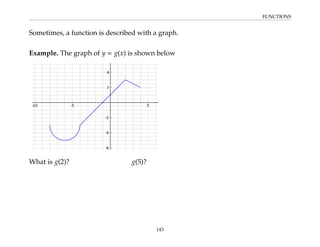
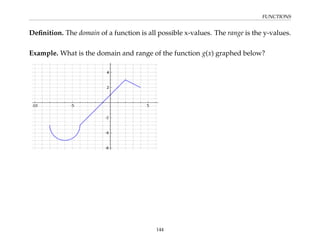
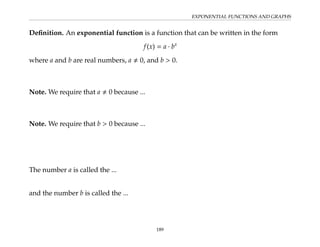
  • 156.
    TRANSFORMING FUNCTIONS Example. Graph •y = √ x • y = √ x − 2 • y = √ x − 2 156
  • 157.
    TRANSFORMING FUNCTIONS Rules fortransformations: • Numbers on the outside of the function affect the y-values and result in vertical motions. These motions are in the direction you expect. • Numbers on the inside of the function affect the x-values and result in horizontal motions. These motions go in the opposite direction from what you expect. • Adding results in a shift (translations) • Multiplying results in a stretch or shrink • A negative sign results in a reflection 157
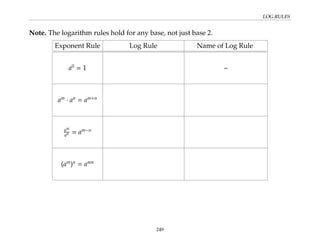
  • 158.
    TRANSFORMING FUNCTIONS Example. Considerg(x) = √ x. How do the graphs of the following functions compare to the graph of y = √ x? a) y = √ x − 4 b) y = √ x + 12 c) y = −3 · √ x d) y = q 1 4x END OF VIDEO 158
  • 159.
    TRANSFORMING FUNCTIONS Rules ofFunction Transformations (see graph animations involving y = √ x and y = sin(x)) • A number added on the OUTSIDE of a function ... • A number added on the INSIDE of a function .... • A number multiplied on the OUTSIDE of a function .... • A number mulitplied on the INSIDE of a function .... • A negative sign on the OUTSIDE of a function .... • A negative sign on the INSIDE of a function .... 159
  • 160.
    TRANSFORMING FUNCTIONS Example. Considerh(x) = x2 . How do the graphs of the following functions compare to the graph of y = x2 ? a) y = 3x2 b) y = (x − 7 2)2 c) y = x2 + 5 d) y = (5x)2 e) y = −3(x − 2)2 + 7 160
  • 161.
    TRANSFORMING FUNCTIONS Note. Thereare two approaches to graphing transformed functions: 161
  • 162.
    TRANSFORMING FUNCTIONS Example. Thegraph of a certain function y = f(x) is shown below. Use transformations to draw the graph of the function y = − f(2x). Label at least 5 points on your final graph. 162
  • 163.
    TRANSFORMING FUNCTIONS Example. Thegraph of a certain function y = f(x) is shown below. Use transformations to draw the graph of the function y = f(x + 1) + 2. Label at least 5 points on your final graph. 163
  • 164.
    TRANSFORMING FUNCTIONS Example. Supposethe graph of y = f(x) contains the point (3, −1). Identify a point that must be on the graph of y = 2f(x − 1). A. (2, −1) B. (2, −1) C. (4, −1) D. (4, −2) 164
  • 165.
    QUADRATIC FUNCTIONS Quadratic Functions Aftercompleting this section, students should be able to: • Find the x-intercepts and y-intercept or a quadratic function. • Find the vertex of a quadratic function. • Determine from the equation of a quadratic function if the graph will be pointing up or down. • Graph a quadratic function from its equation. • Convert a quadratic function from standard form to vertex form and vice versa. 165
  • 166.
    QUADRATIC FUNCTIONS Example. Whichof these equations represent quadratic functions? • g(x) = −5x2 + 10x + 3 • f(x) = x2 • y = 3x − 2 • y = 2(x − 3)2 + 4 166
  • 167.
    QUADRATIC FUNCTIONS Example. Graphthe following functions. For each graph label the vertex and the x-intercepts. A. f(x) = x2 B. y = −3x2 C. y = 2(x − 3)2 + 4 D. g(x) = 5x2 + 10x + 3 167
  • 168.
    QUADRATIC FUNCTIONS Summary To grapha quadratic function f(x) = ax2 + bx + c • The graph has the shape .... • The parabola opens up if ... and down if ... • To find the x-intercepts ... • To find the vertex ... • To find additional points on the graph .... 168
  • 169.
    QUADRATIC FUNCTIONS Example. Convertthis quadratic function to standard form: f(x) = −4(x − 3)2 + 1 Example. Convert this quadratic function to vertex form: g(x) = 2x2 + 8x + 6 END OF VIDEOS 169
  • 170.
    QUADRATIC FUNCTIONS Example. Whatis the vertex for this quadratic function? f(x) = 3(x + 4)2 − 1 A. (4, 1) B. (4, −1) C. (−4, 1) D. (−4, −1) 170
  • 171.
    QUADRATIC FUNCTIONS Example. Doesthe graph of this quadratic function open up or down? y = −5x2 +40x−3 A. Up B. Down Example. Find the vertex for the quadratic function y = −5x2 + 40x − 3 Write your answer as an ordered pair. Write the equation for this function in vertex form y = a(x − h)2 + k 171
  • 172.
    QUADRATIC FUNCTIONS Example. Findthe x-intercepts and the vertex for y = 3x2 + 7x − 5. 172
  • 173.
    QUADRATIC FUNCTIONS Justification ofthe Vertex Formula Find the x-intercepts and vertex for y = ax2 +bx+c. 173
  • 174.
    APPLICATIONS OF QUADRATICFUNCTIONS Applications of Quadratic Functions After completing this section, students should be able to: • Write a quadratic equation to model a real world problem. • Use a quadratic equation to answer questions involving maximums and minimums in a real world context. • Use a quadratic equation to determine values of one variable based on given values of the other in a real world context. 174
  • 175.
    APPLICATIONS OF QUADRATICFUNCTIONS Example. A projectile is launched straight up into the air so that its height in feet above the ground after t seconds is given by the function h(t) = −16t2 + 380t + 100 • How high does it go? • When does it reach its maximum height? • When does it hit the ground? 175
  • 176.
    APPLICATIONS OF QUADRATICFUNCTIONS Example. A rancher plans to build a rectangular corral according to the plan shown in the diagram. If the rancher has a total length of 800 feet of fencing, determine the dimensions that will allow for the maximum enclosed area. 176
  • 177.
    APPLICATIONS OF QUADRATICFUNCTIONS Example. A rain gutter is formed by bending up the sides of a 30-inch wide and very long rectangular metal sheet. Where should we put the bends to maximize the amount of rain the gutter can carry? 177
  • 178.
    POLYNOMIALS Polynomials After completing thissection, students should be able to: • Find the leading term, leading coefficient, and degree of a polynomial. • Describe the relationship between the degree of the polynomial and the number of turning points. • Predict the end behavior of the graph of a polynomial from the degree and the leading coefficient. • Use the graph of a polynomial to determine what are all the possible options for degree and what the sign of the leading coefficient must be. • Find the x- and y-intercepts of a rational function. • Use the graph of a function to determine if a zero has multiplicity one or two. • Write down the equation of polynomial from its graph. • Match graphs of polynomials to equations. 178
  • 179.
    POLYNOMIALS Definition. The degreeof the polynomial is The leading term is Definition. The leading coefficient is Definition. The constant term is Example. For p(x) = 5x3 − 3x2 − 7x4 + 2x + 18, what is the • degree? • leading term? • leading coefficient? • constant term? 179
  • 180.
    POLYNOMIALS Definition. In thegraph of f(x) = x4 + 2x3 − 15x2 − 12x + 36 below, the marked points are called ... Compare the degrees of the polynomials to the number of turning points: f(x) = −2x2 + 2x + 8 f(x) = 3x3 − 5x2 − 7x + 13 f(x) = x4 + 6x2 − 17 180
  • 181.
    POLYNOMIALS Definition. The endbehavior of a function is how the “ends” of the function look as x → ∞ and x → −∞. Consider the end behavior for these polynomials: f(x) = −2x2 + 2x + 8 f(x) = x4 + 2x3 − 15x2 − 12x + 36 f(x) = 3x3 − 5x2 − 7x + 13 f(x) = −x3 + 12x 181
  • 182.
    POLYNOMIALS Example. What canyou tell about the equation for the polynomial graphed below? END OF VIDEO 182
  • 183.
    POLYNOMIALS Example. Which figureshows the graph of y = −2x5 + 12x4 − 22x3 + 12x2 + 1? 183
  • 184.
    POLYNOMIALS Extra Example. Thegraph of a polynomial function f(x) is shown below. What is the sign of the leading coefficient of f? What are the possible values for the degree of f? 184
  • 185.
    POLYNOMIALS Example. Which figureshows the graph of y = (x − 3)(x + 4)2 ? 185
  • 186.
    POLYNOMIALS Note. It ispossible to use a number line to show that the graph of y = (x − 3)(x + 4)2 ”bounces” off the x-axis at x = −4 but not at x = 3. 186
  • 187.
    POLYNOMIALS Example. Find theequation for this graph: 187
  • 188.
    EXPONENTIAL FUNCTIONS ANDGRAPHS Exponential Functions and Graphs After completing this section, students should be able to • Identify the domain, range, and horizontal asymptote of an exponential function from its graph or from its equation. • For a function of the form, y = a · bx , explain how the values of a and b determine whether the graph is increasing or decreasing, how steeply it is increasing or decreasing, and what the value of its y-intercept is. • Graph exponential functions and their transformations. • Match the graphs of exponential functions to their equations. 188
  • 189.
    EXPONENTIAL FUNCTIONS ANDGRAPHS Definition. An exponential function is a function that can be written in the form f(x) = a · bx where a and b are real numbers, a , 0, and b 0. Note. We require that a , 0 because ... Note. We require that b 0 because ... The number a is called the ... and the number b is called the ... 189
  • 190.
    EXPONENTIAL FUNCTIONS ANDGRAPHS Example. Graph the function f(x) = 3 · 2x Example. Graph the function g(x) = 3 · 1 2 x . 190
  • 191.
    EXPONENTIAL FUNCTIONS ANDGRAPHS Example. Graph the function y = a · bx for different values of a and b simultaneously. 191
  • 192.
    EXPONENTIAL FUNCTIONS ANDGRAPHS Fact. In the graph of y = a · bx : • The parameter gives the y-intercept. • The parameter tells how the graph is increasing or decreasing. • If b 1, the graph is . • If b 1, the graph is . • The closer b is to the number , the flatter the graph. So, for example, the graph of y = 0.25x is (circle one) flatter / more steep than the graph of y = 0.4x . Fact. The graph of an exponential function y = a · bx • has a horizontal asymptote at the line . • has domain . • has range . Note. The most famous exponential function in the world is f(x) = ex . This func- tion is sometimes written as f(x) = exp(x). The number e is Euler’s number, and is approximately 2.71828182845904523... 192
  • 193.
    EXPONENTIAL FUNCTIONS ANDGRAPHS END OF VIDEO Question. What are some examples of exponential functions in the real world? Hint: what quantities have ”exponential growth” or ”exponential decay”? 193
  • 194.
    EXPONENTIAL FUNCTIONS ANDGRAPHS Example. Which graph represents which? 1. y = 5 · 1 3 x 2. y = 3 · 2x 3. y = 4 · 2−x 194
  • 195.
    EXPONENTIAL FUNCTIONS ANDGRAPHS What is the domain, range, and horizontal asymptote for each of these three functions? 1. y = 5 · 1 3 x 2. y = 3 · 2x 3. y = 4 · 2−x 195
  • 196.
    EXPONENTIAL FUNCTIONS ANDGRAPHS Summary: In the equation y. = a · bx , how do a and b affect the graph ? Consider: • y-intercept • x-intercept • Increasing / decreasing • Steepness • Domain • Range • Horizontal asymptote(s) • Vertical asymptote(s) 196
  • 197.
    EXPONENTIAL FUNCTIONS ANDGRAPHS Example. For the following function, determine the domain, range, and horizontal asymptote: y = 4 · 1 2 x − 6 197
  • 198.
    EXPONENTIAL FUNCTIONS ANDGRAPHS Example. For the following function, determine the domain, range, and horizontal asymptote: y = − 1 4 x+1 + 2 198
  • 199.
    EXPONENTIAL FUNCTIONS ANDGRAPHS Example. Match the equations to the graphs. 1. 2. 3. 4. 5. A. y = 4 · 0.9x B. y = 4 · 1.5x C. y = 4 · 3−x D. y = 3 · 2x E. y = −3 · 2x 199
  • 200.
    APPLICATIONS OF EXPONENTIALFUNCTIONS Applications of Exponential Functions After completing this section, students should be able to: • Write an exponential function to model exponential growth or decay. • Given the equation of an exponential function, determine the initial value, the growth factor, and the percent by which the quantity is increasing or decreasing during each time unit. 200
  • 201.
    APPLICATIONS OF EXPONENTIALFUNCTIONS Example. You are hired for a job and the starting salary is $40,000 with an annual raise of 3% per year. How much will your salary be after 1 year? 2 years? 5 years? t years? 201
  • 202.
    APPLICATIONS OF EXPONENTIALFUNCTIONS Example. The United Nations estimated the world population in 2010 was 6.79 billion, growing at a rate of 1.1% per year. Assume that the growth rate stays the same. Write an equation for the population at t years after the year 2010. 202
  • 203.
    APPLICATIONS OF EXPONENTIALFUNCTIONS Example. Seroquel is metabolized and eliminated from the body at a rate of 11% per hour. If 400 mg are given, how much remains in the body after 24 hours? END OF VIDEO 203
  • 204.
    APPLICATIONS OF EXPONENTIALFUNCTIONS Example. During the Ebola epidemic in 2014, the total number of Ebola cases in Guinea, Sierra Leone, and Liberia was increasing by 25% every week. By June 1, there were 528 reported cases. Which of the following functions represents the total number of Ebola cases t weeks after June 1? A. f(t) = 528 + 25t B. f(t) = 528 + 0.25t C. f(t) = 528 · 25t D. f(t) = 528 · (0.25)t E. f(t) = 528 · (1.25)t Based on this model, how many cases do you expect 32 weeks after June 1? 204
  • 205.
    APPLICATIONS OF EXPONENTIALFUNCTIONS Example. The USDA reports that on Jan 1, 2016, there were 2.59 million honey bee colonies, which was an 8% drop from the number one year previously. If the number of honey bee colonies continues to drop by 8% each year, which function represents the number of honey bee colonies t years after Jan 1, 2016? A. f(t) = 2.59 · (−0.08)t B. f(t) = 2.59 · (0.08)t C. f(t) = 2.59 · (0.92)t D. f(t) = 2.59 · (1.08)t 205
  • 206.
    APPLICATIONS OF EXPONENTIALFUNCTIONS Example. Suppose the price of a 1 terabyte external hard drive is given by the function P(t) = 65 · 0.84t where t is time in years since 2016 and P(t) is price in dollars. 1. Is the price of the hard drive increasing or decreasing? 2. At what rate is it increasing or decreasing? Give your answer as a percent. 3. What was the price in 2016? 206
  • 207.
    APPLICATIONS OF EXPONENTIALFUNCTIONS Extra Example. The number of opioid overdose deaths per 100,00 people in the US is approximated by the equation D(t) = 9.0 · 1.14t , where t is the number of years since 2014 and D(t) is the number of deaths per year. 1. How many opioid overdose deaths were there in 2014? 2. Is the number of deaths increasing or decreasing? 3. At what rate is the number of deaths changing? 4. How many opioid overdose deaths do you expect per 100,000 people in 2018? 207
  • 208.
    COMPOUND INTEREST Compound Interest Aftercompleting this section, students should be able to: • Explain where the formula for compound interest comes from. • Solve for the final amount of money from the initial amount of money, or vice versa, given information about the interest rate, the compounding period, and the number of years. • Solve for the final amount of money from the initial amount of money, or vice versa, for continuously compounded interest, given information about the interest rate and the number of years. • Compare the money accumulated when interest is compounded at different time periods and continuously. 208
  • 209.
    COMPOUND INTEREST Example. Supposeyou invest $ 200 in a bank account that earns 3% interest every year. If you make no deposits or withdrawals, how much money will you have after 10 years? 209
  • 210.
    COMPOUND INTEREST Example. Youdeposit $300 in an account that earns 4.5% annual interest compounded semi-annually. How much money will you have 7 years? 210
  • 211.
    COMPOUND INTEREST Example. Youtake out a loan for $1,200 at an annual interest rate of 6%, compounded monthly. If you pay back the loan with interest as a lump sum, how much will you owe after 3 years? 211
  • 212.
    COMPOUND INTEREST Example. Youinvest $4000 in an account that gives 2.5% interest compounded contin- uously. How much money will you have after 5 years? 212
  • 213.
    COMPOUND INTEREST Summary: • Letr represent ... • Let t represent ... • Let A represent the initial amount of money ... Annual interest: Compound interest, compounded n times per year: Compound interest, compounded continuously. END OF VIDEO 213
  • 214.
    COMPOUND INTEREST Example. Matchthe equations with their descriptions: 1. y = Pert 2. y = P(1 + r)t 3. y = P 1 + r n nt 4. y = a · bt A. Money earns 5% interest once a year. B. Money earns 2% interest compounded monthly. C. Money earns interest compounded continuously, at an APR of 4%. D. A population grows at a rate of 3% an- nually. E. A population grows at a continuous rate of 7% per year. 214
  • 215.
    COMPOUND INTEREST Question. Ifyou invest $1000, how much money do you have after a year, (a) at a 5% APR compounding annually? (b) at a 5% APR compounded monthly? (c) at a 5% APR compounded daily? (d) at a 5% compounded continuously? Question. What is the APY (annual percentage yield) in each of these cases? 215
  • 216.
    COMPOUND INTEREST Extra Example.Your grandparents are loaning you $5000 to buy a car. Instead of making monthly payments, they ask that you pay back all the money in 10 years, with interest, all as a lump sum. They give you three options: Option 1: Annual interest rate of 9.0% compounded once a year. Option 2: Annual interest rate of 8.95%, compounded monthly. Option 3: Annual interest rate of 8.95%, compounded continuously. Which is best for you? Which is worst? 216
  • 217.
    CONTINUOUS GROWTH Continuous Growth Aftercompleting this section, students should be able to: • Write an equation to describe other quantities, like population, that grow or shrink continuously. • Compare and contrast the formulas y = a · bt and a · (1 + r)t for exponential growth and the formula y = a · ert for continuous exponential growth and explain why the two formulas yield different results when the same value of a and r is used in both. 217
  • 218.
    CONTINUOUS GROWTH Example. Writeequations to describe each of the following populations: a) A population grows at a continuous rate of 6% per year. b) A population shrinks at a continuous rate of 10.5% per year. 218
  • 219.
    CONTINUOUS GROWTH Example. Whichpopulation is growing fastest? a) A population that grows at a continuous rate of 19% per year. b) A population that grows at a rate of 19% per year. For the population that grows at a continuous rate of 19% per year, by what percent does it actually increase at the end of each year? 219
  • 220.
    CONTINUOUS GROWTH Compare andcontrast the formulas for: Exponential Growth Continuous Exponential Growth 220
  • 221.
    CONTINUOUS GROWTH Example. Rewritethe equation y = 40e0.17t in the form y = a · bt and in the form y = P(1 + r)t . Question. Could we rewrite the equation y = 88 · 1.07t in the form y = Pert ? 221
  • 222.
    LOGARITHMS Logarithms After completing thissection, students should be able to: • Rewrite a log equation as an exponential equation and vice versa. • Compute simple logarithms by hand by expressing the logarithm expression as a question about exponents. • Explain how to simplify expressions like log4 4z and 5log5 t and why this makes sense. • Explain why logs are useful. 222
  • 223.
    LOGARITHMS Definition. loga b= c means ac = b . You can think of logarithms as exponents: logab is the exponent (or “power”) that you have to raise a to, in order to get b. The number a is called the base of the logarithm. The base is required to be a positive number. Example. log2 8 = 3 because 23 = 8 log2 y = means 2 = y Example. Evaluate the following expressions by hand by rewriting them using expo- nents instead of logs: a) log2 16 = b) log2 2 = c) log2 1 2 = d) log2 1 8 = e) log2 1 = 223
  • 224.
    LOGARITHMS Example. Evaluate thefollowing expressions by hand by rewriting them using expo- nents instead of logs: a) log10 1, 000, 000 = b) log10 0.001 = c) log10 0 = d) log10 −100 = Note. It is possible to take the log of numbers that are but not of numbers that are . In other words, the domain of the function f(x) = loga(x) is: . Note. ln x means loge x, and is called the natural log. log x, with no base, means log10 x and is called the common log. You can find ln x and log x for various values of x using the buttons on your calculator. 224
  • 225.
    LOGARITHMS Example. Rewrite usingexponents. a) log3 1 9 = −2 b) log 13 = 1.11394 c) ln 1 e = −1 Example. Rewrite the following using logs. Do not solve for any variables. a) 3u = 9.78 b) e3x+7 = 4 − y END OF VIDEO 225
  • 226.
    LOGARITHMS What are logs? Away of writing exponents: log2 8 means ... log2 8 = 3 because ... 226
  • 227.
    LOGARITHMS What are logsgood for? • Working with quantities of wildly different sizes. • Solving equations with variables in the exponents. y = Pert y = 100e0.05t 227
  • 228.
    LOGARITHMS Example. What islog5 125? What is log5 1 5? 228
  • 229.
    LOGARITHMS Example. Rewrite thelog expression as an exponential expression: log3(2y) = 4. Example. Rewrite the exponential expression in terms of logs: e4u = 5 229
  • 230.
    LOGARITHMS Extra Example. Evaluatelog4 43 Extra Example. What is log6 6x ? 230
  • 231.
    LOGARITHMS Extra Example. Evaluate2log2 32 Extra Example. Evaluate 3log3 1 9 Extra Example. Evaluate 5log5 57 231
  • 232.
  • 233.
    LOGARITHMS Extra Example. Rewriteas an exponential equation and solve for x: logx+3 0.01 = 2 233
  • 234.
    LOG FUNCTIONS ANDGRAPHS Log Functions and Graphs After completing this section, students should be able to: • Recognize the graphs of log functions. • Graph a basic log function by hand. • Find the asymptote and intercepts of log functions like y = log2(x) and transformed log functions like y = log(x + 3). • Find the domains of functions involving logs. 234
  • 235.
    LOG FUNCTIONS ANDGRAPHS Example. Graph y = log2(x) by plotting points. 235
  • 236.
    LOG FUNCTIONS ANDGRAPHS Example. Graph y = ln(x) + 5. Find the domain, range, and asymptotes. 236
  • 237.
    LOG FUNCTIONS ANDGRAPHS Example. Graph y = log(x + 2). Find the domain, range, and asymptotes. 237
  • 238.
    LOG FUNCTIONS ANDGRAPHS Find the domain of f(x) = ln(2 − 3x). END OF VIDEO 238
  • 239.
    LOG FUNCTIONS ANDGRAPHS Example. Graph y = log2(x) y = log2(x) y = ln(x) What is the • domain • range • asymptote(s) • intercept(s) 239
  • 240.
    LOG FUNCTIONS ANDGRAPHS Which one of these graphs represents y = log(x + 3)? Where does the graph of y = log(x) have an asymptotes? What about y = log(x + 3)? What is the domain of y = log(x)? What about y = log(x + 3)? 240
  • 241.
    LOG FUNCTIONS ANDGRAPHS What is the domain of f(x) = log(x2 − 1)? 241
  • 242.
    COMBINING LOGS ANDEXPONENTS Combining Logs and Exponents After completing this section, students should be able to: • Recognize that loga ab = b and explain why this is true. • Recognize that aloga b = b and explain why this is true. 242
  • 243.
    COMBINING LOGS ANDEXPONENTS Example. Evaluate: a) log10 103 b) loge e4.2 c) 10log10 1000 d) eloge 9.6 Log Rule: For any base a, loga ax = Log Rule: For any base a, aloga x = 243
  • 244.
    COMBINING LOGS ANDEXPONENTS Example. Find 3log3 1.4 Example. Find ln(ex ) Example. Find 10log(3z) Example. True or False: ln 10x = x. END OF VIDEO 244
  • 245.
    COMBINING LOGS ANDEXPONENTS Example. Simplify the following expressions: A. log4 43 B. log2 2−5 C. 4log4 1 64 D. 7log7 18 E. ln e F. eln 5 245
  • 246.
    COMBINING LOGS ANDEXPONENTS Extra Example. Evaluate log6 62x+7 Extra Example. Evaluate 2log2(a+6) . 246
  • 247.
    LOG RULES Log Rules Aftercompleting this section, students should be able to: • Write down the product, quotient, and power rules for logs as equations, and describe them in words. • Explain how the product, quotient, and power rules for logs are related to the corresponding rules for exponents. • Use the log rules to expand the log of a complicated expression into a sum or difference of multiplies of logs. • Use the log rules to condense an expression involving a sum or difference of multiples of logs into a single log. 247
  • 248.
    LOG RULES Note. Recallsome of the exponent rules. 1. 2. Product rule: 3. Quotient rule: 4. Power rule: Note. The exponent rules hold for any base, not just base 2. The corresponding logarithm rules are: 1. 2. Product rule: 3. Quotient rule: 4. Power rule: 248
  • 249.
    LOG RULES Note. Thelogarithm rules hold for any base, not just base 2. Exponent Rule Log Rule Name of Log Rule a0 = 1 – am · an = am+n am an = am−n (am )n = amn 249
  • 250.
    LOG RULES Example. Rewritethe following as a sum or difference of logs: a) log x yz b) log(5 · 2t ) 250
  • 251.
    LOG RULES Example. Rewriteas a single log: a) log5 a − log5 b + log5 c b) ln(x + 1) + ln(x − 1) − 2 ln(x2 − 1) END OF VIDEO 251
  • 252.
    LOG RULES Review. logaab = Review. aloga b = Note. Which order of operations is the correct interpretation for log2 37 ? (a) log2(37 ) (b) (log2 3)7 252
  • 253.
    LOG RULES Name ofRule Exponent Rule Log Rule Description of Log Rule in Words Zero Power 30 = Product Rule 3a 3b = Quotient Rule 3a 3b = Power Rule (3a )b = 253
  • 254.
    LOG RULES Example. Rewritethese expressions using log rules. (a) log (x · y)4 = (b) log x · y4 = 254
  • 255.
    LOG RULES Example. Usethe properties of logs to expand the following expression: log       3 p y4 xz4       255
  • 256.
    LOG RULES Example. Useproperties of logs to expand the following expression: log (x + 4)5 √ x3 ! A. (log(x+4))5 √ (log(x))3 B. 5 log(x+4) 3 2 log(x) C. 5 log(x + 4) − 3 2 log(x) D. 5 log(x) + 5 log(4) − 3 2 log(x) 256
  • 257.
    LOG RULES Example. Writethe expression as a single log: 3 ln(x) − ln(x − 7) + ln(x + 1) 2 257
  • 258.
    LOG RULES Example. Writethe expression as a single log: log3(x + 2) − log3(y) − 1 3 log3(z − 1) A. log3 (x+2) 1 3 y(z−1) B. log3 (x+2) y(z−1)1/3 C. log3 (x+2)(z−1)1/3 y D. log3 x + 2 − y − (z − 1)1/3 258
  • 259.
    LOG RULES Example. Rememberingthe log rules, decide which of the following statements are true. (Select all correct answers, and assume all arguments of ln are positive numbers.) A. ln(x + 1) + ln(x − 1) = ln(x2 − 1) B. ln(x) − ln(y) = ln(x) ln(y) C. ln(9x + 17) = ln(9x) + ln(17) D. ln(x2) ln(x) = 2 for x , 1 E. ln(5x3 ) = 3 ln(5x) 259
  • 260.
    LOG RULES Extra Example.Remembering the log rules, decide which of the following statements are true. (Select all correct answers, and assume all arguments of ln are positive numbers.) A. log(1 a) = − log(a) B. 102 log x = x2 C. log(w − v) = log(w) log(v) 260
  • 261.
    SOLVING EXPONENTIAL EQUATIONS SolvingExponential Equations After completing this section students should be able to: 1. Use logs to solve equations with variables in the exponent. 261
  • 262.
    SOLVING EXPONENTIAL EQUATIONS Example.Solve: 5 · 2x+1 = 17 262
  • 263.
    SOLVING EXPONENTIAL EQUATIONS Example.Solve: 22x−3 = 5x−2 263
  • 264.
    SOLVING EXPONENTIAL EQUATIONS Example.Solve: 5 · e−0.05t = 3 · e0.2t END OF VIDEO 264
  • 265.
    SOLVING EXPONENTIAL EQUATIONS Example.In 2015, the population of Guatemala was 16.3 million and was growing at a rate of 2.1% per year. 1. Write an equation to model the population of Guatemala, assuming this rate of growth continues. Let t represent the number of years since 2015. 2. If this rate continues, when will the population of Guatemala reach 100 million? 265
  • 266.
    SOLVING EXPONENTIAL EQUATIONS Example.In 2015, the population of Nigeria was 182 million and was growing at a continuous rate of 2.7% per year. 1. Write an equation to model the population of Nigeria, assuming this rate of growth continues. Let t represent the number of years since 2015. 2. If this rate continues, when will the population of Nigeria reach 1 billion? 266
  • 267.
    SOLVING EXPONENTIAL EQUATIONS Example.Solve for x: 11−x+2 = 14−10x 267
  • 268.
    SOLVING EXPONENTIAL EQUATIONS Example.Solve for x: 42−3x = 5x 268
  • 269.
    SOLVING LOG EQUATIONS SolvingLog Equations After completing this sections, students should be able to: • Solve equations with log expressions in them. 269
  • 270.
    SOLVING LOG EQUATIONS Example.Solve: 2 ln(2x + 5) − 3 = 1 270
  • 271.
    SOLVING LOG EQUATIONS Example.Solve: log(x + 3) + log(x) = 1 271
  • 272.
    SOLVING LOG EQUATIONS Example.Solve: log3 5 = x Example. Solve: 4 · x6 − 1 = 18 END OF VIDEO 272
  • 273.
    SOLVING LOG EQUATIONS Example.Solve for x: 3 log2(x + 3) − 1 = 6 273
  • 274.
    SOLVING LOG EQUATIONS Example.Solve for x: log(x + 2) + log(x − 1) = 1 274
  • 275.
    DOUBLING TIME ANDHALF LIFE Doubling Time and Half Life After completing this section, students should be able to: • Define doubling time and half life. • Calculate doubling time of half life from an equation for exponential growth or decay or from a growth or decay rate. • Use double time or half life to write an equation to model exponential growth or decay in a real world applications. 275
  • 276.
    DOUBLING TIME ANDHALF LIFE Example. Suppose you invest $1600 in a bank account that earns 6.5% annual interest, compounded monthly. How many years will it take until the account has $2000 in it, assuming you make no further deposits or withdrawals? 276
  • 277.
    DOUBLING TIME ANDHALF LIFE Example. A population of bacteria contains 1.5 million bacteria and is growing by 12% per day. What is its doubling time? 277
  • 278.
    DOUBLING TIME ANDHALF LIFE Example. Suppose a bacteria population doubles every 15 minutes. Write an equation for its growth using the exponential equation y = a · bt , where t represents time in minutes. 278
  • 279.
    DOUBLING TIME ANDHALF LIFE Example. The half life of radioactive Carbon-14 is 5750 years. A sample of bone that originally contained 200 grams of C-14 now contains only 40 grams. How old is the sample? END OF VIDEO 279
  • 280.
    DOUBLING TIME ANDHALF LIFE Example. Suppose today, your grandparents put $10,000 in a bank account in your name, earning 4.5% annual interest, compounded monthly. How long will it take for that money to double (assuming no money is added or withdrawn)? What if the original deposit is $20,000 ? 280
  • 281.
    DOUBLING TIME ANDHALF LIFE Example. The doubling time of a bacteria population is 18 hours. How long will it take for the bacteria culture to grow from 5 grams to 12 grams? 281
  • 282.
    DOUBLING TIME ANDHALF LIFE Example. Tylenol has a half life of approximately 2.5 hours. If you take Tylenol once and then repeat the dose again after 4 hours, how much of the original dose is still in your system when you take the second dose? 282
  • 283.
    DOUBLING TIME ANDHALF LIFE Summary: • What are the equations we use to model exponential growth and decay (including interest rate problems)? • In what situations do we use each type? • In what situations can we freely choose between two or more equations? 283
  • 284.
    DOUBLING TIME ANDHALF LIFE Example. A car that was worth $15,000 in 2015 is now worth $11,000. A. Assuming an exponential decay model, what will the car be worth in 2025? B. Assuming a linear model, what will the car be worth in 2025? 284
  • 285.
    DOUBLING TIME ANDHALF LIFE Example. Write an equations to model the following situations: 1. In the year 2000, the population of raccoons on Island A was 70 thousand and increasing at a rate of 5% per year. Write an equation to model the raccoon population over time, where t represents years since 2000. 2. In the year 2000, the population of raccoons on Island B was 70 thousand and increasing at a rate of 5 thousand raccoons per year. Write an equation to model the raccoon population over time, where t represents years since 2000. 285
  • 286.
    DOUBLING TIME ANDHALF LIFE Extra Example. In 1991 hikers found the preserved body of a man partially frozen in a glacier in the Austrian Alps. It was found that the body of Otzi (as the iceman came to be called) contained 53% as much Carbon-14 as the body of a living person. What is the approximate date of his death? 286
  • 287.
    SOLVING SYSTEMS OFEQUATIONS Solving Systems of Equations After completing this section, students should be able to: • Determine if an (x, y) pair is the solution to a system of equations in two variables. • Use substitution to solve a system of linear equations in two variables. • Use elimination to solve a system of linear equations in two variables. • Determine algebraically if a system of linear equations has one solution, no solu- tions, or infinitely many solutions. • Explain how graphing the two linear equations in a system of equations can show whether the system will have one solution, no solutions, or infinitely many solutions. • Use substitution or elimination to solve a system of non-linear equations in two variables. 287
  • 288.
    SOLVING SYSTEMS OFEQUATIONS Example. Solve the system of equations: 3x − 2y = 4 5x + 6y = 2 288
  • 289.
    SOLVING SYSTEMS OFEQUATIONS Example. Solve the system of equations: 8y = 1 + 4x 3x − 6y = 2 289
  • 290.
    SOLVING SYSTEMS OFEQUATIONS Example. Solve the system of equations: x + 5y = 6 3x + 15y = 18 END OF VIDEO 290
  • 291.
    SOLVING SYSTEMS OFEQUATIONS Example. Solve for x and y: 1 5 x = 1 4 y − 6 − 3 4 x + 1 2 y = −2 291
  • 292.
    SOLVING SYSTEMS OFEQUATIONS Example. Which system of equations has NO solutions? A. x + y = 1, 2x + y = 3 B. x + y = 1, 2x + 2y = 4 C. x + y = 1, 2x + 2y = 2 292
  • 293.
    SOLVING SYSTEMS OFEQUATIONS Example. Solve for x and y: x2 = y − 10 3x + y = 14 293
  • 294.
    SOLVING SYSTEMS OFEQUATIONS Example. Solve for x and y: x2 + y2 = 25 x2 − 2y = 1 294
  • 295.
    APPLICATIONS OF SYSTEMSOF EQUATIONS Applications of Systems of Equations After completing this section, students should be able to: • Set up and solve systems of equations involving distance, rate, and time. • Set up and solve systems of equations involving mixtures and percents. • Set up and solve systems of equations involving costs, perimeters and areas, and other applications. 295
  • 296.
    APPLICATIONS OF SYSTEMSOF EQUATIONS Distance, Rate, and Time Example. Elsa’s boat has a top speed of 6 miles per hour in still water. While traveling on a river at top speed, she went 10 miles upstream in the same amount of time she went 30 miles downstream. Find the rate of the river current. 296
  • 297.
    APPLICATIONS OF SYSTEMSOF EQUATIONS Mixtures Example. Household bleach contains 6% sodium hypochlorite. How much household bleach should be combined with 70 liters of a weaker 1% sodium hypochlorite solution to form a solution that is 2.5% sodium hypochlorite? END OF VIDEOS 297
  • 298.
    APPLICATIONS OF SYSTEMSOF EQUATIONS Example. Two factory plants are making TV panels. Yesterday, Plant A produced 7000 fewer panels than Plant B did. Five percent of the panels from Plant A and 3% of the panels from Plant B were defective. If the two plants together produced 1090 defective panels, how many panels did Plant A produce? 298
  • 299.
    APPLICATIONS OF SYSTEMSOF EQUATIONS Example. A chef plans to mix 100% vinegar with Italian dressing. The Italian dressing contains 12% vinegar. The chef wants to make 160 milliliters of a mixture that contains 23% vinegar. How much vinegar and how much Italian dressing should she use? 299
  • 300.
    APPLICATIONS OF SYSTEMSOF EQUATIONS Example. Hannah and Linda and Caroline participated in a triathalon relay. Hannah did the swimming, Linda did the biking, and Caroline did the running. The biking distance plus the running distance together was 11 miles. Linda spent 30 minutes on the bike and Caroline spent 15 minutes running. If LindaÕs average speed on the bicycle was 10 mph faster than CarolineÕs average speed running, find LindaÕs average biking speed and CarolineÕs average running speed. 300
  • 301.
    APPLICATIONS OF SYSTEMSOF EQUATIONS Extra Example. Two trains leave towns 462 miles apart at the same time and travel toward each other. One train travels 20 miles per hour faster than the other. If they meet in 3 hours, what is the rate of each train? 301
  • 302.
    APPLICATIONS OF SYSTEMSOF EQUATIONS Rational Functions After completing this section, students should be able to: • Find the vertical asymptotes of a rational function. • Find the horizontal asymptotes of a rational function. • Find the holes of a rational function. • Find the x- and y-intercepts of a rational function, • Match equations of rational functions to graphs. • Write down the equation of a rational function from its graph. 302
  • 303.
    APPLICATIONS OF SYSTEMSOF EQUATIONS Example. The graph of the function h(x) = 3x2 − 12 x2 + 3x − 10 is shown below. How is the graph of this function h(x) different from the graph of a polynomial? What is the end behavior of the graph? What is the behavior of the graph of this function h(x) near x = −5? What is going on at x = 2? 303
  • 304.
    APPLICATIONS OF SYSTEMSOF EQUATIONS For a rational function • find the vertical asymptotes by: • find the holes by: • find the horizontal asymptotes by: Example. What are the horizontal asymptotes for these functions? 1. f(x) = 5x + 4 3x2 + 5x − 7 2. g(x) = 2x3 + 4 3x3 − 7x 3. h(x) = x2 + 4x − 5 2x − 1 304
  • 305.
    APPLICATIONS OF SYSTEMSOF EQUATIONS Example. Find the vertical asymptotes, horizontal asymptotes, and holes: q(x) = 3x2 + 3x 2x3 + 5x2 − 3x END OF VIDEO 305
  • 306.
    APPLICATIONS OF SYSTEMSOF EQUATIONS Example. Find the horizontal asymptotes of these three functions: 1. f(x) = −2x4 − 3x3 + x2 + 7x + 1 5x4 + 7 2. g(x) = x2 − 4x + 4 5x3 + 9x2 + 2x − 7 3. h(x) = 4x3 + 5x − 7 3x2 − 2x + 6 306
  • 307.
    APPLICATIONS OF SYSTEMSOF EQUATIONS Example. Which of these rational functions has a horizontal asymptote at y = 2? A. y = 2x (x − 3)(x + 5) B. y = 2x2 (x − 3)(x + 5) C. y = x − 2 2x2 D. y = (x + 4)(x − 1) (x − 2)(x + 3) 307
  • 308.
    APPLICATIONS OF SYSTEMSOF EQUATIONS Example. The function f(x) = x + 2 x2 + 3x + 2 has a vertical asymptote at x = −1 and a hole at x = −2. How could we predict this from its equation? 308
  • 309.
    APPLICATIONS OF SYSTEMSOF EQUATIONS Example. Find the horizontal asymptotes, vertical asymptotes, x- and y-intercepts, and holes of f(x) = (x − 2)(x − 3) (x − 3)(x + 1)2 309
  • 310.
    APPLICATIONS OF SYSTEMSOF EQUATIONS Example. Find the graph of the function y = (x − 3)(x + 2) (x + 4)(x − 1) 310
  • 311.
    APPLICATIONS OF SYSTEMSOF EQUATIONS Example. Find the equation of this rational function. 311
  • 312.
    COMBINING FUNCTIONS Combining Functions Aftercompleting this section, students should be able to: • Find equations for the sum, difference, product, and quotient of two functions, given their equations. • Use graphs or tables of values to find the sum, difference product, or quotient of two functions, evaluated at a number. 312
  • 313.
    COMBINING FUNCTIONS We cancombine functions, such as f(x) = x + 1 and g(x) = x2 in the following ways. • Add them together: (f + g)(x) = • Subtract them: (f − g)(x) = • Multiply them: (f · g)(x) = • Divide them: f g ! (x) = 313
  • 314.
    COMBINING FUNCTIONS Example. Thefollowing graphs represent two functions h and p. Find a) (h − p)(0) b) (ph)(−3) END OF VIDEO 314
  • 315.
    COMBINING FUNCTIONS Example. Supposef(x) = x2 and g(x) = 3x − 2. Find (a) (f + g)(2) (b) (f − g)(x) (c) (f g)(−1) (d) f g (x) 315
  • 316.
    COMBINING FUNCTIONS Example. Lett represent the number of years since 2010 and consider the following: • f(t) is the number of tickets sold per week by Mission X Escape at time t. • g(t) is the number of tickets sold per week by Bull City Escape at time t. • p(t) is the cost of a ticket at Mission X as a function of time t. • q(t) is the cost of a ticket at Bull City Escape as a function of time t. • d(t) is the population of Durham in thousands of people at time t. How could you represent the following quantities as functions of t? 1. The total number of escape room tickets sold per week in Durham as a function of time? (Assume there are only the two venues: Mission X and Bull City.) 2. The weekly revenue at of Mission X Escape as a function of time? 3. The total weekly revenue from escape room tickets in Durham, as a function of time? 4. The total per capita weekly revenue from escape room tickets in Durham, as a function of time? 316
  • 317.
    COMPOSITION OF FUNCTIONS Compositionof Functions After completing this section, students should be able to: • Find the composition of two functions given as equations. • Use graphs or tables of values to find the composition of two functions, evaluated at a point. • Decompose a function into the composition of two other functions. 317
  • 318.
    COMPOSITION OF FUNCTIONS Thecomposition of two functions: g ◦ f(x) is defined by: I J J䌬㻌㼒 318
  • 319.
    COMPOSITION OF FUNCTIONS Example.The tables below define the functions f and g. x 1 2 3 4 5 f(x) 8 3 6 7 4 x 4 5 6 7 8 9 g(x) 1 3 8 10 2 2 Find: a) g ◦ f(4) b) f ◦ g(4) c) f ◦ f(2) d) f ◦ g(6) 319
  • 320.
    COMPOSITION OF FUNCTIONS Example.Let p(x) = x2 + x. Let q(x) = −2x. Find: a) q ◦ p(1) b) q ◦ p(x) c) p ◦ q(x) d) p ◦ p(x) Note. In general, f ◦ g , g ◦ f! 320
  • 321.
    COMPOSITION OF FUNCTIONS Example.h(x) = √ x2 + 7. Find functions f and g so that h(x) = f ◦ g(x). Example. r(x) = (7x + 2)3 . Find f and g such that r(x) = f ◦ g(x). END OF VIDEO 321
  • 322.
    COMPOSITION OF FUNCTIONS Example.Two children decided to run a lemonade and hot chocolate stand. The function f(x) = 3|x − 65| + 10 represents the number of drinks sold as a function of the day’s high temperature in degrees Fahrenheit. The function g(x) = 0.5x − 5 represents the profit in dollars as a function of the number of drinks sold. The kids want to know how much they’ll make if the day’s high temperature is 75◦ degrees. Find the answer for them. In general, how much money will they make as a function of the temperature in degrees Fahrneheit? 322
  • 323.
    COMPOSITION OF FUNCTIONS Example.Let f(x) = 1 x and g(x) = x2 + 3x. Find a) f ◦ g(x) b) g ◦ f(x) c) g ◦ g(x) d) f ◦ f(x) 323
  • 324.
    COMPOSITION OF FUNCTIONS Example.Consider the function H(x) = 3 r 1 x + 1 . Find two function f and g such that H(x) = f ◦ g(x). 324
  • 325.
    COMPOSITION OF FUNCTIONS Example.Consider the function P(x) = 4e3x−7 . Find two function f and g such that H(x) = f ◦ g(x). 325
  • 326.
    INVERSE FUNCTIONS Inverse functions Aftercompleting this section, students should be able to: • Based on the graph of a function, determine if the function has an inverse that is a function. • Draw the graph of an inverse function, given the graph of the original. • Use a table of values for a function to write a table of values for its inverse. • Determine if two given functions are inverses of each other by computing their compositions. • Use a formula for a function to find a formula for its inverse. • Find the range of the inverse function from the domain of the original function. • Find the domain of the inverse function from the range of the original function. 326
  • 327.
    INVERSE FUNCTIONS Example. Supposef(x) is the function defined by the chart below: x 2 3 4 5 f(x) 3 5 6 1 In other words, • f(2) = 3 • f(3) = 5 • f(4) = 6 • f(5) = 1 Definition. The inverse function for f, written f−1 (x), undoes what f does. I [ ¦A í [ • f−1 ( 3 ) = 2 • f−1 ( ) = • f−1 ( ) = • f−1 ( ) = x 3 f−1 (x) 2 Key Fact 1. Inverse functions reverse the roles of y and x. 327
  • 328.
    INVERSE FUNCTIONS Graph y= f(x) and y = f−1 (x) on the same axes below. What do you notice about the points on the graph of y = f(x) and the points on the graph of y = f−1 ? Key Fact 2. The graph of y = f−1 (x) is obtained from the graph of y = f(x) by reflecting over the line . 328
  • 329.
    INVERSE FUNCTIONS In oursame example, compute: f−1 ◦ f(2) = f ◦ f−1 (3) = f−1 ◦ f(3) = f ◦ f−1 (5) = f−1 ◦ f(4) = f ◦ f−1 (6) = f−1 ◦ f(5) = f ◦ f−1 (1) = Key Fact 3. f−1 ◦ f(x) = and f ◦ f−1 (x) = . This is the mathematical way of saying that f and f−1 undo each other. Example. f(x) = x3 . Guess what the inverse of f should be. Remember, f−1 undoes the work that f does. 329
  • 330.
    INVERSE FUNCTIONS Example. Findthe inverse of the function: f(x) = 5 − x 3x Note. f−1 (x) means the inverse function for f(x). Note that f−1 (x) , 1 f(x). 330
  • 331.
    INVERSE FUNCTIONS Question. Doall functions have inverse functions? That is, for any function that you might encounter, is there always a function that is its inverse? Try to find an example of a function that does not have an inverse function. 331
  • 332.
    INVERSE FUNCTIONS Key Fact4. A function f has an inverse function if and only if the graph of f satisfies the horizontal line test (i.e. every horizontal line intersects the graph of y = f(x) in at most one point.) Definition. A function is one-to-one if it passes the horizontal line test. Equivalently, a function is one-to-one if for any two different x-values x1 and x2, f(x1) and f(x2) are different numbers. Sometimes, this is said: f is one-to-one if, whenever f(x1) = f(x2), then x1 = x2. 332
  • 333.
    INVERSE FUNCTIONS Example. (Tricky)Find p−1 (x), where p(x) = √ x − 2 drawn above. Graph p−1 (x) on the same axes as p(x). For the function p(x) = √ x − 2, what is: • the domain of p? • the range of p? • the domain of p−1 ? • the range of p−1 ? Key Fact 5. For any invertible function f, the domain of f−1 (x) is and the range of f−1 (x) is . 333
  • 334.
    INVERSE FUNCTIONS END OFVIDEO What are some facts about inverse functions? 334
  • 335.
    INVERSE FUNCTIONS Example. Thegraph of f(x) is show below. Find the graph of f−1 (x). 335
  • 336.
    INVERSE FUNCTIONS Example. Foreach function graph, determine whether it has an inverse function. A. B. C. D. 336
  • 337.
    INVERSE FUNCTIONS Example. Considerthe function g(x) = 5 − x x + 2 . What is the RANGE of g−1 (x)? Hint: you do not need to compute a formula for g−1 (x) to answer this question. 337
  • 338.
    INVERSE FUNCTIONS Example. Iff(x) = x 2 − 1, what is the inverse function f−1 (x)? A) p(x) = 1 x 2 − 1 B) r(x) = 2 x + 1 C) v(x) = 2(x + 1) D) w(x) = 2x + 1 338
  • 339.
    INVERSE FUNCTIONS Example. Findthe inverse function for the exponential function f(x) = 10x . Example. Find the inverse function for the exponential function g(x) = ex . 339
  • 340.
    INVERSE FUNCTIONS Example. Graphg(x) = 10x and its inverse g−1 (x) = log10 x on the same axes. List the properties of the graphs, including domain, range, and asymptotes. y = 10x y = log10(x) 340
  • 341.
    INVERSE FUNCTIONS Example. Findthe inverse of the function: f(x) = 3x + 1 x − 6 341
  • 342.
    INVERSE FUNCTIONS Example. Findthe inverse of the function: f(x) = 7 − x 2x + 3 Find the domain and range of f(x) and f−1 (x). 342
  • 343.
    INVERSE FUNCTIONS Example. Accordingto math lore, if you are age x, the oldest person that it is okay for you to date is given by the formula d(x) = 2x − 14. Plug in your own age for x and see how old a person you can date. Suppose you want to date a younger person instead of an older person. Invert the formula to find out how young a person someone of a given age can date. Plug in your own age for x into d−1 (x) and see how young a person you can date. 343
  • 344.
    INVERSE FUNCTIONS Extra Example.h(x) = 7 − x3 . Find h−1 (x) by reversing the roles of y and x and solving for y. 344
  • 345.
    INVERSE FUNCTIONS Extra Example.Find f−1 (x), where f(x) = √ x + 1. Graph f−1 (x) on the same axes as f(x). For the function f(x) = √ x + 1, what is: • the domain of f? • the range of f? • the domain of f−1 ? • the range of f−1 ? 345
  • 346.
    SYMMETRY AND EVENAND ODD FUNCTIONS Symmetry and Even and Odd Functions After completing this sections, students should be able to: • Identify whether a graph is symmetric with respect to the x-axis, symmetric with respect to the y-axis, symmetric with respect to the origin, or none of these. • Determine whether a function is even or odd or neither, based in its equation. 346
  • 347.
    SYMMETRY AND EVENAND ODD FUNCTIONS Definition. A graph is sym- metric with respect to the x- axis if ... Whenever a point (x, y) is on the graph, the point is also on the graph. Definition. A graph is sym- metric with respect to the y- axis if ... Whenever a point (x, y) is on the graph, the point is also on the graph. Definition. A graph is sym- metric with respect to the ori- gin if ... Whenever a point (x, y) is on the graph, the point is also on the graph. 347
  • 348.
    SYMMETRY AND EVENAND ODD FUNCTIONS Example. Which graphs are symmetric with respect to the x-axis, the y-axis, the origin, or neither? 348
  • 349.
    SYMMETRY AND EVENAND ODD FUNCTIONS Example. Which graphs are symmetric with respect to the x-axis, the y-axis, the origin, or neither? 1. y = 2 x3 + x 2. x2 + 2y4 = 6 349
  • 350.
    SYMMETRY AND EVENAND ODD FUNCTIONS Definition. A function f(x) is even if ... Example. f(x) = x2 + 3 is even because ... Definition. A function f(x) is odd if ... Example. f(x) = 5x − 1 x is odd because ... Question. There is no word like even or odd for when a function’s graph is symmetric with respect to the x-axis. Why not? 350
  • 351.
    SYMMETRY AND EVENAND ODD FUNCTIONS Example. Determine whether the functions are even, odd, or neither. 1. f(x) = 4x3 + 2x 2. g(x) = 5x4 − 3x2 + 1 3. h(x) = 2x3 + 7x2 351
  • 352.
    PIECEWISE FUNCTIONS Piecewise Functions Aftercompleting this sections, students should be able to: • Evaluate piecewise functions at a given x-value. • Graph piecewise functions 352
  • 353.
    PIECEWISE FUNCTIONS Example. Thefunction f is defined as follows: f(x) =        1 − x2 if x 1 −2x + 3 if x ≥ 1 1. What is f(−2)? What is f(1)? 2. Graph y = f(x). 3. Is f(x) continuous? 353
  • 354.
  • 355.
    REVIEW Review Decide which ofthe following statements are true. (Select all correct answers, and assume all arguments of ln are positive numbers.) A. √ x2 + 4 = x + 2 B. log(1 a) = − log(a) C. 102 log x = x2 D. log(w − v) = log(w) log(v) E. log2(x + 8) = log2(x) + 3 355
  • 356.
    REVIEW What are sometypes of equations we have solved? What are some techniques for solving equations? What are extraneous solutions? When do we have to watch for them? 356
  • 357.
    REVIEW What types ofequations are these? What technique is needed to solve them? 1. 3 2 − x = 4 x 2. (x − 2)(x + 1) = 3 for x 3. 2x = 3x+1 4. 5x5 = 17 5. 7 log(5x) = 2 6. √ 4 + x + 2 = x 7. 3x2/3 + 1 = 28 8. y = 4 − 3x 5x − 9 for x 357
  • 358.
    REVIEW What kinds ofinequalities have we solved? What techniques do we use? 358
  • 359.
    REVIEW 1. x2 − 1 x +3 0 2. 7 1 − 3|2 − 4x| 3. x3 + 5x2 ≤ 6x 4. 8x + 4 5x − 2 and 2 − 3x 5x 359
  • 360.
    REVIEW What do wehave to worry about when looking for domains? 360
  • 361.
    REVIEW What types ofequations are these? What technique is needed to solve them? 1. A = P(1 + rt) for r 2. 1 a + 1 b = 1 c for b 3. y = 4 − 3x 5x − 9 for x 4. a + b = rx − 4x2 for x 5. M = log(I S) for S 6. bat = 3 + x for t 7. bat = 3 + x for a 8. √ 4 + x = 3y for x 361