Radicals are rad!
I wonder if they can be simplified? Hmmmmm….
“ Simplified” means that there are no perfect square factors in the radicand.
Objective: Given 10 different radicals, students will be able to simplify at least 9 of them correctly.
Purpose: To be able to compute radicals and express the answer in simplest radical form To do well on their assessments quizzes chapter test final exam CRCT Yeah!  Way cool!
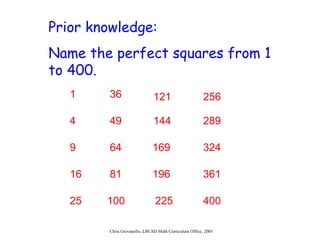
Prior knowledge: Name the perfect squares from 1 to 400. 1 4 9 16 25 36 49 64 81 100 121 144 169 196 225 256 289 324 361 400
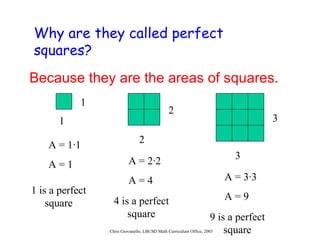
Why are they called perfect squares? Because they are the areas of squares. 1 1 2 2 3 3 A = 1·1 A = 1 A = 2·2 A = 4 A = 3·3 A = 9 1 is a perfect square 4 is a perfect square 9 is a perfect square
Is 8 a perfect square? No o o o o o   !
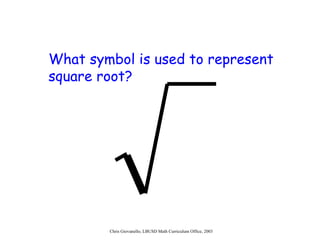
What symbol is used to represent square root?
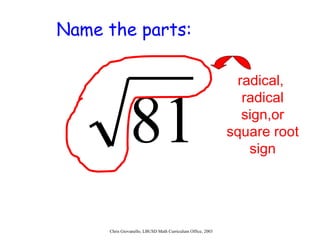
Name the parts: radical,  radical sign,or square root sign
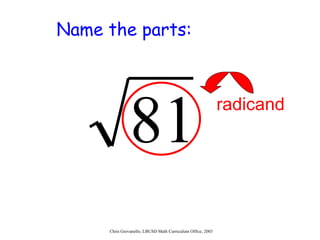
Name the parts: radicand
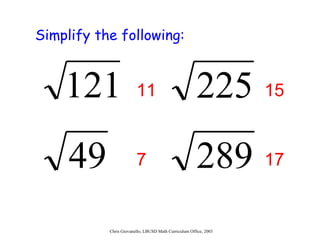
Simplify the following: 11  15 7  17
What if the radicand is not a perfect square? Huh?
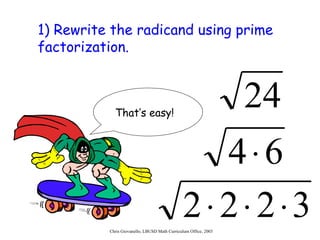
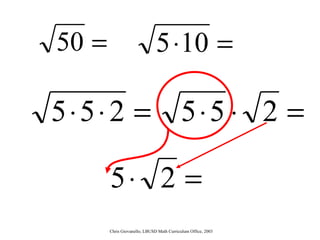
1) Rewrite the radicand using prime factorization. That’s easy!
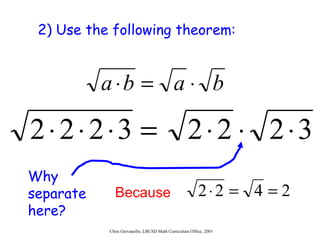
2) Use the following theorem: Why separate here? Because
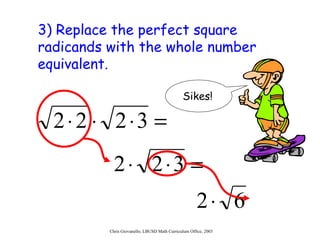
3) Replace the perfect square radicands with the whole number equivalent. Sikes!
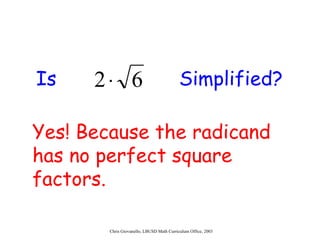
Is Simplified? Yes! Because the radicand has no perfect square factors.
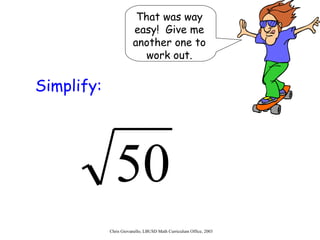
That was way easy!  Give me another one to work out. Simplify:
 
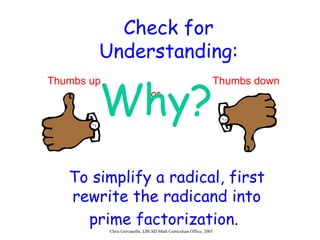
Check for Understanding: Thumbs up or Thumbs down To simplify a radical, first rewrite the radicand into prime factorization.   Why?
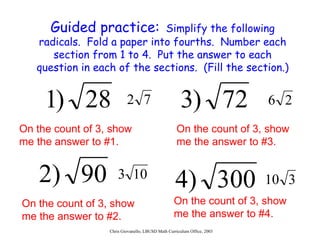
Guided practice:   Simplify the following radicals.  Fold a paper into fourths.  Number each section from 1 to 4.  Put the answer to each question in each of the sections.  (Fill the section.) On the count of 3, show me the answer to #1. On the count of 3, show me the answer to #2. On the count of 3, show me the answer to #3. On the count of 3, show me the answer to #4.
You are now ready to add and subtract radicals!

Simplifying+radicals

  • 1.
  • 2.
    I wonder ifthey can be simplified? Hmmmmm….
  • 3.
    “ Simplified” meansthat there are no perfect square factors in the radicand.
  • 4.
    Objective: Given 10different radicals, students will be able to simplify at least 9 of them correctly.
  • 5.
    Purpose: To beable to compute radicals and express the answer in simplest radical form To do well on their assessments quizzes chapter test final exam CRCT Yeah! Way cool!
  • 6.
    Prior knowledge: Namethe perfect squares from 1 to 400. 1 4 9 16 25 36 49 64 81 100 121 144 169 196 225 256 289 324 361 400
  • 7.
    Why are theycalled perfect squares? Because they are the areas of squares. 1 1 2 2 3 3 A = 1·1 A = 1 A = 2·2 A = 4 A = 3·3 A = 9 1 is a perfect square 4 is a perfect square 9 is a perfect square
  • 8.
    Is 8 aperfect square? No o o o o o !
  • 9.
    What symbol isused to represent square root?
  • 10.
    Name the parts:radical, radical sign,or square root sign
  • 11.
  • 12.
  • 13.
    What if theradicand is not a perfect square? Huh?
  • 14.
    1) Rewrite theradicand using prime factorization. That’s easy!
  • 15.
    2) Use thefollowing theorem: Why separate here? Because
  • 16.
    3) Replace theperfect square radicands with the whole number equivalent. Sikes!
  • 17.
    Is Simplified? Yes!Because the radicand has no perfect square factors.
  • 18.
    That was wayeasy! Give me another one to work out. Simplify:
  • 19.
  • 20.
    Check for Understanding:Thumbs up or Thumbs down To simplify a radical, first rewrite the radicand into prime factorization. Why?
  • 21.
    Guided practice: Simplify the following radicals. Fold a paper into fourths. Number each section from 1 to 4. Put the answer to each question in each of the sections. (Fill the section.) On the count of 3, show me the answer to #1. On the count of 3, show me the answer to #2. On the count of 3, show me the answer to #3. On the count of 3, show me the answer to #4.
  • 22.
    You are nowready to add and subtract radicals!