2014 DIVISION MID-YEAR INSET ON 
CONTENT AND PEDAGOGY FOR 
SECONDARY MATHEMATICS 
EDUCATION 
DAYAP NATIONAL HIGH SCHOOL 
CALAUAN, LAGUNA 
ALVIN O. INSORIO 
Pacita Complex National High School
Module 4 
Rational 
Exponents and 
Radicals
Lessons: 1. Zero, Negative Integral 
and Rational Exponents 
2. Radicals 
3. Solving Radical Equations
Priming 
1. Have you ever wondered about how to 
identify the side lengths of a square lot 
if you know its area? 
2. Have you tried solving for the length of 
any side of a right triangle? 
3. Has it come to your mind how you can 
find the radius of a cylindrical water 
tank given its volume?
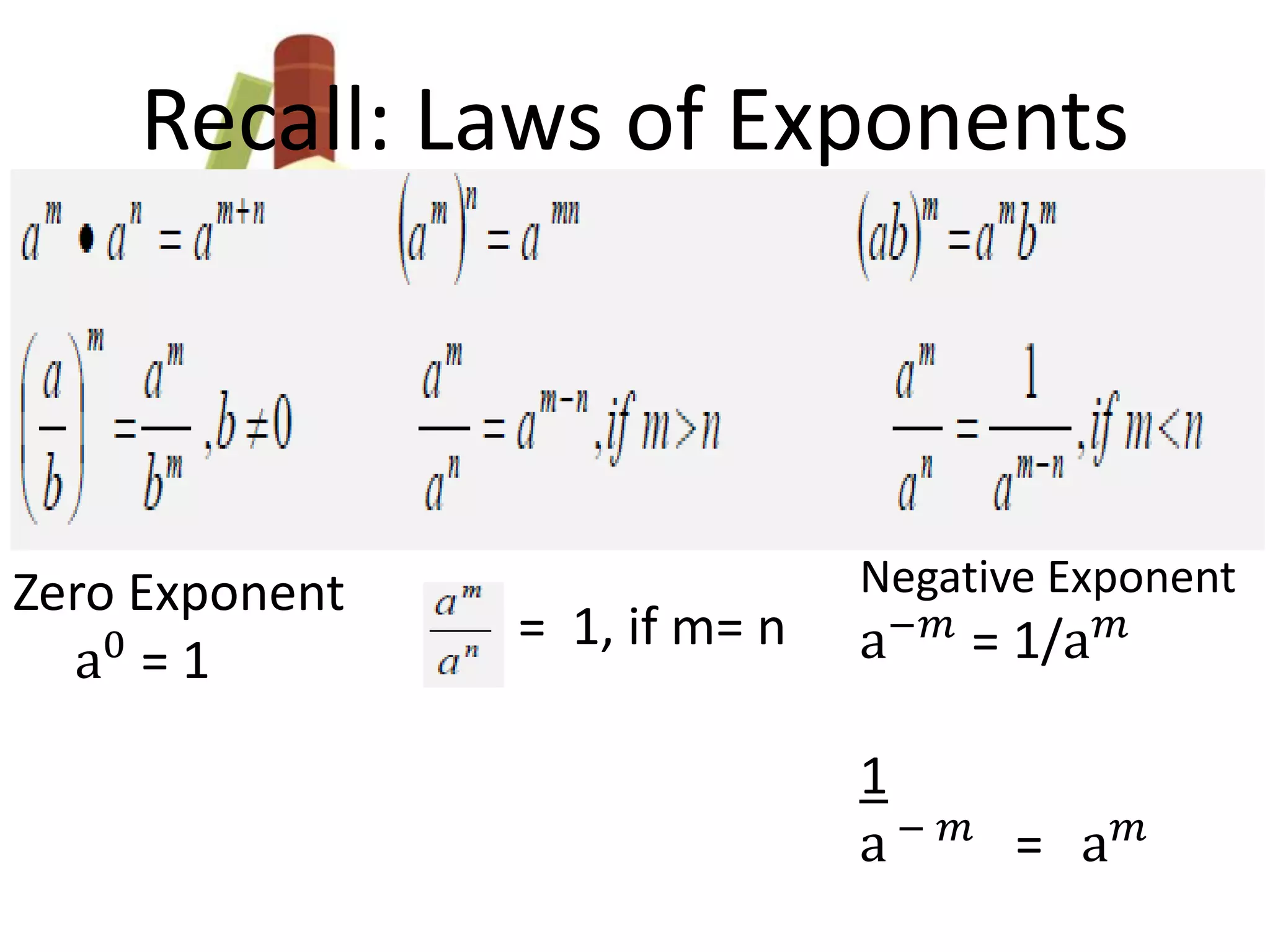
Recall: Laws of Exponents 
= 1, if m= n 
Zero Exponent 
a0 = 1 
Negative Exponent 
a−푚 = 1/a푚 
1 
a − 푚 = a푚
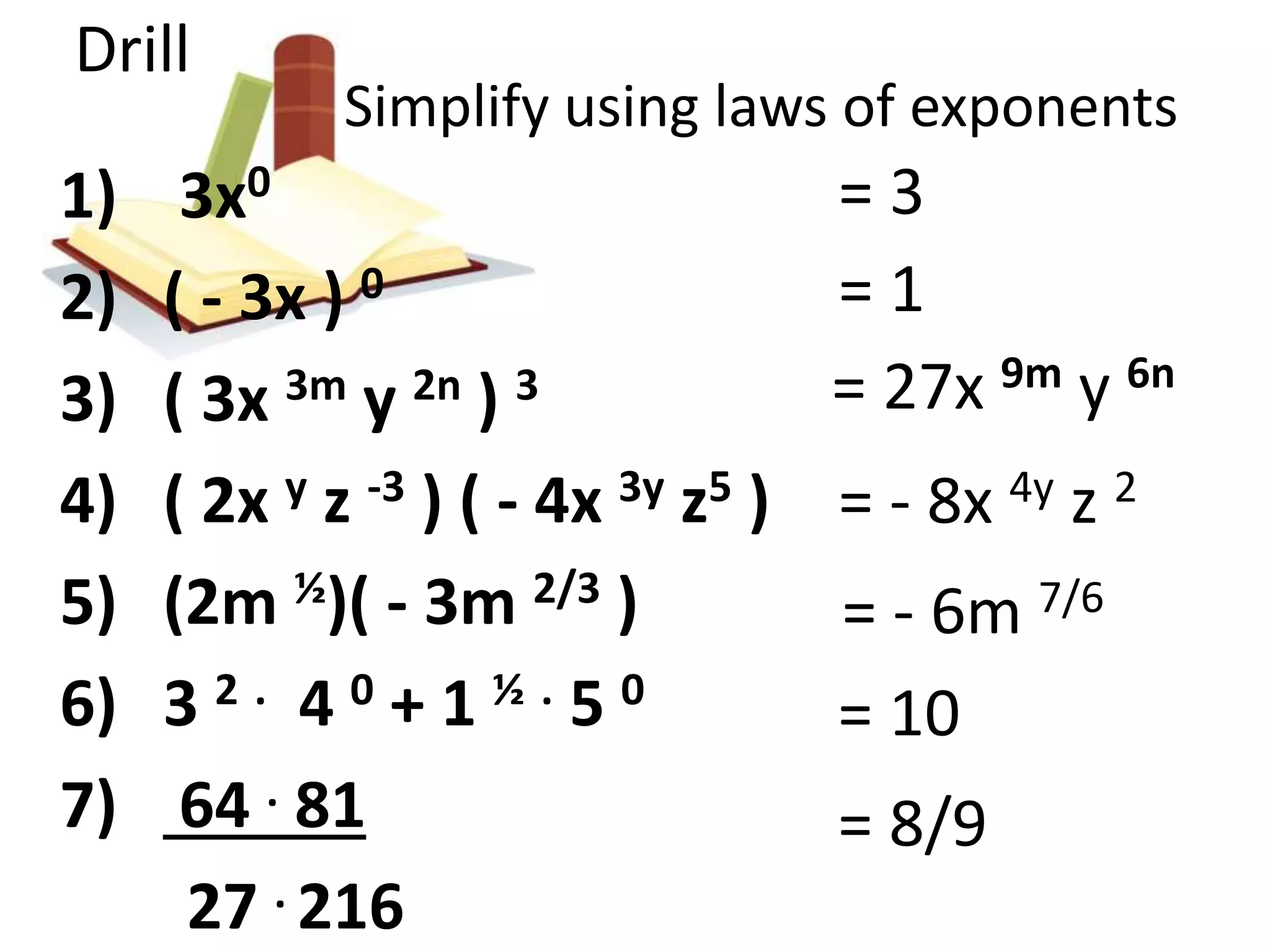
Drill 
Simplify using laws of exponents 
1) 3x0 
2) ( - 3x ) 0 
3) ( 3x 3m y 2n ) 3 
4) ( 2x y z -3 ) ( - 4x 3y z5 ) 
5) (2m ½)( - 3m 2/3 ) 
6) 3 2 . 4 0 + 1 ½ . 5 0 
7) 64 . 81 
27 . 216 
= 3 
= 1 
= 27x 9m y 6n 
= - 8x 4y z 2 
= - 6m 7/6 
= 10 
= 8/9
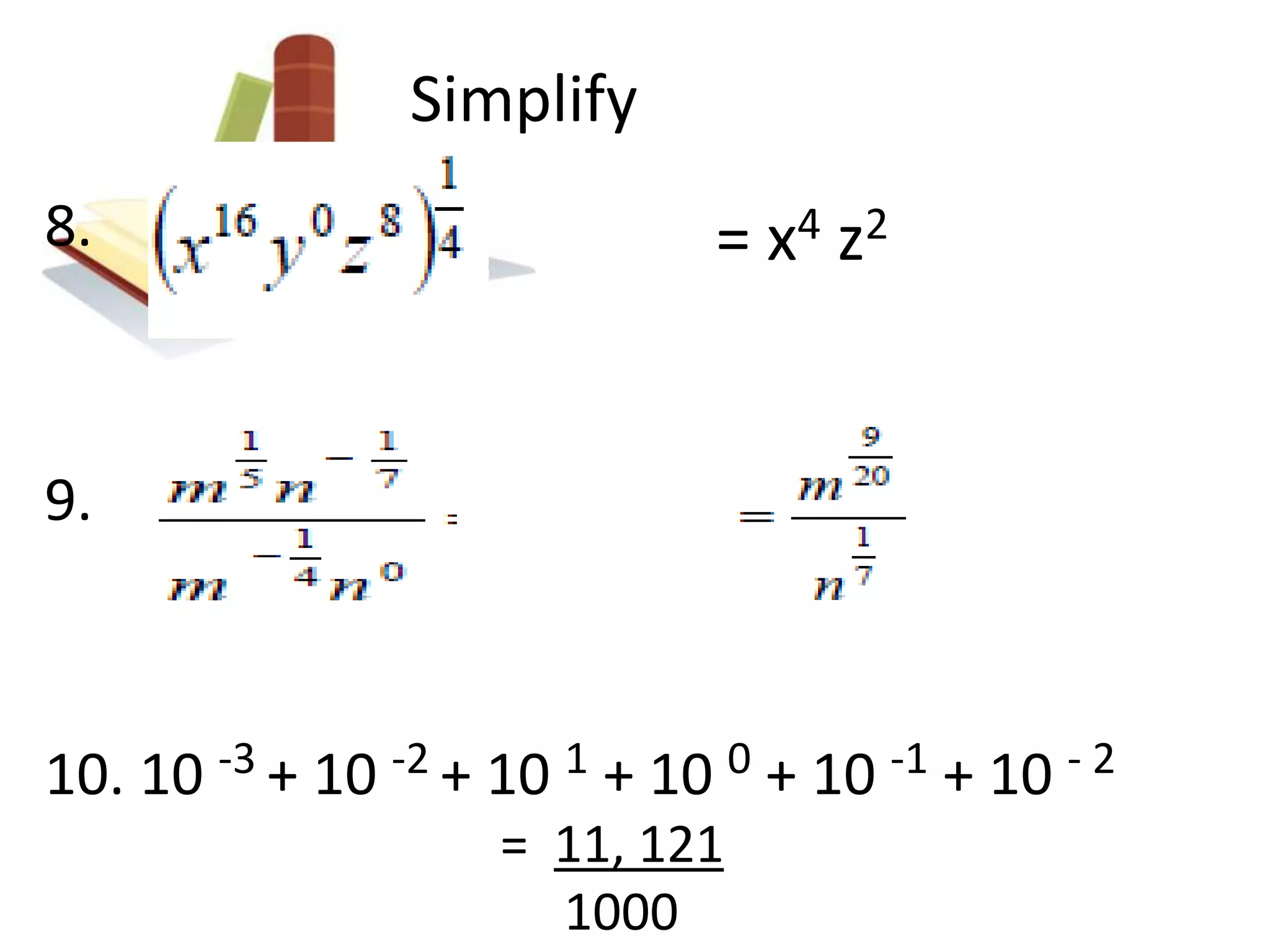
Simplify 
8. 
9. 
= x4 z2 
10. 10 -3 + 10 -2 + 10 1 + 10 0 + 10 -1 + 10 - 2 
= 11, 121 
1000
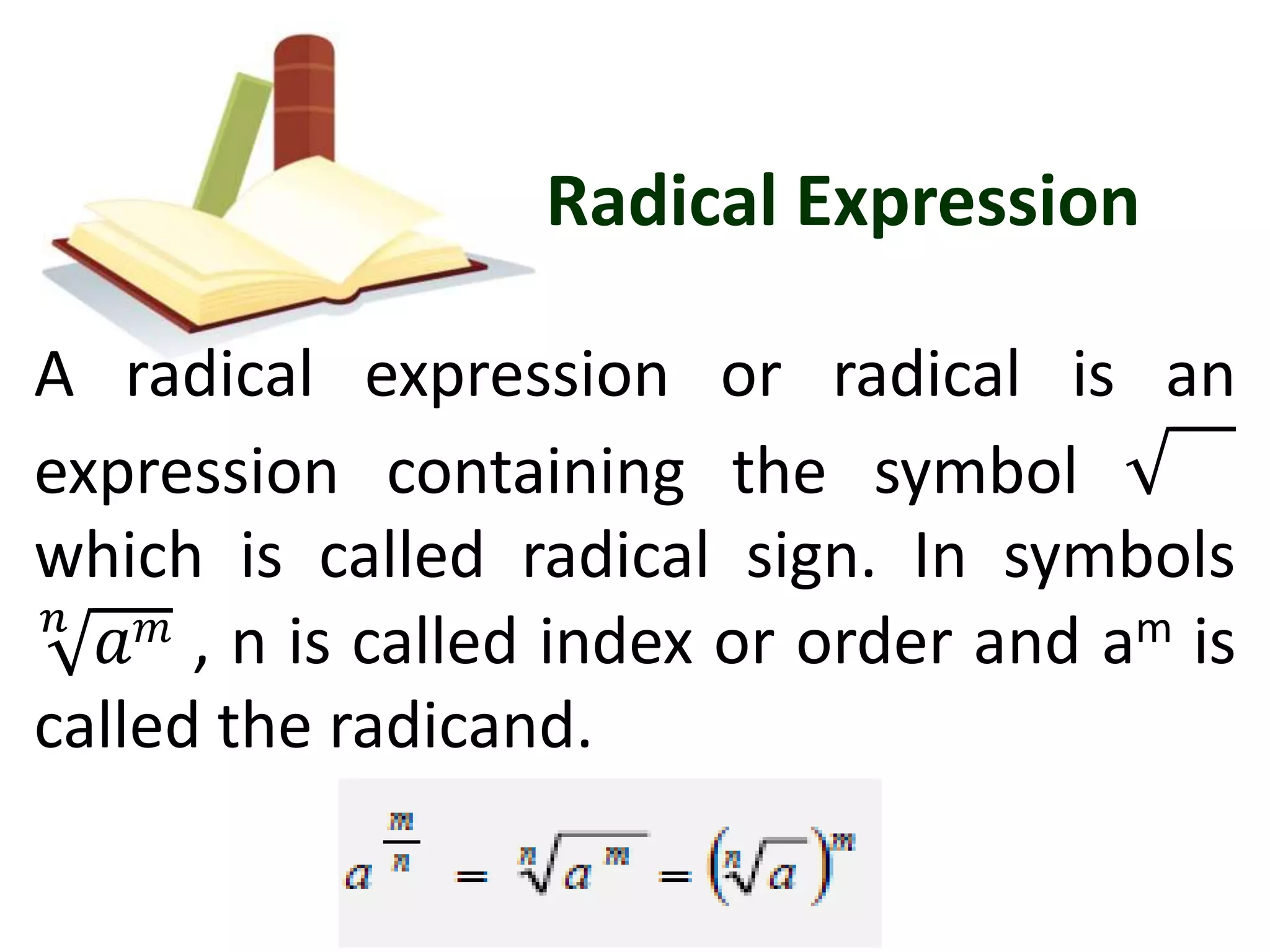
Radical Expression 
A radical expression or radical is an 
expression containing the symbol 
which is called radical sign. In symbols 
푛 푎푚 , n is called index or order and am is 
called the radicand.
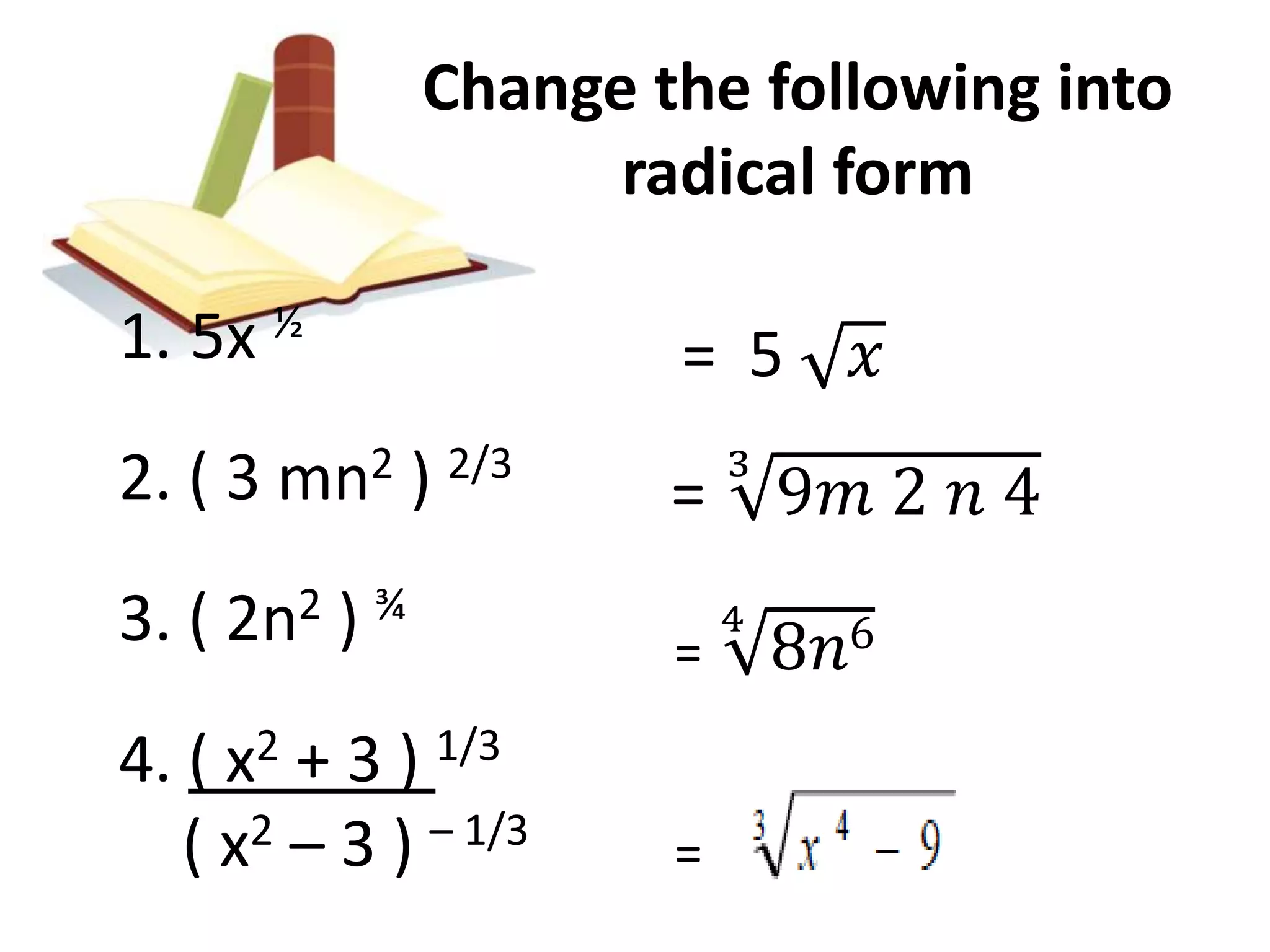
Change the following into 
radical form 
1. 5x ½ 
2. ( 3 mn2 ) 2/3 
3. ( 2n2 ) ¾ 
4. ( x2 + 3 ) 1/3 
( x2 – 3 ) – 1/3 
= 5 푥 
= 3 9푚 2 푛 4 
= 
4 8푛6 
=
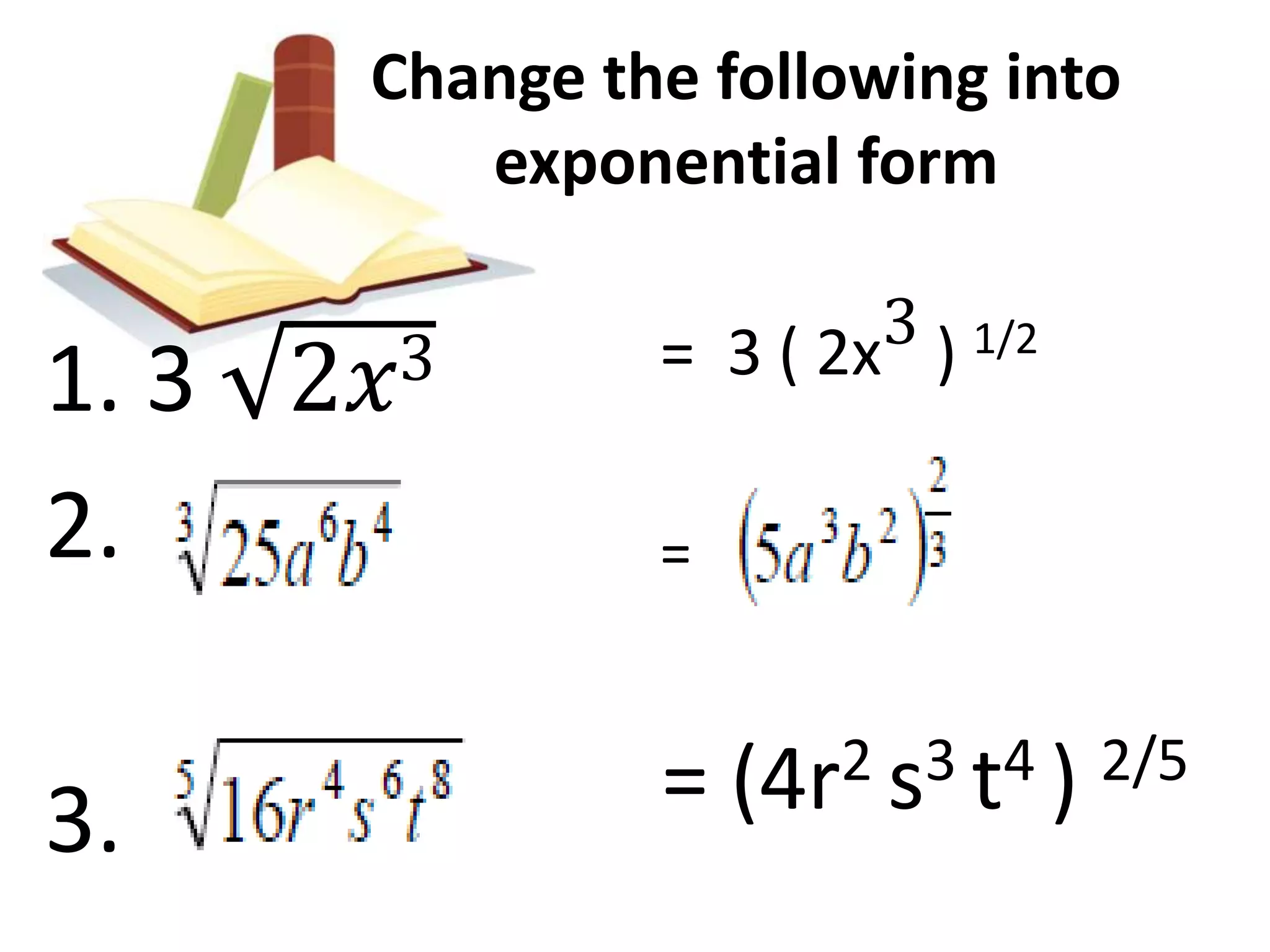
Change the following into 
exponential form 
1. 3 2푥3 
2. 
3. 
= 3 ( 2x3 ) 1/2 
= 
= (4r2 s3 t4 ) 2/5
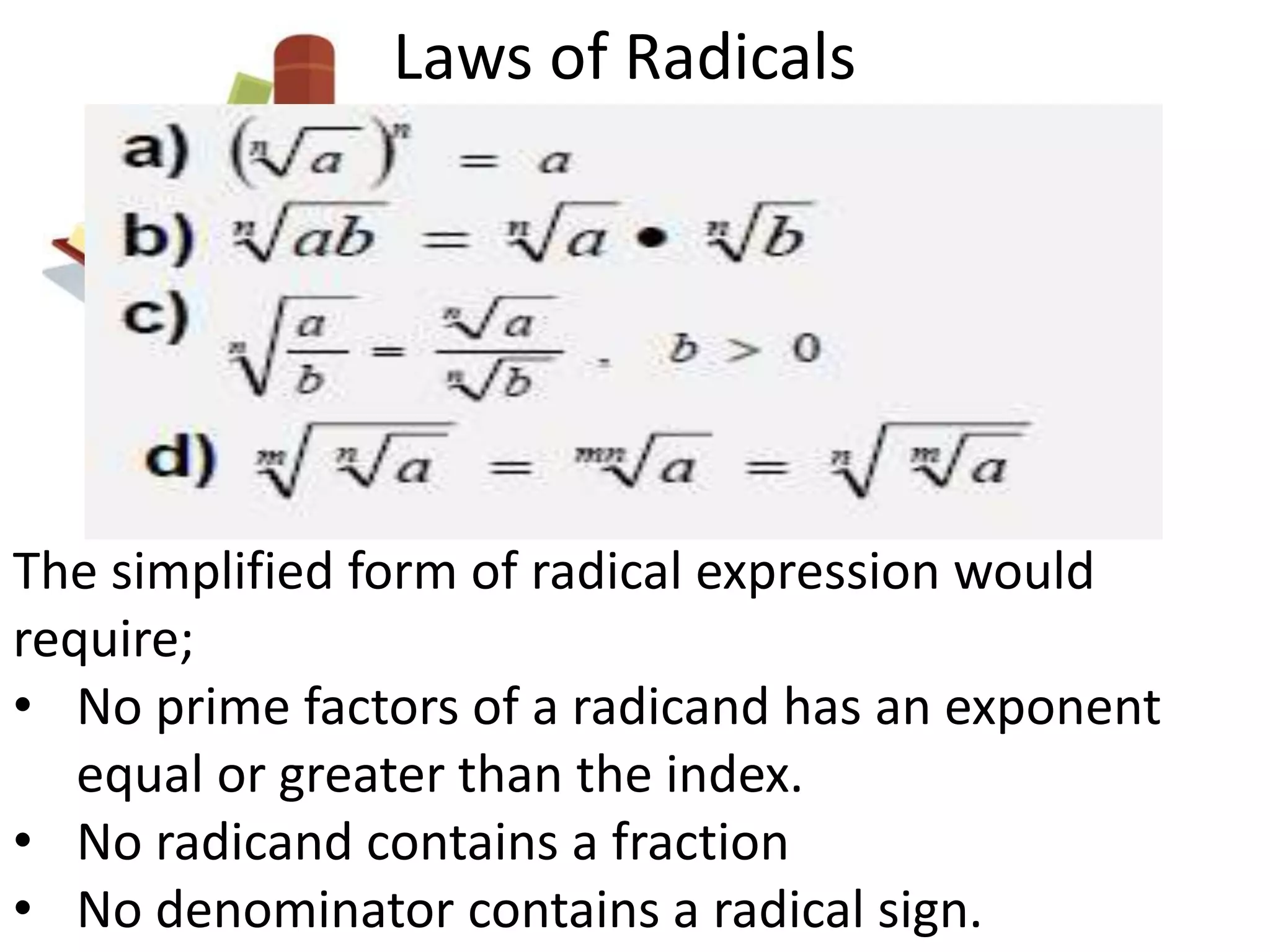
Laws of Radicals 
The simplified form of radical expression would 
require; 
• No prime factors of a radicand has an exponent 
equal or greater than the index. 
• No radicand contains a fraction 
• No denominator contains a radical sign.
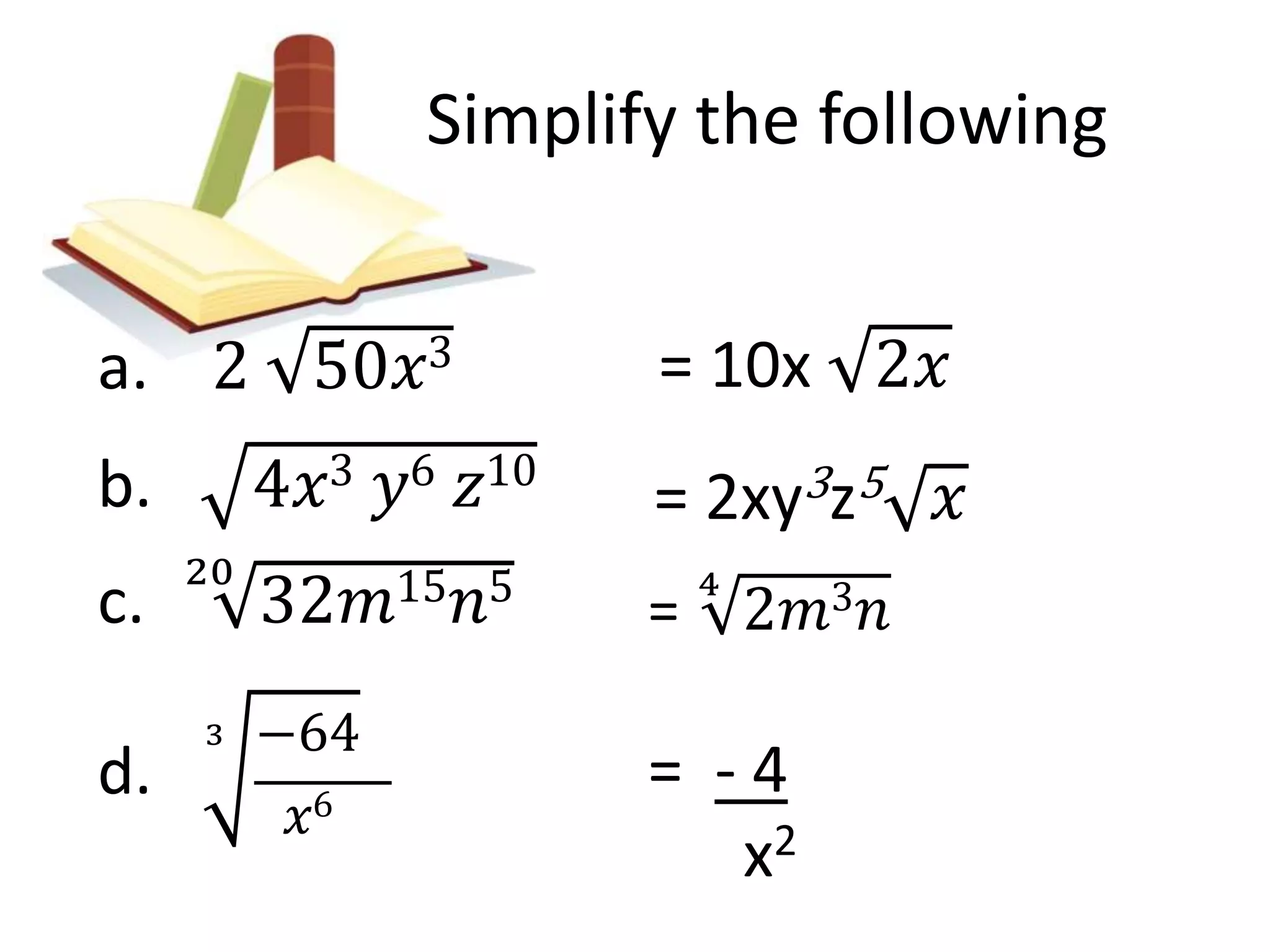
Simplify the following 
a. 2 50푥3 
b. 4푥3 푦6 푧10 
c. 20 32푚15푛5 
d. 
3 −64 
푥6 
= 10x 2푥 
= 2xy3z5 푥 
= 4 2푚3푛 
= - 4 
x2
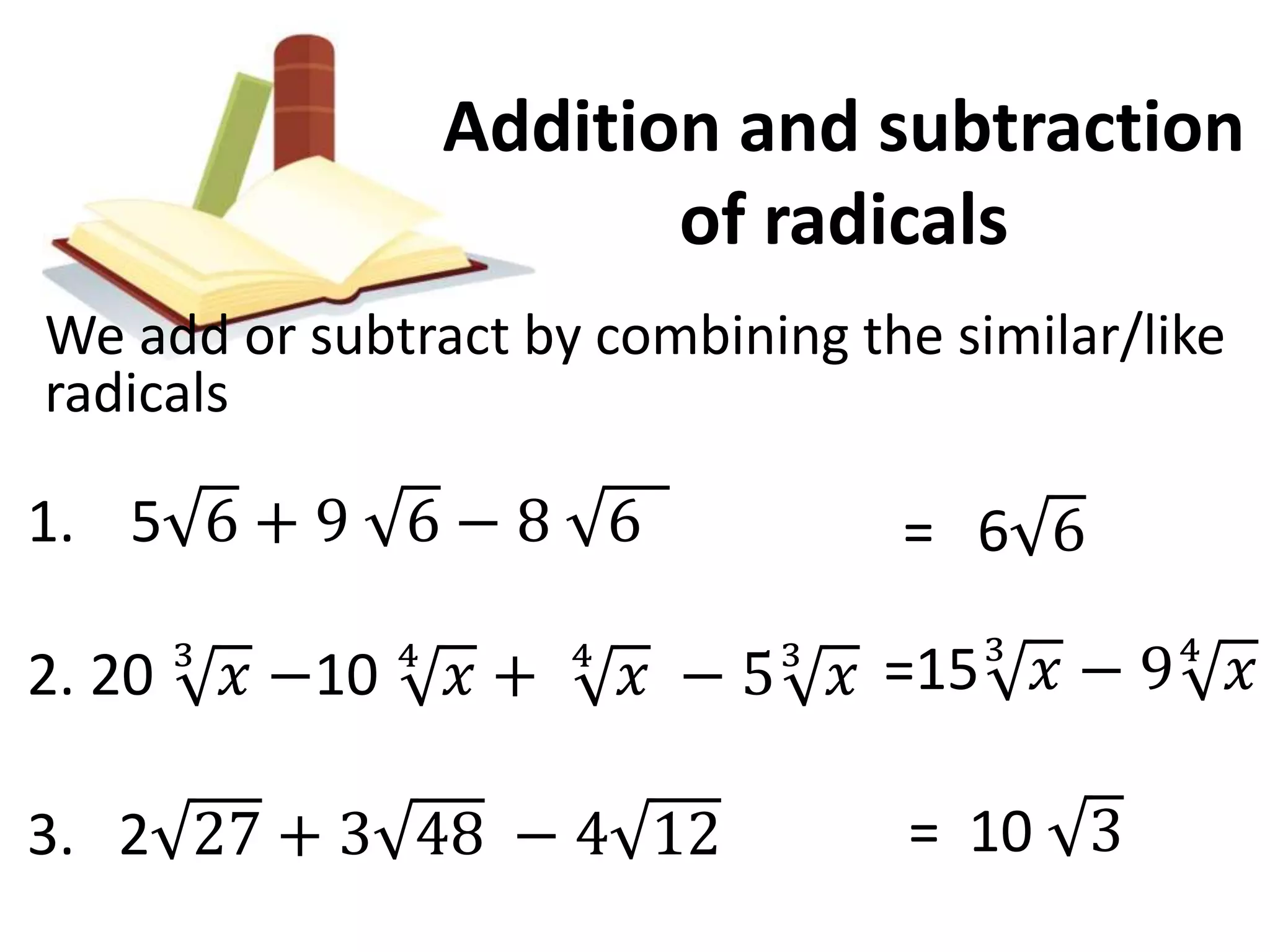
Addition and subtraction 
of radicals 
We add or subtract by combining the similar/like 
radicals 
1. 5 6 + 9 6 − 8 6 
2. 20 3 푥 −10 4 푥 + 4 푥 − 53 푥 
3. 2 27 + 3 48 − 4 12 
= 6 6 
=153 푥 − 94 푥 
= 10 3
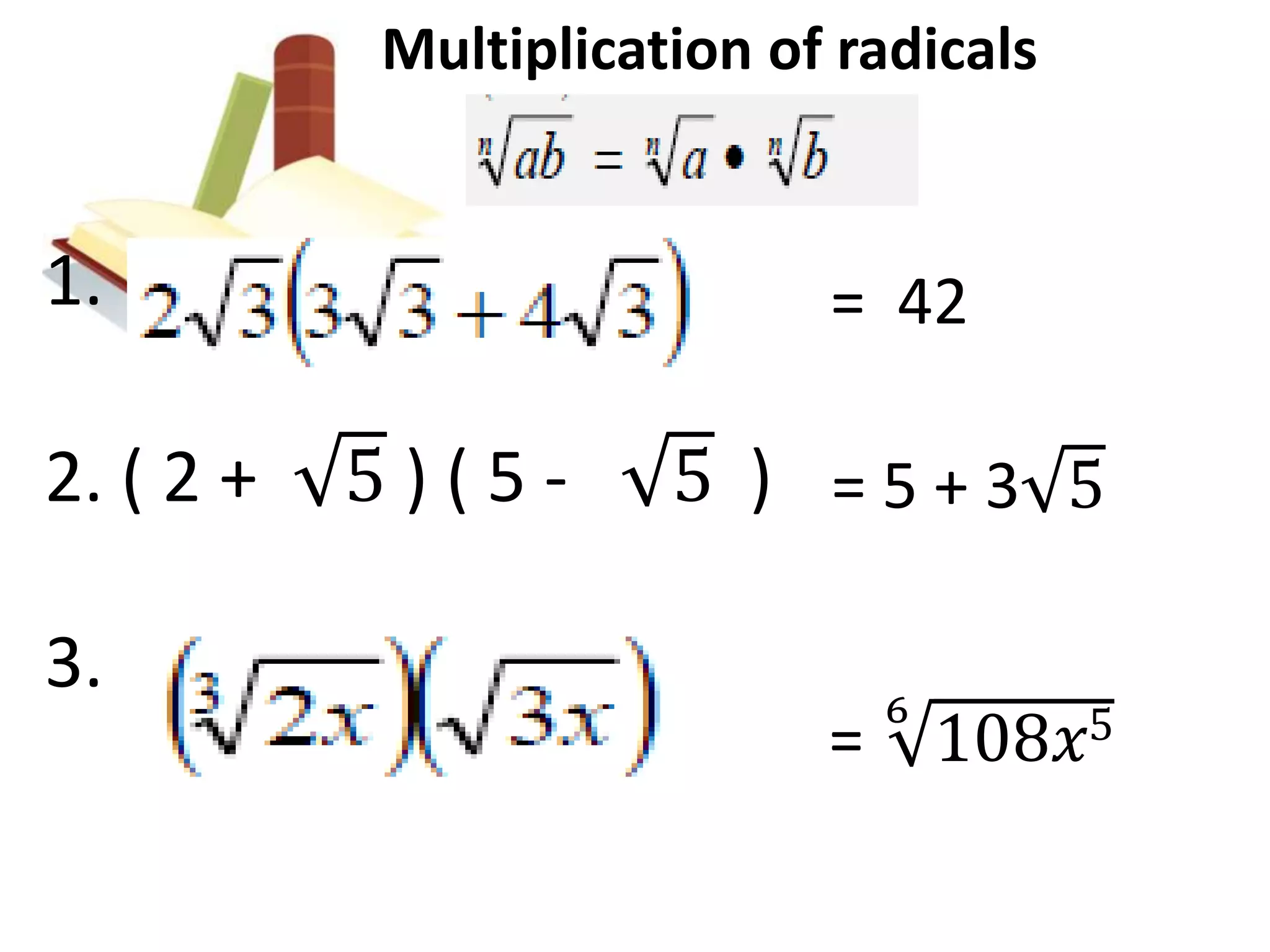
Multiplication of radicals 
= 42 
= 5 + 3 5 
= 6 108푥5 
1. 
2. ( 2 + 5 ) ( 5 - 5 ) 
3.
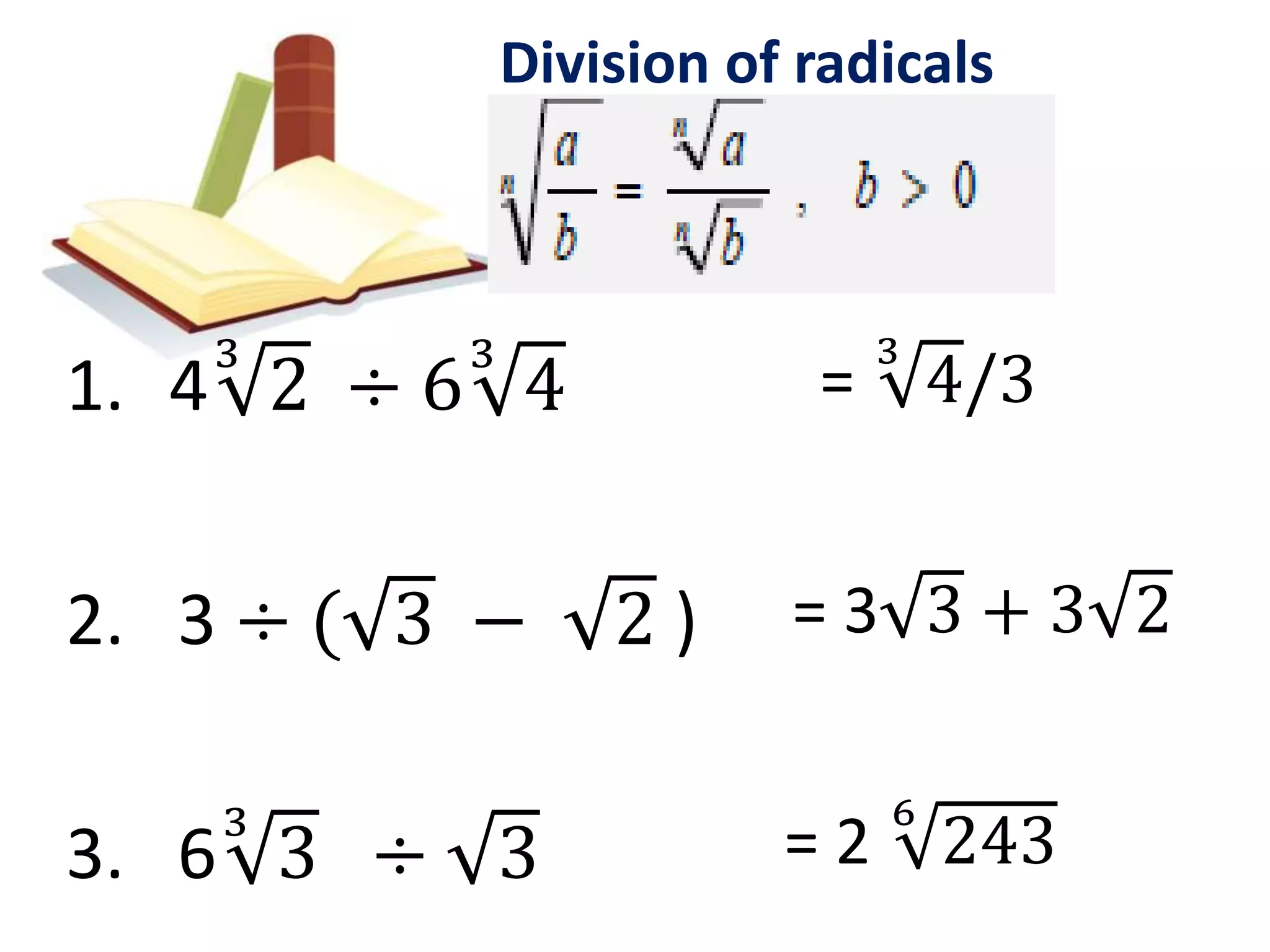
Division of radicals 
= 3 4/3 
= 3 3 + 3 2 
= 2 6 243 
1. 43 2 ÷ 63 4 
2. 3 ÷ ( 3 − 2 ) 
3. 63 3 ÷ 3
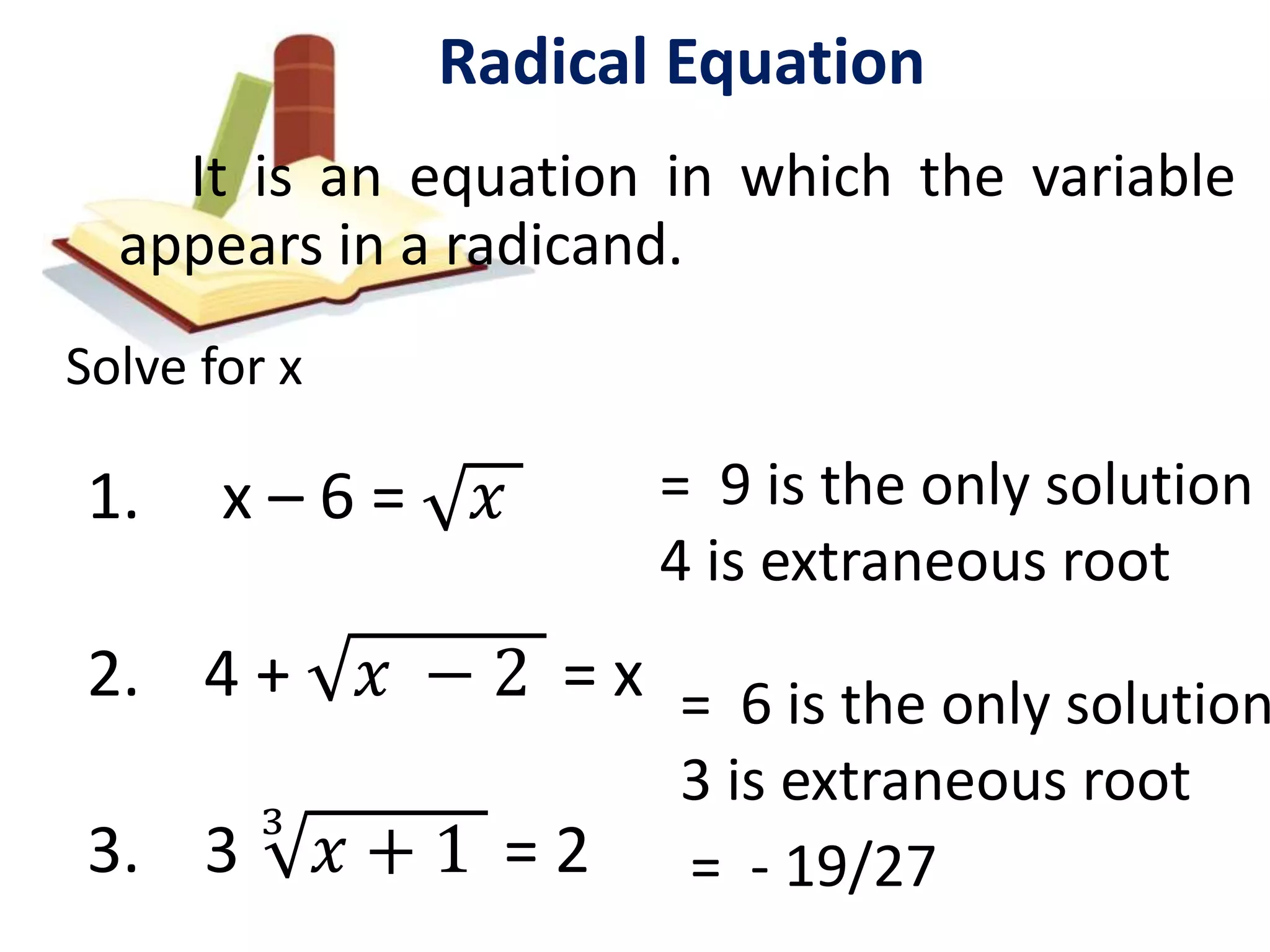
Radical Equation 
It is an equation in which the variable 
appears in a radicand. 
Solve for x 
1. x – 6 = 푥 
2. 4 + 푥 − 2 = x 
3. 3 3 푥 + 1 = 2 
= 9 is the only solution 
4 is extraneous root 
= 6 is the only solution 
3 is extraneous root 
= - 19/27
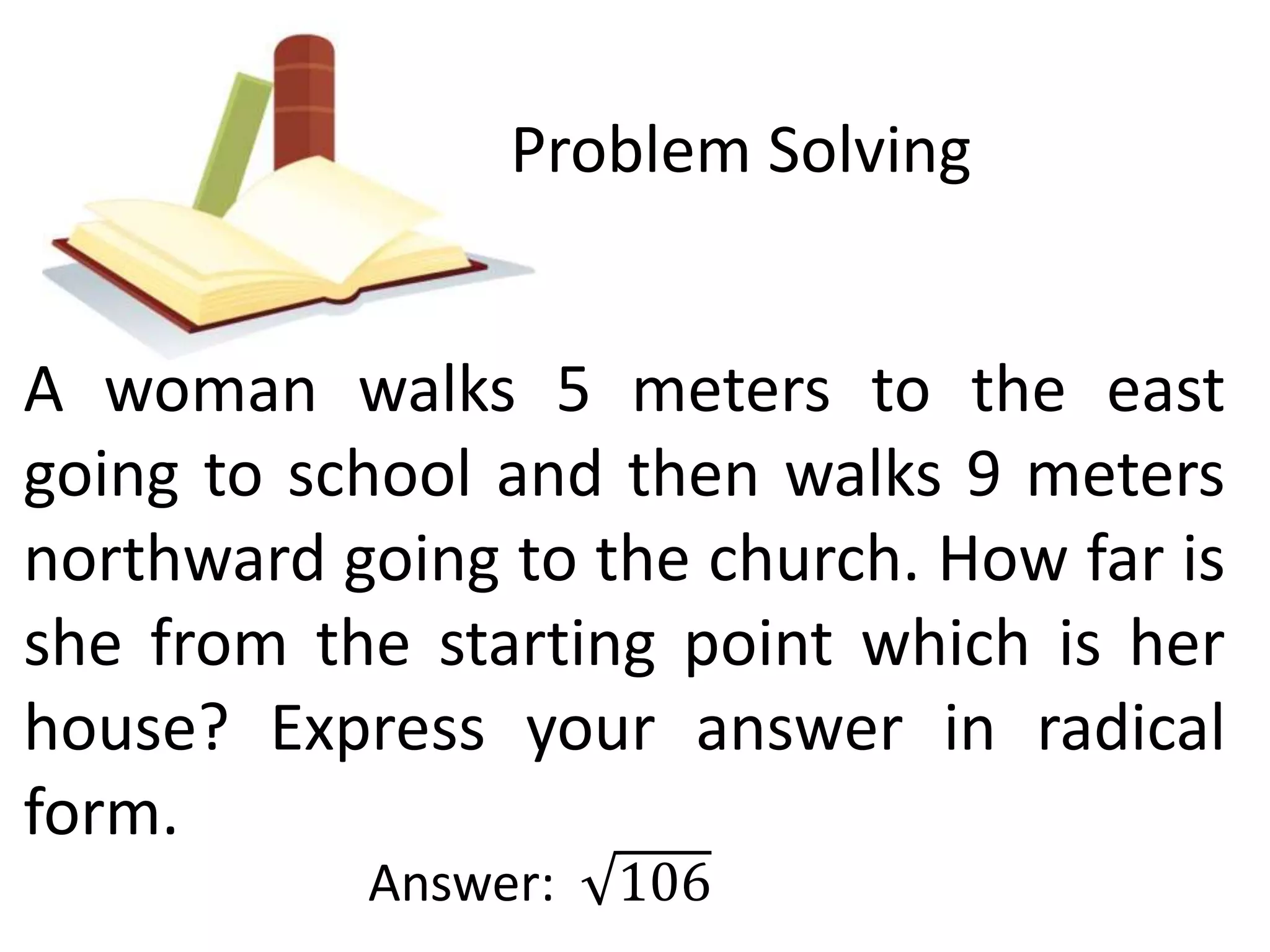
Problem Solving 
A woman walks 5 meters to the east 
going to school and then walks 9 meters 
northward going to the church. How far is 
she from the starting point which is her 
house? Express your answer in radical 
form. 
Answer: 106
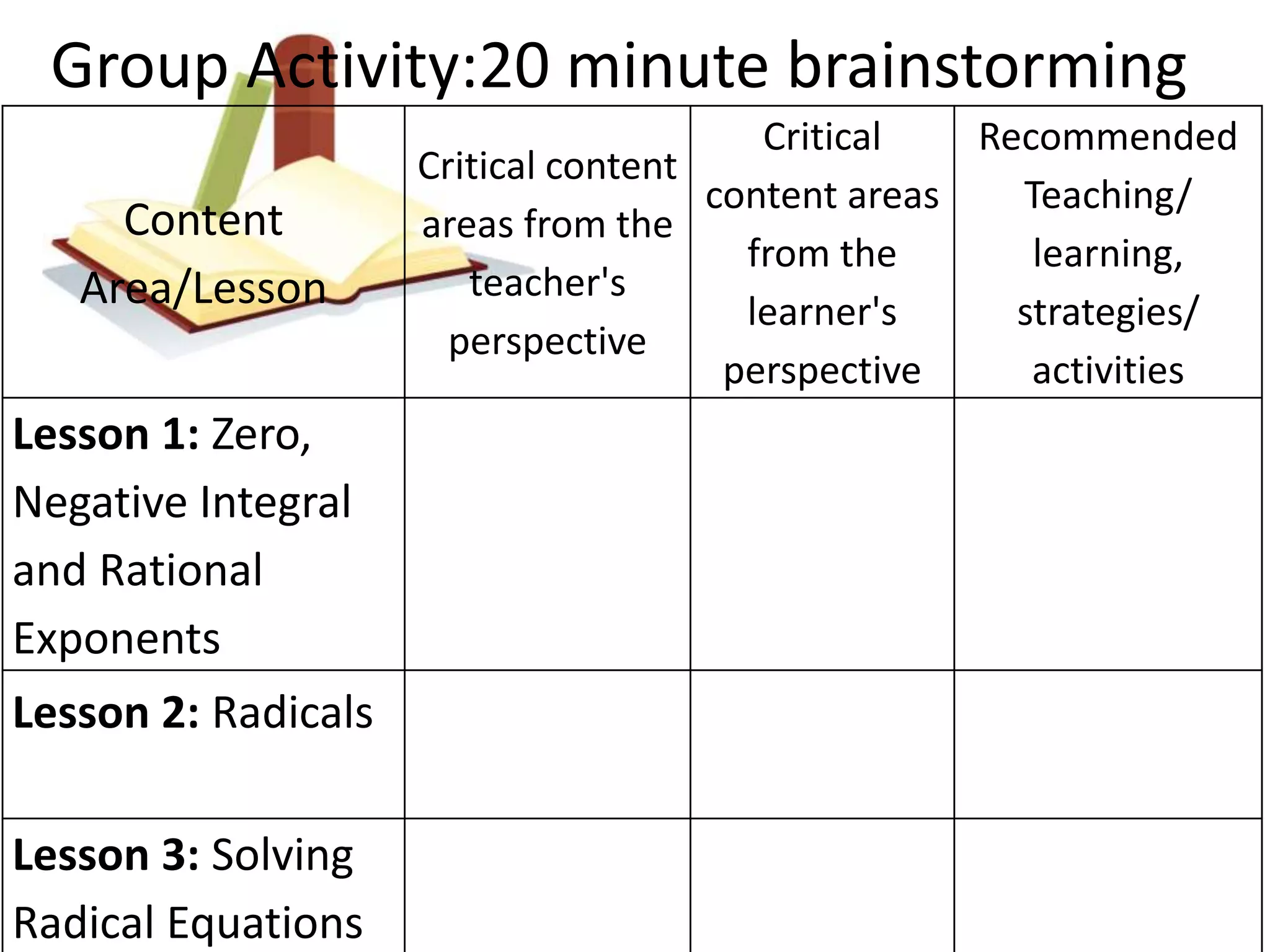
Group Activity:20 minute brainstorming 
Content 
Area/Lesson 
Critical content 
areas from the 
teacher's 
perspective 
Critical 
content areas 
from the 
learner's 
perspective 
Recommended 
Teaching/ 
learning, 
strategies/ 
activities 
Lesson 1: Zero, 
Negative Integral 
and Rational 
Exponents 
Lesson 2: Radicals 
Lesson 3: Solving 
Radical Equations
Analysis 
1. From the activity, what are the content areas 
teachers do find most easy to teach? most difficult to 
teach? 
2. What are the common difficulties encountered by 
the teachers in teaching the concepts of rational 
exponents and radicals? 
3. Which of the content/s is/are most challenging for 
the students to learn? most difficult to comprehend? 
4. What are the insights you have gained from this 
activity? 
5. Are the recommended strategies/activities practical 
and appropriate in eliminating the perceived 
difficulty?
Abstraction 
1. Explain the identified critical content areas 
based on the perception and prior 
experience of the teachers and the learners. 
2. Discuss appropriate teaching strategies and 
learning activities that can be used in the 
classroom. 
3. Share best practices in teaching variations.
Application 
1. Create a scenario of the task in 
paragraph form about variation 
incorporating GRASPS format. Create a 
rubric for the grading of this activity. 
2. Present the output to the class.
THANK YOU!!!! 
GOD BLESS US ALL

Module 4 Grade 9 Mathematics (RADICALS)

  • 1.
    2014 DIVISION MID-YEARINSET ON CONTENT AND PEDAGOGY FOR SECONDARY MATHEMATICS EDUCATION DAYAP NATIONAL HIGH SCHOOL CALAUAN, LAGUNA ALVIN O. INSORIO Pacita Complex National High School
  • 2.
    Module 4 Rational Exponents and Radicals
  • 3.
    Lessons: 1. Zero,Negative Integral and Rational Exponents 2. Radicals 3. Solving Radical Equations
  • 4.
    Priming 1. Haveyou ever wondered about how to identify the side lengths of a square lot if you know its area? 2. Have you tried solving for the length of any side of a right triangle? 3. Has it come to your mind how you can find the radius of a cylindrical water tank given its volume?
  • 5.
    Recall: Laws ofExponents = 1, if m= n Zero Exponent a0 = 1 Negative Exponent a−푚 = 1/a푚 1 a − 푚 = a푚
  • 6.
    Drill Simplify usinglaws of exponents 1) 3x0 2) ( - 3x ) 0 3) ( 3x 3m y 2n ) 3 4) ( 2x y z -3 ) ( - 4x 3y z5 ) 5) (2m ½)( - 3m 2/3 ) 6) 3 2 . 4 0 + 1 ½ . 5 0 7) 64 . 81 27 . 216 = 3 = 1 = 27x 9m y 6n = - 8x 4y z 2 = - 6m 7/6 = 10 = 8/9
  • 7.
    Simplify 8. 9. = x4 z2 10. 10 -3 + 10 -2 + 10 1 + 10 0 + 10 -1 + 10 - 2 = 11, 121 1000
  • 8.
    Radical Expression Aradical expression or radical is an expression containing the symbol which is called radical sign. In symbols 푛 푎푚 , n is called index or order and am is called the radicand.
  • 9.
    Change the followinginto radical form 1. 5x ½ 2. ( 3 mn2 ) 2/3 3. ( 2n2 ) ¾ 4. ( x2 + 3 ) 1/3 ( x2 – 3 ) – 1/3 = 5 푥 = 3 9푚 2 푛 4 = 4 8푛6 =
  • 10.
    Change the followinginto exponential form 1. 3 2푥3 2. 3. = 3 ( 2x3 ) 1/2 = = (4r2 s3 t4 ) 2/5
  • 11.
    Laws of Radicals The simplified form of radical expression would require; • No prime factors of a radicand has an exponent equal or greater than the index. • No radicand contains a fraction • No denominator contains a radical sign.
  • 12.
    Simplify the following a. 2 50푥3 b. 4푥3 푦6 푧10 c. 20 32푚15푛5 d. 3 −64 푥6 = 10x 2푥 = 2xy3z5 푥 = 4 2푚3푛 = - 4 x2
  • 13.
    Addition and subtraction of radicals We add or subtract by combining the similar/like radicals 1. 5 6 + 9 6 − 8 6 2. 20 3 푥 −10 4 푥 + 4 푥 − 53 푥 3. 2 27 + 3 48 − 4 12 = 6 6 =153 푥 − 94 푥 = 10 3
  • 14.
    Multiplication of radicals = 42 = 5 + 3 5 = 6 108푥5 1. 2. ( 2 + 5 ) ( 5 - 5 ) 3.
  • 15.
    Division of radicals = 3 4/3 = 3 3 + 3 2 = 2 6 243 1. 43 2 ÷ 63 4 2. 3 ÷ ( 3 − 2 ) 3. 63 3 ÷ 3
  • 16.
    Radical Equation Itis an equation in which the variable appears in a radicand. Solve for x 1. x – 6 = 푥 2. 4 + 푥 − 2 = x 3. 3 3 푥 + 1 = 2 = 9 is the only solution 4 is extraneous root = 6 is the only solution 3 is extraneous root = - 19/27
  • 17.
    Problem Solving Awoman walks 5 meters to the east going to school and then walks 9 meters northward going to the church. How far is she from the starting point which is her house? Express your answer in radical form. Answer: 106
  • 18.
    Group Activity:20 minutebrainstorming Content Area/Lesson Critical content areas from the teacher's perspective Critical content areas from the learner's perspective Recommended Teaching/ learning, strategies/ activities Lesson 1: Zero, Negative Integral and Rational Exponents Lesson 2: Radicals Lesson 3: Solving Radical Equations
  • 19.
    Analysis 1. Fromthe activity, what are the content areas teachers do find most easy to teach? most difficult to teach? 2. What are the common difficulties encountered by the teachers in teaching the concepts of rational exponents and radicals? 3. Which of the content/s is/are most challenging for the students to learn? most difficult to comprehend? 4. What are the insights you have gained from this activity? 5. Are the recommended strategies/activities practical and appropriate in eliminating the perceived difficulty?
  • 20.
    Abstraction 1. Explainthe identified critical content areas based on the perception and prior experience of the teachers and the learners. 2. Discuss appropriate teaching strategies and learning activities that can be used in the classroom. 3. Share best practices in teaching variations.
  • 21.
    Application 1. Createa scenario of the task in paragraph form about variation incorporating GRASPS format. Create a rubric for the grading of this activity. 2. Present the output to the class.
  • 22.
    THANK YOU!!!! GODBLESS US ALL

Editor's Notes