





CHAPTER 6: 
Slopes and Lines
RATE OF 
CHANGE 
Lesson 6.1
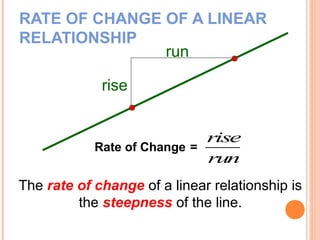
RATE OF CHANGE OF A LINEAR 
RELATIONSHIP 
rise 
run 
Rate of Change = 
The rate of change of a linear relationship is 
the steepness of the line. 
   
rise 
run
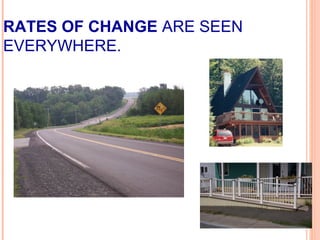
RATES OF CHANGE ARE SEEN 
EVERYWHERE.
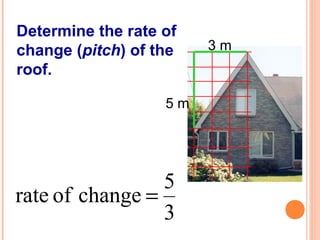
The steepness of 
the roof of a house 
is referred to as the 
pitch of the roof by 
home builders.
Give one reason 
why some homes 
have roofs which 
have a greater 
pitch. 
There is less snow buildup in the 
wintertime.
Engineers refer to the 
rate of change of a road as 
the grade.
They often represent the rate of 
change as a percentage.
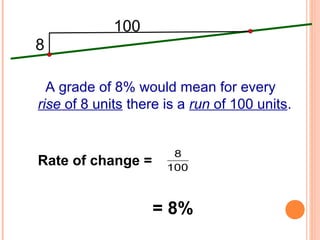
8 
100 
A grade of 8% would mean for every 
rise of 8 units there is a run of 100 units. 
= 8% 
Rate of change = 
8 
100
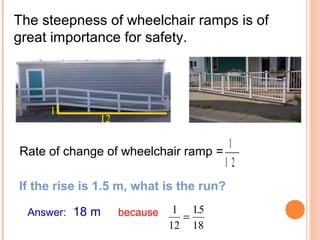
The steepness of wheelchair ramps is of 
great importance for safety. 
1 
12 
Rate of change of wheelchair ramp = 
1 
1 2 
If the rise is 1.5 m, what is the run? 
Answer: 18 m because 
1 
12 
= . 
15 
18
3 m 
Determine the rate of 
change (pitch) of the 
roof. 
5 m 
rate of change = 5 
3
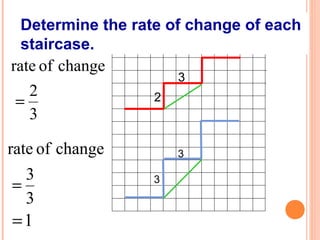
Determine the rate of change of each 
staircase. 
2 
3 
3 
3 
rate of change 
= 
2 
3 
rate of change 
= 
3 
3 
=1
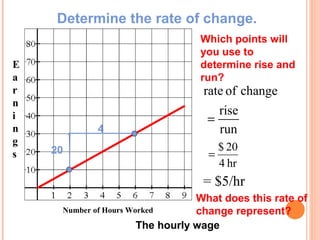
Determine the rate of change. 
Which points will 
you use to 
determine rise and 
run? 
rate of change 
= 
rise 
run 
20 = $ 20 
4 hr 
= $5/hr 
4 
Ear 
ni 
ngs 
Number of Hours Worked 
What does this rate of 
change represent? 
The hourly wage
REAL LIFE 
Mr. and Mrs. Overjoyed had a 
healthy baby girl named Joy 
who weighed 7.5lbs. at birth. At 
the end of 4 months, the baby 
weighed 13.5lbs. 
 How fast did her weight change 
from birth to 4 months?
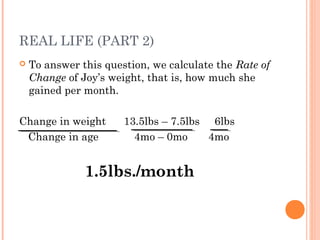
REAL LIFE (PART 2) 
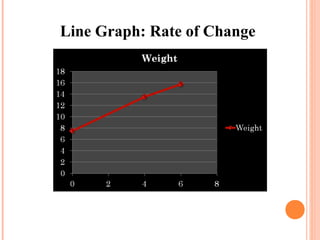
 To answer this question, we calculate the Rate of 
Change of Joy’s weight, that is, how much she 
gained per month. 
Change in weight 13.5lbs – 7.5lbs 6lbs 
Change in age 4mo – 0mo 4mo 
1.5lbs./month
POSITIVE RATE OF CHANGE 
At age 6 months, Joy weighed 15.75lbs. 
 How fast did she grow from 4 months to 6 
months?
Line Graph: Rate of Change
NEGATIVE RATE OF CHANGE 
Joy was gaining weight, so the rate of change was 
positive. But a rate of change can be negative. 
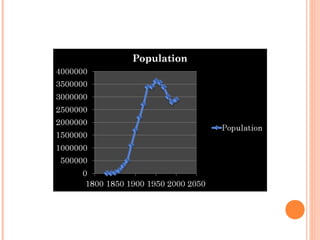
 Let’s take a look at the population of Chicago 
from 1830 to 2000…
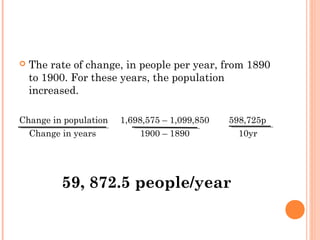
 The rate of change, in people per year, from 1890 
to 1900. For these years, the population 
increased. 
Change in population 1,698,575 – 1,099,850 598,725p 
Change in years 1900 – 1890 10yr 
59, 872.5 people/year
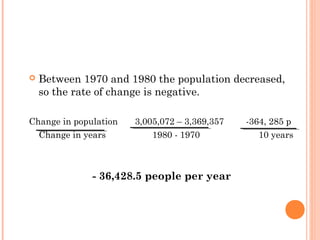
 Between 1970 and 1980 the population decreased, 
so the rate of change is negative. 
Change in population 3,005,072 – 3,369,357 -364, 285 p 
Change in years 1980 - 1970 10 years 
- 36,428.5 people per year
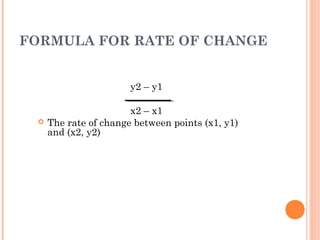
FORMULA FOR RATE OF CHANGE 
y2 – y1 
x2 – x1 
 The rate of change between points (x1, y1) 
and (x2, y2)

Rate of change

  • 1.
  • 2.
    RATE OF CHANGE Lesson 6.1
  • 3.
    RATE OF CHANGEOF A LINEAR RELATIONSHIP rise run Rate of Change = The rate of change of a linear relationship is the steepness of the line.   rise run
  • 4.
    RATES OF CHANGEARE SEEN EVERYWHERE.
  • 5.
    The steepness of the roof of a house is referred to as the pitch of the roof by home builders.
  • 6.
    Give one reason why some homes have roofs which have a greater pitch. There is less snow buildup in the wintertime.
  • 7.
    Engineers refer tothe rate of change of a road as the grade.
  • 8.
    They often representthe rate of change as a percentage.
  • 9.
    8 100 Agrade of 8% would mean for every rise of 8 units there is a run of 100 units. = 8% Rate of change = 8 100
  • 10.
    The steepness ofwheelchair ramps is of great importance for safety. 1 12 Rate of change of wheelchair ramp = 1 1 2 If the rise is 1.5 m, what is the run? Answer: 18 m because 1 12 = . 15 18
  • 11.
    3 m Determinethe rate of change (pitch) of the roof. 5 m rate of change = 5 3
  • 12.
    Determine the rateof change of each staircase. 2 3 3 3 rate of change = 2 3 rate of change = 3 3 =1
  • 13.
    Determine the rateof change. Which points will you use to determine rise and run? rate of change = rise run 20 = $ 20 4 hr = $5/hr 4 Ear ni ngs Number of Hours Worked What does this rate of change represent? The hourly wage
  • 14.
    REAL LIFE Mr.and Mrs. Overjoyed had a healthy baby girl named Joy who weighed 7.5lbs. at birth. At the end of 4 months, the baby weighed 13.5lbs.  How fast did her weight change from birth to 4 months?
  • 15.
    REAL LIFE (PART2)  To answer this question, we calculate the Rate of Change of Joy’s weight, that is, how much she gained per month. Change in weight 13.5lbs – 7.5lbs 6lbs Change in age 4mo – 0mo 4mo 1.5lbs./month
  • 16.
    POSITIVE RATE OFCHANGE At age 6 months, Joy weighed 15.75lbs.  How fast did she grow from 4 months to 6 months?
  • 17.
  • 18.
    NEGATIVE RATE OFCHANGE Joy was gaining weight, so the rate of change was positive. But a rate of change can be negative.  Let’s take a look at the population of Chicago from 1830 to 2000…
  • 19.
     The rateof change, in people per year, from 1890 to 1900. For these years, the population increased. Change in population 1,698,575 – 1,099,850 598,725p Change in years 1900 – 1890 10yr 59, 872.5 people/year
  • 20.
     Between 1970and 1980 the population decreased, so the rate of change is negative. Change in population 3,005,072 – 3,369,357 -364, 285 p Change in years 1980 - 1970 10 years - 36,428.5 people per year
  • 22.
    FORMULA FOR RATEOF CHANGE y2 – y1 x2 – x1  The rate of change between points (x1, y1) and (x2, y2)