Simplifying Basic
Radical Expressions
        By L.D.


                      S
Table of Contents
S Slide 3: What is a Radical?

S Slide 4: Instructions For The Problems

S Slide 5: Problem 1

S Slide 11: Problem 1 Example Problems

S Slide 13: Problem 2

S Slide 16: Problem 3

S Slide 18: Problem 4

S Slide 21: Problem 5
What is a Radical?


“Radical” is a fancy name for a square root. A radical
expression is an expression with a square root.
Instructions For The Problems


S Simplify the problems until there are no perfect squares
  under the square roots.
Problem 1


√24
Problem 1


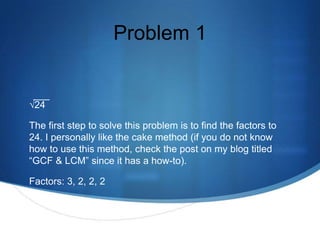
√24

Your first thought when seeing this problem is probably that
24 is not a perfect square. This can easily be fixed.
Problem 1


√24

The first step to solve this problem is to find the factors to
24. I personally like the cake method (if you do not know
how to use this method, check the post on my blog titled
“GCF & LCM” since it has a how-to).

Factors: 3, 2, 2, 2
Problem 1

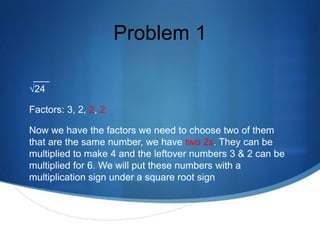
√24

Factors: 3, 2, 2, 2

Now we have the factors we need to choose two of them
that are the same number, we have two 2s. They can be
multiplied to make 4 and the leftover numbers 3 & 2 can be
multiplied for 6. We will put these numbers with a
multiplication sign under a square root sign
Problem 1

√6 x 4 can also be seen as √6 x √4 . We will simplify the
square root we can now simplify(√4 ).

The problem will now look like 4 x √6 or 4√6 .
Problem 1

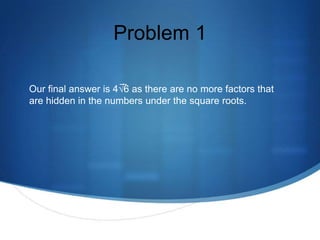
Our final answer is 4√6 as there are no more factors that
are hidden in the numbers under the square roots.
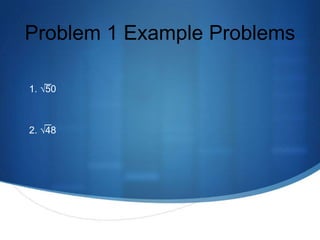
Problem 1 Example Problems

1. √50


2. √48
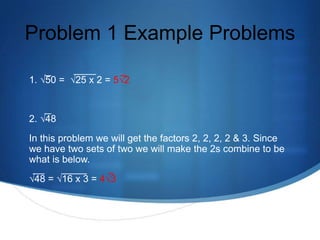
Problem 1 Example Problems

1. √50 = √25 x 2 = 5√2


2. √48
In this problem we will get the factors 2, 2, 2, 2 & 3. Since
we have two sets of two we will make the 2s combine to be
what is below.
√48 = √16 x 3 = 4√3
Problem 2


√25g5
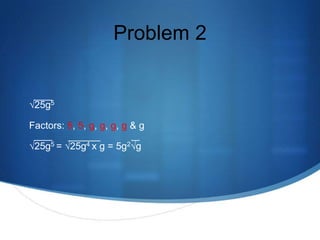
Problem 2


√25g5

To find the answer to this we will as usual find the factors.

Factors: 5, 5, g, g, g, g & g

We will do as usual and multiply all the doubles together.
Problem 2


√25g5

Factors: 5, 5, g, g, g, g & g

√25g5 = √25g4 x g = 5g2√g
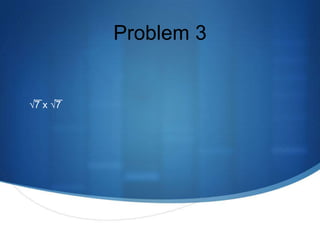
Problem 3


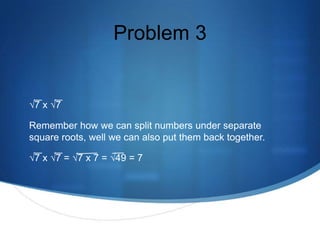
√7 x √7
Problem 3


√7 x √7

Remember how we can split numbers under separate
square roots, well we can also put them back together.

√7 x √7 = √7 x 7 = √49 = 7
Problem 4


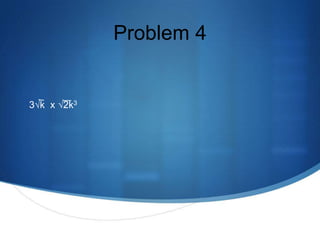
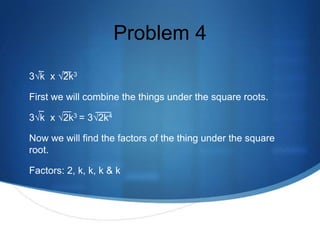
3√k x √2k3
Problem 4
3√k x √2k3

First we will combine the things under the square roots.

3√k x √2k3 = 3√2k4

Now we will find the factors of the thing under the square
root.

Factors: 2, k, k, k & k
Problem 4
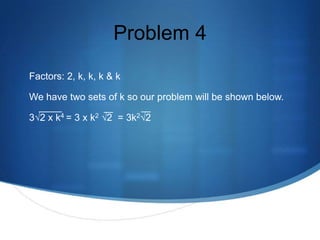
Factors: 2, k, k, k & k

We have two sets of k so our problem will be shown below.

3√2 x k4 = 3 x k2 √2 = 3k2√2
Problem 5


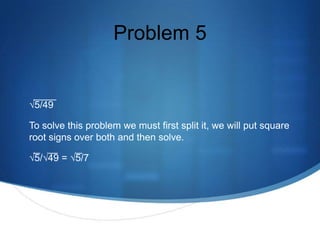
√5/49
Problem 5


√5/49

To solve this problem we must first split it, we will put square
root signs over both and then solve.

√5/√49 = √5/7
Simplifying basic radical expressions

Simplifying basic radical expressions

  • 1.
  • 2.
    Table of Contents SSlide 3: What is a Radical? S Slide 4: Instructions For The Problems S Slide 5: Problem 1 S Slide 11: Problem 1 Example Problems S Slide 13: Problem 2 S Slide 16: Problem 3 S Slide 18: Problem 4 S Slide 21: Problem 5
  • 3.
    What is aRadical? “Radical” is a fancy name for a square root. A radical expression is an expression with a square root.
  • 4.
    Instructions For TheProblems S Simplify the problems until there are no perfect squares under the square roots.
  • 5.
  • 6.
    Problem 1 √24 Your firstthought when seeing this problem is probably that 24 is not a perfect square. This can easily be fixed.
  • 7.
    Problem 1 √24 The firststep to solve this problem is to find the factors to 24. I personally like the cake method (if you do not know how to use this method, check the post on my blog titled “GCF & LCM” since it has a how-to). Factors: 3, 2, 2, 2
  • 8.
    Problem 1 √24 Factors: 3,2, 2, 2 Now we have the factors we need to choose two of them that are the same number, we have two 2s. They can be multiplied to make 4 and the leftover numbers 3 & 2 can be multiplied for 6. We will put these numbers with a multiplication sign under a square root sign
  • 9.
    Problem 1 √6 x4 can also be seen as √6 x √4 . We will simplify the square root we can now simplify(√4 ). The problem will now look like 4 x √6 or 4√6 .
  • 10.
    Problem 1 Our finalanswer is 4√6 as there are no more factors that are hidden in the numbers under the square roots.
  • 11.
    Problem 1 ExampleProblems 1. √50 2. √48
  • 12.
    Problem 1 ExampleProblems 1. √50 = √25 x 2 = 5√2 2. √48 In this problem we will get the factors 2, 2, 2, 2 & 3. Since we have two sets of two we will make the 2s combine to be what is below. √48 = √16 x 3 = 4√3
  • 13.
  • 14.
    Problem 2 √25g5 To findthe answer to this we will as usual find the factors. Factors: 5, 5, g, g, g, g & g We will do as usual and multiply all the doubles together.
  • 15.
    Problem 2 √25g5 Factors: 5,5, g, g, g, g & g √25g5 = √25g4 x g = 5g2√g
  • 16.
  • 17.
    Problem 3 √7 x√7 Remember how we can split numbers under separate square roots, well we can also put them back together. √7 x √7 = √7 x 7 = √49 = 7
  • 18.
  • 19.
    Problem 4 3√k x√2k3 First we will combine the things under the square roots. 3√k x √2k3 = 3√2k4 Now we will find the factors of the thing under the square root. Factors: 2, k, k, k & k
  • 20.
    Problem 4 Factors: 2,k, k, k & k We have two sets of k so our problem will be shown below. 3√2 x k4 = 3 x k2 √2 = 3k2√2
  • 21.
  • 22.
    Problem 5 √5/49 To solvethis problem we must first split it, we will put square root signs over both and then solve. √5/√49 = √5/7