Linear programming
           simplex method


This presentation will help you to solve linear
      programming problems using the
              Simplex tableau


              Steve Bishop 2004, 2007, 2012       1
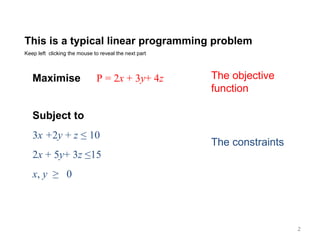
This is a typical linear programming problem
Keep left clicking the mouse to reveal the next part


   Maximise                   P = 2x + 3y+ 4z          The objective
                                                       function

   Subject to
   3x +2y + z ≤ 10
                                                       The constraints
   2x + 5y+ 3z ≤15
   x, y ≥ 0


                                                                         2
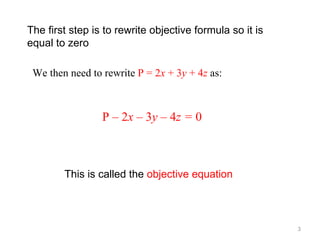
The first step is to rewrite objective formula so it is
equal to zero

 We then need to rewrite P = 2x + 3y + 4z as:


                 P – 2x – 3y – 4z = 0


        This is called the objective equation


                                                          3
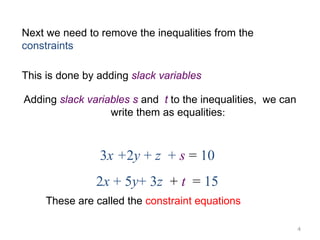
Next we need to remove the inequalities from the
constraints

This is done by adding slack variables

Adding slack variables s and t to the inequalities, we can
                  write them as equalities:


                3x +2y + z + s = 10
               2x + 5y+ 3z + t = 15
     These are called the constraint equations

                                                             4
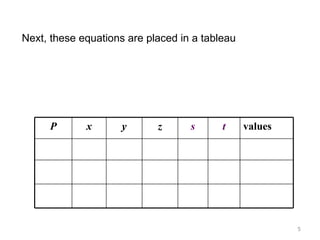
Next, these equations are placed in a tableau


     P       x       y      z      s      t     values


                                                         5
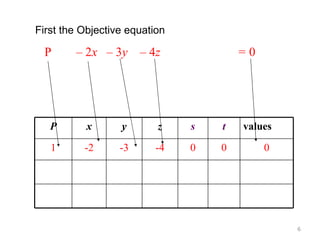
First the Objective equation

  P     – 2x – 3y – 4z                 =0


   P       x      y       z    s   t   values

   1      -2      -3     -4    0   0        0


                                                6
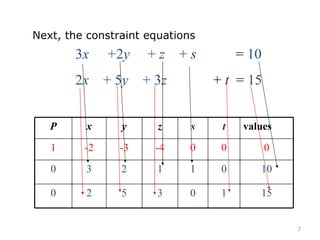
Next, the constraint equations
       3x     +2y    +z     +s        = 10
       2x     + 5y   + 3z        + t = 15


   P     x      y      z     s    t    values

   1     -2     -3     -4    0    0          0

   0     3      2      1     1    0       10

   0     2      5      3     0    1       15


                                                 7
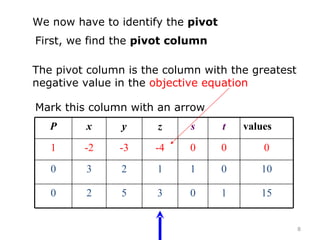
We now have to identify the pivot
First, we find the pivot column

The pivot column is the column with the greatest
negative value in the objective equation

Mark this column with an arrow
   P     x      y     z     s       t   values

   1     -2    -3     -4    0       0       0

   0     3      2     1     1       0      10

   0     2      5     3     0       1      15


                                                   8
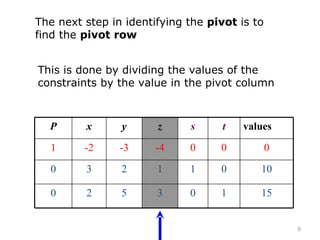
The next step in identifying the pivot is to
find the pivot row


This is done by dividing the values of the
constraints by the value in the pivot column


  P      x      y      z     s      t   values

  1      -2     -3     -4    0     0           0

  0      3      2      1     1     0       10

  0      2      5      3     0     1       15


                                                   9
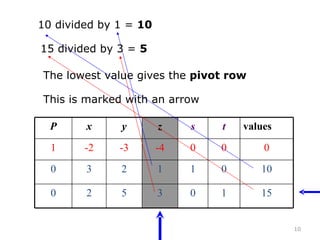
10 divided by 1 = 10

15 divided by 3 = 5

The lowest value gives the pivot row

This is marked with an arrow

  P     x     y        z    s   t   values

  1     -2    -3       -4   0   0       0

  0     3     2        1    1   0      10

  0     2     5        3    0   1      15


                                             10
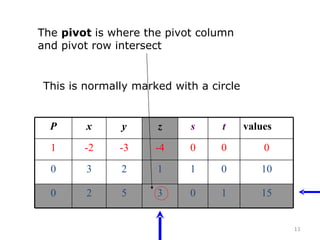
The pivot is where the pivot column
and pivot row intersect


This is normally marked with a circle


  P     x     y      z     s     t      values

  1     -2    -3     -4    0     0          0

  0     3     2      1     1     0         10

  0     2     5      3     0     1         15


                                                 11
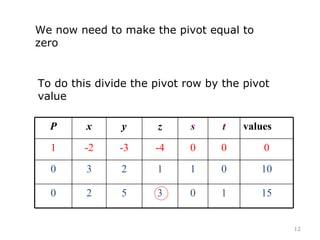
We now need to make the pivot equal to
zero


To do this divide the pivot row by the pivot
value

  P      x     y      z      s     t   values

  1     -2     -3     -4    0     0        0

  0      3     2      1     1     0       10

  0      2     5      3     0     1       15


                                                12
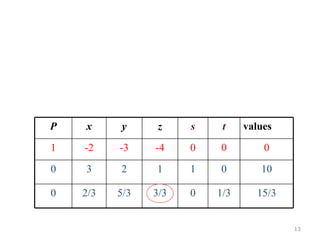
P   x     y      z    s    t    values

1   -2    -3    -4    0   0         0

0   3     2     1     1   0        10

0   2/3   5/3   3/3   0   1/3     15/3


                                         13
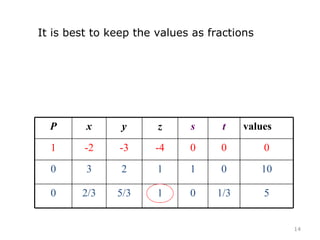
It is best to keep the values as fractions


  P      x      y      z     s     t    values

  1      -2    -3     -4     0     0         0

  0      3      2      1     1     0         10

  0     2/3    5/3     1     0    1/3        5


                                                  14
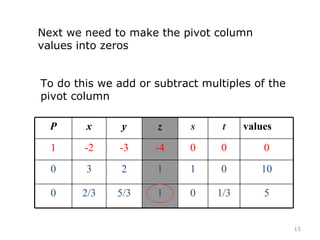
Next we need to make the pivot column
values into zeros


To do this we add or subtract multiples of the
pivot column

  P     x      y      z     s     t    values

  1     -2    -3     -4     0    0         0

  0     3      2     1      1    0        10

  0    2/3    5/3    1      0    1/3       5


                                                 15
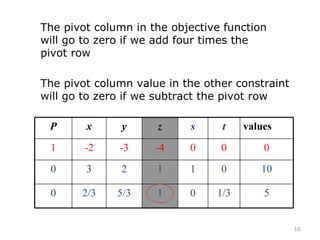
The pivot column in the objective function
will go to zero if we add four times the
pivot row

The pivot column value in the other constraint
will go to zero if we subtract the pivot row

 P      x      y     z     s     t    values

 1      -2    -3     -4    0     0        0

 0      3      2     1     1     0       10

 0     2/3    5/3    1     0    1/3       5


                                                 16
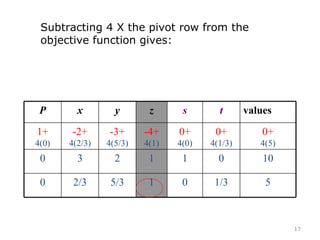
Subtracting 4 X the pivot row from the
 objective function gives:


 P       x        y       z      s       t      values

1+     -2+      -3+      -4+    0+      0+          0+
4(0)   4(2/3)   4(5/3)   4(1)   4(0)   4(1/3)      4(5)
 0       3        2       1      1       0          10

 0      2/3      5/3      1      0      1/3         5


                                                          17
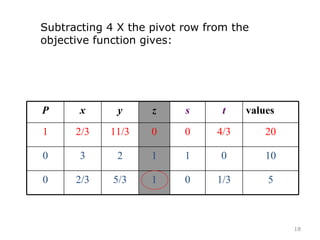
Subtracting 4 X the pivot row from the
objective function gives:


P      x      y     z     s      t    values

1     2/3   11/3    0     0     4/3       20

0      3      2     1     1     0         10

0     2/3    5/3    1     0     1/3       5


                                               18
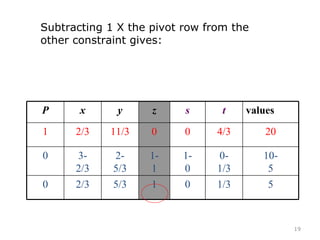
Subtracting 1 X the pivot row from the
other constraint gives:


P      x      y     z     s      t    values

1     2/3   11/3    0     0     4/3       20

0     3-     2-    1-     1-    0-       10-
      2/3    5/3   1      0     1/3       5
0     2/3    5/3   1      0     1/3       5


                                               19
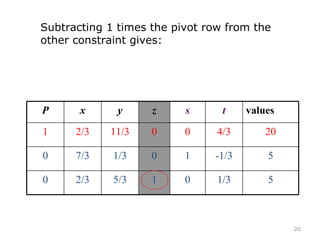
Subtracting 1 times the pivot row from the
other constraint gives:


P      x      y     z     s      t    values

1     2/3   11/3    0     0     4/3       20

0     7/3    1/3    0     1    -1/3       5

0     2/3    5/3    1     0     1/3       5


                                               20
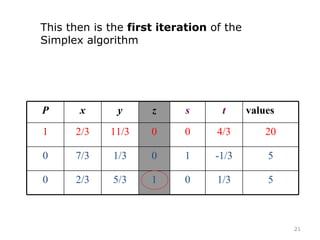
This then is the first iteration of the
Simplex algorithm


P      x      y      z      s      t      values

1     2/3    11/3    0     0      4/3         20

0     7/3     1/3    0     1     -1/3         5

0     2/3     5/3    1     0      1/3         5


                                                   21
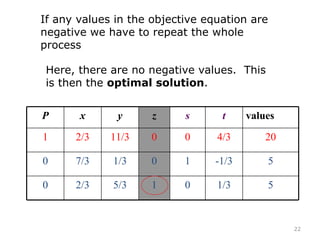
If any values in the objective equation are
negative we have to repeat the whole
process

 Here, there are no negative values. This
 is then the optimal solution.


P      x      y      z     s      t     values

1     2/3    11/3    0     0     4/3        20

0     7/3    1/3     0     1     -1/3         5

0     2/3    5/3     1     0     1/3          5


                                                  22
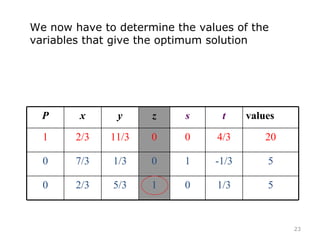
We now have to determine the values of the
variables that give the optimum solution


  P     x      y     z     s     t     values

  1     2/3   11/3   0     0    4/3        20

  0     7/3   1/3    0     1    -1/3       5

  0     2/3   5/3    1     0    1/3        5


                                                23
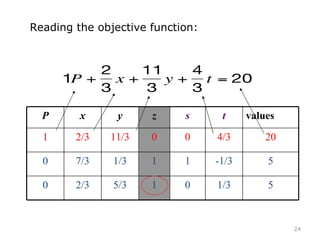
Reading the objective function:


  P      x      y     z     s      t     values

  1     2/3   11/3    0     0     4/3        20

  0     7/3    1/3    1     1     -1/3       5

  0     2/3    5/3    1     0     1/3        5


                                                  24
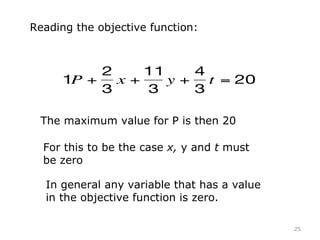
Reading the objective function:


 The maximum value for P is then 20

  For this to be the case x, y and t must
  be zero

  In general any variable that has a value
  in the objective function is zero.

                                             25
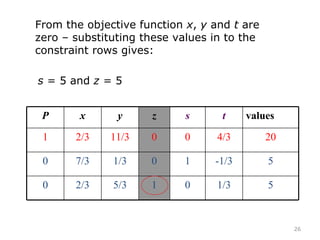
From the objective function x, y and t are
zero – substituting these values in to the
constraint rows gives:

s = 5 and z = 5


 P      x      y     z      s      t    values

 1     2/3    11/3   0      0     4/3        20

 0     7/3    1/3    0      1    -1/3        5

 0     2/3    5/3    1      0     1/3        5


                                                  26
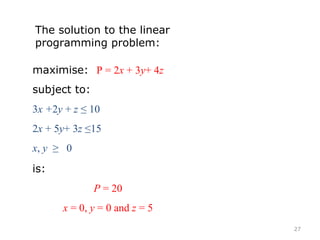
The solution to the linear
programming problem:

maximise: P = 2x + 3y+ 4z
subject to:
3x +2y + z ≤ 10
2x + 5y+ 3z ≤15
x, y ≥ 0
is:
              P = 20
      x = 0, y = 0 and z = 5
                               27
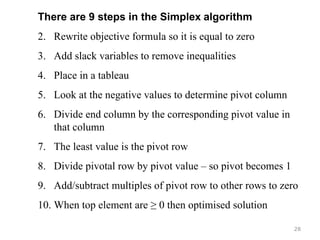
There are 9 steps in the Simplex algorithm
2. Rewrite objective formula so it is equal to zero
3. Add slack variables to remove inequalities
4. Place in a tableau
5. Look at the negative values to determine pivot column
6. Divide end column by the corresponding pivot value in
   that column
7. The least value is the pivot row
8. Divide pivotal row by pivot value – so pivot becomes 1
9. Add/subtract multiples of pivot row to other rows to zero
10. When top element are ≥ 0 then optimised solution

                                                            28
Go to this web site to solve any linear
programme problem using the simplex
method:


For on-line exercises go here:


                                          29

Simplex Algorithm

  • 1.
    Linear programming simplex method This presentation will help you to solve linear programming problems using the Simplex tableau Steve Bishop 2004, 2007, 2012 1
  • 2.
    This is atypical linear programming problem Keep left clicking the mouse to reveal the next part Maximise P = 2x + 3y+ 4z The objective function Subject to 3x +2y + z ≤ 10 The constraints 2x + 5y+ 3z ≤15 x, y ≥ 0 2
  • 3.
    The first stepis to rewrite objective formula so it is equal to zero We then need to rewrite P = 2x + 3y + 4z as: P – 2x – 3y – 4z = 0 This is called the objective equation 3
  • 4.
    Next we needto remove the inequalities from the constraints This is done by adding slack variables Adding slack variables s and t to the inequalities, we can write them as equalities: 3x +2y + z + s = 10 2x + 5y+ 3z + t = 15 These are called the constraint equations 4
  • 5.
    Next, these equationsare placed in a tableau P x y z s t values 5
  • 6.
    First the Objectiveequation P – 2x – 3y – 4z =0 P x y z s t values 1 -2 -3 -4 0 0 0 6
  • 7.
    Next, the constraintequations 3x +2y +z +s = 10 2x + 5y + 3z + t = 15 P x y z s t values 1 -2 -3 -4 0 0 0 0 3 2 1 1 0 10 0 2 5 3 0 1 15 7
  • 8.
    We now haveto identify the pivot First, we find the pivot column The pivot column is the column with the greatest negative value in the objective equation Mark this column with an arrow P x y z s t values 1 -2 -3 -4 0 0 0 0 3 2 1 1 0 10 0 2 5 3 0 1 15 8
  • 9.
    The next stepin identifying the pivot is to find the pivot row This is done by dividing the values of the constraints by the value in the pivot column P x y z s t values 1 -2 -3 -4 0 0 0 0 3 2 1 1 0 10 0 2 5 3 0 1 15 9
  • 10.
    10 divided by1 = 10 15 divided by 3 = 5 The lowest value gives the pivot row This is marked with an arrow P x y z s t values 1 -2 -3 -4 0 0 0 0 3 2 1 1 0 10 0 2 5 3 0 1 15 10
  • 11.
    The pivot iswhere the pivot column and pivot row intersect This is normally marked with a circle P x y z s t values 1 -2 -3 -4 0 0 0 0 3 2 1 1 0 10 0 2 5 3 0 1 15 11
  • 12.
    We now needto make the pivot equal to zero To do this divide the pivot row by the pivot value P x y z s t values 1 -2 -3 -4 0 0 0 0 3 2 1 1 0 10 0 2 5 3 0 1 15 12
  • 13.
    P x y z s t values 1 -2 -3 -4 0 0 0 0 3 2 1 1 0 10 0 2/3 5/3 3/3 0 1/3 15/3 13
  • 14.
    It is bestto keep the values as fractions P x y z s t values 1 -2 -3 -4 0 0 0 0 3 2 1 1 0 10 0 2/3 5/3 1 0 1/3 5 14
  • 15.
    Next we needto make the pivot column values into zeros To do this we add or subtract multiples of the pivot column P x y z s t values 1 -2 -3 -4 0 0 0 0 3 2 1 1 0 10 0 2/3 5/3 1 0 1/3 5 15
  • 16.
    The pivot columnin the objective function will go to zero if we add four times the pivot row The pivot column value in the other constraint will go to zero if we subtract the pivot row P x y z s t values 1 -2 -3 -4 0 0 0 0 3 2 1 1 0 10 0 2/3 5/3 1 0 1/3 5 16
  • 17.
    Subtracting 4 Xthe pivot row from the objective function gives: P x y z s t values 1+ -2+ -3+ -4+ 0+ 0+ 0+ 4(0) 4(2/3) 4(5/3) 4(1) 4(0) 4(1/3) 4(5) 0 3 2 1 1 0 10 0 2/3 5/3 1 0 1/3 5 17
  • 18.
    Subtracting 4 Xthe pivot row from the objective function gives: P x y z s t values 1 2/3 11/3 0 0 4/3 20 0 3 2 1 1 0 10 0 2/3 5/3 1 0 1/3 5 18
  • 19.
    Subtracting 1 Xthe pivot row from the other constraint gives: P x y z s t values 1 2/3 11/3 0 0 4/3 20 0 3- 2- 1- 1- 0- 10- 2/3 5/3 1 0 1/3 5 0 2/3 5/3 1 0 1/3 5 19
  • 20.
    Subtracting 1 timesthe pivot row from the other constraint gives: P x y z s t values 1 2/3 11/3 0 0 4/3 20 0 7/3 1/3 0 1 -1/3 5 0 2/3 5/3 1 0 1/3 5 20
  • 21.
    This then isthe first iteration of the Simplex algorithm P x y z s t values 1 2/3 11/3 0 0 4/3 20 0 7/3 1/3 0 1 -1/3 5 0 2/3 5/3 1 0 1/3 5 21
  • 22.
    If any valuesin the objective equation are negative we have to repeat the whole process Here, there are no negative values. This is then the optimal solution. P x y z s t values 1 2/3 11/3 0 0 4/3 20 0 7/3 1/3 0 1 -1/3 5 0 2/3 5/3 1 0 1/3 5 22
  • 23.
    We now haveto determine the values of the variables that give the optimum solution P x y z s t values 1 2/3 11/3 0 0 4/3 20 0 7/3 1/3 0 1 -1/3 5 0 2/3 5/3 1 0 1/3 5 23
  • 24.
    Reading the objectivefunction: P x y z s t values 1 2/3 11/3 0 0 4/3 20 0 7/3 1/3 1 1 -1/3 5 0 2/3 5/3 1 0 1/3 5 24
  • 25.
    Reading the objectivefunction: The maximum value for P is then 20 For this to be the case x, y and t must be zero In general any variable that has a value in the objective function is zero. 25
  • 26.
    From the objectivefunction x, y and t are zero – substituting these values in to the constraint rows gives: s = 5 and z = 5 P x y z s t values 1 2/3 11/3 0 0 4/3 20 0 7/3 1/3 0 1 -1/3 5 0 2/3 5/3 1 0 1/3 5 26
  • 27.
    The solution tothe linear programming problem: maximise: P = 2x + 3y+ 4z subject to: 3x +2y + z ≤ 10 2x + 5y+ 3z ≤15 x, y ≥ 0 is: P = 20 x = 0, y = 0 and z = 5 27
  • 28.
    There are 9steps in the Simplex algorithm 2. Rewrite objective formula so it is equal to zero 3. Add slack variables to remove inequalities 4. Place in a tableau 5. Look at the negative values to determine pivot column 6. Divide end column by the corresponding pivot value in that column 7. The least value is the pivot row 8. Divide pivotal row by pivot value – so pivot becomes 1 9. Add/subtract multiples of pivot row to other rows to zero 10. When top element are ≥ 0 then optimised solution 28
  • 29.
    Go to thisweb site to solve any linear programme problem using the simplex method: For on-line exercises go here: 29

Editor's Notes

  • #5 Steve Bishop 2004