4-10


4.2.5 Infeasible solution
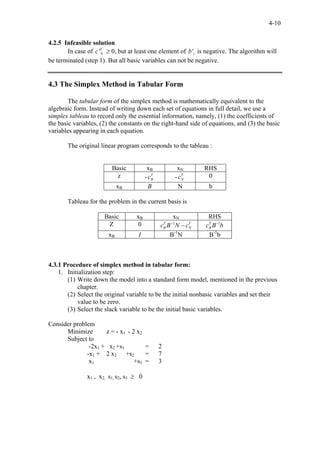
       In case of c 'T ≥ 0, but at least one element of b 'i is negative. The algorithm will
                     N

be terminated (step 1). But all basic variables can not be negative.


4.3 The Simplex Method in Tabular Form

        The tabular form of the simplex method is mathematically equivalent to the
algebraic form. Instead of writing down each set of equations in full detail, we use a
simplex tableau to record only the essential information, namely, (1) the coefficients of
the basic variables, (2) the constants on the right-hand side of equations, and (3) the basic
variables appearing in each equation.

       The original linear program corresponds to the tableau :


                         Basic            xB                  xN    RHS
                          z                 T
                                         - cB                - cT
                                                                N
                                                                     0
                             xB            B                   N     b

       Tableau for the problem in the current basis is

                      Basic        xB               xN               RHS
                       Z           0                    −1
                                                c B N − cT
                                                    T
                                                    B    N          cB B −1b
                                                                     T

                                                    -1
                        xB          I              B N               B-1b


4.3.1 Procedure of simplex method in tabular form:
    1. Initialization step:
       (1) Write down the model into a standard form model, mentioned in the previous
           chapter.
       (2) Select the original variable to be the initial nonbasic variables and set their
           value to be zero.
       (3) Select the slack variable to be the initial basic variables.

Consider problem
      Minimize       z = - x1 - 2 x2
      Subject to
               -2x1 + x2 +s1         =          2
              -x1 + 2 x2 +s2         =          7
               x1                +s3 =          3

               x1 , x2, s1, s2, s3 ≥ 0
4-11


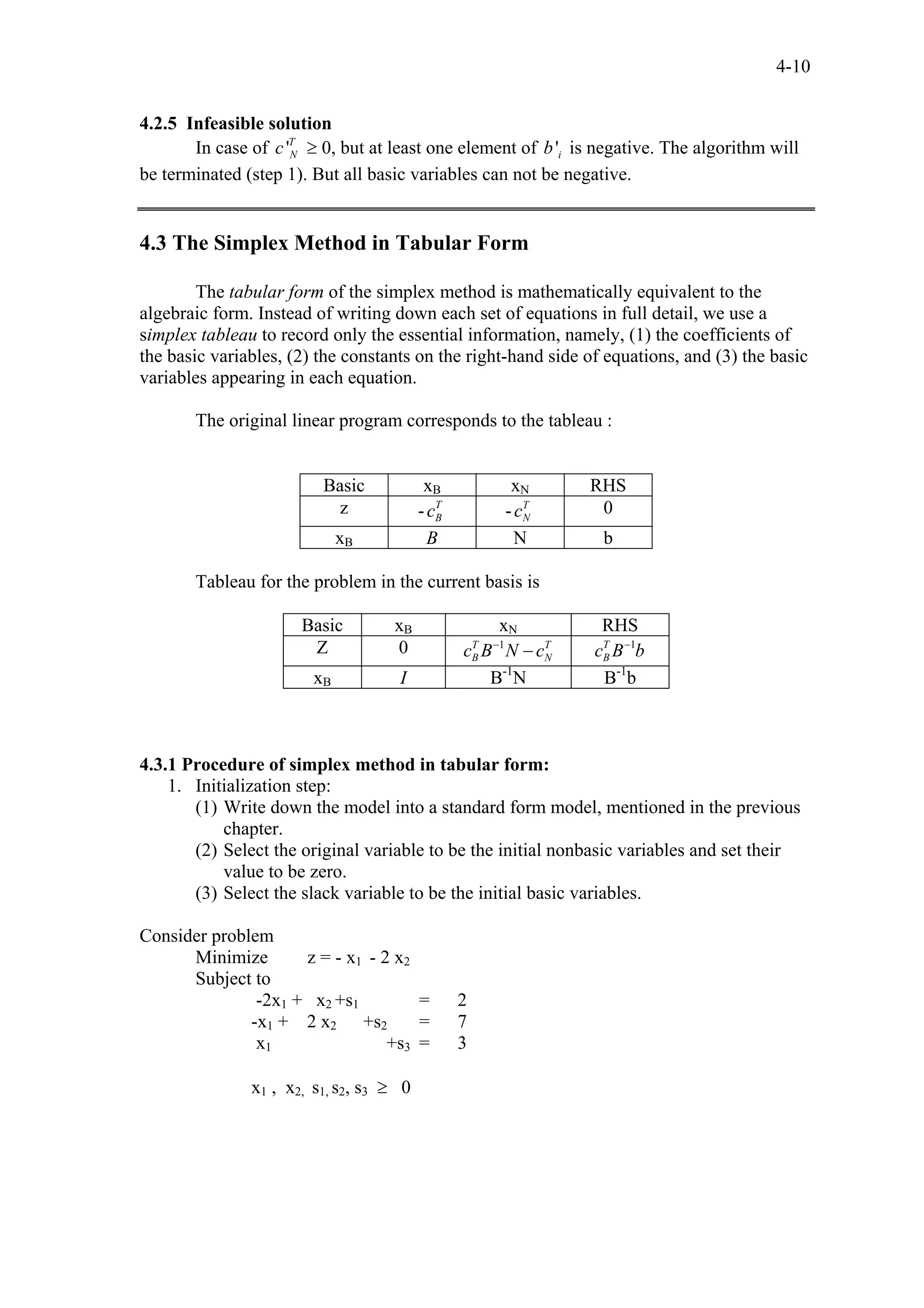
The initial tabular is

                   Basic    x1       x2       s1      s2       s3     RHS
                    z        1       2        0       0        0       0
                    s1      -2       1        1       0        0       2
                    s2      -1       2        0       1        0       7
                    s3       1       0        0       0        1       3


    2. Optimality Test:
       The current basic solution is optimal if and only if every coefficient in the first
       row of table (Z’s row) is ≤ 0. If it is, then stop; otherwise, go to the iterative step
       to obtain the next basic feasible solution. In this example the initial tabular above,
       coefficients of x1 and x2 are positive. Thus go to the iterative step.
    3. Iterative Step:
       (1) Determine the entering basic variable by selecting the variable with the
           positive coefficient having the largest value in the first row (Z’s row). The
           column below this coefficient is called the pivot column. In this example the
           column of x2 is the pivot.

                   Basic    x1       x2       s1      s2       s3     RHS
                    Z        1       2        0       0        0       0
                    s1      -2       1        1       0        0       2
                    s2      -1       2        0       1        0       7
                    s3       1       0        0       0        1       3

        (2) Determine the leaving basic variable by (1) picking out each coefficient in the
            pivot column that is positive (>0), (2) dividing each of these coefficients into
            “right hand side” for the same row, (3) identifying the equation that has
            smallest of this ratios, and (4) selecting the basic variable for this equation.

            For this example, the ratios for row 1 to row 3 are :
               Row 1 : 2/1 = 2
               Row 2: 7/2 = 3.5
               Row 3: -
            Row 1 has the smallest ratio. Thus, choose the s1 to leave the basis.

        (3) Put a box around this equation’s row in the tabular to the right of z column.
            This row is called pivot row and one number in these boxes is also called the
            pivot number.

            For example the first row (the row of s1 ) is pivot row and “1” is the pivot
            number.

                   Basic    x1       x2       s1      s2       s3     RHS
                    z        1       2        0       0        0       0
                    s1      -2       1        1       0        0       2
                    s2      -1       2        0       1        0       7
                    s3       1       0        0       0        1       3
4-12


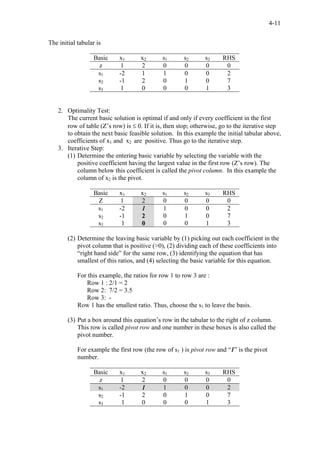
       (4) Determine the new feasible solution by constructing a new simplex tabular in
           proper from Gaussian elimination below the current one.

                 Basic      x1      x2       s1      s2       s3     RHS
                  z         -5      0         2      0        0       4
                  s1        -2      1         1      0        0       2
                  s2         3      0        -2      1        0       3
                  s3         1      0         0      0        1       3

       Then perform return to step 2.


4.3.2 Tie Breaking in the simplex method
       (1) Tie for the entering basic variable
           In step of determining the entering variable, it the objective function is
           z = - 4x1 - 4 x2. The coefficients of x1 and x2 are equal. The selection between
           these two variables can be made arbitrarily. The optimal solution will be
           reached eventually.

       (2) Tie for the leaving basic variable (degeneracy)
           In step of determining the leaving variable, the minimum ratio of right side
           and the coefficient in pivot column for the two variables are equal. Choosing
           one variable to be the leaving basis variable would lead the other one being
           zero in the new basis solution.

       (3) No leaving basic variable (unbounded z)
           In step of determining the leaving variable, no variable qualifies to be the
           leaving basis variable. This means that every coefficient in the pivot column
           (excluding z’row) is either zero or negative. This result would occur if the
           entering basic variable could be increased indefinitely without giving negative
           values to any of the current basis.

       (4) Multiple optimal solution
           Since the tabular simplex method will be stop after reaching one optimal
           solution. In order to test whether the multiple optimal solutions exist. After
           getting the optimal solution, perform the extra iteration by force one nonbasic
           variable into the basis. If the solution is still feasible, there are multiple
           solutions (since there are no changes in the coefficients of variables in the z’s
           row and objective value).
4-13


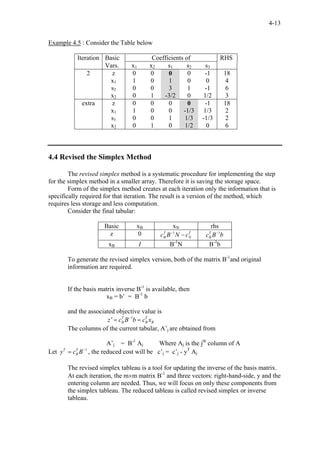
Example 4.5 : Consider the Table below

           Iteration Basic                 Coefficients of           RHS
                     Vars.       x1       x2     s1      s2    s3
               2       z         0        0      0       0     -1        18
                       x1        1        0      1       0     0          4
                       s2        0        0      3       1     -1        6
                       x2        0        1    -3/2      0    1/2         3
             extra     z         0        0      0       0     -1        18
                       x1        1        0      0     -1/3   1/3         2
                       s1        0        0      1      1/3   -1/3       2
                       x2        0        1      0      1/2    0          6


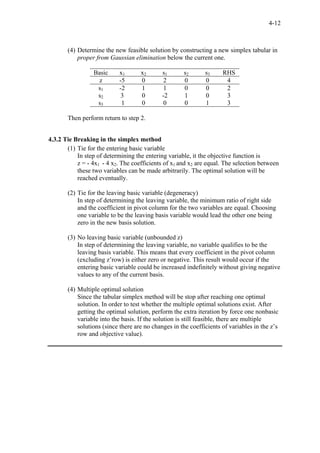
4.4 Revised the Simplex Method

        The revised simplex method is a systematic procedure for implementing the step
for the simplex method in a smaller array. Therefore it is saving the storage space.
        Form of the simplex method creates at each iteration only the information that is
specifically required for that iteration. The result is a version of the method, which
requires less storage and less computation.
        Consider the final tabular:

                      Basic        xB             xN             rhs
                       z           0           T
                                               B
                                                   −1
                                              c B N − cT
                                                       N       c B −1b
                                                                T
                                                                B
                                                  -1
                       xB             I          B N            B-1b

       To generate the revised simplex version, both of the matrix B-1and original
       information are required.


       If the basis matrix inverse B-1 is available, then
                      xB = b’ = B-1 b

       and the associated objective value is
                      z ' = cB B −1b = cB xB
                             T          T


       The columns of the current tabular, A’j are obtained from

                         A’j = B-1 Aj        Where Aj is the jth column of A
Let yT = cB B −1 , the reduced cost will be c’j = c’j - yT Aj
          T


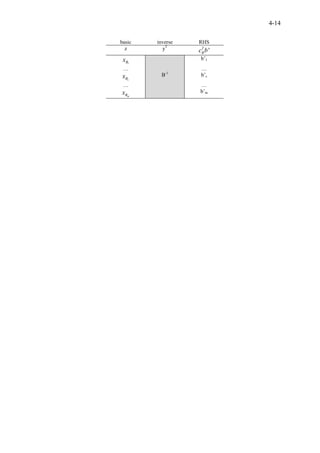
       The revised simplex tableau is a tool for updating the inverse of the basis matrix.
       At each iteration, the m×m matrix B-1 and three vectors: right-hand-side, y and the
       entering column are needed. Thus, we will focus on only these components from
       the simplex tableau. The reduced tableau is called revised simplex or inverse
       tableau.
4-14

basic   inverse   RHS
  z       yT       T
                  cB b '
 xB1               b’1
 …                 …
 xBs      B-1      b’s
 …                …
xBm               b’m

Simplextabular

  • 1.
    4-10 4.2.5 Infeasible solution In case of c 'T ≥ 0, but at least one element of b 'i is negative. The algorithm will N be terminated (step 1). But all basic variables can not be negative. 4.3 The Simplex Method in Tabular Form The tabular form of the simplex method is mathematically equivalent to the algebraic form. Instead of writing down each set of equations in full detail, we use a simplex tableau to record only the essential information, namely, (1) the coefficients of the basic variables, (2) the constants on the right-hand side of equations, and (3) the basic variables appearing in each equation. The original linear program corresponds to the tableau : Basic xB xN RHS z T - cB - cT N 0 xB B N b Tableau for the problem in the current basis is Basic xB xN RHS Z 0 −1 c B N − cT T B N cB B −1b T -1 xB I B N B-1b 4.3.1 Procedure of simplex method in tabular form: 1. Initialization step: (1) Write down the model into a standard form model, mentioned in the previous chapter. (2) Select the original variable to be the initial nonbasic variables and set their value to be zero. (3) Select the slack variable to be the initial basic variables. Consider problem Minimize z = - x1 - 2 x2 Subject to -2x1 + x2 +s1 = 2 -x1 + 2 x2 +s2 = 7 x1 +s3 = 3 x1 , x2, s1, s2, s3 ≥ 0
  • 2.
    4-11 The initial tabularis Basic x1 x2 s1 s2 s3 RHS z 1 2 0 0 0 0 s1 -2 1 1 0 0 2 s2 -1 2 0 1 0 7 s3 1 0 0 0 1 3 2. Optimality Test: The current basic solution is optimal if and only if every coefficient in the first row of table (Z’s row) is ≤ 0. If it is, then stop; otherwise, go to the iterative step to obtain the next basic feasible solution. In this example the initial tabular above, coefficients of x1 and x2 are positive. Thus go to the iterative step. 3. Iterative Step: (1) Determine the entering basic variable by selecting the variable with the positive coefficient having the largest value in the first row (Z’s row). The column below this coefficient is called the pivot column. In this example the column of x2 is the pivot. Basic x1 x2 s1 s2 s3 RHS Z 1 2 0 0 0 0 s1 -2 1 1 0 0 2 s2 -1 2 0 1 0 7 s3 1 0 0 0 1 3 (2) Determine the leaving basic variable by (1) picking out each coefficient in the pivot column that is positive (>0), (2) dividing each of these coefficients into “right hand side” for the same row, (3) identifying the equation that has smallest of this ratios, and (4) selecting the basic variable for this equation. For this example, the ratios for row 1 to row 3 are : Row 1 : 2/1 = 2 Row 2: 7/2 = 3.5 Row 3: - Row 1 has the smallest ratio. Thus, choose the s1 to leave the basis. (3) Put a box around this equation’s row in the tabular to the right of z column. This row is called pivot row and one number in these boxes is also called the pivot number. For example the first row (the row of s1 ) is pivot row and “1” is the pivot number. Basic x1 x2 s1 s2 s3 RHS z 1 2 0 0 0 0 s1 -2 1 1 0 0 2 s2 -1 2 0 1 0 7 s3 1 0 0 0 1 3
  • 3.
    4-12 (4) Determine the new feasible solution by constructing a new simplex tabular in proper from Gaussian elimination below the current one. Basic x1 x2 s1 s2 s3 RHS z -5 0 2 0 0 4 s1 -2 1 1 0 0 2 s2 3 0 -2 1 0 3 s3 1 0 0 0 1 3 Then perform return to step 2. 4.3.2 Tie Breaking in the simplex method (1) Tie for the entering basic variable In step of determining the entering variable, it the objective function is z = - 4x1 - 4 x2. The coefficients of x1 and x2 are equal. The selection between these two variables can be made arbitrarily. The optimal solution will be reached eventually. (2) Tie for the leaving basic variable (degeneracy) In step of determining the leaving variable, the minimum ratio of right side and the coefficient in pivot column for the two variables are equal. Choosing one variable to be the leaving basis variable would lead the other one being zero in the new basis solution. (3) No leaving basic variable (unbounded z) In step of determining the leaving variable, no variable qualifies to be the leaving basis variable. This means that every coefficient in the pivot column (excluding z’row) is either zero or negative. This result would occur if the entering basic variable could be increased indefinitely without giving negative values to any of the current basis. (4) Multiple optimal solution Since the tabular simplex method will be stop after reaching one optimal solution. In order to test whether the multiple optimal solutions exist. After getting the optimal solution, perform the extra iteration by force one nonbasic variable into the basis. If the solution is still feasible, there are multiple solutions (since there are no changes in the coefficients of variables in the z’s row and objective value).
  • 4.
    4-13 Example 4.5 :Consider the Table below Iteration Basic Coefficients of RHS Vars. x1 x2 s1 s2 s3 2 z 0 0 0 0 -1 18 x1 1 0 1 0 0 4 s2 0 0 3 1 -1 6 x2 0 1 -3/2 0 1/2 3 extra z 0 0 0 0 -1 18 x1 1 0 0 -1/3 1/3 2 s1 0 0 1 1/3 -1/3 2 x2 0 1 0 1/2 0 6 4.4 Revised the Simplex Method The revised simplex method is a systematic procedure for implementing the step for the simplex method in a smaller array. Therefore it is saving the storage space. Form of the simplex method creates at each iteration only the information that is specifically required for that iteration. The result is a version of the method, which requires less storage and less computation. Consider the final tabular: Basic xB xN rhs z 0 T B −1 c B N − cT N c B −1b T B -1 xB I B N B-1b To generate the revised simplex version, both of the matrix B-1and original information are required. If the basis matrix inverse B-1 is available, then xB = b’ = B-1 b and the associated objective value is z ' = cB B −1b = cB xB T T The columns of the current tabular, A’j are obtained from A’j = B-1 Aj Where Aj is the jth column of A Let yT = cB B −1 , the reduced cost will be c’j = c’j - yT Aj T The revised simplex tableau is a tool for updating the inverse of the basis matrix. At each iteration, the m×m matrix B-1 and three vectors: right-hand-side, y and the entering column are needed. Thus, we will focus on only these components from the simplex tableau. The reduced tableau is called revised simplex or inverse tableau.
  • 5.
    4-14 basic inverse RHS z yT T cB b ' xB1 b’1 … … xBs B-1 b’s … … xBm b’m