SIMPLEX METHOD
ITERATIVE IMPROVEMENT METHOD
1
Dr. P. Subathra
Professor/ IT
KAMARAJ College of Engg. & Tech.
(AUTONOMOUS)
SIMPLEX METHOD
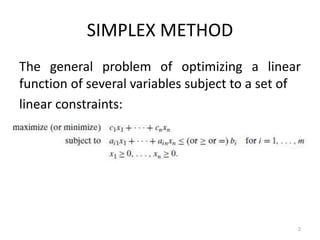
The general problem of optimizing a linear
function of several variables subject to a set of
linear constraints:
2
SIMPLEX METHOD
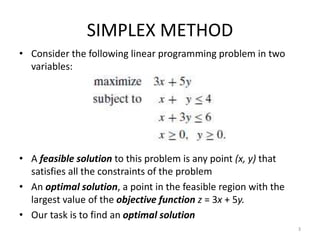
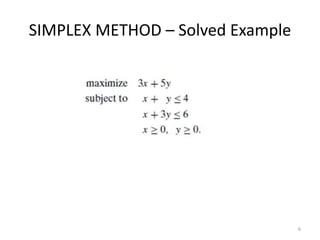
• Consider the following linear programming problem in two
variables:
• A feasible solution to this problem is any point (x, y) that
satisfies all the constraints of the problem
• An optimal solution, a point in the feasible region with the
largest value of the objective function z = 3x + 5y.
• Our task is to find an optimal solution
3
SIMPLEX METHOD
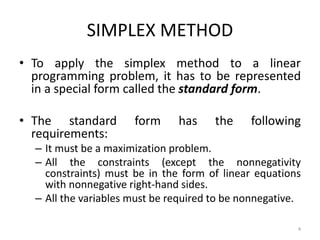
• To apply the simplex method to a linear
programming problem, it has to be represented
in a special form called the standard form.
• The standard form has the following
requirements:
– It must be a maximization problem.
– All the constraints (except the nonnegativity
constraints) must be in the form of linear equations
with nonnegative right-hand sides.
– All the variables must be required to be nonnegative.
4
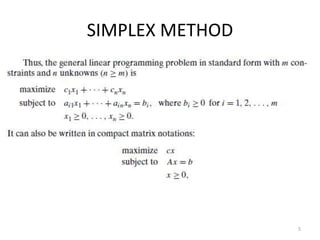
SIMPLEX METHOD
5
SIMPLEX METHOD – Solved Example
6
SIMPLEX METHOD – Solved Example
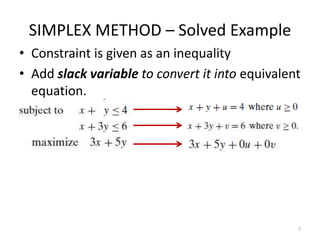
• Constraint is given as an inequality
• Add slack variable to convert it into equivalent
equation.
7
SIMPLEX METHOD – Solved Example
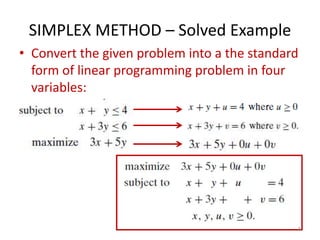
• Convert the given problem into a the standard
form of linear programming problem in four
variables:
8
SIMPLEX METHOD – Solved Example
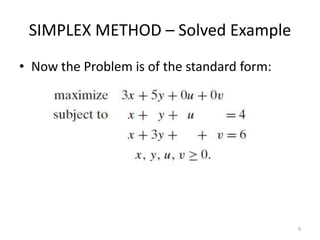
• Now the Problem is of the standard form:
9
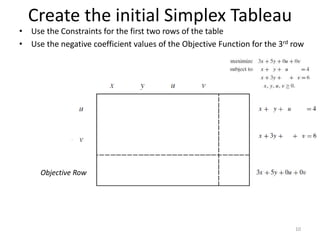
Create the initial Simplex Tableau
• Use the Constraints for the first two rows of the table
• Use the negative coefficient values of the Objective Function for the 3rd row
Objective Row
10
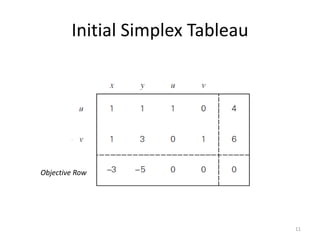
Initial Simplex Tableau
Objective Row
11
ITERATION 1
12
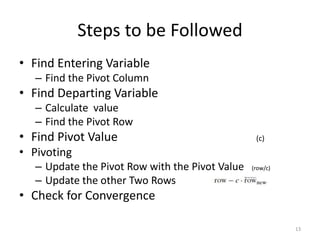
Steps to be Followed
• Find Entering Variable
– Find the Pivot Column
• Find Departing Variable
– Calculate value
– Find the Pivot Row
• Find Pivot Value (c)
• Pivoting
– Update the Pivot Row with the Pivot Value (row/c)
– Update the other Two Rows
• Check for Convergence
13
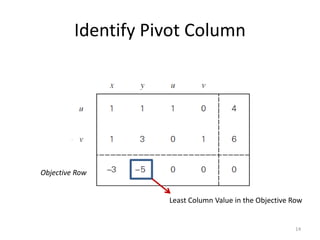
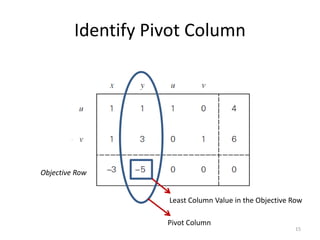
Identify Pivot Column
Least Column Value in the Objective Row
Objective Row
14
Identify Pivot Column
Least Column Value in the Objective Row
Objective Row
Pivot Column
15
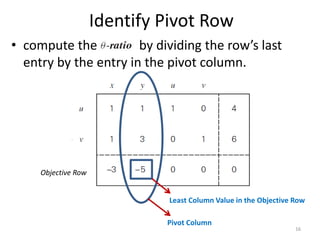
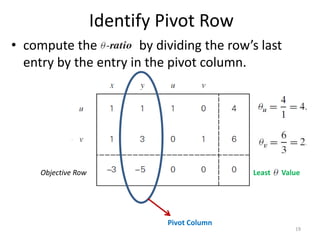
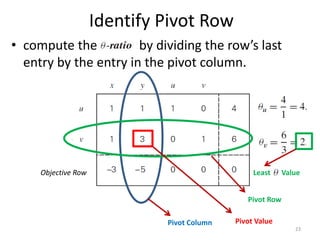
Identify Pivot Row
• compute the by dividing the row’s last
entry by the entry in the pivot column.
Least Column Value in the Objective Row
Objective Row
Pivot Column
16
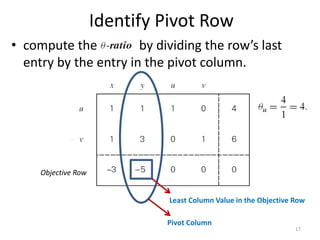
Identify Pivot Row
• compute the by dividing the row’s last
entry by the entry in the pivot column.
Least Column Value in the Objective Row
Objective Row
Pivot Column
17
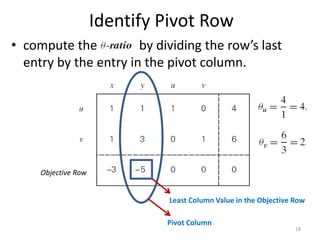
Identify Pivot Row
• compute the by dividing the row’s last
entry by the entry in the pivot column.
Least Column Value in the Objective Row
Objective Row
Pivot Column
18
Identify Pivot Row
• compute the by dividing the row’s last
entry by the entry in the pivot column.
Objective Row
Pivot Column
Least Value
19
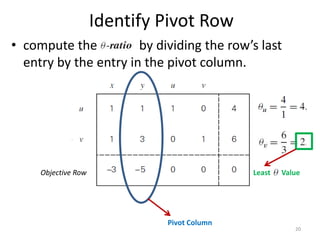
Identify Pivot Row
• compute the by dividing the row’s last
entry by the entry in the pivot column.
Objective Row
Pivot Column
Least Value
20
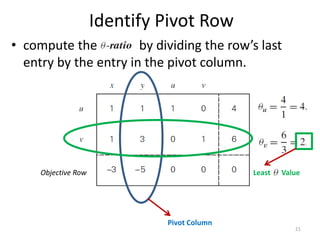
Identify Pivot Row
• compute the by dividing the row’s last
entry by the entry in the pivot column.
Objective Row
Pivot Column
Least Value
21
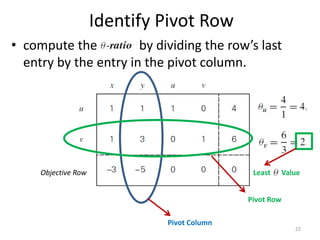
Identify Pivot Row
• compute the by dividing the row’s last
entry by the entry in the pivot column.
Objective Row
Pivot Column
Least Value
Pivot Row
22
Identify Pivot Row
• compute the by dividing the row’s last
entry by the entry in the pivot column.
Objective Row
Pivot Column
Least Value
Pivot Row
Pivot Value
23
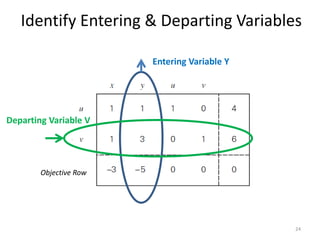
Identify Entering & Departing Variables
Objective Row
24
Entering Variable Y
Departing Variable V
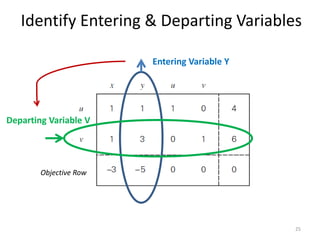
Identify Entering & Departing Variables
Objective Row
25
Entering Variable Y
Departing Variable V
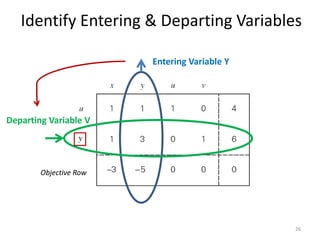
Identify Entering & Departing Variables
Objective Row
26
Entering Variable Y
Departing Variable V
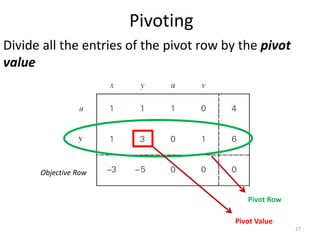
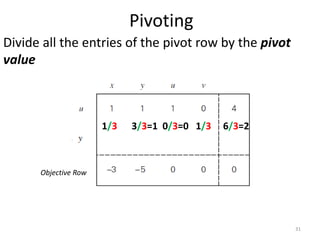
Pivoting
Divide all the entries of the pivot row by the pivot
value
Objective Row
Pivot Row
Pivot Value
27
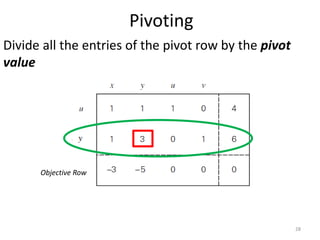
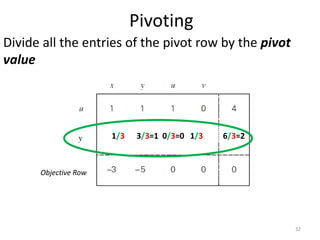
Pivoting
Divide all the entries of the pivot row by the pivot
value
Objective Row
28
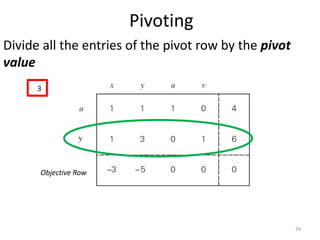
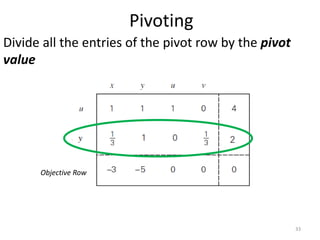
Pivoting
Divide all the entries of the pivot row by the pivot
value
Objective Row
3
29
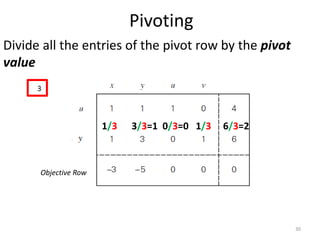
Pivoting
Divide all the entries of the pivot row by the pivot
value
Objective Row
1/3 3/3=1 0/3=0 1/3 6/3=2
3
30
Pivoting
Divide all the entries of the pivot row by the pivot
value
Objective Row
1/3 3/3=1 0/3=0 1/3 6/3=2
31
Pivoting
Divide all the entries of the pivot row by the pivot
value
Objective Row
32
1/3 3/3=1 0/3=0 1/3 6/3=2
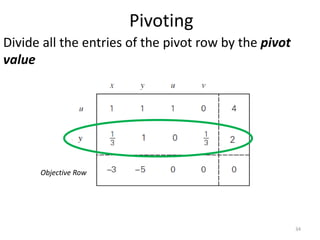
Pivoting
Divide all the entries of the pivot row by the pivot
value
Objective Row
33
Pivoting
Divide all the entries of the pivot row by the pivot
value
Objective Row
34
Pivoting
Objective Row
35
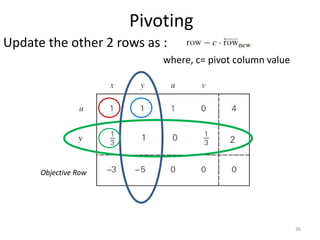
Pivoting
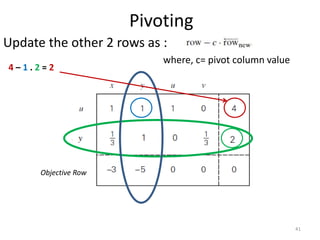
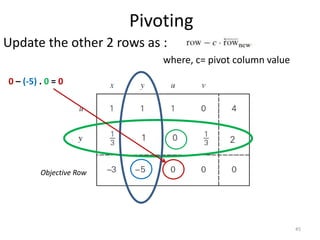
Update the other 2 rows as :
where, c= pivot column value
Objective Row
36
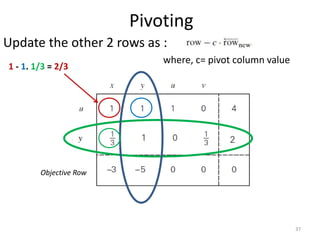
Pivoting
Update the other 2 rows as :
where, c= pivot column value
Objective Row
37
1 - 1. 1/3 = 2/3
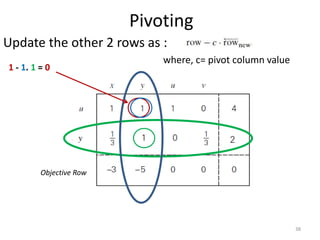
Pivoting
Update the other 2 rows as :
where, c= pivot column value
Objective Row
38
1 - 1. 1 = 0
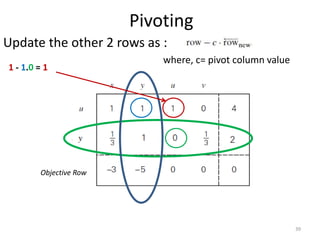
Pivoting
Update the other 2 rows as :
where, c= pivot column value
Objective Row
39
1 - 1.0 = 1
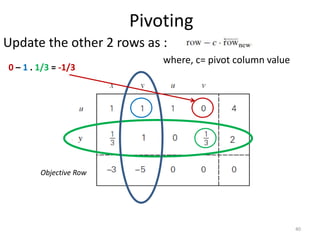
Pivoting
Update the other 2 rows as :
where, c= pivot column value
Objective Row
40
0 – 1 . 1/3 = -1/3
Pivoting
Update the other 2 rows as :
where, c= pivot column value
Objective Row
41
4 – 1 . 2 = 2
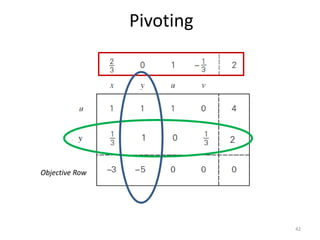
Pivoting
Objective Row
42
Pivoting
Update the other 2 rows as :
where, c= pivot column value
Objective Row
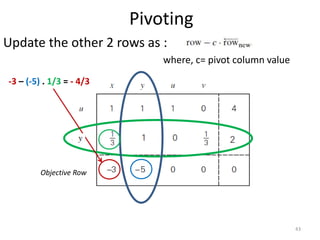
43
-3 – (-5) . 1/3 = - 4/3
Pivoting
Update the other 2 rows as :
where, c= pivot column value
Objective Row
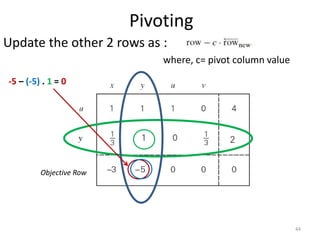
44
-5 – (-5) . 1 = 0
Pivoting
Update the other 2 rows as :
where, c= pivot column value
Objective Row
45
0 – (-5) . 0 = 0
Pivoting
Update the other 2 rows as :
where, c= pivot column value
Objective Row
46
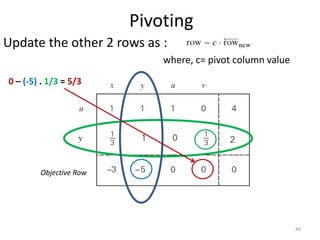
0 – (-5) . 1/3 = 5/3
Pivoting
Update the other 2 rows as :
where, c= pivot column value
Objective Row
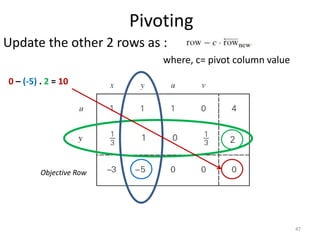
47
0 – (-5) . 2 = 10
Pivoting
Objective Row
48
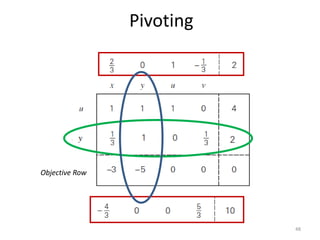
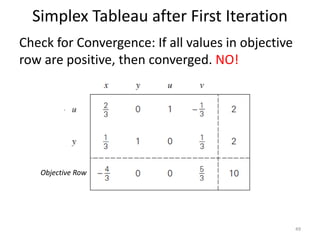
Simplex Tableau after First Iteration
Check for Convergence: If all values in objective
row are positive, then converged. NO!
49
Objective Row
ITERATION 2
50
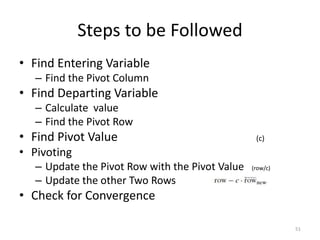
Steps to be Followed
• Find Entering Variable
– Find the Pivot Column
• Find Departing Variable
– Calculate value
– Find the Pivot Row
• Find Pivot Value (c)
• Pivoting
– Update the Pivot Row with the Pivot Value (row/c)
– Update the other Two Rows
• Check for Convergence
51
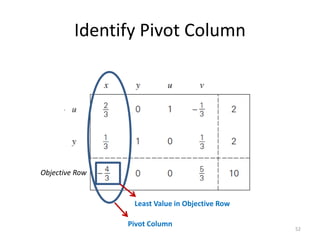
Identify Pivot Column
52
Least Value in Objective Row
Pivot Column
Objective Row
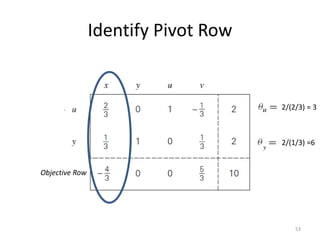
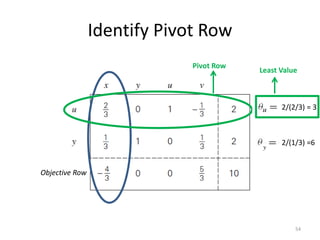
Identify Pivot Row
53
2/(2/3) = 3
2/(1/3) =6
Objective Row
Identify Pivot Row
54
2/(2/3) = 3
2/(1/3) =6
Objective Row
Least Value
Pivot Row
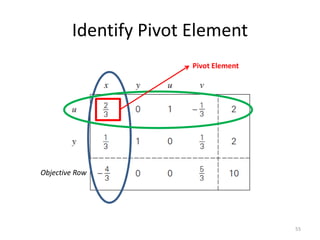
Identify Pivot Element
55
Objective Row
Pivot Element
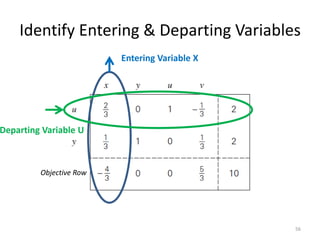
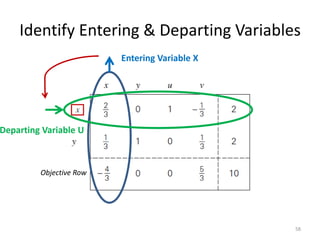
Identify Entering & Departing Variables
56
Objective Row
Departing Variable U
Entering Variable X
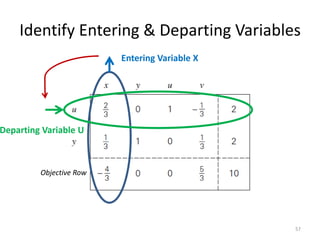
Identify Entering & Departing Variables
57
Objective Row
Departing Variable U
Entering Variable X
Identify Entering & Departing Variables
58
Objective Row
Departing Variable U
Entering Variable X
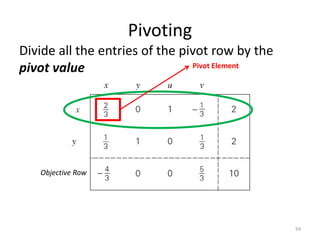
Pivoting
Divide all the entries of the pivot row by the
pivot value
59
Objective Row
Pivot Element
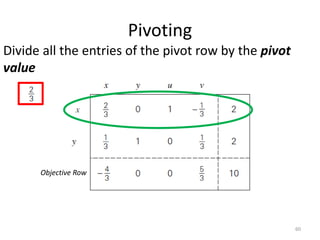
Pivoting
Divide all the entries of the pivot row by the pivot
value
60
Objective Row
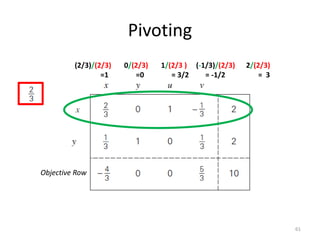
Pivoting
61
Objective Row
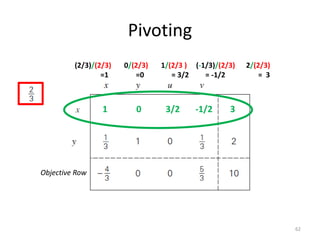
(2/3)/(2/3) 0/(2/3) 1/(2/3 ) (-1/3)/(2/3) 2/(2/3)
=1 =0 = 3/2 = -1/2 = 3
Pivoting
62
Objective Row
(2/3)/(2/3) 0/(2/3) 1/(2/3 ) (-1/3)/(2/3) 2/(2/3)
=1 =0 = 3/2 = -1/2 = 3
1 0 3/2 -1/2 3
Pivoting
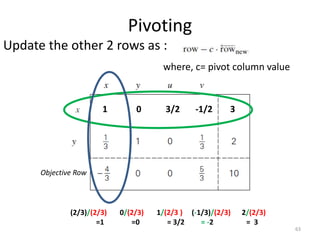
Update the other 2 rows as :
where, c= pivot column value
63
Objective Row
(2/3)/(2/3) 0/(2/3) 1/(2/3 ) (-1/3)/(2/3) 2/(2/3)
=1 =0 = 3/2 = -2 = 3
1 0 3/2 -1/2 3
Pivoting
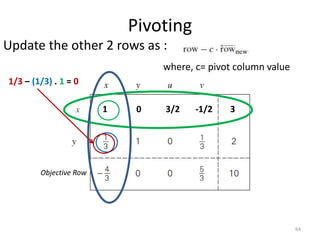
Update the other 2 rows as :
where, c= pivot column value
64
Objective Row
1 0 3/2 -1/2 3
1/3 – (1/3) . 1 = 0
Pivoting
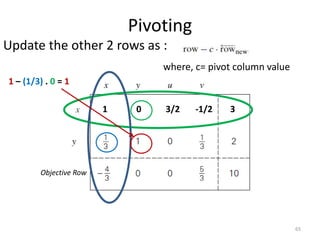
Update the other 2 rows as :
where, c= pivot column value
65
Objective Row
1 0 3/2 -1/2 3
1 – (1/3) . 0 = 1
Pivoting
Update the other 2 rows as :
where, c= pivot column value
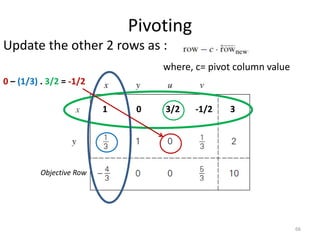
66
Objective Row
1 0 3/2 -1/2 3
0 – (1/3) . 3/2 = -1/2
Pivoting
Update the other 2 rows as :
where, c= pivot column value
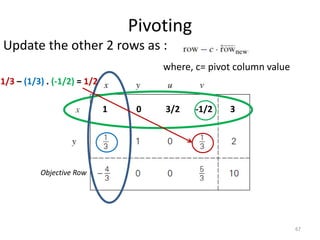
67
Objective Row
1 0 3/2 -1/2 3
1/3 – (1/3) . (-1/2) = 1/2
Pivoting
Update the other 2 rows as :
where, c= pivot column value
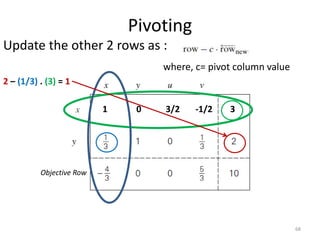
68
Objective Row
1 0 3/2 -1/2 3
2 – (1/3) . (3) = 1
Pivoting
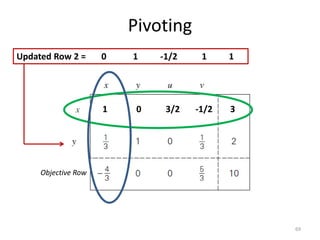
69
Objective Row
1 0 3/2 -1/2 3
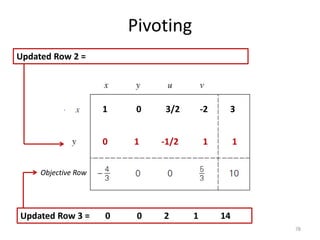
Updated Row 2 = 0 1 -1/2 1 1
Pivoting
Update the other 2 rows as :
where, c= pivot column value
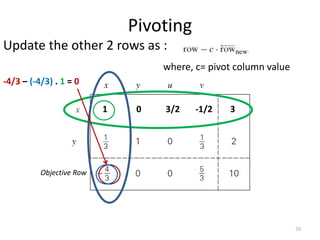
70
Objective Row
1 0 3/2 -1/2 3
-4/3 – (-4/3) . 1 = 0
Pivoting
Update the other 2 rows as :
where, c= pivot column value
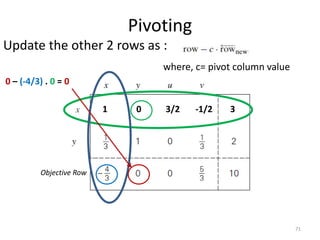
71
Objective Row
1 0 3/2 -1/2 3
0 – (-4/3) . 0 = 0
Pivoting
Update the other 2 rows as :
where, c= pivot column value
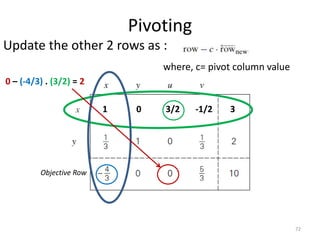
72
Objective Row
1 0 3/2 -1/2 3
0 – (-4/3) . (3/2) = 2
Pivoting
Update the other 2 rows as :
where, c= pivot column value
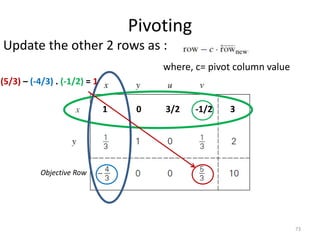
73
Objective Row
1 0 3/2 -1/2 3
(5/3) – (-4/3) . (-1/2) = 1
Pivoting
Update the other 2 rows as :
where, c= pivot column value
74
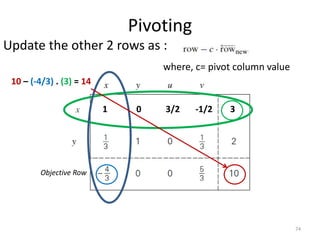
Objective Row
1 0 3/2 -1/2 3
10 – (-4/3) . (3) = 14
Pivoting
75
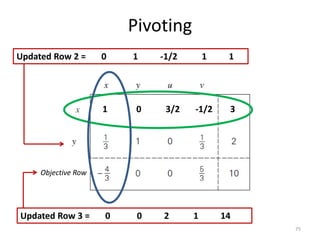
Objective Row
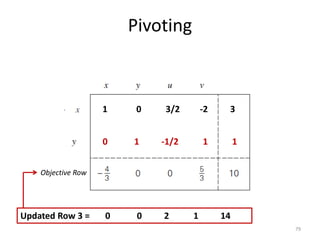
1 0 3/2 -1/2 3
Updated Row 2 = 0 1 -1/2 1 1
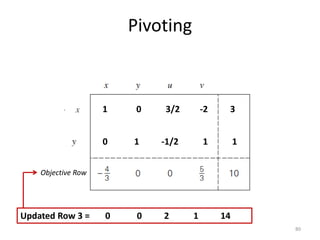
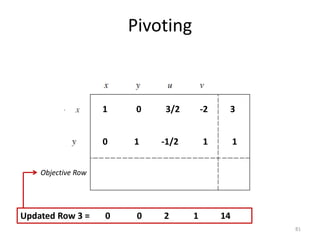
Updated Row 3 = 0 0 2 1 14
Pivoting
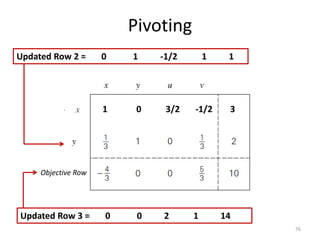
76
Objective Row
1 0 3/2 -1/2 3
Updated Row 2 = 0 1 -1/2 1 1
Updated Row 3 = 0 0 2 1 14
Pivoting
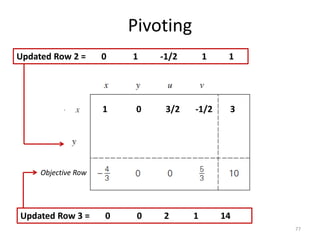
77
Objective Row
1 0 3/2 -1/2 3
Updated Row 2 = 0 1 -1/2 1 1
Updated Row 3 = 0 0 2 1 14
Pivoting
78
Objective Row
1 0 3/2 -2 3
Updated Row 2 =
Updated Row 3 = 0 0 2 1 14
0 1 -1/2 1 1
Pivoting
79
Objective Row
1 0 3/2 -2 3
Updated Row 3 = 0 0 2 1 14
0 1 -1/2 1 1
Pivoting
80
Objective Row
1 0 3/2 -2 3
Updated Row 3 = 0 0 2 1 14
0 1 -1/2 1 1
Pivoting
81
Objective Row
1 0 3/2 -2 3
Updated Row 3 = 0 0 2 1 14
0 1 -1/2 1 1
Pivoting
82
Objective Row
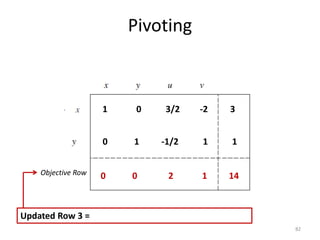
1 0 3/2 -2 3
Updated Row 3 =
0 1 -1/2 1
0 0 2 1
1
14
Pivoting
83
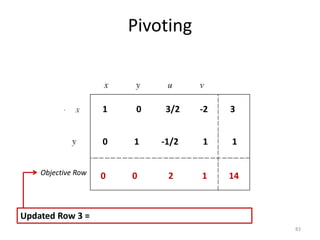
Objective Row
1 0 3/2 -2 3
Updated Row 3 =
0 1 -1/2 1
0 0 2 1
1
14
Pivoting
84
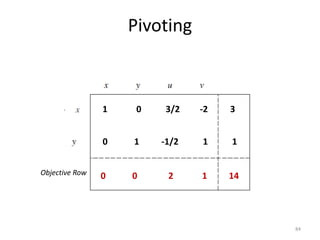
Objective Row
1 0 3/2 -2 3
0 1 -1/2 1
0 0 2 1
1
14
Pivoting
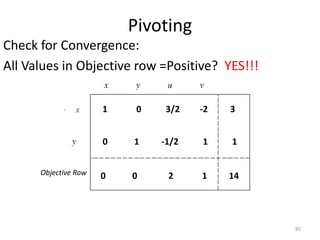
Check for Convergence:
All Values in Objective row =Positive? YES!!!
85
Objective Row
1 0 3/2 -2 3
0 1 -1/2 1
0 0 2 1
1
14
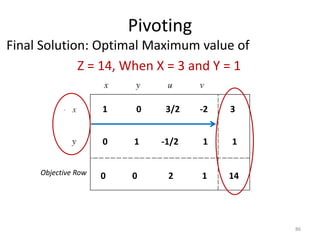
Pivoting
Final Solution: Optimal Maximum value of
Z = 14, When X = 3 and Y = 1
86
Objective Row
1 0 3/2 -2 3
0 1 -1/2 1
0 0 2 1
1
14
87
88

Simplex method