Operation Research
CHAPTER 06 - THE BIG M METHOD
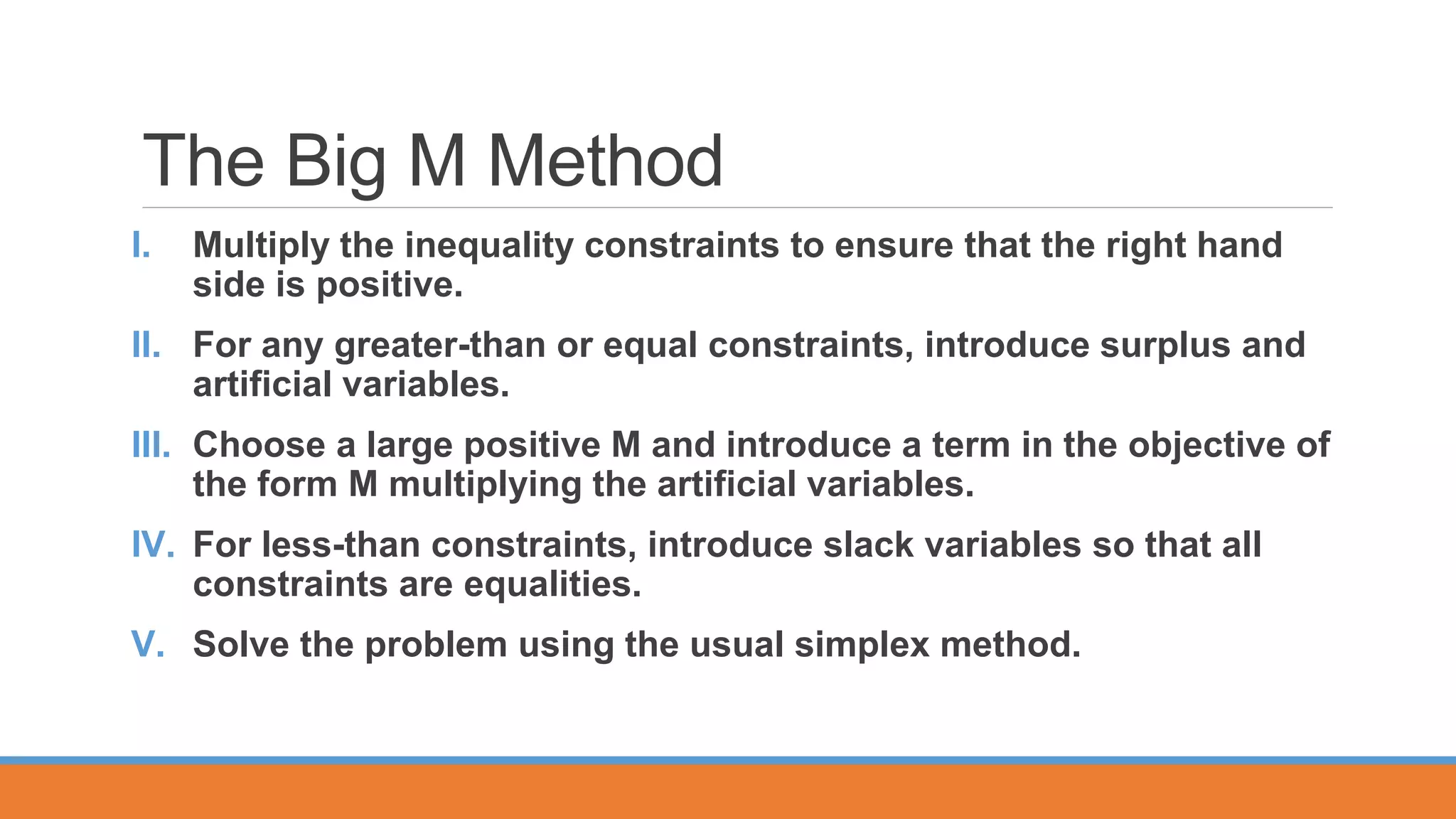
The Big M Method
I. Multiply the inequality constraints to ensure that the right hand
side is positive.
II. For any greater-than or equal constraints, introduce surplus and
artificial variables.
III. Choose a large positive M and introduce a term in the objective of
the form M multiplying the artificial variables.
IV. For less-than constraints, introduce slack variables so that all
constraints are equalities.
V. Solve the problem using the usual simplex method.
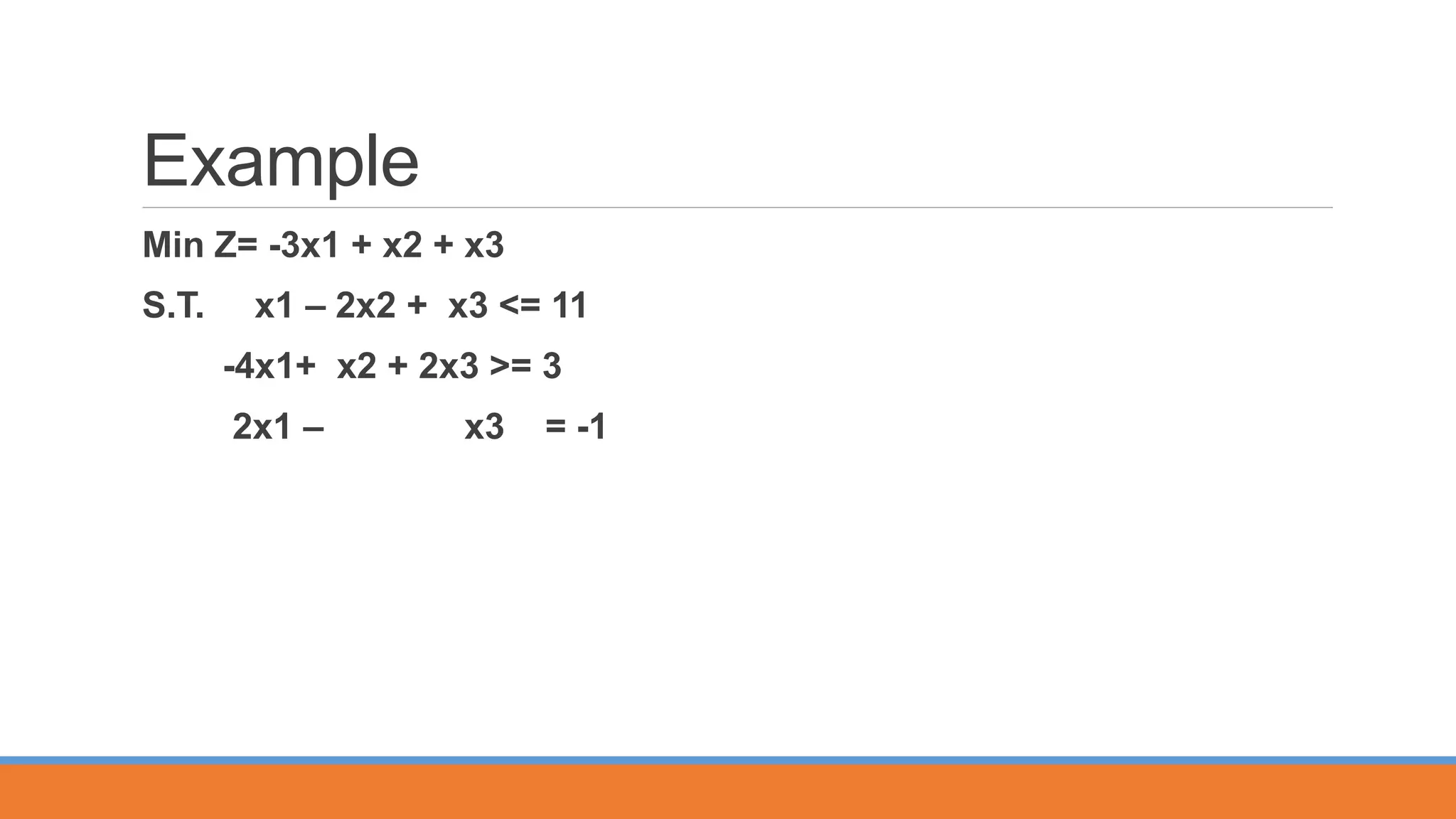
Example
Min Z= -3x1 + x2 + x3
S.T. x1 – 2x2 + x3 <= 11
-4x1+ x2 + 2x3 >= 3
2x1 – x3 = -1
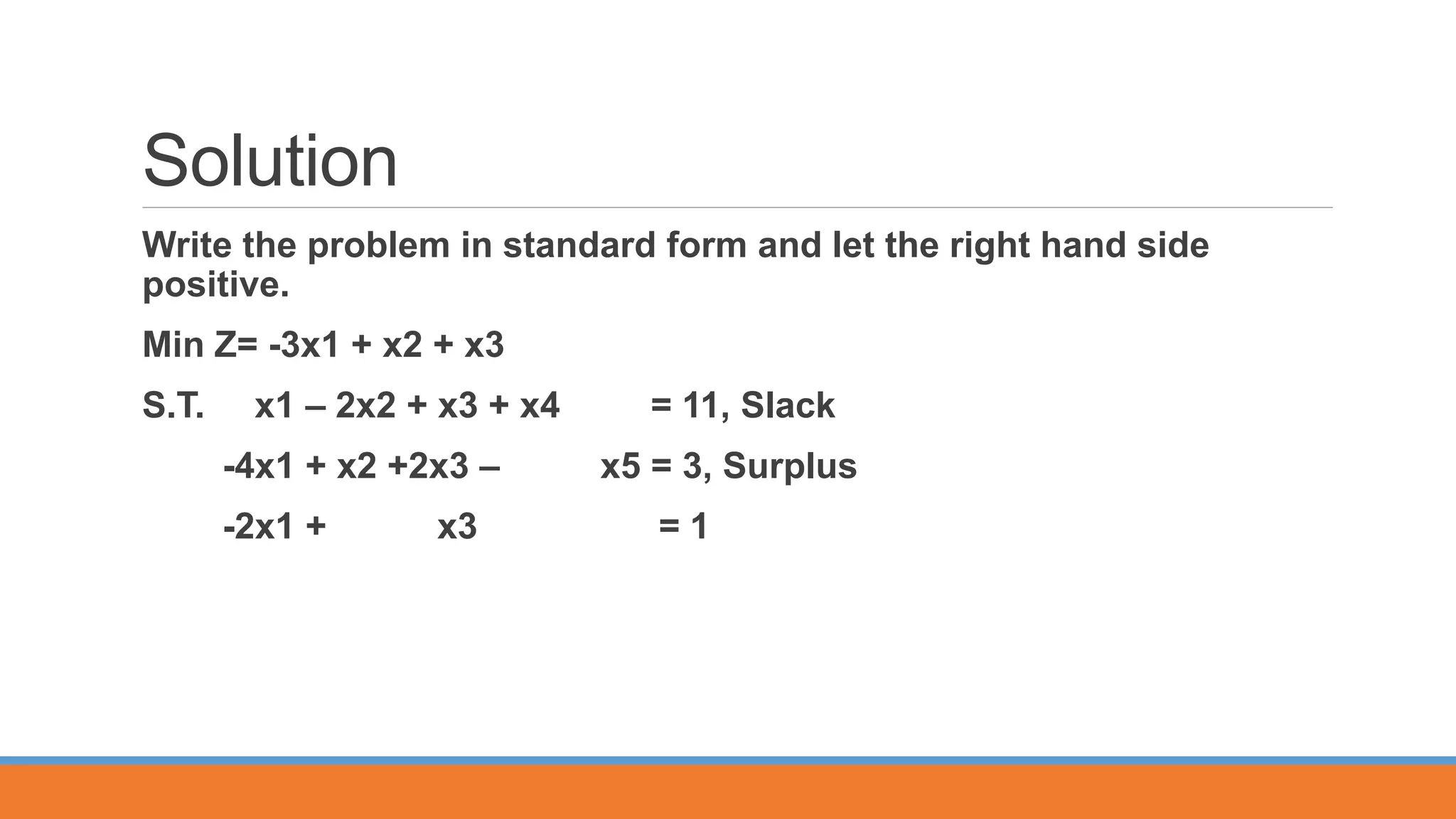
Solution
Write the problem in standard form and let the right hand side
positive.
Min Z= -3x1 + x2 + x3
S.T. x1 – 2x2 + x3 + x4 = 11, Slack
-4x1 + x2 +2x3 – x5 = 3, Surplus
-2x1 + x3 = 1
Solution
Write the problem in canonical form (add artificial variable to the 2nd
and to the 3rd constraints).
Add M to the artificial variables in the objective function
In case the problem is a maximization problem, add –M as a
coefficient to the artificial variables, Otherwise add M.
Min Z= -3x1 + x2 + x3 + Mx6 + Mx7
S.T. x1 – 2x2 + x3 + x4 = 11
-4x1 + x2 +2x3 – x5 + x6 = 3
-2x1 + x3 + x7 = 1
Solution
Iteration 1: Basic: x4=11, x6=3, x7=1. Z=Mx6+Mx7=3M+M=4M
-3 1 1 0 0 M M
x1 x2 x3 x4 x5 x6 x7
0 x4 1 -2 1 1 0 0 0 11
M x6 -4 1 2 0 -1 1 0 3
M x7 -2 0 1 0 0 0 1 1
CJ 0 0 0
Solution
C1= -3 – (0,M,M) = 6M-3 >0
C2= 1 – (0,M,M) = 1-M <0
C3= 1 – (0,M,M) = 1-3M <0
C5= 0 – (0,M,M) = M >0
x3 is entering, x3= min{11,3/2,1}=1, x7 is leaving.
1
-4
-2
-2
1
0
1
2
1
0
-1
0
Solution
Iteration 2: Basic: x4=11-1=10, x6=3-2=1, x3=1. Z=1+M
-3 1 1 0 0 M M
x1 x2 x3 x4 x5 x6 x7
0 x4 3 -2 0 1 0 0 -1 10
M x6 0 1 0 0 -1 1 -2 1
1 x3 -2 0 1 0 0 0 1 1
CJ 0 0 0 0
Solution
C1= -3 – (0,M,1) = -1 <0
C2= 1 – (0,M,1) = 1-M <0
C5= 0 – (0,M,1) = M >0
x2 is entering, x2= min{-5,1,inf.}=1, x6 is leaving.
Basic: x4=12, x2=1, x3=1. Z=2.
3
0
-2
-2
1
0
0
-1
0
Solution
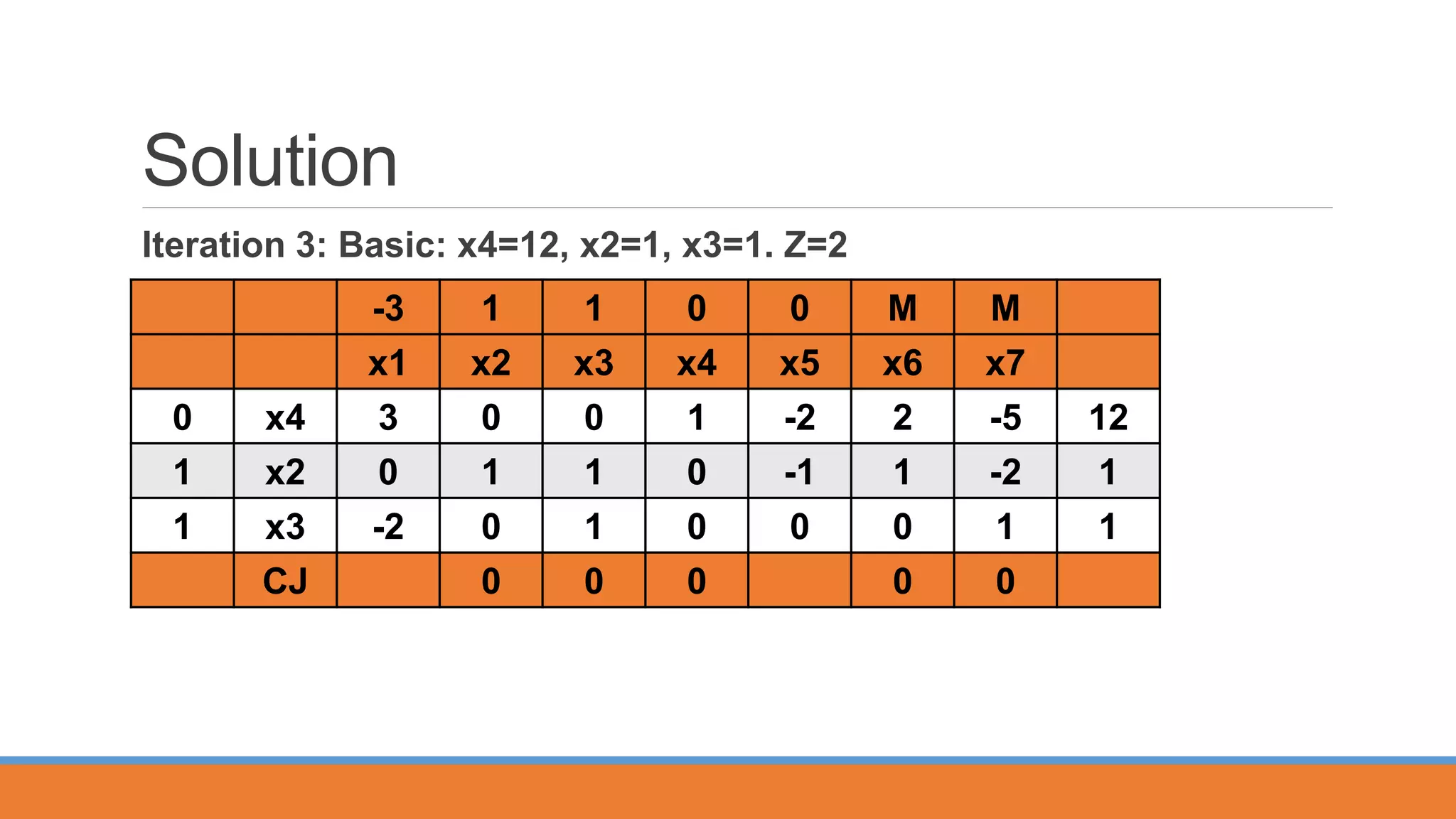
Iteration 3: Basic: x4=12, x2=1, x3=1. Z=2
-3 1 1 0 0 M M
x1 x2 x3 x4 x5 x6 x7
0 x4 3 0 0 1 -2 2 -5 12
1 x2 0 1 1 0 -1 1 -2 1
1 x3 -2 0 1 0 0 0 1 1
CJ 0 0 0 0 0
Solution
C1= -3 – (0,1,1) = -1 <0
C5= 0 – (0,1,1) = 1 >0
x1 is entering, x1= min{4,inf.,-1/2}=4, x4 is leaving.
Basic: x1=4, x2=1, x3=9. Z=-2.
3
0
-2
-2
-1
0
Solution
Iteration 4: Basic: x1=4, x2=1, x3=9. Z=-2
-3 1 1 0 0 M M
x1 x2 x3 x4 x5 x6 x7
-3 x1 1 0 0 1/3 -2/3 2/3 -5/3 4
1 x2 0 1 0 0 -1 1 -2 1
1 x3 0 0 1 2/3 -4/3 4/3 -7/3 9
CJ 0 0 0 0 0 0
Solution
C5= 0 – (-3,1,1) = 1/3 >0
No entering variables.
The current solution is optimal.
x1=4, x2=1, x3=9, Z=-2
-2/3
-1
-4/3

The Big M Method - Operation Research

  • 1.
  • 2.
    The Big MMethod I. Multiply the inequality constraints to ensure that the right hand side is positive. II. For any greater-than or equal constraints, introduce surplus and artificial variables. III. Choose a large positive M and introduce a term in the objective of the form M multiplying the artificial variables. IV. For less-than constraints, introduce slack variables so that all constraints are equalities. V. Solve the problem using the usual simplex method.
  • 3.
    Example Min Z= -3x1+ x2 + x3 S.T. x1 – 2x2 + x3 <= 11 -4x1+ x2 + 2x3 >= 3 2x1 – x3 = -1
  • 4.
    Solution Write the problemin standard form and let the right hand side positive. Min Z= -3x1 + x2 + x3 S.T. x1 – 2x2 + x3 + x4 = 11, Slack -4x1 + x2 +2x3 – x5 = 3, Surplus -2x1 + x3 = 1
  • 5.
    Solution Write the problemin canonical form (add artificial variable to the 2nd and to the 3rd constraints). Add M to the artificial variables in the objective function In case the problem is a maximization problem, add –M as a coefficient to the artificial variables, Otherwise add M. Min Z= -3x1 + x2 + x3 + Mx6 + Mx7 S.T. x1 – 2x2 + x3 + x4 = 11 -4x1 + x2 +2x3 – x5 + x6 = 3 -2x1 + x3 + x7 = 1
  • 6.
    Solution Iteration 1: Basic:x4=11, x6=3, x7=1. Z=Mx6+Mx7=3M+M=4M -3 1 1 0 0 M M x1 x2 x3 x4 x5 x6 x7 0 x4 1 -2 1 1 0 0 0 11 M x6 -4 1 2 0 -1 1 0 3 M x7 -2 0 1 0 0 0 1 1 CJ 0 0 0
  • 7.
    Solution C1= -3 –(0,M,M) = 6M-3 >0 C2= 1 – (0,M,M) = 1-M <0 C3= 1 – (0,M,M) = 1-3M <0 C5= 0 – (0,M,M) = M >0 x3 is entering, x3= min{11,3/2,1}=1, x7 is leaving. 1 -4 -2 -2 1 0 1 2 1 0 -1 0
  • 8.
    Solution Iteration 2: Basic:x4=11-1=10, x6=3-2=1, x3=1. Z=1+M -3 1 1 0 0 M M x1 x2 x3 x4 x5 x6 x7 0 x4 3 -2 0 1 0 0 -1 10 M x6 0 1 0 0 -1 1 -2 1 1 x3 -2 0 1 0 0 0 1 1 CJ 0 0 0 0
  • 9.
    Solution C1= -3 –(0,M,1) = -1 <0 C2= 1 – (0,M,1) = 1-M <0 C5= 0 – (0,M,1) = M >0 x2 is entering, x2= min{-5,1,inf.}=1, x6 is leaving. Basic: x4=12, x2=1, x3=1. Z=2. 3 0 -2 -2 1 0 0 -1 0
  • 10.
    Solution Iteration 3: Basic:x4=12, x2=1, x3=1. Z=2 -3 1 1 0 0 M M x1 x2 x3 x4 x5 x6 x7 0 x4 3 0 0 1 -2 2 -5 12 1 x2 0 1 1 0 -1 1 -2 1 1 x3 -2 0 1 0 0 0 1 1 CJ 0 0 0 0 0
  • 11.
    Solution C1= -3 –(0,1,1) = -1 <0 C5= 0 – (0,1,1) = 1 >0 x1 is entering, x1= min{4,inf.,-1/2}=4, x4 is leaving. Basic: x1=4, x2=1, x3=9. Z=-2. 3 0 -2 -2 -1 0
  • 12.
    Solution Iteration 4: Basic:x1=4, x2=1, x3=9. Z=-2 -3 1 1 0 0 M M x1 x2 x3 x4 x5 x6 x7 -3 x1 1 0 0 1/3 -2/3 2/3 -5/3 4 1 x2 0 1 0 0 -1 1 -2 1 1 x3 0 0 1 2/3 -4/3 4/3 -7/3 9 CJ 0 0 0 0 0 0
  • 13.
    Solution C5= 0 –(-3,1,1) = 1/3 >0 No entering variables. The current solution is optimal. x1=4, x2=1, x3=9, Z=-2 -2/3 -1 -4/3