Linear Programming: The
       Simplex Method

                  Section 3
The Dual Problem: Minimization with Problem
          Constraints of the Form ≥

               Prof. Jonathan Lamb / Finite Mathematics
                 http://www.pstcc.edu/facstaff/jwlamb/
Learning Objectives for Section 3


 Dual Problem: Minimization with
Problem Constraints of the Form >
 The student will be able to formulate the dual problem.
 The student will be able to solve minimization problems.
 The student will be able to solve applications of the dual
  such as the transportation problem.
 The student will be able to summarize problem types and
  solution methods.


                                                               2
Dual Problem: Minimization With
Problem Constraints of the Form >

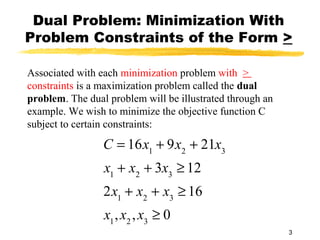
Associated with each minimization problem with >
constraints is a maximization problem called the dual
problem. The dual problem will be illustrated through an
example. We wish to minimize the objective function C
subject to certain constraints:

                 C = 16x1 + 9x2 + 21x3
                 x1 + x2 + 3x3 ≥ 12
                 2x1 + x2 + x3 ≥ 16
                 x1 , x2 , x3 ≥ 0
                                                           3
Initial Matrix


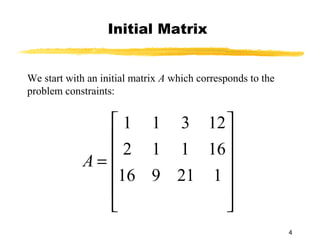
We start with an initial matrix A which corresponds to the
problem constraints:


                 1 1 3 12 
                          
                  2 1 1 16 
             A= 
                16 9 21 1 
                          
                          
                                                             4
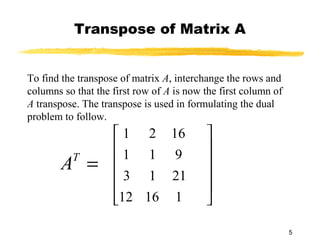
Transpose of Matrix A


To find the transpose of matrix A, interchange the rows and
columns so that the first row of A is now the first column of
A transpose. The transpose is used in formulating the dual
problem to follow.
                     1 2 16              
                                         
        A =
          T         1 1 9                
                     3 1 21              
                                         
                    12 16 1              

                                                                5
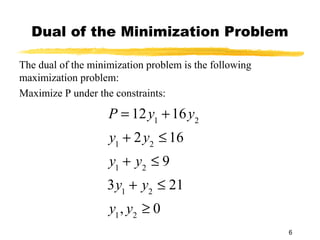
Dual of the Minimization Problem

The dual of the minimization problem is the following
maximization problem:
Maximize P under the constraints:

                    P = 12 y1 + 16 y2
                    y1 + 2 y2 ≤ 16
                    y1 + y2 ≤ 9
                    3y1 + y2 ≤ 21
                    y1 , y2 ≥ 0
                                                        6
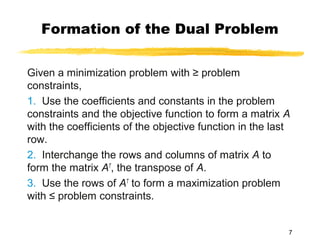
Formation of the Dual Problem

Given a minimization problem with ≥ problem
constraints,
1. Use the coefficients and constants in the problem
constraints and the objective function to form a matrix A
with the coefficients of the objective function in the last
row.
2. Interchange the rows and columns of matrix A to
form the matrix AT, the transpose of A.
3. Use the rows of AT to form a maximization problem
with ≤ problem constraints.


                                                          7
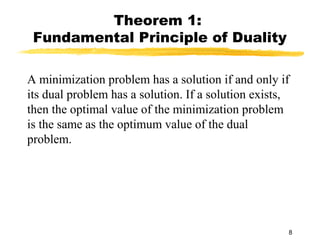
Theorem 1:
 Fundamental Principle of Duality

A minimization problem has a solution if and only if
its dual problem has a solution. If a solution exists,
then the optimal value of the minimization problem
is the same as the optimum value of the dual
problem.


                                                     8
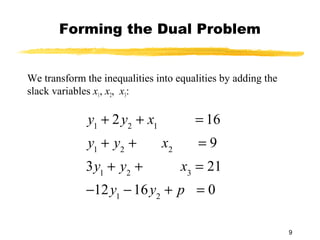
Forming the Dual Problem


We transform the inequalities into equalities by adding the
slack variables x1, x2, x3:

              y1 + 2 y2 + x1           = 16
              y1 + y2 +        x2       =9
             3y1 + y2 +             x3 = 21
             −12 y1 − 16 y2 + p = 0

                                                              9
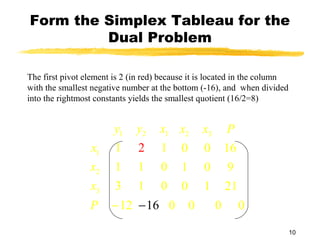
Form the Simplex Tableau for the
         Dual Problem

The first pivot element is 2 (in red) because it is located in the column
with the smallest negative number at the bottom (-16), and when divided
into the rightmost constants yields the smallest quotient (16/2=8)


                        y1    y2     x1 x2         x3       P
                 x1     1      2     1 0           0        16
                 x2     1     1      0     1       0        9
                 x3     3      1     0     0       1        21
                 P     − 12 − 16 0             0        0        0

                                                                            10
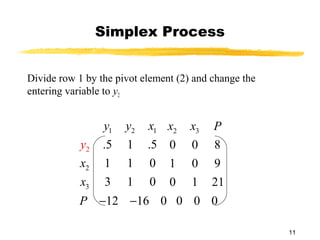
Simplex Process


Divide row 1 by the pivot element (2) and change the
entering variable to y2


                 y1   y2   x1 x2     x3   P
            y2   .5   1    .5 0      0    8
            x2    1   1     0 1      0    9
            x3    3   1     0 0      1    21
           P −12 −16 0 0 0 0

                                                       11
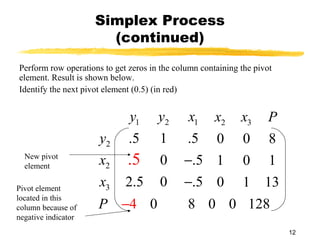
Simplex Process
                       (continued)

Perform row operations to get zeros in the column containing the pivot
element. Result is shown below.
Identify the next pivot element (0.5) (in red)


                              y1      y2      x1      x2     x3      P
                      y2      .5      1       .5      0      0       8
  New pivot
  element             x2      .5       0     −.5 1           0       1
Pivot element
                      x3     2.5       0     −.5 0           1      13
located in this
column because of     P −4 0                  8 0 0 128
negative indicator
                                                                         12
Simplex Process
                  (continued)

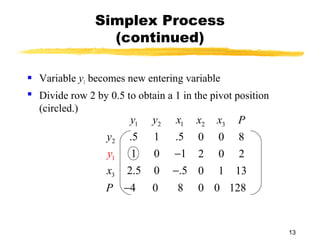
 Variable y1 becomes new entering variable
 Divide row 2 by 0.5 to obtain a 1 in the pivot position
  (circled.)
                        y1   y2    x1   x2   x3 P
                  y2   .5    1    .5    0    0 8
                  y1    1    0    −1    2    0 2
                  x3   2.5   0    −.5   0    1 13
                  P −4       0     8    0 0 128


                                                            13
Simplex Process
                   (continued)

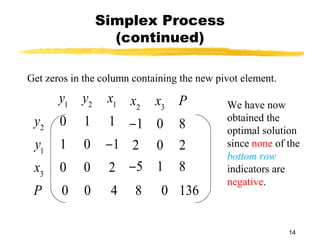
Get zeros in the column containing the new pivot element.
       y1   y2    x1 x x P                   We have now
                      2 3
 y2    0    1     1 −1 0 8                   obtained the
                                             optimal solution
 y1    1    0     −1 2 0 2                   since none of the
                                             bottom row
 x3    0    0     2 −5 1 8                   indicators are
                                             negative.
 P     0     0     4    8     0 136

                                                            14
Solution of the
      Linear Programming Problem
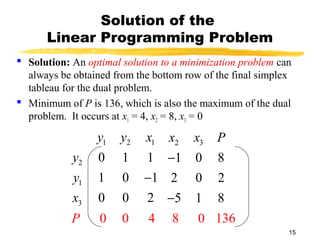
 Solution: An optimal solution to a minimization problem can
  always be obtained from the bottom row of the final simplex
  tableau for the dual problem.
 Minimum of P is 136, which is also the maximum of the dual
  problem. It occurs at x1 = 4, x2 = 8, x3 = 0

                 y1    y2   x1   x2    x3   P
            y2    0    1     1 −1      0    8
            y1    1    0    −1 2       0    2
            x3    0    0    2 −5       1    8
            P     0    0     4    8     0 136
                                                            15
Solution of a Minimization Problem


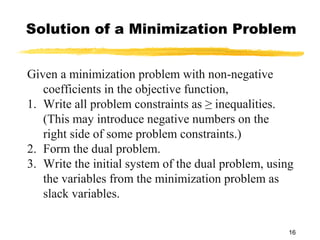
Given a minimization problem with non-negative
   coefficients in the objective function,
1. Write all problem constraints as ≥ inequalities.
   (This may introduce negative numbers on the
   right side of some problem constraints.)
2. Form the dual problem.
3. Write the initial system of the dual problem, using
   the variables from the minimization problem as
   slack variables.

                                                     16
Solution of a Minimization Problem


4. Use the simplex method to solve the dual
   problem.
5. Read the solution of the minimization problem
   from the bottom row of the final simplex tableau
   in step 4.

Note: If the dual problem has no optimal solution,
  the minimization problem has no optimal solution.

                                                      17
Application:
         Transportation Problem

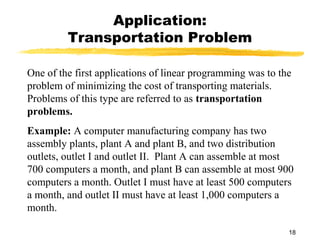
One of the first applications of linear programming was to the
problem of minimizing the cost of transporting materials.
Problems of this type are referred to as transportation
problems.
Example: A computer manufacturing company has two
assembly plants, plant A and plant B, and two distribution
outlets, outlet I and outlet II. Plant A can assemble at most
700 computers a month, and plant B can assemble at most 900
computers a month. Outlet I must have at least 500 computers
a month, and outlet II must have at least 1,000 computers a
month.

                                                             18
Transportation Problem
             (continued)

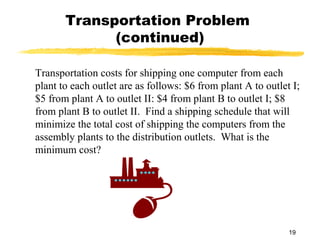
Transportation costs for shipping one computer from each
plant to each outlet are as follows: $6 from plant A to outlet I;
$5 from plant A to outlet II: $4 from plant B to outlet I; $8
from plant B to outlet II. Find a shipping schedule that will
minimize the total cost of shipping the computers from the
assembly plants to the distribution outlets. What is the
minimum cost?


                                                              19
Transportation Problem
              (continued)

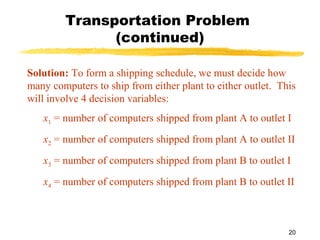
Solution: To form a shipping schedule, we must decide how
many computers to ship from either plant to either outlet. This
will involve 4 decision variables:
   x1 = number of computers shipped from plant A to outlet I
   x2 = number of computers shipped from plant A to outlet II
   x3 = number of computers shipped from plant B to outlet I
   x4 = number of computers shipped from plant B to outlet II


                                                             20
Transportation Problem
              (continued)

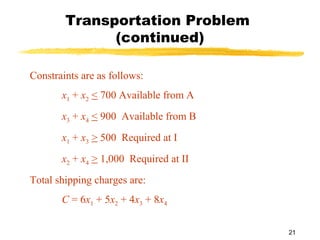
Constraints are as follows:
       x1 + x2 < 700 Available from A
       x3 + x4 < 900 Available from B
       x1 + x3 > 500 Required at I
       x2 + x4 > 1,000 Required at II
Total shipping charges are:
       C = 6x1 + 5x2 + 4x3 + 8x4

                                        21
Transportation Problem
              (continued)

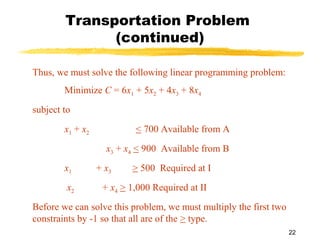
Thus, we must solve the following linear programming problem:
        Minimize C = 6x1 + 5x2 + 4x3 + 8x4
subject to
        x1 + x2            < 700 Available from A
                    x3 + x4 < 900 Available from B
        x1        + x3    > 500 Required at I
         x2        + x4 > 1,000 Required at II
Before we can solve this problem, we must multiply the first two
constraints by -1 so that all are of the > type.
                                                                   22
Transportation Problem
                   (continued)

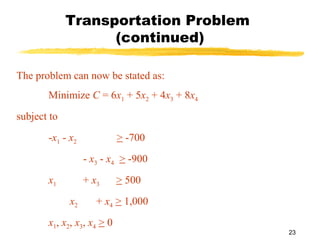
The problem can now be stated as:
       Minimize C = 6x1 + 5x2 + 4x3 + 8x4
subject to
       -x1 - x2             > -700
                  - x3 - x4 > -900
       x1         + x3      > 500
             x2      + x4 > 1,000
       x1, x2, x3, x4 > 0
                                            23
Transportation Problem
      (continued)

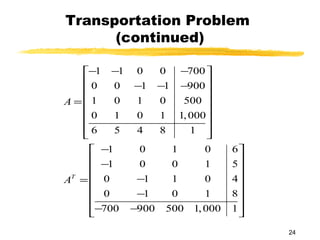
   −1   −1   0      0        −700 
   0    0    −1     −1       −900 
                                    
A = 1   0     1     0         500 
                                    
   0    1     0     1        1, 000 
   6    5     4     8           1 
                                    
      −1      0          1         0     6
      −1      0          0         1     5
                                          
AT =  0       −1         1         0     4
                                          
      0       −1         0         1     8
     −700    −900       500     1, 000   1
                                          
                                               24
Transportation Problem
            (continued)

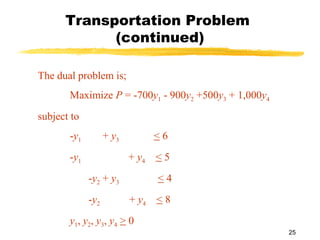
The dual problem is;
       Maximize P = -700y1 - 900y2 +500y3 + 1,000y4
subject to
       -y1         + y3         <6
       -y1                 + y4 < 5
             -y2 + y3           <4
             -y2           + y4 < 8
       y 1, y 2, y 3, y 4 > 0
                                                      25
Transportation Problem
                   (continued)

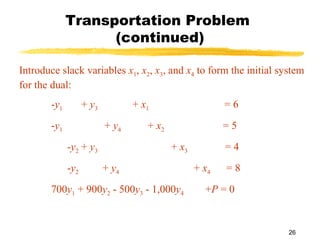
Introduce slack variables x1, x2, x3, and x4 to form the initial system
for the dual:
       -y1         + y3          + x1                    =6
       -y1                + y4      + x2                 =5
             -y2 + y3                      + x3          =4
             -y2          + y4                    + x4   =8
       700y1 + 900y2 - 500y3 - 1,000y4              +P = 0


                                                                   26
ANSWER (?)


             27
Transportation Problem
                 Solution

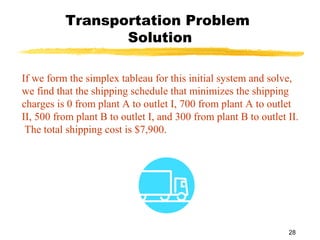
If we form the simplex tableau for this initial system and solve,
we find that the shipping schedule that minimizes the shipping
charges is 0 from plant A to outlet I, 700 from plant A to outlet
II, 500 from plant B to outlet I, and 300 from plant B to outlet II.
 The total shipping cost is $7,900.


                                                                 28
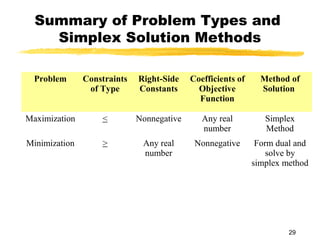
Summary of Problem Types and
    Simplex Solution Methods

  Problem      Constraints   Right-Side    Coefficients of     Method of
                of Type      Constants       Objective         Solution
                                             Function

Maximization       <         Nonnegative      Any real          Simplex
                                              number            Method
Minimization       >          Any real      Nonnegative       Form dual and
                              number                             solve by
                                                             simplex method


                                                                      29

Lp simplex 3_

  • 1.
    Linear Programming: The Simplex Method Section 3 The Dual Problem: Minimization with Problem Constraints of the Form ≥ Prof. Jonathan Lamb / Finite Mathematics http://www.pstcc.edu/facstaff/jwlamb/
  • 2.
    Learning Objectives forSection 3 Dual Problem: Minimization with Problem Constraints of the Form >  The student will be able to formulate the dual problem.  The student will be able to solve minimization problems.  The student will be able to solve applications of the dual such as the transportation problem.  The student will be able to summarize problem types and solution methods. 2
  • 3.
    Dual Problem: MinimizationWith Problem Constraints of the Form > Associated with each minimization problem with > constraints is a maximization problem called the dual problem. The dual problem will be illustrated through an example. We wish to minimize the objective function C subject to certain constraints: C = 16x1 + 9x2 + 21x3 x1 + x2 + 3x3 ≥ 12 2x1 + x2 + x3 ≥ 16 x1 , x2 , x3 ≥ 0 3
  • 4.
    Initial Matrix We startwith an initial matrix A which corresponds to the problem constraints:  1 1 3 12    2 1 1 16  A=  16 9 21 1      4
  • 5.
    Transpose of MatrixA To find the transpose of matrix A, interchange the rows and columns so that the first row of A is now the first column of A transpose. The transpose is used in formulating the dual problem to follow.  1 2 16    A = T 1 1 9   3 1 21    12 16 1  5
  • 6.
    Dual of theMinimization Problem The dual of the minimization problem is the following maximization problem: Maximize P under the constraints: P = 12 y1 + 16 y2 y1 + 2 y2 ≤ 16 y1 + y2 ≤ 9 3y1 + y2 ≤ 21 y1 , y2 ≥ 0 6
  • 7.
    Formation of theDual Problem Given a minimization problem with ≥ problem constraints, 1. Use the coefficients and constants in the problem constraints and the objective function to form a matrix A with the coefficients of the objective function in the last row. 2. Interchange the rows and columns of matrix A to form the matrix AT, the transpose of A. 3. Use the rows of AT to form a maximization problem with ≤ problem constraints. 7
  • 8.
    Theorem 1: FundamentalPrinciple of Duality A minimization problem has a solution if and only if its dual problem has a solution. If a solution exists, then the optimal value of the minimization problem is the same as the optimum value of the dual problem. 8
  • 9.
    Forming the DualProblem We transform the inequalities into equalities by adding the slack variables x1, x2, x3: y1 + 2 y2 + x1 = 16 y1 + y2 + x2 =9 3y1 + y2 + x3 = 21 −12 y1 − 16 y2 + p = 0 9
  • 10.
    Form the SimplexTableau for the Dual Problem The first pivot element is 2 (in red) because it is located in the column with the smallest negative number at the bottom (-16), and when divided into the rightmost constants yields the smallest quotient (16/2=8) y1 y2 x1 x2 x3 P x1 1 2 1 0 0 16 x2 1 1 0 1 0 9 x3 3 1 0 0 1 21 P − 12 − 16 0 0 0 0 10
  • 11.
    Simplex Process Divide row1 by the pivot element (2) and change the entering variable to y2 y1 y2 x1 x2 x3 P y2 .5 1 .5 0 0 8 x2 1 1 0 1 0 9 x3 3 1 0 0 1 21 P −12 −16 0 0 0 0 11
  • 12.
    Simplex Process (continued) Perform row operations to get zeros in the column containing the pivot element. Result is shown below. Identify the next pivot element (0.5) (in red) y1 y2 x1 x2 x3 P y2 .5 1 .5 0 0 8 New pivot element x2 .5 0 −.5 1 0 1 Pivot element x3 2.5 0 −.5 0 1 13 located in this column because of P −4 0 8 0 0 128 negative indicator 12
  • 13.
    Simplex Process (continued)  Variable y1 becomes new entering variable  Divide row 2 by 0.5 to obtain a 1 in the pivot position (circled.) y1 y2 x1 x2 x3 P y2 .5 1 .5 0 0 8 y1 1 0 −1 2 0 2 x3 2.5 0 −.5 0 1 13 P −4 0 8 0 0 128 13
  • 14.
    Simplex Process (continued) Get zeros in the column containing the new pivot element. y1 y2 x1 x x P We have now 2 3 y2 0 1 1 −1 0 8 obtained the optimal solution y1 1 0 −1 2 0 2 since none of the bottom row x3 0 0 2 −5 1 8 indicators are negative. P 0 0 4 8 0 136 14
  • 15.
    Solution of the Linear Programming Problem  Solution: An optimal solution to a minimization problem can always be obtained from the bottom row of the final simplex tableau for the dual problem.  Minimum of P is 136, which is also the maximum of the dual problem. It occurs at x1 = 4, x2 = 8, x3 = 0 y1 y2 x1 x2 x3 P y2 0 1 1 −1 0 8 y1 1 0 −1 2 0 2 x3 0 0 2 −5 1 8 P 0 0 4 8 0 136 15
  • 16.
    Solution of aMinimization Problem Given a minimization problem with non-negative coefficients in the objective function, 1. Write all problem constraints as ≥ inequalities. (This may introduce negative numbers on the right side of some problem constraints.) 2. Form the dual problem. 3. Write the initial system of the dual problem, using the variables from the minimization problem as slack variables. 16
  • 17.
    Solution of aMinimization Problem 4. Use the simplex method to solve the dual problem. 5. Read the solution of the minimization problem from the bottom row of the final simplex tableau in step 4. Note: If the dual problem has no optimal solution, the minimization problem has no optimal solution. 17
  • 18.
    Application: Transportation Problem One of the first applications of linear programming was to the problem of minimizing the cost of transporting materials. Problems of this type are referred to as transportation problems. Example: A computer manufacturing company has two assembly plants, plant A and plant B, and two distribution outlets, outlet I and outlet II. Plant A can assemble at most 700 computers a month, and plant B can assemble at most 900 computers a month. Outlet I must have at least 500 computers a month, and outlet II must have at least 1,000 computers a month. 18
  • 19.
    Transportation Problem (continued) Transportation costs for shipping one computer from each plant to each outlet are as follows: $6 from plant A to outlet I; $5 from plant A to outlet II: $4 from plant B to outlet I; $8 from plant B to outlet II. Find a shipping schedule that will minimize the total cost of shipping the computers from the assembly plants to the distribution outlets. What is the minimum cost? 19
  • 20.
    Transportation Problem (continued) Solution: To form a shipping schedule, we must decide how many computers to ship from either plant to either outlet. This will involve 4 decision variables: x1 = number of computers shipped from plant A to outlet I x2 = number of computers shipped from plant A to outlet II x3 = number of computers shipped from plant B to outlet I x4 = number of computers shipped from plant B to outlet II 20
  • 21.
    Transportation Problem (continued) Constraints are as follows: x1 + x2 < 700 Available from A x3 + x4 < 900 Available from B x1 + x3 > 500 Required at I x2 + x4 > 1,000 Required at II Total shipping charges are: C = 6x1 + 5x2 + 4x3 + 8x4 21
  • 22.
    Transportation Problem (continued) Thus, we must solve the following linear programming problem: Minimize C = 6x1 + 5x2 + 4x3 + 8x4 subject to x1 + x2 < 700 Available from A x3 + x4 < 900 Available from B x1 + x3 > 500 Required at I x2 + x4 > 1,000 Required at II Before we can solve this problem, we must multiply the first two constraints by -1 so that all are of the > type. 22
  • 23.
    Transportation Problem (continued) The problem can now be stated as: Minimize C = 6x1 + 5x2 + 4x3 + 8x4 subject to -x1 - x2 > -700 - x3 - x4 > -900 x1 + x3 > 500 x2 + x4 > 1,000 x1, x2, x3, x4 > 0 23
  • 24.
    Transportation Problem (continued) −1 −1 0 0 −700  0 0 −1 −1 −900    A = 1 0 1 0 500    0 1 0 1 1, 000  6 5 4 8 1     −1 0 1 0 6  −1 0 0 1 5   AT =  0 −1 1 0 4    0 −1 0 1 8 −700 −900 500 1, 000 1   24
  • 25.
    Transportation Problem (continued) The dual problem is; Maximize P = -700y1 - 900y2 +500y3 + 1,000y4 subject to -y1 + y3 <6 -y1 + y4 < 5 -y2 + y3 <4 -y2 + y4 < 8 y 1, y 2, y 3, y 4 > 0 25
  • 26.
    Transportation Problem (continued) Introduce slack variables x1, x2, x3, and x4 to form the initial system for the dual: -y1 + y3 + x1 =6 -y1 + y4 + x2 =5 -y2 + y3 + x3 =4 -y2 + y4 + x4 =8 700y1 + 900y2 - 500y3 - 1,000y4 +P = 0 26
  • 27.
  • 28.
    Transportation Problem Solution If we form the simplex tableau for this initial system and solve, we find that the shipping schedule that minimizes the shipping charges is 0 from plant A to outlet I, 700 from plant A to outlet II, 500 from plant B to outlet I, and 300 from plant B to outlet II. The total shipping cost is $7,900. 28
  • 29.
    Summary of ProblemTypes and Simplex Solution Methods Problem Constraints Right-Side Coefficients of Method of of Type Constants Objective Solution Function Maximization < Nonnegative Any real Simplex number Method Minimization > Any real Nonnegative Form dual and number solve by simplex method 29