Linear Programmingis a mathematical
technique for optimum allocation of limited
or scarce resources, such as labor, material,
machine, money, energy and so on , to
several competing activities such as products,
services, jobs and so on, on the basis of a
given criteria of optimality.
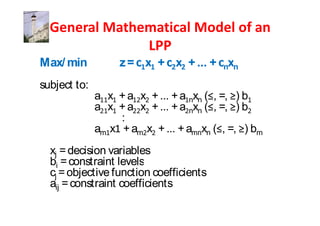
Max/ min           z = c x + c x + ... + cnxn
subject to:
              a x + a x + ... + a nxn ( , =, ) b
              a x + a x + ... + a nxn ( , =, ) b
                   :
              am x + am x + ... + amnxn ( , =, ) bm
  xj = decision variables
  bi = constraint levels
  cj = objective function coefficients
  aij = constraint coefficients
1. Plot model constraint on a set of
   coordinates in a plane
2. Identify the feasible solution space on the
   graph where all constraints are satisfied
   simultaneously
3. Plot objective function to find the point on
   boundary of this space that maximizes (or
   minimizes) value of objective function
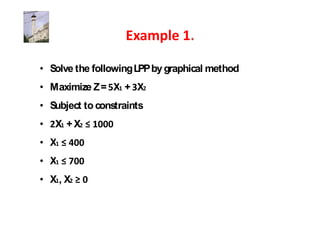
Solve the following LPP by graphical method
Maximize Z = X + X
Subject to constraints
 X +X
X
X
X,X
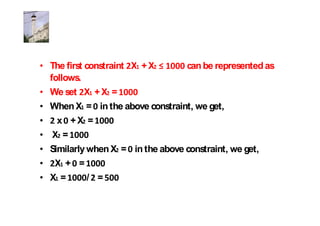
The first constraint X + X      can be represented as
follows.
We set X + X =
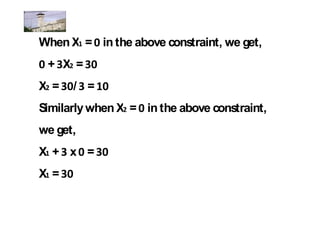
When X = in the above constraint, we get,
  x +X =
 X =
Similarly when X = in the above constraint, we get,
 X + =
X =        / =
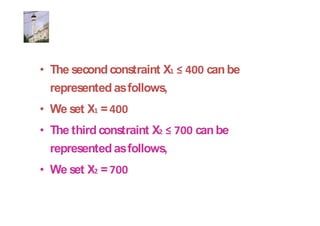
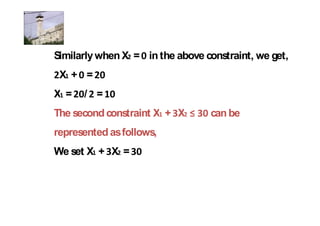
The second constraint X    can be
represented as follows,
We set X =
The third constraint X    can be
represented as follows,
We set X =
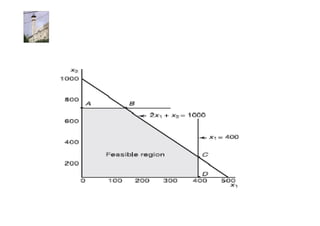
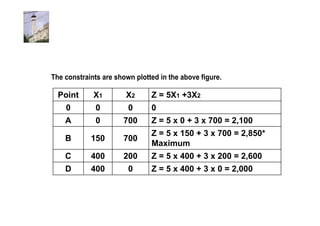
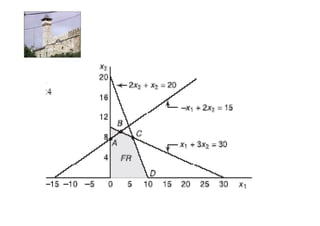
The constraints are shown plotted in the above figure.
  Point      X1        X2      Z = 5X1 +3X2
    0         0         0      0
    A         0       700      Z = 5 x 0 + 3 x 700 = 2,100
                               Z = 5 x 150 + 3 x 700 = 2,850*
    B       150       700
                               Maximum
    C       400       200      Z = 5 x 400 + 3 x 200 = 2,600
    D       400         0      Z = 5 x 400 + 3 x 0 = 2,000
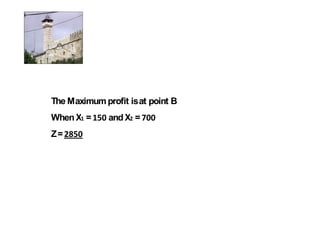
The Maximum profit is at point B
When X =      and X =
Z=
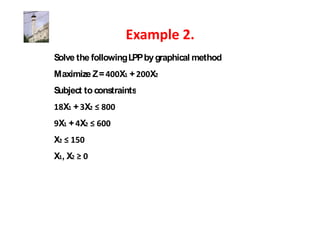
Solve the following LPP by graphical method
Maximize Z =     X +     X
Subject to constraints
    X + X
 X + X
X
X,X
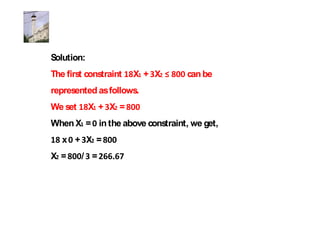
Solution:
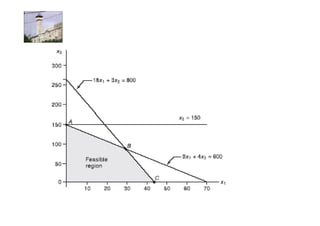
The first constraint   X + X     can be
represented as follows.
We set      X + X =
When X = in the above constraint, we get,
   x + X =
X =      / =     .
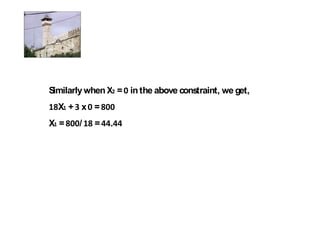
Similarly when X = in the above constraint, we get,
  X + x =
X =    /   =   .
The second constraint X + X         can be represented
as follows,
We set X + X =
When X = in the above constraint, we get,
 x + X =
X =     / =
X =     / =   .
Similarly when X = in the above constraint, we get,
 X + x =
The third constraint X     can be represented as follows,
We set X =
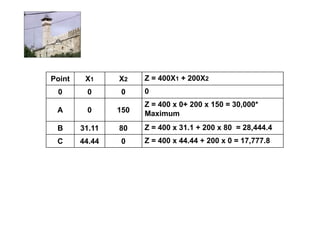
Point    X1     X2    Z = 400X1 + 200X2
 0       0      0     0
                      Z = 400 x 0+ 200 x 150 = 30,000*
 A       0      150   Maximum
 B      31.11   80    Z = 400 x 31.1 + 200 x 80 = 28,444.4
 C      44.44   0     Z = 400 x 44.44 + 200 x 0 = 17,777.8
The Maximum profit is at point A
When X =      and X =
Z=   ,
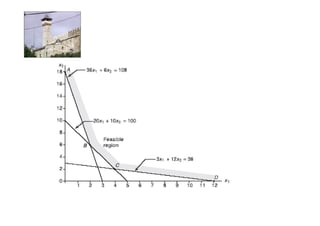
Solve the following LPP by graphical method
Minimize Z =   X +       X
Subject to constraints
  X + X
 X +    X
  X +    X
X ,X
The first constraint   X + X     can be
represented as follows.
We set    X + X =
When X = in the above constraint, we get,
   x + X =
X =      / =
Similarly when X = in the above constraint, we get,
  X + x =
X =    /   =
The second constraint X +    X      can be
represented as follows,
We set X +     X =
When X = in the above constraint, we get,
 x +       X =
X =    /    =
Similarly when X = in the above constraint, we
get,
 X +       x =
X =    / =
The third constraint     X +   X   can be
represented as follows,
We set       X +   X =
When X = in the above constraint, we get,
   x +       X =
X =      /    =
Similarly when X = in the above constraint,
we get,
  X +         x =
X =       /    =
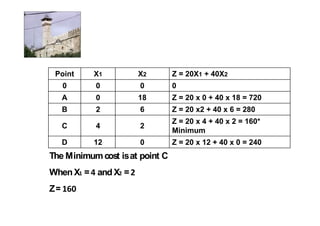
Point     X1         X2         Z = 20X1 + 40X2
     0     0          0          0
     A     0          18         Z = 20 x 0 + 40 x 18 = 720
     B     2          6          Z = 20 x2 + 40 x 6 = 280
                                 Z = 20 x 4 + 40 x 2 = 160*
     C     4          2
                                 Minimum
     D     12         0          Z = 20 x 12 + 40 x 0 = 240
The Minimum cost is at point C
When X = and X =
Z=
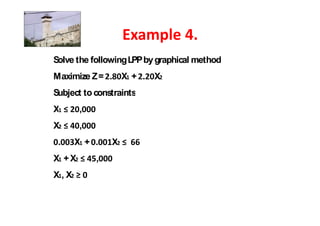
Solve the following LPP by graphical method
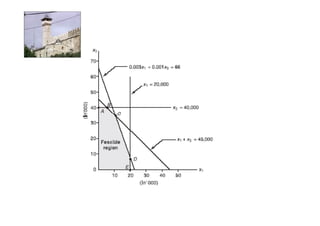
Maximize Z = .     X + .   X
Subject to constraints
X      ,
X      ,
 .    X + .    X
X +X       ,
X,X
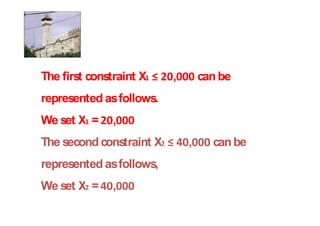
The first constraint X    ,       can be
represented as follows.
We set X =    ,
The second constraint X       ,     can be
represented as follows,
We set X =    ,
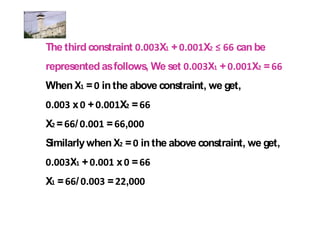
The third constraint .   X + .     X       can be
represented as follows, We set .   X + .      X =
When X = in the above constraint, we get,
 .    x + .       X =
X=    / .     =    ,
Similarly when X = in the above constraint, we get,
 .    X + .       x =
X =    / .    =    ,
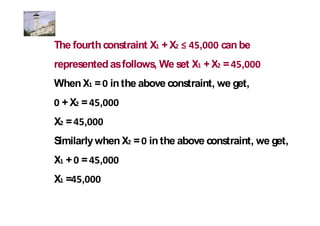
The fourth constraint X + X    ,    can be
represented as follows, We set X + X =   ,
When X = in the above constraint, we get,
 +X =     ,
X =   ,
Similarly when X = in the above constraint, we get,
X + =     ,
X = ,
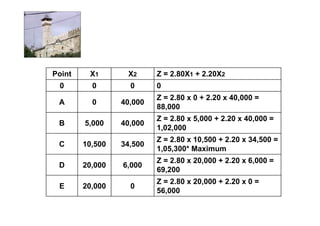
Point    X1       X2      Z = 2.80X1 + 2.20X2
 0        0        0      0
                          Z = 2.80 x 0 + 2.20 x 40,000 =
 A        0      40,000
                          88,000
                          Z = 2.80 x 5,000 + 2.20 x 40,000 =
 B      5,000    40,000
                          1,02,000
                          Z = 2.80 x 10,500 + 2.20 x 34,500 =
 C      10,500   34,500
                          1,05,300* Maximum
                          Z = 2.80 x 20,000 + 2.20 x 6,000 =
 D      20,000   6,000
                          69,200
                          Z = 2.80 x 20,000 + 2.20 x 0 =
 E      20,000     0
                          56,000
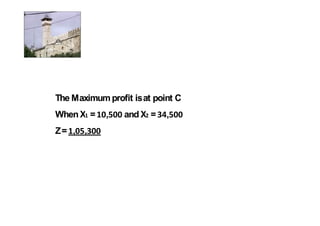
The Maximum profit is at point C
When X =    ,    and X =    ,
Z= , ,
Solve the following LPP by graphical method
Maximize Z =    X + X
Subject to constraints
 X +X
X + X
X - X    -
X X
The first constraint X + X   can be
represented as follows.
We set X + X =
When X = in the above constraint, we get,
 x +X =
X =
Similarly when X = in the above constraint, we get,
 X + =
X =   / =
The second constraint X + X       can be
represented as follows,
We set X + X =
When X = in the above constraint, we get,
 + X =
X =   / =
Similarly when X = in the above constraint,
we get,
X + x =
X =
The third constraint X - X   -   can be
represented as follows,
We set X - X = -
When X = in the above constraint, we get,
    - X =-
X =- / = .
Similarly when X = in the above constraint, we get,
X      x =-
X =-
Point   X1       X2      Z = 10X1 + 8X2
 0      0         0      0
 A      0        7.5     Z = 10 x 0 + 8 x 7.5 = 60
 B      3         9      Z = 10 x 3 + 8 x 9 = 102
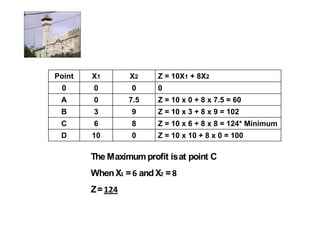
 C      6         8      Z = 10 x 6 + 8 x 8 = 124* Minimum
 D      10        0      Z = 10 x 10 + 8 x 0 = 100

        The Maximum profit is at point C
        When X = and X =
        Z=
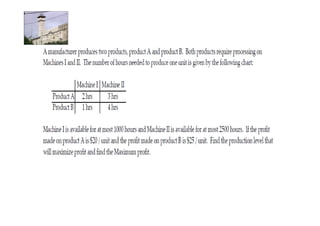
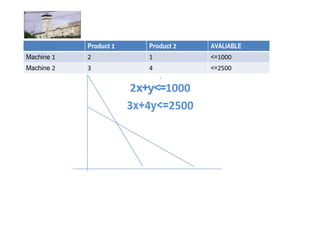
Product     Product   AVALIABLE
Machine                         <=


                     x+y<=
                    x+ y<=
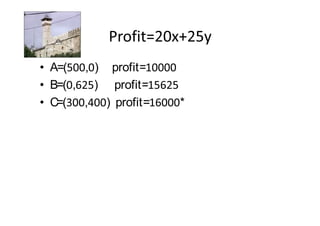
A=( , ) profit=
B=( , ) profit=
C=( , ) profit=   *
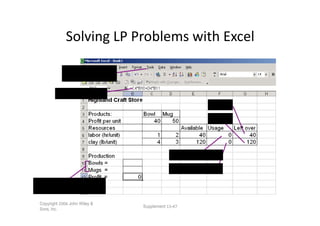
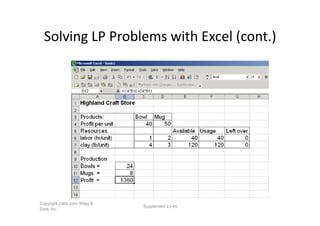
Click on Tools
                to invoke Solver.

              Objective function
                                                                 =E -F

                                                                 =E -F


                                                 =C *B   +D *B

                                                 =C *B   +D *B

Decision variables bowls
(x )=B ; mugs (x )=B

 Copyright        John Wiley &
                                    Supplement   -
 Sons, Inc.
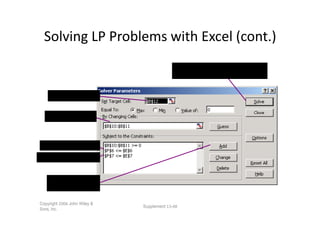
After all parameters and constraints
                                                have been input, click on Solve.


      Objective function


    Decision variables
    Decision variables


 C *B        +D *B
C *B         +D *B


     Click on Add to
     insert constraints

Copyright       John Wiley &
                               Supplement   -
Sons, Inc.
Copyright    John Wiley &
                            Supplement   -
Sons, Inc.

Lpp

  • 3.
    Linear Programmingis amathematical technique for optimum allocation of limited or scarce resources, such as labor, material, machine, money, energy and so on , to several competing activities such as products, services, jobs and so on, on the basis of a given criteria of optimality.
  • 4.
    Max/ min z = c x + c x + ... + cnxn subject to: a x + a x + ... + a nxn ( , =, ) b a x + a x + ... + a nxn ( , =, ) b : am x + am x + ... + amnxn ( , =, ) bm xj = decision variables bi = constraint levels cj = objective function coefficients aij = constraint coefficients
  • 5.
    1. Plot modelconstraint on a set of coordinates in a plane 2. Identify the feasible solution space on the graph where all constraints are satisfied simultaneously 3. Plot objective function to find the point on boundary of this space that maximizes (or minimizes) value of objective function
  • 6.
    Solve the followingLPP by graphical method Maximize Z = X + X Subject to constraints X +X X X X,X
  • 7.
    The first constraintX + X can be represented as follows. We set X + X = When X = in the above constraint, we get, x +X = X = Similarly when X = in the above constraint, we get, X + = X = / =
  • 8.
    The second constraintX can be represented as follows, We set X = The third constraint X can be represented as follows, We set X =
  • 10.
    The constraints areshown plotted in the above figure. Point X1 X2 Z = 5X1 +3X2 0 0 0 0 A 0 700 Z = 5 x 0 + 3 x 700 = 2,100 Z = 5 x 150 + 3 x 700 = 2,850* B 150 700 Maximum C 400 200 Z = 5 x 400 + 3 x 200 = 2,600 D 400 0 Z = 5 x 400 + 3 x 0 = 2,000
  • 11.
    The Maximum profitis at point B When X = and X = Z=
  • 12.
    Solve the followingLPP by graphical method Maximize Z = X + X Subject to constraints X + X X + X X X,X
  • 13.
    Solution: The first constraint X + X can be represented as follows. We set X + X = When X = in the above constraint, we get, x + X = X = / = .
  • 14.
    Similarly when X= in the above constraint, we get, X + x = X = / = .
  • 15.
    The second constraintX + X can be represented as follows, We set X + X = When X = in the above constraint, we get, x + X = X = / = X = / = .
  • 16.
    Similarly when X= in the above constraint, we get, X + x = The third constraint X can be represented as follows, We set X =
  • 18.
    Point X1 X2 Z = 400X1 + 200X2 0 0 0 0 Z = 400 x 0+ 200 x 150 = 30,000* A 0 150 Maximum B 31.11 80 Z = 400 x 31.1 + 200 x 80 = 28,444.4 C 44.44 0 Z = 400 x 44.44 + 200 x 0 = 17,777.8
  • 19.
    The Maximum profitis at point A When X = and X = Z= ,
  • 20.
    Solve the followingLPP by graphical method Minimize Z = X + X Subject to constraints X + X X + X X + X X ,X
  • 21.
    The first constraint X + X can be represented as follows. We set X + X = When X = in the above constraint, we get, x + X = X = / =
  • 22.
    Similarly when X= in the above constraint, we get, X + x = X = / = The second constraint X + X can be represented as follows, We set X + X =
  • 23.
    When X =in the above constraint, we get, x + X = X = / = Similarly when X = in the above constraint, we get, X + x = X = / =
  • 24.
    The third constraint X + X can be represented as follows, We set X + X = When X = in the above constraint, we get, x + X = X = / =
  • 25.
    Similarly when X= in the above constraint, we get, X + x = X = / =
  • 27.
    Point X1 X2 Z = 20X1 + 40X2 0 0 0 0 A 0 18 Z = 20 x 0 + 40 x 18 = 720 B 2 6 Z = 20 x2 + 40 x 6 = 280 Z = 20 x 4 + 40 x 2 = 160* C 4 2 Minimum D 12 0 Z = 20 x 12 + 40 x 0 = 240 The Minimum cost is at point C When X = and X = Z=
  • 28.
    Solve the followingLPP by graphical method Maximize Z = . X + . X Subject to constraints X , X , . X + . X X +X , X,X
  • 29.
    The first constraintX , can be represented as follows. We set X = , The second constraint X , can be represented as follows, We set X = ,
  • 30.
    The third constraint. X + . X can be represented as follows, We set . X + . X = When X = in the above constraint, we get, . x + . X = X= / . = , Similarly when X = in the above constraint, we get, . X + . x = X = / . = ,
  • 31.
    The fourth constraintX + X , can be represented as follows, We set X + X = , When X = in the above constraint, we get, +X = , X = , Similarly when X = in the above constraint, we get, X + = , X = ,
  • 33.
    Point X1 X2 Z = 2.80X1 + 2.20X2 0 0 0 0 Z = 2.80 x 0 + 2.20 x 40,000 = A 0 40,000 88,000 Z = 2.80 x 5,000 + 2.20 x 40,000 = B 5,000 40,000 1,02,000 Z = 2.80 x 10,500 + 2.20 x 34,500 = C 10,500 34,500 1,05,300* Maximum Z = 2.80 x 20,000 + 2.20 x 6,000 = D 20,000 6,000 69,200 Z = 2.80 x 20,000 + 2.20 x 0 = E 20,000 0 56,000
  • 34.
    The Maximum profitis at point C When X = , and X = , Z= , ,
  • 35.
    Solve the followingLPP by graphical method Maximize Z = X + X Subject to constraints X +X X + X X - X - X X
  • 36.
    The first constraintX + X can be represented as follows. We set X + X = When X = in the above constraint, we get, x +X = X =
  • 37.
    Similarly when X= in the above constraint, we get, X + = X = / = The second constraint X + X can be represented as follows, We set X + X =
  • 38.
    When X =in the above constraint, we get, + X = X = / = Similarly when X = in the above constraint, we get, X + x = X =
  • 39.
    The third constraintX - X - can be represented as follows, We set X - X = - When X = in the above constraint, we get, - X =- X =- / = . Similarly when X = in the above constraint, we get, X x =- X =-
  • 41.
    Point X1 X2 Z = 10X1 + 8X2 0 0 0 0 A 0 7.5 Z = 10 x 0 + 8 x 7.5 = 60 B 3 9 Z = 10 x 3 + 8 x 9 = 102 C 6 8 Z = 10 x 6 + 8 x 8 = 124* Minimum D 10 0 Z = 10 x 10 + 8 x 0 = 100 The Maximum profit is at point C When X = and X = Z=
  • 45.
    Product Product AVALIABLE Machine <= Machine <= x+y<= x+ y<=
  • 46.
    A=( , )profit= B=( , ) profit= C=( , ) profit= *
  • 47.
    Click on Tools to invoke Solver. Objective function =E -F =E -F =C *B +D *B =C *B +D *B Decision variables bowls (x )=B ; mugs (x )=B Copyright John Wiley & Supplement - Sons, Inc.
  • 48.
    After all parametersand constraints have been input, click on Solve. Objective function Decision variables Decision variables C *B +D *B C *B +D *B Click on Add to insert constraints Copyright John Wiley & Supplement - Sons, Inc.
  • 49.
    Copyright John Wiley & Supplement - Sons, Inc.