Sequence Similarity  Searching
Why Compare Sequences? Identify sequences found in lab experiments What is this thing I just found? Compare new genes to known ones Compare genes from different species information about evolution Guess functions for entire genomes full of new gene sequences
Are there other sequences like this one? 1) Huge public databases - GenBank, Swissprot, etc. 2) Sequence comparison is the most powerful and reliable method to determine evolutionary relationships between genes  3) Similarity searching is based on alignment  4)  BLAST  and  FASTA  provide rapid similarity searching a. rapid = approximate (heuristic) b. false + and - scores
Similarity ≠ Homology   1) 25% similarity ≥ 100 AAs is strong evidence for homology 2) Homology is an evolutionary statement which means “descent from a common ancestor”  common 3D structure usually common function homology is all or nothing, you cannot say "50% homologous"
Manually line them up and count? an alignment program can do it for you or a just use a text editor Dot Plot  shows regions of similarity as diagonals GATG C C A T A G A G C T G T A G T C GT A CCC T  < — — >  C T A G A G A G C - G T A G T C AG A GTG T CTTTGAGTTCC How to Compare Sequences?
Global   vs   Local   similarity 1)  Global  similarity uses complete aligned sequences - total % matches  GCG   GAP  program, Needleman & Wunch algorithm 2)  Local  similarity looks for best internal matching region between 2 sequences  GCG   BESTFIT  program,  Smith-Waterman algorithm,  BLAST  and  FASTA 3) dynamic programming  optimal computer solution, not approximate
Search with Protein, not DNA Sequences 1) 4 DNA bases vs. 20 amino acids - less chance similarity 2) can have varying degrees of similarity between different AAs - # of mutations, chemical similarity, PAM matrix 3) protein databanks are  much  smaller than DNA databanks
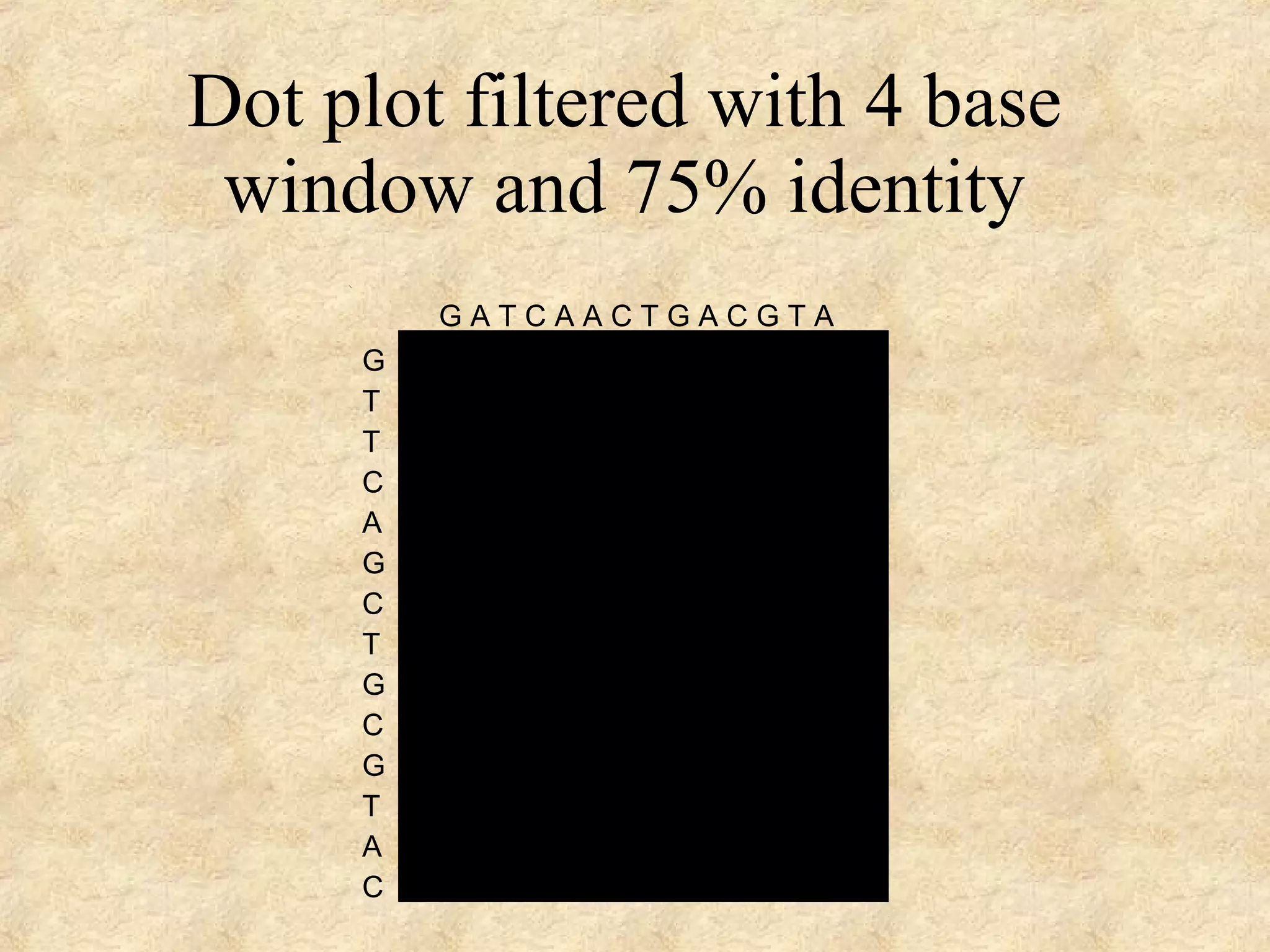
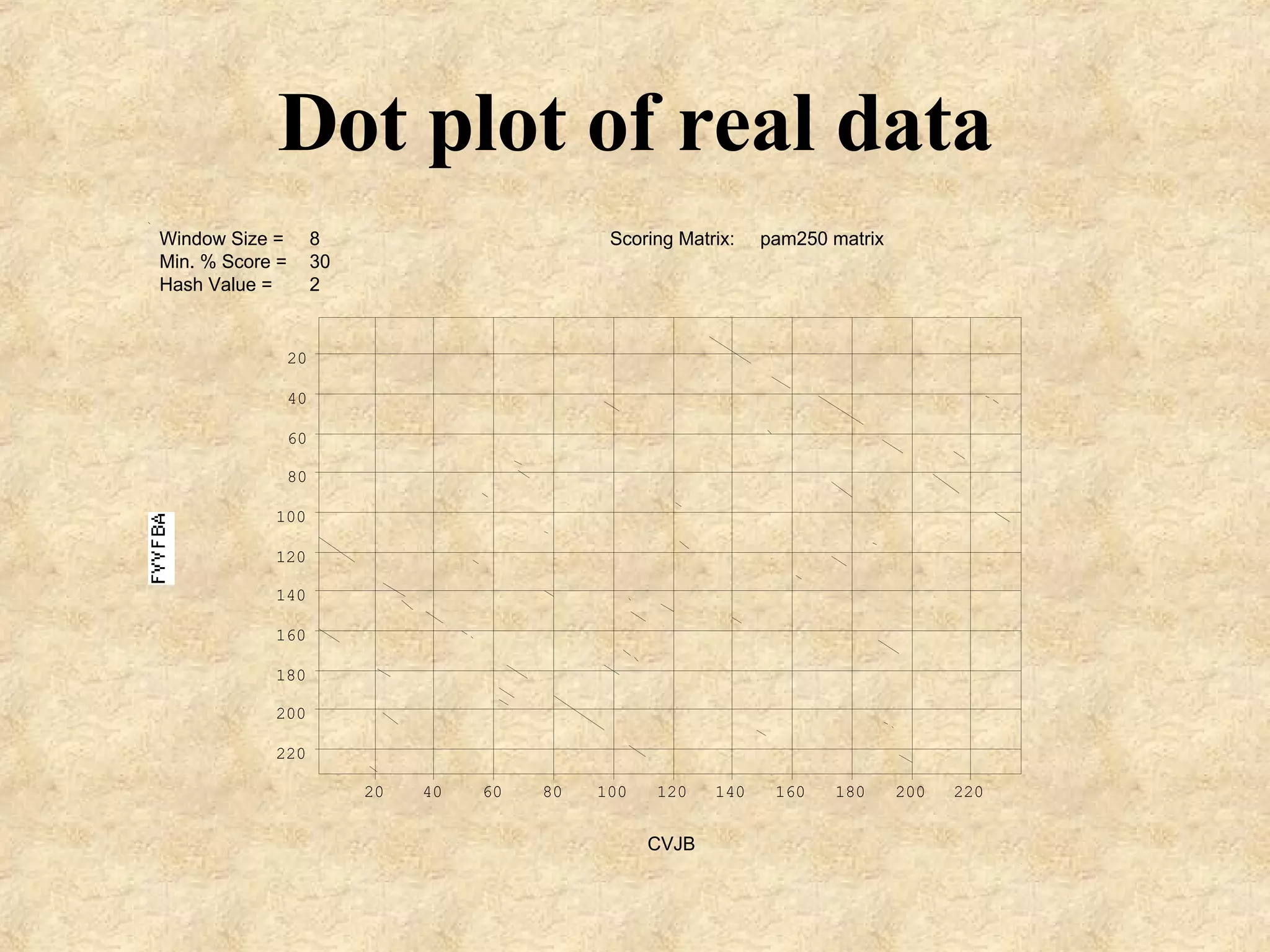
Similarity is Based on Dot Plots 1) two sequences on vertical and horizontal axes of graph 2) put dots wherever there is a match 3) diagonal line is region of identity  (local alignment) 4) apply a window filter - look at a group of bases, must meet % identity to get a dot
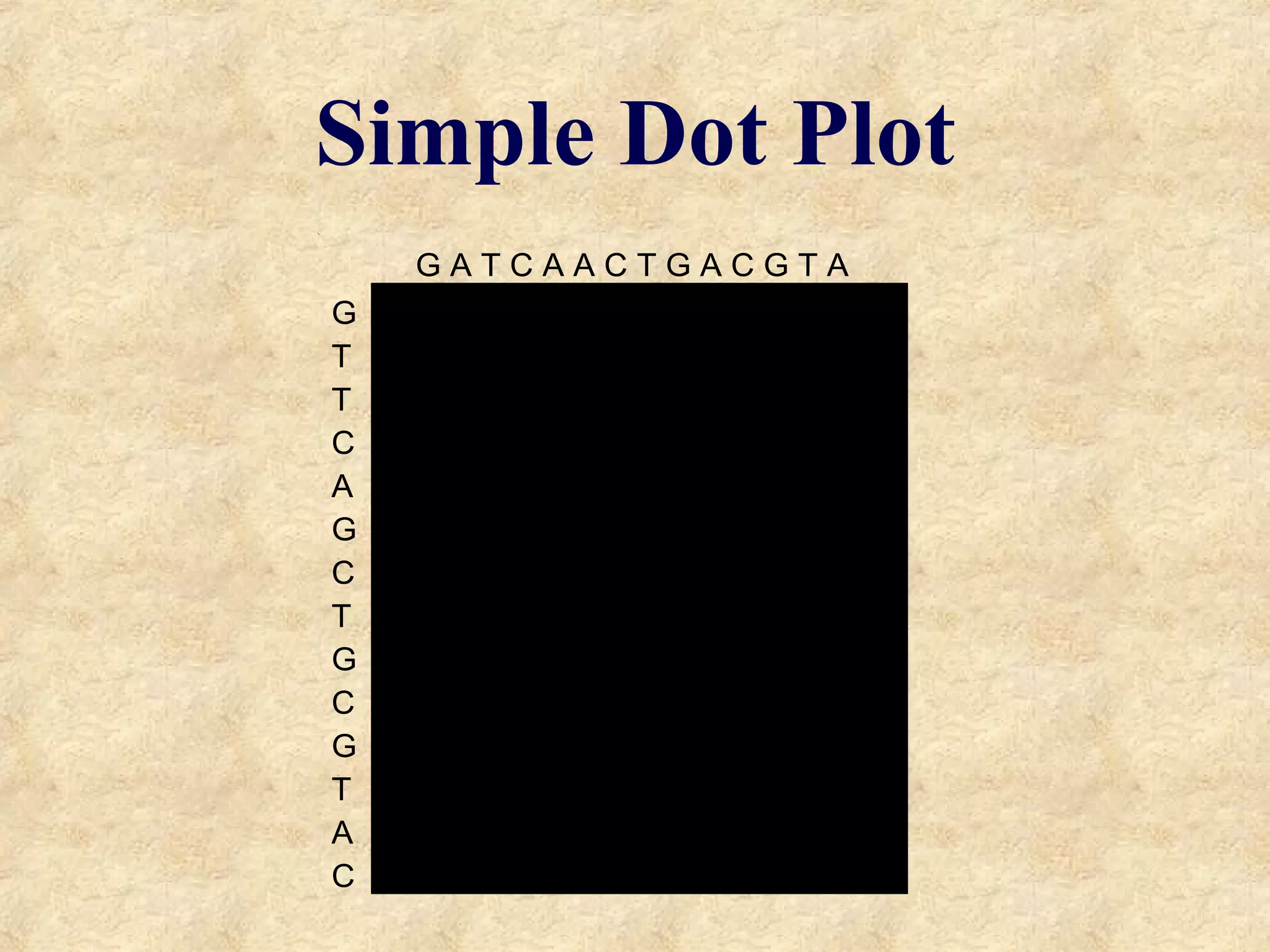
Simple Dot Plot
Dot plot filtered with 4 base window and 75% identity
Dot plot of real data
Global vs. Local Alignments
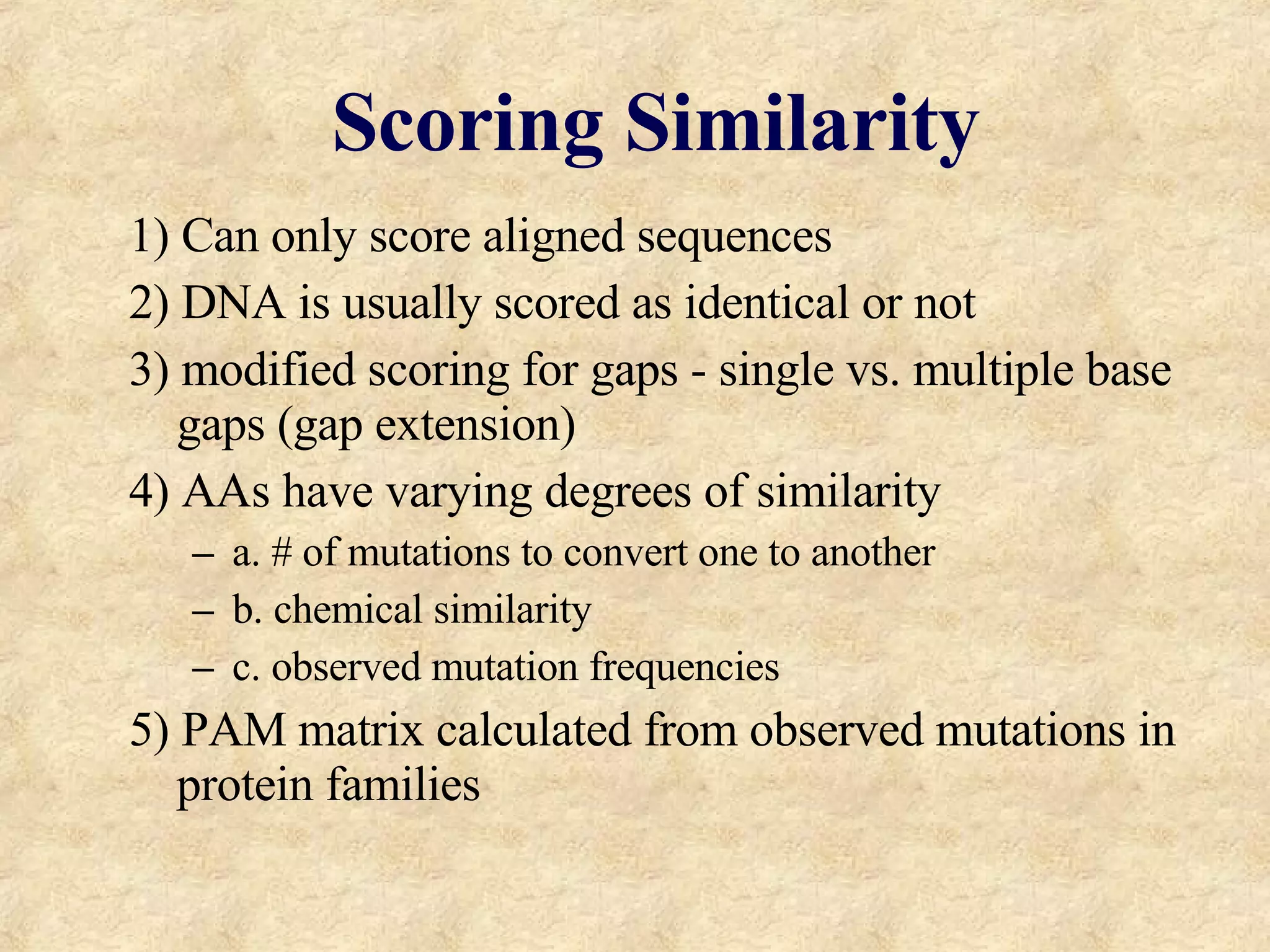
Scoring Similarity 1) Can only score aligned sequences 2) DNA is usually scored as identical or not 3) modified scoring for gaps - single vs. multiple base gaps (gap extension) 4) AAs have varying degrees of similarity a. # of mutations to convert one to another b. chemical similarity c. observed mutation frequencies 5) PAM matrix calculated from observed mutations in protein families
The PAM 250 scoring matrix
What program to use for searching? 1)  BLAST  is fastest and easily accessed on the Web limited sets of databases nice translation tools ( BLASTX, TBLASTN ) 2)  FASTA  works best in  GCG integrated with  GCG precise choice of databases more sensitive for DNA-DNA comparisons FASTX   and  TFASTX  can find similarities in sequences with frameshifts 3)  Smith-Waterman is slower, but more sensitive  known as a “rigorous” or “exhaustive” search SSEARCH   in  GCG  and standalone  FASTA
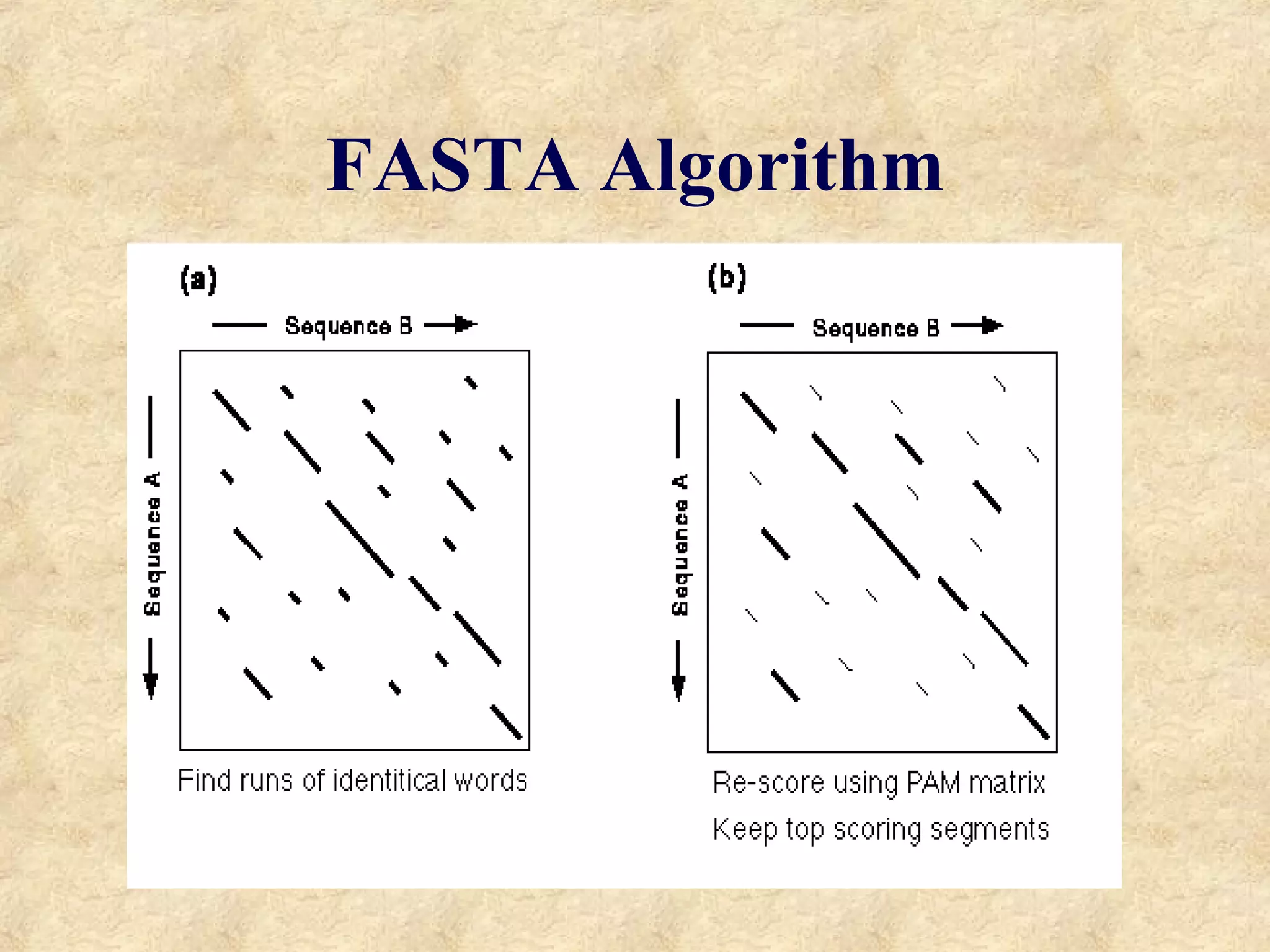
FASTA 1) Derived from logic of the dot plot  compute best diagonals from all frames of alignment 2) Word method looks for exact matches between words in query and test sequence hash tables (fast computer technique) DNA words are usually 6 bases protein words are 1 or 2 amino acids only searches for diagonals in region of word  matches = faster searching
FASTA Algorithm
Makes Longest Diagonal 3) after all diagonals found, tries to join diagonals by adding gaps 4) computes alignments in regions of best diagonals
FASTA Alignments
FASTA Results - Histogram   !!SEQUENCE_LIST 1.0 (Nucleotide) FASTA of: b2.seq  from: 1 to: 693  December 9, 2002 14:02 TO: /u/browns02/Victor/Search-set/*.seq  Sequences:  2,050  Symbols:  913,285  Word Size: 6 Searching with both strands of the query. Scoring matrix: GenRunData:fastadna.cmp Constant pamfactor used Gap creation penalty: 16  Gap extension penalty: 4 Histogram Key: Each histogram symbol represents 4 search set sequences Each inset symbol represents 1 search set sequences z-scores computed from opt scores z-score obs  exp (=)  (*) < 20  0  0: 22  0  0: 24  3  0:= 26  2  0:= 28  5  0:== 30  11  3:*== 32  19  11:==*== 34  38  30:=======*== 36  58  61:===============* 38  79  100:====================  * 40  134  140:==================================* 42  167  171:==========================================* 44  205  189:===============================================*==== 46  209  192:===============================================*===== 48  177  184:=============================================*
FASTA Results - List The best scores are:  init1 initn  opt  z-sc E(1018780).. SW:PPI1_HUMAN  Begin: 1  End: 269 ! Q00169 homo sapiens (human). phosph... 1854  1854  1854  2249.3  1.8e-117 SW:PPI1_RABIT  Begin: 1  End: 269 ! P48738 oryctolagus cuniculus (rabbi... 1840  1840  1840  2232.4  1.6e-116 SW:PPI1_RAT  Begin: 1  End: 270 ! P16446 rattus norvegicus (rat). pho... 1543  1543  1837  2228.7  2.5e-116 SW:PPI1_MOUSE  Begin: 1  End: 270 ! P53810 mus musculus (mouse). phosph... 1542  1542  1836  2227.5  2.9e-116 SW:PPI2_HUMAN  Begin: 1  End: 270 ! P48739 homo sapiens (human). phosph... 1533  1533  1533  1861.0  7.7e-96 SPTREMBL_NEW:BAC25830  Begin: 1  End: 270 ! Bac25830 mus musculus (mouse). 10, ... 1488  1488  1522  1847.6  4.2e-95 SP_TREMBL:Q8N5W1  Begin: 1  End: 268 ! Q8n5w1 homo sapiens (human). simila... 1477  1477  1522  1847.6  4.3e-95 SW:PPI2_RAT  Begin: 1  End: 269 ! P53812 rattus norvegicus (rat). pho... 1482  1482  1516  1840.4  1.1e-94
FASTA Results - Alignment SCORES  Init1: 1515  Initn: 1565  Opt: 1687  z-score: 1158.1 E(): 2.3e-58 >>GB_IN3:DMU09374  (2038 nt) initn: 1565 init1: 1515 opt: 1687 Z-score: 1158.1 expect(): 2.3e-58 66.2% identity in 875 nt overlap (83-957:151-1022) 60  70  80  90  100  110  u39412.gb_pr CCCTTTGTGGCCGCCATGGACAATTCCGGGAAGGAAGCGGAGGCGATGGCGCTGTTGGCC || |||  | ||||| |  ||| ||||| DMU09374  AGGCGGACATAAATCCTCGACATGGGTGACAACGAACAGAAGGCGCTCCAACTGATGGCC 130  140  150  160  170  180 120  130  140  150  160  170  u39412.gb_pr GAGGCGGAGCGCAAAGTGAAGAACTCGCAGTCCTTCTTCTCTGGCCTCTTTGGAGGCTCA |||||||||  ||  |||  |  | ||  |||  |  || || ||||| ||  DMU09374  GAGGCGGAGAAGAAGTTGACCCAGCAGAAGGGCTTTCTGGGATCGCTGTTCGGAGGGTCC 190  200  210  220  230  240 180  190  200  210  220  230  u39412.gb_pr TCCAAAATAGAGGAAGCATGCGAAATCTACGCCAGAGCAGCAAACATGTTCAAAATGGCC |||  | ||||| ||  |||  ||||  | || |  |||||||| || ||| || DMU09374  AACAAGGTGGAGGACGCCATCGAGTGCTACCAGCGGGCGGGCAACATGTTTAAGATGTCC 250  260  270  280  290  300 240  250  260  270  280  290  u39412.gb_pr AAAAACTGGAGTGCTGCTGGAAACGCGTTCTGCCAGGCTGCACAGCTGCACCTGCAGCTC ||||||||||  |||||  |  |||||| |||| |||  || |||  || |  DMU09374  AAAAACTGGACAAAGGCTGGGGAGTGCTTCTGCGAGGCGGCAACTCTACACGCGCGGGCT 310  320  330  340  350  360
FASTA   on the Web Many websites offer  FASTA  searches Various databases and various other services Be sure to use  FASTA 3 Each server has its limits Be aware that you are depending on the kindness of strangers.
Institut de Génétique Humaine, Montpellier France, GeneStream server http://www2.igh.cnrs.fr/bin/fasta-guess.cgi Oak Ridge National Laboratory GenQuest server http://avalon.epm.ornl.gov/ European Bioinformatics Institute, Cambridge, UK http://www.ebi.ac.uk/htbin/fasta.py?request EMBL, Heidelberg, Germany http://www.embl-heidelberg.de/cgi/fasta-wrapper-free Munich Information Center for Protein Sequences (MIPS) at Max-Planck-Institut, Germany http://speedy.mips.biochem.mpg.de/mips/programs/fasta.html Institute of Biology and Chemistry of Proteins Lyon, France http://www.ibcp.fr/serv_main.html Institute Pasteur, France http://central.pasteur.fr/seqanal/interfaces/fasta.html GenQuest at The Johns Hopkins University http://www.bis.med.jhmi.edu/Dan/gq/gq.form.html National Cancer Center of Japan http://bioinfo.ncc.go.jp
FASTA Format simple format used by almost all programs >header line with a [return] at end Sequence (no specific requirements for line length, characters, etc) >URO1 uro1.seq  Length: 2018  November 9, 2000 11:50  Type: N  Check: 3854  .. CGCAGAAAGAGGAGGCGCTTGCCTTCAGCTTGTGGGAAATCCCGAAGATGGCCAAAGACA ACTCAACTGTTCGTTGCTTCCAGGGCCTGCTGATTTTTGGAAATGTGATTATTGGTTGTT GCGGCATTGCCCTGACTGCGGAGTGCATCTTCTTTGTATCTGACCAACACAGCCTCTACC CACTGCTTGAAGCCACCGACAACGATGACATCTATGGGGCTGCCTGGATCGGCATATTTG TGGGCATCTGCCTCTTCTGCCTGTCTGTTCTAGGCATTGTAGGCATCATGAAGTCCAGCA GGAAAATTCTTCTGGCGTATTTCATTCTGATGTTTATAGTATATGCCTTTGAAGTGGCAT CTTGTATCACAGCAGCAACACAACAAGACTTTTTCACACCCAACCTCTTCCTGAAGCAGA TGCTAGAGAGGTACCAAAACAACAGCCCTCCAAACAATGATGACCAGTGGAAAAACAATG GAGTCACCAAAACCTGGGACAGGCTCATGCTCCAGGACAATTGCTGTGGCGTAAATGGTC CATCAGACTGGCAAAAATACACATCTGCCTTCCGGACTGAGAATAATGATGCTGACTATC CCTGGCCTCGTCAATGCTGTGTTATGAACAATCTTAAAGAACCTCTCAACCTGGAGGCTT
BLAST Searches  GenBank [ BLAST =  B asic  L ocal  A lignment  S earch  T ool] The NCBI  BLAST   web server lets you compare your query sequence to various sections of GenBank: nr  = non-redundant (main sections) month  = new sequences from the past few weeks ESTs human, drososphila, yeast, or E.coli genomes proteins (by automatic translation) This is a  VERY  fast and powerful computer.
BLAST Uses word matching like  FASTA Similarity  matching of words (3 aa’s, 11 bases)  does not require identical words. If no words are similar, then no alignment won’t find matches for very short sequences  Does not handle gaps well New “gapped BLAST”  ( BLAST 2 ) is better BLAST  searches can be sent to the NCBI’s server from  GCG , Vector NTI, MacVector, or a custom client program on a personal computer or Mainframe.
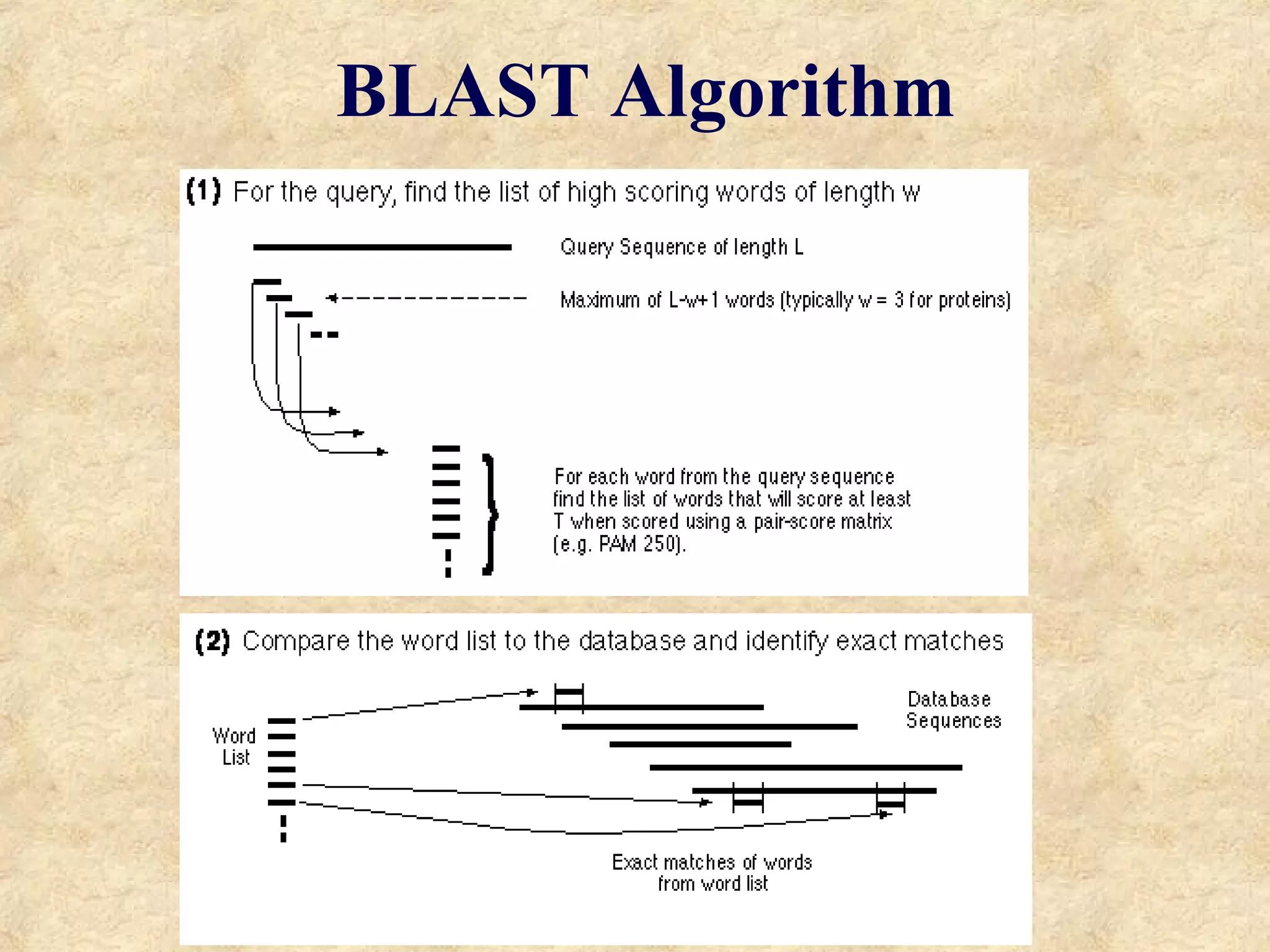
BLAST Algorithm
BLAST Word Matching MEAAVKEEISVEDEAVDKNI MEA   EAA   AAV   AVK   VKE   KEE   EEI   EIS   ISV   ...   Break query  into words: Break database  sequences  into words:
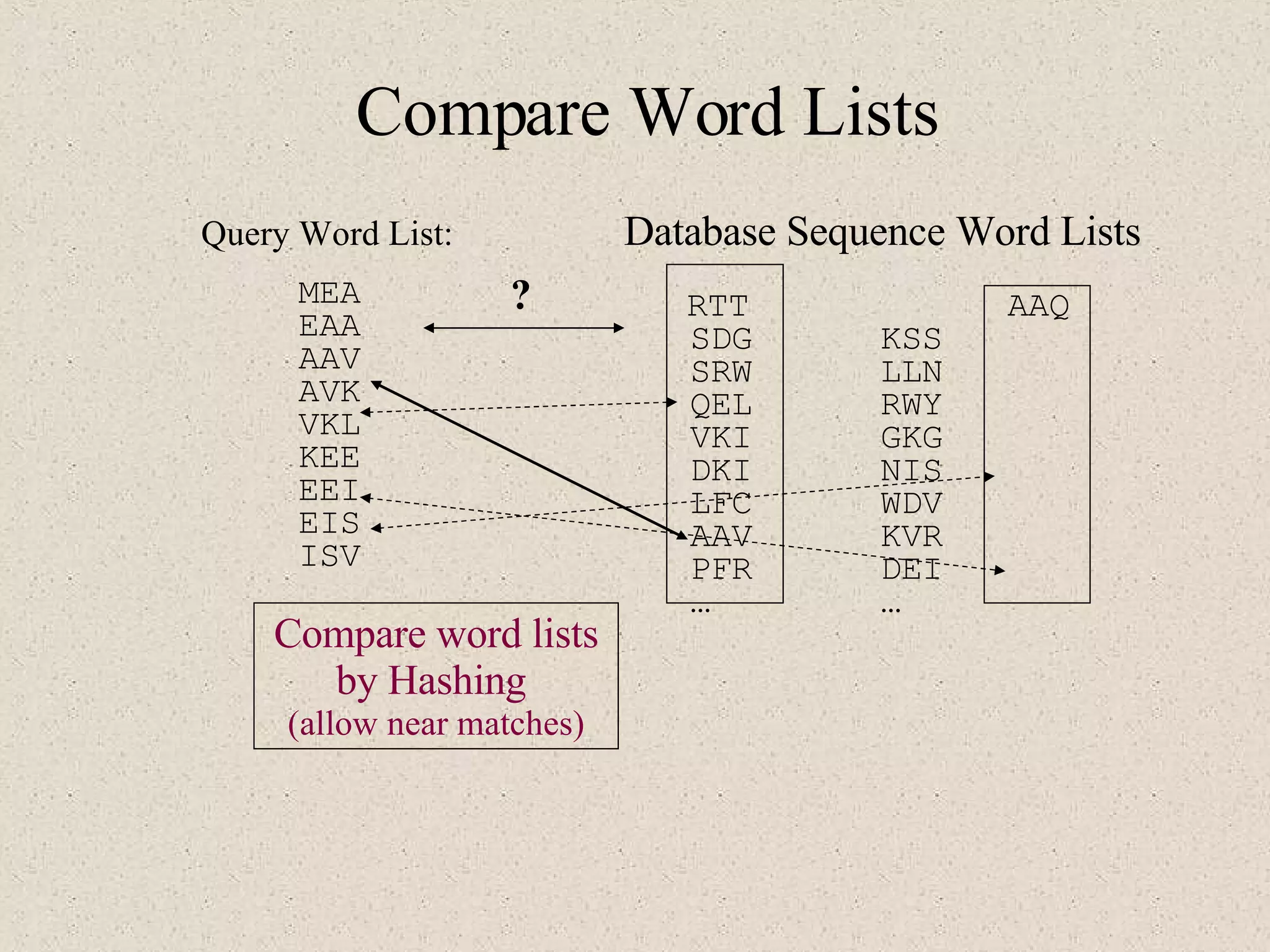
Database Sequence Word Lists     RTT AAQ SDG KSS SRW LLN QEL RWY VKI GKG DKI NIS LFC WDV AAV KVR PFR DEI … … Compare Word Lists Query Word List: MEA EAA AAV AVK VKL KEE EEI EIS ISV ? Compare word lists by Hashing  (allow near matches)
ELEPRRPRYRVPDVLVADPPIARLSVSGRDENSVELT MEA T TDVRWMSETGIIDVFLLLGPSISDVFRQYASLTGTQALPPLFSLGYHQSRWNY IWLDI EEI HADGKRYFTWDPSRFPQPRTMLERLASKRRV KLV AIVDPH MEA EAA AAV AVK KLV KEE EEI EIS ISV Find locations of matching words  in database sequences
Extend hits one base at a time
HVTGRSAF_FS YYG YGCYC GLG TGKGLPVDATDRCCWA QSVFDYI YYG CYCGW GLG _GK__PRDA  Use  two  word matches as anchors to build an alignment  between the query and a database sequence.  Then score the alignment. Query: Seq_XYZ: E-val = 10 -13
HSPs are Aligned Regions The results of the word matching and attempts to extend the alignment are segments - called HSPs (High-scoring Segment Pairs)   BLAST  often produces several short HSPs rather than a single aligned region
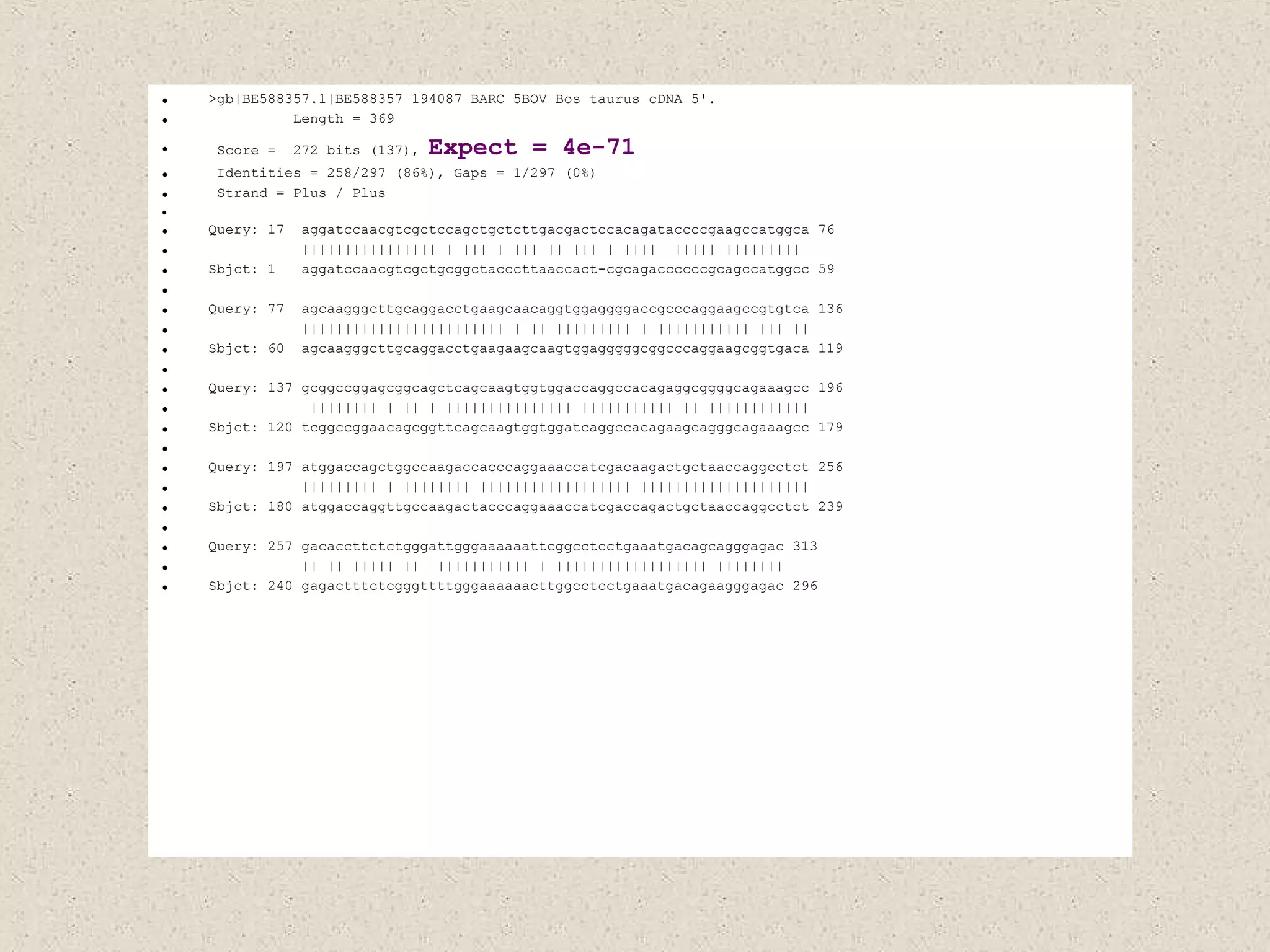
>gb|BE588357.1|BE588357 194087 BARC 5BOV Bos taurus cDNA 5'. Length = 369 Score =  272 bits (137),  Expect =   4e-71 Identities = 258/297 (86%), Gaps = 1/297 (0%) Strand = Plus / Plus Query: 17  aggatccaacgtcgctccagctgctcttgacgactccacagataccccgaagccatggca 76 |||||||||||||||| | ||| | ||| || ||| | ||||  ||||| |||||||||  Sbjct: 1  aggatccaacgtcgctgcggctacccttaaccact-cgcagaccccccgcagccatggcc 59 Query: 77  agcaagggcttgcaggacctgaagcaacaggtggaggggaccgcccaggaagccgtgtca 136 |||||||||||||||||||||||| | || ||||||||| | ||||||||||| ||| || Sbjct: 60  agcaagggcttgcaggacctgaagaagcaagtggagggggcggcccaggaagcggtgaca 119 Query: 137 gcggccggagcggcagctcagcaagtggtggaccaggccacagaggcggggcagaaagcc 196 |||||||| | || | ||||||||||||||| ||||||||||| || |||||||||||| Sbjct: 120 tcggccggaacagcggttcagcaagtggtggatcaggccacagaagcagggcagaaagcc 179 Query: 197 atggaccagctggccaagaccacccaggaaaccatcgacaagactgctaaccaggcctct 256 ||||||||| | |||||||| |||||||||||||||||| |||||||||||||||||||| Sbjct: 180 atggaccaggttgccaagactacccaggaaaccatcgaccagactgctaaccaggcctct 239 Query: 257 gacaccttctctgggattgggaaaaaattcggcctcctgaaatgacagcagggagac 313 || || ||||| ||  ||||||||||| | |||||||||||||||||| |||||||| Sbjct: 240 gagactttctcgggttttgggaaaaaacttggcctcctgaaatgacagaagggagac 296
 
The PAM 250 scoring matrix
BLAST has Automatic Translation BLASTX  makes automatic translation (in all 6 reading frames) of your DNA query sequence to compare with protein databanks TBLASTN  makes automatic translation of an entire DNA database to compare with your protein query sequence  Only make a DNA-DNA search if you are working with a sequence that does not code for protein.
BLAST Results - Summary
BLAST Results - List
BLAST Results - Alignment > gi|17556182|ref|NP_497582.1|   Predicted CDS, phosphatidylinositol transfer protein [Caenorhabditis elegans] gi|14574401|gb|AAK68521.1|AC024814_1   Hypothetical protein Y54F10AR.1 [Caenorhabditis elegans] Length = 336 Score =  283 bits (723), Expect = 8e-75 Identities = 144/270 (53%), Positives = 186/270 (68%), Gaps = 13/270 (4%) Query: 48  KEYRVILPVSVDEYQVGQLYSVAEASKNXXXXXXXXXXXXXXPYEK----DGE--KGQYT 101 K+ RV+LP+SV+EYQVGQL+SVAEASK  P++  +G+  KGQYT Sbjct: 70  KKSRVVLPMSVEEYQVGQLWSVAEASKAETGGGEGVEVLKNEPFDNVPLLNGQFTKGQYT 129 Query: 102 HKIYHLQSKVPTFVRMLAPEGALNIHEKAWNAYPYCRTVITN-EYMKEDFLIKIETWHKP 160 HKIYHLQSKVP  +R +AP+G+L IHE+AWNAYPYC+TV+TN +YMKE+F +KIET H P Sbjct: 130 HKIYHLQSKVPAILRKIAPKGSLAIHEEAWNAYPYCKTVVTNPDYMKENFYVKIETIHLP 189 Query: 161 DLGTQENVHKLEPEAWKHVEAVYIDIADRSQVL-SKDYKAEEDPAKFKSIKTGRGPLGPN 219 D GT EN H L+ +  E V I+IA+  + L S D  +  P+KF+S KTGRGPL  N Sbjct: 190 DNGTTENAHGLKGDELAKREVVNINIANDHEYLNSGDLHPDSTPSKFQSTKTGRGPLSGN 249 Query: 220 WKQELVNQKDCPYMCAYKLVTVKFKWWGLQNKVENFIHKQERRLFTNFHRQLFCWLDKWV 279 WK  +  P MCAYKLVTV FKW+G Q  VEN+ H Q  RLF+ FHR++FCW+DKW  Sbjct: 250 WKDSVQ-----PVMCAYKLVTVYFKWFGFQKIVENYAHTQYPRLFSKFHREVFCWIDKWH 304 Query: 280 DLTMDDIRRMEEETKRQLDEMRQKDPVKGM 309 LTM DIR +E + +++L+E R+  V+GM Sbjct: 305 GLTMVDIREIEAKAQKELEEQRKSGQVRGM 334
BLAST   alignments are short segments BLAST  tends to break alignments into non-overlapping segments can be confusing reduces overall significance score
BLAST 2   algorithm The NCBI’s  BLAST  website and  GCG  ( NETBLAST ) now both use BLAST 2 (also known as “gapped BLAST”) This algorithm is more complex than the original BLAST It requires two word matches close to each other on a pair of sequences (i.e. with a gap) before it creates an alignment
Web  BLAST  runs on a  big  computer at NCBI Usually fast, but does get busy sometimes Fixed choices of databases problems with genome data “clogging” the system ESTs are not part of the default “NR” dataset Uses filtering of repeats Graphical summary of output Links to GenBank sequences
FASTA/BLAST   Statistics E() value is equivalent to standard P value Significant if E() < 0.05 (smaller numbers are more significant)  The E-value represents the likelihood that the observed alignment is due to chance alone. A value of 1 indicates that an alignment this good would happen by chance with any random sequence searched against this database. The histogram should follow expectations (asterisks) except for hits
BLAST is Approximate BLAST makes similarity searches very quickly because it takes shortcuts. looks for short, nearly identical “words” (11 bases) It also makes errors  misses some important similarities makes many incorrect matches easily fooled by repeats or skewed composition
Interpretation of output very low E() values (e-100) are homologs or identical genes moderate E() values are related genes long list of gradually declining of E() values indicates a large gene family long regions of moderate similarity are more significant than short regions of high identity
Biological Relevance It is up to you, the biologist to scrutinize these alignments and determine if they are significant. Were you looking for a short region of nearly identical sequence or a larger region of general similarity?  Are the mismatches conservative ones?  Are the matching regions important structural components of the genes or just introns and flanking regions?
Borderline similarity What to do with matches with E() values in the 0.5 -1.0 range? this is the  “Twilight Zone” retest these sequences and look for related hits (not just your original query sequence) similarity is transitive:  if  A~B  and  B~C , then  A~C
Advanced Similarity Techniques Automated ways of using the results of one search to initiate multiple searches INCA  ( I terative  N eighborhood  C luster  A nalysis)  http://itsa.ucsf.edu/~gram/home/inca / Takes results of one  BLAST  search, does new searches with each one, then combines all results into a single list JAVA applet, compatibility problems on some computers PSI BLAST   http://www.ncbi.nlm.nih.gov/Education/BLASTinfo/psi1.html Creates a “position specific scoring matrix” from the results of one  BLAST  search Uses this matrix to do another search  builds a family of related sequences  can’t trust the resulting e-values
ESTs have frameshifts How to search them as proteins? Can use  TBLASTN   but this breaks each  frame-shifted region into its own little protein GCG  FRAMESEARCH  is killer slow  (uses an extended version of the Smith-Waterman algorithm) FASTX  (DNA vs. protein database)  and  TFASTX  (protein vs. DNA database) search for similarity taking account of frameshifts
Genome Alignment How to match a protein or mRNA to genomic sequence? There is a Genome BLAST server at NCBI  Each of the Genome websites has a similar search function What about introns? An intron is penalized as a gap, or each exon is treated as a separate alignment with its own e-score Need a search algorithm that looks for consensus intron splice sites and points in the alignment where similarity drops off.
Sim4  is for mRNA -> DNA Alignment Florea L, Hartzell G, Zhang Z, Rubin GM,  Miller W . A computer program for aligning a cDNA sequence with a genomic DNA sequence. Genome Res.  1998  8:967-74   This is a fairly new program (1998) as compared to  BLAST  and  FASTA It is written for  UNIX  (of course), but there is a web server (and it is used in many other 'genome analysis' tools):  http://pbil.univ-lyon1.fr/sim4.html Finds best set of segments of local alignment with a preference for fragments that end with splice-site recognition signals   (GT-AG, CT-AC)
More Genome Alignment Est2Genome :  like it says, compares an EST to genome sequence) http://bioweb.pasteur.fr/seqanal/interfaces/est2genome.html GeneWise : Compares a protein (or motif) to genome sequence http://www.sanger.ac.uk/Software/Wise2/genewiseform.shtml
Smith-Waterman searches A more sensitive  brute force  approach to searching  much   slower than  BLAST  or  FASTA uses dynamic programming SSEARCH  is a  GCG  program for Smith-Waterman searches
Smith-Waterman on the Web The  EMBL  offers a service know as  BLITZ ,  which actually runs an algorithm called  MPsrch  on a dedicated  MassPar  massively parallel super-computer. http://www.ebi.ac.uk/bic_sw/ The Weizmann Institute of Science offers a service called the BIOCCELERATOR provided by  Compugen  Inc. http://sgbcd.weizmann.ac.il:80/cgi-bin/genweb/main.cgi
Strategies for similarity searching 1) Web, PC program,  GCG , or custom client? 2) Start with smaller, better annotated databases (limit by taxonomic group if possible) 3) Search  protein  databases (use translation for DNA seqs.) unless you have non-coding DNA

Similarity

  • 1.
  • 2.
    Why Compare Sequences?Identify sequences found in lab experiments What is this thing I just found? Compare new genes to known ones Compare genes from different species information about evolution Guess functions for entire genomes full of new gene sequences
  • 3.
    Are there othersequences like this one? 1) Huge public databases - GenBank, Swissprot, etc. 2) Sequence comparison is the most powerful and reliable method to determine evolutionary relationships between genes 3) Similarity searching is based on alignment 4) BLAST and FASTA provide rapid similarity searching a. rapid = approximate (heuristic) b. false + and - scores
  • 4.
    Similarity ≠ Homology 1) 25% similarity ≥ 100 AAs is strong evidence for homology 2) Homology is an evolutionary statement which means “descent from a common ancestor” common 3D structure usually common function homology is all or nothing, you cannot say &quot;50% homologous&quot;
  • 5.
    Manually line themup and count? an alignment program can do it for you or a just use a text editor Dot Plot shows regions of similarity as diagonals GATG C C A T A G A G C T G T A G T C GT A CCC T < — — > C T A G A G A G C - G T A G T C AG A GTG T CTTTGAGTTCC How to Compare Sequences?
  • 6.
    Global vs Local similarity 1) Global similarity uses complete aligned sequences - total % matches GCG GAP program, Needleman & Wunch algorithm 2) Local similarity looks for best internal matching region between 2 sequences GCG BESTFIT program, Smith-Waterman algorithm, BLAST and FASTA 3) dynamic programming optimal computer solution, not approximate
  • 7.
    Search with Protein,not DNA Sequences 1) 4 DNA bases vs. 20 amino acids - less chance similarity 2) can have varying degrees of similarity between different AAs - # of mutations, chemical similarity, PAM matrix 3) protein databanks are much smaller than DNA databanks
  • 8.
    Similarity is Basedon Dot Plots 1) two sequences on vertical and horizontal axes of graph 2) put dots wherever there is a match 3) diagonal line is region of identity (local alignment) 4) apply a window filter - look at a group of bases, must meet % identity to get a dot
  • 9.
  • 10.
    Dot plot filteredwith 4 base window and 75% identity
  • 11.
    Dot plot ofreal data
  • 12.
    Global vs. LocalAlignments
  • 13.
    Scoring Similarity 1)Can only score aligned sequences 2) DNA is usually scored as identical or not 3) modified scoring for gaps - single vs. multiple base gaps (gap extension) 4) AAs have varying degrees of similarity a. # of mutations to convert one to another b. chemical similarity c. observed mutation frequencies 5) PAM matrix calculated from observed mutations in protein families
  • 14.
    The PAM 250scoring matrix
  • 15.
    What program touse for searching? 1) BLAST is fastest and easily accessed on the Web limited sets of databases nice translation tools ( BLASTX, TBLASTN ) 2) FASTA works best in GCG integrated with GCG precise choice of databases more sensitive for DNA-DNA comparisons FASTX and TFASTX can find similarities in sequences with frameshifts 3) Smith-Waterman is slower, but more sensitive known as a “rigorous” or “exhaustive” search SSEARCH in GCG and standalone FASTA
  • 16.
    FASTA 1) Derivedfrom logic of the dot plot compute best diagonals from all frames of alignment 2) Word method looks for exact matches between words in query and test sequence hash tables (fast computer technique) DNA words are usually 6 bases protein words are 1 or 2 amino acids only searches for diagonals in region of word matches = faster searching
  • 17.
  • 18.
    Makes Longest Diagonal3) after all diagonals found, tries to join diagonals by adding gaps 4) computes alignments in regions of best diagonals
  • 19.
  • 20.
    FASTA Results -Histogram !!SEQUENCE_LIST 1.0 (Nucleotide) FASTA of: b2.seq from: 1 to: 693 December 9, 2002 14:02 TO: /u/browns02/Victor/Search-set/*.seq Sequences: 2,050 Symbols: 913,285 Word Size: 6 Searching with both strands of the query. Scoring matrix: GenRunData:fastadna.cmp Constant pamfactor used Gap creation penalty: 16 Gap extension penalty: 4 Histogram Key: Each histogram symbol represents 4 search set sequences Each inset symbol represents 1 search set sequences z-scores computed from opt scores z-score obs exp (=) (*) < 20 0 0: 22 0 0: 24 3 0:= 26 2 0:= 28 5 0:== 30 11 3:*== 32 19 11:==*== 34 38 30:=======*== 36 58 61:===============* 38 79 100:==================== * 40 134 140:==================================* 42 167 171:==========================================* 44 205 189:===============================================*==== 46 209 192:===============================================*===== 48 177 184:=============================================*
  • 21.
    FASTA Results -List The best scores are: init1 initn opt z-sc E(1018780).. SW:PPI1_HUMAN Begin: 1 End: 269 ! Q00169 homo sapiens (human). phosph... 1854 1854 1854 2249.3 1.8e-117 SW:PPI1_RABIT Begin: 1 End: 269 ! P48738 oryctolagus cuniculus (rabbi... 1840 1840 1840 2232.4 1.6e-116 SW:PPI1_RAT Begin: 1 End: 270 ! P16446 rattus norvegicus (rat). pho... 1543 1543 1837 2228.7 2.5e-116 SW:PPI1_MOUSE Begin: 1 End: 270 ! P53810 mus musculus (mouse). phosph... 1542 1542 1836 2227.5 2.9e-116 SW:PPI2_HUMAN Begin: 1 End: 270 ! P48739 homo sapiens (human). phosph... 1533 1533 1533 1861.0 7.7e-96 SPTREMBL_NEW:BAC25830 Begin: 1 End: 270 ! Bac25830 mus musculus (mouse). 10, ... 1488 1488 1522 1847.6 4.2e-95 SP_TREMBL:Q8N5W1 Begin: 1 End: 268 ! Q8n5w1 homo sapiens (human). simila... 1477 1477 1522 1847.6 4.3e-95 SW:PPI2_RAT Begin: 1 End: 269 ! P53812 rattus norvegicus (rat). pho... 1482 1482 1516 1840.4 1.1e-94
  • 22.
    FASTA Results -Alignment SCORES Init1: 1515 Initn: 1565 Opt: 1687 z-score: 1158.1 E(): 2.3e-58 >>GB_IN3:DMU09374 (2038 nt) initn: 1565 init1: 1515 opt: 1687 Z-score: 1158.1 expect(): 2.3e-58 66.2% identity in 875 nt overlap (83-957:151-1022) 60 70 80 90 100 110 u39412.gb_pr CCCTTTGTGGCCGCCATGGACAATTCCGGGAAGGAAGCGGAGGCGATGGCGCTGTTGGCC || ||| | ||||| | ||| ||||| DMU09374 AGGCGGACATAAATCCTCGACATGGGTGACAACGAACAGAAGGCGCTCCAACTGATGGCC 130 140 150 160 170 180 120 130 140 150 160 170 u39412.gb_pr GAGGCGGAGCGCAAAGTGAAGAACTCGCAGTCCTTCTTCTCTGGCCTCTTTGGAGGCTCA ||||||||| || ||| | | || ||| | || || ||||| || DMU09374 GAGGCGGAGAAGAAGTTGACCCAGCAGAAGGGCTTTCTGGGATCGCTGTTCGGAGGGTCC 190 200 210 220 230 240 180 190 200 210 220 230 u39412.gb_pr TCCAAAATAGAGGAAGCATGCGAAATCTACGCCAGAGCAGCAAACATGTTCAAAATGGCC ||| | ||||| || ||| |||| | || | |||||||| || ||| || DMU09374 AACAAGGTGGAGGACGCCATCGAGTGCTACCAGCGGGCGGGCAACATGTTTAAGATGTCC 250 260 270 280 290 300 240 250 260 270 280 290 u39412.gb_pr AAAAACTGGAGTGCTGCTGGAAACGCGTTCTGCCAGGCTGCACAGCTGCACCTGCAGCTC |||||||||| ||||| | |||||| |||| ||| || ||| || | DMU09374 AAAAACTGGACAAAGGCTGGGGAGTGCTTCTGCGAGGCGGCAACTCTACACGCGCGGGCT 310 320 330 340 350 360
  • 23.
    FASTA on the Web Many websites offer FASTA searches Various databases and various other services Be sure to use FASTA 3 Each server has its limits Be aware that you are depending on the kindness of strangers.
  • 24.
    Institut de GénétiqueHumaine, Montpellier France, GeneStream server http://www2.igh.cnrs.fr/bin/fasta-guess.cgi Oak Ridge National Laboratory GenQuest server http://avalon.epm.ornl.gov/ European Bioinformatics Institute, Cambridge, UK http://www.ebi.ac.uk/htbin/fasta.py?request EMBL, Heidelberg, Germany http://www.embl-heidelberg.de/cgi/fasta-wrapper-free Munich Information Center for Protein Sequences (MIPS) at Max-Planck-Institut, Germany http://speedy.mips.biochem.mpg.de/mips/programs/fasta.html Institute of Biology and Chemistry of Proteins Lyon, France http://www.ibcp.fr/serv_main.html Institute Pasteur, France http://central.pasteur.fr/seqanal/interfaces/fasta.html GenQuest at The Johns Hopkins University http://www.bis.med.jhmi.edu/Dan/gq/gq.form.html National Cancer Center of Japan http://bioinfo.ncc.go.jp
  • 25.
    FASTA Format simpleformat used by almost all programs >header line with a [return] at end Sequence (no specific requirements for line length, characters, etc) >URO1 uro1.seq Length: 2018 November 9, 2000 11:50 Type: N Check: 3854 .. CGCAGAAAGAGGAGGCGCTTGCCTTCAGCTTGTGGGAAATCCCGAAGATGGCCAAAGACA ACTCAACTGTTCGTTGCTTCCAGGGCCTGCTGATTTTTGGAAATGTGATTATTGGTTGTT GCGGCATTGCCCTGACTGCGGAGTGCATCTTCTTTGTATCTGACCAACACAGCCTCTACC CACTGCTTGAAGCCACCGACAACGATGACATCTATGGGGCTGCCTGGATCGGCATATTTG TGGGCATCTGCCTCTTCTGCCTGTCTGTTCTAGGCATTGTAGGCATCATGAAGTCCAGCA GGAAAATTCTTCTGGCGTATTTCATTCTGATGTTTATAGTATATGCCTTTGAAGTGGCAT CTTGTATCACAGCAGCAACACAACAAGACTTTTTCACACCCAACCTCTTCCTGAAGCAGA TGCTAGAGAGGTACCAAAACAACAGCCCTCCAAACAATGATGACCAGTGGAAAAACAATG GAGTCACCAAAACCTGGGACAGGCTCATGCTCCAGGACAATTGCTGTGGCGTAAATGGTC CATCAGACTGGCAAAAATACACATCTGCCTTCCGGACTGAGAATAATGATGCTGACTATC CCTGGCCTCGTCAATGCTGTGTTATGAACAATCTTAAAGAACCTCTCAACCTGGAGGCTT
  • 26.
    BLAST Searches GenBank [ BLAST = B asic L ocal A lignment S earch T ool] The NCBI BLAST web server lets you compare your query sequence to various sections of GenBank: nr = non-redundant (main sections) month = new sequences from the past few weeks ESTs human, drososphila, yeast, or E.coli genomes proteins (by automatic translation) This is a VERY fast and powerful computer.
  • 27.
    BLAST Uses wordmatching like FASTA Similarity matching of words (3 aa’s, 11 bases) does not require identical words. If no words are similar, then no alignment won’t find matches for very short sequences Does not handle gaps well New “gapped BLAST” ( BLAST 2 ) is better BLAST searches can be sent to the NCBI’s server from GCG , Vector NTI, MacVector, or a custom client program on a personal computer or Mainframe.
  • 28.
  • 29.
    BLAST Word MatchingMEAAVKEEISVEDEAVDKNI MEA EAA AAV AVK VKE KEE EEI EIS ISV ... Break query into words: Break database sequences into words:
  • 30.
    Database Sequence WordLists RTT AAQ SDG KSS SRW LLN QEL RWY VKI GKG DKI NIS LFC WDV AAV KVR PFR DEI … … Compare Word Lists Query Word List: MEA EAA AAV AVK VKL KEE EEI EIS ISV ? Compare word lists by Hashing (allow near matches)
  • 31.
    ELEPRRPRYRVPDVLVADPPIARLSVSGRDENSVELT MEA TTDVRWMSETGIIDVFLLLGPSISDVFRQYASLTGTQALPPLFSLGYHQSRWNY IWLDI EEI HADGKRYFTWDPSRFPQPRTMLERLASKRRV KLV AIVDPH MEA EAA AAV AVK KLV KEE EEI EIS ISV Find locations of matching words in database sequences
  • 32.
    Extend hits onebase at a time
  • 33.
    HVTGRSAF_FS YYG YGCYCGLG TGKGLPVDATDRCCWA QSVFDYI YYG CYCGW GLG _GK__PRDA Use two word matches as anchors to build an alignment between the query and a database sequence. Then score the alignment. Query: Seq_XYZ: E-val = 10 -13
  • 34.
    HSPs are AlignedRegions The results of the word matching and attempts to extend the alignment are segments - called HSPs (High-scoring Segment Pairs) BLAST often produces several short HSPs rather than a single aligned region
  • 35.
    >gb|BE588357.1|BE588357 194087 BARC5BOV Bos taurus cDNA 5'. Length = 369 Score = 272 bits (137), Expect = 4e-71 Identities = 258/297 (86%), Gaps = 1/297 (0%) Strand = Plus / Plus Query: 17 aggatccaacgtcgctccagctgctcttgacgactccacagataccccgaagccatggca 76 |||||||||||||||| | ||| | ||| || ||| | |||| ||||| ||||||||| Sbjct: 1 aggatccaacgtcgctgcggctacccttaaccact-cgcagaccccccgcagccatggcc 59 Query: 77 agcaagggcttgcaggacctgaagcaacaggtggaggggaccgcccaggaagccgtgtca 136 |||||||||||||||||||||||| | || ||||||||| | ||||||||||| ||| || Sbjct: 60 agcaagggcttgcaggacctgaagaagcaagtggagggggcggcccaggaagcggtgaca 119 Query: 137 gcggccggagcggcagctcagcaagtggtggaccaggccacagaggcggggcagaaagcc 196 |||||||| | || | ||||||||||||||| ||||||||||| || |||||||||||| Sbjct: 120 tcggccggaacagcggttcagcaagtggtggatcaggccacagaagcagggcagaaagcc 179 Query: 197 atggaccagctggccaagaccacccaggaaaccatcgacaagactgctaaccaggcctct 256 ||||||||| | |||||||| |||||||||||||||||| |||||||||||||||||||| Sbjct: 180 atggaccaggttgccaagactacccaggaaaccatcgaccagactgctaaccaggcctct 239 Query: 257 gacaccttctctgggattgggaaaaaattcggcctcctgaaatgacagcagggagac 313 || || ||||| || ||||||||||| | |||||||||||||||||| |||||||| Sbjct: 240 gagactttctcgggttttgggaaaaaacttggcctcctgaaatgacagaagggagac 296
  • 36.
  • 37.
    The PAM 250scoring matrix
  • 38.
    BLAST has AutomaticTranslation BLASTX makes automatic translation (in all 6 reading frames) of your DNA query sequence to compare with protein databanks TBLASTN makes automatic translation of an entire DNA database to compare with your protein query sequence Only make a DNA-DNA search if you are working with a sequence that does not code for protein.
  • 39.
  • 40.
  • 41.
    BLAST Results -Alignment > gi|17556182|ref|NP_497582.1| Predicted CDS, phosphatidylinositol transfer protein [Caenorhabditis elegans] gi|14574401|gb|AAK68521.1|AC024814_1 Hypothetical protein Y54F10AR.1 [Caenorhabditis elegans] Length = 336 Score = 283 bits (723), Expect = 8e-75 Identities = 144/270 (53%), Positives = 186/270 (68%), Gaps = 13/270 (4%) Query: 48 KEYRVILPVSVDEYQVGQLYSVAEASKNXXXXXXXXXXXXXXPYEK----DGE--KGQYT 101 K+ RV+LP+SV+EYQVGQL+SVAEASK P++ +G+ KGQYT Sbjct: 70 KKSRVVLPMSVEEYQVGQLWSVAEASKAETGGGEGVEVLKNEPFDNVPLLNGQFTKGQYT 129 Query: 102 HKIYHLQSKVPTFVRMLAPEGALNIHEKAWNAYPYCRTVITN-EYMKEDFLIKIETWHKP 160 HKIYHLQSKVP +R +AP+G+L IHE+AWNAYPYC+TV+TN +YMKE+F +KIET H P Sbjct: 130 HKIYHLQSKVPAILRKIAPKGSLAIHEEAWNAYPYCKTVVTNPDYMKENFYVKIETIHLP 189 Query: 161 DLGTQENVHKLEPEAWKHVEAVYIDIADRSQVL-SKDYKAEEDPAKFKSIKTGRGPLGPN 219 D GT EN H L+ + E V I+IA+ + L S D + P+KF+S KTGRGPL N Sbjct: 190 DNGTTENAHGLKGDELAKREVVNINIANDHEYLNSGDLHPDSTPSKFQSTKTGRGPLSGN 249 Query: 220 WKQELVNQKDCPYMCAYKLVTVKFKWWGLQNKVENFIHKQERRLFTNFHRQLFCWLDKWV 279 WK + P MCAYKLVTV FKW+G Q VEN+ H Q RLF+ FHR++FCW+DKW Sbjct: 250 WKDSVQ-----PVMCAYKLVTVYFKWFGFQKIVENYAHTQYPRLFSKFHREVFCWIDKWH 304 Query: 280 DLTMDDIRRMEEETKRQLDEMRQKDPVKGM 309 LTM DIR +E + +++L+E R+ V+GM Sbjct: 305 GLTMVDIREIEAKAQKELEEQRKSGQVRGM 334
  • 42.
    BLAST alignments are short segments BLAST tends to break alignments into non-overlapping segments can be confusing reduces overall significance score
  • 43.
    BLAST 2 algorithm The NCBI’s BLAST website and GCG ( NETBLAST ) now both use BLAST 2 (also known as “gapped BLAST”) This algorithm is more complex than the original BLAST It requires two word matches close to each other on a pair of sequences (i.e. with a gap) before it creates an alignment
  • 44.
    Web BLAST runs on a big computer at NCBI Usually fast, but does get busy sometimes Fixed choices of databases problems with genome data “clogging” the system ESTs are not part of the default “NR” dataset Uses filtering of repeats Graphical summary of output Links to GenBank sequences
  • 45.
    FASTA/BLAST Statistics E() value is equivalent to standard P value Significant if E() < 0.05 (smaller numbers are more significant) The E-value represents the likelihood that the observed alignment is due to chance alone. A value of 1 indicates that an alignment this good would happen by chance with any random sequence searched against this database. The histogram should follow expectations (asterisks) except for hits
  • 46.
    BLAST is ApproximateBLAST makes similarity searches very quickly because it takes shortcuts. looks for short, nearly identical “words” (11 bases) It also makes errors misses some important similarities makes many incorrect matches easily fooled by repeats or skewed composition
  • 47.
    Interpretation of outputvery low E() values (e-100) are homologs or identical genes moderate E() values are related genes long list of gradually declining of E() values indicates a large gene family long regions of moderate similarity are more significant than short regions of high identity
  • 48.
    Biological Relevance Itis up to you, the biologist to scrutinize these alignments and determine if they are significant. Were you looking for a short region of nearly identical sequence or a larger region of general similarity? Are the mismatches conservative ones? Are the matching regions important structural components of the genes or just introns and flanking regions?
  • 49.
    Borderline similarity Whatto do with matches with E() values in the 0.5 -1.0 range? this is the “Twilight Zone” retest these sequences and look for related hits (not just your original query sequence) similarity is transitive: if A~B and B~C , then A~C
  • 50.
    Advanced Similarity TechniquesAutomated ways of using the results of one search to initiate multiple searches INCA ( I terative N eighborhood C luster A nalysis) http://itsa.ucsf.edu/~gram/home/inca / Takes results of one BLAST search, does new searches with each one, then combines all results into a single list JAVA applet, compatibility problems on some computers PSI BLAST http://www.ncbi.nlm.nih.gov/Education/BLASTinfo/psi1.html Creates a “position specific scoring matrix” from the results of one BLAST search Uses this matrix to do another search builds a family of related sequences can’t trust the resulting e-values
  • 51.
    ESTs have frameshiftsHow to search them as proteins? Can use TBLASTN but this breaks each frame-shifted region into its own little protein GCG FRAMESEARCH is killer slow (uses an extended version of the Smith-Waterman algorithm) FASTX (DNA vs. protein database) and TFASTX (protein vs. DNA database) search for similarity taking account of frameshifts
  • 52.
    Genome Alignment Howto match a protein or mRNA to genomic sequence? There is a Genome BLAST server at NCBI Each of the Genome websites has a similar search function What about introns? An intron is penalized as a gap, or each exon is treated as a separate alignment with its own e-score Need a search algorithm that looks for consensus intron splice sites and points in the alignment where similarity drops off.
  • 53.
    Sim4 isfor mRNA -> DNA Alignment Florea L, Hartzell G, Zhang Z, Rubin GM, Miller W . A computer program for aligning a cDNA sequence with a genomic DNA sequence. Genome Res. 1998 8:967-74 This is a fairly new program (1998) as compared to BLAST and FASTA It is written for UNIX (of course), but there is a web server (and it is used in many other 'genome analysis' tools): http://pbil.univ-lyon1.fr/sim4.html Finds best set of segments of local alignment with a preference for fragments that end with splice-site recognition signals (GT-AG, CT-AC)
  • 54.
    More Genome AlignmentEst2Genome : like it says, compares an EST to genome sequence) http://bioweb.pasteur.fr/seqanal/interfaces/est2genome.html GeneWise : Compares a protein (or motif) to genome sequence http://www.sanger.ac.uk/Software/Wise2/genewiseform.shtml
  • 55.
    Smith-Waterman searches Amore sensitive brute force approach to searching much slower than BLAST or FASTA uses dynamic programming SSEARCH is a GCG program for Smith-Waterman searches
  • 56.
    Smith-Waterman on theWeb The EMBL offers a service know as BLITZ , which actually runs an algorithm called MPsrch on a dedicated MassPar massively parallel super-computer. http://www.ebi.ac.uk/bic_sw/ The Weizmann Institute of Science offers a service called the BIOCCELERATOR provided by Compugen Inc. http://sgbcd.weizmann.ac.il:80/cgi-bin/genweb/main.cgi
  • 57.
    Strategies for similaritysearching 1) Web, PC program, GCG , or custom client? 2) Start with smaller, better annotated databases (limit by taxonomic group if possible) 3) Search protein databases (use translation for DNA seqs.) unless you have non-coding DNA