BLAST
BLAST
          Basic Local Alignment Search Tool
National Center for Biotechnology Information (NCBI)


Fundamental                   The search reveals
ways of learning              what related
about a protein               sequences are
or gene                       present in the same
                              organism and other
                              organisms.
BLAST
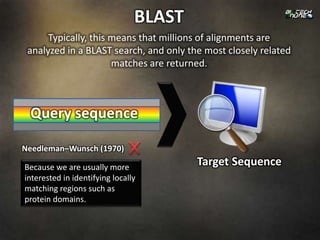
      Typically, this means that millions of alignments are
 analyzed in a BLAST search, and only the most closely related
                      matches are returned.


 Query sequence

Needleman–Wunsch (1970)

Because we are usually more
                                        Target Sequence
interested in identifying locally
matching regions such as
protein domains.
BLAST
        Typically, this means that millions of alignments are
   analyzed in a BLAST search, and only the most closely related
                        matches are returned.


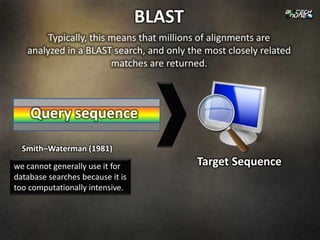
    Query sequence

  Smith–Waterman (1981)
we cannot generally use it for            Target Sequence
database searches because it is
too computationally intensive.
BLAST
        Typically, this means that millions of alignments are
   analyzed in a BLAST search, and only the most closely related
                        matches are returned.


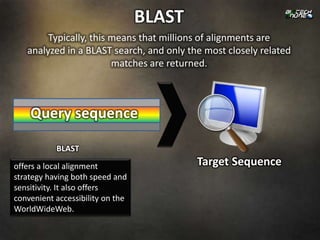
    Query sequence

           BLAST
offers a local alignment                  Target Sequence
strategy having both speed and
sensitivity. It also offers
convenient accessibility on the
WorldWideWeb.
BLAST
                                     Target Sequence
        Query sequence


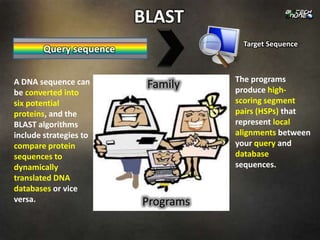
A DNA sequence can                  The programs
                          Family    produce high-
be converted into
six potential                       scoring segment
proteins, and the                   pairs (HSPs) that
BLAST algorithms                    represent local
include strategies to               alignments between
compare protein                     your query and
sequences to                        database
dynamically                         sequences.
translated DNA
databases or vice
versa.                   Programs
BLAST
1. Determining what orthologs and paralogs are known for a
   particular protein or nucleic acid sequence.
2. Determining what proteins or genes are present in a
   particular organism.
3. Determining the identity of a DNA or protein sequence.
4. Discovering new genes.
5. Determining what variants have been described for a
   particular gene or protein.
6. Investigating expressed sequence tags that may exhibit
   alternative splicing.
7. Exploring amino acid residues that are important in the
   function and/or structure of a protein
BLAST
1. Selecting a sequence of interest and pasting, typing, or
   uploading it into the BLAST input box.
2. Selecting a BLAST program (most commonly
   blastp, blastn, blastx, tblastx,blastn).
3. Selecting a database to search. A common choice is the non
   redundant (nr) database, but there are many other
   databases.
4. Selecting optional parameters, both for the search and for the
   format of the output. These options include choosing a
   substitution matrix, filtering of low complexity
   sequences, and restricting the search to a particular set of
   organisms.
BLAST SEARCH STEPS
1. Step 1: Specifying Sequence of Interest:

   First Cutting and pasting DNA or protein sequence (e.g., in
   the FASTA format).

   Second using an accession number (e.g., a RefSeq or
   GenBank Identification [GI] number)

         BLAST searches, your query can be in uppercase or
       lowercase, with or without intervening spaces or numbers.
If the query is DNA, BLAST algorithms will search both strands. It
     is often convenient to input the accession number to a BLAST
                                search.
BLAST SEARCH STEPS
   1. Step 2: Selecting BLAST Program
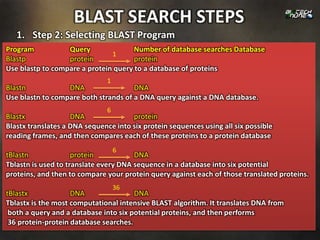
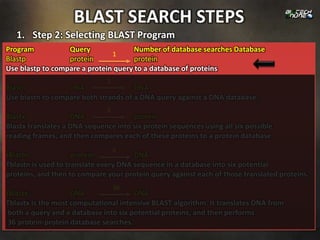
Program           Query               Number of database searches Database
                               1
Blastp            protein             protein
Use blastp to compare a protein query to a database of proteins
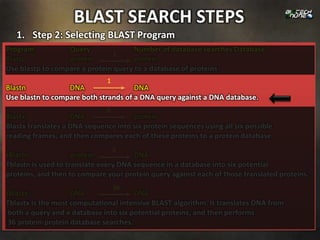
                               1
Blastn            DNA                 DNA
Use blastn to compare both strands of a DNA query against a DNA database.
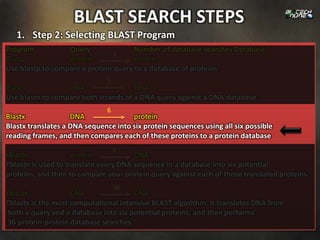
                               6
Blastx              DNA               protein
Blastx translates a DNA sequence into six protein sequences using all six possible
reading frames, and then compares each of these proteins to a protein database
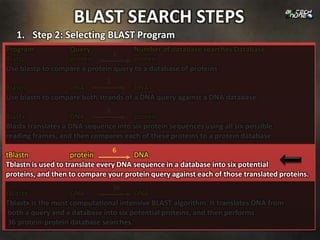
                                   6
tBlastn              protein           DNA
Tblastn is used to translate every DNA sequence in a database into six potential
proteins, and then to compare your protein query against each of those translated proteins.
                                   36
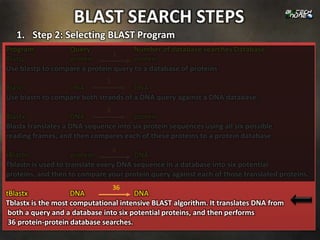
tBlastx             DNA                DNA
Tblastx is the most computational intensive BLAST algorithm. It translates DNA from
 both a query and a database into six potential proteins, and then performs
 36 protein-protein database searches.
BLAST SEARCH STEPS
   1. Step 2: Selecting BLAST Program
Program           Query               Number of database searches Database
                               1
Blastp            protein             protein
Use blastp to compare a protein query to a database of proteins
                               1
Blastn            DNA                 DNA
Use blastn to compare both strands of a DNA query against a DNA database.
                               6
Blastx              DNA               protein
Blastx translates a DNA sequence into six protein sequences using all six possible
reading frames, and then compares each of these proteins to a protein database
                                   6
tBlastn              protein           DNA
Tblastn is used to translate every DNA sequence in a database into six potential
proteins, and then to compare your protein query against each of those translated proteins.
                                   36
tBlastx             DNA                DNA
Tblastx is the most computational intensive BLAST algorithm. It translates DNA from
 both a query and a database into six potential proteins, and then performs
 36 protein-protein database searches.
BLAST SEARCH STEPS
   1. Step 2: Selecting BLAST Program
Program           Query               Number of database searches Database
                               1
Blastp            protein             protein
Use blastp to compare a protein query to a database of proteins
                               1
Blastn            DNA                 DNA
Use blastn to compare both strands of a DNA query against a DNA database.
                               6
Blastx              DNA               protein
Blastx translates a DNA sequence into six protein sequences using all six possible
reading frames, and then compares each of these proteins to a protein database
                                   6
tBlastn              protein           DNA
Tblastn is used to translate every DNA sequence in a database into six potential
proteins, and then to compare your protein query against each of those translated proteins.
                                   36
tBlastx             DNA                DNA
Tblastx is the most computational intensive BLAST algorithm. It translates DNA from
 both a query and a database into six potential proteins, and then performs
 36 protein-protein database searches.
BLAST SEARCH STEPS
   1. Step 2: Selecting BLAST Program
Program           Query               Number of database searches Database
                               1
Blastp            protein             protein
Use blastp to compare a protein query to a database of proteins
                               1
Blastn            DNA                 DNA
Use blastn to compare both strands of a DNA query against a DNA database.
                               6
Blastx              DNA               protein
Blastx translates a DNA sequence into six protein sequences using all six possible
reading frames, and then compares each of these proteins to a protein database
                                   6
tBlastn              protein           DNA
Tblastn is used to translate every DNA sequence in a database into six potential
proteins, and then to compare your protein query against each of those translated proteins.
                                   36
tBlastx             DNA                DNA
Tblastx is the most computational intensive BLAST algorithm. It translates DNA from
 both a query and a database into six potential proteins, and then performs
 36 protein-protein database searches.
BLAST SEARCH STEPS
   1. Step 2: Selecting BLAST Program
Program           Query               Number of database searches Database
                               1
Blastp            protein             protein
Use blastp to compare a protein query to a database of proteins
                               1
Blastn            DNA                 DNA
Use blastn to compare both strands of a DNA query against a DNA database.
                               6
Blastx              DNA               protein
Blastx translates a DNA sequence into six protein sequences using all six possible
reading frames, and then compares each of these proteins to a protein database
                                   6
tBlastn              protein           DNA
Tblastn is used to translate every DNA sequence in a database into six potential
proteins, and then to compare your protein query against each of those translated proteins.
                                   36
tBlastx             DNA                DNA
Tblastx is the most computational intensive BLAST algorithm. It translates DNA from
 both a query and a database into six potential proteins, and then performs
 36 protein-protein database searches.
BLAST SEARCH STEPS
   1. Step 2: Selecting BLAST Program
Program           Query               Number of database searches Database
                               1
Blastp            protein             protein
Use blastp to compare a protein query to a database of proteins
                               1
Blastn            DNA                 DNA
Use blastn to compare both strands of a DNA query against a DNA database.
                               6
Blastx              DNA               protein
Blastx translates a DNA sequence into six protein sequences using all six possible
reading frames, and then compares each of these proteins to a protein database
                                   6
tBlastn              protein           DNA
Tblastn is used to translate every DNA sequence in a database into six potential
proteins, and then to compare your protein query against each of those translated proteins.
                                   36
tBlastx             DNA                DNA
Tblastx is the most computational intensive BLAST algorithm. It translates DNA from
 both a query and a database into six potential proteins, and then performs
 36 protein-protein database searches.
Subscribe

BLAST [Basic Alignment Local Search Tool]

  • 1.
  • 2.
    BLAST Basic Local Alignment Search Tool National Center for Biotechnology Information (NCBI) Fundamental The search reveals ways of learning what related about a protein sequences are or gene present in the same organism and other organisms.
  • 3.
    BLAST Typically, this means that millions of alignments are analyzed in a BLAST search, and only the most closely related matches are returned. Query sequence Needleman–Wunsch (1970) Because we are usually more Target Sequence interested in identifying locally matching regions such as protein domains.
  • 4.
    BLAST Typically, this means that millions of alignments are analyzed in a BLAST search, and only the most closely related matches are returned. Query sequence Smith–Waterman (1981) we cannot generally use it for Target Sequence database searches because it is too computationally intensive.
  • 5.
    BLAST Typically, this means that millions of alignments are analyzed in a BLAST search, and only the most closely related matches are returned. Query sequence BLAST offers a local alignment Target Sequence strategy having both speed and sensitivity. It also offers convenient accessibility on the WorldWideWeb.
  • 6.
    BLAST Target Sequence Query sequence A DNA sequence can The programs Family produce high- be converted into six potential scoring segment proteins, and the pairs (HSPs) that BLAST algorithms represent local include strategies to alignments between compare protein your query and sequences to database dynamically sequences. translated DNA databases or vice versa. Programs
  • 7.
    BLAST 1. Determining whatorthologs and paralogs are known for a particular protein or nucleic acid sequence. 2. Determining what proteins or genes are present in a particular organism. 3. Determining the identity of a DNA or protein sequence. 4. Discovering new genes. 5. Determining what variants have been described for a particular gene or protein. 6. Investigating expressed sequence tags that may exhibit alternative splicing. 7. Exploring amino acid residues that are important in the function and/or structure of a protein
  • 8.
    BLAST 1. Selecting asequence of interest and pasting, typing, or uploading it into the BLAST input box. 2. Selecting a BLAST program (most commonly blastp, blastn, blastx, tblastx,blastn). 3. Selecting a database to search. A common choice is the non redundant (nr) database, but there are many other databases. 4. Selecting optional parameters, both for the search and for the format of the output. These options include choosing a substitution matrix, filtering of low complexity sequences, and restricting the search to a particular set of organisms.
  • 9.
    BLAST SEARCH STEPS 1.Step 1: Specifying Sequence of Interest: First Cutting and pasting DNA or protein sequence (e.g., in the FASTA format). Second using an accession number (e.g., a RefSeq or GenBank Identification [GI] number) BLAST searches, your query can be in uppercase or lowercase, with or without intervening spaces or numbers. If the query is DNA, BLAST algorithms will search both strands. It is often convenient to input the accession number to a BLAST search.
  • 10.
    BLAST SEARCH STEPS 1. Step 2: Selecting BLAST Program Program Query Number of database searches Database 1 Blastp protein protein Use blastp to compare a protein query to a database of proteins 1 Blastn DNA DNA Use blastn to compare both strands of a DNA query against a DNA database. 6 Blastx DNA protein Blastx translates a DNA sequence into six protein sequences using all six possible reading frames, and then compares each of these proteins to a protein database 6 tBlastn protein DNA Tblastn is used to translate every DNA sequence in a database into six potential proteins, and then to compare your protein query against each of those translated proteins. 36 tBlastx DNA DNA Tblastx is the most computational intensive BLAST algorithm. It translates DNA from both a query and a database into six potential proteins, and then performs 36 protein-protein database searches.
  • 11.
    BLAST SEARCH STEPS 1. Step 2: Selecting BLAST Program Program Query Number of database searches Database 1 Blastp protein protein Use blastp to compare a protein query to a database of proteins 1 Blastn DNA DNA Use blastn to compare both strands of a DNA query against a DNA database. 6 Blastx DNA protein Blastx translates a DNA sequence into six protein sequences using all six possible reading frames, and then compares each of these proteins to a protein database 6 tBlastn protein DNA Tblastn is used to translate every DNA sequence in a database into six potential proteins, and then to compare your protein query against each of those translated proteins. 36 tBlastx DNA DNA Tblastx is the most computational intensive BLAST algorithm. It translates DNA from both a query and a database into six potential proteins, and then performs 36 protein-protein database searches.
  • 12.
    BLAST SEARCH STEPS 1. Step 2: Selecting BLAST Program Program Query Number of database searches Database 1 Blastp protein protein Use blastp to compare a protein query to a database of proteins 1 Blastn DNA DNA Use blastn to compare both strands of a DNA query against a DNA database. 6 Blastx DNA protein Blastx translates a DNA sequence into six protein sequences using all six possible reading frames, and then compares each of these proteins to a protein database 6 tBlastn protein DNA Tblastn is used to translate every DNA sequence in a database into six potential proteins, and then to compare your protein query against each of those translated proteins. 36 tBlastx DNA DNA Tblastx is the most computational intensive BLAST algorithm. It translates DNA from both a query and a database into six potential proteins, and then performs 36 protein-protein database searches.
  • 13.
    BLAST SEARCH STEPS 1. Step 2: Selecting BLAST Program Program Query Number of database searches Database 1 Blastp protein protein Use blastp to compare a protein query to a database of proteins 1 Blastn DNA DNA Use blastn to compare both strands of a DNA query against a DNA database. 6 Blastx DNA protein Blastx translates a DNA sequence into six protein sequences using all six possible reading frames, and then compares each of these proteins to a protein database 6 tBlastn protein DNA Tblastn is used to translate every DNA sequence in a database into six potential proteins, and then to compare your protein query against each of those translated proteins. 36 tBlastx DNA DNA Tblastx is the most computational intensive BLAST algorithm. It translates DNA from both a query and a database into six potential proteins, and then performs 36 protein-protein database searches.
  • 14.
    BLAST SEARCH STEPS 1. Step 2: Selecting BLAST Program Program Query Number of database searches Database 1 Blastp protein protein Use blastp to compare a protein query to a database of proteins 1 Blastn DNA DNA Use blastn to compare both strands of a DNA query against a DNA database. 6 Blastx DNA protein Blastx translates a DNA sequence into six protein sequences using all six possible reading frames, and then compares each of these proteins to a protein database 6 tBlastn protein DNA Tblastn is used to translate every DNA sequence in a database into six potential proteins, and then to compare your protein query against each of those translated proteins. 36 tBlastx DNA DNA Tblastx is the most computational intensive BLAST algorithm. It translates DNA from both a query and a database into six potential proteins, and then performs 36 protein-protein database searches.
  • 15.
    BLAST SEARCH STEPS 1. Step 2: Selecting BLAST Program Program Query Number of database searches Database 1 Blastp protein protein Use blastp to compare a protein query to a database of proteins 1 Blastn DNA DNA Use blastn to compare both strands of a DNA query against a DNA database. 6 Blastx DNA protein Blastx translates a DNA sequence into six protein sequences using all six possible reading frames, and then compares each of these proteins to a protein database 6 tBlastn protein DNA Tblastn is used to translate every DNA sequence in a database into six potential proteins, and then to compare your protein query against each of those translated proteins. 36 tBlastx DNA DNA Tblastx is the most computational intensive BLAST algorithm. It translates DNA from both a query and a database into six potential proteins, and then performs 36 protein-protein database searches.
  • 16.