
SEMINAR ON THE
HARDNESS OF
GEMSTONE
Contents
 Introduction
 Gemstones
 Hardness of gemstones
 Relative & quantitative hardness
 Moh’s scale
 Hardness testing &hardness pencils
 Directional hardness
 Abrasional hardness
 Conclusion
 References
Introduction
 Gemmology is the science dealing with
natural and artificial gems and gemstones
 It is considered a geoscience and a branch
of mineralogy
 Some jewelers are academically trained
gemologists and are qualified to identify and
evaluate gems
Gemstones
 A gemstone or gem is a piece of mineral,
which, in cut and polished form, is used to
make jewellery or other adornments
 However certain rocks or organic materials
that are not minerals (such as amber or jet),
are also used for jewellery, and are therefore
often considered to be gemstones as well
 also called a precious or semi-precious
stone, a fine gem, or jewel
Hardness of gemstones
 Hardness is a measure of how
resistant solid matter is to various kinds of
permanent shape change when a force is
applied
 Amber is the lightest and softest
gemstone while Diamond is the hardest
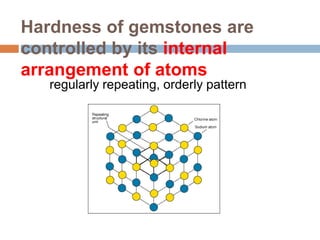
Hardness of gemstones are
controlled by its internal
arrangement of atoms
regularly repeating, orderly pattern
 Hardness depends on the nature of
bonding and cohesiveness
 Polymorphic carbon is a classic example
of hardness controlled by the nature of
bonding
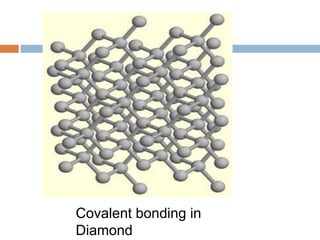
 Diamond owes its superior hardness to
the homodesmic nature of bonding
 In diamond the carbon atoms are linked
with their neighbours uniformly at a
distance of 1.54 Am
Covalent bonding in
Diamond
 In graphite, the bonding length is 1.42 Am
and the nature of bonding is weak
 Thus nature of bonding has kept both
these polymorphic minerals at the extreme
end in the scale of hardness
 Minerals composed of smaller atoms/ions
are harder (eg. Diamond) than those
containing larger ions (eg. gypsum)
Hardness is studied in two
ways
Relative hardness
Quantitative hardness
 Both relative and quantitative hardness are
based on scattering of one substance over the
other
 In relative hardness, Diamond point is used to
scratch the other mineral
 In quantitative hardness, any mineral with a
known hardness is used to scratch the other
 For example, of three substances A,B & C, if A
can scratch B but not C, the hardness of A is
greater than B, but less than C & obviously C
can scratch both A & B
 Scratch test has to be carried out with
great caution
 Often the so called scratch mark could be
the powder of the substance that is
scratched
 So after firm scratches, surface of the
mineral has to be washed and impacted
under a lens to confirm the scratch mark
 For determining quantitative hardness a
diamond point pressed at known pressure
is used on the indentation tester on
smooth surface of a mineral
 Depth of scratch mark or the bite depends
on the hardness of the material
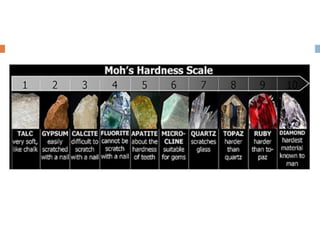
Moh’s scale
 Hardness depends upon the forces
holding the atoms of the mineral together.
 In 1812, a scientist, Friedrick Mohs (an
Austrian mineral expert) as a method to
identify minerals.
 He selected ten minerals and arranged
them in order so that any one mineral
could be used to scratch only minerals
which are less.
 Diamond is the- hardest natural material,
140 times harder than corundum.
Hardness testing & hardness
pencils
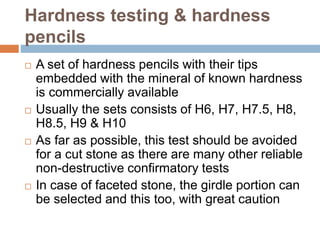
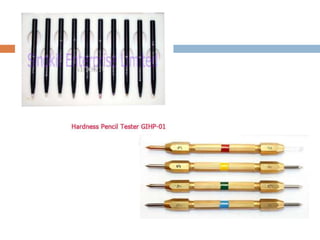
 A set of hardness pencils with their tips
embedded with the mineral of known hardness
is commercially available
 Usually the sets consists of H6, H7, H7.5, H8,
H8.5, H9 & H10
 As far as possible, this test should be avoided
for a cut stone as there are many other reliable
non-destructive confirmatory tests
 In case of faceted stone, the girdle portion can
be selected and this too, with great caution
Hardness testing & hardness
pencils
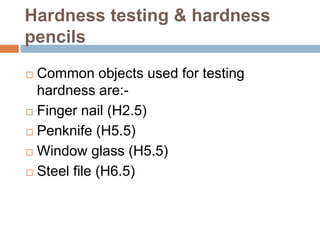
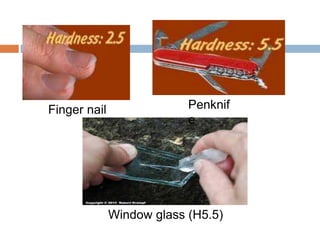
 Common objects used for testing
hardness are:-
 Finger nail (H2.5)
 Penknife (H5.5)
 Window glass (H5.5)
 Steel file (H6.5)
Finger nail Penknif
e
Window glass (H5.5)
Directional hardness
 Although diamond is the hardest substance
there is considerable variation in hardness
from direction to direction
 It is relatively softer along planes of a cube
and hardest parallel to octahedral faces
 Cutting and polishing is easier parallel to
crystallographic directions
Abrasion hardness
 By observing the amount of abrasion that
a stone has undergone during
transportation, its relative hardness can be
known
 To test the abrasive strength, various
minerals of known weight can be dumped
in a drum and tumbled for a particular
period and weighed subsequently
Importance of hardness
 Harder the substance better polish it takes
displaying greater lustre
 For example, diamond and corundum
appear more lustrous
 It is very difficult to polish a softer stone
despite high refractive index
Conclusion
 A gemstone or gem is a piece of mineral,
which, in cut and polished form, is used to
make jewelry or other adornments
 Hardness is a measure of how
resistant solid matter is to various kinds of
permanent shape change when a force is
applied
 Hardness of gemstones are controlled by
its internal arrangement of atoms
 Hardness depends on the nature of bonding
and cohesiveness
Conclusion
 Minerals composed of smaller atoms/ions are
harder (eg. Diamond) than those containing
larger ions (eg. gypsum)
 Hardness is studied in two ways:- relative and
quantitative hardness
 Hardness pencils are commercially available
for hardness testing of gemstones
 Finger nail, penknife, window glass & steel file
are common objects used for testing hardness
of gemstones
References
 Class notes by Professor KNPN
 http://en.wikipedia.org/wiki/Gemology
 http://en.wikipedia.org/wiki/hardnessofgemston
es
 R.V. Karanth(2000), Gems and Gem industry
in India, GSI Memoir 45, Pp 65-69
Thank
You

Hardness of gemstone

  • 1.
  • 2.
    Contents  Introduction  Gemstones Hardness of gemstones  Relative & quantitative hardness  Moh’s scale  Hardness testing &hardness pencils  Directional hardness  Abrasional hardness  Conclusion  References
  • 3.
    Introduction  Gemmology isthe science dealing with natural and artificial gems and gemstones  It is considered a geoscience and a branch of mineralogy  Some jewelers are academically trained gemologists and are qualified to identify and evaluate gems
  • 4.
    Gemstones  A gemstoneor gem is a piece of mineral, which, in cut and polished form, is used to make jewellery or other adornments  However certain rocks or organic materials that are not minerals (such as amber or jet), are also used for jewellery, and are therefore often considered to be gemstones as well  also called a precious or semi-precious stone, a fine gem, or jewel
  • 5.
    Hardness of gemstones Hardness is a measure of how resistant solid matter is to various kinds of permanent shape change when a force is applied  Amber is the lightest and softest gemstone while Diamond is the hardest
  • 6.
    Hardness of gemstonesare controlled by its internal arrangement of atoms regularly repeating, orderly pattern
  • 7.
     Hardness dependson the nature of bonding and cohesiveness  Polymorphic carbon is a classic example of hardness controlled by the nature of bonding  Diamond owes its superior hardness to the homodesmic nature of bonding  In diamond the carbon atoms are linked with their neighbours uniformly at a distance of 1.54 Am
  • 8.
  • 9.
     In graphite,the bonding length is 1.42 Am and the nature of bonding is weak  Thus nature of bonding has kept both these polymorphic minerals at the extreme end in the scale of hardness  Minerals composed of smaller atoms/ions are harder (eg. Diamond) than those containing larger ions (eg. gypsum)
  • 10.
    Hardness is studiedin two ways Relative hardness Quantitative hardness
  • 11.
     Both relativeand quantitative hardness are based on scattering of one substance over the other  In relative hardness, Diamond point is used to scratch the other mineral  In quantitative hardness, any mineral with a known hardness is used to scratch the other  For example, of three substances A,B & C, if A can scratch B but not C, the hardness of A is greater than B, but less than C & obviously C can scratch both A & B
  • 12.
     Scratch testhas to be carried out with great caution  Often the so called scratch mark could be the powder of the substance that is scratched  So after firm scratches, surface of the mineral has to be washed and impacted under a lens to confirm the scratch mark
  • 13.
     For determiningquantitative hardness a diamond point pressed at known pressure is used on the indentation tester on smooth surface of a mineral  Depth of scratch mark or the bite depends on the hardness of the material
  • 14.
    Moh’s scale  Hardnessdepends upon the forces holding the atoms of the mineral together.  In 1812, a scientist, Friedrick Mohs (an Austrian mineral expert) as a method to identify minerals.  He selected ten minerals and arranged them in order so that any one mineral could be used to scratch only minerals which are less.  Diamond is the- hardest natural material, 140 times harder than corundum.
  • 16.
    Hardness testing &hardness pencils  A set of hardness pencils with their tips embedded with the mineral of known hardness is commercially available  Usually the sets consists of H6, H7, H7.5, H8, H8.5, H9 & H10  As far as possible, this test should be avoided for a cut stone as there are many other reliable non-destructive confirmatory tests  In case of faceted stone, the girdle portion can be selected and this too, with great caution
  • 18.
    Hardness testing &hardness pencils  Common objects used for testing hardness are:-  Finger nail (H2.5)  Penknife (H5.5)  Window glass (H5.5)  Steel file (H6.5)
  • 19.
  • 20.
    Directional hardness  Althoughdiamond is the hardest substance there is considerable variation in hardness from direction to direction  It is relatively softer along planes of a cube and hardest parallel to octahedral faces  Cutting and polishing is easier parallel to crystallographic directions
  • 21.
    Abrasion hardness  Byobserving the amount of abrasion that a stone has undergone during transportation, its relative hardness can be known  To test the abrasive strength, various minerals of known weight can be dumped in a drum and tumbled for a particular period and weighed subsequently
  • 22.
    Importance of hardness Harder the substance better polish it takes displaying greater lustre  For example, diamond and corundum appear more lustrous  It is very difficult to polish a softer stone despite high refractive index
  • 23.
    Conclusion  A gemstoneor gem is a piece of mineral, which, in cut and polished form, is used to make jewelry or other adornments  Hardness is a measure of how resistant solid matter is to various kinds of permanent shape change when a force is applied  Hardness of gemstones are controlled by its internal arrangement of atoms  Hardness depends on the nature of bonding and cohesiveness
  • 24.
    Conclusion  Minerals composedof smaller atoms/ions are harder (eg. Diamond) than those containing larger ions (eg. gypsum)  Hardness is studied in two ways:- relative and quantitative hardness  Hardness pencils are commercially available for hardness testing of gemstones  Finger nail, penknife, window glass & steel file are common objects used for testing hardness of gemstones
  • 25.
    References  Class notesby Professor KNPN  http://en.wikipedia.org/wiki/Gemology  http://en.wikipedia.org/wiki/hardnessofgemston es  R.V. Karanth(2000), Gems and Gem industry in India, GSI Memoir 45, Pp 65-69
  • 26.