PREPARATION OF SPECIMEN FOR
MICROSCOPIC EXAMINATION
Deep Patel : U13ME235
B. Bharath : U13ME236
B. Tech II, IV Semester
MATERIALS SCIENCE & METALLURGY
DEPARTMENT OF MECHANICAL ENGINEERING
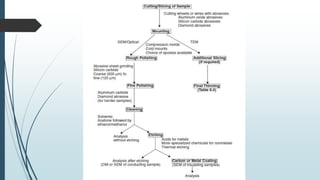
Introduction and Purpose
 Metallography is the study of the physical structure and
components of metals, typically using microscopy.
 Precision metallurgical sample preparation is a key step in
performing reliable metallurgical testing.
 Facilitate examination and interpretation of microstructural features.
 Ex. To find out various phase present in material.
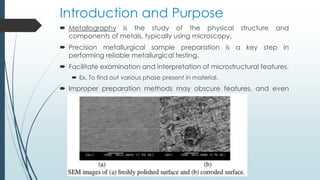
 Improper preparation methods may obscure features, and even
create artefacts that may be misinterpreted.
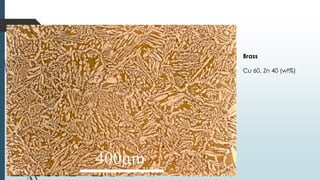
Brass
Cu 60, Zn 40 (wt%)
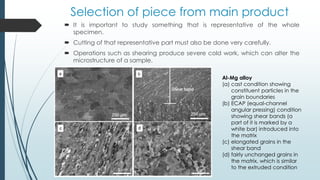
Selection of piece from main product
 It is important to study something that is representative of the whole
specimen.
 Cutting of that representative part must also be done very carefully.
 Operations such as shearing produce severe cold work, which can alter the
microstructure of a sample.
Al-Mg alloy
(a) cast condition showing
constituent particles in the
grain boundaries
(b) ECAP (equal-channel
angular pressing) condition
showing shear bands (a
part of it is marked by a
white bar) introduced into
the matrix
(c) elongated grains in the
shear band
(d) fairly unchanged grains in
the matrix, which is similar
to the extruded condition
Selection of piece from main product
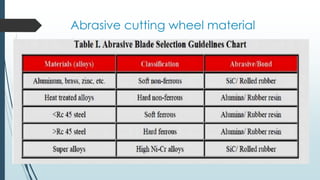
 Abrasive cutting (sectioning) offers the best solution to eliminate these
undesirable features; the resultant surface is smooth, and the sectioning
task is quickly accomplished.
 Low-speed cut-off wheels are utilized in cases where the heat created by
standard abrasive cutters must be avoided. Ample coolant and proper
speed control are essential in all sectioning operations.
Abrasive cutting wheel material
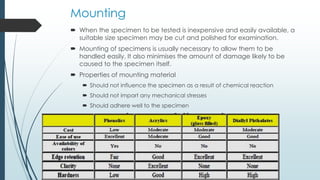
Mounting
 When the specimen to be tested is inexpensive and easily available, a
suitable size specimen may be cut and polished for examination.
 Mounting of specimens is usually necessary to allow them to be
handled easily. It also minimises the amount of damage likely to be
caused to the specimen itself.
 Properties of mounting material
 Should not influence the specimen as a result of chemical reaction
 Should not impart any mechanical stresses
 Should adhere well to the specimen
Mounting
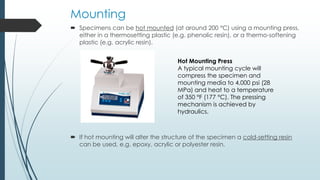
 Specimens can be hot mounted (at around 200 °C) using a mounting press,
either in a thermosetting plastic (e.g. phenolic resin), or a thermo-softening
plastic (e.g. acrylic resin).
 If hot mounting will alter the structure of the specimen a cold-setting resin
can be used, e.g. epoxy, acrylic or polyester resin.
Hot Mounting Press
A typical mounting cycle will
compress the specimen and
mounting media to 4,000 psi (28
MPa) and heat to a temperature
of 350 °F (177 °C). The pressing
mechanism is achieved by
hydraulics.
Mounting
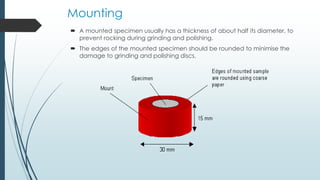
 A mounted specimen usually has a thickness of about half its diameter, to
prevent rocking during grinding and polishing.
 The edges of the mounted specimen should be rounded to minimise the
damage to grinding and polishing discs.
Coarse Grinding
 For a perfect observation sample, it must :
 Be free from scratches, stains and others imperfections which tend to mark the surface.
 Retain non-metallic inclusions.
 Reveal no evidence of chipping due to brittle intermetallic compounds and phases.
 Be free from all traces of disturbed metal.
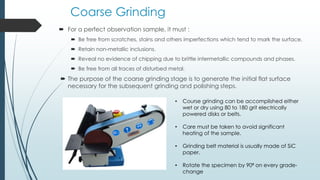
 The purpose of the coarse grinding stage is to generate the initial flat surface
necessary for the subsequent grinding and polishing steps.
• Course grinding can be accomplished either
wet or dry using 80 to 180 grit electrically
powered disks or belts.
• Care must be taken to avoid significant
heating of the sample.
• Grinding belt material is usually made of SiC
paper.
• Rotate the specimen by 90⁰ on every grade-
change
Fine Grinding
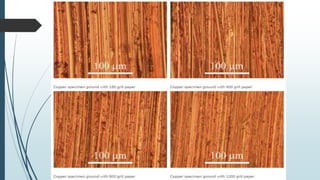
 Each grinding stage removes the scratches from the previous coarser paper.
 This is more easily achieved by orienting the specimen perpendicular to the
previous scratches, and watching for these previously oriented scratches to be
obliterated.
 Between each grade the specimen is washed thoroughly with soapy water to
prevent contamination from coarser grit present on the specimen surface.
 In general, successive steps are 240, 320, 400 and 600 grit SiC and the grinding
rate should steadily decrease from one stage to the next.
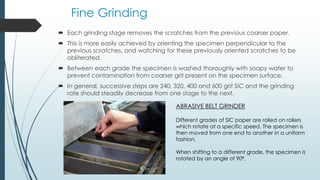
ABRASIVE BELT GRINDER
Different grades of SiC paper are rolled on rollers
which rotate at a specific speed. The specimen is
then moved from one end to another in a uniform
fashion.
When shifting to a different grade, the specimen is
rotated by an angle of 90⁰.
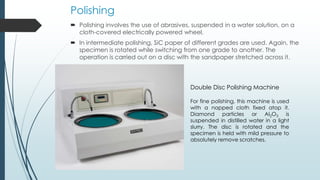
Polishing
 Polishing involves the use of abrasives, suspended in a water solution, on a
cloth-covered electrically powered wheel.
 In intermediate polishing, SiC paper of different grades are used. Again, the
specimen is rotated while switching from one grade to another. The
operation is carried out on a disc with the sandpaper stretched across it.
Double Disc Polishing Machine
For fine polishing, this machine is used
with a napped cloth fixed atop it.
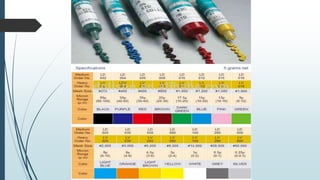
Diamond particles or Al2O3 is
suspended in distilled water in a light
slurry. The disc is rotated and the
specimen is held with mild pressure to
absolutely remove scratches.
Polishing
 Following the final 600 grit fine-grinding stage, the sample must be washed
and carefully dried before proceeding to the first polishing stage.
 Beginning with 25-micron suspended aluminium oxide particles (suspended
in water) on a Nylon-cloth, the final fine-grinding surface layer resulting from
the previous grinding procedure should be completely removed with a
rotation rate of 150-200 rpm.
 Wash the specimen and move on to finer suspended particles on separate
cloth.
 The final polishing stage with 1-micron suspended aluminium oxide or
diamond particles should be carried out on a separate polishing wheel at a
slower speed of 100 - 150 rpm using a napped cloth. After 1 or 2 minutes a
properly polished specimen should have a mirror-like surface free of
scratches
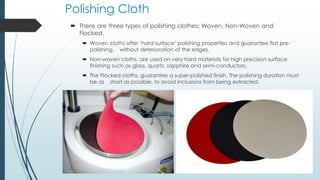
Polishing Cloth
 There are three types of polishing clothes; Woven, Non-Woven and
Flocked.
 Woven cloths offer ‘hard surface’ polishing properties and guarantee flat pre-
polishing, without deterioration of the edges.
 Non-woven cloths, are used on very hard materials for high precision surface
finishing such as glass, quartz, sapphire and semi-conductors.
 The Flocked cloths, guarantee a super-polished finish. The polishing duration must
be as short as possible, to avoid inclusions from being extracted.
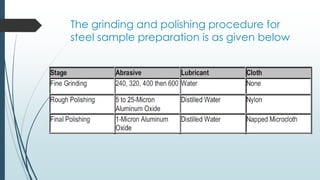
The grinding and polishing procedure for
steel sample preparation is as given below
Etching
 Metallographic etching is the process of revealing microstructural details that would
otherwise not be evident on the as-polished sample.
 Etching is not always required as some features are visible in the as-polished condition
such as porosity, cracks and inclusions, for eg, in grey cast iron.
 Properties revealed by etching
 grain size
 Segregation
 shape, size, and distribution of the phases
 mechanical deformation
 The specimen after polishing needs to be properly washed and cleaned with distilled
water and after proper drying, the etching reagent is applied by various methods.
 Types of Etching:
 Chemical Etching
 Electrolytic etching
 Heat tinting
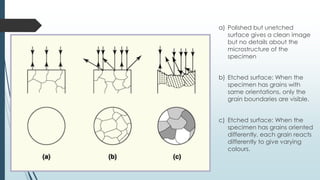
a) Polished but unetched
surface gives a clean image
but no details about the
microstructure of the
specimen
b) Etched surface: When the
specimen has grains with
same orientations, only the
grain boundaries are visible.
c) Etched surface: When the
specimen has grains oriented
differently, each grain reacts
differently to give varying
colours.
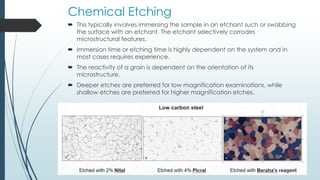
Chemical Etching
 This typically involves immersing the sample in an etchant such or swabbing
the surface with an etchant. The etchant selectively corrodes
microstructural features.
 Immersion time or etching time is highly dependent on the system and in
most cases requires experience.
 The reactivity of a grain is dependent on the orientation of its
microstructure.
 Deeper etches are preferred for low magnification examinations, while
shallow etches are preferred for higher magnification etches.
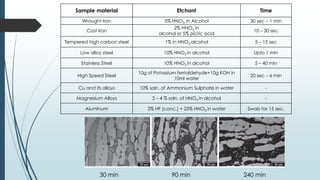
Sample material Etchant Time
Wrought Iron 5% HNO3 in Alcohol 30 sec – 1 min
Cast Iron
2% HNO3 in
alcohol or 5% picric acid
10 – 30 sec
Tempered high carbon steel 1% in HNO3 alcohol 5 – 15 sec
Low alloy steel 10% HNO3 in alcohol Upto 1 min
Stainless Steel 10% HNO3 in alcohol 5 – 40 min
High Speed Steel
10g of Potassium ferrialdehyde+10g KOH in
10ml water
20 sec – 6 min
Cu and its alloys 10% soln. of Ammonium Sulphate in water -
Magnesium Alloys 2 – 4 % soln. of HNO3 in alcohol -
Aluminum 2% HF (conc.) + 25% HNO3 in water Swab for 15 sec.
30 min 90 min 240 min
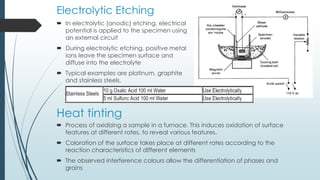
Electrolytic Etching
 In electrolytic (anodic) etching, electrical
potential is applied to the specimen using
an external circuit
 During electrolytic etching, positive metal
ions leave the specimen surface and
diffuse into the electrolyte
 Typical examples are platinum, graphite
and stainless steels.
 Process of oxidizing a sample in a furnace. This induces oxidation of surface
features at different rates, to reveal various features.
 Coloration of the surface takes place at different rates according to the
reaction characteristics of different elements
 The observed interference colours allow the differentiation of phases and
grains
Heat tinting
Final step
 After etching process, the specimen needs to be washed again in distilled
water to remove any excess reagent present on it.
 If not washed, under microscopic observation, there might be aberrations
in the colour of the sample.
 Also, slow and continuous reaction for a long time may take place
because of which we cannot use the sample for proper microscopic
observation.
 Cleaning can also be done by placing a drop of spirit and drying it.
 After washing, it can be dried using a low power blower.
 Finally, the specimen is ready for observation under microscope.
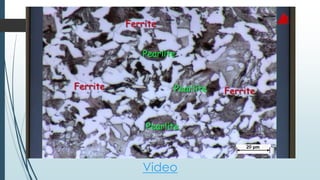
Video
Thank You

Preparation Of Specimen For Microscopic Examination

  • 1.
    PREPARATION OF SPECIMENFOR MICROSCOPIC EXAMINATION Deep Patel : U13ME235 B. Bharath : U13ME236 B. Tech II, IV Semester MATERIALS SCIENCE & METALLURGY DEPARTMENT OF MECHANICAL ENGINEERING
  • 2.
    Introduction and Purpose Metallography is the study of the physical structure and components of metals, typically using microscopy.  Precision metallurgical sample preparation is a key step in performing reliable metallurgical testing.  Facilitate examination and interpretation of microstructural features.  Ex. To find out various phase present in material.  Improper preparation methods may obscure features, and even create artefacts that may be misinterpreted.
  • 3.
  • 5.
    Selection of piecefrom main product  It is important to study something that is representative of the whole specimen.  Cutting of that representative part must also be done very carefully.  Operations such as shearing produce severe cold work, which can alter the microstructure of a sample. Al-Mg alloy (a) cast condition showing constituent particles in the grain boundaries (b) ECAP (equal-channel angular pressing) condition showing shear bands (a part of it is marked by a white bar) introduced into the matrix (c) elongated grains in the shear band (d) fairly unchanged grains in the matrix, which is similar to the extruded condition
  • 6.
    Selection of piecefrom main product  Abrasive cutting (sectioning) offers the best solution to eliminate these undesirable features; the resultant surface is smooth, and the sectioning task is quickly accomplished.  Low-speed cut-off wheels are utilized in cases where the heat created by standard abrasive cutters must be avoided. Ample coolant and proper speed control are essential in all sectioning operations.
  • 7.
  • 8.
    Mounting  When thespecimen to be tested is inexpensive and easily available, a suitable size specimen may be cut and polished for examination.  Mounting of specimens is usually necessary to allow them to be handled easily. It also minimises the amount of damage likely to be caused to the specimen itself.  Properties of mounting material  Should not influence the specimen as a result of chemical reaction  Should not impart any mechanical stresses  Should adhere well to the specimen
  • 9.
    Mounting  Specimens canbe hot mounted (at around 200 °C) using a mounting press, either in a thermosetting plastic (e.g. phenolic resin), or a thermo-softening plastic (e.g. acrylic resin).  If hot mounting will alter the structure of the specimen a cold-setting resin can be used, e.g. epoxy, acrylic or polyester resin. Hot Mounting Press A typical mounting cycle will compress the specimen and mounting media to 4,000 psi (28 MPa) and heat to a temperature of 350 °F (177 °C). The pressing mechanism is achieved by hydraulics.
  • 10.
    Mounting  A mountedspecimen usually has a thickness of about half its diameter, to prevent rocking during grinding and polishing.  The edges of the mounted specimen should be rounded to minimise the damage to grinding and polishing discs.
  • 11.
    Coarse Grinding  Fora perfect observation sample, it must :  Be free from scratches, stains and others imperfections which tend to mark the surface.  Retain non-metallic inclusions.  Reveal no evidence of chipping due to brittle intermetallic compounds and phases.  Be free from all traces of disturbed metal.  The purpose of the coarse grinding stage is to generate the initial flat surface necessary for the subsequent grinding and polishing steps. • Course grinding can be accomplished either wet or dry using 80 to 180 grit electrically powered disks or belts. • Care must be taken to avoid significant heating of the sample. • Grinding belt material is usually made of SiC paper. • Rotate the specimen by 90⁰ on every grade- change
  • 12.
    Fine Grinding  Eachgrinding stage removes the scratches from the previous coarser paper.  This is more easily achieved by orienting the specimen perpendicular to the previous scratches, and watching for these previously oriented scratches to be obliterated.  Between each grade the specimen is washed thoroughly with soapy water to prevent contamination from coarser grit present on the specimen surface.  In general, successive steps are 240, 320, 400 and 600 grit SiC and the grinding rate should steadily decrease from one stage to the next. ABRASIVE BELT GRINDER Different grades of SiC paper are rolled on rollers which rotate at a specific speed. The specimen is then moved from one end to another in a uniform fashion. When shifting to a different grade, the specimen is rotated by an angle of 90⁰.
  • 14.
    Polishing  Polishing involvesthe use of abrasives, suspended in a water solution, on a cloth-covered electrically powered wheel.  In intermediate polishing, SiC paper of different grades are used. Again, the specimen is rotated while switching from one grade to another. The operation is carried out on a disc with the sandpaper stretched across it. Double Disc Polishing Machine For fine polishing, this machine is used with a napped cloth fixed atop it. Diamond particles or Al2O3 is suspended in distilled water in a light slurry. The disc is rotated and the specimen is held with mild pressure to absolutely remove scratches.
  • 15.
    Polishing  Following thefinal 600 grit fine-grinding stage, the sample must be washed and carefully dried before proceeding to the first polishing stage.  Beginning with 25-micron suspended aluminium oxide particles (suspended in water) on a Nylon-cloth, the final fine-grinding surface layer resulting from the previous grinding procedure should be completely removed with a rotation rate of 150-200 rpm.  Wash the specimen and move on to finer suspended particles on separate cloth.  The final polishing stage with 1-micron suspended aluminium oxide or diamond particles should be carried out on a separate polishing wheel at a slower speed of 100 - 150 rpm using a napped cloth. After 1 or 2 minutes a properly polished specimen should have a mirror-like surface free of scratches
  • 17.
    Polishing Cloth  Thereare three types of polishing clothes; Woven, Non-Woven and Flocked.  Woven cloths offer ‘hard surface’ polishing properties and guarantee flat pre- polishing, without deterioration of the edges.  Non-woven cloths, are used on very hard materials for high precision surface finishing such as glass, quartz, sapphire and semi-conductors.  The Flocked cloths, guarantee a super-polished finish. The polishing duration must be as short as possible, to avoid inclusions from being extracted.
  • 18.
    The grinding andpolishing procedure for steel sample preparation is as given below
  • 19.
    Etching  Metallographic etchingis the process of revealing microstructural details that would otherwise not be evident on the as-polished sample.  Etching is not always required as some features are visible in the as-polished condition such as porosity, cracks and inclusions, for eg, in grey cast iron.  Properties revealed by etching  grain size  Segregation  shape, size, and distribution of the phases  mechanical deformation  The specimen after polishing needs to be properly washed and cleaned with distilled water and after proper drying, the etching reagent is applied by various methods.  Types of Etching:  Chemical Etching  Electrolytic etching  Heat tinting
  • 20.
    a) Polished butunetched surface gives a clean image but no details about the microstructure of the specimen b) Etched surface: When the specimen has grains with same orientations, only the grain boundaries are visible. c) Etched surface: When the specimen has grains oriented differently, each grain reacts differently to give varying colours.
  • 21.
    Chemical Etching  Thistypically involves immersing the sample in an etchant such or swabbing the surface with an etchant. The etchant selectively corrodes microstructural features.  Immersion time or etching time is highly dependent on the system and in most cases requires experience.  The reactivity of a grain is dependent on the orientation of its microstructure.  Deeper etches are preferred for low magnification examinations, while shallow etches are preferred for higher magnification etches.
  • 22.
    Sample material EtchantTime Wrought Iron 5% HNO3 in Alcohol 30 sec – 1 min Cast Iron 2% HNO3 in alcohol or 5% picric acid 10 – 30 sec Tempered high carbon steel 1% in HNO3 alcohol 5 – 15 sec Low alloy steel 10% HNO3 in alcohol Upto 1 min Stainless Steel 10% HNO3 in alcohol 5 – 40 min High Speed Steel 10g of Potassium ferrialdehyde+10g KOH in 10ml water 20 sec – 6 min Cu and its alloys 10% soln. of Ammonium Sulphate in water - Magnesium Alloys 2 – 4 % soln. of HNO3 in alcohol - Aluminum 2% HF (conc.) + 25% HNO3 in water Swab for 15 sec. 30 min 90 min 240 min
  • 23.
    Electrolytic Etching  Inelectrolytic (anodic) etching, electrical potential is applied to the specimen using an external circuit  During electrolytic etching, positive metal ions leave the specimen surface and diffuse into the electrolyte  Typical examples are platinum, graphite and stainless steels.  Process of oxidizing a sample in a furnace. This induces oxidation of surface features at different rates, to reveal various features.  Coloration of the surface takes place at different rates according to the reaction characteristics of different elements  The observed interference colours allow the differentiation of phases and grains Heat tinting
  • 24.
    Final step  Afteretching process, the specimen needs to be washed again in distilled water to remove any excess reagent present on it.  If not washed, under microscopic observation, there might be aberrations in the colour of the sample.  Also, slow and continuous reaction for a long time may take place because of which we cannot use the sample for proper microscopic observation.  Cleaning can also be done by placing a drop of spirit and drying it.  After washing, it can be dried using a low power blower.  Finally, the specimen is ready for observation under microscope.
  • 25.
  • 26.