COMPRESSION TEST
INTRODUCTION
• A compression test is a mechanical test in which a material or
product responds to forces that push, compress, squash, crush
and flatten the test specimen.
• Compression testing is a fundamental mechanical test, similar
in nature to tensile and bend tests. Compression tests
characterize material and product strength and stiffness under
applied crushing loads. These tests are typically conducted by
applying compressive pressure to a test specimen using
platens or specialized fixtures with a testing machine that
produces compressive loads.
• Compression test could be used to obtain the mechanical
properties of metals however it is not preferred due to the
following;
– It is difficult to apply a truly axial load in compression which
leading to non uniform stresses
COMPRESSION TEST
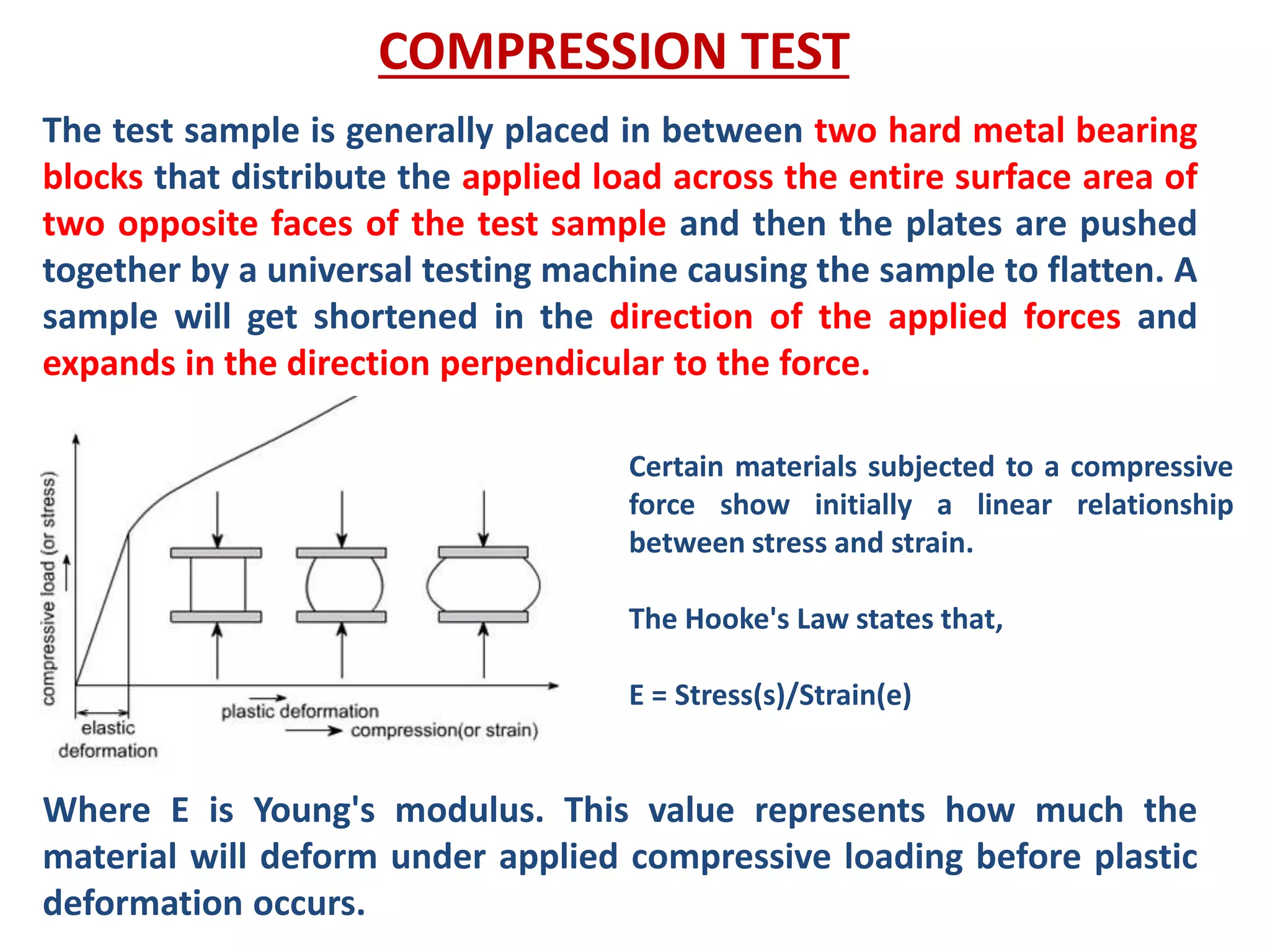
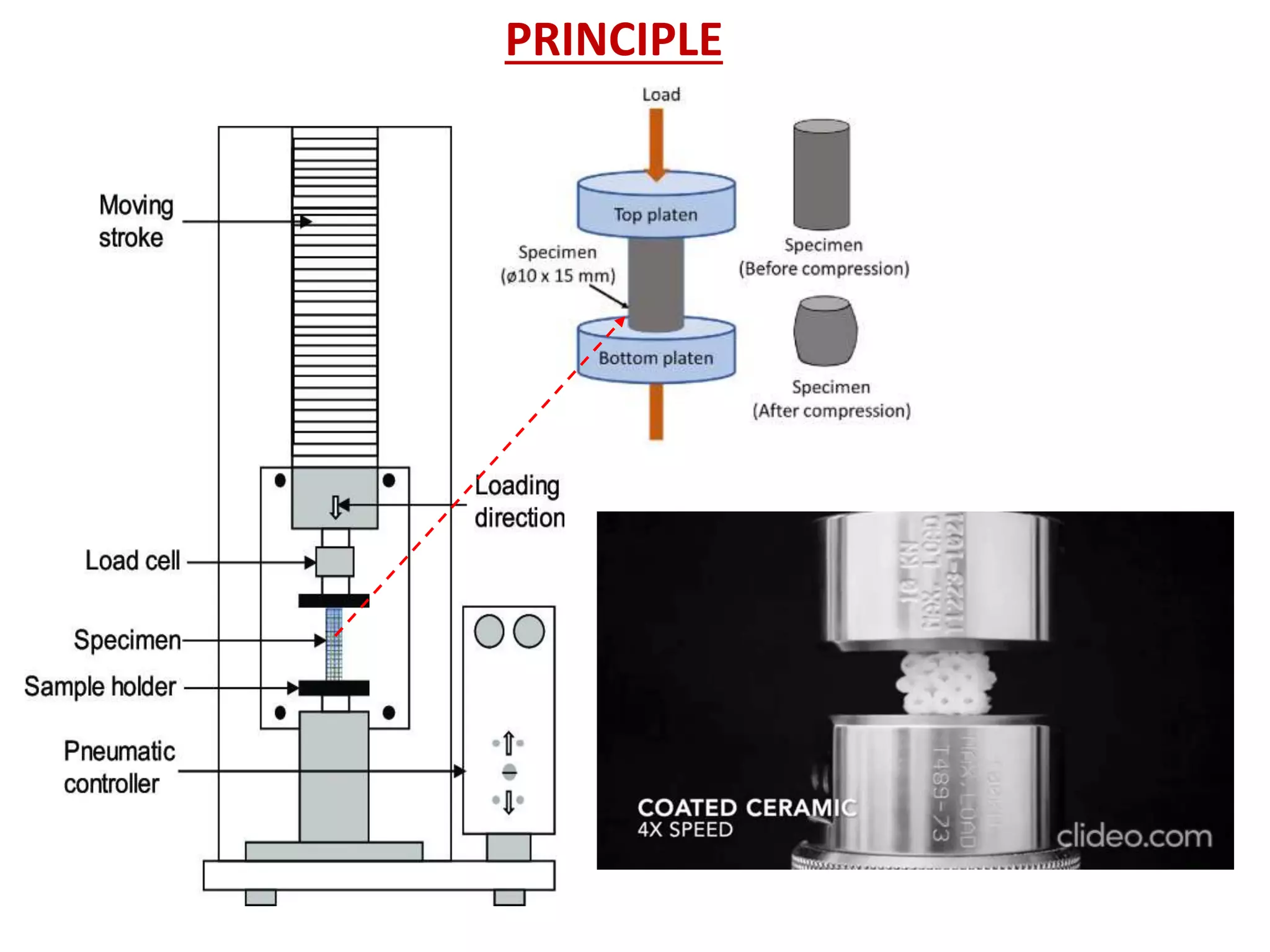
The test sample is generally placed in between two hard metal bearing
blocks that distribute the applied load across the entire surface area of
two opposite faces of the test sample and then the plates are pushed
together by a universal testing machine causing the sample to flatten. A
sample will get shortened in the direction of the applied forces and
expands in the direction perpendicular to the force.
Where E is Young's modulus. This value represents how much the
material will deform under applied compressive loading before plastic
deformation occurs.
Certain materials subjected to a compressive
force show initially a linear relationship
between stress and strain.
The Hooke's Law states that,
E = Stress(s)/Strain(e)
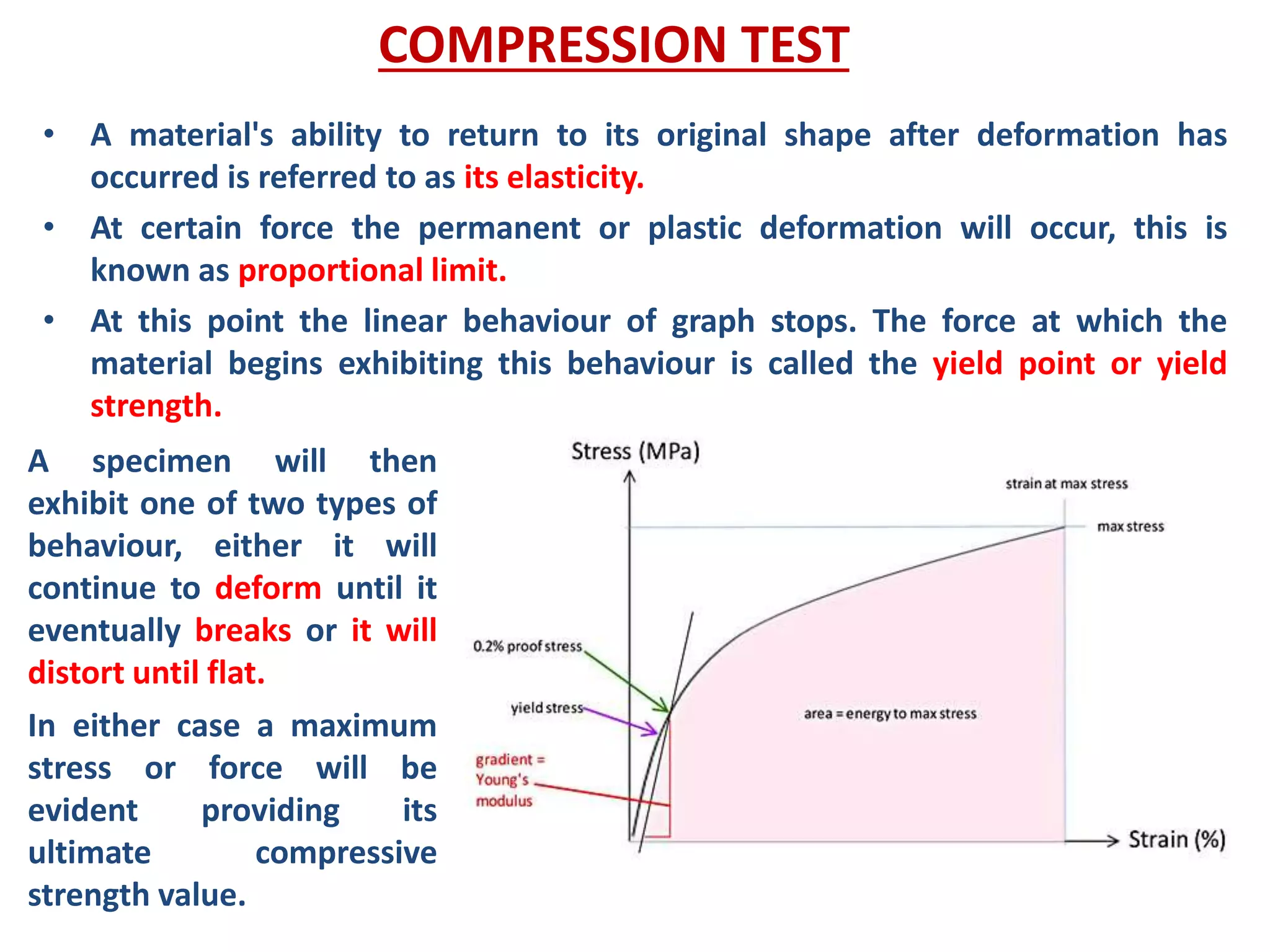
• A material's ability to return to its original shape after deformation has
occurred is referred to as its elasticity.
• At certain force the permanent or plastic deformation will occur, this is
known as proportional limit.
• At this point the linear behaviour of graph stops. The force at which the
material begins exhibiting this behaviour is called the yield point or yield
strength.
A specimen will then
exhibit one of two types of
behaviour, either it will
continue to deform until it
eventually breaks or it will
distort until flat.
In either case a maximum
stress or force will be
evident providing its
ultimate compressive
strength value.
COMPRESSION TEST
PRINCIPLE
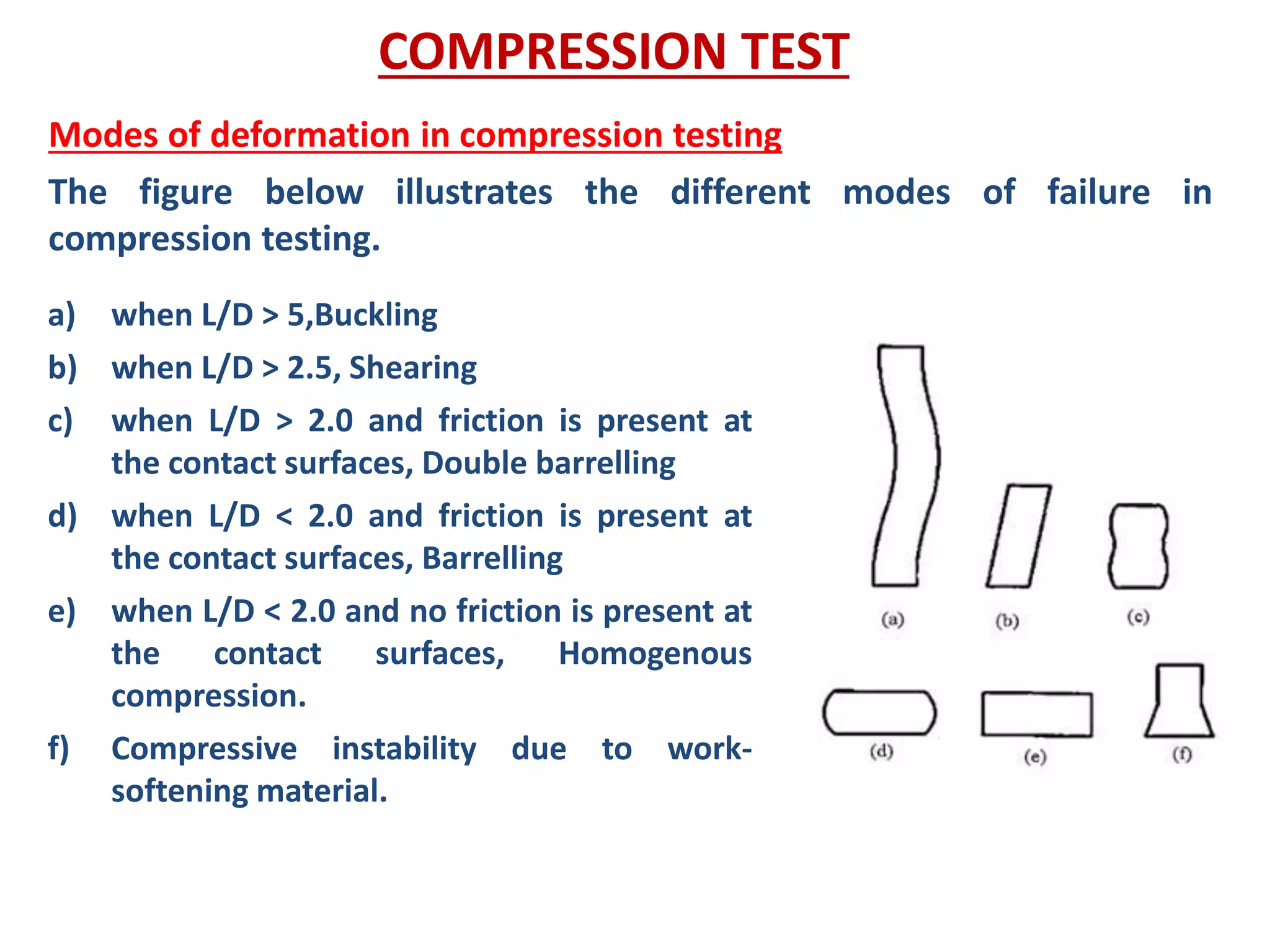
Modes of deformation in compression testing
The figure below illustrates the different modes of failure in
compression testing.
COMPRESSION TEST
a) when L/D > 5,Buckling
b) when L/D > 2.5, Shearing
c) when L/D > 2.0 and friction is present at
the contact surfaces, Double barrelling
d) when L/D < 2.0 and friction is present at
the contact surfaces, Barrelling
e) when L/D < 2.0 and no friction is present at
the contact surfaces, Homogenous
compression.
f) Compressive instability due to work-
softening material.
Failure patterns:
Ductile material will have proportional limit in compression very close to
those in tension. The initial regions of their compression stress strain
diagram are very similar to tension diagrams. When a mild steel
specimen is compressed, it begins to bulge outward on the sides and
become barrel shaped. With increasing load the specimen is flattened
out, thus offering increased resistance to further shortening.
COMPRESSION TEST
TORSION TEST
INTRODUCTION
• Generally, torsion occurs when the twisting moment or torque is
applied to a member.
• The torque is the product of tangential force multiplied by the radial
distance from the twisting axis and the tangent, measured in a unit
of N.m.
• The purpose of a torsion test is to determine the behavior a material
or test sample exhibits when twisted or under torsional forces as a
result of applied moments that cause shear stress about the axis.
Measurable values include: the modulus of elasticity in shear, yield
shear strength, torsional fatigue life, ductility, ultimate shear
strength, and modulus of rupture in shear.
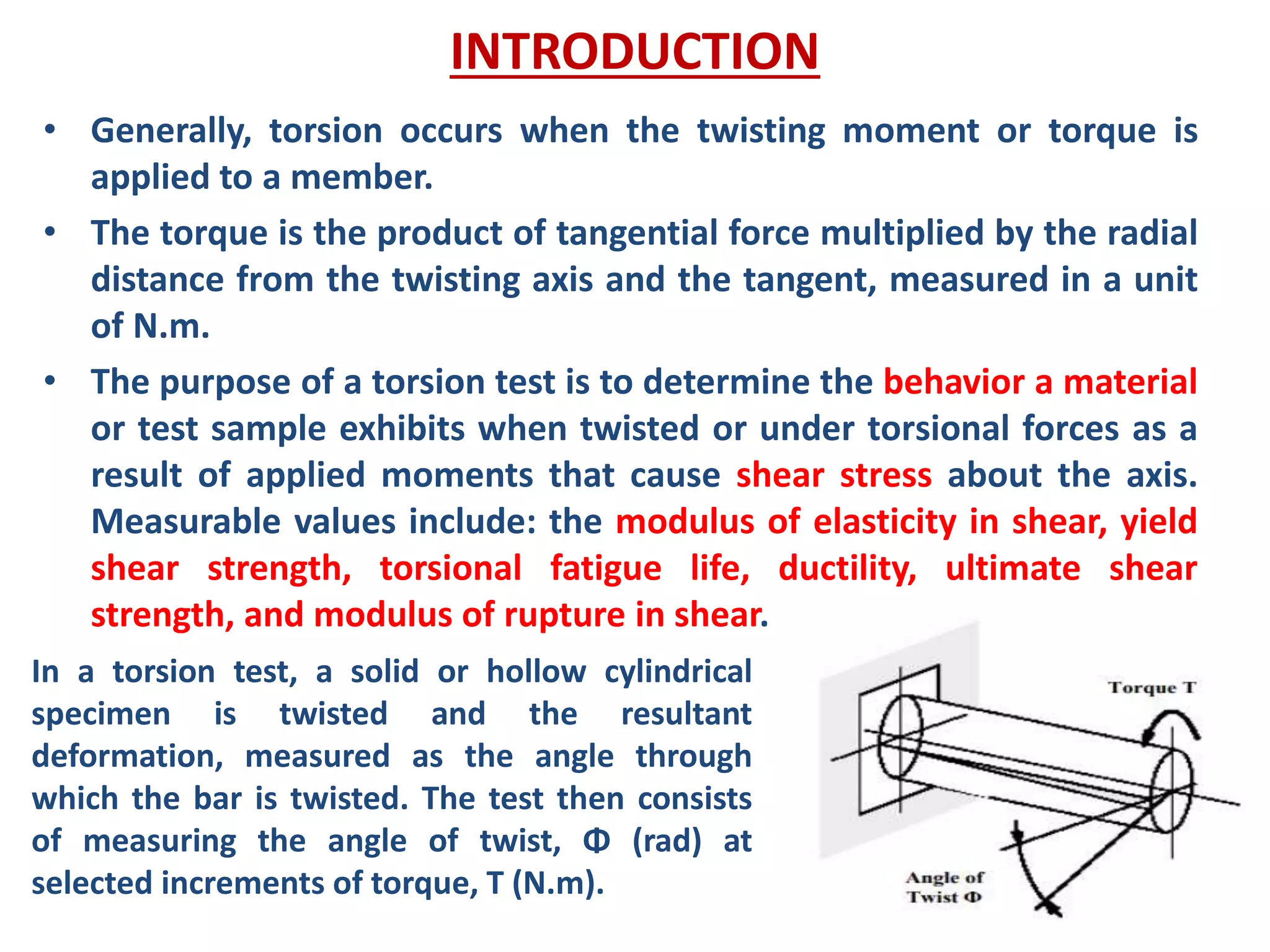
In a torsion test, a solid or hollow cylindrical
specimen is twisted and the resultant
deformation, measured as the angle through
which the bar is twisted. The test then consists
of measuring the angle of twist, Φ (rad) at
selected increments of torque, T (N.m).
• For transmitting power through a rotating shaft it is necessary to apply
a turning force. The force is applied tangentially and in the plane of
transverse cross section. The torque or twisting moment may be
calculated by multiplying two opposite turning moments. It is said to
be in pure torsion and it will exhibit the tendency of shearing off at
every cross section which is perpendicular to the longitudinal axis.
• The three common forms that torsion testing take include failure,
proof and operational.
• A torsion test for failure requires that the test sample be twisted until
it breaks and is designed to measure the strength of the sample.
• A proof test is designed to observe the material under a specified
torque load over a set period of time.
• Finally, operational testing is measures the material’s performance
under the expected service conditions of its application. All of these
forms of tests may be performed with either torsion only loading or a
combination of torsion and axial (tension or compression) loading
depending upon the characteristics to be measured.
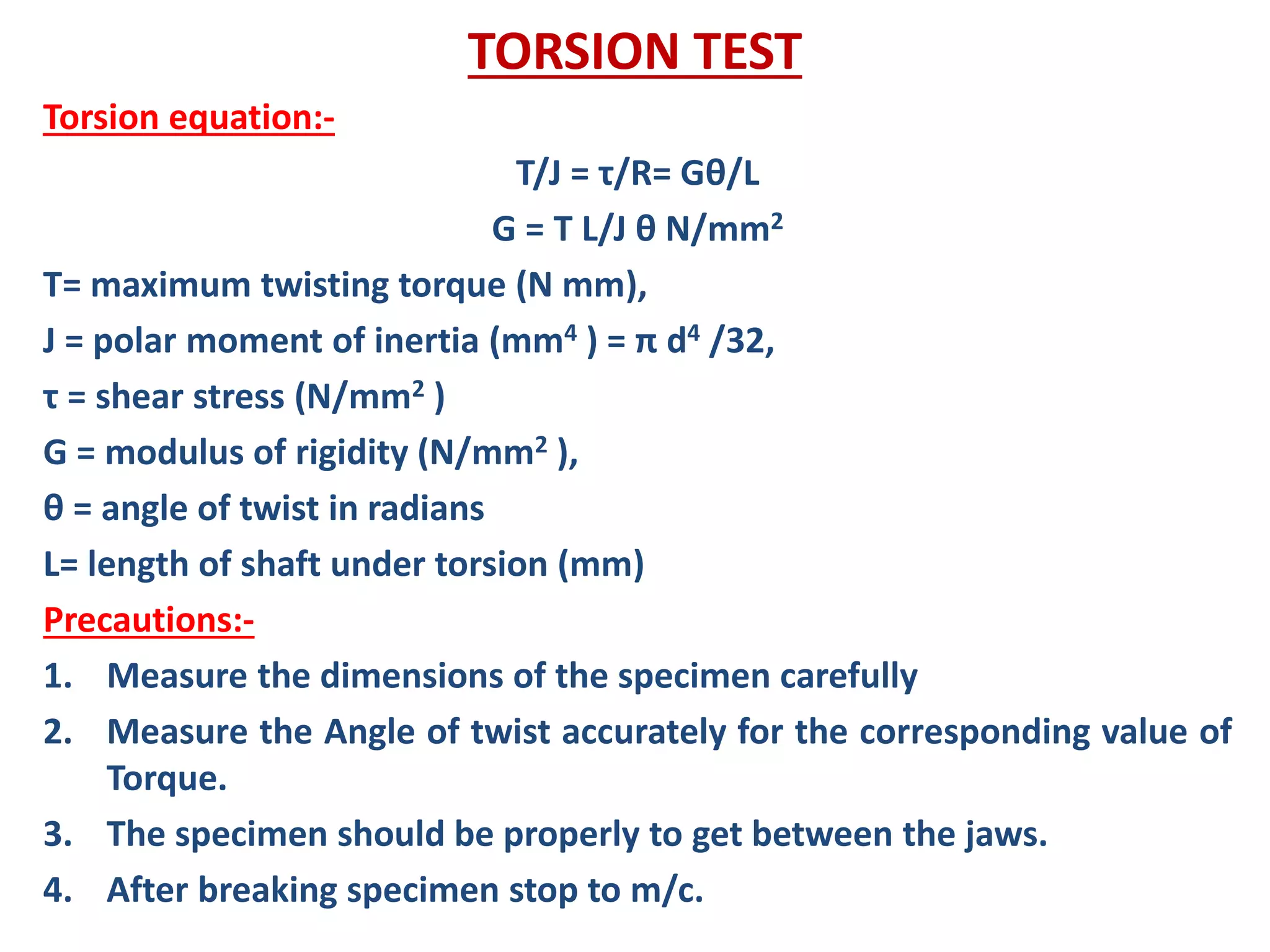
TORSION TEST
Torsion equation:-
T/J = τ/R= Gθ/L
G = T L/J θ N/mm2
T= maximum twisting torque (N mm),
J = polar moment of inertia (mm4 ) = π d4 /32,
τ = shear stress (N/mm2 )
G = modulus of rigidity (N/mm2 ),
θ = angle of twist in radians
L= length of shaft under torsion (mm)
Precautions:-
1. Measure the dimensions of the specimen carefully
2. Measure the Angle of twist accurately for the corresponding value of
Torque.
3. The specimen should be properly to get between the jaws.
4. After breaking specimen stop to m/c.
TORSION TEST
TORSION TEST
• The torsional test is useful for to study the torsional stress-strain
relationship and determine shear modulus (G) and Poisson’s ratio (v)
and relationship between torsional load and angle of twist for a full
range of strains till failure.
• It is useful to determine the mode of failure (ductile or brittle).
• Many materials experience torques or torsional forces in their
applications and so will benefit from or require torsion testing.
Materials used in structural, biomedical and automotive applications
are among the more common materials to experience torsion in their
applications. These materials may be composed of metals, plastics,
woods, polymers, composites, or ceramics among others and
commonly take the forms of fasteners, rods, beams, tubes and wires.
• One of the disadvantages of the hot torsion test is its non-
homogeneity of deformation. It mostly occurs outside the gauge
section of the specimen due to a longitudinal gradient in torsional
stiffness along the specimen.
ADVANTAGES AND DISADVANTAGES
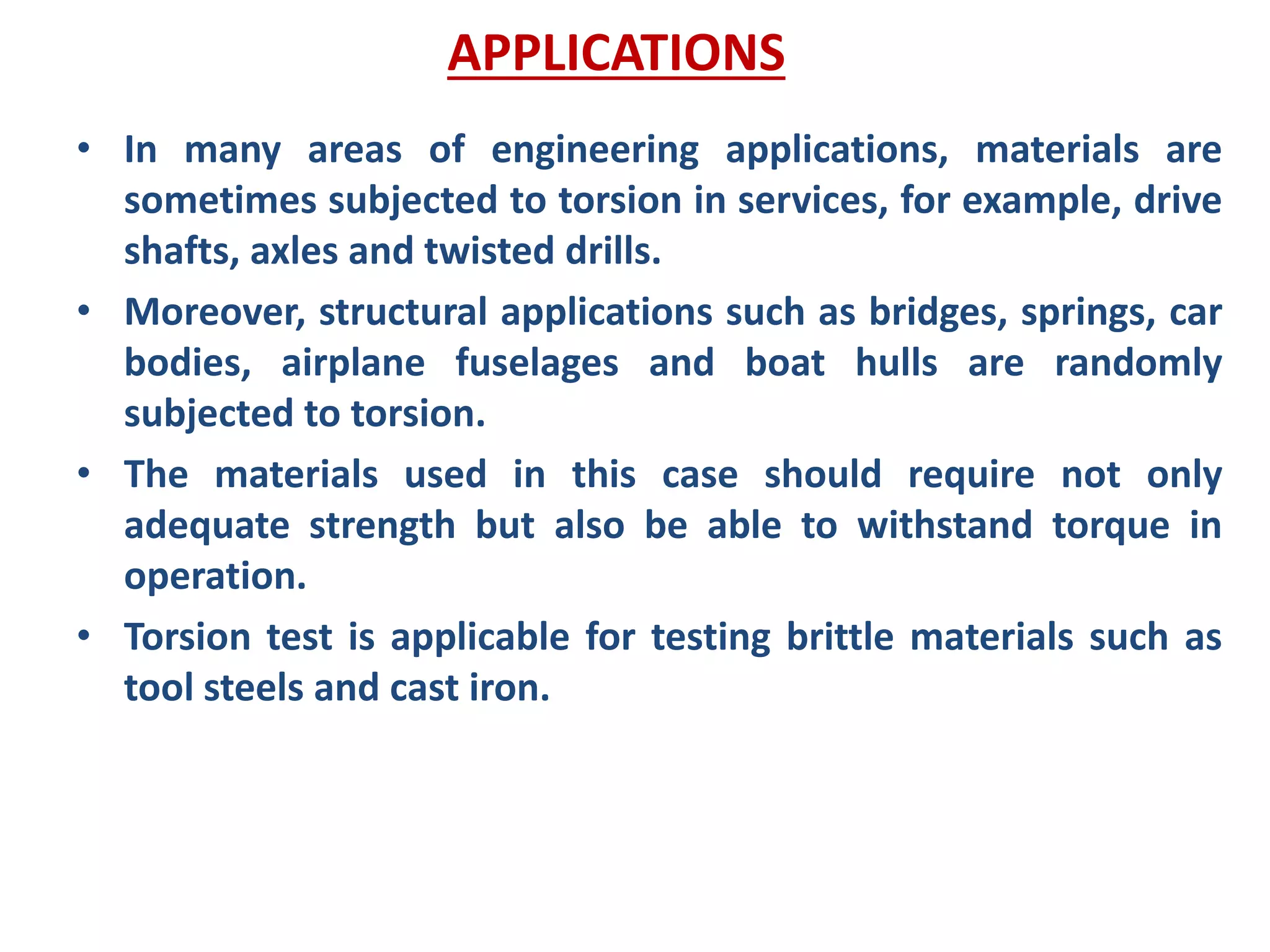
• In many areas of engineering applications, materials are
sometimes subjected to torsion in services, for example, drive
shafts, axles and twisted drills.
• Moreover, structural applications such as bridges, springs, car
bodies, airplane fuselages and boat hulls are randomly
subjected to torsion.
• The materials used in this case should require not only
adequate strength but also be able to withstand torque in
operation.
• Torsion test is applicable for testing brittle materials such as
tool steels and cast iron.
APPLICATIONS
Compression and Torsion Testing.pptx

Compression and Torsion Testing.pptx

  • 1.
  • 2.
    INTRODUCTION • A compressiontest is a mechanical test in which a material or product responds to forces that push, compress, squash, crush and flatten the test specimen. • Compression testing is a fundamental mechanical test, similar in nature to tensile and bend tests. Compression tests characterize material and product strength and stiffness under applied crushing loads. These tests are typically conducted by applying compressive pressure to a test specimen using platens or specialized fixtures with a testing machine that produces compressive loads. • Compression test could be used to obtain the mechanical properties of metals however it is not preferred due to the following; – It is difficult to apply a truly axial load in compression which leading to non uniform stresses
  • 3.
    COMPRESSION TEST The testsample is generally placed in between two hard metal bearing blocks that distribute the applied load across the entire surface area of two opposite faces of the test sample and then the plates are pushed together by a universal testing machine causing the sample to flatten. A sample will get shortened in the direction of the applied forces and expands in the direction perpendicular to the force. Where E is Young's modulus. This value represents how much the material will deform under applied compressive loading before plastic deformation occurs. Certain materials subjected to a compressive force show initially a linear relationship between stress and strain. The Hooke's Law states that, E = Stress(s)/Strain(e)
  • 4.
    • A material'sability to return to its original shape after deformation has occurred is referred to as its elasticity. • At certain force the permanent or plastic deformation will occur, this is known as proportional limit. • At this point the linear behaviour of graph stops. The force at which the material begins exhibiting this behaviour is called the yield point or yield strength. A specimen will then exhibit one of two types of behaviour, either it will continue to deform until it eventually breaks or it will distort until flat. In either case a maximum stress or force will be evident providing its ultimate compressive strength value. COMPRESSION TEST
  • 5.
  • 6.
    Modes of deformationin compression testing The figure below illustrates the different modes of failure in compression testing. COMPRESSION TEST a) when L/D > 5,Buckling b) when L/D > 2.5, Shearing c) when L/D > 2.0 and friction is present at the contact surfaces, Double barrelling d) when L/D < 2.0 and friction is present at the contact surfaces, Barrelling e) when L/D < 2.0 and no friction is present at the contact surfaces, Homogenous compression. f) Compressive instability due to work- softening material.
  • 7.
    Failure patterns: Ductile materialwill have proportional limit in compression very close to those in tension. The initial regions of their compression stress strain diagram are very similar to tension diagrams. When a mild steel specimen is compressed, it begins to bulge outward on the sides and become barrel shaped. With increasing load the specimen is flattened out, thus offering increased resistance to further shortening. COMPRESSION TEST
  • 8.
  • 9.
    INTRODUCTION • Generally, torsionoccurs when the twisting moment or torque is applied to a member. • The torque is the product of tangential force multiplied by the radial distance from the twisting axis and the tangent, measured in a unit of N.m. • The purpose of a torsion test is to determine the behavior a material or test sample exhibits when twisted or under torsional forces as a result of applied moments that cause shear stress about the axis. Measurable values include: the modulus of elasticity in shear, yield shear strength, torsional fatigue life, ductility, ultimate shear strength, and modulus of rupture in shear. In a torsion test, a solid or hollow cylindrical specimen is twisted and the resultant deformation, measured as the angle through which the bar is twisted. The test then consists of measuring the angle of twist, Φ (rad) at selected increments of torque, T (N.m).
  • 10.
    • For transmittingpower through a rotating shaft it is necessary to apply a turning force. The force is applied tangentially and in the plane of transverse cross section. The torque or twisting moment may be calculated by multiplying two opposite turning moments. It is said to be in pure torsion and it will exhibit the tendency of shearing off at every cross section which is perpendicular to the longitudinal axis. • The three common forms that torsion testing take include failure, proof and operational. • A torsion test for failure requires that the test sample be twisted until it breaks and is designed to measure the strength of the sample. • A proof test is designed to observe the material under a specified torque load over a set period of time. • Finally, operational testing is measures the material’s performance under the expected service conditions of its application. All of these forms of tests may be performed with either torsion only loading or a combination of torsion and axial (tension or compression) loading depending upon the characteristics to be measured. TORSION TEST
  • 11.
    Torsion equation:- T/J =τ/R= Gθ/L G = T L/J θ N/mm2 T= maximum twisting torque (N mm), J = polar moment of inertia (mm4 ) = π d4 /32, τ = shear stress (N/mm2 ) G = modulus of rigidity (N/mm2 ), θ = angle of twist in radians L= length of shaft under torsion (mm) Precautions:- 1. Measure the dimensions of the specimen carefully 2. Measure the Angle of twist accurately for the corresponding value of Torque. 3. The specimen should be properly to get between the jaws. 4. After breaking specimen stop to m/c. TORSION TEST
  • 12.
  • 13.
    • The torsionaltest is useful for to study the torsional stress-strain relationship and determine shear modulus (G) and Poisson’s ratio (v) and relationship between torsional load and angle of twist for a full range of strains till failure. • It is useful to determine the mode of failure (ductile or brittle). • Many materials experience torques or torsional forces in their applications and so will benefit from or require torsion testing. Materials used in structural, biomedical and automotive applications are among the more common materials to experience torsion in their applications. These materials may be composed of metals, plastics, woods, polymers, composites, or ceramics among others and commonly take the forms of fasteners, rods, beams, tubes and wires. • One of the disadvantages of the hot torsion test is its non- homogeneity of deformation. It mostly occurs outside the gauge section of the specimen due to a longitudinal gradient in torsional stiffness along the specimen. ADVANTAGES AND DISADVANTAGES
  • 14.
    • In manyareas of engineering applications, materials are sometimes subjected to torsion in services, for example, drive shafts, axles and twisted drills. • Moreover, structural applications such as bridges, springs, car bodies, airplane fuselages and boat hulls are randomly subjected to torsion. • The materials used in this case should require not only adequate strength but also be able to withstand torque in operation. • Torsion test is applicable for testing brittle materials such as tool steels and cast iron. APPLICATIONS