The document discusses different types of composite materials, their properties, manufacturing techniques, and applications. It describes composites as a combination of two or more materials and classifies them into ceramic matrix composites, metal matrix composites, polymer matrix composites, carbon-carbon composites, and green composites. It discusses characterization techniques like thermal analysis, water absorption testing, and morphological analysis using SEM and TEM. Finally, it provides examples of applications for each composite type and lists some of their advantages and disadvantages.
Overview of composite materials, their properties, examples like bone and wood.
Explanation of matrix and reinforcement components; classification into CMCs, MMCs, PMCs, and more.
Details on CMCs including materials, production methods, and thermal properties.
Description of MMCs, materials used, fabrication processes, and sub-classifications.Characteristics of PMCs, including matrix and reinforcement details.
Focus on bio-composites made from natural fibers and their ecological benefits.
Various molding methods for producing composites, including open and closed molding.
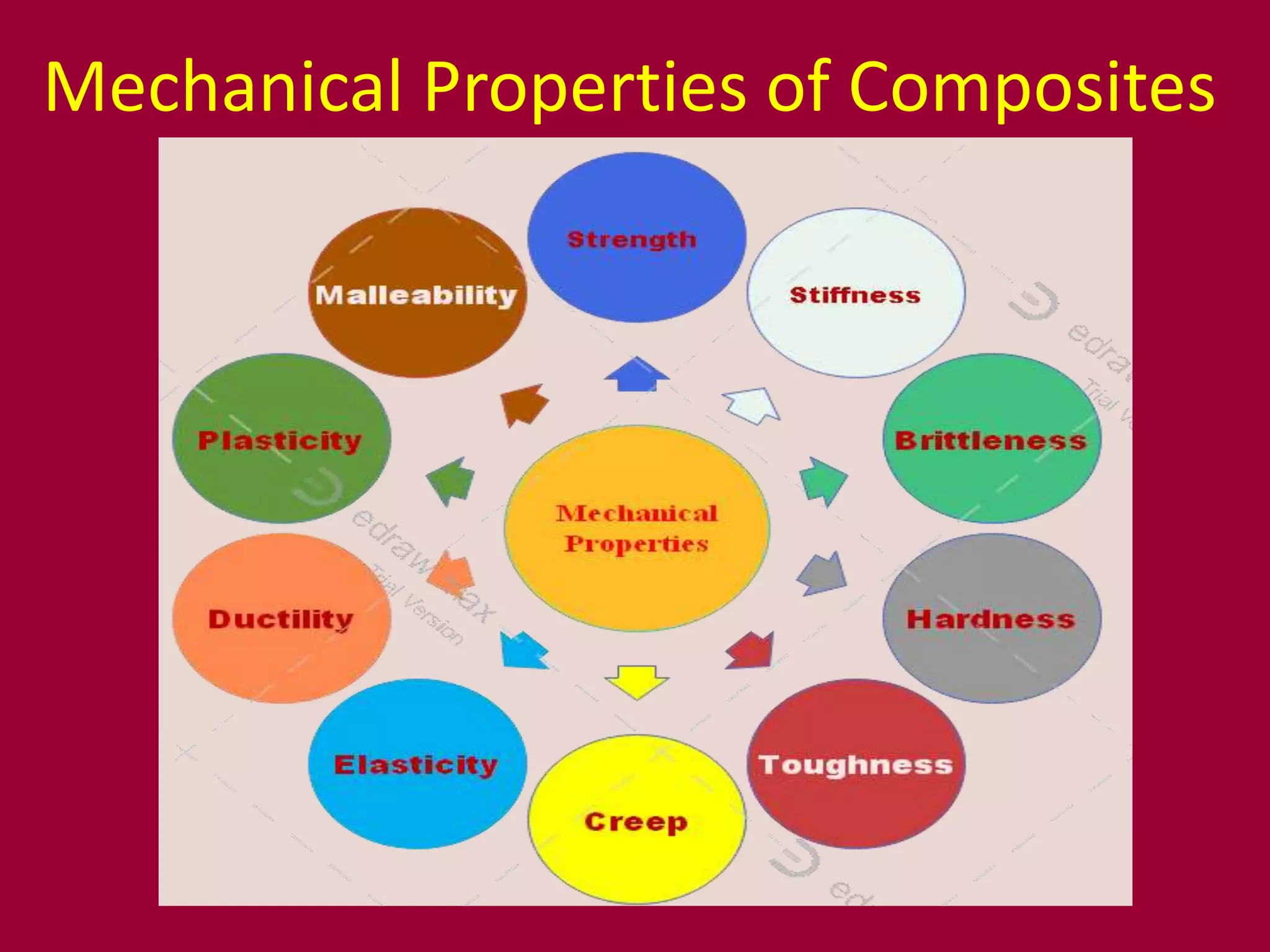
Overview of mechanical properties like strength, hardness, elasticity, plasticity, and brittleness.
Introduction to thermal analysis methods for composites, such as DSC and their processes.Distinction between endothermic and exothermic reactions in thermal analysis.
DSC as a powerful technique for measuring thermal properties of various materials.
Technique to measure temperature differences during phase transitions in materials.
Insights into TGA for weight changes in materials, applications in different fields.
DMA measures material's physical properties, including elastic and viscous responses.
TMA provides data on dimensional changes of materials under temperature and force.
Investigates water absorption properties of PMCs and methods to evaluate it.Techniques like SEM and TEM for understanding the microstructure of composites.
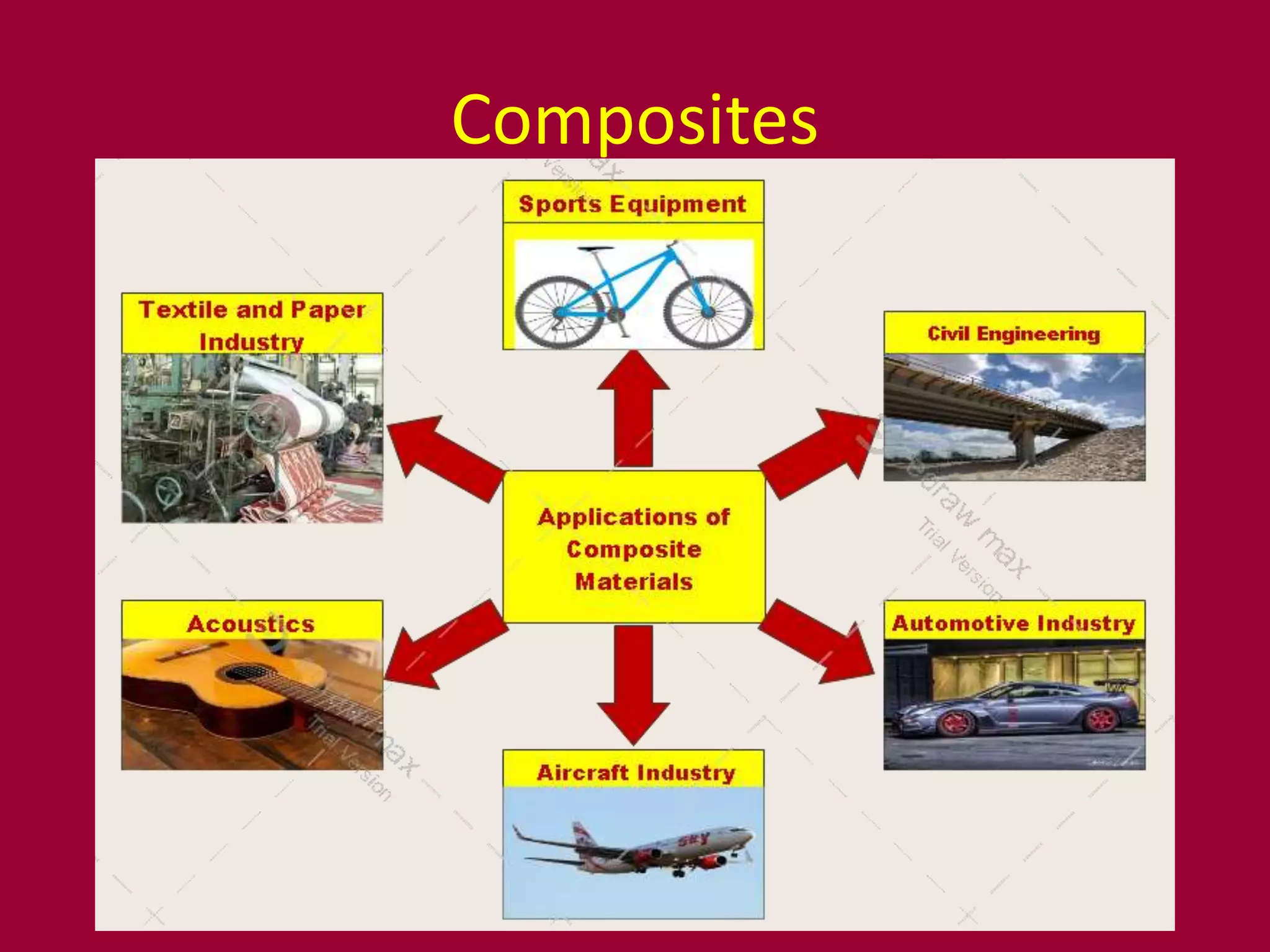
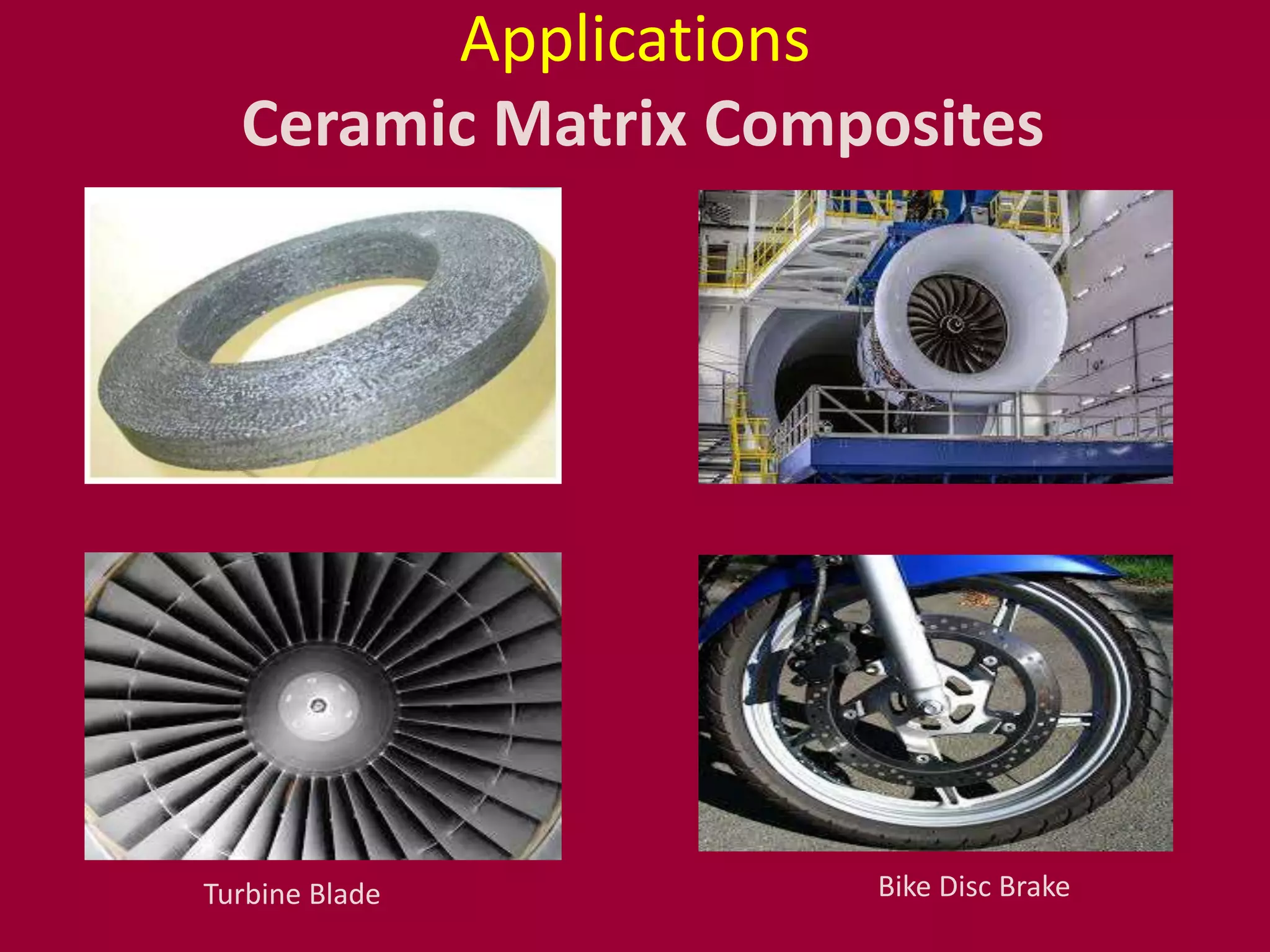
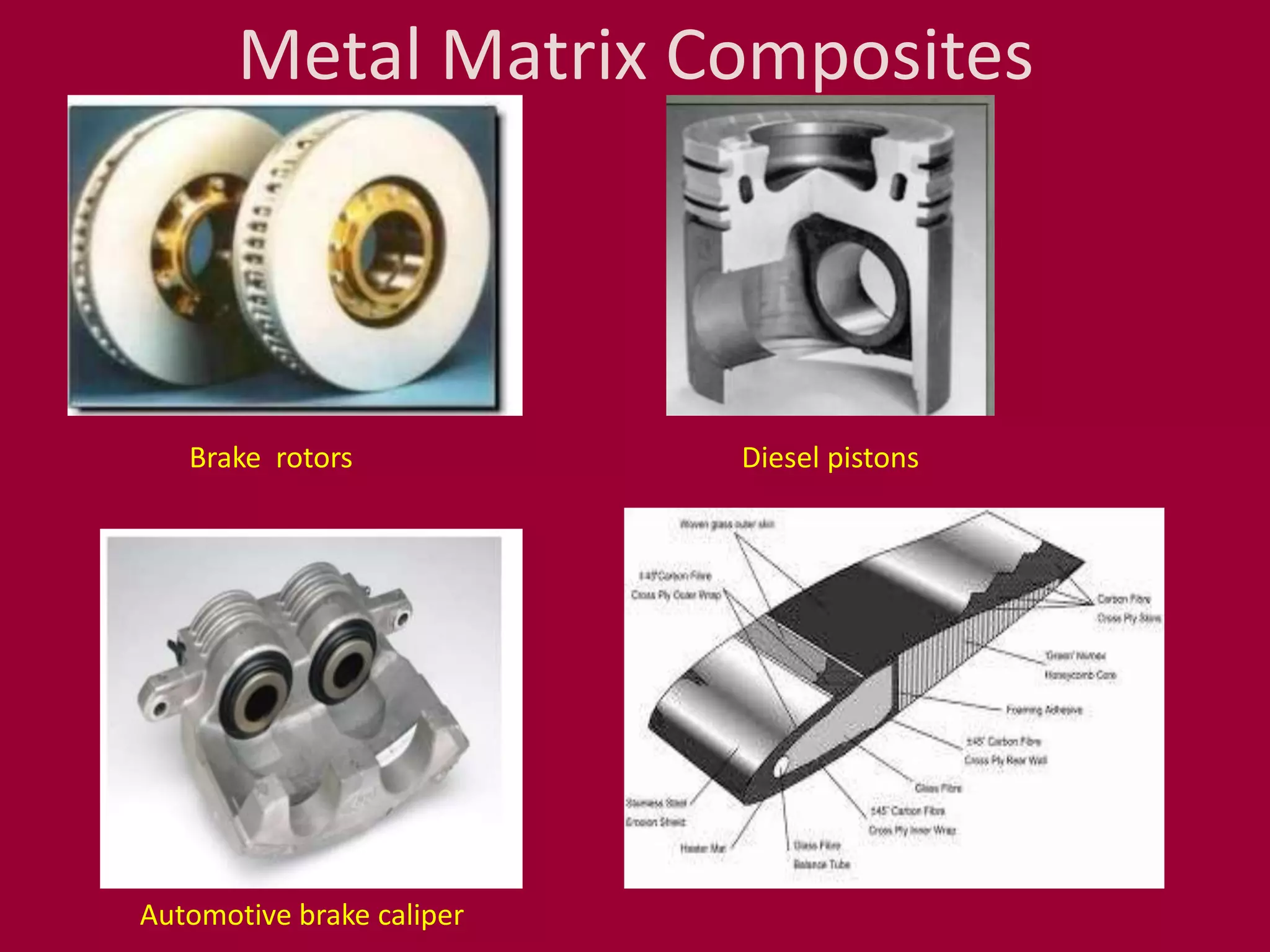
Showcases practical applications of different composites in various industries.
Highlights benefits of MMCs, CMCs, and green composites in different applications.
Details on the drawbacks and challenges faced in composite materials usage.
COMPOSITE MATERIALS –
PROPERTIESAND APPLICATIONS
Dr. A.V.Kiruthika
Assistant Professor of Physics
Seethalakshmi Achi College for Women
Pallathur, Sivagangai Dt, Tamilnadu
2.
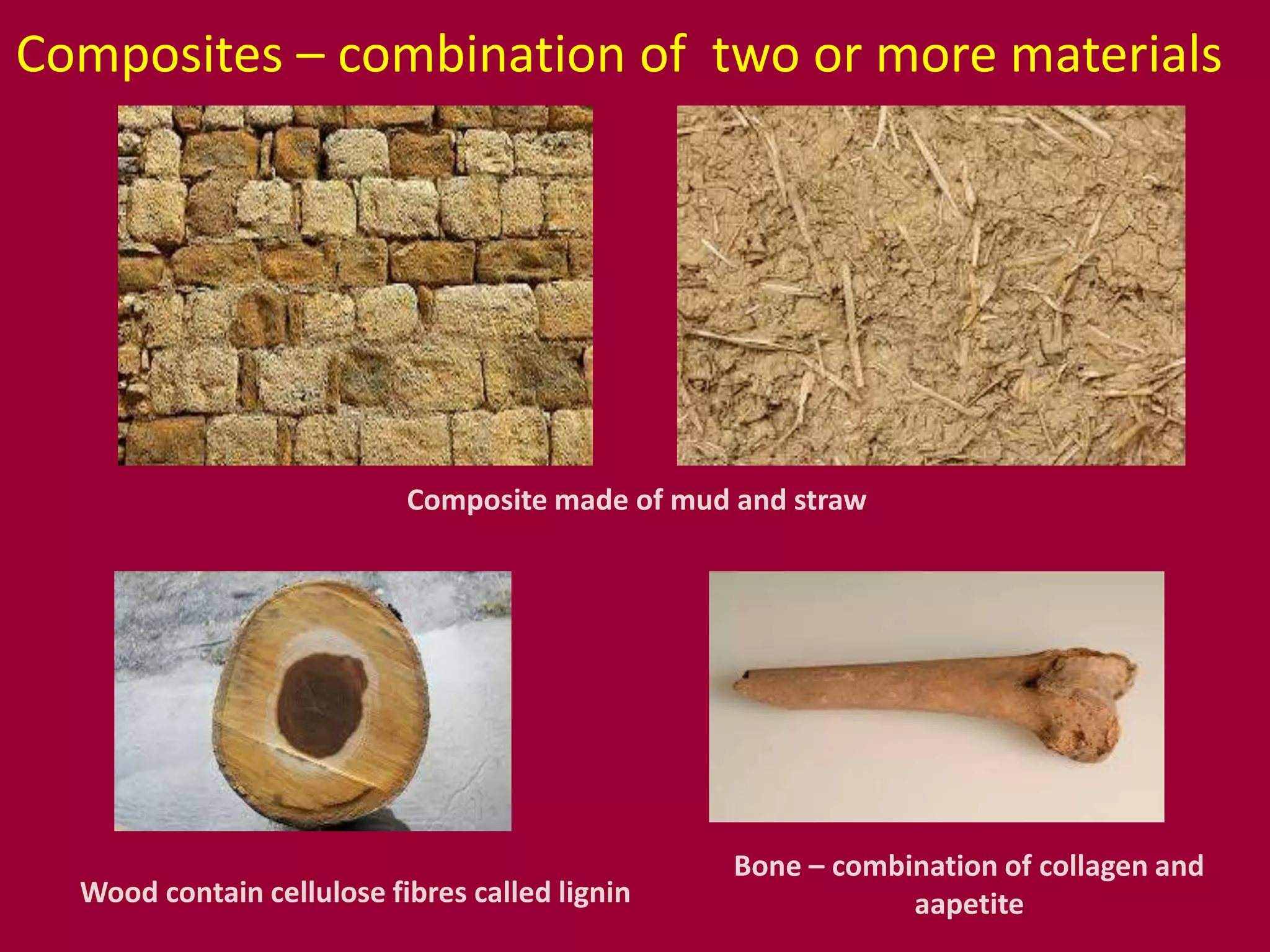
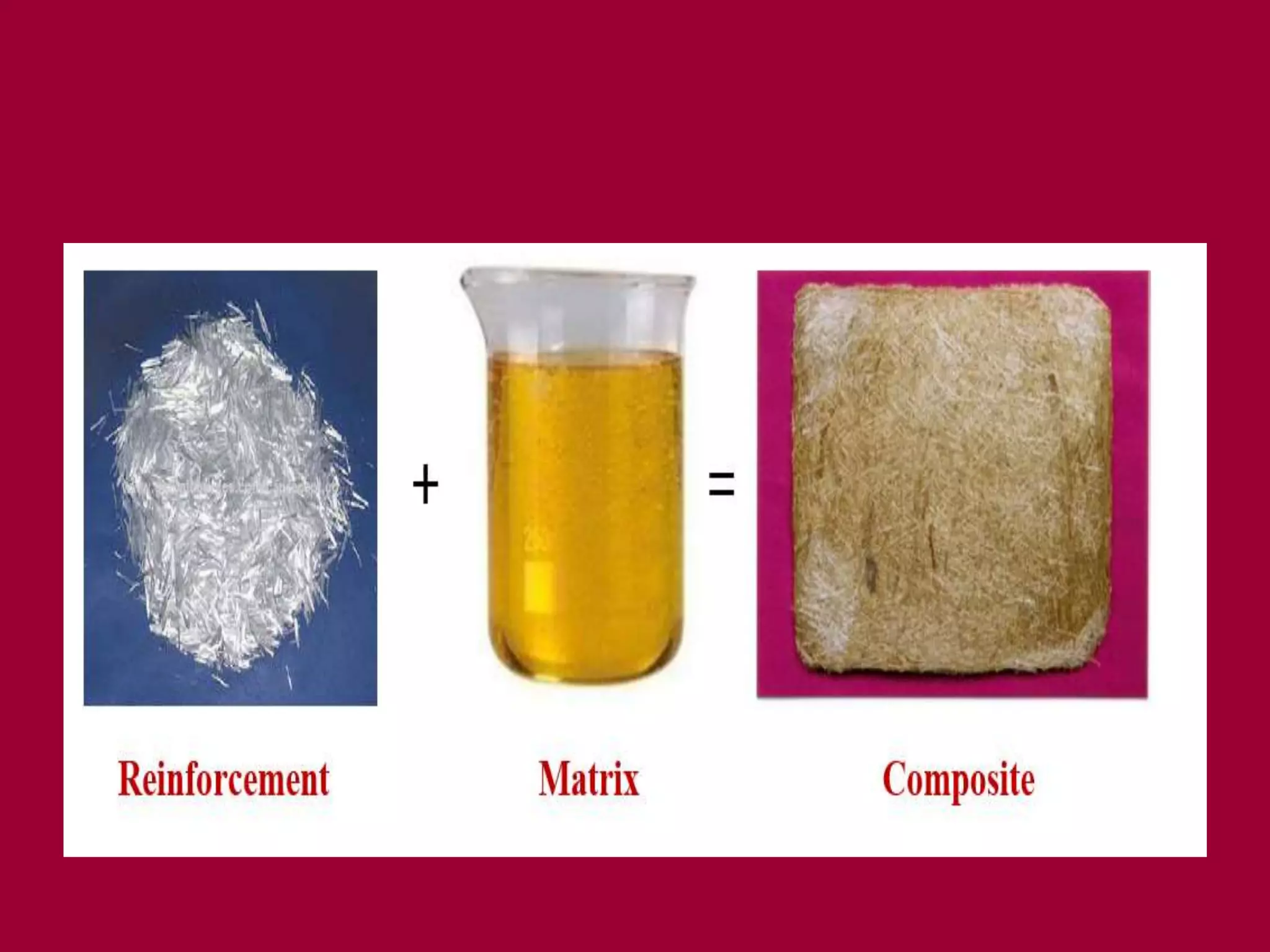
Composites – combinationof two or more materials
Composite made of mud and straw
Wood contain cellulose fibres called lignin
Bone – combination of collagen and
aapetite
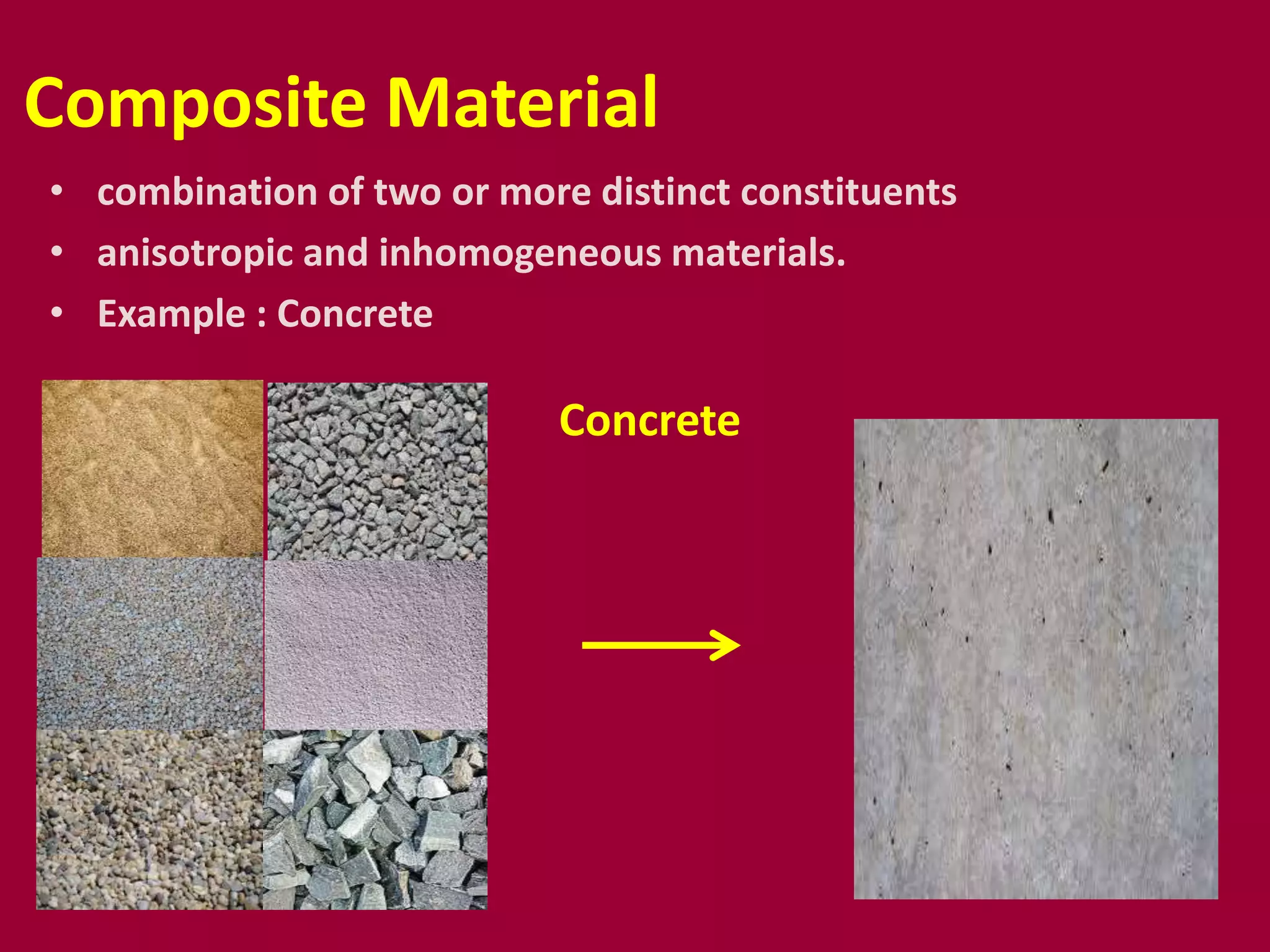
• combination oftwo or more distinct constituents
• anisotropic and inhomogeneous materials.
• Example : Concrete
Composite Material
Concrete
6.
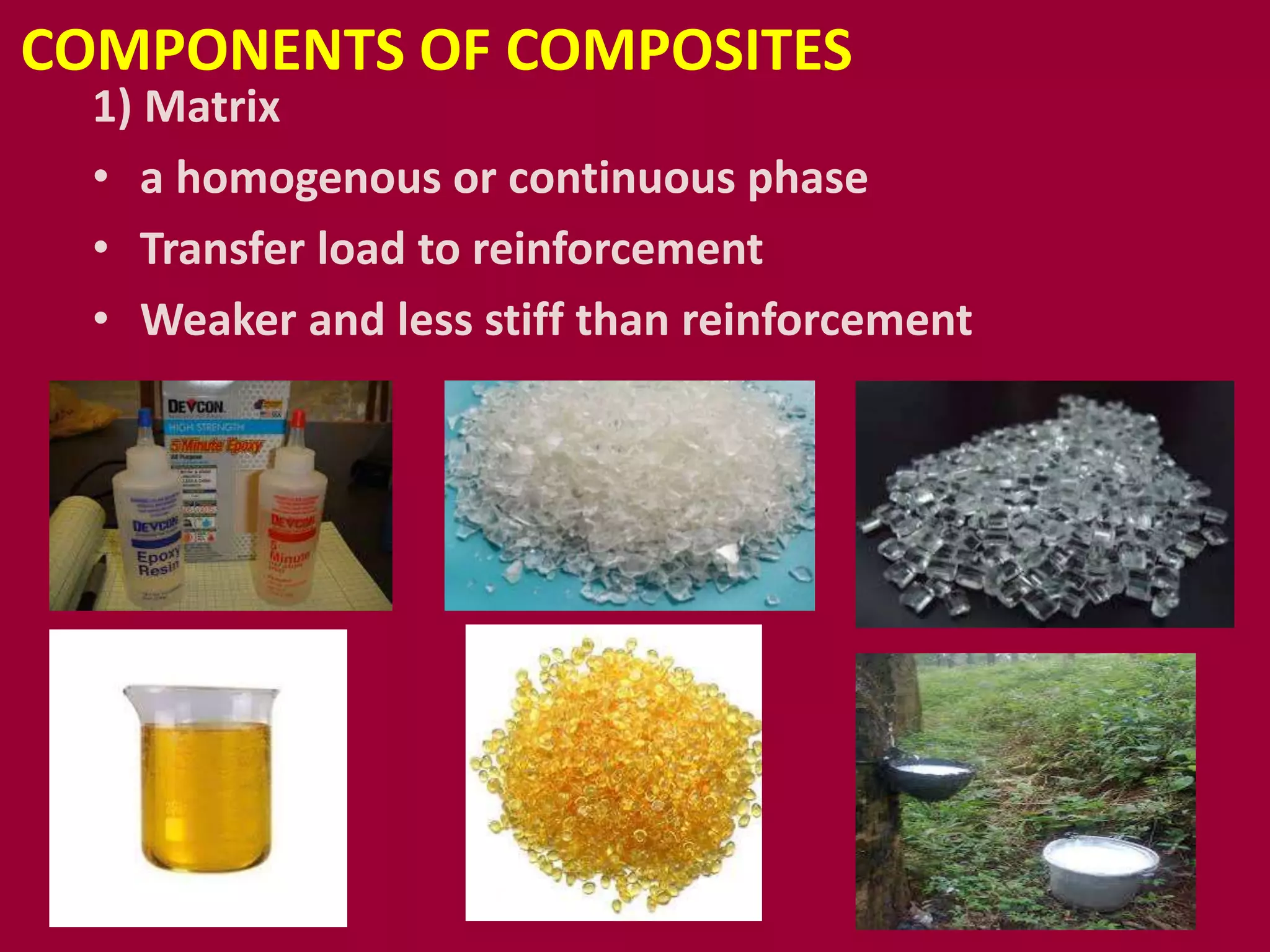
COMPONENTS OF COMPOSITES
1)Matrix
• a homogenous or continuous phase
• Transfer load to reinforcement
• Weaker and less stiff than reinforcement
7.
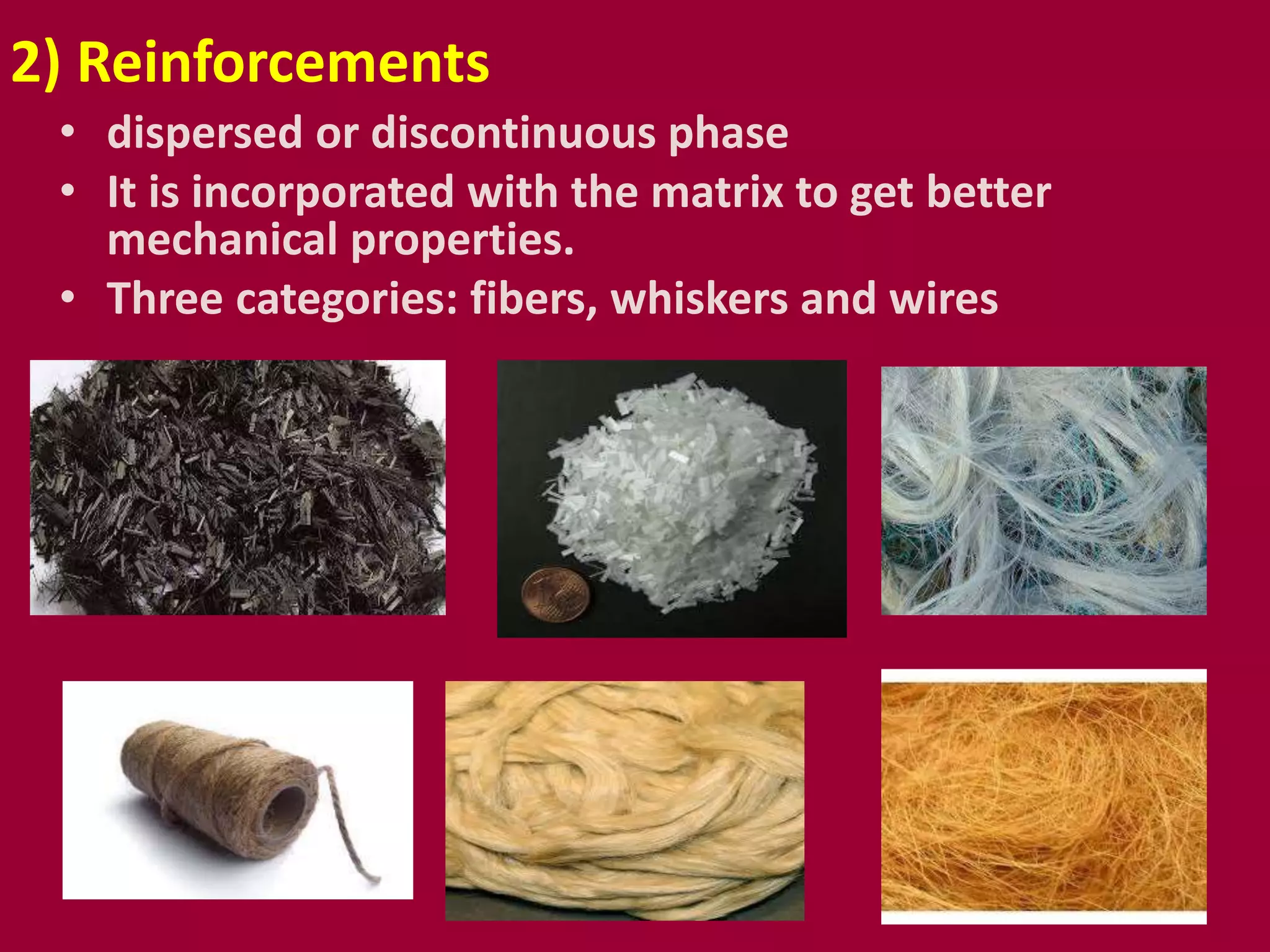
• dispersed ordiscontinuous phase
• It is incorporated with the matrix to get better
mechanical properties.
• Three categories: fibers, whiskers and wires
2) Reinforcements
8.
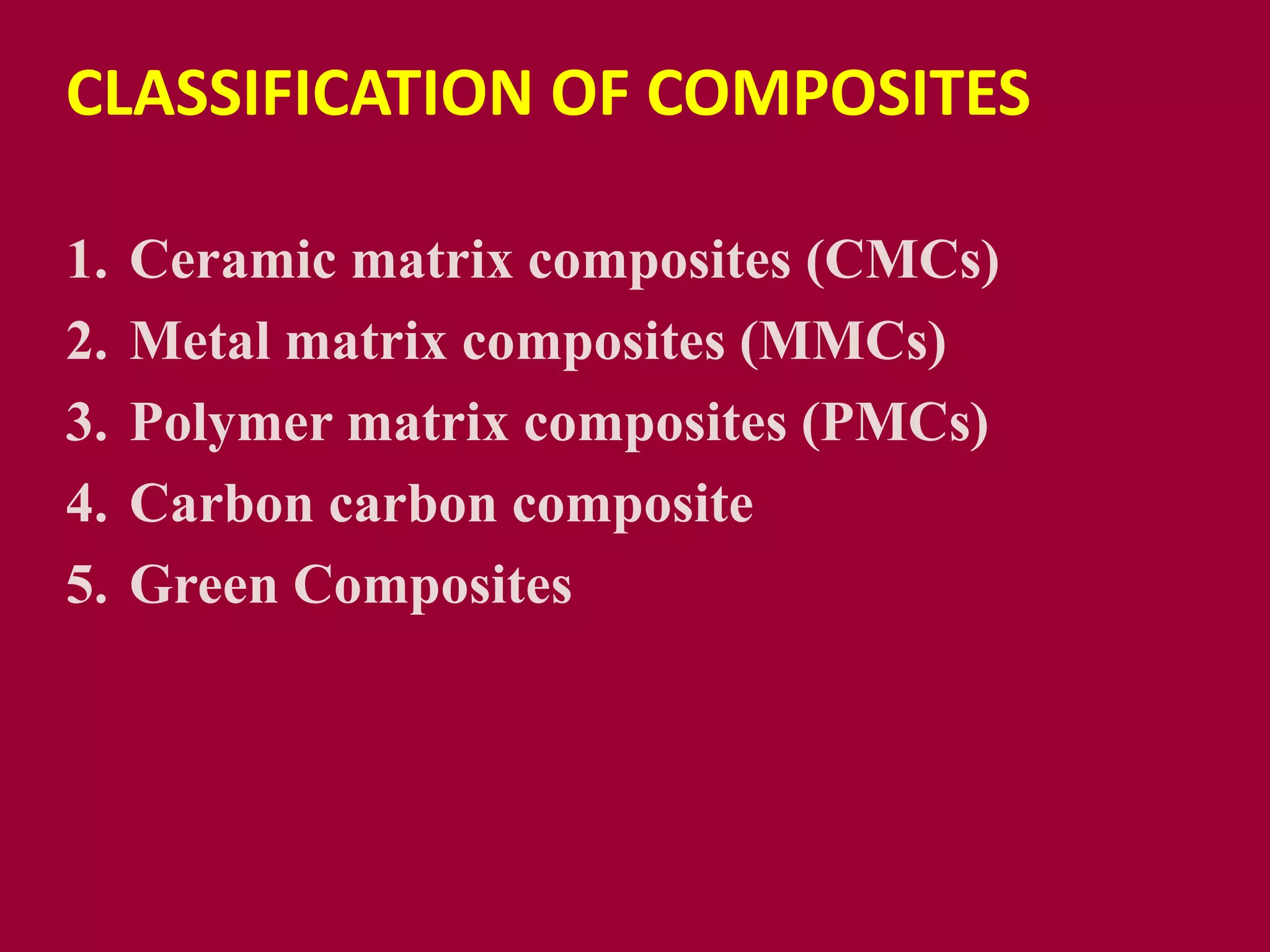
CLASSIFICATION OF COMPOSITES
1.Ceramic matrix composites (CMCs)
2. Metal matrix composites (MMCs)
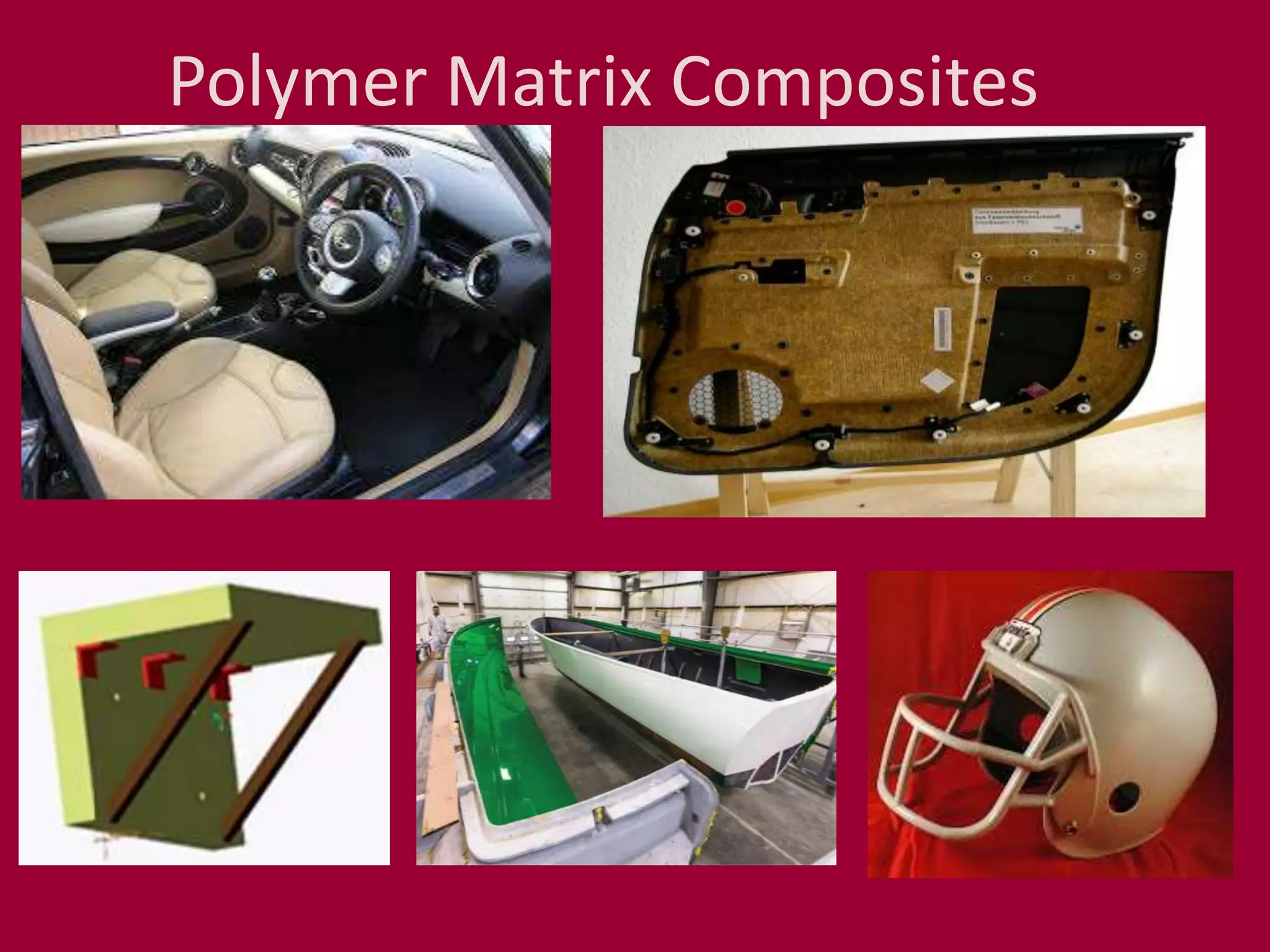
3. Polymer matrix composites (PMCs)
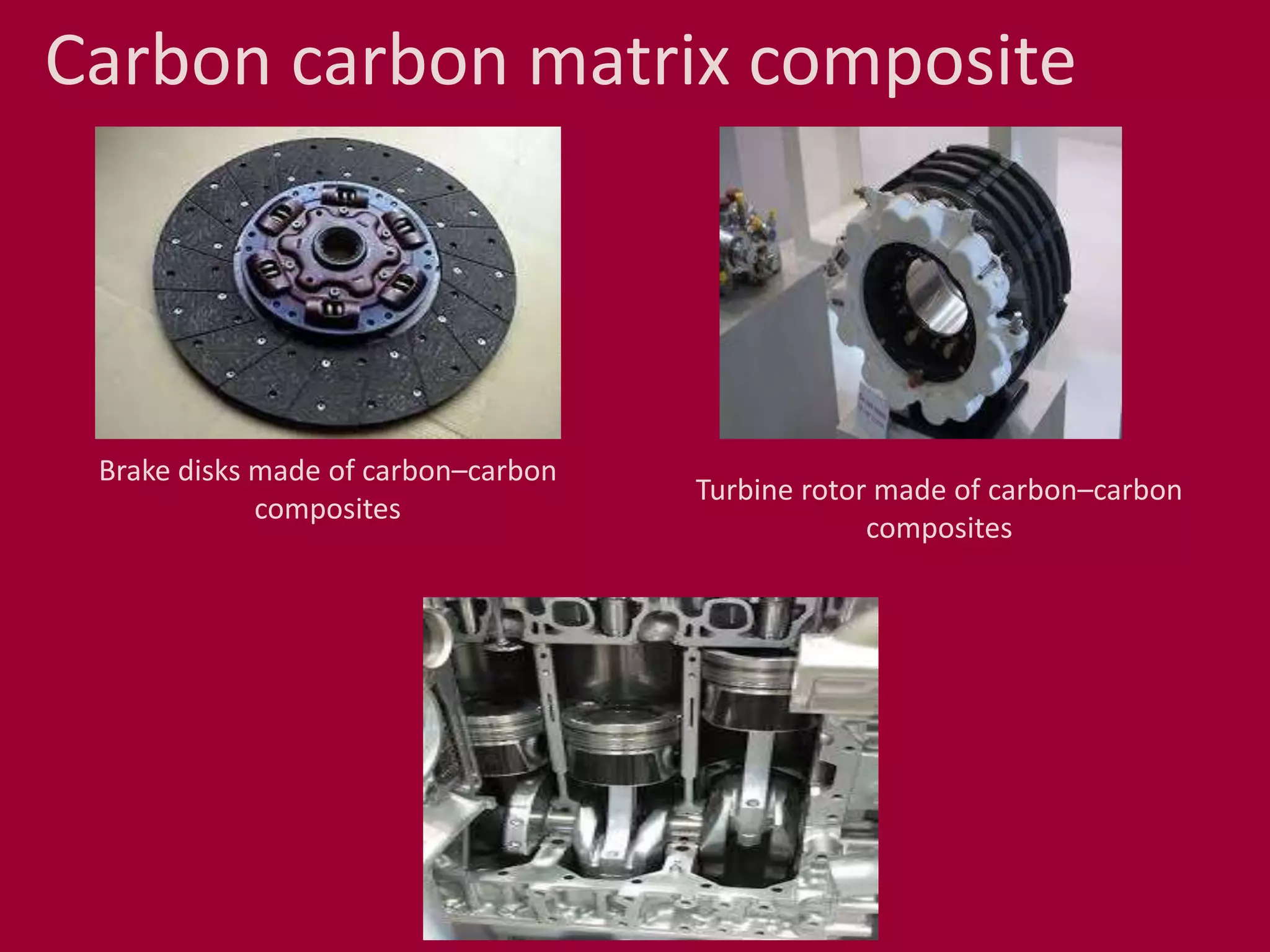
4. Carbon carbon composite
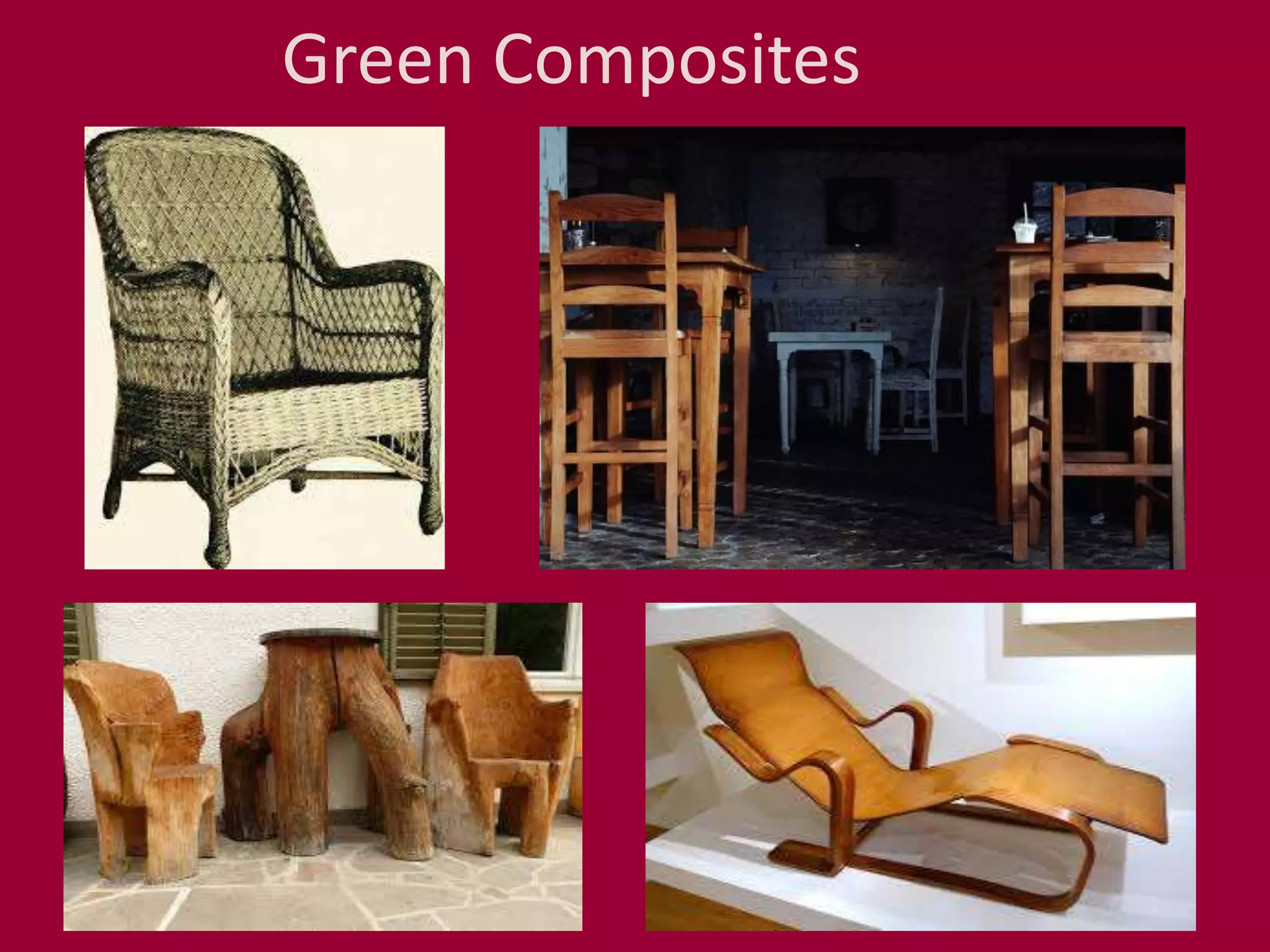
5. Green Composites
9.
CERAMIC MATRIX COMPOSITES(CMC)
• both the reinforcement and matrix material are
ceramics
• Fabrication process :polymer infiltration and
pyrolysis (PIP)
• the operating temperature lies in between
800˚C to 1650 ˚ C
• Reinforcements are Carbon, silicon, alumina,
mullite
• offer low density, high hardness and superior
thermal and chemical resistance.
10.
METAL MATRIX COMPOSITES(MMCS)
• Reinforcement materials: Silicon carbide, Boron,
Molybdenum, ceramic fibres, carbon
• matrix (Al, Mg, Fe, Co, Cu)
• Fabrication: Solid-phase and liquid-phase processes
• the operating temperature lies in between 250˚C to
750˚C
• provide stiffness, strength, and relatively low
density.
11.
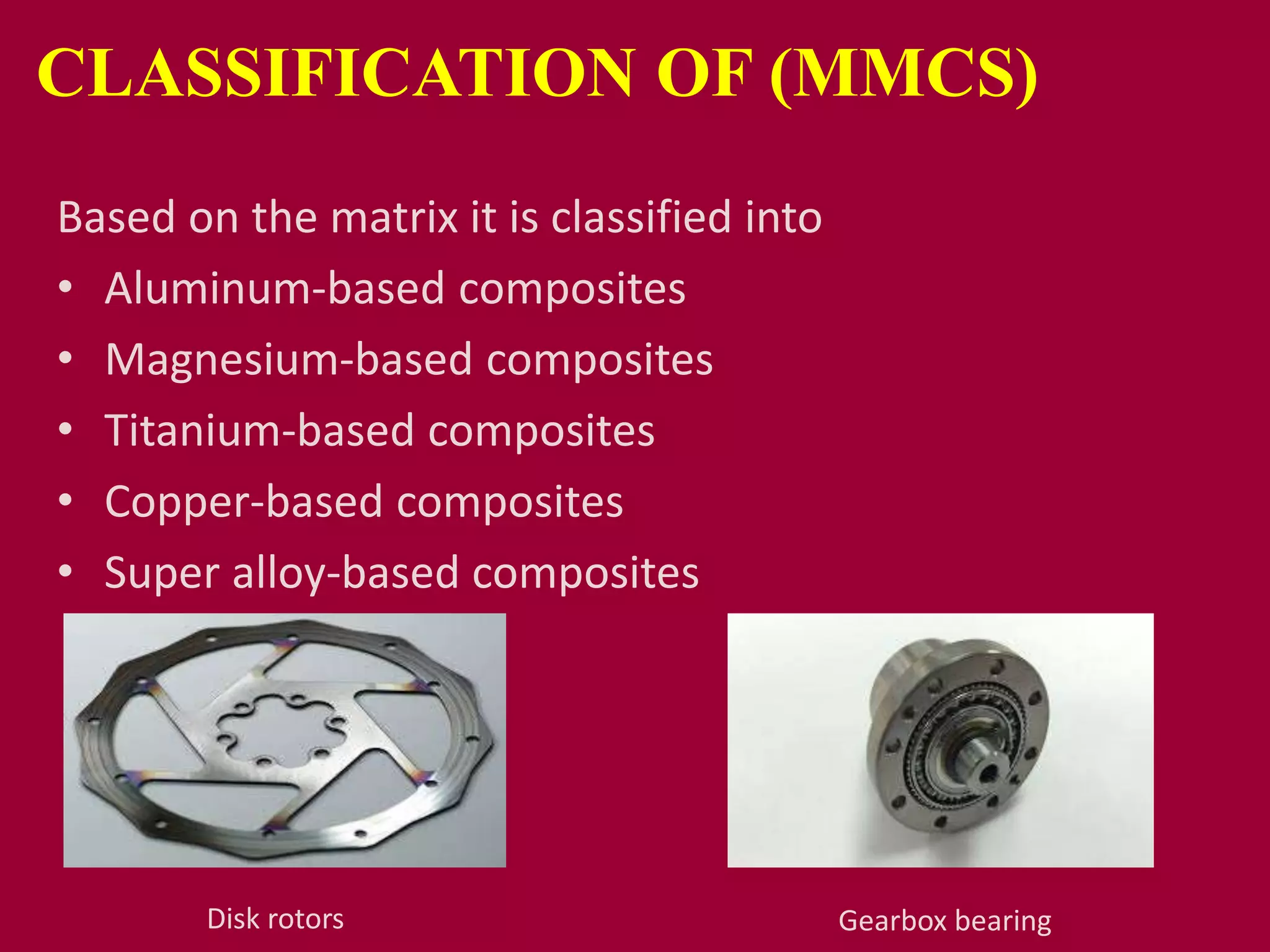
CLASSIFICATION OF (MMCS)
Basedon the matrix it is classified into
• Aluminum-based composites
• Magnesium-based composites
• Titanium-based composites
• Copper-based composites
• Super alloy-based composites
Disk rotors Gearbox bearing
12.
POLYMER MATRIX COMPOSITES(PMCS)
• Matrix: thermosets,(polyesters, vinyl-esters, epoxies,
bismaleimides, and polyamides) thermoplasts(nylon,
polystyrene, some polyesters, poly -etherimide, polyamide,
polyphenylene sulfide, polyether-etherketone ), rubber
• Reinforcement: glass, carbon, steel or Kevler fibers
• Does not need high pressure and temperature
• Lighter, stiffer and stronger
• Properties depends upon the fibre orientation, fibre weight
fraction and properties of both fibre and matrix
13.
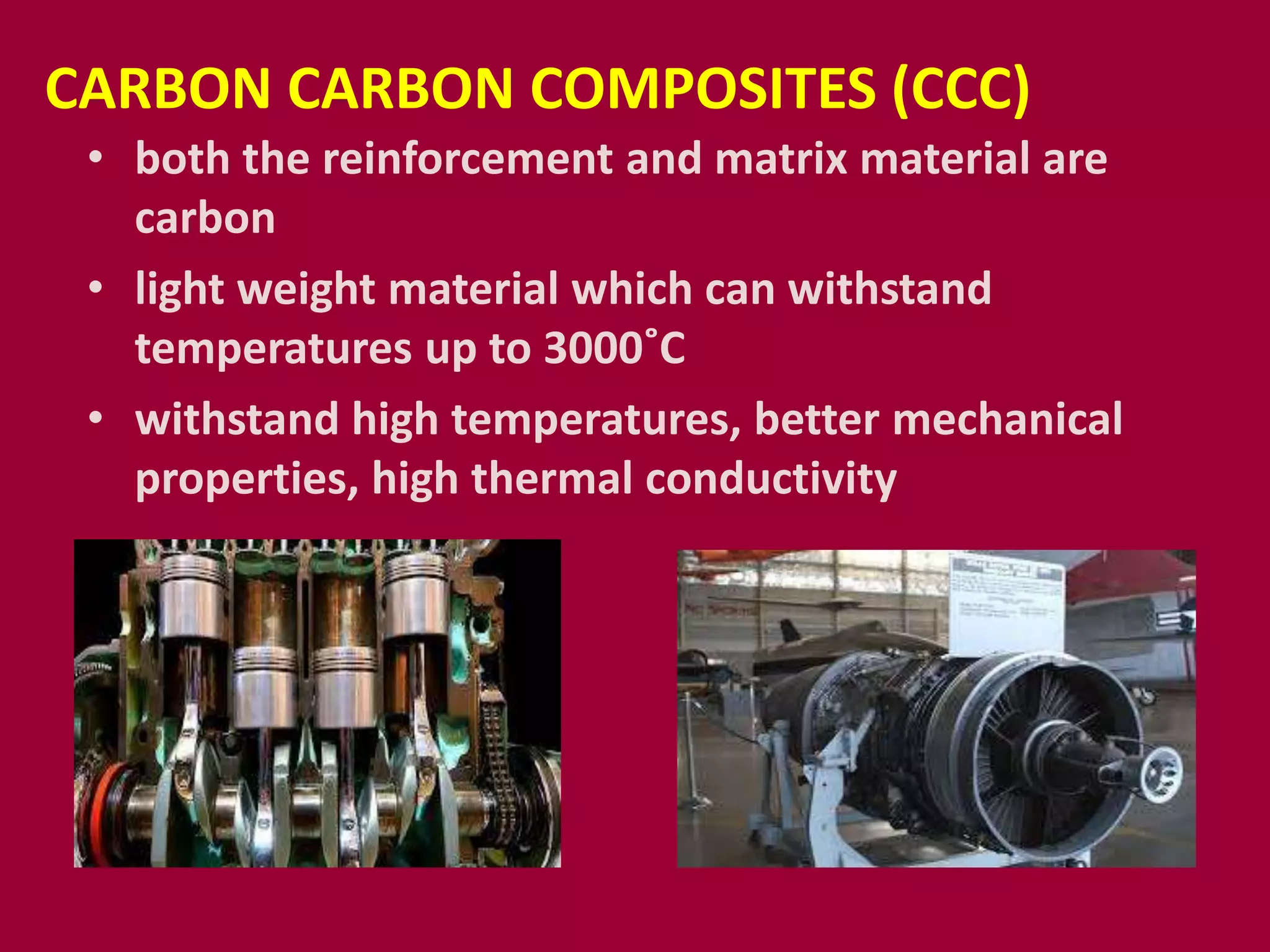
CARBON CARBON COMPOSITES(CCC)
• both the reinforcement and matrix material are
carbon
• light weight material which can withstand
temperatures up to 3000˚C
• withstand high temperatures, better mechanical
properties, high thermal conductivity
14.
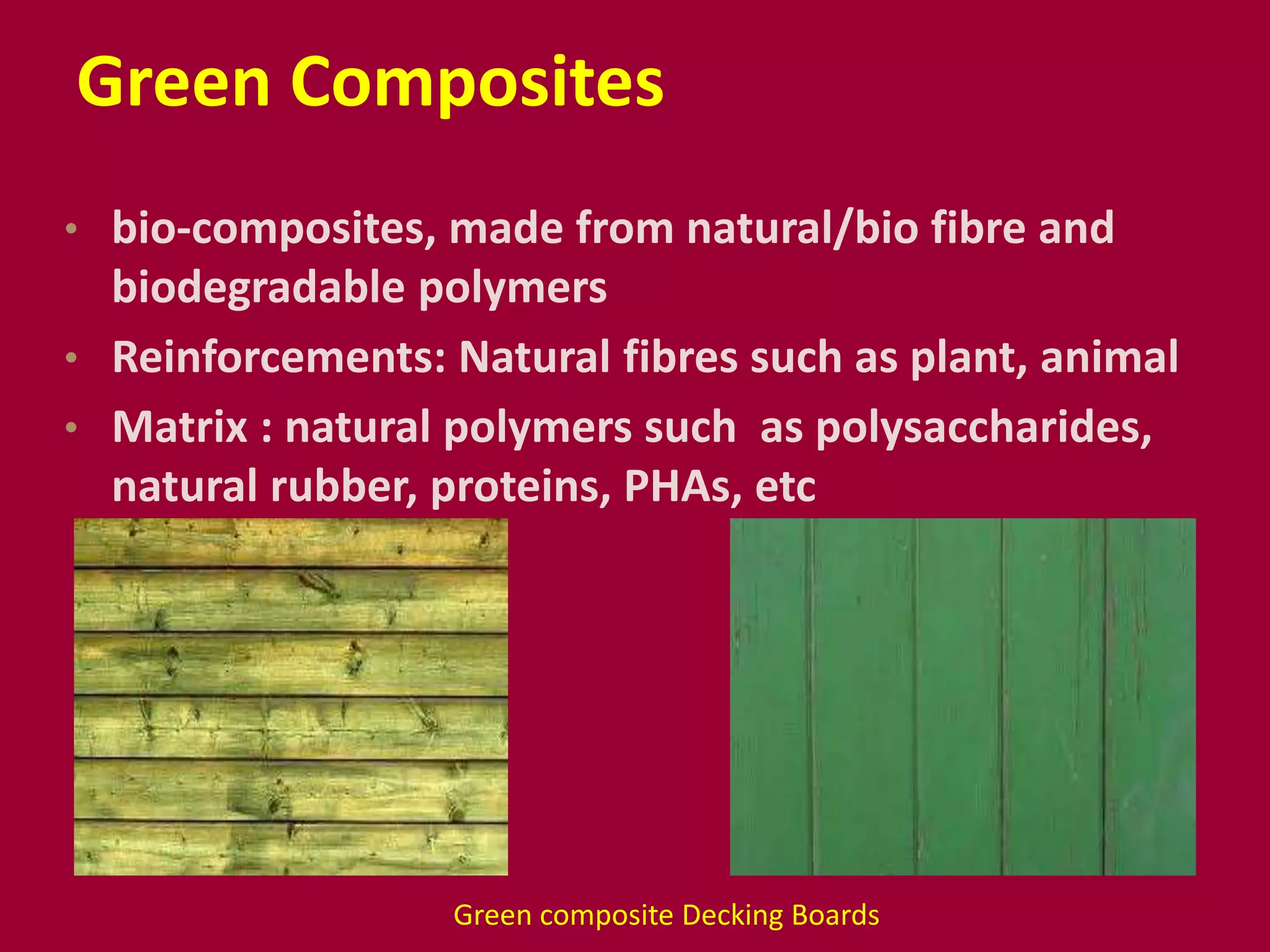
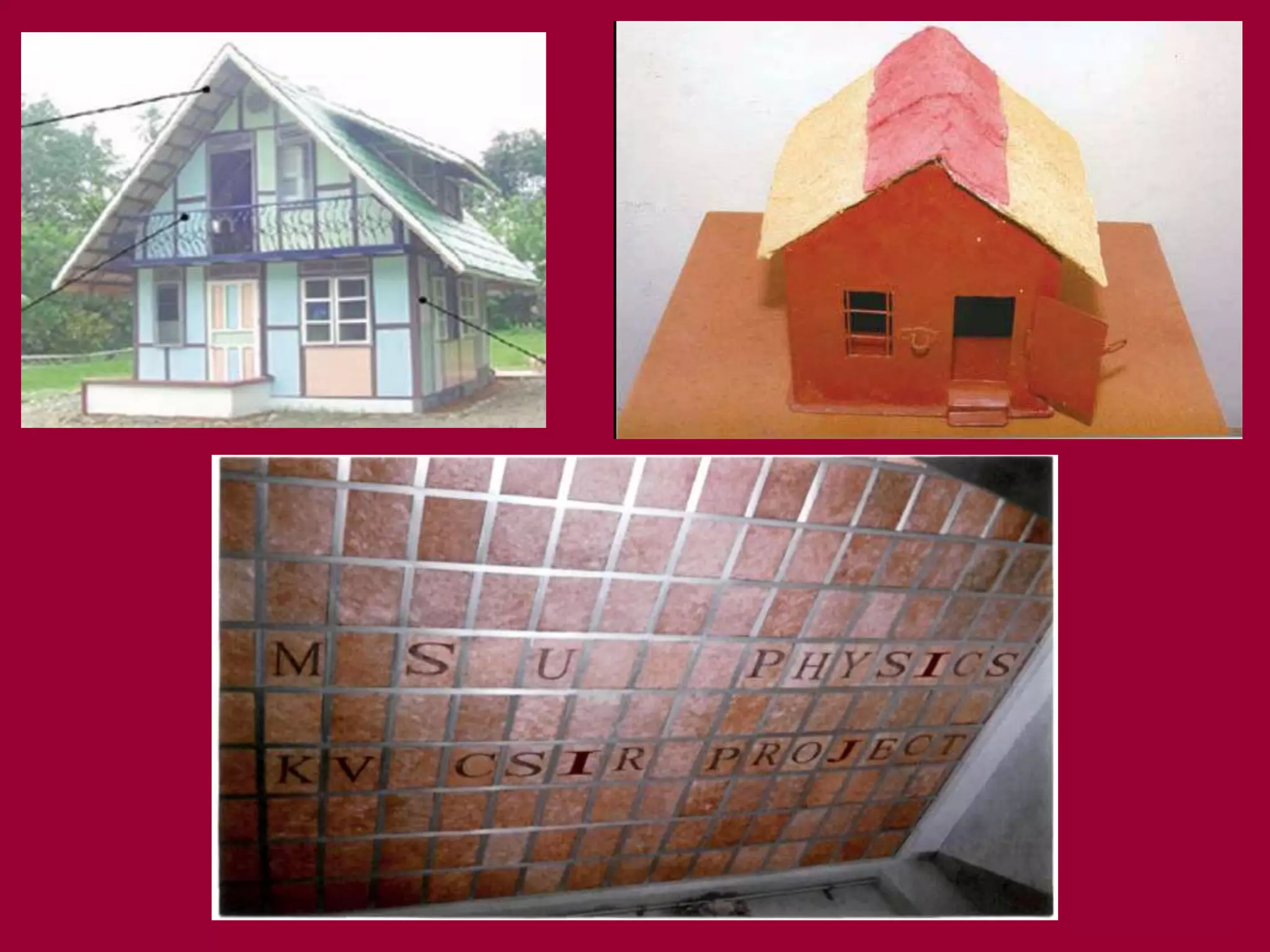
Green Composites
• bio-composites,made from natural/bio fibre and
biodegradable polymers
• Reinforcements: Natural fibres such as plant, animal
• Matrix : natural polymers such as polysaccharides,
natural rubber, proteins, PHAs, etc
Green composite Decking Boards
15.
• Open Molding
•Closed Molding
• Cast Polymer Molding
• Open Molding
Hand Lay-up
Spray-up
Filament Winding
• Cast Polymer Molding
Gel Coated Cultured Stone Molding
Solid Surface Molding
Composite Manufacturing techniques
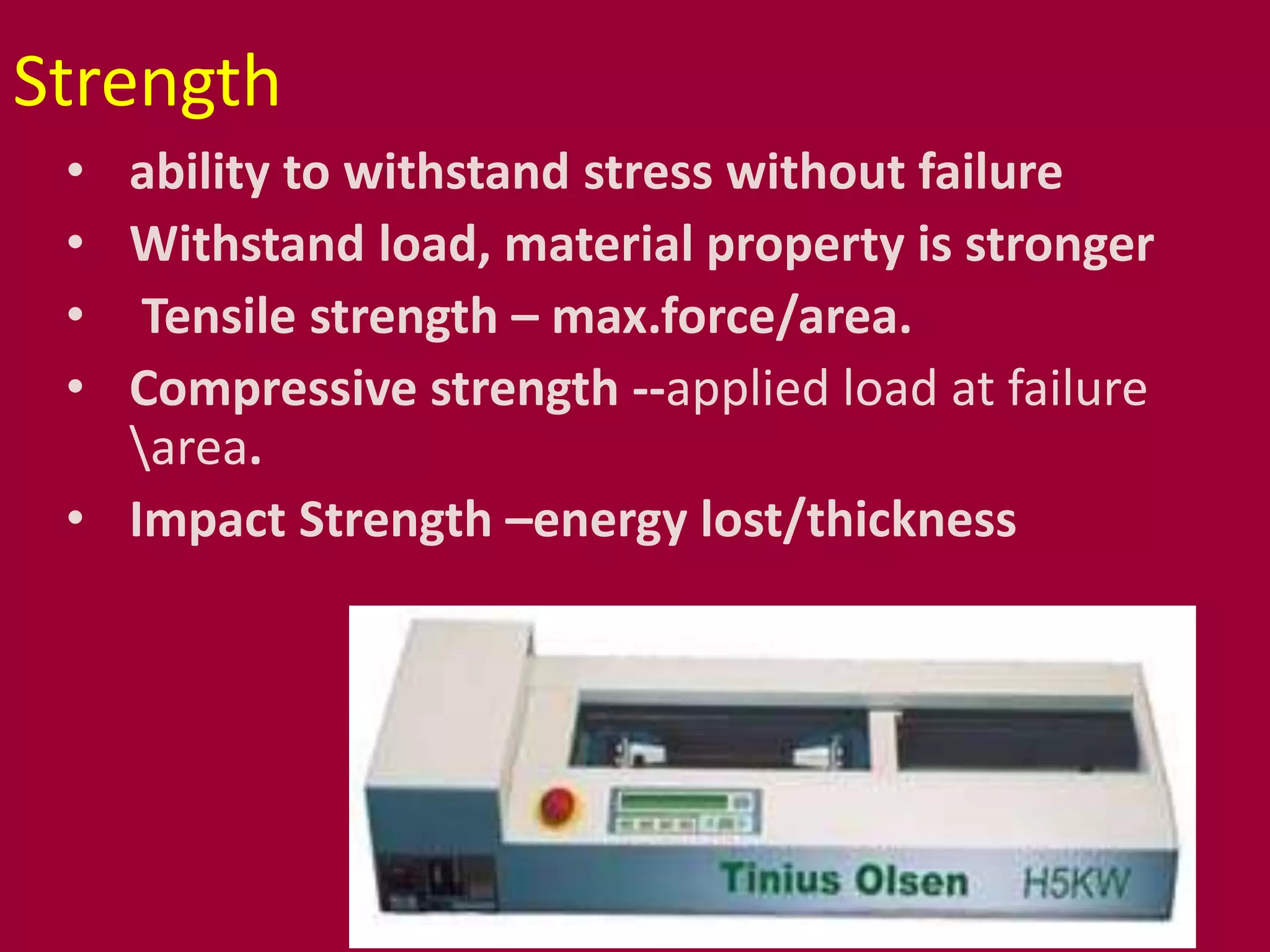
Strength
• ability towithstand stress without failure
• Withstand load, material property is stronger
• Tensile strength – max.force/area.
• Compressive strength --applied load at failure
area.
• Impact Strength –energy lost/thickness
19.
Hardness
• resistance topermanent indentation
• expressed in numbers
• Four test
a) Brinell hardness test
b) Rockwell hardness test
c) Vickers hardness test
d) Shore scleroscope
20.
Elasticity -- Whenthe material is subjected to force, it
dimensions changed, then the applied force removed,
it comes to its original position.
Plasticity -- When the external force is applied, the
material undergoes inelastic strain. This is because of
plasticity.
Brittleness -- It is the property of breaking of
a material with little permanent distortion. The
materials having less than 5% elongation under
loading behavior are said to be brittle materials.
Glass, concrete and cast iron are some examples of
brittle material.
21.
Thermal Analysis isa field of materials
science in which the properties of composites
are analyzed with respect to temperature.
Various techniques
a) Differential Scanning Calorimetry(DSC)
b) Differential Thermal Analysis(DTA)
c) Thermo Gravimetric Analysis (TGA)
d) Dynamic Mechanical Analysis(DMA)
e) Thermo Mechanical Analysis(TMA)
THERMAL ANALYSIS OF COMPOSITES
22.
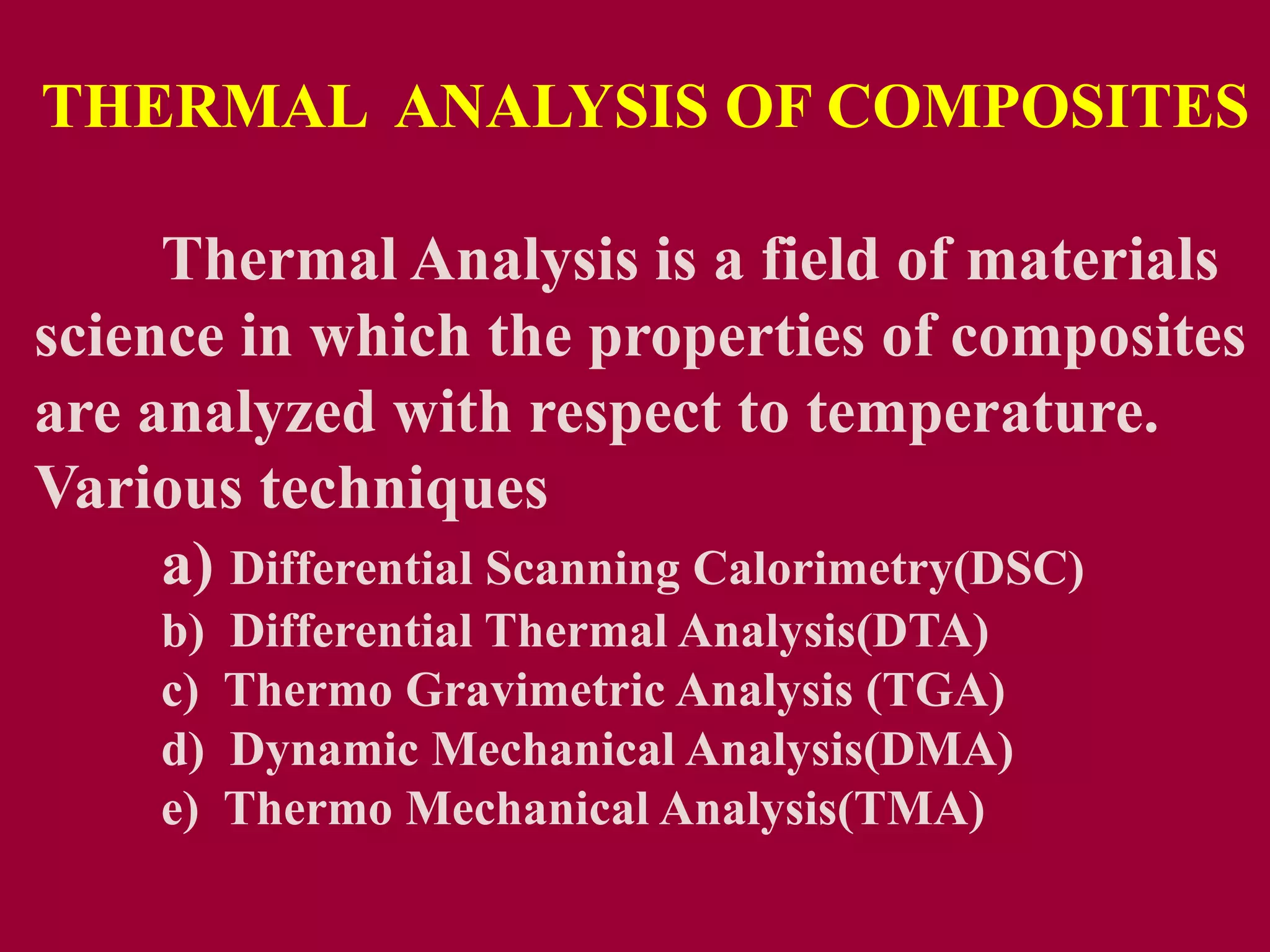
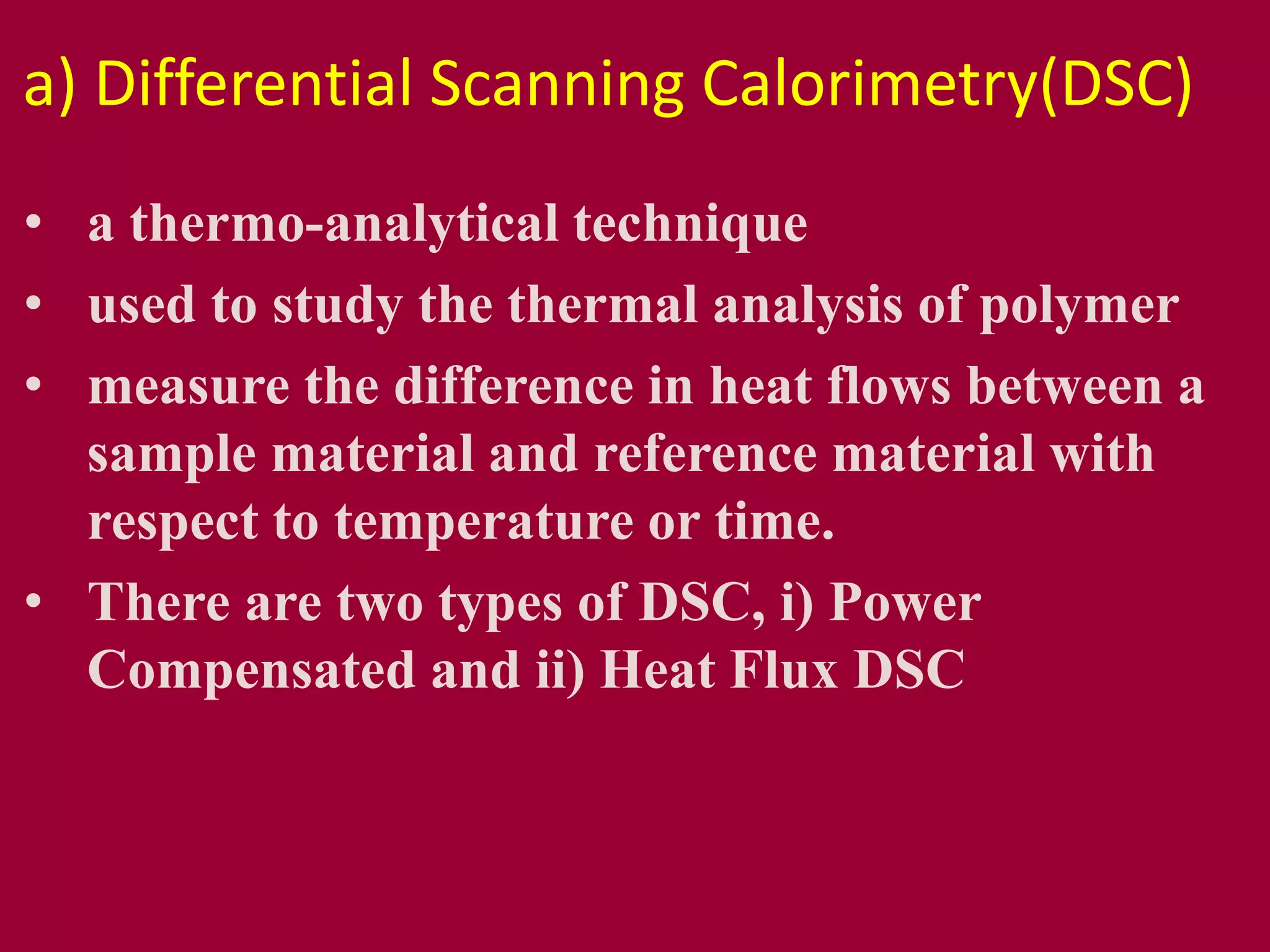
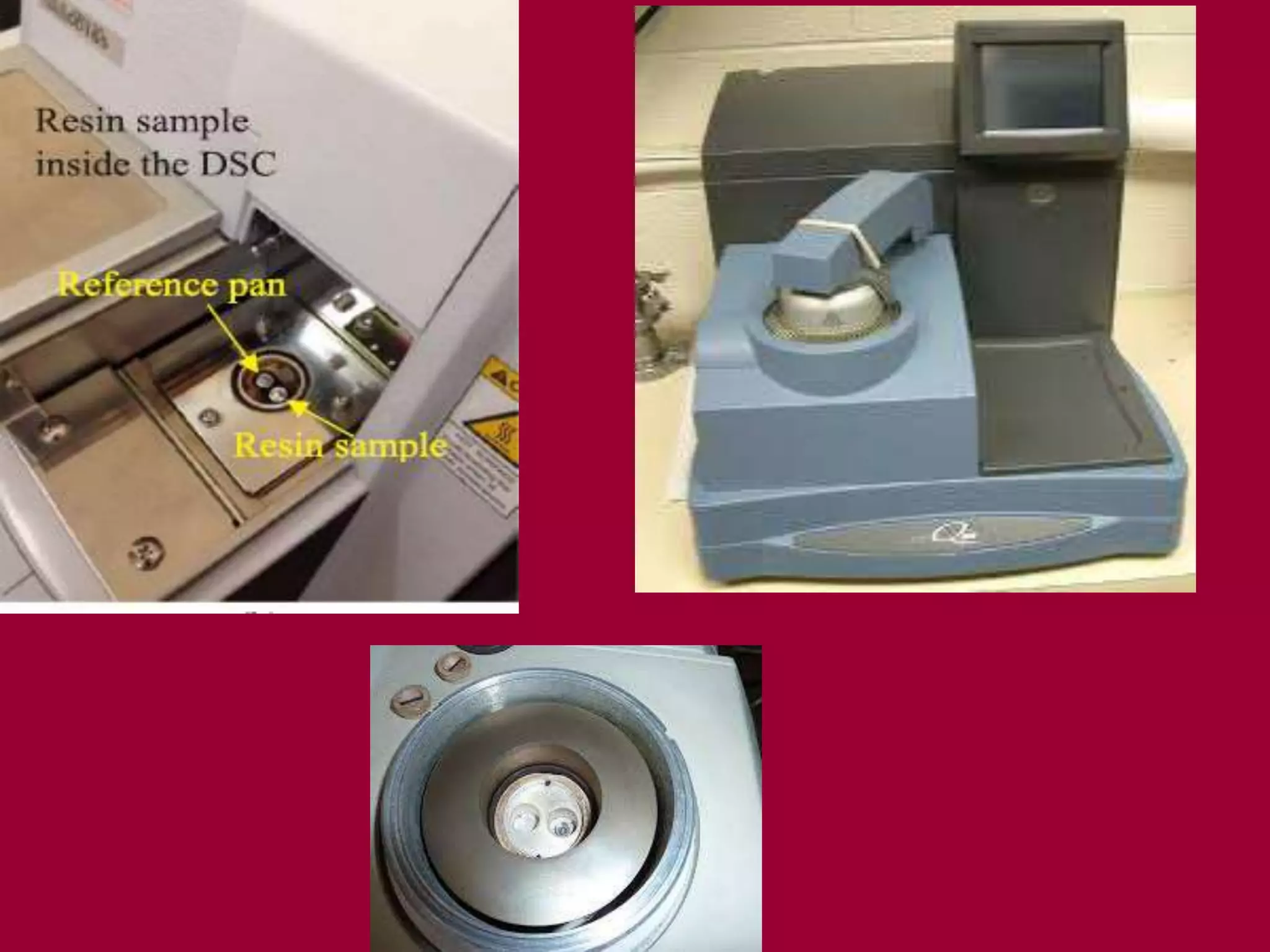
a) Differential ScanningCalorimetry(DSC)
• a thermo-analytical technique
• used to study the thermal analysis of polymer
• measure the difference in heat flows between a
sample material and reference material with
respect to temperature or time.
• There are two types of DSC, i) Power
Compensated and ii) Heat Flux DSC
24.
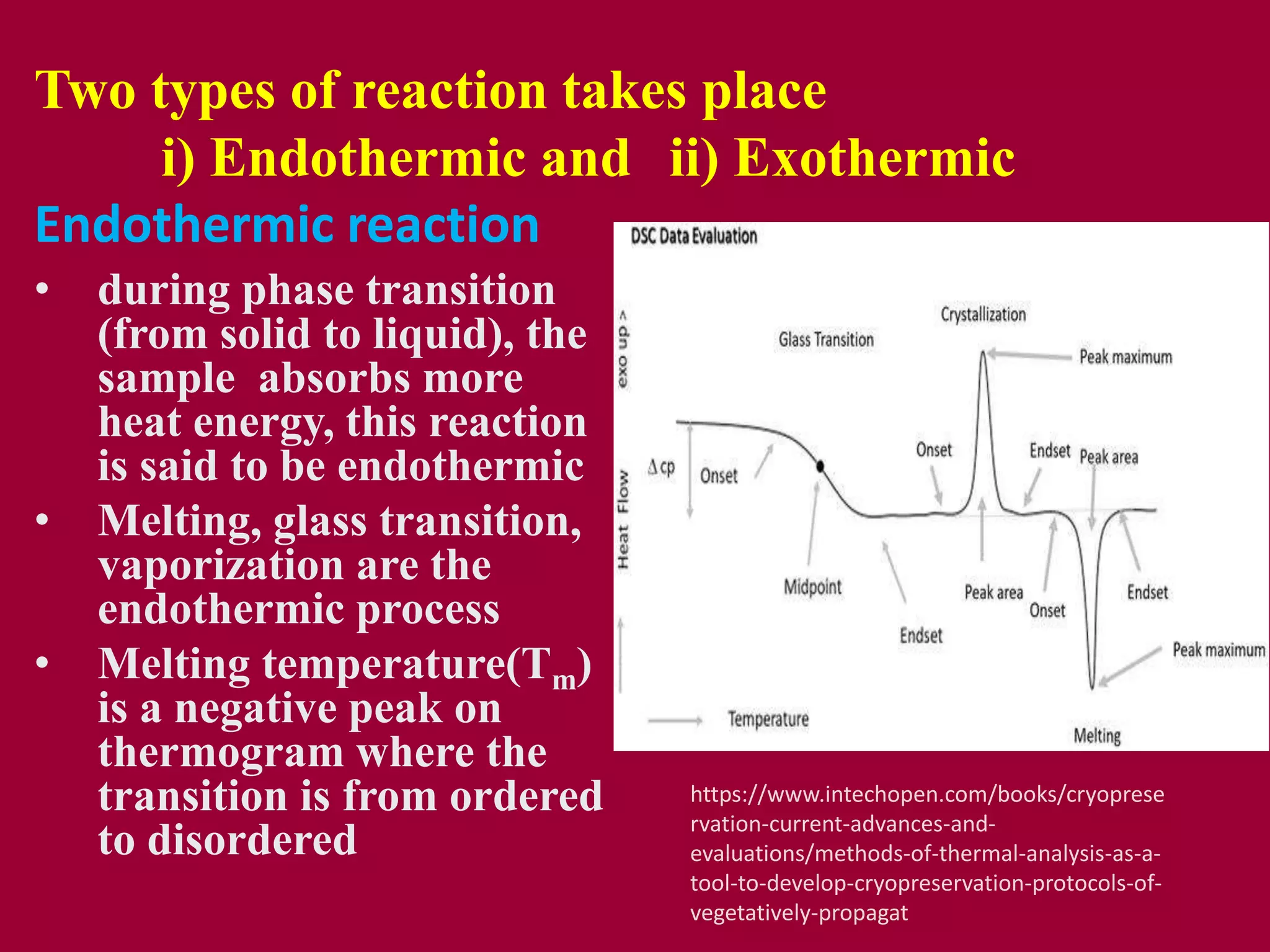
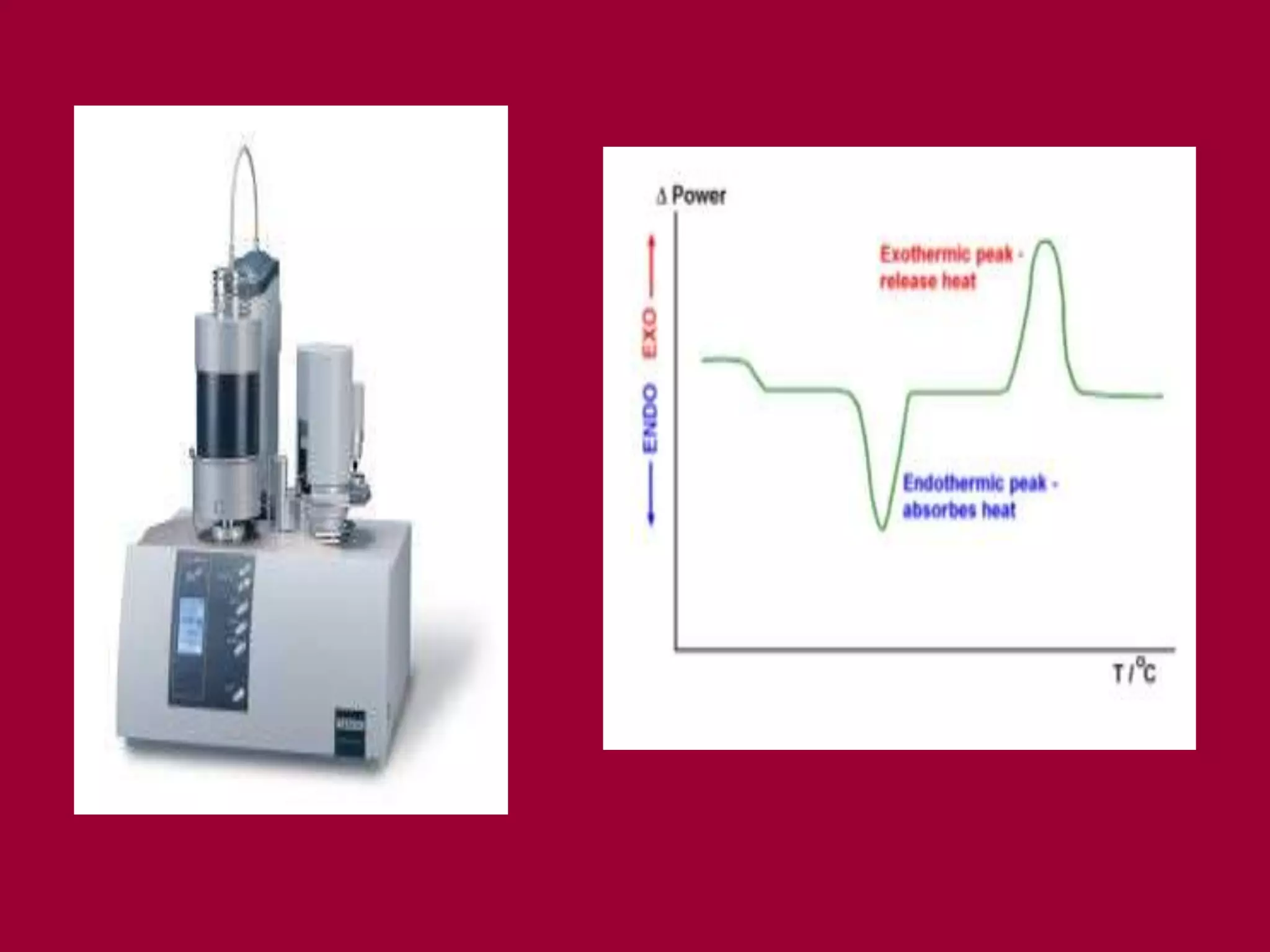
Two types ofreaction takes place
i) Endothermic and ii) Exothermic
Endothermic reaction
• during phase transition
(from solid to liquid), the
sample absorbs more
heat energy, this reaction
is said to be endothermic
• Melting, glass transition,
vaporization are the
endothermic process
• Melting temperature(Tm)
is a negative peak on
thermogram where the
transition is from ordered
to disordered
https://www.intechopen.com/books/cryoprese
rvation-current-advances-and-
evaluations/methods-of-thermal-analysis-as-a-
tool-to-develop-cryopreservation-protocols-of-
vegetatively-propagat
25.
Exothermic reaction
• duringphase transition (such as
crystallization), the sample released some
amount of heat energy, this reaction is said
to be exothermic
• crystallization, curing, oxidation,
polymerization degradation are the
exothermic process
• Crystallization temperature(TC)
it shows a positive peak on thermograms
where the transition is from disordered to
ordered and then material can crystallize
26.
Why DSC?
• apowerful technique to measure the thermal
property
• detect melting, glass transitions, percentage of
crystallinity, thermal stability, purity and
degree of curing.
• provides test data for a wide range of
materials, including pharmaceuticals, organic,
inorganic materials, chemical, minerals
petroleum, biological samples and more.
27.
Differential Thermal Analysis(DTA)
• also a thermo analytical technique.
• determine the temperature difference between
the sample and the reference
• during endothermic reaction sample temperature
will be low, than the reference
• the reverse action takes place during exothermic
• used to measure the phase transitions, such as Tg,
Tm, Tc etc.
• it is also provide the data for a materials like
composites, adhesives, chemicals,
pharmaceuticals, plastics, rubber etc.
29.
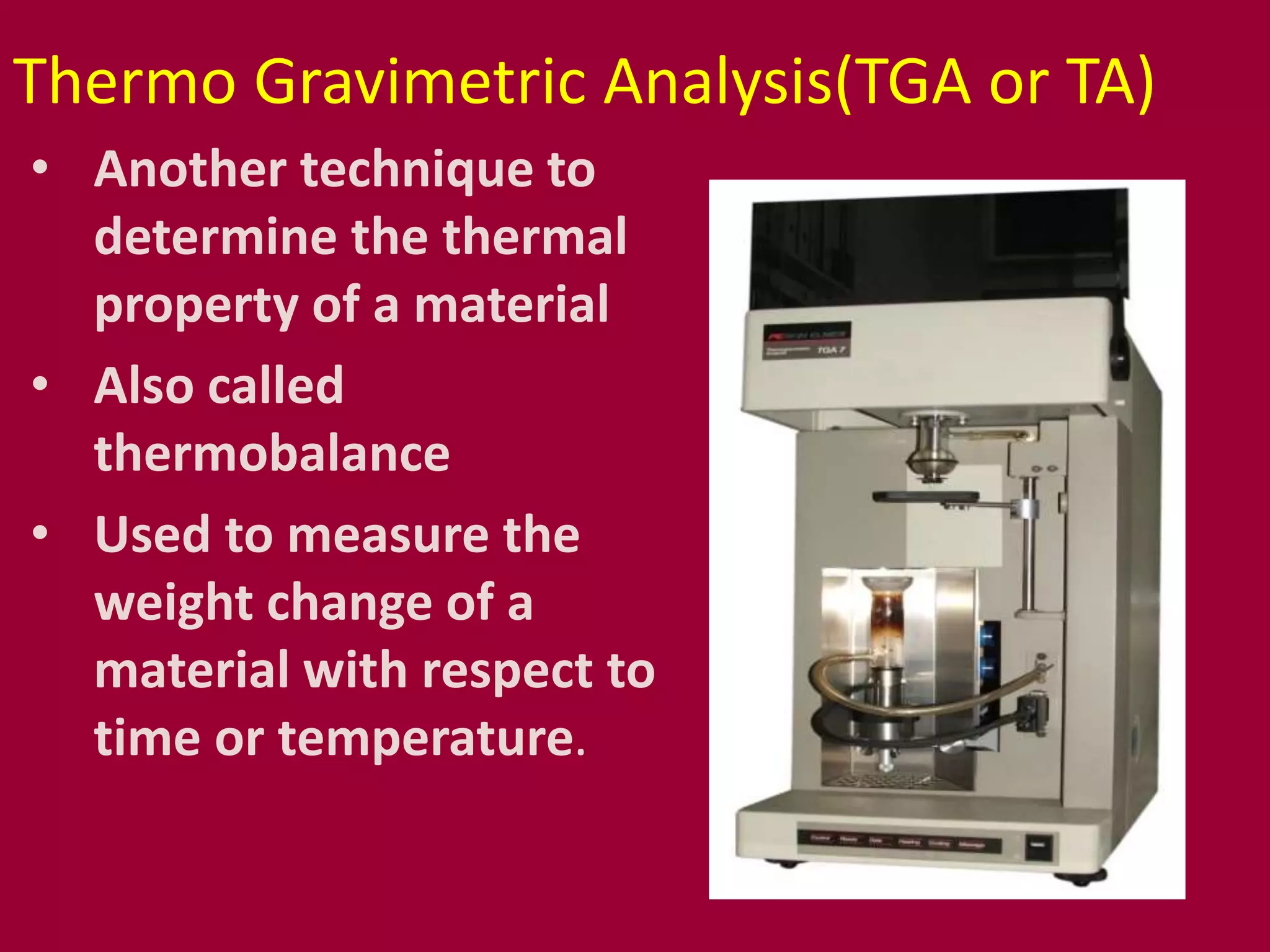
Thermo Gravimetric Analysis(TGAor TA)
• Another technique to
determine the thermal
property of a material
• Also called
thermobalance
• Used to measure the
weight change of a
material with respect to
time or temperature.
30.
Types of TGA
1)Isothermal or static thermogravimetry
2) Quasistatic thermogravimetry
3) Dynamic thermogravimetry
Applications of TGA
TGA provides an information about the
mass changes, determination of carbon black,
% of ash content, loss of water, loss of
solvent, loss of plasticizer, filler content of
polymer resins etc.
31.
Dynamic Mechanical Analysis(DMA)
• A sensitive method compared to DSC and
DTA
• Used to measure the physical properties of
materials such as storage modulus, loss
modulus, Tg, damping factor
• Used for studying the polymers viscoelastic
behavior such as thermoplastics, thermosets,
elastomers, ceramics and metals.
• measured modulus as a function of time or
temperature and give data on phase
transitions.
32.
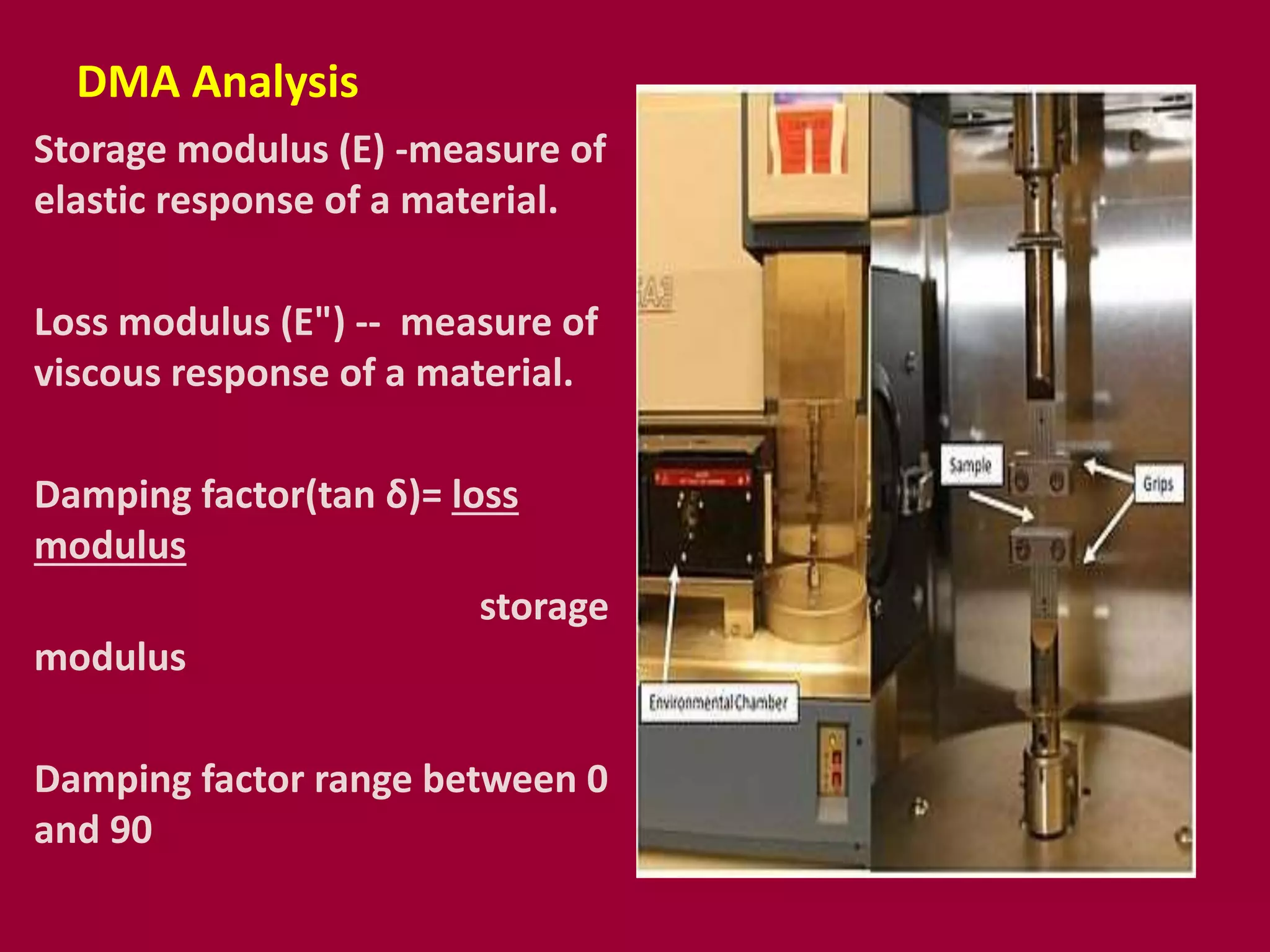
DMA Analysis
Storage modulus(E) -measure of
elastic response of a material.
Loss modulus (E") -- measure of
viscous response of a material.
Damping factor(tan δ)= loss
modulus
storage
modulus
Damping factor range between 0
and 90
33.
Thermo Mechanical Analysis(TMA)
•Used to determine measures sample
displacement (growth, shrinkage, movement,
etc.) as a function of temperature, time and
applied force.
• There is a change in dimension of sample with
respect to temperature
• A highly sensitive experiment compared to DSC
• Provides a lot of information on highly filled or
highly cross-linked materials, such as composites.
34.
WATER ABSORPTION(PMC)
• usedto determine the amount of water absorbed
• used to determine the suitability of the material for
applications that involve prolonged exposure to
water.
• mechanisms of water absorption
1. Diffusion
a) Fickian
b) Non-Fickian
c) intermediate
2. Capillary transport
3. Transport of water molecule
35.
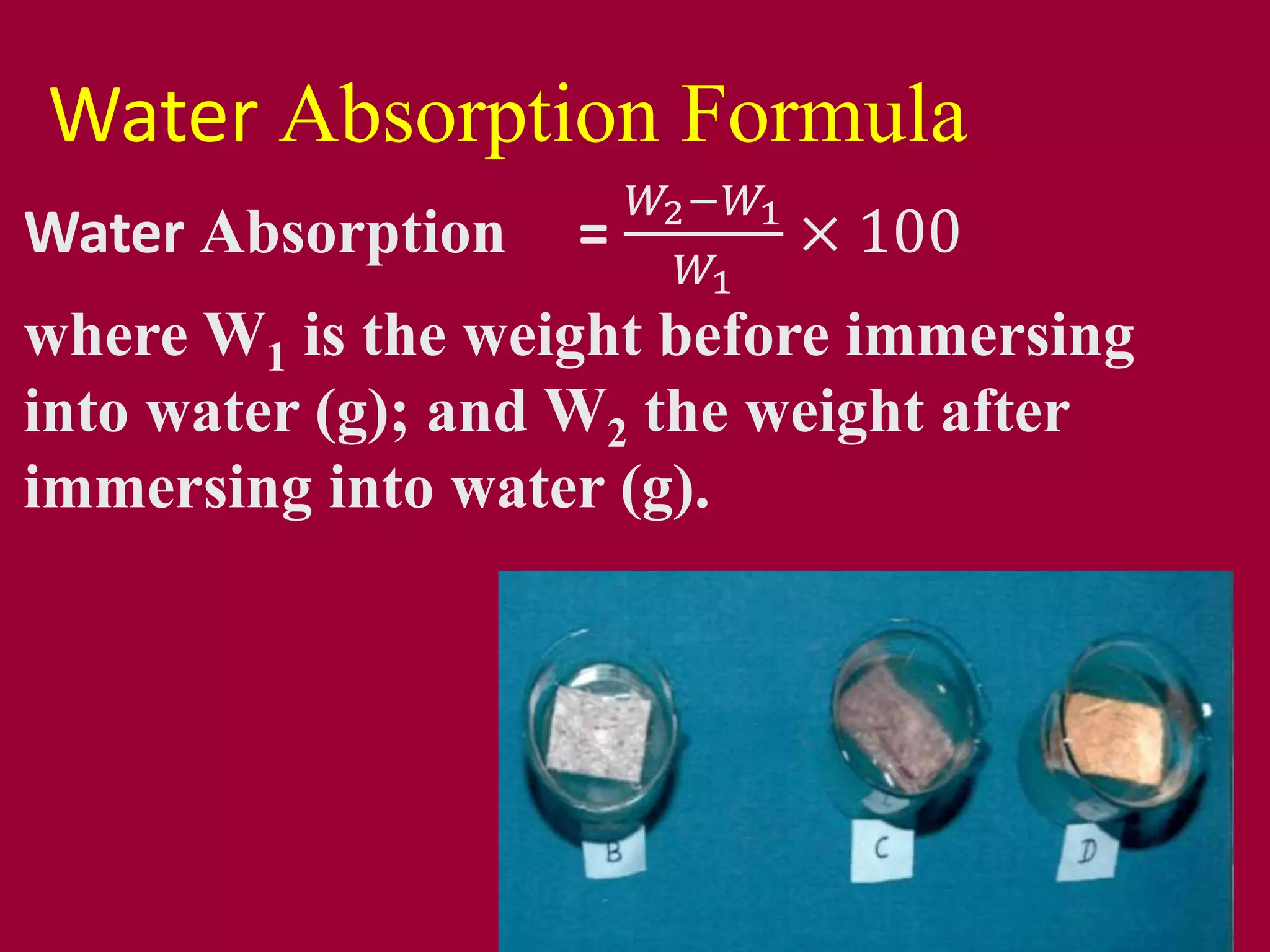
Water Absorption =
𝑊2−𝑊1
𝑊1
×100
where W1 is the weight before immersing
into water (g); and W2 the weight after
immersing into water (g).
Water Absorption Formula
36.
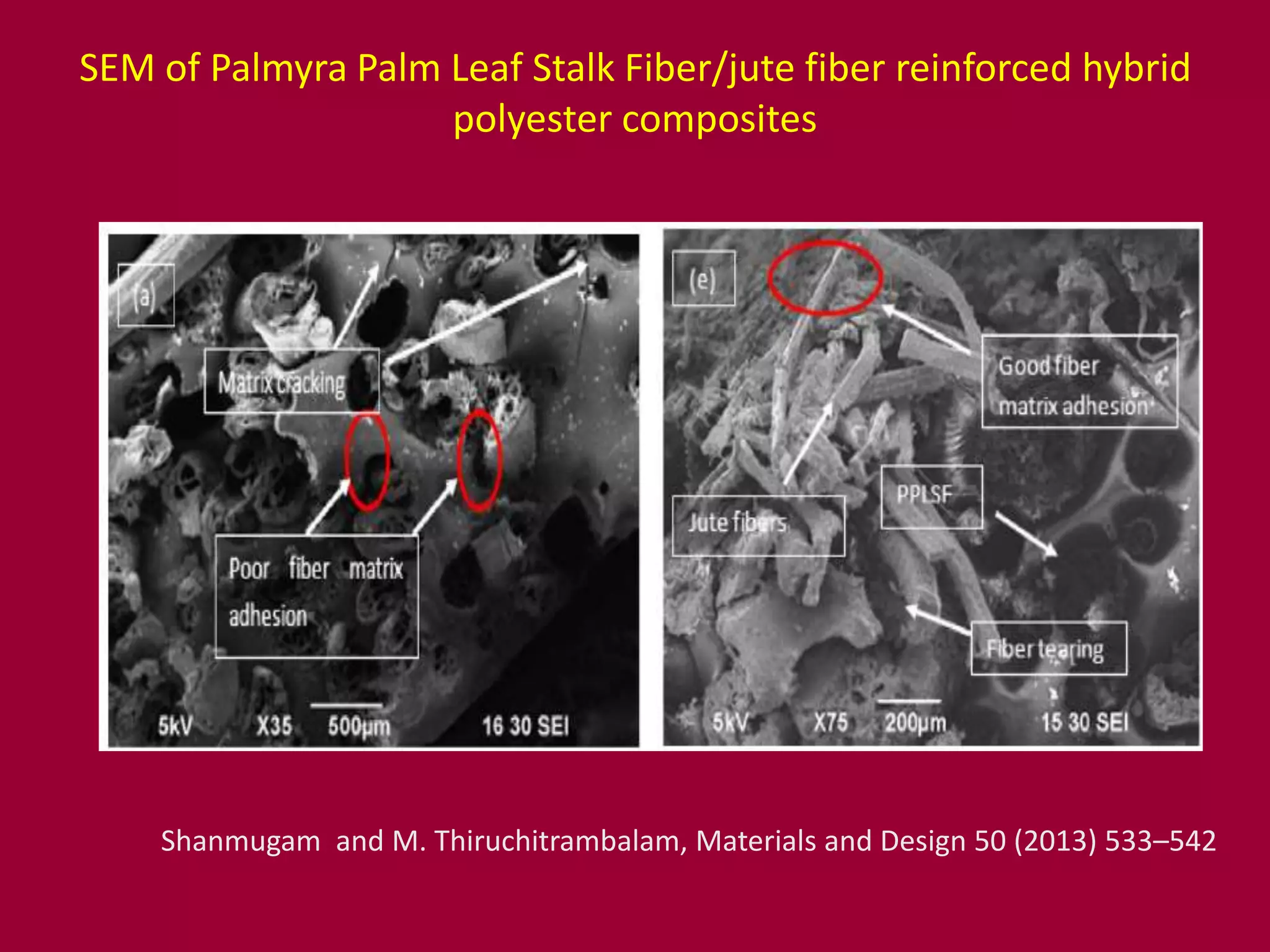
Morphological Properties
Scanning ElectronMicroscopy(SEM)
• scanning surface with a high-energy beam
of electrons.
• Various components
• information about the microstructural
information of the sample
• Resolution as close as 20 nm.
37.
SEM of PalmyraPalm Leaf Stalk Fiber/jute fiber reinforced hybrid
polyester composites
Shanmugam and M. Thiruchitrambalam, Materials and Design 50 (2013) 533–542
38.
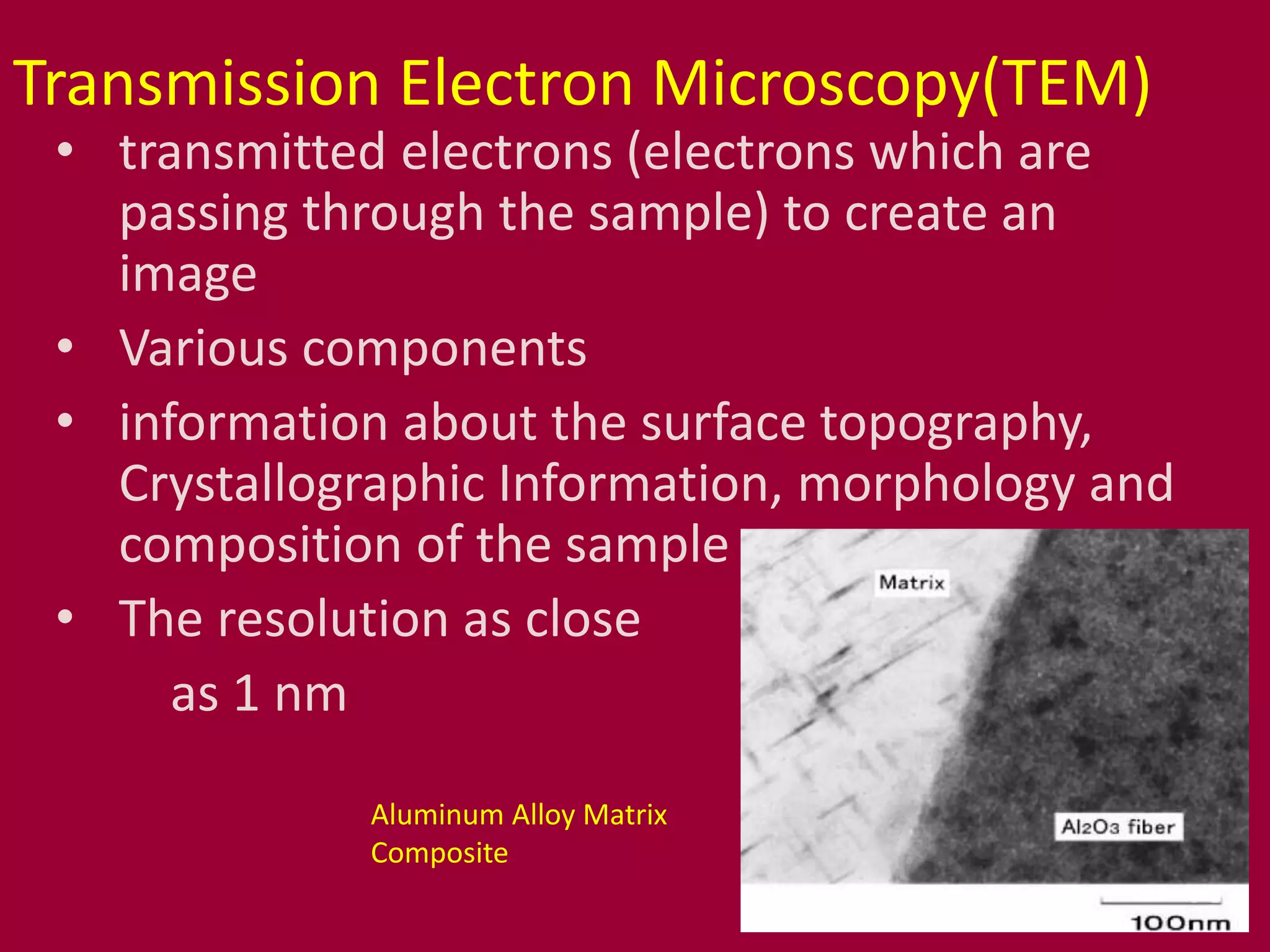
Transmission Electron Microscopy(TEM)
•transmitted electrons (electrons which are
passing through the sample) to create an
image
• Various components
• information about the surface topography,
Crystallographic Information, morphology and
composition of the sample
• The resolution as close
as 1 nm
Aluminum Alloy Matrix
Composite
a) MMCs arehigh temperature capability, no moisture
absorption, high electrical and thermal conductivities,
higher stiffness and strength
b) CMCs are chemical inertness, high strength to weight
ratio, high hardness, light in weight, corrosion resistance
in a wide range of environments and temperature
c) Green composites are biodegradable, low specific
weight results in higher specific strength and stiffness
than glass, Renewable resources, production requires
little energy, low CO2 emissions, friendly processing, low
cost and no skin irritation.
Advantages
46.
Higher cost ofmaterial systems, fabrication
methods are complex.
Reuse and disposal is difficult.
Composites have very expensive repairs and
maintenance.
Green composites - Poor moisture resistance,
Lower durability
Disadvantages