PLASTIC
Learning Outcomes; 
Define what is plastic 
Define the polymeric structure 
Differentiate between thermoset and thermoplastic 
List advantages and disadvantages of plastics application 
Explain the making of plastic products processes
What is Plastic? 
Organic polymer (synthetic / semi synthetic) 
Moldable – easy to be shaped when heated 
Categorized into two; 
i)Thermoset plastic 
ii)Thermoplastic
Terms in Polymeric Structure 
Monomer – single / small molecule 
Polymer – many monomer that held together by covalent bond in long chain. 
Polymerization- chemical reaction process that produces a polymer from its monomer. 
Amorphous – non-crystalline
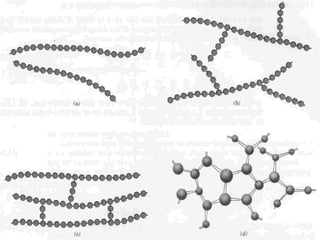
Types of Polymer Chain 
There are 4 types of polymer chains; 
a. Linear chain polymers 
- in the form of a long molecular chains 
b. Branched chain polymers 
- the linear chain with a series of branched 
c. Cross-linked chain polymers 
- with short links which connected the closer chains together 
d. Network chain polymers 
- molecular structure in 3 dimension networks
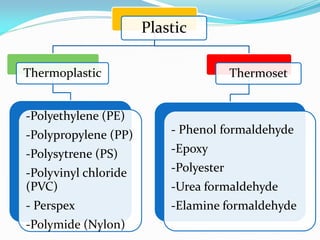
Plastic 
Thermoplastic 
-Polyethylene (PE) -Polypropylene (PP) -Polysytrene (PS) -Polyvinyl chloride (PVC) - Perspex -Polymide (Nylon) 
Thermoset 
- Phenol formaldehyde -Epoxy -Polyester -Urea formaldehyde -Elamine formaldehyde
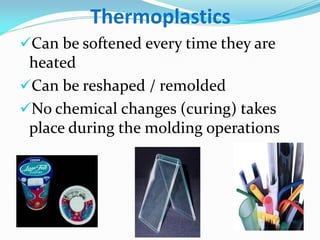
Thermoplastics 
Can be softened every time they are heated 
Can be reshaped / remolded 
No chemical changes (curing) takes place during the molding operations
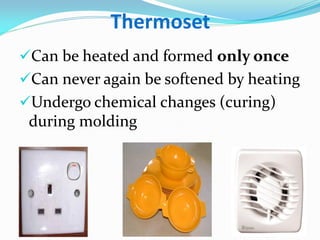
Thermoset 
Can be heated and formed only once 
Can never again be softened by heating 
Undergo chemical changes (curing) during molding
Advantages of Plastic 
1. Cheap 
2. Easily molded / shaped 
3. Corrosion resistance 
4. Light weight 
5. Transparent 
6. Water resistant 
7. Reusable & recyclable
Disadvantages of Plastic 
1. Brittle at low temperature 
2. Produce toxic fumes when its burnt 
3. Low heat resistance 
4. Softer and less elastic than metal 
5. Not biodegradable
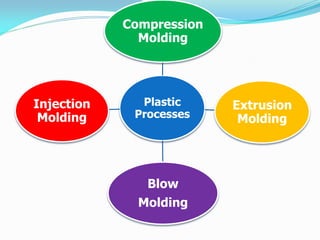
Plastic Processes 
Injection Molding 
Extrusion Molding 
Blow 
Molding 
Compression Molding
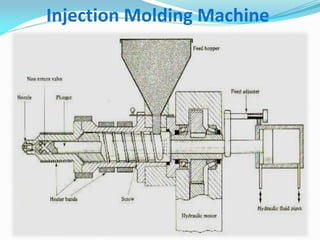
Injection Molding Process 
Work Principles; 
i)Resins inserted into hopper. 
ii)Resins goes into injection channel while softened by heater. 
iii)Softer resin injected into nozzle to the mould cavity by plunger / screw. 
iv)Product will be solidify under water cooling system. 
v)Lastly, ejector pins will ejected the product from the mould.
Injection Molding Machine
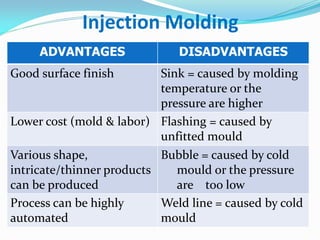
Injection Molding 
ADVANTAGES 
DISADVANTAGES 
Good surface finish 
Sink = caused by molding temperature or the pressure are higher 
Lower cost (mold & labor) 
Flashing = caused by unfitted mould 
Various shape, intricate/thinner products can be produced 
Bubble = caused by cold mould or the pressure are too low 
Process can be highly automated 
Weld line = caused by cold mould
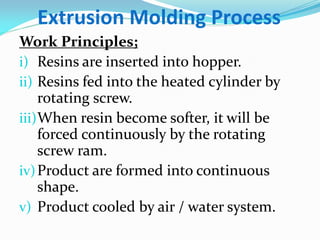
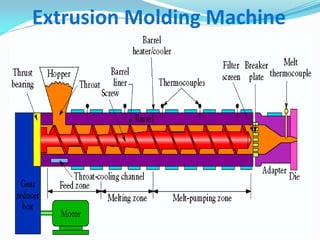
Extrusion Molding Process 
Work Principles; 
i)Resins are inserted into hopper. 
ii)Resins fed into the heated cylinder by rotating screw. 
iii)When resin become softer, it will be forced continuously by the rotating screw ram. 
iv)Product are formed into continuous shape. 
v)Product cooled by air / water system.
Extrusion Molding Machine
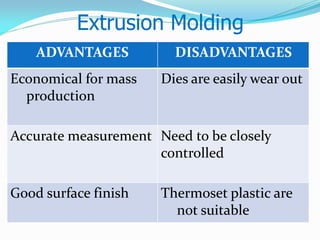
Extrusion Molding 
ADVANTAGES 
DISADVANTAGES 
Economical for mass production 
Dies are easily wear out 
Accurate measurement 
Need to be closely controlled 
Good surface finish 
Thermoset plastic are not suitable
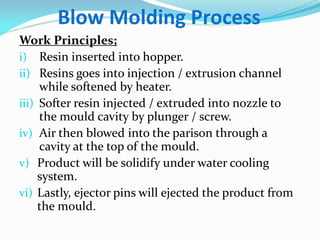
Blow Molding Process 
Work Principles; 
i)Resin inserted into hopper. 
ii)Resins goes into injection / extrusion channel while softened by heater. 
iii)Softer resin injected / extruded into nozzle to the mould cavity by plunger / screw. 
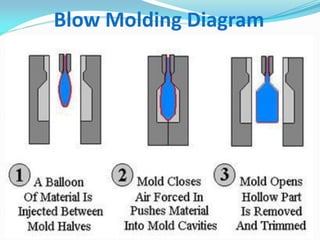
iv)Air then blowed into the parison through a cavity at the top of the mould. 
v)Product will be solidify under water cooling system. 
vi)Lastly, ejector pins will ejected the product from the mould.
Blow Molding Diagram
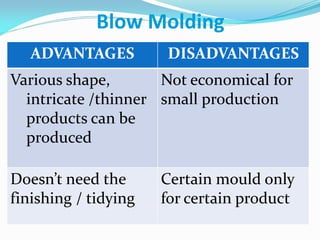
Blow Molding 
ADVANTAGES 
DISADVANTAGES 
Various shape, intricate /thinner products can be produced 
Not economical for small production 
Doesn’t need the finishing / tidying 
Certain mould only for certain product
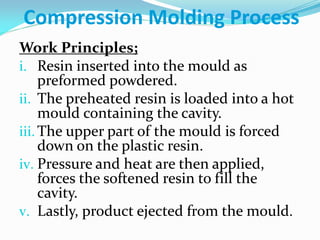
Compression Molding Process 
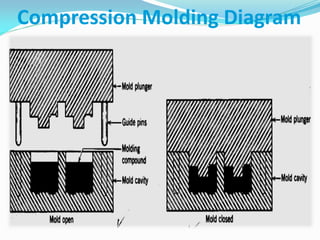
Work Principles; 
i.Resin inserted into the mould as preformed powdered. 
ii.The preheated resin is loaded into a hot mould containing the cavity. 
iii.The upper part of the mould is forced down on the plastic resin. 
iv.Pressure and heat are then applied, forces the softened resin to fill the cavity. 
v.Lastly, product ejected from the mould.
Compression Molding Diagram
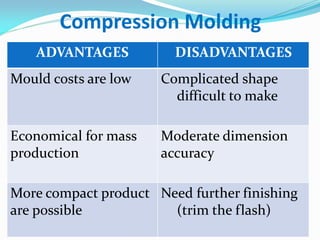
Compression Molding 
ADVANTAGES 
DISADVANTAGES 
Mould costs are low 
Complicated shape difficult to make 
Economical for mass production 
Moderate dimension accuracy 
More compact product are possible 
Need further finishing (trim the flash)

Material Technology. Chapter 6 - Plastic

  • 1.
  • 2.
    Learning Outcomes; Definewhat is plastic Define the polymeric structure Differentiate between thermoset and thermoplastic List advantages and disadvantages of plastics application Explain the making of plastic products processes
  • 3.
    What is Plastic? Organic polymer (synthetic / semi synthetic) Moldable – easy to be shaped when heated Categorized into two; i)Thermoset plastic ii)Thermoplastic
  • 4.
    Terms in PolymericStructure Monomer – single / small molecule Polymer – many monomer that held together by covalent bond in long chain. Polymerization- chemical reaction process that produces a polymer from its monomer. Amorphous – non-crystalline
  • 5.
    Types of PolymerChain There are 4 types of polymer chains; a. Linear chain polymers - in the form of a long molecular chains b. Branched chain polymers - the linear chain with a series of branched c. Cross-linked chain polymers - with short links which connected the closer chains together d. Network chain polymers - molecular structure in 3 dimension networks
  • 7.
    Plastic Thermoplastic -Polyethylene(PE) -Polypropylene (PP) -Polysytrene (PS) -Polyvinyl chloride (PVC) - Perspex -Polymide (Nylon) Thermoset - Phenol formaldehyde -Epoxy -Polyester -Urea formaldehyde -Elamine formaldehyde
  • 8.
    Thermoplastics Can besoftened every time they are heated Can be reshaped / remolded No chemical changes (curing) takes place during the molding operations
  • 9.
    Thermoset Can beheated and formed only once Can never again be softened by heating Undergo chemical changes (curing) during molding
  • 10.
    Advantages of Plastic 1. Cheap 2. Easily molded / shaped 3. Corrosion resistance 4. Light weight 5. Transparent 6. Water resistant 7. Reusable & recyclable
  • 11.
    Disadvantages of Plastic 1. Brittle at low temperature 2. Produce toxic fumes when its burnt 3. Low heat resistance 4. Softer and less elastic than metal 5. Not biodegradable
  • 12.
    Plastic Processes InjectionMolding Extrusion Molding Blow Molding Compression Molding
  • 13.
    Injection Molding Process Work Principles; i)Resins inserted into hopper. ii)Resins goes into injection channel while softened by heater. iii)Softer resin injected into nozzle to the mould cavity by plunger / screw. iv)Product will be solidify under water cooling system. v)Lastly, ejector pins will ejected the product from the mould.
  • 14.
  • 15.
    Injection Molding ADVANTAGES DISADVANTAGES Good surface finish Sink = caused by molding temperature or the pressure are higher Lower cost (mold & labor) Flashing = caused by unfitted mould Various shape, intricate/thinner products can be produced Bubble = caused by cold mould or the pressure are too low Process can be highly automated Weld line = caused by cold mould
  • 16.
    Extrusion Molding Process Work Principles; i)Resins are inserted into hopper. ii)Resins fed into the heated cylinder by rotating screw. iii)When resin become softer, it will be forced continuously by the rotating screw ram. iv)Product are formed into continuous shape. v)Product cooled by air / water system.
  • 17.
  • 18.
    Extrusion Molding ADVANTAGES DISADVANTAGES Economical for mass production Dies are easily wear out Accurate measurement Need to be closely controlled Good surface finish Thermoset plastic are not suitable
  • 19.
    Blow Molding Process Work Principles; i)Resin inserted into hopper. ii)Resins goes into injection / extrusion channel while softened by heater. iii)Softer resin injected / extruded into nozzle to the mould cavity by plunger / screw. iv)Air then blowed into the parison through a cavity at the top of the mould. v)Product will be solidify under water cooling system. vi)Lastly, ejector pins will ejected the product from the mould.
  • 20.
  • 21.
    Blow Molding ADVANTAGES DISADVANTAGES Various shape, intricate /thinner products can be produced Not economical for small production Doesn’t need the finishing / tidying Certain mould only for certain product
  • 22.
    Compression Molding Process Work Principles; i.Resin inserted into the mould as preformed powdered. ii.The preheated resin is loaded into a hot mould containing the cavity. iii.The upper part of the mould is forced down on the plastic resin. iv.Pressure and heat are then applied, forces the softened resin to fill the cavity. v.Lastly, product ejected from the mould.
  • 23.
  • 24.
    Compression Molding ADVANTAGES DISADVANTAGES Mould costs are low Complicated shape difficult to make Economical for mass production Moderate dimension accuracy More compact product are possible Need further finishing (trim the flash)