Engineering Tests
Lecture No. (2)
Faculty of Engineering
Prod. & Mech. Design Engineering Department
Dr. Rania Mostafa
Compression Test
Outline
• compression test
• test purpose
• Applications
• Limitations
• test specimen
• Test procedures
• Types of fractures
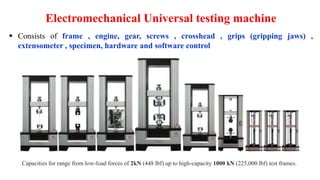
Electromechanical Universal testing machine
▪ Consists of frame , engine, gear, screws , crosshead , grips (gripping jaws) ,
extensometer , specimen, hardware and software control
Capacities for range from low-load forces of 2kN (448 lbf) up to high-capacity 1000 kN (225,000 lbf) test frames.
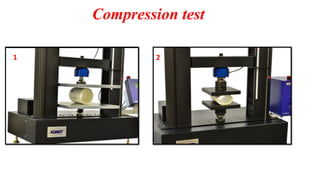
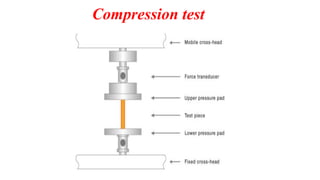
Compression test
1 2
Compression test
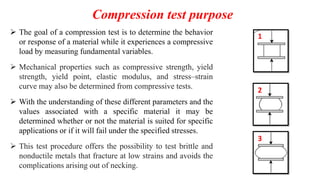
➢ The goal of a compression test is to determine the behavior
or response of a material while it experiences a compressive
load by measuring fundamental variables.
➢ Mechanical properties such as compressive strength, yield
strength, yield point, elastic modulus, and stress–strain
curve may also be determined from compressive tests.
➢ With the understanding of these different parameters and the
values associated with a specific material it may be
determined whether or not the material is suited for specific
applications or if it will fail under the specified stresses.
➢ This test procedure offers the possibility to test brittle and
nonductile metals that fracture at low strains and avoids the
complications arising out of necking.
Compression test purpose
1
2
3
Applications
➢Aerospace and Automotive Industry
➢Construction Industry
➢Cosmetics Industry
➢Electrical and Electronic Industry
➢Medical Device Industry
➢Packaging Industry
➢Paper and Board Industry
➢Plastics, Rubber and Elastomers Industry
➢Safety, Health, Fitness Industry
➢ Compression testing is usually easier to conduct than tension test and is used more
commonly at elevated temperature in plasticity or formability studies since it simulates
compressive stress as is expected under rolling, forging or extrusion operation.
Compression test Limitations
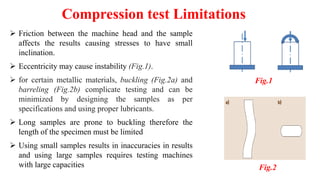
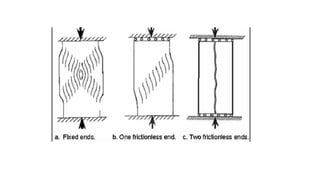
➢ Friction between the machine head and the sample
affects the results causing stresses to have small
inclination.
➢ Eccentricity may cause instability (Fig.1).
➢ for certain metallic materials, buckling (Fig.2a) and
barreling (Fig.2b) complicate testing and can be
minimized by designing the samples as per
specifications and using proper lubricants.
➢ Long samples are prone to buckling therefore the
length of the specimen must be limited
➢ Using small samples results in inaccuracies in results
and using large samples requires testing machines
with large capacities
Fig.1
Fig.2
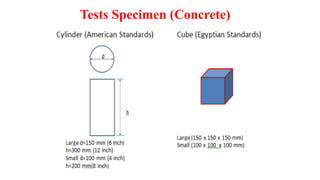
Tests Specimen (Concrete)
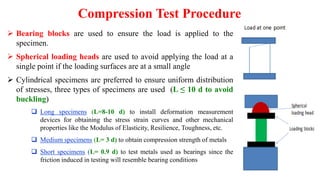
➢ Bearing blocks are used to ensure the load is applied to the
specimen.
➢ Spherical loading heads are used to avoid applying the load at a
single point if the loading surfaces are at a small angle
➢ Cylindrical specimens are preferred to ensure uniform distribution
of stresses, three types of specimens are used (L ≤ 10 d to avoid
buckling)
 Long specimens (L=8-10 d) to install deformation measurement
devices for obtaining the stress strain curves and other mechanical
properties like the Modulus of Elasticity, Resilience, Toughness, etc.
 Medium specimens (L= 3 d) to obtain compression strength of metals
 Short specimens (L= 0.9 d) to test metals used as bearings since the
friction induced in testing will resemble bearing conditions
Compression Test Procedure
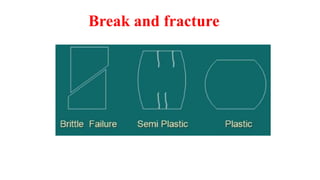
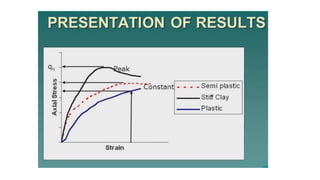
Break and fracture
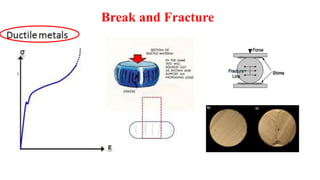
Break and Fracture
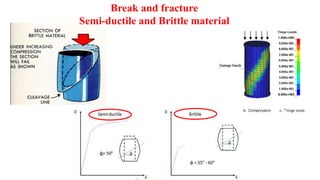
Break and fracture
Semi-ductile and Brittle material
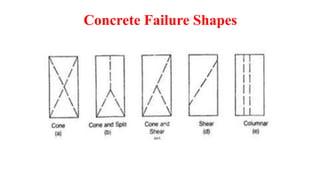
Concrete Failure Shapes
Lec 2 compression  test

Lec 2 compression test

  • 1.
    Engineering Tests Lecture No.(2) Faculty of Engineering Prod. & Mech. Design Engineering Department Dr. Rania Mostafa Compression Test
  • 2.
    Outline • compression test •test purpose • Applications • Limitations • test specimen • Test procedures • Types of fractures
  • 4.
    Electromechanical Universal testingmachine ▪ Consists of frame , engine, gear, screws , crosshead , grips (gripping jaws) , extensometer , specimen, hardware and software control Capacities for range from low-load forces of 2kN (448 lbf) up to high-capacity 1000 kN (225,000 lbf) test frames.
  • 5.
  • 6.
  • 7.
    ➢ The goalof a compression test is to determine the behavior or response of a material while it experiences a compressive load by measuring fundamental variables. ➢ Mechanical properties such as compressive strength, yield strength, yield point, elastic modulus, and stress–strain curve may also be determined from compressive tests. ➢ With the understanding of these different parameters and the values associated with a specific material it may be determined whether or not the material is suited for specific applications or if it will fail under the specified stresses. ➢ This test procedure offers the possibility to test brittle and nonductile metals that fracture at low strains and avoids the complications arising out of necking. Compression test purpose 1 2 3
  • 8.
    Applications ➢Aerospace and AutomotiveIndustry ➢Construction Industry ➢Cosmetics Industry ➢Electrical and Electronic Industry ➢Medical Device Industry ➢Packaging Industry ➢Paper and Board Industry ➢Plastics, Rubber and Elastomers Industry ➢Safety, Health, Fitness Industry ➢ Compression testing is usually easier to conduct than tension test and is used more commonly at elevated temperature in plasticity or formability studies since it simulates compressive stress as is expected under rolling, forging or extrusion operation.
  • 9.
    Compression test Limitations ➢Friction between the machine head and the sample affects the results causing stresses to have small inclination. ➢ Eccentricity may cause instability (Fig.1). ➢ for certain metallic materials, buckling (Fig.2a) and barreling (Fig.2b) complicate testing and can be minimized by designing the samples as per specifications and using proper lubricants. ➢ Long samples are prone to buckling therefore the length of the specimen must be limited ➢ Using small samples results in inaccuracies in results and using large samples requires testing machines with large capacities Fig.1 Fig.2
  • 10.
  • 12.
    ➢ Bearing blocksare used to ensure the load is applied to the specimen. ➢ Spherical loading heads are used to avoid applying the load at a single point if the loading surfaces are at a small angle ➢ Cylindrical specimens are preferred to ensure uniform distribution of stresses, three types of specimens are used (L ≤ 10 d to avoid buckling)  Long specimens (L=8-10 d) to install deformation measurement devices for obtaining the stress strain curves and other mechanical properties like the Modulus of Elasticity, Resilience, Toughness, etc.  Medium specimens (L= 3 d) to obtain compression strength of metals  Short specimens (L= 0.9 d) to test metals used as bearings since the friction induced in testing will resemble bearing conditions Compression Test Procedure
  • 13.
  • 14.
  • 15.
    Break and fracture Semi-ductileand Brittle material
  • 17.