COMPOSITES AND IT’S MANUFACTURING
Prepared by : Harsh B Joshi
(M.Tech Production Engineering, 2nd Semester)
Parul Institute of Engineering, Limda
PRESENTATION MAP
 WHAT IS COMPOSITE ?
 TYPES OF COMPOSITES
 MANUFACTURING
 DELAMINATION
WHAT IS COMPOSITE ?
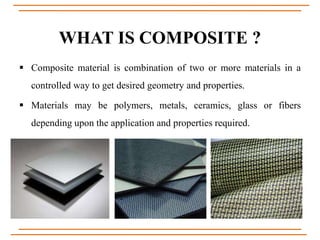
 Composite material is combination of two or more materials in a
controlled way to get desired geometry and properties.
 Materials may be polymers, metals, ceramics, glass or fibers
depending upon the application and properties required.
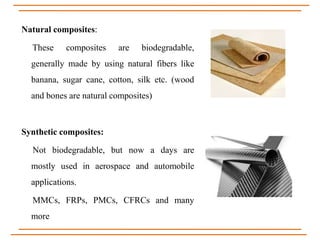
Natural composites:
These composites are biodegradable,
generally made by using natural fibers like
banana, sugar cane, cotton, silk etc. (wood
and bones are natural composites)
Synthetic composites:
Not biodegradable, but now a days are
mostly used in aerospace and automobile
applications.
MMCs, FRPs, PMCs, CFRCs and many
more
WHY COMPOSITES ?
 Engineering applications often require unusual combinations of
properties like aerospace, underwater, and transportation that can’t be
achieved with a single material.
 Lets think about aerospace, which requires strong, stiff and light
material
• most strong, stiff materials are dense and heavy
So ,the solution is in composite materials.
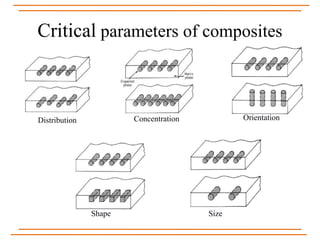
Critical parameters of composites
Distribution Concentration Orientation
Shape Size
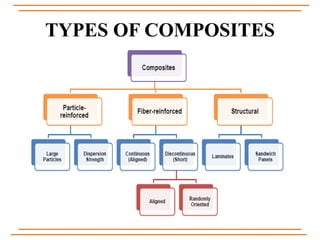
TYPES OF COMPOSITES
Fiber Reinforced Composites
Consists of two phases:
1.Fiber phase: Reinforced medium which is covered by matrix.
- whiskers
- fibers
- wires forms of fibers are used.
2.Matrix phase: Outer most medium to protect the fiber from
wear, abrasion and corrosion. Generally, only polymers and metals
are used as matrix material.
Examples of FRC are PMCs, MMCs, CCCs, CMCs etc.
Structural composites
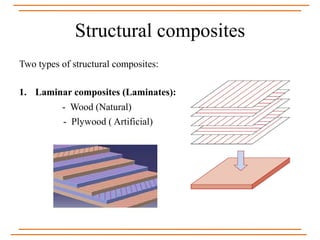
Two types of structural composites:
1. Laminar composites (Laminates):
- Wood (Natural)
- Plywood ( Artificial)
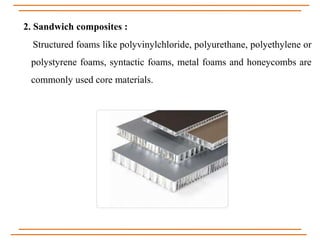
2. Sandwich composites :
Structured foams like polyvinylchloride, polyurethane, polyethylene or
polystyrene foams, syntactic foams, metal foams and honeycombs are
commonly used core materials.
Manufacturing of composites
 The manufacturing of the composites includes following:
PROCESSING and SHAPING
 There are some manufacturing processes for Composites are listed below:
1. FILAMENT WINDING
2. PULTRUSION
3. PREPREGING
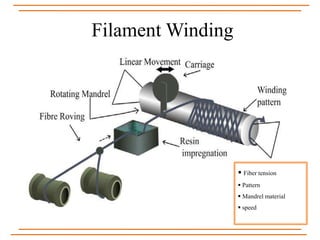
Filament Winding
 Fiber tension
 Pattern
 Mandrel material
 speed
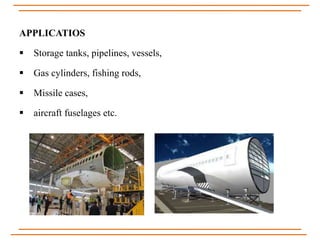
APPLICATIOS
 Storage tanks, pipelines, vessels,
 Gas cylinders, fishing rods,
 Missile cases,
 aircraft fuselages etc.
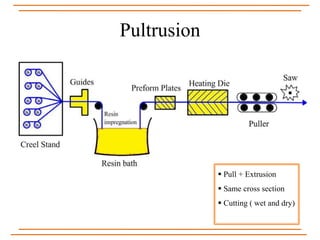
Pultrusion
 Pull + Extrusion
 Same cross section
 Cutting ( wet and dry)
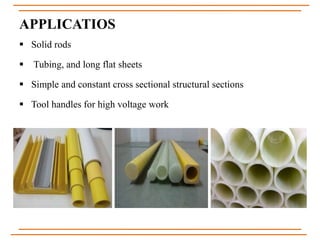
APPLICATIOS
 Solid rods
 Tubing, and long flat sheets
 Simple and constant cross sectional structural sections
 Tool handles for high voltage work
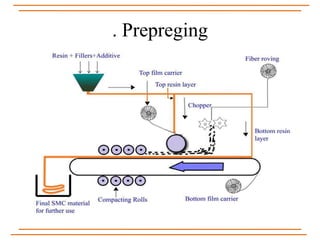
. Prepreging
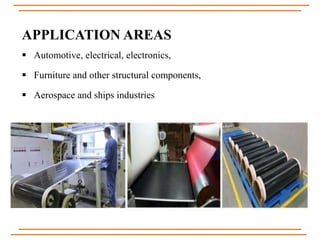
APPLICATION AREAS
 Automotive, electrical, electronics,
 Furniture and other structural components,
 Aerospace and ships industries
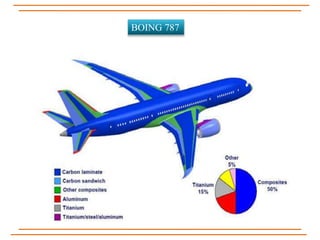
BOING 787
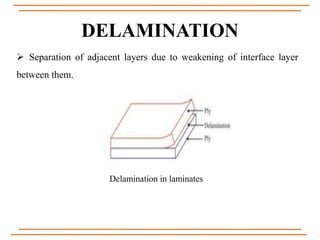
DELAMINATION
 Separation of adjacent layers due to weakening of interface layer
between them.
Delamination in laminates
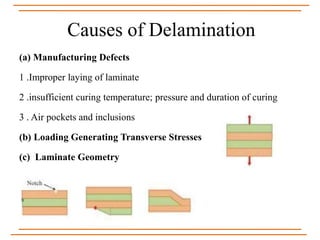
Causes of Delamination
(a) Manufacturing Defects
1 .Improper laying of laminate
2 .insufficient curing temperature; pressure and duration of curing
3 . Air pockets and inclusions
(b) Loading Generating Transverse Stresses
(c) Laminate Geometry
THANK YOU
For your carefully listening and attention..!

Composites and it's manufacturing

  • 1.
    COMPOSITES AND IT’SMANUFACTURING Prepared by : Harsh B Joshi (M.Tech Production Engineering, 2nd Semester) Parul Institute of Engineering, Limda
  • 2.
    PRESENTATION MAP  WHATIS COMPOSITE ?  TYPES OF COMPOSITES  MANUFACTURING  DELAMINATION
  • 3.
    WHAT IS COMPOSITE?  Composite material is combination of two or more materials in a controlled way to get desired geometry and properties.  Materials may be polymers, metals, ceramics, glass or fibers depending upon the application and properties required.
  • 4.
    Natural composites: These compositesare biodegradable, generally made by using natural fibers like banana, sugar cane, cotton, silk etc. (wood and bones are natural composites) Synthetic composites: Not biodegradable, but now a days are mostly used in aerospace and automobile applications. MMCs, FRPs, PMCs, CFRCs and many more
  • 5.
    WHY COMPOSITES ? Engineering applications often require unusual combinations of properties like aerospace, underwater, and transportation that can’t be achieved with a single material.  Lets think about aerospace, which requires strong, stiff and light material • most strong, stiff materials are dense and heavy So ,the solution is in composite materials.
  • 6.
    Critical parameters ofcomposites Distribution Concentration Orientation Shape Size
  • 7.
  • 8.
    Fiber Reinforced Composites Consistsof two phases: 1.Fiber phase: Reinforced medium which is covered by matrix. - whiskers - fibers - wires forms of fibers are used. 2.Matrix phase: Outer most medium to protect the fiber from wear, abrasion and corrosion. Generally, only polymers and metals are used as matrix material. Examples of FRC are PMCs, MMCs, CCCs, CMCs etc.
  • 9.
    Structural composites Two typesof structural composites: 1. Laminar composites (Laminates): - Wood (Natural) - Plywood ( Artificial)
  • 10.
    2. Sandwich composites: Structured foams like polyvinylchloride, polyurethane, polyethylene or polystyrene foams, syntactic foams, metal foams and honeycombs are commonly used core materials.
  • 11.
    Manufacturing of composites The manufacturing of the composites includes following: PROCESSING and SHAPING  There are some manufacturing processes for Composites are listed below: 1. FILAMENT WINDING 2. PULTRUSION 3. PREPREGING
  • 12.
    Filament Winding  Fibertension  Pattern  Mandrel material  speed
  • 13.
    APPLICATIOS  Storage tanks,pipelines, vessels,  Gas cylinders, fishing rods,  Missile cases,  aircraft fuselages etc.
  • 14.
    Pultrusion  Pull +Extrusion  Same cross section  Cutting ( wet and dry)
  • 15.
    APPLICATIOS  Solid rods Tubing, and long flat sheets  Simple and constant cross sectional structural sections  Tool handles for high voltage work
  • 16.
  • 17.
    APPLICATION AREAS  Automotive,electrical, electronics,  Furniture and other structural components,  Aerospace and ships industries
  • 18.
  • 19.
    DELAMINATION  Separation ofadjacent layers due to weakening of interface layer between them. Delamination in laminates
  • 20.
    Causes of Delamination (a)Manufacturing Defects 1 .Improper laying of laminate 2 .insufficient curing temperature; pressure and duration of curing 3 . Air pockets and inclusions (b) Loading Generating Transverse Stresses (c) Laminate Geometry
  • 21.
    THANK YOU For yourcarefully listening and attention..!