 Clinical condition of multiple origin,
characterised by the frequent passage of
blood stained mucopurulent stools.
 Two common types:
 Bacillary
 amoebic
• Tribe – Escherechiae
• Genus – Shigella
• Species – S. flexneri – Flexner (1900),
S. sonne – Sonne (1915), S. boydii – Boyd
(1931)
•GN rods, non-motile, non-sporing, non-
capsulated, fimbriae may be present
•Aerobes and facultative anaerobes, 10–40°C
•Nutrient agar – 2–3 mm translucent colonies,
S. sonnei – larger and opaque
•MA – NLF, S. sonnei – LLF
•DCA – selective medium – colourless colonies
•XLD – xylose lysine deoxycholate – red
colonies
•SS – Salmonella, Shigella – colourless colonies
•Enrichment media – selenite F broth
•Transport medium – 30% buffer glycerol
saline solution
•Biochemical reactions
•MR +ve, reduce nitrates – nitrites, NLF/LLF,
VP, citrate −ve
• Mannitol non-fermenter, S. dysenteriae type 1
• 12 serotypes, type 1; only member that is Sh. shigae,
catalase negative
• Exotoxin – Shiga toxin
• 3 types of toxic activity have been demonstrated
• Neurotoxicity – blood vessels – CNS
• Enterotoxicity – induce inflammation of the epithelial
cells. By decreased secretion of interleukin-8
• cytotoxicity causes cytopathic changes in Vero cells.
Verotoxin it has two subunits B, A–A1 inactivates host
cell 60 s ribosome, interfering with protein synthesis
•Sh. schmitzi – indole +ve, ferments sorbitol
and rhamnose
•Serotypes 3-7 ; Large and Sachs (India)
•Flexner – mannitol fermenting Philippines
(1900)
•Antigenically most complex – six serotypes
(1–6) and several subtypes (1a, 1b; 2a, 2b;
3a, 3b, 3c; 4a, 4b; 5a, 5b), two antigenic
variants – X and Y are recognised which lack
the type specific antigens
•Boyd – India – 1931
•18 serotypes
•Isolated least frequently – bacillary dysentery
•Resembles Sh. flexneri biochemically not
antigenically
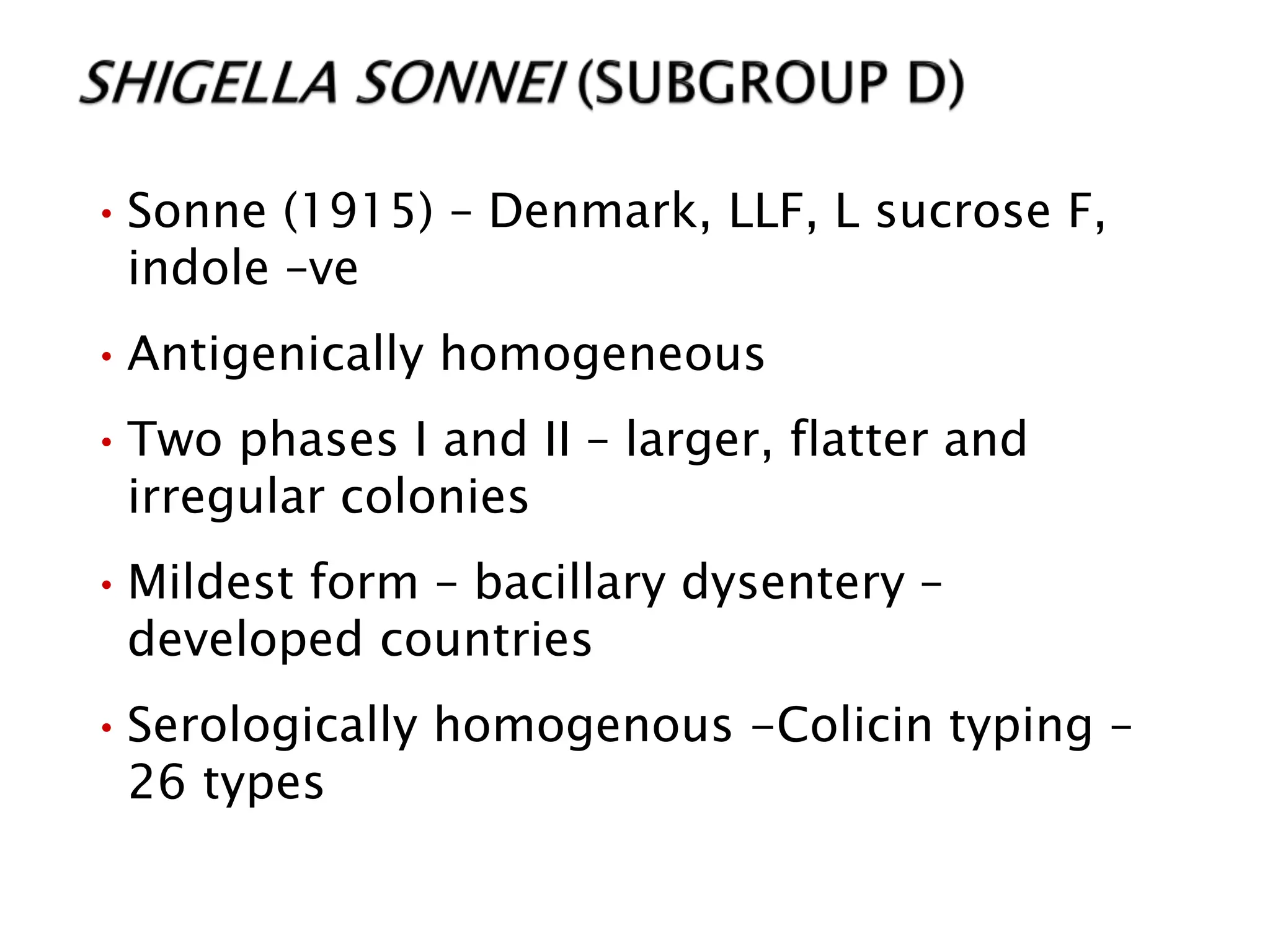
•Sonne (1915) – Denmark, LLF, L sucrose F,
indole –ve
•Antigenically homogeneous
•Two phases I and II – larger, flatter and
irregular colonies
•Mildest form – bacillary dysentery –
developed countries
•Serologically homogenous -Colicin typing –
26 types
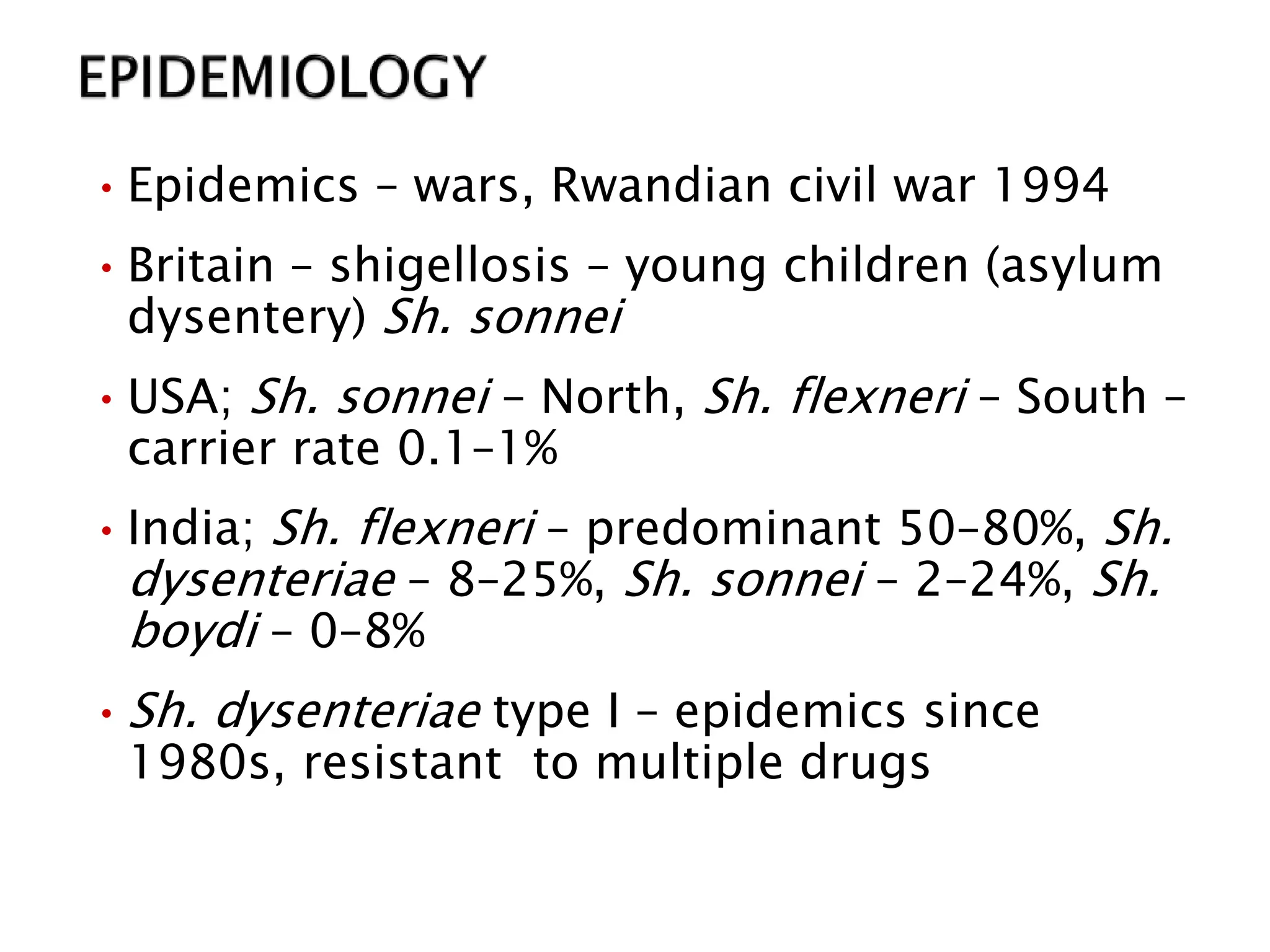
•Epidemics – wars, Rwandian civil war 1994
•Britain – shigellosis – young children (asylum
dysentery) Sh. sonnei
•USA; Sh. sonnei – North, Sh. flexneri – South –
carrier rate 0.1–1%
•India; Sh. flexneri – predominant 50–80%, Sh.
dysenteriae – 8–25%, Sh. sonnei – 2–24%, Sh.
boydi – 0–8%
•Sh. dysenteriae type I – epidemics since
1980s, resistant to multiple drugs
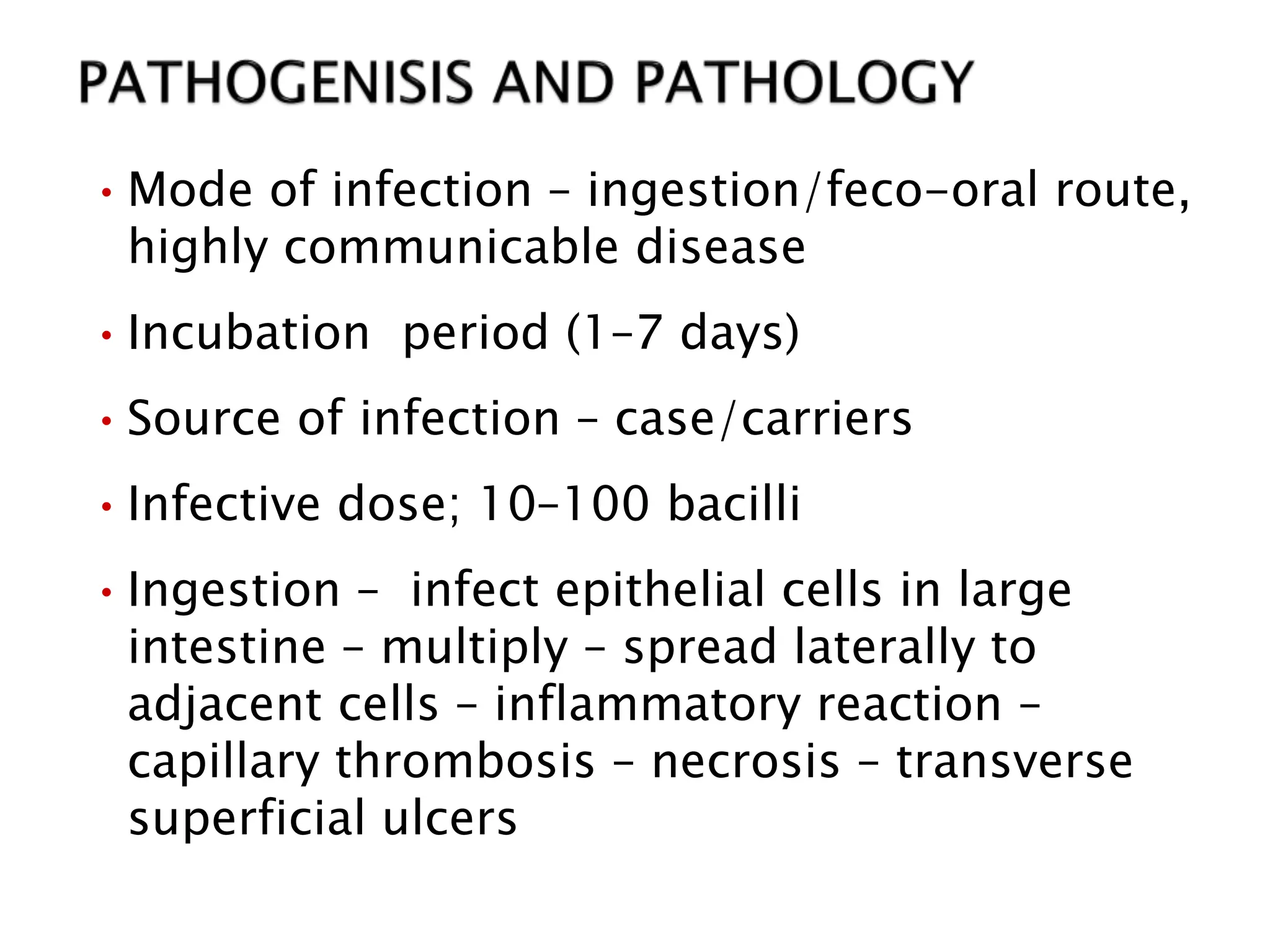
•Mode of infection – ingestion/feco-oral route,
highly communicable disease
•Incubation period (1–7 days)
•Source of infection – case/carriers
•Infective dose; 10–100 bacilli
•Ingestion – infect epithelial cells in large
intestine – multiply – spread laterally to
adjacent cells – inflammatory reaction –
capillary thrombosis – necrosis – transverse
superficial ulcers
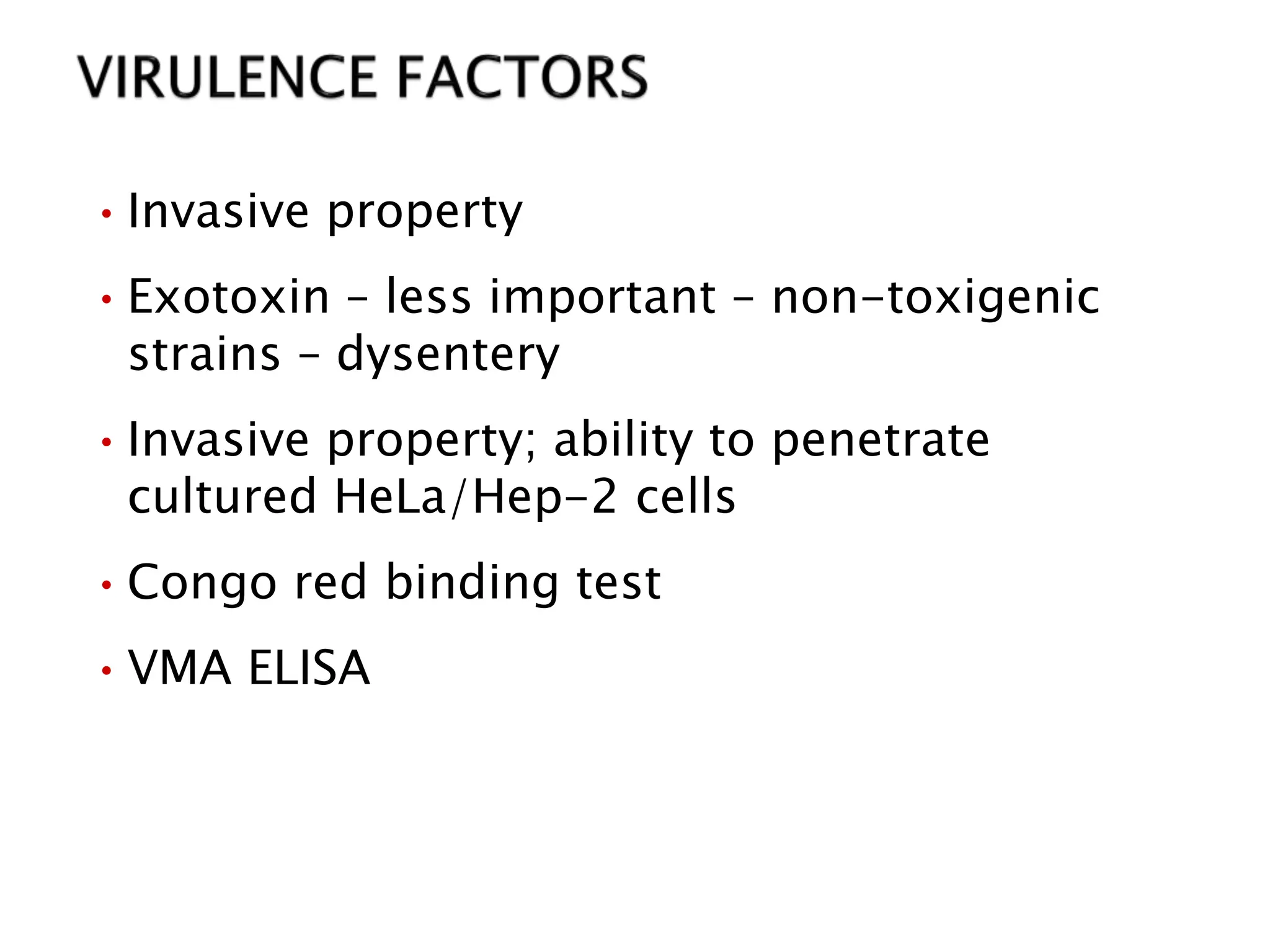
•Invasive property
•Exotoxin – less important – non-toxigenic
strains – dysentery
•Invasive property; ability to penetrate
cultured HeLa/Hep-2 cells
•Congo red binding test
•VMA ELISA
•Dysentery – loose scanty feces – blood and
mucus
•Fever and vomiting
•Arthritis, toxic neuritis, conjunctivitis,
parotitis, intussusception, hemolytic uremic
syndrome
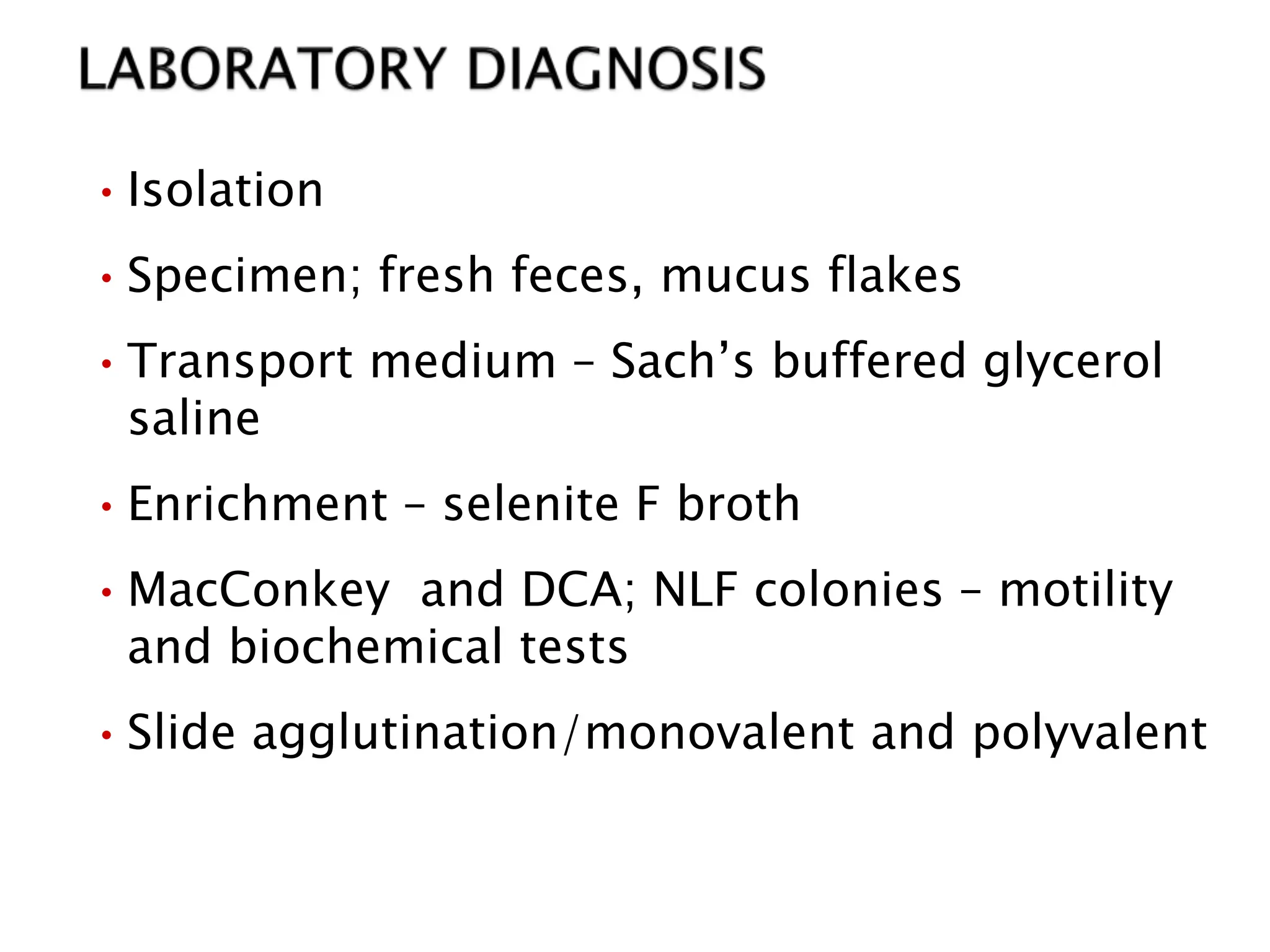
•Isolation
•Specimen; fresh feces, mucus flakes
•Transport medium – Sach’s buffered glycerol
saline
•Enrichment – selenite F broth
•MacConkey and DCA; NLF colonies – motility
and biochemical tests
•Slide agglutination/monovalent and polyvalent
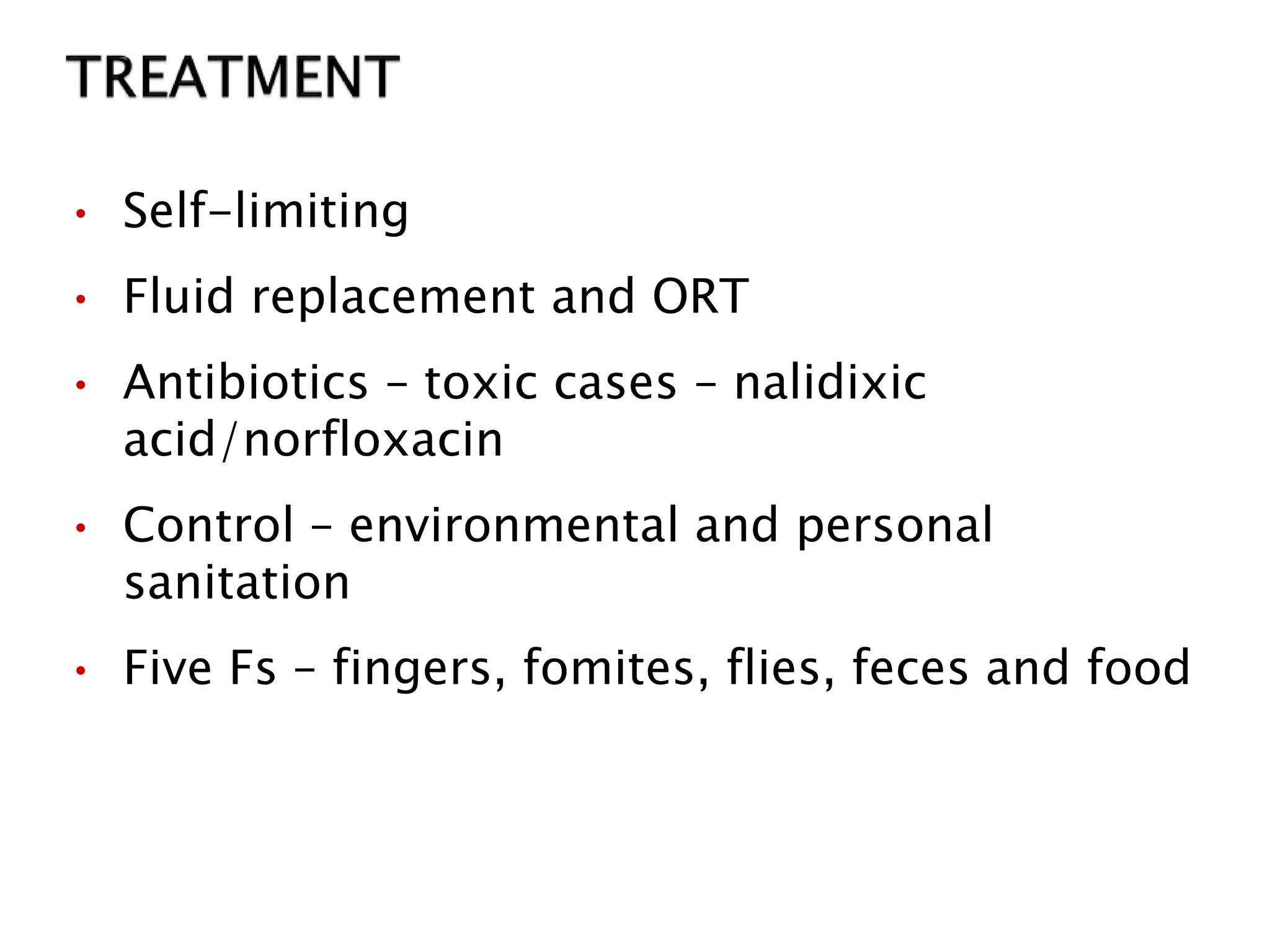
• Self-limiting
• Fluid replacement and ORT
• Antibiotics – toxic cases – nalidixic
acid/norfloxacin
• Control – environmental and personal
sanitation
• Five Fs – fingers, fomites, flies, feces and food

shigella 1 powerpoint presentation. ppt x

  • 2.
     Clinical conditionof multiple origin, characterised by the frequent passage of blood stained mucopurulent stools.  Two common types:  Bacillary  amoebic
  • 3.
    • Tribe –Escherechiae • Genus – Shigella • Species – S. flexneri – Flexner (1900), S. sonne – Sonne (1915), S. boydii – Boyd (1931)
  • 4.
    •GN rods, non-motile,non-sporing, non- capsulated, fimbriae may be present •Aerobes and facultative anaerobes, 10–40°C •Nutrient agar – 2–3 mm translucent colonies, S. sonnei – larger and opaque
  • 5.
    •MA – NLF,S. sonnei – LLF •DCA – selective medium – colourless colonies •XLD – xylose lysine deoxycholate – red colonies •SS – Salmonella, Shigella – colourless colonies
  • 6.
    •Enrichment media –selenite F broth •Transport medium – 30% buffer glycerol saline solution •Biochemical reactions •MR +ve, reduce nitrates – nitrites, NLF/LLF, VP, citrate −ve
  • 7.
    • Mannitol non-fermenter,S. dysenteriae type 1 • 12 serotypes, type 1; only member that is Sh. shigae, catalase negative • Exotoxin – Shiga toxin • 3 types of toxic activity have been demonstrated • Neurotoxicity – blood vessels – CNS • Enterotoxicity – induce inflammation of the epithelial cells. By decreased secretion of interleukin-8 • cytotoxicity causes cytopathic changes in Vero cells. Verotoxin it has two subunits B, A–A1 inactivates host cell 60 s ribosome, interfering with protein synthesis
  • 8.
    •Sh. schmitzi –indole +ve, ferments sorbitol and rhamnose •Serotypes 3-7 ; Large and Sachs (India)
  • 9.
    •Flexner – mannitolfermenting Philippines (1900) •Antigenically most complex – six serotypes (1–6) and several subtypes (1a, 1b; 2a, 2b; 3a, 3b, 3c; 4a, 4b; 5a, 5b), two antigenic variants – X and Y are recognised which lack the type specific antigens
  • 10.
    •Boyd – India– 1931 •18 serotypes •Isolated least frequently – bacillary dysentery •Resembles Sh. flexneri biochemically not antigenically
  • 11.
    •Sonne (1915) –Denmark, LLF, L sucrose F, indole –ve •Antigenically homogeneous •Two phases I and II – larger, flatter and irregular colonies •Mildest form – bacillary dysentery – developed countries •Serologically homogenous -Colicin typing – 26 types
  • 12.
    •Epidemics – wars,Rwandian civil war 1994 •Britain – shigellosis – young children (asylum dysentery) Sh. sonnei •USA; Sh. sonnei – North, Sh. flexneri – South – carrier rate 0.1–1% •India; Sh. flexneri – predominant 50–80%, Sh. dysenteriae – 8–25%, Sh. sonnei – 2–24%, Sh. boydi – 0–8% •Sh. dysenteriae type I – epidemics since 1980s, resistant to multiple drugs
  • 13.
    •Mode of infection– ingestion/feco-oral route, highly communicable disease •Incubation period (1–7 days) •Source of infection – case/carriers •Infective dose; 10–100 bacilli •Ingestion – infect epithelial cells in large intestine – multiply – spread laterally to adjacent cells – inflammatory reaction – capillary thrombosis – necrosis – transverse superficial ulcers
  • 14.
    •Invasive property •Exotoxin –less important – non-toxigenic strains – dysentery •Invasive property; ability to penetrate cultured HeLa/Hep-2 cells •Congo red binding test •VMA ELISA
  • 15.
    •Dysentery – loosescanty feces – blood and mucus •Fever and vomiting •Arthritis, toxic neuritis, conjunctivitis, parotitis, intussusception, hemolytic uremic syndrome
  • 16.
    •Isolation •Specimen; fresh feces,mucus flakes •Transport medium – Sach’s buffered glycerol saline •Enrichment – selenite F broth •MacConkey and DCA; NLF colonies – motility and biochemical tests •Slide agglutination/monovalent and polyvalent
  • 17.
    • Self-limiting • Fluidreplacement and ORT • Antibiotics – toxic cases – nalidixic acid/norfloxacin • Control – environmental and personal sanitation • Five Fs – fingers, fomites, flies, feces and food