Shift share analysis is a traditional tool; through a descriptive analysis
of the productive structure, it allows the comparison of regional
differences within a country, region or state (SIMÕES, 2004).

The

analysis

is

primarily

used

to

decompose

employment

changes, change in gross domestic product etc. within an economy over
a specific period of time.

Can be used to analyze individual industries or the whole economy.


National Share (NS) Component
 Share of regional job growth attributable to growth of the

national economy
 “If the regional industry grew at the industry’s national

growth rate, what would be the result?”

NS

t
ir

E

t 1
ir

t
EUS
1
t 1
EUS


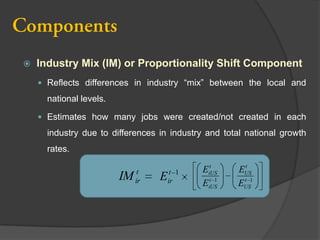
Industry Mix (IM) or Proportionality Shift Component
 Reflects differences in industry “mix” between the local and

national levels.
 Estimates how many jobs were created/not created in each

industry due to differences in industry and total national growth
rates.

IM

t
ir

t
Eir 1

t
EiUS
t 1
EiUS

t
EUS
t
EUS1


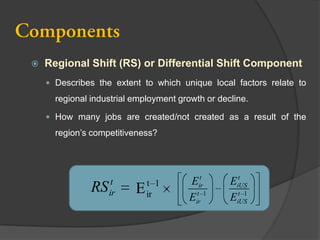
Regional Shift (RS) or Differential Shift Component
 Describes the extent to which unique local factors relate to

regional industrial employment growth or decline.
 How many jobs are created/not created as a result of the

region’s competitiveness?

RS

t
ir

E

t 1
ir

t
Eir
t
Eir 1

t
EiUS
t 1
EiUS
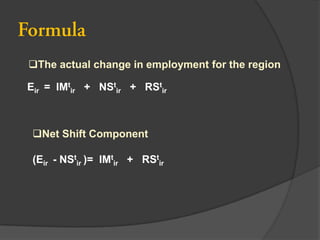
The actual change in employment for the region
Eir = IMtir + NStir + RStir

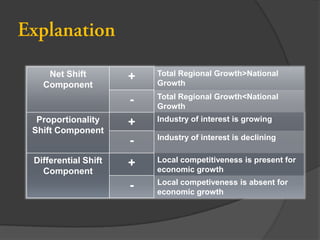
Net Shift Component
(Eir - NStir )= IMtir + RStir
+

Total Regional Growth>National
Growth

-

Total Regional Growth<National
Growth

Proportionality
Shift Component

+
-

Industry of interest is growing

Differential Shift
Component

+

Local competitiveness is present for
economic growth

-

Local competiveness is absent for
economic growth

Net Shift
Component

Industry of interest is declining
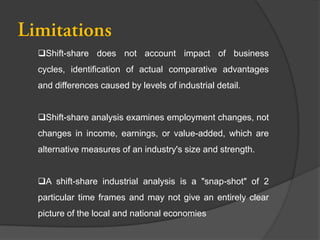
Shift-share does not account impact of business
cycles, identification of actual comparative advantages

and differences caused by levels of industrial detail.
Shift-share analysis examines employment changes, not
changes in income, earnings, or value-added, which are
alternative measures of an industry's size and strength.
A shift-share industrial analysis is a "snap-shot" of 2

particular time frames and may not give an entirely clear
picture of the local and national economies
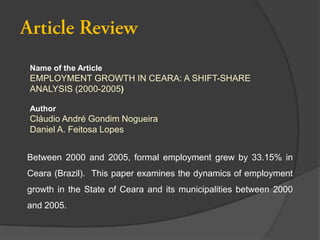
Name of the Article

EMPLOYMENT GROWTH IN CEARA: A SHIFT-SHARE
ANALYSIS (2000-2005)
Author

Cláudio André Gondim Nogueira
Daniel A. Feitosa Lopes
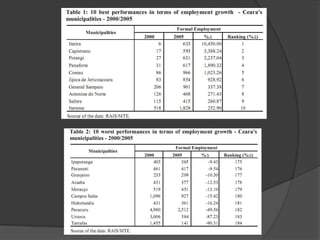
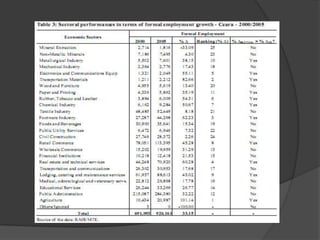
Between 2000 and 2005, formal employment grew by 33.15% in
Ceara (Brazil). This paper examines the dynamics of employment
growth in the State of Ceara and its municipalities between 2000
and 2005.
Objectives

•To analyze which municipalities and sectors contributed the
most to such growth through a shift-share analysis of
employment.
•To analyze which factors affect the process of job creation at
the municipal level.
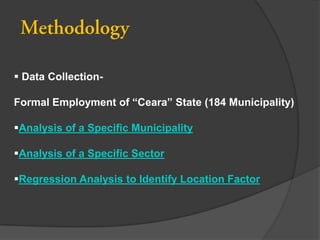
 Data CollectionFormal Employment of “Ceara” State (184 Municipality)
Analysis of a Specific Municipality

Analysis of a Specific Sector
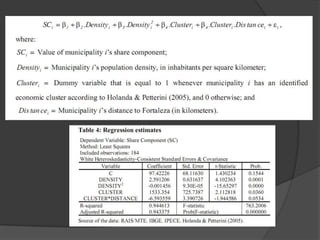
Regression Analysis to Identify Location Factor
Major Findings
Differential effect is positively correlated to the municipalities’
population

density

up

to

a

point

where

agglomeration

diseconomies actually reduce employment creation.
Municipalities with economic clusters tend to have a greater
differential effect than others and this effect is smaller the further

away they are located from Fortaleza, the State’s capital.
Fortaleza, the State’s capital, the results show that employment
grew at a slower pace there if compared to almost all other
neighboring municipalities, which is due to strong agglomeration
diseconomies in Fortaleza.
Possible Analysis in Bangladesh
To analyze regional competitive scenario

Factor/DataGDP, No. of Employment, No. of Service
Activity, Structure Type, Road Type, Amount of
Open Space, Utility Facilities etc.
Thanks for your patience…..
Q/A
Analysis of a Specific Municipality
Finding the formal employment growth rate.
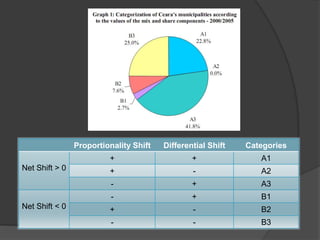
 Categorization of Ceara's municipalities according
to the values of the mix and share components
following the typology of Simões (2004).
Proportionality Shift

+

A1

+

-

A2

-

+

A3

Net Shift < 0

Categories

+
Net Shift > 0

Differential Shift

+

B1

+

-

B2

-

-

B3
Findings
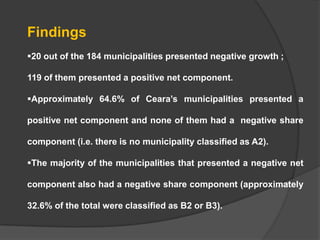
20 out of the 184 municipalities presented negative growth ;
119 of them presented a positive net component.
Approximately 64.6% of Ceara’s municipalities presented a
positive net component and none of them had a negative share

component (i.e. there is no municipality classified as A2).
The majority of the municipalities that presented a negative net
component also had a negative share component (approximately
32.6% of the total were classified as B2 or B3).
Findings
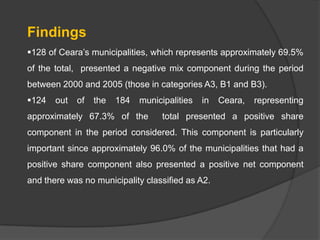
128 of Ceara’s municipalities, which represents approximately 69.5%
of the total, presented a negative mix component during the period

between 2000 and 2005 (those in categories A3, B1 and B3).
124

out

of

the

184

municipalities

approximately 67.3% of the

in

Ceara,

representing

total presented a positive share

component in the period considered. This component is particularly
important since approximately 96.0% of the municipalities that had a
positive share component also presented a positive net component
and there was no municipality classified as A2.
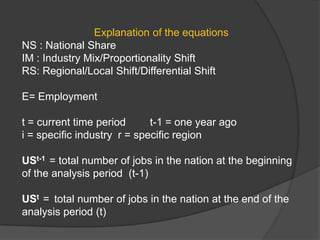
Explanation of the equations
NS : National Share
IM : Industry Mix/Proportionality Shift
RS: Regional/Local Shift/Differential Shift
E= Employment
t = current time period
t-1 = one year ago
i = specific industry r = specific region
USt-1 = total number of jobs in the nation at the beginning
of the analysis period (t-1)
USt = total number of jobs in the nation at the end of the
analysis period (t)
References
Lopes, Cláudio André Gondim Nogueira and Daniel A. Feitosa. (n.d.). EMPLOYMENT
GROWTH IN CEARA: A SHIFT-SHARE ANALYSIS (2000-2005). Retrieved 4 20, 2011, from
IPECE: www2.ipece.ce.gov.br/encontro/artigos_2008/16.pdf
Geoffrey .J.D. Hewings, M. A. (2008, 9). INCORPORATING SECTORAL STRUCTURE .
Retrieved 4 19, 2011, from REAL,The University of Illinois at Urbana-Champaign :
www.real.uiuc.edu/.
SHIFT SHARE ANALYSIS NARRATIVE . (2002, 1 25). Retrieved 4 18, 2011, from
socrates.cdr.state.tx.us/iSocrates/files/ShiftShareNarrative.pdf
Quintero, James Paul, " Regional Economic Development: An Economic Base Study and ShiftShare Analysis of Hays County, Texas" (2007). Applied Research Projects, Texas State
University-San Marcos. Paper 259. http://ecommons.txstate.edu/arp/259

Shift Share Analysis

  • 2.
    Shift share analysisis a traditional tool; through a descriptive analysis of the productive structure, it allows the comparison of regional differences within a country, region or state (SIMÕES, 2004). The analysis is primarily used to decompose employment changes, change in gross domestic product etc. within an economy over a specific period of time. Can be used to analyze individual industries or the whole economy.
  • 3.
     National Share (NS)Component  Share of regional job growth attributable to growth of the national economy  “If the regional industry grew at the industry’s national growth rate, what would be the result?” NS t ir E t 1 ir t EUS 1 t 1 EUS
  • 4.
     Industry Mix (IM)or Proportionality Shift Component  Reflects differences in industry “mix” between the local and national levels.  Estimates how many jobs were created/not created in each industry due to differences in industry and total national growth rates. IM t ir t Eir 1 t EiUS t 1 EiUS t EUS t EUS1
  • 5.
     Regional Shift (RS)or Differential Shift Component  Describes the extent to which unique local factors relate to regional industrial employment growth or decline.  How many jobs are created/not created as a result of the region’s competitiveness? RS t ir E t 1 ir t Eir t Eir 1 t EiUS t 1 EiUS
  • 6.
    The actual changein employment for the region Eir = IMtir + NStir + RStir Net Shift Component (Eir - NStir )= IMtir + RStir
  • 7.
    + Total Regional Growth>National Growth - TotalRegional Growth<National Growth Proportionality Shift Component + - Industry of interest is growing Differential Shift Component + Local competitiveness is present for economic growth - Local competiveness is absent for economic growth Net Shift Component Industry of interest is declining
  • 8.
    Shift-share does notaccount impact of business cycles, identification of actual comparative advantages and differences caused by levels of industrial detail. Shift-share analysis examines employment changes, not changes in income, earnings, or value-added, which are alternative measures of an industry's size and strength. A shift-share industrial analysis is a "snap-shot" of 2 particular time frames and may not give an entirely clear picture of the local and national economies
  • 9.
    Name of theArticle EMPLOYMENT GROWTH IN CEARA: A SHIFT-SHARE ANALYSIS (2000-2005) Author Cláudio André Gondim Nogueira Daniel A. Feitosa Lopes Between 2000 and 2005, formal employment grew by 33.15% in Ceara (Brazil). This paper examines the dynamics of employment growth in the State of Ceara and its municipalities between 2000 and 2005.
  • 10.
    Objectives •To analyze whichmunicipalities and sectors contributed the most to such growth through a shift-share analysis of employment. •To analyze which factors affect the process of job creation at the municipal level.
  • 11.
     Data CollectionFormalEmployment of “Ceara” State (184 Municipality) Analysis of a Specific Municipality Analysis of a Specific Sector Regression Analysis to Identify Location Factor
  • 12.
    Major Findings Differential effectis positively correlated to the municipalities’ population density up to a point where agglomeration diseconomies actually reduce employment creation. Municipalities with economic clusters tend to have a greater differential effect than others and this effect is smaller the further away they are located from Fortaleza, the State’s capital. Fortaleza, the State’s capital, the results show that employment grew at a slower pace there if compared to almost all other neighboring municipalities, which is due to strong agglomeration diseconomies in Fortaleza.
  • 13.
    Possible Analysis inBangladesh To analyze regional competitive scenario Factor/DataGDP, No. of Employment, No. of Service Activity, Structure Type, Road Type, Amount of Open Space, Utility Facilities etc.
  • 14.
    Thanks for yourpatience….. Q/A
  • 15.
    Analysis of aSpecific Municipality Finding the formal employment growth rate.  Categorization of Ceara's municipalities according to the values of the mix and share components following the typology of Simões (2004).
  • 17.
    Proportionality Shift + A1 + - A2 - + A3 Net Shift< 0 Categories + Net Shift > 0 Differential Shift + B1 + - B2 - - B3
  • 20.
    Findings 20 out ofthe 184 municipalities presented negative growth ; 119 of them presented a positive net component. Approximately 64.6% of Ceara’s municipalities presented a positive net component and none of them had a negative share component (i.e. there is no municipality classified as A2). The majority of the municipalities that presented a negative net component also had a negative share component (approximately 32.6% of the total were classified as B2 or B3).
  • 21.
    Findings 128 of Ceara’smunicipalities, which represents approximately 69.5% of the total, presented a negative mix component during the period between 2000 and 2005 (those in categories A3, B1 and B3). 124 out of the 184 municipalities approximately 67.3% of the in Ceara, representing total presented a positive share component in the period considered. This component is particularly important since approximately 96.0% of the municipalities that had a positive share component also presented a positive net component and there was no municipality classified as A2.
  • 22.
    Explanation of theequations NS : National Share IM : Industry Mix/Proportionality Shift RS: Regional/Local Shift/Differential Shift E= Employment t = current time period t-1 = one year ago i = specific industry r = specific region USt-1 = total number of jobs in the nation at the beginning of the analysis period (t-1) USt = total number of jobs in the nation at the end of the analysis period (t)
  • 23.
    References Lopes, Cláudio AndréGondim Nogueira and Daniel A. Feitosa. (n.d.). EMPLOYMENT GROWTH IN CEARA: A SHIFT-SHARE ANALYSIS (2000-2005). Retrieved 4 20, 2011, from IPECE: www2.ipece.ce.gov.br/encontro/artigos_2008/16.pdf Geoffrey .J.D. Hewings, M. A. (2008, 9). INCORPORATING SECTORAL STRUCTURE . Retrieved 4 19, 2011, from REAL,The University of Illinois at Urbana-Champaign : www.real.uiuc.edu/. SHIFT SHARE ANALYSIS NARRATIVE . (2002, 1 25). Retrieved 4 18, 2011, from socrates.cdr.state.tx.us/iSocrates/files/ShiftShareNarrative.pdf Quintero, James Paul, " Regional Economic Development: An Economic Base Study and ShiftShare Analysis of Hays County, Texas" (2007). Applied Research Projects, Texas State University-San Marcos. Paper 259. http://ecommons.txstate.edu/arp/259