CONTRIBUTION OF INFORMAL
SECTOR TO INDIAN ECONOMY:
POTENTIAL AND CHALLENGES
Dr.(Mrs) Anupma Srivastava
Associate Professor/Head, Department of
Economics
Isabella Thoburn College
Ms Amita Marwha
Faculty Department of Economics
Isabella Thoburn College
Informal Sector- The Engine Of Growth
• The Informal sector is now seen as the next
engine of growth for India's economy.
• Nearly 81% of all employed persons in India make
a living by working in the informal sector, with
only 6.5% in the formal sector and 0.8% in the
household sector, according to a new ILO
(International Labour Organisation) report
"Women and Men in the Informal Economy – A
Statistical Picture (Third edition) 2018 .“
Informal Sector -Background
• The term 'informal sector' was first used by
John Keith Hart in 1973 in the study of
employment pattern in urban Ghana.‘
• its further elaboration and elucidation was
made by the ILO's Employment Mission to
Kenya under the auspices of the World
Employment Programme in 1972
Key Question In Hart’s Study
• key question: does the “reserve army of
urban unemployed and underemployed”
constitute a passive exploited majority OR do
their informal economy activities “possess
some autonomous capacity for generating
incomes”?
• answer: both - external constraints/capitalist
domination + autonomous capacity
National Commission for Enterprises in
the Unorganised Sector (NCEUS)
• The Government of India, constituted a
National Commission for Enterprises in the
Unorganised Sector (NCEUS) vide Ministry of
Small Scale Industries Resolution No.
5(2)/2004-ICC dated 20th September, 2004, to
act as an advisory body and watchdog for the
informal sector
Definition Given By NCEUS
• "The unorganised sector consists of all
unincorporated private enterprises owned by
individuals or households engaged in the sale
and production of goods and services
operated on a proprietary or partnership basis
and with less than ten total workers".
• Definition given by NCEUS (National
Commission For Enterprises In The
Unorganized Sector)
Informal Sector -Lack In Conceptual
Clarity
• National Accounts Statistics (NAS) defines the
unorganised sector in addition to the
unincorporated proprieties or partnership
enterprises, includes enterprises run by
cooperative societies, trust, private and
limited companies. The informal sector can
therefore, be considered as a sub-set of the
unorganised sector.
Shortcoming Of The Definition
• The definition is, therefore, in terms of
characteristics of the enterprise rather than in
terms of the characteristics of the worker.
Thus a large number of workers with informal
job status were excluded.
Define Unorganised Employment
• Employment in the unorganised sector has
hitherto been derived as a residual of the total
workers minus workers in the organised sector
as Reported by the Directorate General of
Employment and Training (DGET).
Features Of Informal Sector
• Low level of organization; small in scale usually
employing fewer than ten workers and often
from the immediate family;
• Heterogeneity in activities;
• Easier entry and exit than in the formal sector;
• Usually minimal capital investment; little or no
division between labour and capital;
• Mostly labour intensive work, requiring low-level
skills; there is usually no formal training as
workers learn on the job;
Features Of Informal Sector
• Labour relations based on casual employment
and or social relationships as opposed to formal
contracts; employer and employee relationship is
often unwritten and informal with little or no
rights;
• Due to their isolation and invisibility, workers in
the informal sector are often largely unaware of
their rights, cannot organise them and have little
negotiating power with their employers and
intermediaries (ILO 2000).
Segments of Informal Economy
• Wage work for informal enterprises
• Domestic work without a regular contract
• Casual day labour without a fixed employer
• Unregistered or undeclared work for formal or informal firms
• Temporary and part-time work for formal firms
• EXAMPLES (total = 106 activities):
– Agriculture: landless labourers, small farmers, traditional artisans, animal
husbandry
– Industry: workers in brick-kilns, construction, beedi-making, incense
stick
– Services: workers in local transport, shops, domestic servants, community
services like street cleaning, street vendors, garbage collectors
– Small Workshops: shoe makers, garment makers and embroiderers
– At Home: garment workers artisans or craft producers
– On Rivers, Ponds, Lakes, and Oceans: fishermen, shippers
• Most labour has moved from agriculture to the informal
non-agricultural sector and this has boosted productivity.
However, at the same time, labour has moved out of the
highest-productivity sector – the formal sector.
• The proportionate fall in formal employment was greatest
in the public sector and, even in the most productive
formal private sector, the share of employment has fallen
slightly
• High capital intensity in the organised sector – despite low
labour costs – and an extraordinarily large share of overall
manufacturing employment in micro-enterprises, most of
which are in the informal sector are the potential reasons
why industrial /manufacturing sector is lagging behind.
Employment Status in Informal
sector-A Bleak Picture
Employment Status in Informal
sector-A Bleak Picture
• Construction, manufacturing and wholesale and retail
trade activities together was the main providers of
employment for the informal sector enterprises and
‘all’ enterprises in both the rural and urban areas.
• Out of all workers in the non-agriculture informal
sector, 76 per cent in the rural areas and 72 per cent in
urban areas belonged to construction, manufacturing
and wholesale and retail trade.
• The corresponding figures for all workers in non-
agriculture sector in rural and urban areas were nearly
69 per cent and 59 per cent, respectively.
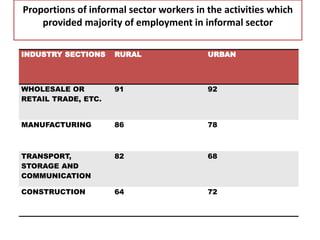
Proportions of informal sector workers in the activities which
provided majority of employment in informal sector
INDUSTRY SECTIONS RURAL URBAN
WHOLESALE OR
RETAIL TRADE, ETC.
91 92
MANUFACTURING 86 78
TRANSPORT,
STORAGE AND
COMMUNICATION
82 68
CONSTRUCTION 64 72
Why study of Urban Informal sector
• Economic activities in the informal sector play
an important role in developing countries,
especially in urban areas where its income
opportunities have been increasing rapidly
with economic development.
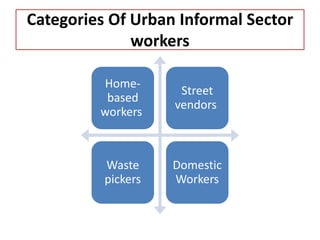
Categories Of Urban Informal Sector
workers
Home-
based
workers
Street
vendors
Waste
pickers
Domestic
Workers
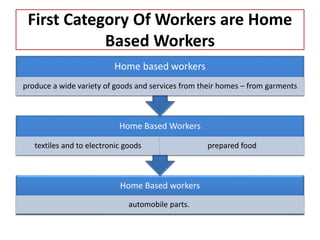
First Category Of Workers are Home
Based Workers
Home Based workers
automobile parts.
Home Based Workers
textiles and to electronic goods prepared food
Home based workers
produce a wide variety of goods and services from their homes – from garments
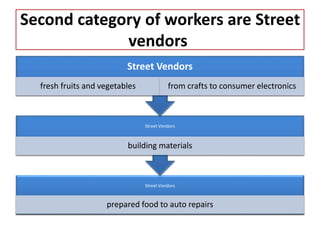
Second category of workers are Street
vendors
Street Vendors
prepared food to auto repairs
Street Vendors
building materials
Street Vendors
fresh fruits and vegetables from crafts to consumer electronics
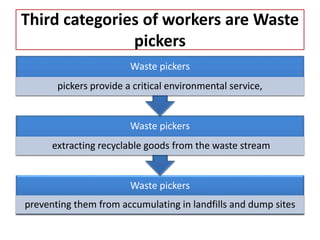
Third categories of workers are Waste
pickers
Waste pickers
preventing them from accumulating in landfills and dump sites
Waste pickers
extracting recyclable goods from the waste stream
Waste pickers
pickers provide a critical environmental service,
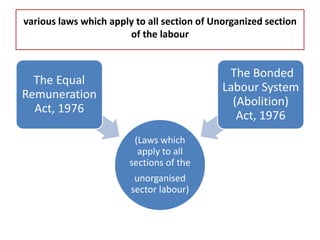
various laws which apply to all section of Unorganized section
of the labour
(Laws which
apply to all
sections of the
unorganised
sector labour)
The Equal
Remuneration
Act, 1976
The Bonded
Labour System
(Abolition)
Act, 1976
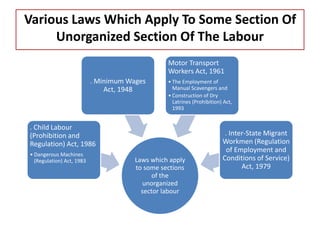
Various Laws Which Apply To Some Section Of
Unorganized Section Of The Labour
Laws which apply
to some sections
of the
unorganized
sector labour
. Child Labour
(Prohibition and
Regulation) Act, 1986
• Dangerous Machines
(Regulation) Act, 1983
. Minimum Wages
Act, 1948
Motor Transport
Workers Act, 1961
• The Employment of
Manual Scavengers and
• Construction of Dry
Latrines (Prohibition) Act,
1993
. Inter-State Migrant
Workmen (Regulation
of Employment and
Conditions of Service)
Act, 1979
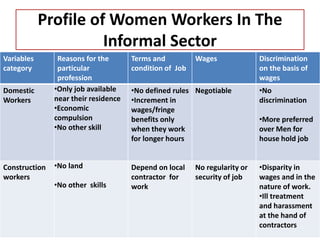
Profile of Women Workers In The
Informal Sector
Variables
category
Reasons for the
particular
profession
Terms and
condition of Job
Wages Discrimination
on the basis of
wages
Domestic
Workers
•Only job available
near their residence
•Economic
compulsion
•No other skill
•No defined rules
•Increment in
wages/fringe
benefits only
when they work
for longer hours
Negotiable •No
discrimination
•More preferred
over Men for
house hold job
Construction
workers
•No land
•No other skills
Depend on local
contractor for
work
No regularity or
security of job
•Disparity in
wages and in the
nature of work.
•Ill treatment
and harassment
at the hand of
contractors
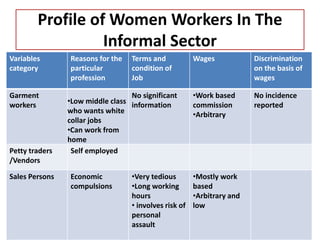
Profile of Women Workers In The
Informal Sector
Variables
category
Reasons for the
particular
profession
Terms and
condition of
Job
Wages Discrimination
on the basis of
wages
Garment
workers •Low middle class
who wants white
collar jobs
•Can work from
home
No significant
information
•Work based
commission
•Arbitrary
No incidence
reported
Petty traders
/Vendors
Self employed
Sales Persons Economic
compulsions
•Very tedious
•Long working
hours
• involves risk of
personal
assault
•Mostly work
based
•Arbitrary and
low
Challenges In Formalization
• Restrictive labour laws- which promotes ad -
hocism and contract hiring in the labour
market to circumvent the rigid labour laws.
• Predominance of services-sector led growth
• Absence of thrust on manufacturing
Challenges In Formalization
• Lack of an exit mechanism such as insolvency and
bankruptcy laws has led to firms remaining small,
barely breaking even, and not scaling up. Such
small firms can circumvent formal sector laws
such as mandatory registrations with the EPFO
etc. rendering them informal.
• The advent of the Fourth Industrial Revolution
and automation poses even more dangers to
present formal sector jobs since workers with
current skills will be rendered obsolete unless
they undergo skill reorientation.
Conclusion
• Clearly, the informal sector is not the residual sector of the
economy. In reality, it is the dominant sector. The informal
sector may not contribute much to the national income but
its dominance in employment is likely to continue for some
more time as informal sector has the major role to play in
expanding the capacity of Non agriculture sector to absorb
labour.
• Government can play both direct and indirect role in
providing formalization to the large section of the
population engaged in informal sector through the better
measures of contribution of the informal sector in the GDP
of the country and to provide labour productivity, capital
productivity and capital output ratio to measure the
efficiency in the informal sector.
Thank You

Informal sector

  • 1.
    CONTRIBUTION OF INFORMAL SECTORTO INDIAN ECONOMY: POTENTIAL AND CHALLENGES Dr.(Mrs) Anupma Srivastava Associate Professor/Head, Department of Economics Isabella Thoburn College Ms Amita Marwha Faculty Department of Economics Isabella Thoburn College
  • 2.
    Informal Sector- TheEngine Of Growth • The Informal sector is now seen as the next engine of growth for India's economy. • Nearly 81% of all employed persons in India make a living by working in the informal sector, with only 6.5% in the formal sector and 0.8% in the household sector, according to a new ILO (International Labour Organisation) report "Women and Men in the Informal Economy – A Statistical Picture (Third edition) 2018 .“
  • 3.
    Informal Sector -Background •The term 'informal sector' was first used by John Keith Hart in 1973 in the study of employment pattern in urban Ghana.‘ • its further elaboration and elucidation was made by the ILO's Employment Mission to Kenya under the auspices of the World Employment Programme in 1972
  • 4.
    Key Question InHart’s Study • key question: does the “reserve army of urban unemployed and underemployed” constitute a passive exploited majority OR do their informal economy activities “possess some autonomous capacity for generating incomes”? • answer: both - external constraints/capitalist domination + autonomous capacity
  • 5.
    National Commission forEnterprises in the Unorganised Sector (NCEUS) • The Government of India, constituted a National Commission for Enterprises in the Unorganised Sector (NCEUS) vide Ministry of Small Scale Industries Resolution No. 5(2)/2004-ICC dated 20th September, 2004, to act as an advisory body and watchdog for the informal sector
  • 6.
    Definition Given ByNCEUS • "The unorganised sector consists of all unincorporated private enterprises owned by individuals or households engaged in the sale and production of goods and services operated on a proprietary or partnership basis and with less than ten total workers". • Definition given by NCEUS (National Commission For Enterprises In The Unorganized Sector)
  • 7.
    Informal Sector -LackIn Conceptual Clarity • National Accounts Statistics (NAS) defines the unorganised sector in addition to the unincorporated proprieties or partnership enterprises, includes enterprises run by cooperative societies, trust, private and limited companies. The informal sector can therefore, be considered as a sub-set of the unorganised sector.
  • 8.
    Shortcoming Of TheDefinition • The definition is, therefore, in terms of characteristics of the enterprise rather than in terms of the characteristics of the worker. Thus a large number of workers with informal job status were excluded.
  • 9.
    Define Unorganised Employment •Employment in the unorganised sector has hitherto been derived as a residual of the total workers minus workers in the organised sector as Reported by the Directorate General of Employment and Training (DGET).
  • 10.
    Features Of InformalSector • Low level of organization; small in scale usually employing fewer than ten workers and often from the immediate family; • Heterogeneity in activities; • Easier entry and exit than in the formal sector; • Usually minimal capital investment; little or no division between labour and capital; • Mostly labour intensive work, requiring low-level skills; there is usually no formal training as workers learn on the job;
  • 11.
    Features Of InformalSector • Labour relations based on casual employment and or social relationships as opposed to formal contracts; employer and employee relationship is often unwritten and informal with little or no rights; • Due to their isolation and invisibility, workers in the informal sector are often largely unaware of their rights, cannot organise them and have little negotiating power with their employers and intermediaries (ILO 2000).
  • 12.
    Segments of InformalEconomy • Wage work for informal enterprises • Domestic work without a regular contract • Casual day labour without a fixed employer • Unregistered or undeclared work for formal or informal firms • Temporary and part-time work for formal firms • EXAMPLES (total = 106 activities): – Agriculture: landless labourers, small farmers, traditional artisans, animal husbandry – Industry: workers in brick-kilns, construction, beedi-making, incense stick – Services: workers in local transport, shops, domestic servants, community services like street cleaning, street vendors, garbage collectors – Small Workshops: shoe makers, garment makers and embroiderers – At Home: garment workers artisans or craft producers – On Rivers, Ponds, Lakes, and Oceans: fishermen, shippers
  • 13.
    • Most labourhas moved from agriculture to the informal non-agricultural sector and this has boosted productivity. However, at the same time, labour has moved out of the highest-productivity sector – the formal sector. • The proportionate fall in formal employment was greatest in the public sector and, even in the most productive formal private sector, the share of employment has fallen slightly • High capital intensity in the organised sector – despite low labour costs – and an extraordinarily large share of overall manufacturing employment in micro-enterprises, most of which are in the informal sector are the potential reasons why industrial /manufacturing sector is lagging behind. Employment Status in Informal sector-A Bleak Picture
  • 14.
    Employment Status inInformal sector-A Bleak Picture • Construction, manufacturing and wholesale and retail trade activities together was the main providers of employment for the informal sector enterprises and ‘all’ enterprises in both the rural and urban areas. • Out of all workers in the non-agriculture informal sector, 76 per cent in the rural areas and 72 per cent in urban areas belonged to construction, manufacturing and wholesale and retail trade. • The corresponding figures for all workers in non- agriculture sector in rural and urban areas were nearly 69 per cent and 59 per cent, respectively.
  • 15.
    Proportions of informalsector workers in the activities which provided majority of employment in informal sector INDUSTRY SECTIONS RURAL URBAN WHOLESALE OR RETAIL TRADE, ETC. 91 92 MANUFACTURING 86 78 TRANSPORT, STORAGE AND COMMUNICATION 82 68 CONSTRUCTION 64 72
  • 16.
    Why study ofUrban Informal sector • Economic activities in the informal sector play an important role in developing countries, especially in urban areas where its income opportunities have been increasing rapidly with economic development.
  • 17.
    Categories Of UrbanInformal Sector workers Home- based workers Street vendors Waste pickers Domestic Workers
  • 18.
    First Category OfWorkers are Home Based Workers Home Based workers automobile parts. Home Based Workers textiles and to electronic goods prepared food Home based workers produce a wide variety of goods and services from their homes – from garments
  • 19.
    Second category ofworkers are Street vendors Street Vendors prepared food to auto repairs Street Vendors building materials Street Vendors fresh fruits and vegetables from crafts to consumer electronics
  • 20.
    Third categories ofworkers are Waste pickers Waste pickers preventing them from accumulating in landfills and dump sites Waste pickers extracting recyclable goods from the waste stream Waste pickers pickers provide a critical environmental service,
  • 21.
    various laws whichapply to all section of Unorganized section of the labour (Laws which apply to all sections of the unorganised sector labour) The Equal Remuneration Act, 1976 The Bonded Labour System (Abolition) Act, 1976
  • 22.
    Various Laws WhichApply To Some Section Of Unorganized Section Of The Labour Laws which apply to some sections of the unorganized sector labour . Child Labour (Prohibition and Regulation) Act, 1986 • Dangerous Machines (Regulation) Act, 1983 . Minimum Wages Act, 1948 Motor Transport Workers Act, 1961 • The Employment of Manual Scavengers and • Construction of Dry Latrines (Prohibition) Act, 1993 . Inter-State Migrant Workmen (Regulation of Employment and Conditions of Service) Act, 1979
  • 23.
    Profile of WomenWorkers In The Informal Sector Variables category Reasons for the particular profession Terms and condition of Job Wages Discrimination on the basis of wages Domestic Workers •Only job available near their residence •Economic compulsion •No other skill •No defined rules •Increment in wages/fringe benefits only when they work for longer hours Negotiable •No discrimination •More preferred over Men for house hold job Construction workers •No land •No other skills Depend on local contractor for work No regularity or security of job •Disparity in wages and in the nature of work. •Ill treatment and harassment at the hand of contractors
  • 24.
    Profile of WomenWorkers In The Informal Sector Variables category Reasons for the particular profession Terms and condition of Job Wages Discrimination on the basis of wages Garment workers •Low middle class who wants white collar jobs •Can work from home No significant information •Work based commission •Arbitrary No incidence reported Petty traders /Vendors Self employed Sales Persons Economic compulsions •Very tedious •Long working hours • involves risk of personal assault •Mostly work based •Arbitrary and low
  • 25.
    Challenges In Formalization •Restrictive labour laws- which promotes ad - hocism and contract hiring in the labour market to circumvent the rigid labour laws. • Predominance of services-sector led growth • Absence of thrust on manufacturing
  • 26.
    Challenges In Formalization •Lack of an exit mechanism such as insolvency and bankruptcy laws has led to firms remaining small, barely breaking even, and not scaling up. Such small firms can circumvent formal sector laws such as mandatory registrations with the EPFO etc. rendering them informal. • The advent of the Fourth Industrial Revolution and automation poses even more dangers to present formal sector jobs since workers with current skills will be rendered obsolete unless they undergo skill reorientation.
  • 27.
    Conclusion • Clearly, theinformal sector is not the residual sector of the economy. In reality, it is the dominant sector. The informal sector may not contribute much to the national income but its dominance in employment is likely to continue for some more time as informal sector has the major role to play in expanding the capacity of Non agriculture sector to absorb labour. • Government can play both direct and indirect role in providing formalization to the large section of the population engaged in informal sector through the better measures of contribution of the informal sector in the GDP of the country and to provide labour productivity, capital productivity and capital output ratio to measure the efficiency in the informal sector.
  • 28.