Sectorial Planning Approach
School of Planning and Architecture, Bhopal
Omkar Parishwad


Evolution:
How do cities evolve?
Who should plan the cities?
Do the location, culture, climate and other factors play a crucial role in planning of a city?
Why study foreign policies than discover and invent our own strategies?

Introduction:
Sectorial Planning is strategic planning for defined sectors or industries of the economy.
‘Sector’ in terms of ‘sectorial planning’ means the spatial planning under consideration of
only one planning criteria (e.g. traffic, environmental heritage, etc.). Sectoral planning
process includes the following
significant characteristics:
   Presents the detailed sectorial
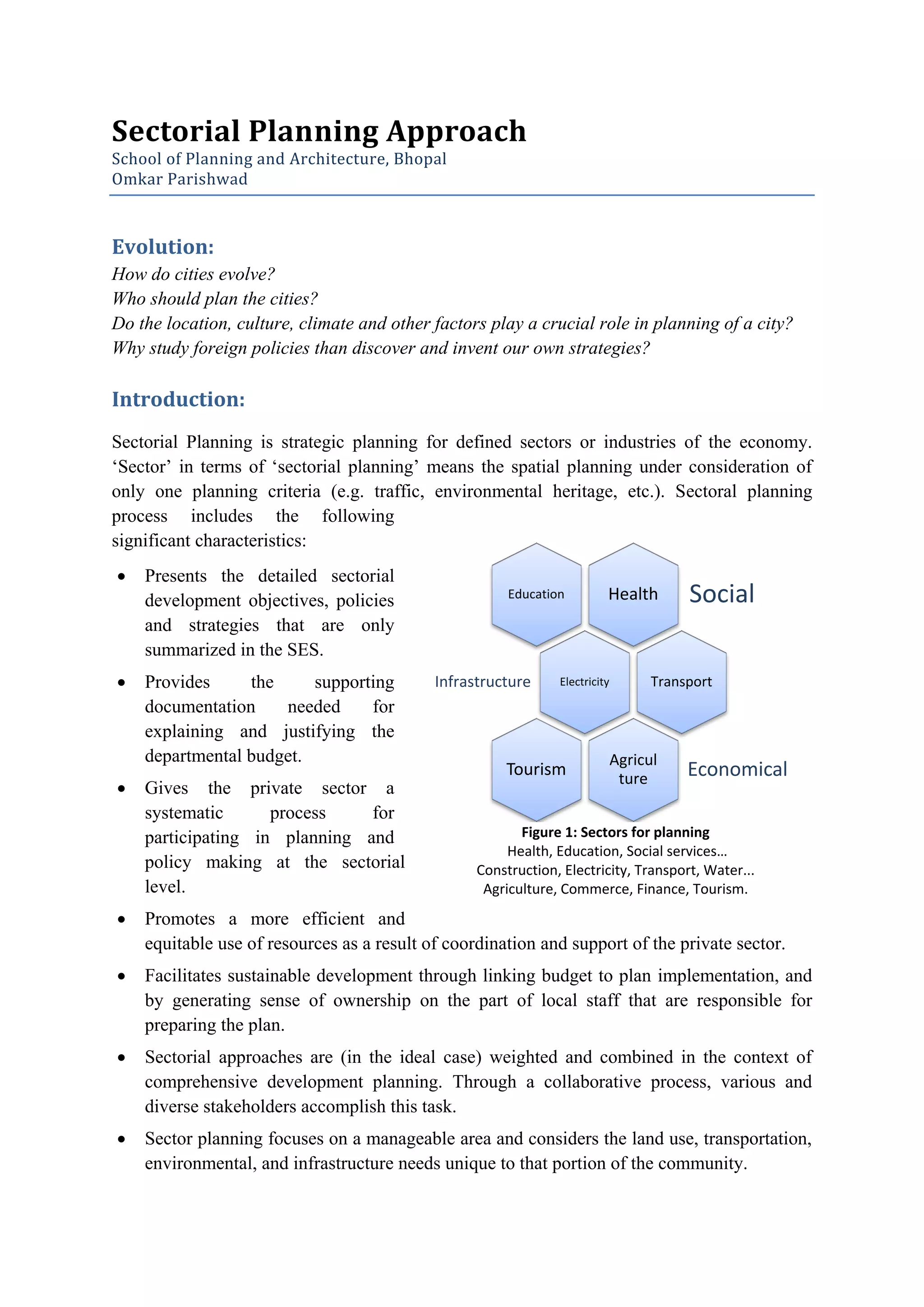
    development objectives, policies                   Education         Health         Social
    and strategies that are only
    summarized in the SES.
   Provides     the     supporting         Infrastructure     Electricity         Transport
    documentation    needed     for
    explaining and justifying the
    departmental budget.                                                     Agricul
                                                      Tourism                 ture      Economical
   Gives the private sector a
    systematic      process    for
    participating in planning and                        Figure 1: Sectors for planning
                                                       Health, Education, Social services…
    policy making at the sectorial                Construction, Electricity, Transport, Water...
    level.                                         Agriculture, Commerce, Finance, Tourism.
   Promotes a more efficient and
    equitable use of resources as a result of coordination and support of the private sector.
   Facilitates sustainable development through linking budget to plan implementation, and
    by generating sense of ownership on the part of local staff that are responsible for
    preparing the plan.
   Sectorial approaches are (in the ideal case) weighted and combined in the context of
    comprehensive development planning. Through a collaborative process, various and
    diverse stakeholders accomplish this task.
   Sector planning focuses on a manageable area and considers the land use, transportation,
    environmental, and infrastructure needs unique to that portion of the community.
Omkar Parishwad 2010MURP007

   The generalities of comprehensive planning and the pitfalls of single issue or narrow
    scope planning are avoided. Approving the sector plan minimizes the inconsistencies
    resulting from parcel-by-parcel decisions.
Process:
The formulation of a sectorial plan involves the same logical process as for any strategic
development plan, including the SES. This logical process can be summed up by the Department
asking six fundamental questions which will have to be answered in the course of preparing the
sectorial plan.
It may be useful to think of each question as a scenario.
   The first scenario is intended to get the Department to systematically review its operating
    experience within the sector, and to explicitly document what it has found in the form of the
    sectorial performance assessment.
    1. Where have we been and where are we now?
    2. Where do we want to go from here?
    3. How are we going to get there?
    4. What resources will be required to enable us to get there?
    5. How will we know when we have arrived?
    6. What problems are we likely to face on the way, and do we have a contingency plan to
    deal with them?
   The second scenario represents the core of the planning process, and is calculated to produce
    a clear identification of outcomes,
    objectives or end states that the
    Department and stakeholders want
    to achieve.
   The third scenario essentially
    requires the Department and
    stakeholders to specify the
    strategies that will be followed to
    achieve     the     outcomes     or
    objectives set in the second
    scenario. This scenario must
    consider               development
    opportunities and constraints, as
    well as the macroeconomic and
    sector        specific       policy
    environment.
   In the fourth scenario required resources are addressed. Resources must be broadly
    considered, including, in addition to financial and personnel resources stipulated in the
    budget, political support and macroeconomic environment.


                                                                                                    1
Omkar Parishwad 2010MURP007

   The fifth scenario calls for success criteria. Success criteria must be specified in terms of
    performance measures that will enable the Department to objectively determine how much
    progress has been made toward targeted departmental and sectoral objectives or outcomes.
 The last (sixth) scenario requires policy makers to anticipate likely problems (issues and
    constraints) and to formulate a contingency plan to deal with them. Essentially contingency
    plans will be incorporated in the policies and strategies supporting each of the Department’s
    budget outputs (output structure).
The national planning system incorporates four major components:
Performance budgeting
National strategic planning (SES)
Sectorial planning
Project planning

Purpose:
Departmental Budget Support

   Budgetary resources enable the Department to produce and deliver the goods and services
    (outputs) that directly contribute to achieving the predetermined outcomes (objectives)
    specified in the sectorial plan.

Enables Systematic Participation of the Private Sector

   The sense of ownership generated in this process should result in obtaining endorsement of
    the sectorial plan, along with support in its implementation.

Promotes More Efficient Use of Resources

   Formulating the sectorial plan with systematic input from stakeholders can be expected to
    result in a more efficient use of resources through better co-ordination and support from the
    private sector in working toward jointly set objectives, and through more rigorous analysis of
    appropriate strategies and policies for achieving the objectives.

Facilitates Sustainable Development

   Both continuing budgetary supports, and stakeholder involvement in the planning process,
    constitute critical elements toward promoting sustainable development.


                                                                                                     2
Omkar Parishwad 2010MURP007

Content:


Case Study:
The United Nations 1990 International Standard Industrial Classification of all Economic
Activities (ISIC) is used as a point of reference to define sectors for the purposes of sectorial
planning in Samoa.

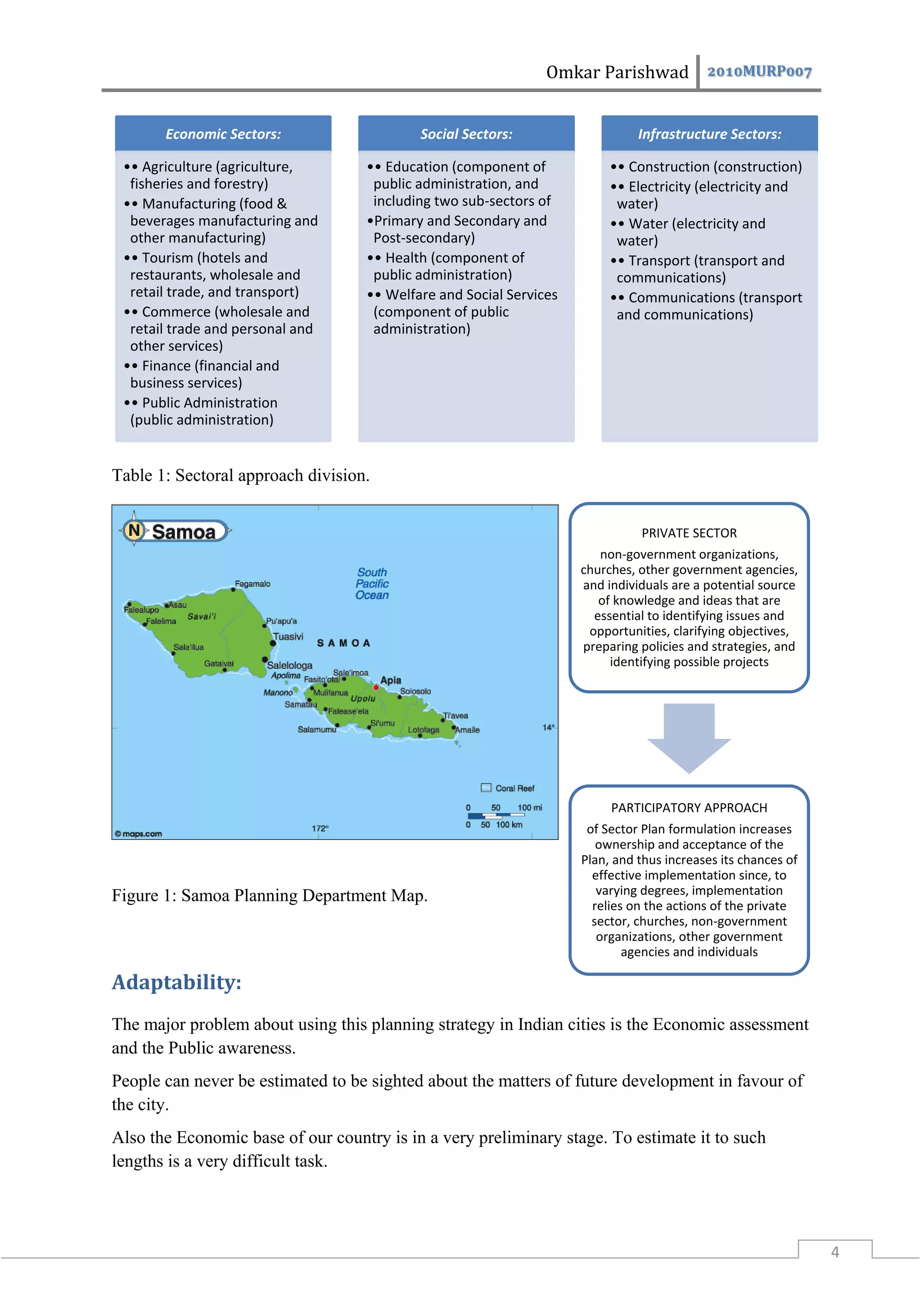
These sectors can be grouped under the three broad sectorial headings used in PSIP, as follows,
with the corresponding national accounts categories shown in brackets.


                                                                                                    3
Omkar Parishwad 2010MURP007


       Economic Sectors:                   Social Sectors:                    Infrastructure Sectors:

 •• Agriculture (agriculture,      •• Education (component of            •• Construction (construction)
  fisheries and forestry)           public administration, and           •• Electricity (electricity and
 •• Manufacturing (food &           including two sub-sectors of          water)
  beverages manufacturing and      •Primary and Secondary and            •• Water (electricity and
  other manufacturing)              Post-secondary)                       water)
 •• Tourism (hotels and            •• Health (component of               •• Transport (transport and
  restaurants, wholesale and        public administration)                communications)
  retail trade, and transport)     •• Welfare and Social Services        •• Communications (transport
 •• Commerce (wholesale and         (component of public                  and communications)
  retail trade and personal and     administration)
  other services)
 •• Finance (financial and
  business services)
 •• Public Administration
  (public administration)


Table 1: Sectoral approach division.


                                                                              PRIVATE SECTOR
                                                                       non-government organizations,
                                                                    churches, other government agencies,
                                                                    and individuals are a potential source
                                                                       of knowledge and ideas that are
                                                                      essential to identifying issues and
                                                                     opportunities, clarifying objectives,
                                                                    preparing policies and strategies, and
                                                                         identifying possible projects


                                                                         PARTICIPATORY APPROACH
                                                                     of Sector Plan formulation increases
                                                                       ownership and acceptance of the
                                                                    Plan, and thus increases its chances of
                                                                      effective implementation since, to
Figure 1: Samoa Planning Department Map.                               varying degrees, implementation
                                                                      relies on the actions of the private
                                                                      sector, churches, non-government
                                                                       organizations, other government
                                                                            agencies and individuals

Adaptability:
The major problem about using this planning strategy in Indian cities is the Economic assessment
and the Public awareness.
People can never be estimated to be sighted about the matters of future development in favour of
the city.
Also the Economic base of our country is in a very preliminary stage. To estimate it to such
lengths is a very difficult task.


                                                                                                              4
Omkar Parishwad 2010MURP007

Also the implementation tasks that should take place in incremental sense would take a lot of
management and synchronizing from all the sectors of the society.
The positive side of the coin is also very impelling, though that stage would arrive late.

Merits & Demerits:
As the purpose states, the merits are

       Sustainable growth due to involvement of the local bodies and private sector.
       Better management of the resources and facilities as planners are the managing link
        between the two.
       Economic stability as it is priory estimated for the development.

The Demerits being;

       Poor standards of the locals in terms of progress. So over-estimation and costly affairs in
        terms of progress.
       Political interference as the law is not interfering directly.

Conclusions:
       City planning takes place smoothly as the Economic Strategy is well balanced beforehand.
       As locals get involved in the planning perspectives, better solutions are developed and
        implemented.
       Citizens orient buildings, plant trees and return stores to a depressed area. So the sense of
        ownership is generated which results in swifter progress of the city.
       Criminal activity is reduced through improved lighting and reduced blight. Schools are more
        community friendly through integration into the neighbourhood.
       As the planning authority remains with the planner, the progress is controlled.


References:
       Davis, Derrin and Stephen Pollard, , Economic Management and the Role of Planning, East
        West Centre, Development Series, No. 6, March 1995.
       United Nations, International Standard Industrial Classification of all Economic Activities,
        Third Revision, 1990.
       Samoa, Government of, Treasury Department, Manual on Project Planning and
        Programming, September 1998.
       United Nations Development Programme (UNDP), Report of Mission on Economic Planning
        in the Pacific Island Countries, 1991.
       Workshop on sectorial planning:
        www.unpan1.un.org/intradoc/groups/public/documents/CARICAD/UNPAN...


                                                                                                        5

Sectorial planning

  • 1.
    Sectorial Planning Approach Schoolof Planning and Architecture, Bhopal Omkar Parishwad Evolution: How do cities evolve? Who should plan the cities? Do the location, culture, climate and other factors play a crucial role in planning of a city? Why study foreign policies than discover and invent our own strategies? Introduction: Sectorial Planning is strategic planning for defined sectors or industries of the economy. ‘Sector’ in terms of ‘sectorial planning’ means the spatial planning under consideration of only one planning criteria (e.g. traffic, environmental heritage, etc.). Sectoral planning process includes the following significant characteristics:  Presents the detailed sectorial development objectives, policies Education Health Social and strategies that are only summarized in the SES.  Provides the supporting Infrastructure Electricity Transport documentation needed for explaining and justifying the departmental budget. Agricul Tourism ture Economical  Gives the private sector a systematic process for participating in planning and Figure 1: Sectors for planning Health, Education, Social services… policy making at the sectorial Construction, Electricity, Transport, Water... level. Agriculture, Commerce, Finance, Tourism.  Promotes a more efficient and equitable use of resources as a result of coordination and support of the private sector.  Facilitates sustainable development through linking budget to plan implementation, and by generating sense of ownership on the part of local staff that are responsible for preparing the plan.  Sectorial approaches are (in the ideal case) weighted and combined in the context of comprehensive development planning. Through a collaborative process, various and diverse stakeholders accomplish this task.  Sector planning focuses on a manageable area and considers the land use, transportation, environmental, and infrastructure needs unique to that portion of the community.
  • 2.
    Omkar Parishwad 2010MURP007  The generalities of comprehensive planning and the pitfalls of single issue or narrow scope planning are avoided. Approving the sector plan minimizes the inconsistencies resulting from parcel-by-parcel decisions. Process: The formulation of a sectorial plan involves the same logical process as for any strategic development plan, including the SES. This logical process can be summed up by the Department asking six fundamental questions which will have to be answered in the course of preparing the sectorial plan. It may be useful to think of each question as a scenario.  The first scenario is intended to get the Department to systematically review its operating experience within the sector, and to explicitly document what it has found in the form of the sectorial performance assessment. 1. Where have we been and where are we now? 2. Where do we want to go from here? 3. How are we going to get there? 4. What resources will be required to enable us to get there? 5. How will we know when we have arrived? 6. What problems are we likely to face on the way, and do we have a contingency plan to deal with them?  The second scenario represents the core of the planning process, and is calculated to produce a clear identification of outcomes, objectives or end states that the Department and stakeholders want to achieve.  The third scenario essentially requires the Department and stakeholders to specify the strategies that will be followed to achieve the outcomes or objectives set in the second scenario. This scenario must consider development opportunities and constraints, as well as the macroeconomic and sector specific policy environment.  In the fourth scenario required resources are addressed. Resources must be broadly considered, including, in addition to financial and personnel resources stipulated in the budget, political support and macroeconomic environment. 1
  • 3.
    Omkar Parishwad 2010MURP007  The fifth scenario calls for success criteria. Success criteria must be specified in terms of performance measures that will enable the Department to objectively determine how much progress has been made toward targeted departmental and sectoral objectives or outcomes.  The last (sixth) scenario requires policy makers to anticipate likely problems (issues and constraints) and to formulate a contingency plan to deal with them. Essentially contingency plans will be incorporated in the policies and strategies supporting each of the Department’s budget outputs (output structure). The national planning system incorporates four major components: Performance budgeting National strategic planning (SES) Sectorial planning Project planning Purpose: Departmental Budget Support  Budgetary resources enable the Department to produce and deliver the goods and services (outputs) that directly contribute to achieving the predetermined outcomes (objectives) specified in the sectorial plan. Enables Systematic Participation of the Private Sector  The sense of ownership generated in this process should result in obtaining endorsement of the sectorial plan, along with support in its implementation. Promotes More Efficient Use of Resources  Formulating the sectorial plan with systematic input from stakeholders can be expected to result in a more efficient use of resources through better co-ordination and support from the private sector in working toward jointly set objectives, and through more rigorous analysis of appropriate strategies and policies for achieving the objectives. Facilitates Sustainable Development  Both continuing budgetary supports, and stakeholder involvement in the planning process, constitute critical elements toward promoting sustainable development. 2
  • 4.
    Omkar Parishwad 2010MURP007 Content: CaseStudy: The United Nations 1990 International Standard Industrial Classification of all Economic Activities (ISIC) is used as a point of reference to define sectors for the purposes of sectorial planning in Samoa. These sectors can be grouped under the three broad sectorial headings used in PSIP, as follows, with the corresponding national accounts categories shown in brackets. 3
  • 5.
    Omkar Parishwad 2010MURP007 Economic Sectors: Social Sectors: Infrastructure Sectors: •• Agriculture (agriculture, •• Education (component of •• Construction (construction) fisheries and forestry) public administration, and •• Electricity (electricity and •• Manufacturing (food & including two sub-sectors of water) beverages manufacturing and •Primary and Secondary and •• Water (electricity and other manufacturing) Post-secondary) water) •• Tourism (hotels and •• Health (component of •• Transport (transport and restaurants, wholesale and public administration) communications) retail trade, and transport) •• Welfare and Social Services •• Communications (transport •• Commerce (wholesale and (component of public and communications) retail trade and personal and administration) other services) •• Finance (financial and business services) •• Public Administration (public administration) Table 1: Sectoral approach division. PRIVATE SECTOR non-government organizations, churches, other government agencies, and individuals are a potential source of knowledge and ideas that are essential to identifying issues and opportunities, clarifying objectives, preparing policies and strategies, and identifying possible projects PARTICIPATORY APPROACH of Sector Plan formulation increases ownership and acceptance of the Plan, and thus increases its chances of effective implementation since, to Figure 1: Samoa Planning Department Map. varying degrees, implementation relies on the actions of the private sector, churches, non-government organizations, other government agencies and individuals Adaptability: The major problem about using this planning strategy in Indian cities is the Economic assessment and the Public awareness. People can never be estimated to be sighted about the matters of future development in favour of the city. Also the Economic base of our country is in a very preliminary stage. To estimate it to such lengths is a very difficult task. 4
  • 6.
    Omkar Parishwad 2010MURP007 Alsothe implementation tasks that should take place in incremental sense would take a lot of management and synchronizing from all the sectors of the society. The positive side of the coin is also very impelling, though that stage would arrive late. Merits & Demerits: As the purpose states, the merits are  Sustainable growth due to involvement of the local bodies and private sector.  Better management of the resources and facilities as planners are the managing link between the two.  Economic stability as it is priory estimated for the development. The Demerits being;  Poor standards of the locals in terms of progress. So over-estimation and costly affairs in terms of progress.  Political interference as the law is not interfering directly. Conclusions:  City planning takes place smoothly as the Economic Strategy is well balanced beforehand.  As locals get involved in the planning perspectives, better solutions are developed and implemented.  Citizens orient buildings, plant trees and return stores to a depressed area. So the sense of ownership is generated which results in swifter progress of the city.  Criminal activity is reduced through improved lighting and reduced blight. Schools are more community friendly through integration into the neighbourhood.  As the planning authority remains with the planner, the progress is controlled. References:  Davis, Derrin and Stephen Pollard, , Economic Management and the Role of Planning, East West Centre, Development Series, No. 6, March 1995.  United Nations, International Standard Industrial Classification of all Economic Activities, Third Revision, 1990.  Samoa, Government of, Treasury Department, Manual on Project Planning and Programming, September 1998.  United Nations Development Programme (UNDP), Report of Mission on Economic Planning in the Pacific Island Countries, 1991.  Workshop on sectorial planning: www.unpan1.un.org/intradoc/groups/public/documents/CARICAD/UNPAN... 5