SSR3033:
Theories & Techniques of Regional
Planning
Introduction to Regional Planning
5th and 6th Sept 2016
1
Assessment
1. Assignment 1 (individual) – 30%
2. Assignment 2 (Group) – 20%
3. Quiz (2) – 10%
4. Final Exam – 40%
2
Objectives
• To explain the concept of region
• To identify the characteristics of a region
• To differentiate the terms “planning region”
and “regional planning”
• To differentiate between objective view and
subjective view in the context of regional
classification
• To discuss the techniques of regional
delimitation
3
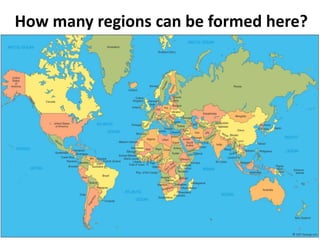
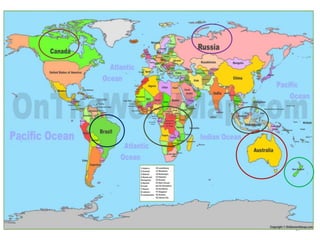
How many regions can be formed here?
4
Among the key questions in planning
and development field:
• Why do people create region?
• Who creates regions?
• How do people creates regions?
• When do people creates regions?
In order to do all that, one must understand the
concept of region and classification of region
5
Concept of region
6
Region
• An area identified by specific boundary and
meet specific criteria and/or characteristics
• Could be a combination of more than two
areas – but with similar characteristics or
features
• but it can be any tract of land or any area
7
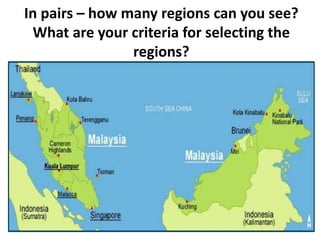
In pairs – how many regions can you see?
What are your criteria for selecting the
regions?
8
• Is it a homogenous area from a physical point of
view and can one talk of a natural region?
• Is it a heterogeneous area with a basic structure
such as a river or a fluvial basin?
• Is it a cultural area based on a common way of life
or an area based on a city and its hinterland - a
so-called nodal region?
9
In fact, all are regions even if, for a long time, natural
regions were the only ones considered by the scientists
owing to the dominance of the naturalist point of view.
Justification for region identification?
Categories and types of region
1. Formal, functional and perceptual regions
2. Multi-level planning classification of region
3. Economic development region
4. Activity region
10
Other important terms:
• Nodal region
• Planning region
Regional classification #1
Objective View
11
Linked with space & has spatial dimension
(e.g. fishing villages, Light & Medium Industries
area)
Region as an end itself – natural & absolute entity
Also known as “formal region”
Favoured by geographers and general public
Problem: in determining the boundaries
Example: Herbertson’s way of regional classification
Herbertson’s work
• A pioneer in essaying a classification of natural
environment
• Divided the world into natural regions (6
types)
• Read: Sum, Kong-Sut (n.d) Andrew John
Herbertson (1865 – 1915) and the Natural
Regions
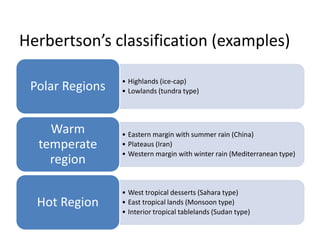
Herbertson’s classification (examples)
• Highlands (ice-cap)
• Lowlands (tundra type)Polar Regions
• Eastern margin with summer rain (China)
• Plateaus (Iran)
• Western margin with winter rain (Mediterranean type)
Warm
temperate
region
• West tropical desserts (Sahara type)
• East tropical lands (Monsoon type)
• Interior tropical tablelands (Sudan type)
Hot Region
Regional classification #2
14
Subjective View
Mental construct (spaceless)
arbitrarily dividing it into as many region as needs
be – independent of the considerations of space
Region defined based on particular criteria for
particular purpose (i.e. used as descriptive tool)
Favoured by economist – engaged in the
formulation of regional growth theory
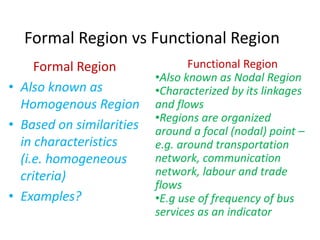
Formal Region vs Functional Region
Formal Region
• Also known as
Homogenous Region
• Based on similarities
in characteristics
(i.e. homogeneous
criteria)
• Examples?
Functional Region
•Also known as Nodal Region
•Characterized by its linkages
and flows
•Regions are organized
around a focal (nodal) point –
e.g. around transportation
network, communication
network, labour and trade
flows
•E.g use of frequency of bus
services as an indicator
Perceptual region
• Defined by people’s feeling and attitudes
about an area
• E.g. what is your view of the Klang Valley
area? What is your justification for saying
that? What of your view on the East
Coast/West Coast?
• On a smaller scale: Chinatown, Little Italy,
French Quarter
16
17
18
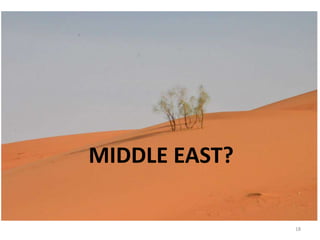
MIDDLE EAST?
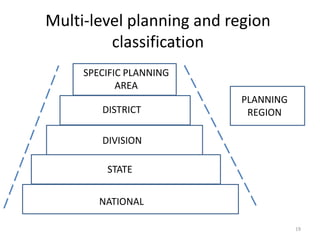
Multi-level planning and region
classification
19
NATIONAL
STATE
DIVISION
DISTRICT
SPECIFIC PLANNING
AREA
PLANNING
REGION
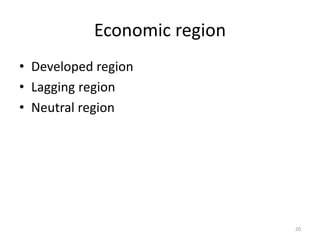
Economic region
• Developed region
• Lagging region
• Neutral region
20
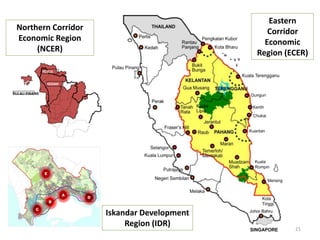
21
Eastern
Corridor
Economic
Region (ECER)
Northern Corridor
Economic Region
(NCER)
PERLIS
PULAU PINANG
KEDAH
Iskandar Development
Region (IDR)
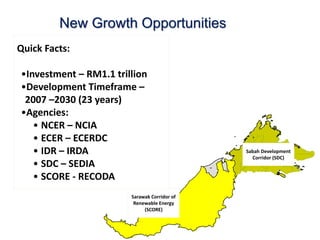
New Growth Opportunities
Sarawak Corridor of
Renewable Energy
(SCORE)
Sabah Development
Corridor (SDC)
Quick Facts:
•Investment – RM1.1 trillion
•Development Timeframe –
2007 –2030 (23 years)
•Agencies:
• NCER – NCIA
• ECER – ECERDC
• IDR – IRDA
• SDC – SEDIA
• SCORE - RECODA
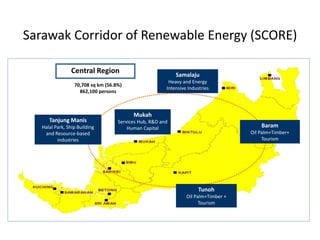
Sarawak Corridor of Renewable Energy (SCORE)
Tunoh
Oil Palm+Timber +
Tourism
Baram
Oil Palm+Timber+
Tourism
Tanjung Manis
Halal Park, Ship Building
and Resource-based
industries
Samalaju
Heavy and Energy
Intensive Industries
70,708 sq km (56.8%)
862,100 persons
Central Region
Mukah
Services Hub, R&D and
Human Capital
Activity region
• Agricultural region
• Mining region
• Industrial region
• Others?
24
Other terms
• Nodal region
• Planning region
• Regional Planning
25
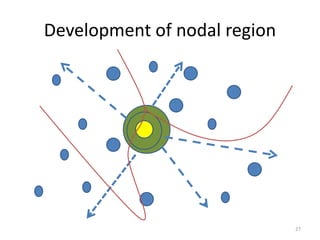
Nodal Region
• an area organized around a node, or focal
point, and is defined by interactions or
connections.
• E.g. A metropolitan area such as the Klang
Valley region (KL, PJ, Shah Alam, Klang) or
Putrajaya
26
Development of nodal region
27
Planning Region
Q1.What is the difference between region
and planning region?
Q2. Why do we need planning?
Q3. What is ‘planning’?
• Region demarcated for planning purposes
• Demarcation needs to take into account (for
ease of implementation):
 Existing administrative boundaries
 Political realities
 Availability of data for specific administrative unit
 Factors of homogeneity and nodality
Planning region:
Regional Planning
• Primary purpose: general distribution of
resources, activities and development
• Territorial competition (therefore territorial
approach to development)
• E.g. regional co-ordination of transportation
and landuse; regional sharing of resources,
regional growth control
Note: will be discussed further in the next lecture
In short,
Elements:
• Relative
homogeneity
• Uniqueness,
distinctiveness &
identification
• Blurred boundaries
types:
• Formal Region
• Functional Region
• Perceptual Region
• Planning Region
views:
• Objective View
• Subjective View
Summary
• Concept of region - An area identified by
specific boundary and meet specific criteria
and/or characteristics
• Criteria for planning regions, and its
significance (economic competition etc)
• Regional planning – justifications and examples
• Planning region vs. Regional Planning
Ask yourself
• What is your understanding of “region” now?
• Does this understanding differ from your
earlier perception of region i.e. before the
start of lecture?
• Will you be able to identify the different types
and aspects of a region?
References
• Ahmad, I & Bajwa, I.U. (2005). Regional
development planning: Issues and realities
(http://www.isocarp.net/data/case_studies/649.
pdf)
• Glasson, J & Marshall, T. (2007). Regional
Planning. New York: Routledge
• Pike, A. (2006). Local and Regional Planning. New
York: Routledge
• RECODA. (2016). What is SCORE?
(http://www.recoda.com.my/invest-in-
score/what-is-score/)

Regional 1

  • 1.
    SSR3033: Theories & Techniquesof Regional Planning Introduction to Regional Planning 5th and 6th Sept 2016 1
  • 2.
    Assessment 1. Assignment 1(individual) – 30% 2. Assignment 2 (Group) – 20% 3. Quiz (2) – 10% 4. Final Exam – 40% 2
  • 3.
    Objectives • To explainthe concept of region • To identify the characteristics of a region • To differentiate the terms “planning region” and “regional planning” • To differentiate between objective view and subjective view in the context of regional classification • To discuss the techniques of regional delimitation 3
  • 4.
    How many regionscan be formed here? 4
  • 5.
    Among the keyquestions in planning and development field: • Why do people create region? • Who creates regions? • How do people creates regions? • When do people creates regions? In order to do all that, one must understand the concept of region and classification of region 5
  • 6.
  • 7.
    Region • An areaidentified by specific boundary and meet specific criteria and/or characteristics • Could be a combination of more than two areas – but with similar characteristics or features • but it can be any tract of land or any area 7
  • 8.
    In pairs –how many regions can you see? What are your criteria for selecting the regions? 8
  • 9.
    • Is ita homogenous area from a physical point of view and can one talk of a natural region? • Is it a heterogeneous area with a basic structure such as a river or a fluvial basin? • Is it a cultural area based on a common way of life or an area based on a city and its hinterland - a so-called nodal region? 9 In fact, all are regions even if, for a long time, natural regions were the only ones considered by the scientists owing to the dominance of the naturalist point of view. Justification for region identification?
  • 10.
    Categories and typesof region 1. Formal, functional and perceptual regions 2. Multi-level planning classification of region 3. Economic development region 4. Activity region 10 Other important terms: • Nodal region • Planning region
  • 11.
    Regional classification #1 ObjectiveView 11 Linked with space & has spatial dimension (e.g. fishing villages, Light & Medium Industries area) Region as an end itself – natural & absolute entity Also known as “formal region” Favoured by geographers and general public Problem: in determining the boundaries Example: Herbertson’s way of regional classification
  • 12.
    Herbertson’s work • Apioneer in essaying a classification of natural environment • Divided the world into natural regions (6 types) • Read: Sum, Kong-Sut (n.d) Andrew John Herbertson (1865 – 1915) and the Natural Regions
  • 13.
    Herbertson’s classification (examples) •Highlands (ice-cap) • Lowlands (tundra type)Polar Regions • Eastern margin with summer rain (China) • Plateaus (Iran) • Western margin with winter rain (Mediterranean type) Warm temperate region • West tropical desserts (Sahara type) • East tropical lands (Monsoon type) • Interior tropical tablelands (Sudan type) Hot Region
  • 14.
    Regional classification #2 14 SubjectiveView Mental construct (spaceless) arbitrarily dividing it into as many region as needs be – independent of the considerations of space Region defined based on particular criteria for particular purpose (i.e. used as descriptive tool) Favoured by economist – engaged in the formulation of regional growth theory
  • 15.
    Formal Region vsFunctional Region Formal Region • Also known as Homogenous Region • Based on similarities in characteristics (i.e. homogeneous criteria) • Examples? Functional Region •Also known as Nodal Region •Characterized by its linkages and flows •Regions are organized around a focal (nodal) point – e.g. around transportation network, communication network, labour and trade flows •E.g use of frequency of bus services as an indicator
  • 16.
    Perceptual region • Definedby people’s feeling and attitudes about an area • E.g. what is your view of the Klang Valley area? What is your justification for saying that? What of your view on the East Coast/West Coast? • On a smaller scale: Chinatown, Little Italy, French Quarter 16
  • 17.
  • 18.
  • 19.
    Multi-level planning andregion classification 19 NATIONAL STATE DIVISION DISTRICT SPECIFIC PLANNING AREA PLANNING REGION
  • 20.
    Economic region • Developedregion • Lagging region • Neutral region 20
  • 21.
    21 Eastern Corridor Economic Region (ECER) Northern Corridor EconomicRegion (NCER) PERLIS PULAU PINANG KEDAH Iskandar Development Region (IDR)
  • 22.
    New Growth Opportunities SarawakCorridor of Renewable Energy (SCORE) Sabah Development Corridor (SDC) Quick Facts: •Investment – RM1.1 trillion •Development Timeframe – 2007 –2030 (23 years) •Agencies: • NCER – NCIA • ECER – ECERDC • IDR – IRDA • SDC – SEDIA • SCORE - RECODA
  • 23.
    Sarawak Corridor ofRenewable Energy (SCORE) Tunoh Oil Palm+Timber + Tourism Baram Oil Palm+Timber+ Tourism Tanjung Manis Halal Park, Ship Building and Resource-based industries Samalaju Heavy and Energy Intensive Industries 70,708 sq km (56.8%) 862,100 persons Central Region Mukah Services Hub, R&D and Human Capital
  • 24.
    Activity region • Agriculturalregion • Mining region • Industrial region • Others? 24
  • 25.
    Other terms • Nodalregion • Planning region • Regional Planning 25
  • 26.
    Nodal Region • anarea organized around a node, or focal point, and is defined by interactions or connections. • E.g. A metropolitan area such as the Klang Valley region (KL, PJ, Shah Alam, Klang) or Putrajaya 26
  • 27.
  • 28.
    Planning Region Q1.What isthe difference between region and planning region? Q2. Why do we need planning? Q3. What is ‘planning’?
  • 29.
    • Region demarcatedfor planning purposes • Demarcation needs to take into account (for ease of implementation):  Existing administrative boundaries  Political realities  Availability of data for specific administrative unit  Factors of homogeneity and nodality Planning region:
  • 30.
    Regional Planning • Primarypurpose: general distribution of resources, activities and development • Territorial competition (therefore territorial approach to development) • E.g. regional co-ordination of transportation and landuse; regional sharing of resources, regional growth control Note: will be discussed further in the next lecture
  • 31.
    In short, Elements: • Relative homogeneity •Uniqueness, distinctiveness & identification • Blurred boundaries types: • Formal Region • Functional Region • Perceptual Region • Planning Region views: • Objective View • Subjective View
  • 32.
    Summary • Concept ofregion - An area identified by specific boundary and meet specific criteria and/or characteristics • Criteria for planning regions, and its significance (economic competition etc) • Regional planning – justifications and examples • Planning region vs. Regional Planning
  • 33.
    Ask yourself • Whatis your understanding of “region” now? • Does this understanding differ from your earlier perception of region i.e. before the start of lecture? • Will you be able to identify the different types and aspects of a region?
  • 34.
    References • Ahmad, I& Bajwa, I.U. (2005). Regional development planning: Issues and realities (http://www.isocarp.net/data/case_studies/649. pdf) • Glasson, J & Marshall, T. (2007). Regional Planning. New York: Routledge • Pike, A. (2006). Local and Regional Planning. New York: Routledge • RECODA. (2016). What is SCORE? (http://www.recoda.com.my/invest-in- score/what-is-score/)