

Project Scope Management
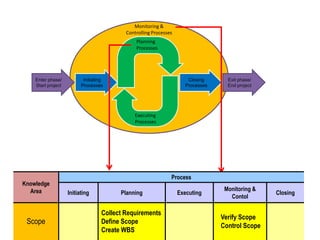
Enter phase/
Start project
Exit phase/
End project
Initiating
Processes
Closing
Processes
Planning
Processes
Executing
Processes
Monitoring &
Controlling Processes
Knowledge
Area
Process
Initiating Planning Executing
Monitoring &
Contol
Closing
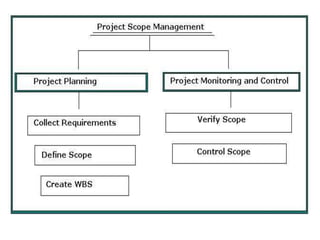
Scope
Collect Requirements
Define Scope
Create WBS
Verify Scope
Control Scope
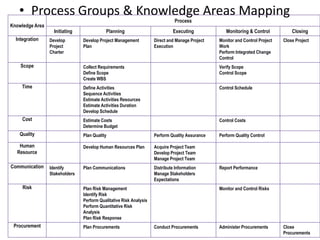
• Process Groups & Knowledge Areas Mapping
Knowledge Area
Process
Initiating Planning Executing Monitoring & Control Closing
Integration Develop
Project
Charter
Develop Project Management
Plan
Direct and Manage Project
Execution
Monitor and Control Project
Work
Perform Integrated Change
Control
Close Project
Scope Collect Requirements
Define Scope
Create WBS
Verify Scope
Control Scope
Time Define Activities
Sequence Activities
Estimate Activities Resources
Estimate Activities Duration
Develop Schedule
Control Schedule
Cost Estimate Costs
Determine Budget
Control Costs
Quality Plan Quality Perform Quality Assurance Perform Quality Control
Human
Resource
Develop Human Resources Plan Acquire Project Team
Develop Project Team
Manage Project Team
Communication Identify
Stakeholders
Plan Communications Distribute Information
Manage Stakeholders
Expectations
Report Performance
Risk Plan Risk Management
Identify Risk
Perform Qualitative Risk Analysis
Perform Quantitative Risk
Analysis
Plan Risk Response
Monitor and Control Risks
Procurement Plan Procurements Conduct Procurements Administer Procurements Close
Procurements
• Management Project Scope
- the processes required to ensure that the project includes all the
work required, and only the work required (prevent gold plat)
• scope Management Plan
- How will I do scope?
- Create this Document is not identified as Separate Process.
- It is part of Project management plan
•
• Project scope include
• 1- Product Scope :
• The features and functions that
characterize a product, service, or result
• 2- project Scope :
• The work that needs to be accomplished to
deliver a product, service, or result with the
specified features and functions.
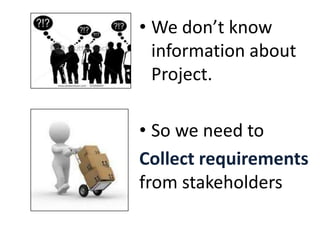
• We don’t know
information about
Project.
• So we need to
Collect requirements
from stakeholders
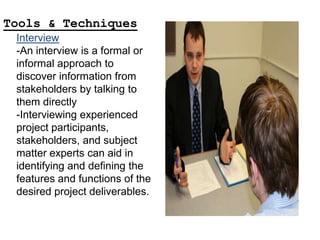
Interview
-An interview is a formal or
informal approach to
discover information from
stakeholders by talking to
them directly
-Interviewing experienced
project participants,
stakeholders, and subject
matter experts can aid in
identifying and defining the
features and functions of the
desired project deliverables.
Tools & Techniques
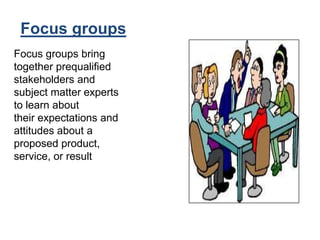
Focus groups
Focus groups bring
together prequalified
stakeholders and
subject matter experts
to learn about
their expectations and
attitudes about a
proposed product,
service, or result
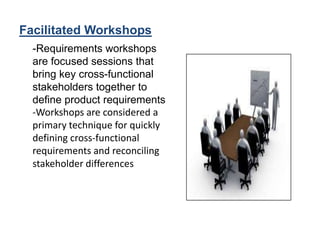
Facilitated Workshops
-Requirements workshops
are focused sessions that
bring key cross-functional
stakeholders together to
define product requirements
-Workshops are considered a
primary technique for quickly
defining cross-functional
requirements and reconciling
stakeholder differences
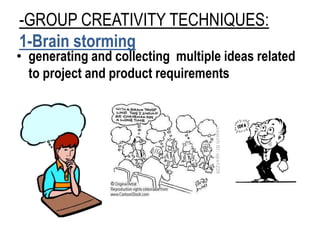
-GROUP CREATIVITY TECHNIQUES:
1-Brain storming
• generating and collecting multiple ideas related
to project and product requirements
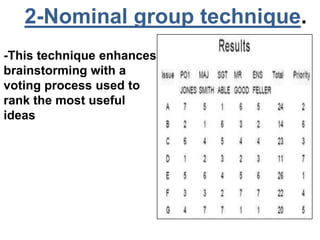
-This technique enhances
brainstorming with a
voting process used to
rank the most useful
ideas
2-Nominal group technique.
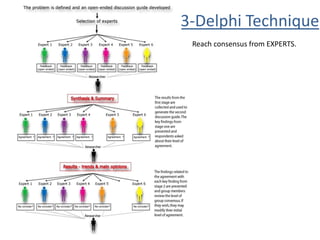
• 3-Delphi Technique
Reach consensus from EXPERTS.
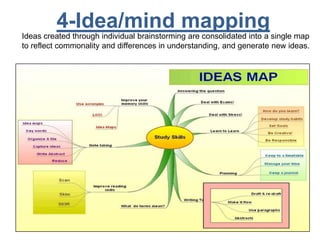
4-Idea/mind mapping
Ideas created through individual brainstorming are consolidated into a single map
to reflect commonality and differences in understanding, and generate new ideas.
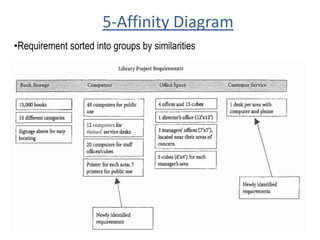
5-Affinity Diagram
•Requirement sorted into groups by similarities
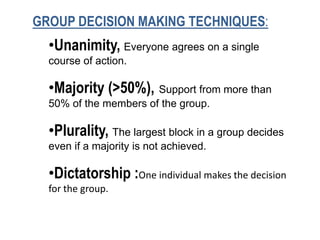
GROUP DECISION MAKING TECHNIQUES:
•Unanimity, Everyone agrees on a single
course of action.
•Majority (>50%), Support from more than
50% of the members of the group.
•Plurality, The largest block in a group decides
even if a majority is not achieved.
•Dictatorship :One individual makes the decision
for the group.
Questionnaires and surveys
Questionnaires and surveys are written sets of questions
designed to quickly accumulate information from a wide
number of respondents. Questionnaires and/or surveys are
most appropriate with broad audiences, when quick
turnaround is needed, and where statistical analysis is
appropriate.
Observations
Observations provide a direct way of viewing individuals in their
environment and how they perform their jobs or tasks and carry
out processes. It is particularly helpful for detailed processes
when the people that use the product have difficulty or are
reluctant to articulate their requirements
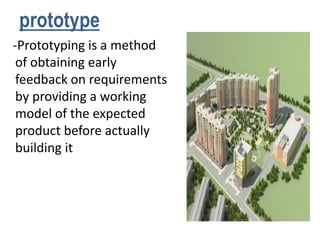
prototype
-Prototyping is a method
of obtaining early
feedback on requirements
by providing a working
model of the expected
product before actually
building it
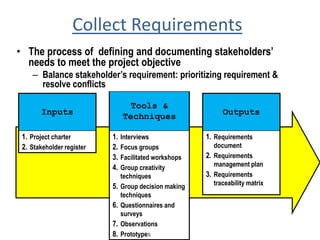
Collect Requirements
• The process of defining and documenting stakeholders’
needs to meet the project objective
– Balance stakeholder’s requirement: prioritizing requirement &
resolve conflicts
Inputs
1. Project charter
2. Stakeholder register
Tools &
Techniques
1. Interviews
2. Focus groups
3. Facilitated workshops
4. Group creativity
techniques
5. Group decision making
techniques
6. Questionnaires and
surveys
7. Observations
8. Prototypes
Outputs
1. Requirements
document
2. Requirements
management plan
3. Requirements
traceability matrix
•Balance Stakeholder’s Requirement
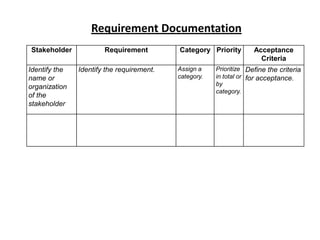
1-Requirements Documentation
•Stakeholder request is not related to the reason of
project created should be rejected!
Output
Stakeholder Requirement Category Priority Acceptance
Criteria
Identify the
name or
organization
of the
stakeholder
Identify the requirement. Assign a
category.
Prioritize
in total or
by
category.
Define the criteria
for acceptance.
Requirement Documentation
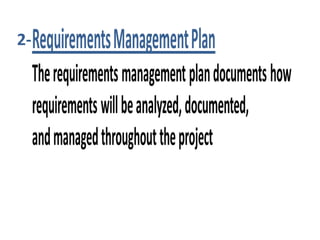
2-
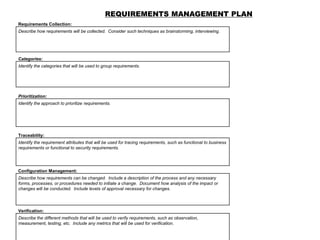
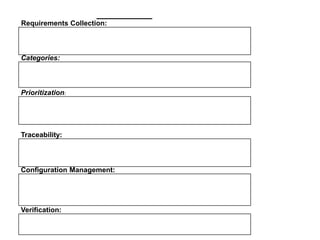
Requirements Collection:
Describe how requirements will be collected. Consider such techniques as brainstorming, interviewing.
Categories:
Identify the categories that will be used to group requirements.
Prioritization:
Identify the approach to prioritize requirements.
Traceability:
Identify the requirement attributes that will be used for tracing requirements, such as functional to business
requirements or functional to security requirements.
Configuration Management:
Describe how requirements can be changed. Include a description of the process and any necessary
forms, processes, or procedures needed to initiate a change. Document how analysis of the impact or
changes will be conducted. Include levels of approval necessary for changes.
Verification:
Describe the different methods that will be used to verify requirements, such as observation,
measurement, testing, etc. Include any metrics that will be used for verification.
REQUIREMENTS MANAGEMENT PLAN
Requirements Collection:
Categories:
Prioritization:
Traceability:
Configuration Management:
Verification:
-Attributes associated with each requirement can be
recorded in the requirements traceability matrix.
These attributes help to define key information about
the requirement.
3-Requirements Traceability Matrix
-The requirements traceability matrix is a table that
links requirements to their origin and traces them
throughout the project life cycle
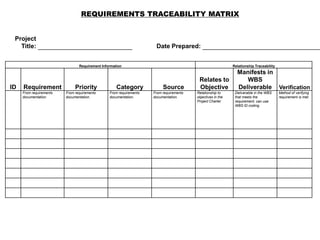
Requirement Information Relationship Traceability
ID Requirement Priority Category Source
Relates to
Objective
Manifests in
WBS
Deliverable Verification
From requirements
documentation.
From requirements
documentation.
From requirements
documentation.
From requirements
documentation.
Relationship to
objectives in the
Project Charter
Deliverable in the WBS
that meets the
requirement; can use
WBS ID coding.
Method of verifying
requirement is met.
REQUIREMENTS TRACEABILITY MATRIX
Project
Title: Date Prepared:
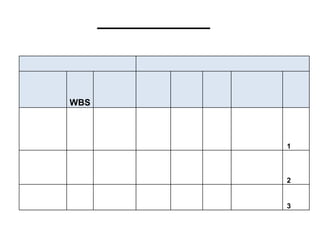
WBS
1
2
3
QUESTIONS?
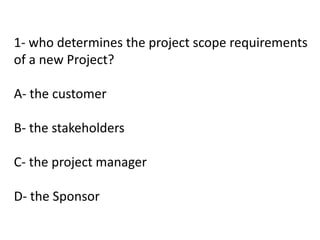
1- who determines the project scope requirements
of a new Project?
A- the customer
B- the stakeholders
C- the project manager
D- the Sponsor
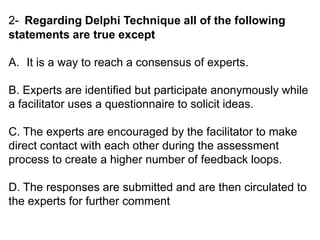
2- Regarding Delphi Technique all of the following
statements are true except
A. It is a way to reach a consensus of experts.
B. Experts are identified but participate anonymously while
a facilitator uses a questionnaire to solicit ideas.
C. The experts are encouraged by the facilitator to make
direct contact with each other during the assessment
process to create a higher number of feedback loops.
D. The responses are submitted and are then circulated to
the experts for further comment
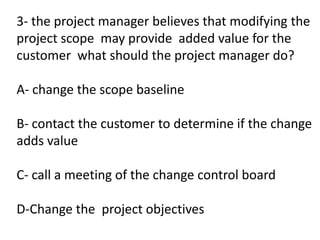
3- the project manager believes that modifying the
project scope may provide added value for the
customer what should the project manager do?
A- change the scope baseline
B- contact the customer to determine if the change
adds value
C- call a meeting of the change control board
D-Change the project objectives
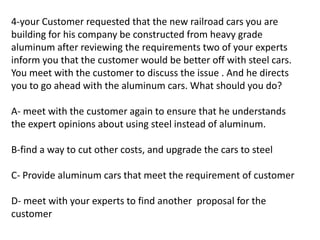
4-your Customer requested that the new railroad cars you are
building for his company be constructed from heavy grade
aluminum after reviewing the requirements two of your experts
inform you that the customer would be better off with steel cars.
You meet with the customer to discuss the issue . And he directs
you to go ahead with the aluminum cars. What should you do?
A- meet with the customer again to ensure that he understands
the expert opinions about using steel instead of aluminum.
B-find a way to cut other costs, and upgrade the cars to steel
C- Provide aluminum cars that meet the requirement of customer
D- meet with your experts to find another proposal for the
customer
5- the project manager wishes to use the delphi technique to
obtain expert openion on some difficult technical issues he is
facing what should he be careful to do?
A- make sure the experts consultant are recognized to do
B- compare information and work toward a single openion
C-consult the stakeholders
D- meet together with the expert to obtain consensus
Thank you

Session 3 4th edition

  • 1.
  • 2.
    Enter phase/ Start project Exitphase/ End project Initiating Processes Closing Processes Planning Processes Executing Processes Monitoring & Controlling Processes Knowledge Area Process Initiating Planning Executing Monitoring & Contol Closing Scope Collect Requirements Define Scope Create WBS Verify Scope Control Scope
  • 3.
    • Process Groups& Knowledge Areas Mapping Knowledge Area Process Initiating Planning Executing Monitoring & Control Closing Integration Develop Project Charter Develop Project Management Plan Direct and Manage Project Execution Monitor and Control Project Work Perform Integrated Change Control Close Project Scope Collect Requirements Define Scope Create WBS Verify Scope Control Scope Time Define Activities Sequence Activities Estimate Activities Resources Estimate Activities Duration Develop Schedule Control Schedule Cost Estimate Costs Determine Budget Control Costs Quality Plan Quality Perform Quality Assurance Perform Quality Control Human Resource Develop Human Resources Plan Acquire Project Team Develop Project Team Manage Project Team Communication Identify Stakeholders Plan Communications Distribute Information Manage Stakeholders Expectations Report Performance Risk Plan Risk Management Identify Risk Perform Qualitative Risk Analysis Perform Quantitative Risk Analysis Plan Risk Response Monitor and Control Risks Procurement Plan Procurements Conduct Procurements Administer Procurements Close Procurements
  • 5.
    • Management ProjectScope - the processes required to ensure that the project includes all the work required, and only the work required (prevent gold plat) • scope Management Plan - How will I do scope? - Create this Document is not identified as Separate Process. - It is part of Project management plan •
  • 6.
    • Project scopeinclude • 1- Product Scope : • The features and functions that characterize a product, service, or result • 2- project Scope : • The work that needs to be accomplished to deliver a product, service, or result with the specified features and functions.
  • 7.
    • We don’tknow information about Project. • So we need to Collect requirements from stakeholders
  • 8.
    Interview -An interview isa formal or informal approach to discover information from stakeholders by talking to them directly -Interviewing experienced project participants, stakeholders, and subject matter experts can aid in identifying and defining the features and functions of the desired project deliverables. Tools & Techniques
  • 9.
    Focus groups Focus groupsbring together prequalified stakeholders and subject matter experts to learn about their expectations and attitudes about a proposed product, service, or result
  • 10.
    Facilitated Workshops -Requirements workshops arefocused sessions that bring key cross-functional stakeholders together to define product requirements -Workshops are considered a primary technique for quickly defining cross-functional requirements and reconciling stakeholder differences
  • 11.
    -GROUP CREATIVITY TECHNIQUES: 1-Brainstorming • generating and collecting multiple ideas related to project and product requirements
  • 12.
    -This technique enhances brainstormingwith a voting process used to rank the most useful ideas 2-Nominal group technique.
  • 13.
    • 3-Delphi Technique Reachconsensus from EXPERTS.
  • 14.
    4-Idea/mind mapping Ideas createdthrough individual brainstorming are consolidated into a single map to reflect commonality and differences in understanding, and generate new ideas.
  • 15.
    5-Affinity Diagram •Requirement sortedinto groups by similarities
  • 16.
    GROUP DECISION MAKINGTECHNIQUES: •Unanimity, Everyone agrees on a single course of action. •Majority (>50%), Support from more than 50% of the members of the group. •Plurality, The largest block in a group decides even if a majority is not achieved. •Dictatorship :One individual makes the decision for the group.
  • 17.
    Questionnaires and surveys Questionnairesand surveys are written sets of questions designed to quickly accumulate information from a wide number of respondents. Questionnaires and/or surveys are most appropriate with broad audiences, when quick turnaround is needed, and where statistical analysis is appropriate. Observations Observations provide a direct way of viewing individuals in their environment and how they perform their jobs or tasks and carry out processes. It is particularly helpful for detailed processes when the people that use the product have difficulty or are reluctant to articulate their requirements
  • 18.
    prototype -Prototyping is amethod of obtaining early feedback on requirements by providing a working model of the expected product before actually building it
  • 19.
    Collect Requirements • Theprocess of defining and documenting stakeholders’ needs to meet the project objective – Balance stakeholder’s requirement: prioritizing requirement & resolve conflicts Inputs 1. Project charter 2. Stakeholder register Tools & Techniques 1. Interviews 2. Focus groups 3. Facilitated workshops 4. Group creativity techniques 5. Group decision making techniques 6. Questionnaires and surveys 7. Observations 8. Prototypes Outputs 1. Requirements document 2. Requirements management plan 3. Requirements traceability matrix
  • 20.
    •Balance Stakeholder’s Requirement 1-RequirementsDocumentation •Stakeholder request is not related to the reason of project created should be rejected! Output
  • 21.
    Stakeholder Requirement CategoryPriority Acceptance Criteria Identify the name or organization of the stakeholder Identify the requirement. Assign a category. Prioritize in total or by category. Define the criteria for acceptance. Requirement Documentation
  • 22.
  • 23.
  • 24.
    Requirements Collection: Describe howrequirements will be collected. Consider such techniques as brainstorming, interviewing. Categories: Identify the categories that will be used to group requirements. Prioritization: Identify the approach to prioritize requirements. Traceability: Identify the requirement attributes that will be used for tracing requirements, such as functional to business requirements or functional to security requirements. Configuration Management: Describe how requirements can be changed. Include a description of the process and any necessary forms, processes, or procedures needed to initiate a change. Document how analysis of the impact or changes will be conducted. Include levels of approval necessary for changes. Verification: Describe the different methods that will be used to verify requirements, such as observation, measurement, testing, etc. Include any metrics that will be used for verification. REQUIREMENTS MANAGEMENT PLAN
  • 25.
  • 26.
    -Attributes associated witheach requirement can be recorded in the requirements traceability matrix. These attributes help to define key information about the requirement. 3-Requirements Traceability Matrix -The requirements traceability matrix is a table that links requirements to their origin and traces them throughout the project life cycle
  • 27.
    Requirement Information RelationshipTraceability ID Requirement Priority Category Source Relates to Objective Manifests in WBS Deliverable Verification From requirements documentation. From requirements documentation. From requirements documentation. From requirements documentation. Relationship to objectives in the Project Charter Deliverable in the WBS that meets the requirement; can use WBS ID coding. Method of verifying requirement is met. REQUIREMENTS TRACEABILITY MATRIX Project Title: Date Prepared:
  • 28.
  • 29.
  • 30.
    1- who determinesthe project scope requirements of a new Project? A- the customer B- the stakeholders C- the project manager D- the Sponsor
  • 31.
    2- Regarding DelphiTechnique all of the following statements are true except A. It is a way to reach a consensus of experts. B. Experts are identified but participate anonymously while a facilitator uses a questionnaire to solicit ideas. C. The experts are encouraged by the facilitator to make direct contact with each other during the assessment process to create a higher number of feedback loops. D. The responses are submitted and are then circulated to the experts for further comment
  • 32.
    3- the projectmanager believes that modifying the project scope may provide added value for the customer what should the project manager do? A- change the scope baseline B- contact the customer to determine if the change adds value C- call a meeting of the change control board D-Change the project objectives
  • 33.
    4-your Customer requestedthat the new railroad cars you are building for his company be constructed from heavy grade aluminum after reviewing the requirements two of your experts inform you that the customer would be better off with steel cars. You meet with the customer to discuss the issue . And he directs you to go ahead with the aluminum cars. What should you do? A- meet with the customer again to ensure that he understands the expert opinions about using steel instead of aluminum. B-find a way to cut other costs, and upgrade the cars to steel C- Provide aluminum cars that meet the requirement of customer D- meet with your experts to find another proposal for the customer
  • 34.
    5- the projectmanager wishes to use the delphi technique to obtain expert openion on some difficult technical issues he is facing what should he be careful to do? A- make sure the experts consultant are recognized to do B- compare information and work toward a single openion C-consult the stakeholders D- meet together with the expert to obtain consensus
  • 35.

Editor's Notes