Created by ejlp12@gmail.com, June 201012 - Project Procurement ManagementProject Management Training
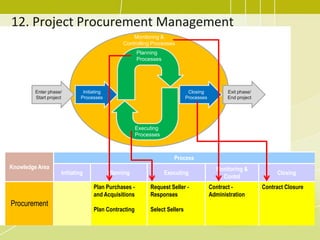
12. Project Procurement ManagementMonitoring &Controlling ProcessesPlanningProcessesEnter phase/Start projectExit phase/End projectInitiatingProcessesClosingProcessesExecutingProcesses
Project Procurement ManagementThe process necessary to process and acquire product or services, or result needed from outside the project team.Involve planning, acquiring the product or services from sources, choosing a source, administering the contract, and closing out the contract.Can be applied to internal work orders, formal agreements, and contracts between organization units within single entity.
Project Manager’s Role in ProcurementsPM must be involved in the creation of contractsKey roles:Know the procurement processUnderstand contract terms and conditionsMake sure the contract contains all project management requirements such as attendance at meeting, reports, actions and communications deemed necessaryIdentify risks and incorporate mitigation and allocation of risks into the contractHelp tailor the contract to the unique needs of the projectAlign schedule of the contract and schedule of the projectInvolved in contract negotiationMake sure procurement process done smoothlyWork with contract manager to manage changes to the contractPM must be assigned before contract signed!
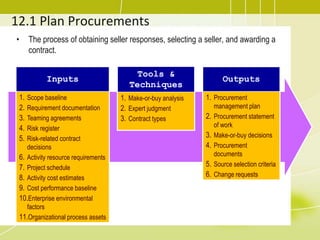
12.1 Plan ProcurementsThe process of obtaining seller responses, selecting a seller, and awarding a contract.
Make-or-buy analysisDetermine whether an organization should make or perform particular product or service by themselves or buy/acquire from others.Evaluate of the benefit and drawbackOften involves financial analysisMake or buy analysis focus on:skills and resourcescosttimeHow critical is it that we retain detailed control over a certain area?proprietary information or trade secretSee decision analysis in “Project Risk Management”
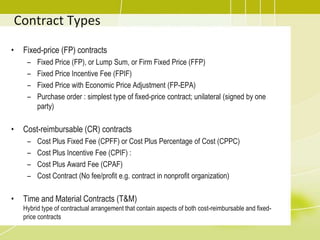
Contract TypesFixed-price (FP) contractsFixed Price (FP), or Lump Sum, or Firm Fixed Price (FFP) Fixed Price Incentive Fee (FPIF)Fixed Price with Economic Price Adjustment (FP-EPA)Purchase order : simplest type of fixed-price contract; unilateral (signed by one party)Cost-reimbursable (CR) contractsCost Plus Fixed Fee (CPFF) or Cost Plus Percentage of Cost (CPPC)Cost Plus Incentive Fee (CPIF) : Cost Plus Award Fee (CPAF)Cost Contract (No fee/profit e.g. contract in nonprofit organization)Time and Material Contracts (T&M)Hybrid type of contractual arrangement that contain aspects of both cost-reimbursable and fixed-price contracts
Fixed-price (FP) contractsUsed for acquiring goods or services with well defined specifications or requirements.Seller is most concerned with the SOWSometime the buyer forces seller to accept a high level riskSeller would need huge amount of reservesSeller can try to increase profit by cutting scopeExamples:FP: Contract = $1MFPIF: Contract = $1M + for every month added $1000FPAF: Contract = $1M + for every month added $1000 if performance exceedFPEA: Contract = $1M + additional pricing based on Government Center Bank depreciation rate.PO: $1K per 1 metric ton
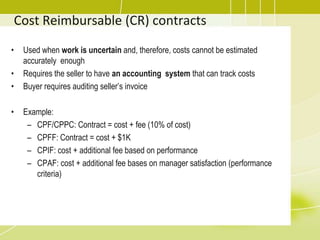
Cost Reimbursable (CR) contractsUsed when work is uncertain and, therefore, costs cannot be estimated accurately  enoughRequires the seller to have an accounting  system that can track costs Buyer requires auditing seller’s invoiceExample:CPF/CPPC: Contract = cost + fee (10% of cost)CPFF: Contract = cost + $1KCPIF: cost + additional fee based on performanceCPAF: cost + additional fee bases on manager satisfaction (performance criteria)
Time & Material (T&M) contractsUsed for service  efforts in  which the  level of effort cannot be defined  at the time the contract  is awardedTo make sure the costs do not become higher  than budgeted, the buyer may put a "Not to Exceed" and time limits clause in the contract.Often used for staff augmentation, acquisition of experts, outside supportExample:Contract = $1K per day plus expenses or material cost.Contract = $1K per day plus material at $5 per linear meter of wood.
Contract Types vs. RiskEffect of contract type on buyer & seller riskHighLowFixed PriceFFPFPIFTime and MaterialsCost ReimbursableCPIFCPFFCPFCPPCBUYERRISKSELLER RISKT&M can be a high risk for buyer if contract does not include a “total not-to-exceed” (NTE)LowHigh
Plan Procurement OutputProcurement Management plan Describe how procurement process will be managedGuidance for any procurement processProcurement Statement of Work (SOW)Develop from scope baselineInclude only the portion will be included within the contractThis can be revised/refined through the procurement process until signedMake-or-buy decisionsThe conclusion reach regarding what product/service/result will be acquired from outside
Procurement Documents (output)May includes:Information for SellersContract statement of  workProposed terms & conditions of the contractNon-disclosure agreement (NDA) -- to disclose some confidential informationProcurement documents, examples:Request for Information (RFI)Invitation For Bid (IFB)Request For Proposal (RFP)Request For Quotation (RFQ)Tender noticeInvitation for negotiationInvitation for seller’s initial response
Procurement DocumentLetter of Intent (LOI)It is not a contract, but a letter without legal binding, that says the buyer intends to hire seller.Privity of contractA contractual relationshipExample:You hired a contractor A, and the contractor hires another sub-contractor B to deliver part of your work. Even though B is performing your work, he/she is contractually not bound to you, because B contractually bound to “A” only. So you need to talk to A instead of B.Teaming Agreements (or a join venture)Two sellers join force for one procurement
Noncompetitive Form of ProcurementForm used when only one seller awarded without a competitive procurement.Should keep follow rules of bidding process and lawsSaving time on procurement processWould be implemented in the following condition:The project under schedule pressureA seller has unique qualificationThere is only one sellerA seller hold a patentOther mechanism exist that seller’s prices are reasonable.Type of noncompetitive procurementSingle source: contract directly to preferred seller.Sole source: there is one seller; might be a company owns a patent
Source selection criteriaSome criteria for evaluating proposals and bids (due diligence):Understanding of needTechnical CapabilityPast performance of sellers (experience)Project management approachFinancial stability & capacityIntellectual & property rightsOverall or life cycle costRiskWarrantyReferences
Important TermsPrice, Profit (fee), CostTarget price: used  to compare the end result of the project with what was expected (the target price).Sharing  ratio: Incentives  take the form of a formula, usually expressed as a ratio, e.g. 90/10 (buyer/seller)Ceiling price: This  is the highest price the buyer will pay.Point of total assumption (PTA):  This only applies to fixed price incentive  fee contractsRefers to the amount above which the seller bears all the loss of a cost overrun. Seller usually monitor actual costs against PTA to make still having profit.Formula: PTA =  ((Ceiling  price -  Target price)/Buyer's  share ratio) + Target cost
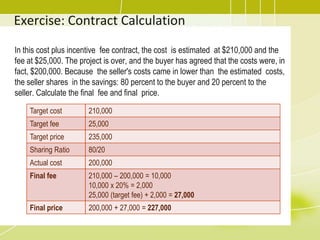
Exercise: Contract Calculation In this cost plus incentive  fee contract, the cost  is estimated  at $210,000 and the fee at $25,000. The project is over, and the buyer has agreed that the costs were, in fact, $200,000. Because  the seller's costs came in lower than  the estimated  costs, the seller shares  in the savings: 80 percent to the buyer and 20 percent to the seller. Calculate the final  fee and final  price.
12.2 Conduct ProcurementsThe process of obtaining seller responses, selecting a seller, and awarding a contract.
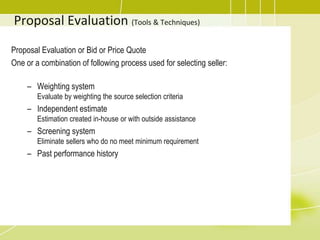
Proposal Evaluation (Tools & Techniques)Proposal Evaluation or Bid or Price Quote One or a combination of following process used for selecting seller:Weighting systemEvaluate by weighting the source selection criteriaIndependent estimateEstimation created in-house or with outside assistanceScreening systemEliminate sellers who do no meet minimum requirementPast performance history
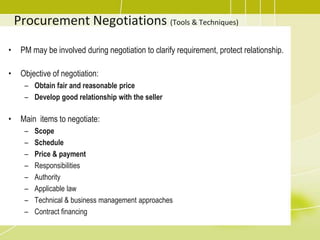
Procurement Negotiations (Tools & Techniques)PM may be involved during negotiation to clarify requirement, protect relationship.Objective of negotiation:Obtain fair and reasonable priceDevelop good relationship with the sellerMain  items to negotiate:ScopeSchedulePrice & paymentResponsibilitiesAuthorityApplicable lawTechnical & business management approachesContract financing
Contract DocumentPurpose of contract:To define role and responsibilitiesTo make things legally bindingTo mitigate or allocate risks.Contract has many names and types from simple to complex documentAgreement, subcontract, purchase order, memorandum of understanding (MOU)A legal contract  will need..An offer AcceptanceConsideration (Something of value, not necessary money)Legal capacity (Separate legal parties, competent parties)Legal purpose (We cannot have a contract for something illegal)
Contract DocumentContract document usually includes:Statement of work or deliverablesSchedule baselinePerformance reportingPeriod of performanceRole & responsibilitiesSeller’s place of performancePricingPayment termsPlace of deliveryInspection and acceptance criteriaWarranty
12.3 Administer ProcurementsThe process of managing procurement relationship, monitoring contract performance and making change and corrections as needed.
Contract AdministrationAssuring the performance of both parties to the contract meets contractual requirement.Contract change controls systemA process for modifying a contractReview the impactsContract administrator is the only one with authority to change the contractThere are potential conflict between project manager and contract administrator
12.4 Close ProcurementsThe process of completing each project procurement.
Negotiated SettlementsIn all procurement relationships the final equitable settlement of all outstanding issues , claims , and disputes by negotiations is a primary goal. Whenever settlement cannot be achieved by direct negotiation , some form of alternative dispute achieved by direct negotiation , some form of alternative dispute resolution (ADR) including mediation or arbitration may be explored . When all else fails , litigation in the courts is the least desirable option
INCOTERMS 2000 Terms from International Chamber of Commerce To make the same definition between seller and buyer used for export/importGroup E Incoterms (departure)EXW (Ex works)Group F Incoterms (main carriage unpaid)FCA (Free carrier)FAS (Free alongside ship)FOB (Free on board)Group C Incoterms (main carriage paid)CFR (Cost and freight)CIF (Cost, insurance and freight)CIP (Carriage and insurance paid to)Group D Incoterms (arrival)DAF (Delivered at frontier)DES (Delivered ex ship)DEQ (Delivered ex quay)DDU (Delivered duty unpaid)DDP (Delivered duty paid)
.Thank You

PMP Training - 12 project procurement management

  • 1.
    Created by ejlp12@gmail.com,June 201012 - Project Procurement ManagementProject Management Training
  • 2.
    12. Project ProcurementManagementMonitoring &Controlling ProcessesPlanningProcessesEnter phase/Start projectExit phase/End projectInitiatingProcessesClosingProcessesExecutingProcesses
  • 3.
    Project Procurement ManagementTheprocess necessary to process and acquire product or services, or result needed from outside the project team.Involve planning, acquiring the product or services from sources, choosing a source, administering the contract, and closing out the contract.Can be applied to internal work orders, formal agreements, and contracts between organization units within single entity.
  • 4.
    Project Manager’s Rolein ProcurementsPM must be involved in the creation of contractsKey roles:Know the procurement processUnderstand contract terms and conditionsMake sure the contract contains all project management requirements such as attendance at meeting, reports, actions and communications deemed necessaryIdentify risks and incorporate mitigation and allocation of risks into the contractHelp tailor the contract to the unique needs of the projectAlign schedule of the contract and schedule of the projectInvolved in contract negotiationMake sure procurement process done smoothlyWork with contract manager to manage changes to the contractPM must be assigned before contract signed!
  • 5.
    12.1 Plan ProcurementsTheprocess of obtaining seller responses, selecting a seller, and awarding a contract.
  • 6.
    Make-or-buy analysisDetermine whetheran organization should make or perform particular product or service by themselves or buy/acquire from others.Evaluate of the benefit and drawbackOften involves financial analysisMake or buy analysis focus on:skills and resourcescosttimeHow critical is it that we retain detailed control over a certain area?proprietary information or trade secretSee decision analysis in “Project Risk Management”
  • 7.
    Contract TypesFixed-price (FP)contractsFixed Price (FP), or Lump Sum, or Firm Fixed Price (FFP) Fixed Price Incentive Fee (FPIF)Fixed Price with Economic Price Adjustment (FP-EPA)Purchase order : simplest type of fixed-price contract; unilateral (signed by one party)Cost-reimbursable (CR) contractsCost Plus Fixed Fee (CPFF) or Cost Plus Percentage of Cost (CPPC)Cost Plus Incentive Fee (CPIF) : Cost Plus Award Fee (CPAF)Cost Contract (No fee/profit e.g. contract in nonprofit organization)Time and Material Contracts (T&M)Hybrid type of contractual arrangement that contain aspects of both cost-reimbursable and fixed-price contracts
  • 8.
    Fixed-price (FP) contractsUsedfor acquiring goods or services with well defined specifications or requirements.Seller is most concerned with the SOWSometime the buyer forces seller to accept a high level riskSeller would need huge amount of reservesSeller can try to increase profit by cutting scopeExamples:FP: Contract = $1MFPIF: Contract = $1M + for every month added $1000FPAF: Contract = $1M + for every month added $1000 if performance exceedFPEA: Contract = $1M + additional pricing based on Government Center Bank depreciation rate.PO: $1K per 1 metric ton
  • 9.
    Cost Reimbursable (CR)contractsUsed when work is uncertain and, therefore, costs cannot be estimated accurately enoughRequires the seller to have an accounting system that can track costs Buyer requires auditing seller’s invoiceExample:CPF/CPPC: Contract = cost + fee (10% of cost)CPFF: Contract = cost + $1KCPIF: cost + additional fee based on performanceCPAF: cost + additional fee bases on manager satisfaction (performance criteria)
  • 10.
    Time & Material(T&M) contractsUsed for service efforts in which the level of effort cannot be defined at the time the contract is awardedTo make sure the costs do not become higher than budgeted, the buyer may put a "Not to Exceed" and time limits clause in the contract.Often used for staff augmentation, acquisition of experts, outside supportExample:Contract = $1K per day plus expenses or material cost.Contract = $1K per day plus material at $5 per linear meter of wood.
  • 11.
    Contract Types vs.RiskEffect of contract type on buyer & seller riskHighLowFixed PriceFFPFPIFTime and MaterialsCost ReimbursableCPIFCPFFCPFCPPCBUYERRISKSELLER RISKT&M can be a high risk for buyer if contract does not include a “total not-to-exceed” (NTE)LowHigh
  • 12.
    Plan Procurement OutputProcurementManagement plan Describe how procurement process will be managedGuidance for any procurement processProcurement Statement of Work (SOW)Develop from scope baselineInclude only the portion will be included within the contractThis can be revised/refined through the procurement process until signedMake-or-buy decisionsThe conclusion reach regarding what product/service/result will be acquired from outside
  • 13.
    Procurement Documents (output)Mayincludes:Information for SellersContract statement of workProposed terms & conditions of the contractNon-disclosure agreement (NDA) -- to disclose some confidential informationProcurement documents, examples:Request for Information (RFI)Invitation For Bid (IFB)Request For Proposal (RFP)Request For Quotation (RFQ)Tender noticeInvitation for negotiationInvitation for seller’s initial response
  • 14.
    Procurement DocumentLetter ofIntent (LOI)It is not a contract, but a letter without legal binding, that says the buyer intends to hire seller.Privity of contractA contractual relationshipExample:You hired a contractor A, and the contractor hires another sub-contractor B to deliver part of your work. Even though B is performing your work, he/she is contractually not bound to you, because B contractually bound to “A” only. So you need to talk to A instead of B.Teaming Agreements (or a join venture)Two sellers join force for one procurement
  • 15.
    Noncompetitive Form ofProcurementForm used when only one seller awarded without a competitive procurement.Should keep follow rules of bidding process and lawsSaving time on procurement processWould be implemented in the following condition:The project under schedule pressureA seller has unique qualificationThere is only one sellerA seller hold a patentOther mechanism exist that seller’s prices are reasonable.Type of noncompetitive procurementSingle source: contract directly to preferred seller.Sole source: there is one seller; might be a company owns a patent
  • 16.
    Source selection criteriaSomecriteria for evaluating proposals and bids (due diligence):Understanding of needTechnical CapabilityPast performance of sellers (experience)Project management approachFinancial stability & capacityIntellectual & property rightsOverall or life cycle costRiskWarrantyReferences
  • 17.
    Important TermsPrice, Profit(fee), CostTarget price: used to compare the end result of the project with what was expected (the target price).Sharing ratio: Incentives take the form of a formula, usually expressed as a ratio, e.g. 90/10 (buyer/seller)Ceiling price: This is the highest price the buyer will pay.Point of total assumption (PTA): This only applies to fixed price incentive fee contractsRefers to the amount above which the seller bears all the loss of a cost overrun. Seller usually monitor actual costs against PTA to make still having profit.Formula: PTA = ((Ceiling price - Target price)/Buyer's share ratio) + Target cost
  • 18.
    Exercise: Contract CalculationIn this cost plus incentive fee contract, the cost is estimated at $210,000 and the fee at $25,000. The project is over, and the buyer has agreed that the costs were, in fact, $200,000. Because the seller's costs came in lower than the estimated costs, the seller shares in the savings: 80 percent to the buyer and 20 percent to the seller. Calculate the final fee and final price.
  • 19.
    12.2 Conduct ProcurementsTheprocess of obtaining seller responses, selecting a seller, and awarding a contract.
  • 20.
    Proposal Evaluation (Tools& Techniques)Proposal Evaluation or Bid or Price Quote One or a combination of following process used for selecting seller:Weighting systemEvaluate by weighting the source selection criteriaIndependent estimateEstimation created in-house or with outside assistanceScreening systemEliminate sellers who do no meet minimum requirementPast performance history
  • 21.
    Procurement Negotiations (Tools& Techniques)PM may be involved during negotiation to clarify requirement, protect relationship.Objective of negotiation:Obtain fair and reasonable priceDevelop good relationship with the sellerMain items to negotiate:ScopeSchedulePrice & paymentResponsibilitiesAuthorityApplicable lawTechnical & business management approachesContract financing
  • 22.
    Contract DocumentPurpose ofcontract:To define role and responsibilitiesTo make things legally bindingTo mitigate or allocate risks.Contract has many names and types from simple to complex documentAgreement, subcontract, purchase order, memorandum of understanding (MOU)A legal contract will need..An offer AcceptanceConsideration (Something of value, not necessary money)Legal capacity (Separate legal parties, competent parties)Legal purpose (We cannot have a contract for something illegal)
  • 23.
    Contract DocumentContract documentusually includes:Statement of work or deliverablesSchedule baselinePerformance reportingPeriod of performanceRole & responsibilitiesSeller’s place of performancePricingPayment termsPlace of deliveryInspection and acceptance criteriaWarranty
  • 24.
    12.3 Administer ProcurementsTheprocess of managing procurement relationship, monitoring contract performance and making change and corrections as needed.
  • 25.
    Contract AdministrationAssuring theperformance of both parties to the contract meets contractual requirement.Contract change controls systemA process for modifying a contractReview the impactsContract administrator is the only one with authority to change the contractThere are potential conflict between project manager and contract administrator
  • 26.
    12.4 Close ProcurementsTheprocess of completing each project procurement.
  • 27.
    Negotiated SettlementsIn allprocurement relationships the final equitable settlement of all outstanding issues , claims , and disputes by negotiations is a primary goal. Whenever settlement cannot be achieved by direct negotiation , some form of alternative dispute achieved by direct negotiation , some form of alternative dispute resolution (ADR) including mediation or arbitration may be explored . When all else fails , litigation in the courts is the least desirable option
  • 28.
    INCOTERMS 2000 Termsfrom International Chamber of Commerce To make the same definition between seller and buyer used for export/importGroup E Incoterms (departure)EXW (Ex works)Group F Incoterms (main carriage unpaid)FCA (Free carrier)FAS (Free alongside ship)FOB (Free on board)Group C Incoterms (main carriage paid)CFR (Cost and freight)CIF (Cost, insurance and freight)CIP (Carriage and insurance paid to)Group D Incoterms (arrival)DAF (Delivered at frontier)DES (Delivered ex ship)DEQ (Delivered ex quay)DDU (Delivered duty unpaid)DDP (Delivered duty paid)
  • 29.

Editor's Notes

  • #7  Does our organization have the skills and resources to make the product or service? Can we make the product or service more cheaply than we can buy it? If time is a very important factor, do we need to buy (or make) the product or service to save time? How critical is it that we retain detailed control over a certain area? Is there proprietary information that we don’t what other’s to have access to? Do we have people available who have significant spare capacity (i.e. the organization has to pay for them to stand idle)?