Gathering Business Requirements
An overview of the Data Management & Warehousing approach
Gathering Business Requirements   © 2010 Data Management & Warehousing   21 Jan 2010
Agenda
           ¤  Overview of the process
                 ¤    Why gather requirements like this?
                 ¤    Types of requirement
                 ¤    Understanding what we can do
                 ¤    Business processes create data
                 ¤    Understanding dimensions and measures
                 ¤    How these requirements are used
                 ¤    Things to remember

           ¤  Straw-man Proposal
                 ¤  A "straw-man proposal" is a simple proposal intended to
                     generate discussion of its disadvantages and to
                     provoke the generation of new and better proposals.

           ¤  Next Steps

Gathering Business Requirements   © 2010 Data Management & Warehousing   21 Jan 2010
Overview of the process
                                  Why gather requirements like this?
                                       Types of requirement
                                   Understanding what we can do
                                   Business processes create data
                         Understanding dimensions and measures
                                  How these requirements are used
                                        Things to remember


Gathering Business Requirements       © 2010 Data Management & Warehousing   21 Jan 2010
Why gather requirements like this?
           ¤  Your opportunity to explain to us what you want to see
               from the system in a way that we can understand

           ¤  There are two parts to this:
                 ¤  US: Ensuring that you get the information that you need to
                     run the business effectively
                 ¤  YOU: Ensuring that we understand enough about what you
                     want to quickly and effectively deliver that information

           ¤  Success requires effective two way communication

           ¤  Requirements always change
                 ¤  Don’t worry – we know that things will be forgotten or
                     change – but once we have a good baseline it is much
                     easier to refine and enhance the solution
                 ¤  We will address how to update the requirements later


Gathering Business Requirements   © 2010 Data Management & Warehousing   21 Jan 2010
Types of requirements
           ¤  There are two types of requirement we need:
                 ¤  Business Requirements
                     ¤  What information do you want to see?
                         (the data and how it needs to be grouped)
                         This is the primary focus of the workshop
                 ¤  Technical Requirements
                      ¤  When do you want to see the information
                          (Frequency of refresh and of reporting)
                      ¤  How do you want the information formatted?
                          (Tables, graphs, charts, etc.)
                      ¤  Where do you want to see it?
                          (Web, e-mail, RSS, application, etc.)
                      ¤  Who should see the information?
                          (Security, publication)

Gathering Business Requirements   © 2010 Data Management & Warehousing   21 Jan 2010
Understanding what we can do
           ¤  We can only deliver data that is there
                 ¤  We capture as much as we can at the lowest level to use
                     but your environment creates limitations
                 ¤  This is true of every organisation

           ¤  We have to prioritise which data we deal with
                 ¤  Whilst we try to deliver as much as possible as quickly as
                     possible we have to ensure that the most important things
                     are delivered first

           ¤  We can only optimise what you ask us to optimise
                 ¤  Business intelligence solutions group and aggregate data
                     to optimise it for reporting and presentation
                 ¤  Whilst we will have all the data that is available it may take
                     time to make it available if we don’t know that it is
                     required as a priority for reporting


Gathering Business Requirements   © 2010 Data Management & Warehousing    21 Jan 2010
Example Limitations
           ¤  We only get a feed once a day from the source
                 ¤  LIMITATION: Data can only be refreshed daily

           ¤  We only get source data in x units
                 ¤  LIMITATION: Limits the granularity of the reports (e.g. if the data is
                     number of calls per hour, we can not report calls per minute)

           ¤  The source data has data type discrepancies
                 ¤  LIMITATION: Over time this will negatively affect data quality (e.g. if
                     31st Feb consistently appears it how do we handle the data?)

           ¤  We only get a subset of data from source system
                 ¤  LIMITATION: If we haven’t asked for it we won’t get it
                 ¤  LIMITATION: We may not be able to go back and get historical
                     information if we change the subset of data


           ¤  None of these are show stoppers, all can be changed as long
               as we know what we need

Gathering Business Requirements   © 2010 Data Management & Warehousing             21 Jan 2010
Business processes create data
           ¤  There is a known state - a checkpoint
                 ¤  This is measurable using a set of criteria known as dimensions

           ¤  Some process step is performed – a flow

           ¤  There is now a new known state - another checkpoint
                 ¤  This is also measurable
                 ¤  Some of the dimensions will have remained the same
                 ¤  But some dimensions will be added and some removed

           ¤  Reporting is the delivery of data for a given state or states
                 ¤  Reports should be designed to inform management decision making

           ¤  Analysis is the attempt to gain understanding of the causes of the
               state change
                 ¤  Analysis should be designed to help improve the business process

           ¤  You must have the reporting data before you can effectively
               perform analysis


Gathering Business Requirements   © 2010 Data Management & Warehousing                21 Jan 2010
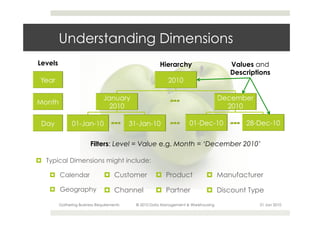
Understanding Dimensions
Levels                                               Hierarchy                    Values and
                                                                                  Descriptions


                         Filters: Level = Value e.g. Month = ‘December 2010’

¤  Typical Dimensions might include:

    ¤  Calendar                ¤  Customer        ¤  Product            ¤  Manufacturer

    ¤  Geography               ¤  Channel         ¤  Partner            ¤  Discount Type
         Gathering Business Requirements   © 2010 Data Management & Warehousing           21 Jan 2010
Understanding Measures
           ¤  Numeric Values
                 ¤  Examples: Quantities, Money, Time
                 ¤  Basic Maths: Sum, Count, Maximum, Minimum
                 ¤  Derived Maths: Average, StdDev, Rank


           ¤  Linked to and described by Dimensions
                 ¤  Every measure relates to many dimensions
                 ¤  Always relates to the lowest possible level of each
                     hierarchy

           ¤  Example:
                 ¤  Number (Measure) and Value (Measure) of
                     Product (Dimension) sold on Date (Dimension) through
                     Channel (Dimension)


Gathering Business Requirements   © 2010 Data Management & Warehousing   21 Jan 2010
How these requirements are used …
               Select             Month                                       Descriptions
                                  County

                                  Count(Policy)                               Basic Maths
                                  Sum(Premium)                                On Numeric Values
                                  Average(Premium)                            Derived Maths
                                  Rank(Policy)                                On Numeric Values
               From               Policies                                    Measures


                                  Calendar                                    Dimensions
                                  Geography

               Where              Year = ‘2010’                               Filters
               And                Country = ‘England’

               And                Policy Date = Calendar Date                 Joins
               And                Policy Postcode = Geography Postcode

               Group By           Month                                       Levels
                                  County

               Order By           Rank(Policy)                                Sorting

Gathering Business Requirements        © 2010 Data Management & Warehousing             21 Jan 2010
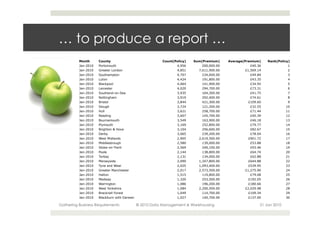
… to produce a report …
          Month      County                              Count(Policy)   Sum(Premium)     Average(Premium)     Rank(Policy)
          Jan-2010   Portsmouth                                 4,956        200,000.00               £40.36              1
          Jan-2010   Greater London                             4,851      7,611,900.00            £1,569.14              2
          Jan-2010   Southampton                                4,707        234,600.00               £49.84              3
          Jan-2010   Luton                                      4,424        191,800.00               £43.35              4
          Jan-2010   Blackpool                                  4,064        141,900.00               £34.92              5
          Jan-2010   Leicester                                  4,020        294,700.00               £73.31              6
          Jan-2010   Southend-on-Sea                            3,935        164,300.00               £41.75              7
          Jan-2010   Nottingham                                 3,919        292,400.00               £74.61              8
          Jan-2010   Bristol                                    3,844        421,300.00              £109.60              9
          Jan-2010   Slough                                     3,724        121,200.00               £32.55             10
          Jan-2010   Hull                                       3,621        258,700.00               £71.44             11
          Jan-2010   Reading                                    3,607        145,700.00               £40.39             12
          Jan-2010   Bournemouth                                3,549        163,900.00               £46.18             13
          Jan-2010   Plymouth                                   3,169        252,800.00               £79.77             14
          Jan-2010   Brighton & Hove                            3,104        256,600.00               £82.67             15
          Jan-2010   Derby                                      3,065        239,200.00               £78.04             16
          Jan-2010   West Midlands                              2,905      2,619,500.00              £901.72             17
          Jan-2010   Middlesbrough                              2,580        139,000.00               £53.88             18
          Jan-2010   Stoke-on-Trent                             2,569        240,100.00               £93.46             19
          Jan-2010   Poole                                      2,144        138,800.00               £64.74             20
          Jan-2010   Torbay                                     2,131        134,000.00               £62.88             21
          Jan-2010   Merseyside                                 2,090      1,347,800.00              £644.88             22
          Jan-2010   Tyne and Wear                              2,025      1,093,400.00              £539.95             23
          Jan-2010   Greater Manchester                         2,017      2,573,500.00            £1,275.90             24
          Jan-2010   Halton                                     1,515        119,800.00               £79.08             25
          Jan-2010   Medway                                     1,320        253,500.00              £192.05             26
          Jan-2010   Warrington                                 1,086        196,200.00              £180.66             27
          Jan-2010   West Yorkshire                             1,084      2,200,500.00            £2,029.98             28
          Jan-2010   Bracknell Forest                           1,049        114,700.00              £109.34             29
          Jan-2010   Blackburn with Darwen                      1,027        140,700.00              £137.00             30

Gathering Business Requirements              © 2010 Data Management & Warehousing                          21 Jan 2010
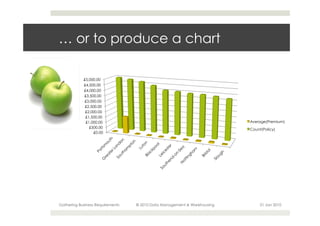
… or to produce a chart

            £5,000.00
            £4,500.00
            £4,000.00
            £3,500.00
            £3,000.00
             £2,500.00
             £2,000.00
             £1,500.00
             £1,000.00                                                   Average(Premium)
               £500.00                                                   Count(Policy)
                  £0.00


Gathering Business Requirements   © 2010 Data Management & Warehousing        21 Jan 2010
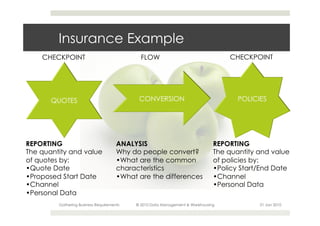
Insurance Example
    CHECKPOINT                                FLOW                                  CHECKPOINT


REPORTING                             ANALYSIS                                 REPORTING
The quantity and value                Why do people convert?                   The quantity and value
of quotes by:                         • What are the common                    of policies by:
• Quote Date                          characteristics                          • Policy Start/End Date
• Proposed Start Date                 • What are the differences               • Channel
• Channel                                                                      • Personal Data
• Personal Data
         Gathering Business Requirements    © 2010 Data Management & Warehousing             21 Jan 2010
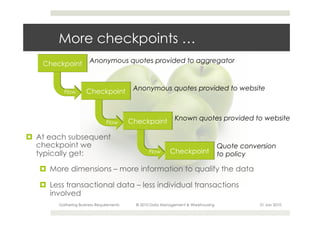
More checkpoints …
                       Anonymous quotes provided to aggregator


          Flow
                                          Anonymous quotes provided to website


                                                           Known quotes provided to website
                                Flow

¤  At each subsequent
    checkpoint we                                                                Quote conversion
    typically get:                             Flow
                                                                                 to policy

   ¤  More dimensions – more information to qualify the data

   ¤  Less transactional data – less individual transactions
       involved
        Gathering Business Requirements   © 2010 Data Management & Warehousing              21 Jan 2010
Things to remember …
           ¤  Keep your requirements ‘reasonable’
                 ¤  Can be sourced from existing source systems
                 ¤  Will be used to affect your decision making
                 ¤  Consider things in terms of ‘MoSCoW’:
                     Must Have; Should Have; Could Have; Would Have
                 ¤  Focus your time and effort on Must and Should Haves

           ¤  Expect to be challenged by us
                 ¤  This is just to make sure that we understand everything by
                     getting you to (re-)explain and justify

           ¤  You are the experts in your business ...
                 ¤  We know how manage data to deliver business
                     intelligence
                 ¤  We know more than most about how data works
                     ¤  See http://datamgmt.com/how-data-works
                 ¤  Working together we can specify the optimal solution

Gathering Business Requirements   © 2010 Data Management & Warehousing   21 Jan 2010
Straw-man Proposal
 A "straw-man proposal" is a simple proposal intended to generate
 discussion of its disadvantages and to provoke the generation of
 new and better proposals. Often, a straw man document will be
prepared by one or two people prior to kicking off a larger project.
     In this way, the team can jump start their discussions with a
document that is likely to contain many, but not all the key aspects
                           to be discussed.


Gathering Business Requirements   © 2010 Data Management & Warehousing   21 Jan 2010
Sources for Straw-man
           Sources for the straw-                          Other potential data
           man:                                            sources:


Gathering Business Requirements   © 2010 Data Management & Warehousing   21 Jan 2010
Straw-man Description

           Measures                                        Analyse by


Gathering Business Requirements   © 2010 Data Management & Warehousing   21 Jan 2010
Next Steps …
Do we need more time to add more requirements?

How will we review the requirements?

Who will help flesh out the technical requirements?

Who will sign off the requirements?

Any other questions?


Gathering Business Requirements   © 2010 Data Management & Warehousing   21 Jan 2010
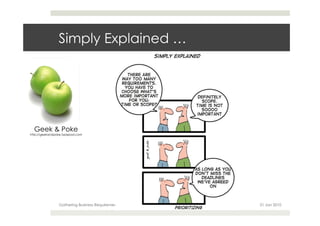
Simply Explained …


  Geek & Poke
http://geekandpoke.typepad.com


                Gathering Business Requirements   © 2010 Data Management & Warehousing   21 Jan 2010
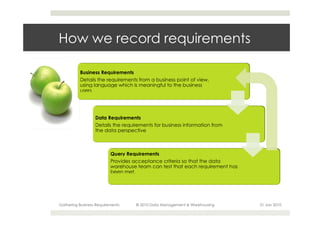
How we record requirements


Gathering Business Requirements   © 2010 Data Management & Warehousing   21 Jan 2010
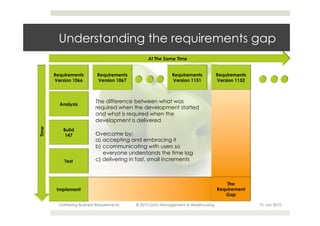
Understanding the requirements gap


                  The difference between what was
                  required when the development started
                  and what is required when the
                  development is delivered

                  Overcome by:
                  a) accepting and embracing it
                  b) ccommunicating with users so
                     everyone understands the time lag
                  c) delivering in fast, small increments


Gathering Business Requirements   © 2010 Data Management & Warehousing   21 Jan 2010
Thank You


Gathering Business Requirements   © 2010 Data Management & Warehousing   21 Jan 2010

Gathering Business Requirements for Data Warehouses

  • 1.
    Gathering Business Requirements Anoverview of the Data Management & Warehousing approach Gathering Business Requirements © 2010 Data Management & Warehousing 21 Jan 2010
  • 2.
    Agenda ¤  Overview of the process ¤  Why gather requirements like this? ¤  Types of requirement ¤  Understanding what we can do ¤  Business processes create data ¤  Understanding dimensions and measures ¤  How these requirements are used ¤  Things to remember ¤  Straw-man Proposal ¤  A "straw-man proposal" is a simple proposal intended to generate discussion of its disadvantages and to provoke the generation of new and better proposals. ¤  Next Steps Gathering Business Requirements © 2010 Data Management & Warehousing 21 Jan 2010
  • 3.
    Overview of theprocess Why gather requirements like this? Types of requirement Understanding what we can do Business processes create data Understanding dimensions and measures How these requirements are used Things to remember Gathering Business Requirements © 2010 Data Management & Warehousing 21 Jan 2010
  • 4.
    Why gather requirementslike this? ¤  Your opportunity to explain to us what you want to see from the system in a way that we can understand ¤  There are two parts to this: ¤  US: Ensuring that you get the information that you need to run the business effectively ¤  YOU: Ensuring that we understand enough about what you want to quickly and effectively deliver that information ¤  Success requires effective two way communication ¤  Requirements always change ¤  Don’t worry – we know that things will be forgotten or change – but once we have a good baseline it is much easier to refine and enhance the solution ¤  We will address how to update the requirements later Gathering Business Requirements © 2010 Data Management & Warehousing 21 Jan 2010
  • 5.
    Types of requirements ¤  There are two types of requirement we need: ¤  Business Requirements ¤  What information do you want to see? (the data and how it needs to be grouped) This is the primary focus of the workshop ¤  Technical Requirements ¤  When do you want to see the information (Frequency of refresh and of reporting) ¤  How do you want the information formatted? (Tables, graphs, charts, etc.) ¤  Where do you want to see it? (Web, e-mail, RSS, application, etc.) ¤  Who should see the information? (Security, publication) Gathering Business Requirements © 2010 Data Management & Warehousing 21 Jan 2010
  • 6.
    Understanding what wecan do ¤  We can only deliver data that is there ¤  We capture as much as we can at the lowest level to use but your environment creates limitations ¤  This is true of every organisation ¤  We have to prioritise which data we deal with ¤  Whilst we try to deliver as much as possible as quickly as possible we have to ensure that the most important things are delivered first ¤  We can only optimise what you ask us to optimise ¤  Business intelligence solutions group and aggregate data to optimise it for reporting and presentation ¤  Whilst we will have all the data that is available it may take time to make it available if we don’t know that it is required as a priority for reporting Gathering Business Requirements © 2010 Data Management & Warehousing 21 Jan 2010
  • 7.
    Example Limitations ¤  We only get a feed once a day from the source ¤  LIMITATION: Data can only be refreshed daily ¤  We only get source data in x units ¤  LIMITATION: Limits the granularity of the reports (e.g. if the data is number of calls per hour, we can not report calls per minute) ¤  The source data has data type discrepancies ¤  LIMITATION: Over time this will negatively affect data quality (e.g. if 31st Feb consistently appears it how do we handle the data?) ¤  We only get a subset of data from source system ¤  LIMITATION: If we haven’t asked for it we won’t get it ¤  LIMITATION: We may not be able to go back and get historical information if we change the subset of data ¤  None of these are show stoppers, all can be changed as long as we know what we need Gathering Business Requirements © 2010 Data Management & Warehousing 21 Jan 2010
  • 8.
    Business processes createdata ¤  There is a known state - a checkpoint ¤  This is measurable using a set of criteria known as dimensions ¤  Some process step is performed – a flow ¤  There is now a new known state - another checkpoint ¤  This is also measurable ¤  Some of the dimensions will have remained the same ¤  But some dimensions will be added and some removed ¤  Reporting is the delivery of data for a given state or states ¤  Reports should be designed to inform management decision making ¤  Analysis is the attempt to gain understanding of the causes of the state change ¤  Analysis should be designed to help improve the business process ¤  You must have the reporting data before you can effectively perform analysis Gathering Business Requirements © 2010 Data Management & Warehousing 21 Jan 2010
  • 9.
    Understanding Dimensions Levels Hierarchy Values and Descriptions Filters: Level = Value e.g. Month = ‘December 2010’ ¤  Typical Dimensions might include: ¤  Calendar ¤  Customer ¤  Product ¤  Manufacturer ¤  Geography ¤  Channel ¤  Partner ¤  Discount Type Gathering Business Requirements © 2010 Data Management & Warehousing 21 Jan 2010
  • 10.
    Understanding Measures ¤  Numeric Values ¤  Examples: Quantities, Money, Time ¤  Basic Maths: Sum, Count, Maximum, Minimum ¤  Derived Maths: Average, StdDev, Rank ¤  Linked to and described by Dimensions ¤  Every measure relates to many dimensions ¤  Always relates to the lowest possible level of each hierarchy ¤  Example: ¤  Number (Measure) and Value (Measure) of Product (Dimension) sold on Date (Dimension) through Channel (Dimension) Gathering Business Requirements © 2010 Data Management & Warehousing 21 Jan 2010
  • 11.
    How these requirementsare used … Select Month Descriptions County Count(Policy) Basic Maths Sum(Premium) On Numeric Values Average(Premium) Derived Maths Rank(Policy) On Numeric Values From Policies Measures Calendar Dimensions Geography Where Year = ‘2010’ Filters And Country = ‘England’ And Policy Date = Calendar Date Joins And Policy Postcode = Geography Postcode Group By Month Levels County Order By Rank(Policy) Sorting Gathering Business Requirements © 2010 Data Management & Warehousing 21 Jan 2010
  • 12.
    … to producea report … Month County Count(Policy) Sum(Premium) Average(Premium) Rank(Policy) Jan-2010 Portsmouth 4,956 200,000.00 £40.36 1 Jan-2010 Greater London 4,851 7,611,900.00 £1,569.14 2 Jan-2010 Southampton 4,707 234,600.00 £49.84 3 Jan-2010 Luton 4,424 191,800.00 £43.35 4 Jan-2010 Blackpool 4,064 141,900.00 £34.92 5 Jan-2010 Leicester 4,020 294,700.00 £73.31 6 Jan-2010 Southend-on-Sea 3,935 164,300.00 £41.75 7 Jan-2010 Nottingham 3,919 292,400.00 £74.61 8 Jan-2010 Bristol 3,844 421,300.00 £109.60 9 Jan-2010 Slough 3,724 121,200.00 £32.55 10 Jan-2010 Hull 3,621 258,700.00 £71.44 11 Jan-2010 Reading 3,607 145,700.00 £40.39 12 Jan-2010 Bournemouth 3,549 163,900.00 £46.18 13 Jan-2010 Plymouth 3,169 252,800.00 £79.77 14 Jan-2010 Brighton & Hove 3,104 256,600.00 £82.67 15 Jan-2010 Derby 3,065 239,200.00 £78.04 16 Jan-2010 West Midlands 2,905 2,619,500.00 £901.72 17 Jan-2010 Middlesbrough 2,580 139,000.00 £53.88 18 Jan-2010 Stoke-on-Trent 2,569 240,100.00 £93.46 19 Jan-2010 Poole 2,144 138,800.00 £64.74 20 Jan-2010 Torbay 2,131 134,000.00 £62.88 21 Jan-2010 Merseyside 2,090 1,347,800.00 £644.88 22 Jan-2010 Tyne and Wear 2,025 1,093,400.00 £539.95 23 Jan-2010 Greater Manchester 2,017 2,573,500.00 £1,275.90 24 Jan-2010 Halton 1,515 119,800.00 £79.08 25 Jan-2010 Medway 1,320 253,500.00 £192.05 26 Jan-2010 Warrington 1,086 196,200.00 £180.66 27 Jan-2010 West Yorkshire 1,084 2,200,500.00 £2,029.98 28 Jan-2010 Bracknell Forest 1,049 114,700.00 £109.34 29 Jan-2010 Blackburn with Darwen 1,027 140,700.00 £137.00 30 Gathering Business Requirements © 2010 Data Management & Warehousing 21 Jan 2010
  • 13.
    … or toproduce a chart £5,000.00 £4,500.00 £4,000.00 £3,500.00 £3,000.00 £2,500.00 £2,000.00 £1,500.00 £1,000.00 Average(Premium) £500.00 Count(Policy) £0.00 Gathering Business Requirements © 2010 Data Management & Warehousing 21 Jan 2010
  • 14.
    Insurance Example CHECKPOINT FLOW CHECKPOINT REPORTING ANALYSIS REPORTING The quantity and value Why do people convert? The quantity and value of quotes by: • What are the common of policies by: • Quote Date characteristics • Policy Start/End Date • Proposed Start Date • What are the differences • Channel • Channel • Personal Data • Personal Data Gathering Business Requirements © 2010 Data Management & Warehousing 21 Jan 2010
  • 15.
    More checkpoints … Anonymous quotes provided to aggregator Flow Anonymous quotes provided to website Known quotes provided to website Flow ¤  At each subsequent checkpoint we Quote conversion typically get: Flow to policy ¤  More dimensions – more information to qualify the data ¤  Less transactional data – less individual transactions involved Gathering Business Requirements © 2010 Data Management & Warehousing 21 Jan 2010
  • 16.
    Things to remember… ¤  Keep your requirements ‘reasonable’ ¤  Can be sourced from existing source systems ¤  Will be used to affect your decision making ¤  Consider things in terms of ‘MoSCoW’: Must Have; Should Have; Could Have; Would Have ¤  Focus your time and effort on Must and Should Haves ¤  Expect to be challenged by us ¤  This is just to make sure that we understand everything by getting you to (re-)explain and justify ¤  You are the experts in your business ... ¤  We know how manage data to deliver business intelligence ¤  We know more than most about how data works ¤  See http://datamgmt.com/how-data-works ¤  Working together we can specify the optimal solution Gathering Business Requirements © 2010 Data Management & Warehousing 21 Jan 2010
  • 17.
    Straw-man Proposal A"straw-man proposal" is a simple proposal intended to generate discussion of its disadvantages and to provoke the generation of new and better proposals. Often, a straw man document will be prepared by one or two people prior to kicking off a larger project. In this way, the team can jump start their discussions with a document that is likely to contain many, but not all the key aspects to be discussed. Gathering Business Requirements © 2010 Data Management & Warehousing 21 Jan 2010
  • 18.
    Sources for Straw-man Sources for the straw- Other potential data man: sources: Gathering Business Requirements © 2010 Data Management & Warehousing 21 Jan 2010
  • 19.
    Straw-man Description Measures Analyse by Gathering Business Requirements © 2010 Data Management & Warehousing 21 Jan 2010
  • 20.
    Next Steps … Dowe need more time to add more requirements? How will we review the requirements? Who will help flesh out the technical requirements? Who will sign off the requirements? Any other questions? Gathering Business Requirements © 2010 Data Management & Warehousing 21 Jan 2010
  • 21.
    Simply Explained … Geek & Poke http://geekandpoke.typepad.com Gathering Business Requirements © 2010 Data Management & Warehousing 21 Jan 2010
  • 22.
    How we recordrequirements Gathering Business Requirements © 2010 Data Management & Warehousing 21 Jan 2010
  • 23.
    Understanding the requirementsgap The difference between what was required when the development started and what is required when the development is delivered Overcome by: a) accepting and embracing it b) ccommunicating with users so everyone understands the time lag c) delivering in fast, small increments Gathering Business Requirements © 2010 Data Management & Warehousing 21 Jan 2010
  • 24.
    Thank You Gathering BusinessRequirements © 2010 Data Management & Warehousing 21 Jan 2010