©2013 Ingenium Communications Inc. 
Risk Mitigation Guide 
Agency/Consultant Relationship Management 
 
 
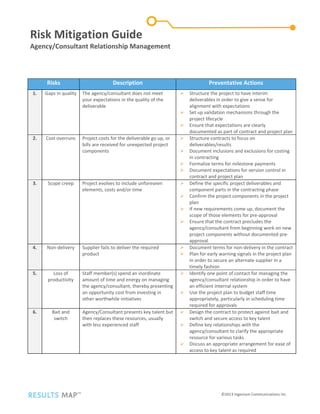
Risks  Description  Preventative Actions 
1.  Gaps in quality  The agency/consultant does not meet 
your expectations in the quality of the 
deliverable 
Structure the project to have interim 
deliverables in order to give a sense for 
alignment with expectations 
Set up validation mechanisms through the 
project lifecycle 
Ensure that expectations are clearly 
documented as part of contract and project plan 
2.  Cost overruns   Project costs for the deliverable go up, or 
bills are received for unexpected project 
components 
Structure contracts to focus on 
deliverables/results  
Document inclusions and exclusions for costing 
in contracting 
Formalize terms for milestone payments 
Document expectations for version control in 
contract and project plan 
3.  Scope creep  Project evolves to include unforeseen 
elements, costs and/or time 
Define the specific project deliverables and 
component parts in the contracting phase 
Confirm the project components in the project 
plan 
If new requirements come up, document the 
scope of those elements for pre‐approval 
Ensure that the contract precludes the 
agency/consultant from beginning work on new 
project components without documented pre‐
approval 
4.  Non‐delivery  Supplier fails to deliver the required 
product 
Document terms for non‐delivery in the contract
Plan for early warning signals in the project plan 
in order to secure an alternate supplier in a 
timely fashion 
5.  Loss of 
productivity 
Staff member(s) spend an inordinate 
amount of time and energy on managing 
the agency/consultant, thereby presenting 
an opportunity cost from investing in 
other worthwhile initiatives 
Identify one point of contact for managing the 
agency/consultant relationship in order to have 
an efficient internal system 
Use the project plan to budget staff time 
appropriately, particularly in scheduling time 
required for approvals 
6.  Bait and 
switch 
Agency/Consultant presents key talent but 
then replaces these resources, usually 
with less experienced staff 
Design the contract to protect against bait and 
switch and secure access to key talent 
Define key relationships with the 
agency/consultant to clarify the appropriate 
resource for various tasks 
Discuss an appropriate arrangement for ease of 
access to key talent as required 


Risk Mitigation Guide – Agency/Consultant Relationship Management    Page 2 
 
                                                                    ©2013 Ingenium Communications Inc. 
 
 
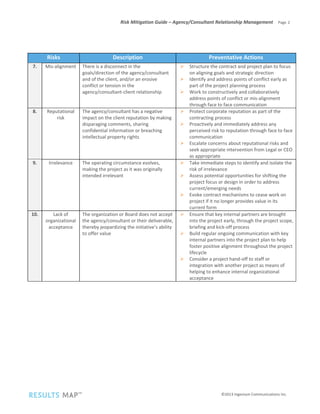
Risks  Description  Preventative Actions 
7.  Mis‐alignment  There is a disconnect in the 
goals/direction of the agency/consultant 
and of the client, and/or an erosive 
conflict or tension in the 
agency/consultant‐client relationship 
Structure the contract and project plan to focus 
on aligning goals and strategic direction 
Identify and address points of conflict early as 
part of the project planning process 
Work to constructively and collaboratively 
address points of conflict or mis‐alignment 
through face to face communication 
8.  Reputational 
risk 
The agency/consultant has a negative 
impact on the client reputation by making 
disparaging comments, sharing 
confidential information or breaching 
intellectual property rights 
Protect corporate reputation as part of the 
contracting process 
Proactively and immediately address any 
perceived risk to reputation through face to face 
communication 
Escalate concerns about reputational risks and 
seek appropriate intervention as appropriate 
9.  Irrelevance  The operating circumstance evolves, 
making the project as it was originally 
intended irrelevant 
Take immediate steps to identify and isolate the 
risk of irrelevance 
Assess potential opportunities for shifting the 
project focus or design in order to address 
current/emerging needs 
Evoke contract mechanisms to cease work on 
project if it no longer provides value in its 
current form 
10.  Lack of 
organizational 
acceptance 
The organization or Board does not accept 
the agency/consultant or their deliverable, 
thereby jeopardizing the initiative’s ability 
to offer value 
Ensure that key internal partners are brought 
into the project early, through the project scope, 
briefing and kick‐off process 
Build regular ongoing communication with key 
internal partners into the project plan to help 
foster positive alignment throughout the project 
lifecycle 
Consider a project hand‐off to staff or 
integration with another project as means of 
helping to enhance internal organizational 
acceptance 
 

Risk Mitigation Guide: Client-Agency/Consultant Relationship Management

  • 1.
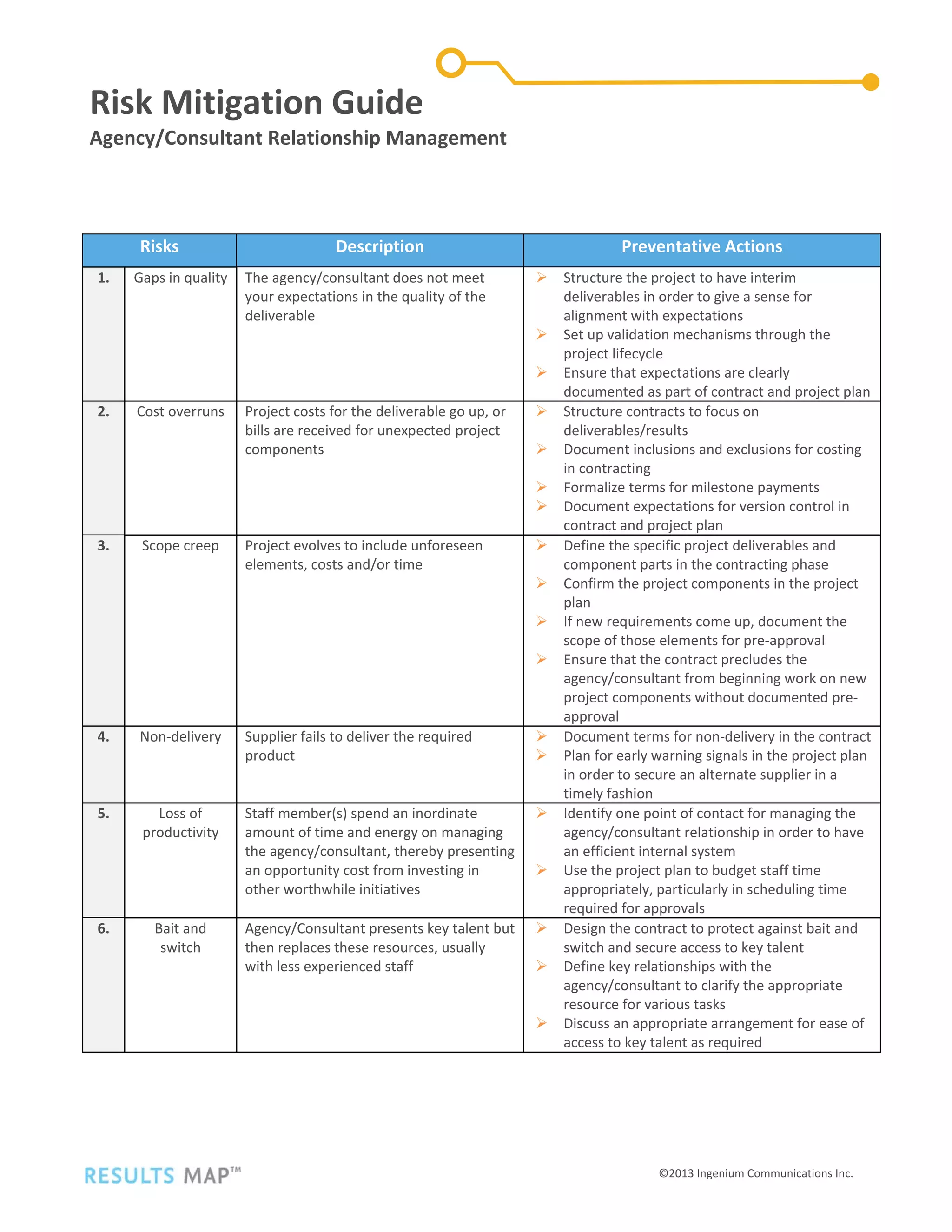
    ©2013 Ingenium Communications Inc.  Risk Mitigation Guide  Agency/Consultant Relationship Management      Risks  Description  Preventative Actions  1. Gaps in quality  The agency/consultant does not meet  your expectations in the quality of the  deliverable  Structure the project to have interim  deliverables in order to give a sense for  alignment with expectations  Set up validation mechanisms through the  project lifecycle  Ensure that expectations are clearly  documented as part of contract and project plan  2.  Cost overruns   Project costs for the deliverable go up, or  bills are received for unexpected project  components  Structure contracts to focus on  deliverables/results   Document inclusions and exclusions for costing  in contracting  Formalize terms for milestone payments  Document expectations for version control in  contract and project plan  3.  Scope creep  Project evolves to include unforeseen  elements, costs and/or time  Define the specific project deliverables and  component parts in the contracting phase  Confirm the project components in the project  plan  If new requirements come up, document the  scope of those elements for pre‐approval  Ensure that the contract precludes the  agency/consultant from beginning work on new  project components without documented pre‐ approval  4.  Non‐delivery  Supplier fails to deliver the required  product  Document terms for non‐delivery in the contract Plan for early warning signals in the project plan  in order to secure an alternate supplier in a  timely fashion  5.  Loss of  productivity  Staff member(s) spend an inordinate  amount of time and energy on managing  the agency/consultant, thereby presenting  an opportunity cost from investing in  other worthwhile initiatives  Identify one point of contact for managing the  agency/consultant relationship in order to have  an efficient internal system  Use the project plan to budget staff time  appropriately, particularly in scheduling time  required for approvals  6.  Bait and  switch  Agency/Consultant presents key talent but  then replaces these resources, usually  with less experienced staff  Design the contract to protect against bait and  switch and secure access to key talent  Define key relationships with the  agency/consultant to clarify the appropriate  resource for various tasks  Discuss an appropriate arrangement for ease of  access to key talent as required       
  • 2.
    Risk Mitigation Guide – Agency/Consultant Relationship Management    Page 2                                                                       ©2013 Ingenium Communications Inc.      Risks  Description  Preventative Actions  7.  Mis‐alignment  There is a disconnect in the  goals/direction of the agency/consultant  and of the client, and/or an erosive  conflict or tension in the  agency/consultant‐client relationship  Structure the contract and project plan to focus  on aligning goals and strategic direction  Identify and address points of conflict early as  part of the project planning process  Work to constructively and collaboratively  address points of conflict or mis‐alignment  through face to face communication  8.  Reputational  risk  The agency/consultant has a negative  impact on the client reputation by making  disparaging comments, sharing  confidential information or breaching  intellectual property rights  Protect corporate reputation as part of the  contracting process  Proactively and immediately address any  perceived risk to reputation through face to face  communication  Escalate concerns about reputational risks and  seek appropriate intervention as appropriate  9.  Irrelevance  The operating circumstance evolves,  making the project as it was originally  intended irrelevant  Take immediate steps to identify and isolate the  risk of irrelevance  Assess potential opportunities for shifting the  project focus or design in order to address  current/emerging needs  Evoke contract mechanisms to cease work on  project if it no longer provides value in its  current form  10.  Lack of  organizational  acceptance  The organization or Board does not accept  the agency/consultant or their deliverable,  thereby jeopardizing the initiative’s ability  to offer value  Ensure that key internal partners are brought  into the project early, through the project scope,  briefing and kick‐off process  Build regular ongoing communication with key  internal partners into the project plan to help  foster positive alignment throughout the project  lifecycle  Consider a project hand‐off to staff or  integration with another project as means of  helping to enhance internal organizational  acceptance