
2. Project Management Body of
Knowledge
Understanding of Project
Environment
• Cultural and social environment: how the project
affects people and how people affect the project.
This may require an understanding of aspects of
the economic, demographic, educational, ethical,
ethnic, religious, and other characteristics of the
people whom the project affects or who may have
an interest in the project.
Understanding of Project Environment
• International and political environment: Some team
members may need to be familiar with applicable
international, national, regional, and local laws and
customs, as well as the political climate that could
affect the project. Other international factors to
consider are time-zone differences, national and
regional holidays, travel requirements for face-to-face
meetings, and the logistics of teleconferencing.
• Physical environment: If the project will affect its
physical surroundings, some team members should be
knowledgeable about the local ecology and physical
geography that could affect the project or be affected
by the project.
Success Criteria for Projects
Technical Tangible Quantitative
• Deadlines
• Performance Spec.
• Specific Quality Standards
• Cost Requirements
• Resource Constraints
Success Criteria for Projects
People Intangible Qualitative
• Commitment
• Cooperative attitude
• Positive image
• Total project focus
• Risk assessed
• Ethical conduct
Inhibitors of Project Success
• Poor project planning and direction
• Insufficient communication
• Lack of change, risk, financial, and performance
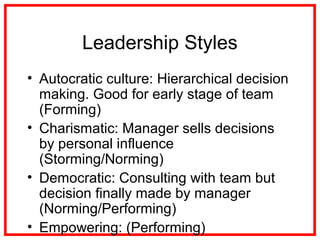
management
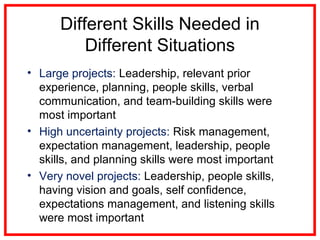
• Failure to align with components and stakeholders
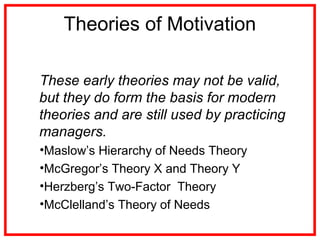
• Ineffective involvement of executive management
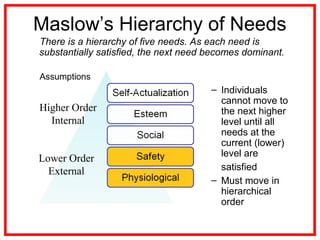
• Lack of skilled team members in the areas of soft
skills, ability to adapt, and experience
• Poor or missing methodology and tools
Organisational Planning – Understand the
Organisational Framework in Which the Project
Will Function
• Define the role of the project manager which can range
from a more passive coordinating to a more
commanding approach
• Understand the constraints placed on the project by
management and other key stakeholder organisations
• Understand the pertinent human resource policies,
procedures and guidelines
• Assess the availability, timing, skills and capabilities of
the people to be assigned to the project
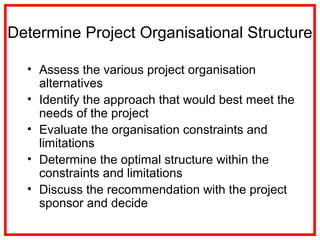
Determine Project Organisational Structure
• Assess the various project organisation
alternatives
• Identify the approach that would best meet the
needs of the project
• Evaluate the organisation constraints and
limitations
• Determine the optimal structure within the
constraints and limitations
• Discuss the recommendation with the project
sponsor and decide
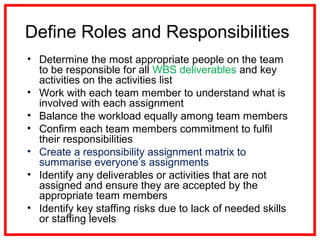
Define Roles and Responsibilities
• Determine the most appropriate people on the team
to be responsible for all WBS deliverables and key
activities on the activities list
• Work with each team member to understand what is
involved with each assignment
• Balance the workload equally among team members
• Confirm each team members commitment to fulfil
their responsibilities
• Create a responsibility assignment matrix to
summarise everyone’s assignments
• Identify any deliverables or activities that are not
assigned and ensure they are accepted by the
appropriate team members
• Identify key staffing risks due to lack of needed skills
or staffing levels
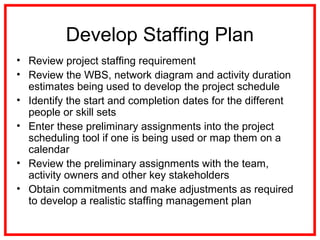
Develop Staffing Plan
• Review project staffing requirement
• Review the WBS, network diagram and activity duration
estimates being used to develop the project schedule
• Identify the start and completion dates for the different
people or skill sets
• Enter these preliminary assignments into the project
scheduling tool if one is being used or map them on a
calendar
• Review the preliminary assignments with the team,
activity owners and other key stakeholders
• Obtain commitments and make adjustments as required
to develop a realistic staffing management plan
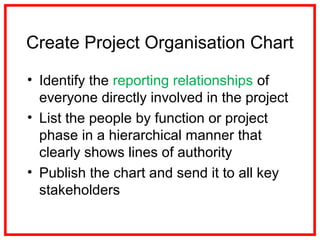
Create Project Organisation Chart
• Identify the reporting relationships of
everyone directly involved in the project
• List the people by function or project
phase in a hierarchical manner that
clearly shows lines of authority
• Publish the chart and send it to all key
stakeholders
Document Supporting Detail
• Alternative organisational approaches – this
should be a description of each structure, the
reason for its exclusion and the person
responsible for making the decision
• Create job descriptions – although this is not
mandatory it is a good idea to create written
descriptions for each position
• Identify and describe training needs – activities
that will be needed to provide the necessary
training must be incorporated into the project plan
Staff Acquisition - Identify
• Related work history and performance
• Special knowledge and expertise
• Previous attendance record
• Current workload
• Cost and permits to work overtime
• Interest in the project
Staff Identification Involves
• Compare the staffing requirements to the
resource pool
• Identify those individuals with the closest
match to the requirements for the various
project assignments
• Identify back up selections in case of any of
the first selections becoming unavailable
• Identify gaps in the staffing plan where
suitable internal candidates are unavailable
Negotiate Staffing Commitments
• Develop positive relations with the various project
managers
• Be sure about staffing the project with the best people,
but be willing to compromise
• Identify alternative internal staff selection
• Determine the feasibility and costs involved with hiring
from the outside if the required people cannot be made
available
• Seek to negotiate a fair deal in which both parties can
achieve their objective
• Consult with the project sponsor in cases where a
reasonable agreement cannot be worked out
• Confirm all negotiated staff commitments in writing
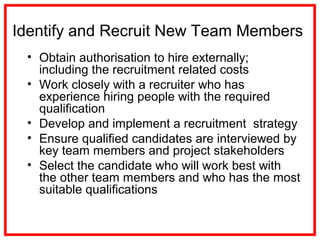
Identify and Recruit New Team Members
• Obtain authorisation to hire externally;
including the recruitment related costs
• Work closely with a recruiter who has
experience hiring people with the required
qualification
• Develop and implement a recruitment strategy
• Ensure qualified candidates are interviewed by
key team members and project stakeholders
• Select the candidate who will work best with
the other team members and who has the most
suitable qualifications
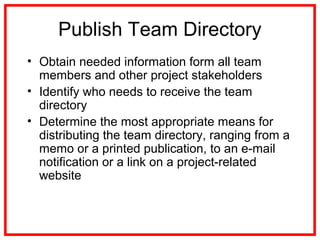
Publish Team Directory
• Obtain needed information form all team
members and other project stakeholders
• Identify who needs to receive the team
directory
• Determine the most appropriate means for
distributing the team directory, ranging from a
memo or a printed publication, to an e-mail
notification or a link on a project-related
website
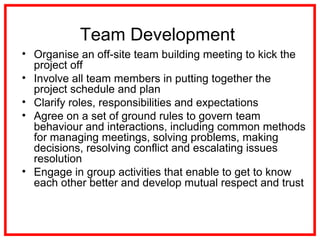
Team Development
• Organise an off-site team building meeting to kick the
project off
• Involve all team members in putting together the
project schedule and plan
• Clarify roles, responsibilities and expectations
• Agree on a set of ground rules to govern team
behaviour and interactions, including common methods
for managing meetings, solving problems, making
decisions, resolving conflict and escalating issues
resolution
• Engage in group activities that enable to get to know
each other better and develop mutual respect and trust
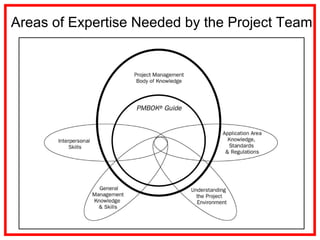
Areas of Expertise Needed by the Project Team
Set Up Reward System
• Identify key milestones in the project schedule that will
serve as appropriate times to recognise and reward
individuals and team accomplishments
• Identify informal forms of recognition and rewards that
are in the project manager’s authority to provide
• Identify formal forms of recognition and rewards that
would be appropriate but require high level approval
• Seek approval for the project’s recognition and reward
system from the project sponsor and functional
management
• Administer recognition and rewards in an equitable,
non-biased manner based upon individual and team
accomplishment of important project milestones
Location
• Co-location is the strategy of placing many or all of
the most active project team members in the same
physical location to enhance their ability to perform
as a team.
• Assess the physical proximity of team members and
determine whether co-location could significantly
improve team communications
• Determine if the potential benefits of co-locating team
members would out-weigh the costs
• Where co-location is not possible, organise a project
war-room for displaying and discussing project
information
• Provide the team with an easy to use electronic mail
system to expedite communication and the exchange
of project documents
Training
• Identify the skills required for successful team
performance
• Assess team skills individually and collectively
• Schedule technical and non-technical training
needed by most members of the team
• Work with individuals who have specific
learning needs to attend appropriate classes
• Encourage team members to share their
knowledge to help each other learn
Coach
• Observe team member performance and
identify areas for possible improvement
• Be available to team members to talk
about their questions, concerns and
problems
• Ask team members if they would like help
or assistance
• Coach team members as needed to
improve their performance
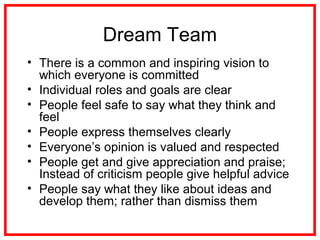
Dream Team
• There is a common and inspiring vision to
which everyone is committed
• Individual roles and goals are clear
• People feel safe to say what they think and
feel
• People express themselves clearly
• Everyone’s opinion is valued and respected
• People get and give appreciation and praise;
Instead of criticism people give helpful advice
• People say what they like about ideas and
develop them; rather than dismiss them
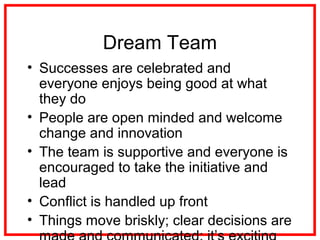
Dream Team
• Successes are celebrated and
everyone enjoys being good at what
they do
• People are open minded and welcome
change and innovation
• The team is supportive and everyone is
encouraged to take the initiative and
lead
• Conflict is handled up front
• Things move briskly; clear decisions are
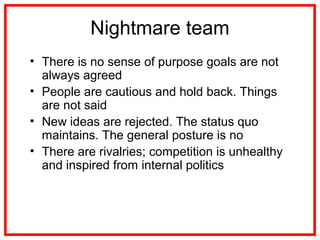
Nightmare team
• There is no sense of purpose goals are not
always agreed
• People are cautious and hold back. Things
are not said
• New ideas are rejected. The status quo
maintains. The general posture is no
• There are rivalries; competition is unhealthy
and inspired from internal politics
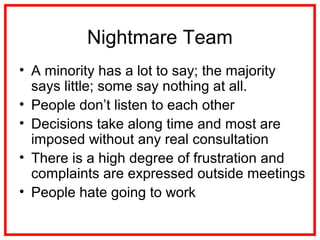
Nightmare Team
• A minority has a lot to say; the majority
says little; some say nothing at all.
• People don’t listen to each other
• Decisions take along time and most are
imposed without any real consultation
• There is a high degree of frustration and
complaints are expressed outside meetings
• People hate going to work
• Job descriptions vary, but most include
responsibilities like planning,
scheduling, coordinating, and working
with people to achieve project goals
• Remember that 97% of successful
projects were led by experienced
project managers, who can often help
influence success factors
The Role of the Project Manager
• The Project Management Body of Knowledge
• Application area knowledge, standards, and
regulations
• Project environment knowledge
• General management knowledge and skills
• Soft skills or human relations skills
Suggested Skills for Project Managers
Projects Managers’
Responsibility to the team
• Leadership
• Team building
• Team Motivation
• Team Decision Making
• Team Reward system
• Conflict Management
• Organisational Politics
• Communicating with group
Project Managers’ Responsibilities
to Individual Members
• Communicating with Individuals
• Motivating
• Counselling
• Negotiating
• Delegating
• Problem Resolution
• Personal Rewards
• Personal Recognition
• Power/ Influence
Skills Required In The Management of
People
• Avoiding conflicts in advance
• Motivation for the right candidates
• Tracking people’s satisfaction
• Accessing people’s delivery in terms of
benefits brought to the Project
Project Manager
• A Good Project Manager
– Takes ownership of the whole project
– Is proactive not reactive
– Effectively plans the project
– Is Authoritative (NOT Authoritarian)
– Is Decisive
– Is a good communicator
– Manages by data and facts
– Leads by example
– Has sound judgement
– Is a motivator
– Is diplomatic
– Can delegate
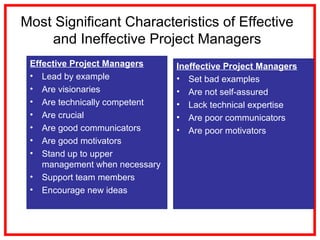
Most Significant Characteristics of Effective
and Ineffective Project Managers
Effective Project Managers
• Lead by example
• Are visionaries
• Are technically competent
• Are crucial
• Are good communicators
• Are good motivators
• Stand up to upper
management when necessary
• Support team members
• Encourage new ideas
Ineffective Project Managers
• Set bad examples
• Are not self-assured
• Lack technical expertise
• Are poor communicators
• Are poor motivators
General Management Knowledge and Skills
• General management provides the foundation for building project
management skills and is often essential for the project manager.
– Financial management and accounting
– Purchasing and procurement
– Sales and marketing
– Contracts and commercial law
– Manufacturing and distribution
– Logistics and supply chain
– Strategic planning, tactical planning, and operational planning
– Organizational structures, organizational behavior, personnel
administration, compensation, benefits, and career paths
– Health and safety practices
– Information technology.
Interpersonal Skills
• The management of interpersonal relationships includes:
– Effective communication. The exchange of information
– Influencing the organization. The ability to 'get things done'
– Leadership. Developing a vision and strategy, and motivating
people to achieve that vision and strategy
– Motivation. Energizing people to achieve high levels of
performance and to overcome barriers to change
– Negotiation and conflict management. Talk with others to
come to terms with them or to reach an agreement
– Problem solving. The combination of problem definition,
alternatives identification and analysis, and decision-making.
Leadership
• Leadership is the capacity to translate
vision into reality
• Leadership occurs when one person
induces others to work toward some
predetermined objectives
• The superior leader gets things done
with very little motion. He conveys
instruction not through many words but
through a few deeds
Leadership
• He keeps informed about everything but
interferes hardly at all
• He is a catalyst, and though things would not
get done well if he were not there, when they
succeed he takes no credit. And because he
takes no credit, credit never leaves him
• Leader is a man who can convince people to
do what they don't want to do, or do what
they're too lazy to do, and like it
Leadership
• A leader is best When people barely
know that he exists, Not so good when
people obey and acclaim him, Worst
when they hate him.
• A leader focuses on long-term goals and big-
picture objectives while inspiring people to
reach those goals
• A manager deals with the day-to-day details
of meeting specific goals
• Project managers often take on the role of
both leader and manager
Importance of Leadership Skills
Leadership Formation
• Hereditary e.g. Family business, Royalty
• Qualities – positive qualities developed
over years
• Situational – good in some situations
• Functional – (Doing things consistently
well)
Project Leadership
• Achieve the task
• Build the team
• Develop the individual
Effective Leadership Influenced by
• Superior’s expectations and behavior
• Task requirements
• Peer’s expectations and behavior
• Subordinate’s characteristics,
expectations and behavior
• Organisational climate and policies
• Personality, past experience and
expectations
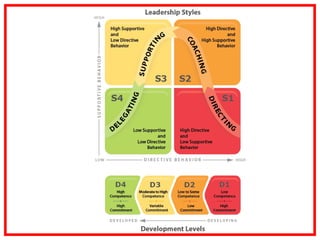
Leadership Styles
• Autocratic culture: Hierarchical decision
making. Good for early stage of team
(Forming)
• Charismatic: Manager sells decisions
by personal influence
(Storming/Norming)
• Democratic: Consulting with team but
decision finally made by manager
(Norming/Performing)
• Empowering: (Performing)
• Large projects: Leadership, relevant prior
experience, planning, people skills, verbal
communication, and team-building skills were
most important
• High uncertainty projects: Risk management,
expectation management, leadership, people
skills, and planning skills were most important
• Very novel projects: Leadership, people skills,
having vision and goals, self confidence,
expectations management, and listening skills
were most important
Different Skills Needed in
Different Situations
Theories of Motivation
These early theories may not be valid,
but they do form the basis for modern
theories and are still used by practicing
managers.
•Maslow’s Hierarchy of Needs Theory
•McGregor’s Theory X and Theory Y
•Herzberg’s Two-Factor Theory
•McClelland’s Theory of Needs
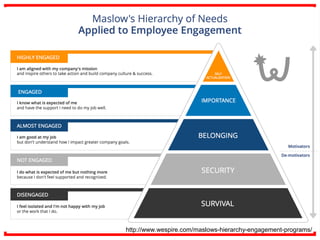
Maslow’s Hierarchy of Needs
There is a hierarchy of five needs. As each need is
substantially satisfied, the next need becomes dominant.
Assumptions
– Individuals
cannot move to
the next higher
level until all
needs at the
current (lower)
level are
satisfied
– Must move in
hierarchical
order
Lower Order
External
Higher Order
Internal
http://www.wespire.com/maslows-hierarchy-engagement-programs/
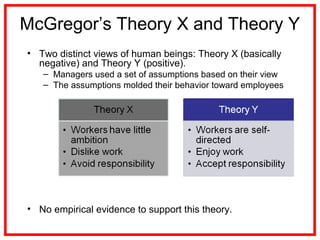
McGregor’s Theory X and Theory Y
• Two distinct views of human beings: Theory X (basically
negative) and Theory Y (positive).
– Managers used a set of assumptions based on their view
– The assumptions molded their behavior toward employees
• No empirical evidence to support this theory.
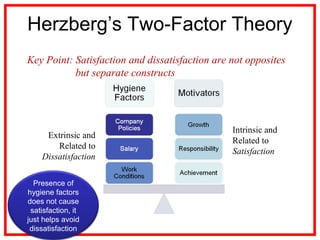
Herzberg’s Two-Factor Theory
Key Point: Satisfaction and dissatisfaction are not opposites
but separate constructs
Extrinsic and
Related to
Dissatisfaction
Intrinsic and
Related to
Satisfaction
Presence of
hygiene factors
does not cause
satisfaction, it
just helps avoid
dissatisfaction
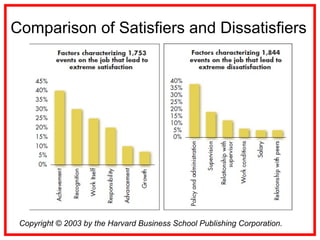
Comparison of Satisfiers and Dissatisfiers
Copyright © 2003 by the Harvard Business School Publishing Corporation.
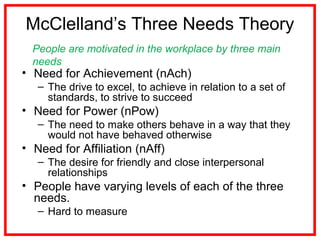
McClelland’s Three Needs Theory
• Need for Achievement (nAch)
– The drive to excel, to achieve in relation to a set of
standards, to strive to succeed
• Need for Power (nPow)
– The need to make others behave in a way that they
would not have behaved otherwise
• Need for Affiliation (nAff)
– The desire for friendly and close interpersonal
relationships
• People have varying levels of each of the three
needs.
– Hard to measure
People are motivated in the workplace by three main
needs
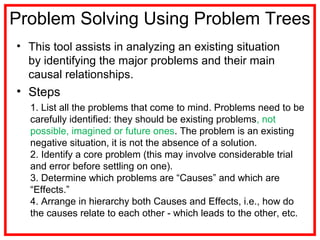
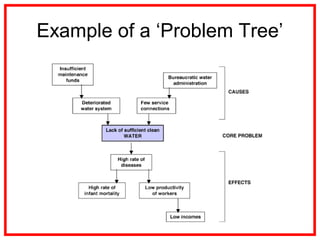
Problem Solving Using Problem Trees
• This tool assists in analyzing an existing situation
by identifying the major problems and their main
causal relationships.
• Steps
1. List all the problems that come to mind. Problems need to be
carefully identified: they should be existing problems, not
possible, imagined or future ones. The problem is an existing
negative situation, it is not the absence of a solution.
2. Identify a core problem (this may involve considerable trial
and error before settling on one).
3. Determine which problems are “Causes” and which are
“Effects.”
4. Arrange in hierarchy both Causes and Effects, i.e., how do
the causes relate to each other - which leads to the other, etc.
Example of a ‘Problem Tree’
More study materials
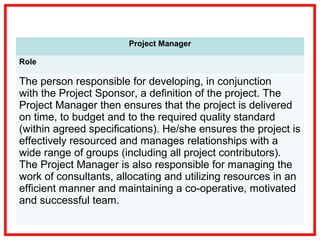
Project Manager
Role
The person responsible for developing, in conjunction
with the Project Sponsor, a definition of the project. The
Project Manager then ensures that the project is delivered
on time, to budget and to the required quality standard
(within agreed specifications). He/she ensures the project is
effectively resourced and manages relationships with a
wide range of groups (including all project contributors).
The Project Manager is also responsible for managing the
work of consultants, allocating and utilizing resources in an
efficient manner and maintaining a co-operative, motivated
and successful team.
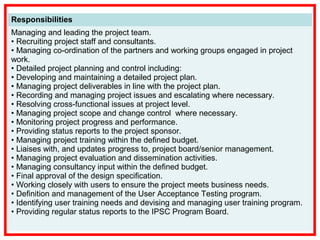
Responsibilities
Managing and leading the project team.
• Recruiting project staff and consultants.
• Managing co-ordination of the partners and working groups engaged in project
work.
• Detailed project planning and control including:
• Developing and maintaining a detailed project plan.
• Managing project deliverables in line with the project plan.
• Recording and managing project issues and escalating where necessary.
• Resolving cross-functional issues at project level.
• Managing project scope and change control where necessary.
• Monitoring project progress and performance.
• Providing status reports to the project sponsor.
• Managing project training within the defined budget.
• Liaises with, and updates progress to, project board/senior management.
• Managing project evaluation and dissemination activities.
• Managing consultancy input within the defined budget.
• Final approval of the design specification.
• Working closely with users to ensure the project meets business needs.
• Definition and management of the User Acceptance Testing program.
• Identifying user training needs and devising and managing user training program.
• Providing regular status reports to the IPSC Program Board.
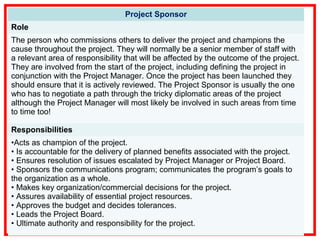
Project Sponsor
Role
The person who commissions others to deliver the project and champions the
cause throughout the project. They will normally be a senior member of staff with
a relevant area of responsibility that will be affected by the outcome of the project.
They are involved from the start of the project, including defining the project in
conjunction with the Project Manager. Once the project has been launched they
should ensure that it is actively reviewed. The Project Sponsor is usually the one
who has to negotiate a path through the tricky diplomatic areas of the project
although the Project Manager will most likely be involved in such areas from time
to time too!
Responsibilities
•Acts as champion of the project.
• Is accountable for the delivery of planned benefits associated with the project.
• Ensures resolution of issues escalated by Project Manager or Project Board.
• Sponsors the communications program; communicates the program’s goals to
the organization as a whole.
• Makes key organization/commercial decisions for the project.
• Assures availability of essential project resources.
• Approves the budget and decides tolerances.
• Leads the Project Board.
• Ultimate authority and responsibility for the project.
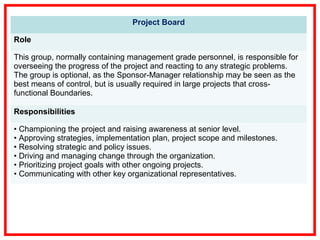
Project Board
Role
This group, normally containing management grade personnel, is responsible for
overseeing the progress of the project and reacting to any strategic problems.
The group is optional, as the Sponsor-Manager relationship may be seen as the
best means of control, but is usually required in large projects that cross-
functional Boundaries.
Responsibilities
• Championing the project and raising awareness at senior level.
• Approving strategies, implementation plan, project scope and milestones.
• Resolving strategic and policy issues.
• Driving and managing change through the organization.
• Prioritizing project goals with other ongoing projects.
• Communicating with other key organizational representatives.
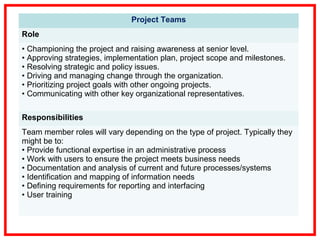
Project Teams
Role
• Championing the project and raising awareness at senior level.
• Approving strategies, implementation plan, project scope and milestones.
• Resolving strategic and policy issues.
• Driving and managing change through the organization.
• Prioritizing project goals with other ongoing projects.
• Communicating with other key organizational representatives.
Responsibilities
Team member roles will vary depending on the type of project. Typically they
might be to:
• Provide functional expertise in an administrative process
• Work with users to ensure the project meets business needs
• Documentation and analysis of current and future processes/systems
• Identification and mapping of information needs
• Defining requirements for reporting and interfacing
• User training

2. Project management body of knowledge

  • 1.
    2. Project ManagementBody of Knowledge
  • 2.
    Understanding of Project Environment •Cultural and social environment: how the project affects people and how people affect the project. This may require an understanding of aspects of the economic, demographic, educational, ethical, ethnic, religious, and other characteristics of the people whom the project affects or who may have an interest in the project.
  • 3.
    Understanding of ProjectEnvironment • International and political environment: Some team members may need to be familiar with applicable international, national, regional, and local laws and customs, as well as the political climate that could affect the project. Other international factors to consider are time-zone differences, national and regional holidays, travel requirements for face-to-face meetings, and the logistics of teleconferencing. • Physical environment: If the project will affect its physical surroundings, some team members should be knowledgeable about the local ecology and physical geography that could affect the project or be affected by the project.
  • 4.
    Success Criteria forProjects Technical Tangible Quantitative • Deadlines • Performance Spec. • Specific Quality Standards • Cost Requirements • Resource Constraints
  • 5.
    Success Criteria forProjects People Intangible Qualitative • Commitment • Cooperative attitude • Positive image • Total project focus • Risk assessed • Ethical conduct
  • 6.
    Inhibitors of ProjectSuccess • Poor project planning and direction • Insufficient communication • Lack of change, risk, financial, and performance management • Failure to align with components and stakeholders • Ineffective involvement of executive management • Lack of skilled team members in the areas of soft skills, ability to adapt, and experience • Poor or missing methodology and tools
  • 7.
    Organisational Planning –Understand the Organisational Framework in Which the Project Will Function • Define the role of the project manager which can range from a more passive coordinating to a more commanding approach • Understand the constraints placed on the project by management and other key stakeholder organisations • Understand the pertinent human resource policies, procedures and guidelines • Assess the availability, timing, skills and capabilities of the people to be assigned to the project
  • 8.
    Determine Project OrganisationalStructure • Assess the various project organisation alternatives • Identify the approach that would best meet the needs of the project • Evaluate the organisation constraints and limitations • Determine the optimal structure within the constraints and limitations • Discuss the recommendation with the project sponsor and decide
  • 9.
    Define Roles andResponsibilities • Determine the most appropriate people on the team to be responsible for all WBS deliverables and key activities on the activities list • Work with each team member to understand what is involved with each assignment • Balance the workload equally among team members • Confirm each team members commitment to fulfil their responsibilities • Create a responsibility assignment matrix to summarise everyone’s assignments • Identify any deliverables or activities that are not assigned and ensure they are accepted by the appropriate team members • Identify key staffing risks due to lack of needed skills or staffing levels
  • 10.
    Develop Staffing Plan •Review project staffing requirement • Review the WBS, network diagram and activity duration estimates being used to develop the project schedule • Identify the start and completion dates for the different people or skill sets • Enter these preliminary assignments into the project scheduling tool if one is being used or map them on a calendar • Review the preliminary assignments with the team, activity owners and other key stakeholders • Obtain commitments and make adjustments as required to develop a realistic staffing management plan
  • 11.
    Create Project OrganisationChart • Identify the reporting relationships of everyone directly involved in the project • List the people by function or project phase in a hierarchical manner that clearly shows lines of authority • Publish the chart and send it to all key stakeholders
  • 12.
    Document Supporting Detail •Alternative organisational approaches – this should be a description of each structure, the reason for its exclusion and the person responsible for making the decision • Create job descriptions – although this is not mandatory it is a good idea to create written descriptions for each position • Identify and describe training needs – activities that will be needed to provide the necessary training must be incorporated into the project plan
  • 13.
    Staff Acquisition -Identify • Related work history and performance • Special knowledge and expertise • Previous attendance record • Current workload • Cost and permits to work overtime • Interest in the project
  • 14.
    Staff Identification Involves •Compare the staffing requirements to the resource pool • Identify those individuals with the closest match to the requirements for the various project assignments • Identify back up selections in case of any of the first selections becoming unavailable • Identify gaps in the staffing plan where suitable internal candidates are unavailable
  • 15.
    Negotiate Staffing Commitments •Develop positive relations with the various project managers • Be sure about staffing the project with the best people, but be willing to compromise • Identify alternative internal staff selection • Determine the feasibility and costs involved with hiring from the outside if the required people cannot be made available • Seek to negotiate a fair deal in which both parties can achieve their objective • Consult with the project sponsor in cases where a reasonable agreement cannot be worked out • Confirm all negotiated staff commitments in writing
  • 16.
    Identify and RecruitNew Team Members • Obtain authorisation to hire externally; including the recruitment related costs • Work closely with a recruiter who has experience hiring people with the required qualification • Develop and implement a recruitment strategy • Ensure qualified candidates are interviewed by key team members and project stakeholders • Select the candidate who will work best with the other team members and who has the most suitable qualifications
  • 17.
    Publish Team Directory •Obtain needed information form all team members and other project stakeholders • Identify who needs to receive the team directory • Determine the most appropriate means for distributing the team directory, ranging from a memo or a printed publication, to an e-mail notification or a link on a project-related website
  • 18.
    Team Development • Organisean off-site team building meeting to kick the project off • Involve all team members in putting together the project schedule and plan • Clarify roles, responsibilities and expectations • Agree on a set of ground rules to govern team behaviour and interactions, including common methods for managing meetings, solving problems, making decisions, resolving conflict and escalating issues resolution • Engage in group activities that enable to get to know each other better and develop mutual respect and trust
  • 19.
    Areas of ExpertiseNeeded by the Project Team
  • 20.
    Set Up RewardSystem • Identify key milestones in the project schedule that will serve as appropriate times to recognise and reward individuals and team accomplishments • Identify informal forms of recognition and rewards that are in the project manager’s authority to provide • Identify formal forms of recognition and rewards that would be appropriate but require high level approval • Seek approval for the project’s recognition and reward system from the project sponsor and functional management • Administer recognition and rewards in an equitable, non-biased manner based upon individual and team accomplishment of important project milestones
  • 21.
    Location • Co-location isthe strategy of placing many or all of the most active project team members in the same physical location to enhance their ability to perform as a team. • Assess the physical proximity of team members and determine whether co-location could significantly improve team communications • Determine if the potential benefits of co-locating team members would out-weigh the costs • Where co-location is not possible, organise a project war-room for displaying and discussing project information • Provide the team with an easy to use electronic mail system to expedite communication and the exchange of project documents
  • 22.
    Training • Identify theskills required for successful team performance • Assess team skills individually and collectively • Schedule technical and non-technical training needed by most members of the team • Work with individuals who have specific learning needs to attend appropriate classes • Encourage team members to share their knowledge to help each other learn
  • 23.
    Coach • Observe teammember performance and identify areas for possible improvement • Be available to team members to talk about their questions, concerns and problems • Ask team members if they would like help or assistance • Coach team members as needed to improve their performance
  • 24.
    Dream Team • Thereis a common and inspiring vision to which everyone is committed • Individual roles and goals are clear • People feel safe to say what they think and feel • People express themselves clearly • Everyone’s opinion is valued and respected • People get and give appreciation and praise; Instead of criticism people give helpful advice • People say what they like about ideas and develop them; rather than dismiss them
  • 25.
    Dream Team • Successesare celebrated and everyone enjoys being good at what they do • People are open minded and welcome change and innovation • The team is supportive and everyone is encouraged to take the initiative and lead • Conflict is handled up front • Things move briskly; clear decisions are
  • 26.
    Nightmare team • Thereis no sense of purpose goals are not always agreed • People are cautious and hold back. Things are not said • New ideas are rejected. The status quo maintains. The general posture is no • There are rivalries; competition is unhealthy and inspired from internal politics
  • 27.
    Nightmare Team • Aminority has a lot to say; the majority says little; some say nothing at all. • People don’t listen to each other • Decisions take along time and most are imposed without any real consultation • There is a high degree of frustration and complaints are expressed outside meetings • People hate going to work
  • 28.
    • Job descriptionsvary, but most include responsibilities like planning, scheduling, coordinating, and working with people to achieve project goals • Remember that 97% of successful projects were led by experienced project managers, who can often help influence success factors The Role of the Project Manager
  • 29.
    • The ProjectManagement Body of Knowledge • Application area knowledge, standards, and regulations • Project environment knowledge • General management knowledge and skills • Soft skills or human relations skills Suggested Skills for Project Managers
  • 30.
    Projects Managers’ Responsibility tothe team • Leadership • Team building • Team Motivation • Team Decision Making • Team Reward system • Conflict Management • Organisational Politics • Communicating with group
  • 31.
    Project Managers’ Responsibilities toIndividual Members • Communicating with Individuals • Motivating • Counselling • Negotiating • Delegating • Problem Resolution • Personal Rewards • Personal Recognition • Power/ Influence
  • 32.
    Skills Required InThe Management of People • Avoiding conflicts in advance • Motivation for the right candidates • Tracking people’s satisfaction • Accessing people’s delivery in terms of benefits brought to the Project
  • 33.
    Project Manager • AGood Project Manager – Takes ownership of the whole project – Is proactive not reactive – Effectively plans the project – Is Authoritative (NOT Authoritarian) – Is Decisive – Is a good communicator – Manages by data and facts – Leads by example – Has sound judgement – Is a motivator – Is diplomatic – Can delegate
  • 34.
    Most Significant Characteristicsof Effective and Ineffective Project Managers Effective Project Managers • Lead by example • Are visionaries • Are technically competent • Are crucial • Are good communicators • Are good motivators • Stand up to upper management when necessary • Support team members • Encourage new ideas Ineffective Project Managers • Set bad examples • Are not self-assured • Lack technical expertise • Are poor communicators • Are poor motivators
  • 35.
    General Management Knowledgeand Skills • General management provides the foundation for building project management skills and is often essential for the project manager. – Financial management and accounting – Purchasing and procurement – Sales and marketing – Contracts and commercial law – Manufacturing and distribution – Logistics and supply chain – Strategic planning, tactical planning, and operational planning – Organizational structures, organizational behavior, personnel administration, compensation, benefits, and career paths – Health and safety practices – Information technology.
  • 36.
    Interpersonal Skills • Themanagement of interpersonal relationships includes: – Effective communication. The exchange of information – Influencing the organization. The ability to 'get things done' – Leadership. Developing a vision and strategy, and motivating people to achieve that vision and strategy – Motivation. Energizing people to achieve high levels of performance and to overcome barriers to change – Negotiation and conflict management. Talk with others to come to terms with them or to reach an agreement – Problem solving. The combination of problem definition, alternatives identification and analysis, and decision-making.
  • 37.
    Leadership • Leadership isthe capacity to translate vision into reality • Leadership occurs when one person induces others to work toward some predetermined objectives • The superior leader gets things done with very little motion. He conveys instruction not through many words but through a few deeds
  • 38.
    Leadership • He keepsinformed about everything but interferes hardly at all • He is a catalyst, and though things would not get done well if he were not there, when they succeed he takes no credit. And because he takes no credit, credit never leaves him • Leader is a man who can convince people to do what they don't want to do, or do what they're too lazy to do, and like it
  • 39.
    Leadership • A leaderis best When people barely know that he exists, Not so good when people obey and acclaim him, Worst when they hate him.
  • 40.
    • A leaderfocuses on long-term goals and big- picture objectives while inspiring people to reach those goals • A manager deals with the day-to-day details of meeting specific goals • Project managers often take on the role of both leader and manager Importance of Leadership Skills
  • 41.
    Leadership Formation • Hereditarye.g. Family business, Royalty • Qualities – positive qualities developed over years • Situational – good in some situations • Functional – (Doing things consistently well)
  • 42.
    Project Leadership • Achievethe task • Build the team • Develop the individual
  • 43.
    Effective Leadership Influencedby • Superior’s expectations and behavior • Task requirements • Peer’s expectations and behavior • Subordinate’s characteristics, expectations and behavior • Organisational climate and policies • Personality, past experience and expectations
  • 44.
    Leadership Styles • Autocraticculture: Hierarchical decision making. Good for early stage of team (Forming) • Charismatic: Manager sells decisions by personal influence (Storming/Norming) • Democratic: Consulting with team but decision finally made by manager (Norming/Performing) • Empowering: (Performing)
  • 45.
    • Large projects:Leadership, relevant prior experience, planning, people skills, verbal communication, and team-building skills were most important • High uncertainty projects: Risk management, expectation management, leadership, people skills, and planning skills were most important • Very novel projects: Leadership, people skills, having vision and goals, self confidence, expectations management, and listening skills were most important Different Skills Needed in Different Situations
  • 46.
    Theories of Motivation Theseearly theories may not be valid, but they do form the basis for modern theories and are still used by practicing managers. •Maslow’s Hierarchy of Needs Theory •McGregor’s Theory X and Theory Y •Herzberg’s Two-Factor Theory •McClelland’s Theory of Needs
  • 47.
    Maslow’s Hierarchy ofNeeds There is a hierarchy of five needs. As each need is substantially satisfied, the next need becomes dominant. Assumptions – Individuals cannot move to the next higher level until all needs at the current (lower) level are satisfied – Must move in hierarchical order Lower Order External Higher Order Internal
  • 48.
  • 49.
    McGregor’s Theory Xand Theory Y • Two distinct views of human beings: Theory X (basically negative) and Theory Y (positive). – Managers used a set of assumptions based on their view – The assumptions molded their behavior toward employees • No empirical evidence to support this theory.
  • 50.
    Herzberg’s Two-Factor Theory KeyPoint: Satisfaction and dissatisfaction are not opposites but separate constructs Extrinsic and Related to Dissatisfaction Intrinsic and Related to Satisfaction Presence of hygiene factors does not cause satisfaction, it just helps avoid dissatisfaction
  • 51.
    Comparison of Satisfiersand Dissatisfiers Copyright © 2003 by the Harvard Business School Publishing Corporation.
  • 52.
    McClelland’s Three NeedsTheory • Need for Achievement (nAch) – The drive to excel, to achieve in relation to a set of standards, to strive to succeed • Need for Power (nPow) – The need to make others behave in a way that they would not have behaved otherwise • Need for Affiliation (nAff) – The desire for friendly and close interpersonal relationships • People have varying levels of each of the three needs. – Hard to measure People are motivated in the workplace by three main needs
  • 54.
    Problem Solving UsingProblem Trees • This tool assists in analyzing an existing situation by identifying the major problems and their main causal relationships. • Steps 1. List all the problems that come to mind. Problems need to be carefully identified: they should be existing problems, not possible, imagined or future ones. The problem is an existing negative situation, it is not the absence of a solution. 2. Identify a core problem (this may involve considerable trial and error before settling on one). 3. Determine which problems are “Causes” and which are “Effects.” 4. Arrange in hierarchy both Causes and Effects, i.e., how do the causes relate to each other - which leads to the other, etc.
  • 55.
    Example of a‘Problem Tree’
  • 56.
  • 57.
    Project Manager Role The personresponsible for developing, in conjunction with the Project Sponsor, a definition of the project. The Project Manager then ensures that the project is delivered on time, to budget and to the required quality standard (within agreed specifications). He/she ensures the project is effectively resourced and manages relationships with a wide range of groups (including all project contributors). The Project Manager is also responsible for managing the work of consultants, allocating and utilizing resources in an efficient manner and maintaining a co-operative, motivated and successful team.
  • 58.
    Responsibilities Managing and leadingthe project team. • Recruiting project staff and consultants. • Managing co-ordination of the partners and working groups engaged in project work. • Detailed project planning and control including: • Developing and maintaining a detailed project plan. • Managing project deliverables in line with the project plan. • Recording and managing project issues and escalating where necessary. • Resolving cross-functional issues at project level. • Managing project scope and change control where necessary. • Monitoring project progress and performance. • Providing status reports to the project sponsor. • Managing project training within the defined budget. • Liaises with, and updates progress to, project board/senior management. • Managing project evaluation and dissemination activities. • Managing consultancy input within the defined budget. • Final approval of the design specification. • Working closely with users to ensure the project meets business needs. • Definition and management of the User Acceptance Testing program. • Identifying user training needs and devising and managing user training program. • Providing regular status reports to the IPSC Program Board.
  • 59.
    Project Sponsor Role The personwho commissions others to deliver the project and champions the cause throughout the project. They will normally be a senior member of staff with a relevant area of responsibility that will be affected by the outcome of the project. They are involved from the start of the project, including defining the project in conjunction with the Project Manager. Once the project has been launched they should ensure that it is actively reviewed. The Project Sponsor is usually the one who has to negotiate a path through the tricky diplomatic areas of the project although the Project Manager will most likely be involved in such areas from time to time too! Responsibilities •Acts as champion of the project. • Is accountable for the delivery of planned benefits associated with the project. • Ensures resolution of issues escalated by Project Manager or Project Board. • Sponsors the communications program; communicates the program’s goals to the organization as a whole. • Makes key organization/commercial decisions for the project. • Assures availability of essential project resources. • Approves the budget and decides tolerances. • Leads the Project Board. • Ultimate authority and responsibility for the project.
  • 60.
    Project Board Role This group,normally containing management grade personnel, is responsible for overseeing the progress of the project and reacting to any strategic problems. The group is optional, as the Sponsor-Manager relationship may be seen as the best means of control, but is usually required in large projects that cross- functional Boundaries. Responsibilities • Championing the project and raising awareness at senior level. • Approving strategies, implementation plan, project scope and milestones. • Resolving strategic and policy issues. • Driving and managing change through the organization. • Prioritizing project goals with other ongoing projects. • Communicating with other key organizational representatives.
  • 61.
    Project Teams Role • Championingthe project and raising awareness at senior level. • Approving strategies, implementation plan, project scope and milestones. • Resolving strategic and policy issues. • Driving and managing change through the organization. • Prioritizing project goals with other ongoing projects. • Communicating with other key organizational representatives. Responsibilities Team member roles will vary depending on the type of project. Typically they might be to: • Provide functional expertise in an administrative process • Work with users to ensure the project meets business needs • Documentation and analysis of current and future processes/systems • Identification and mapping of information needs • Defining requirements for reporting and interfacing • User training

Editor's Notes

  • #47 There are number of theories of motivation that help us gain a better understanding of the concept. Some of the earlier theories are not entirely valid anymore but they are still used by many managers.
  • #48 The first theory was developed by Abraham Maslow in the 1950’s. His theory states that with every individual there is a hierarchy of five needs. As each need is met or satisfied, the next need becomes dominant. His theory posits that individuals are stuck in their existing need level until it is satisfied and then they can move on to the next level. For example, until their safety needs are met, they will not be able to move on to the social level.
  • #50 Douglas McGregor added to the motivation work done in the 1950’s and developed the theory called Theory X, Theory Y. He believed that there are two distinct views of human beings that managers hold. The Theory X view is basically negative and believes that workers have little ambition, dislike work, and avoid responsibility. The Theory Y view is in contrast to X and believes that workers tend to be self-directed, enjoy work, and accept responsibility. Managers will modify their behavior toward employees based on what view they hold about them.
  • #51 Herzberg’s Two-Factor theory is another one of the earlier developed theories. This theory sets forth that satisfaction and dissatisfaction are not opposites but two separate ideas. There are a set of factors that when present will help to avoid dissatisfaction in workers. This group is called the hygiene factors and includes such things as salary, working conditions, and company policies. There is another set of factors that when present will help to cause satisfaction in workers. This group is called motivators and includes things such as growth, responsibility, and achievement. These sets are distinct and the presence of hygiene factors does not cause satisfaction, it just helps avoid dissatisfaction.
  • #53 The final earlier theory of needs we will look at is McClelland’s need theory. He bases his theory on the idea that people are motivated in the workplace by three main needs. The first need is the need for achievement or the drive to excel in relation to a set of defined standards. The second is the need for power, to make others behave in a way that they would not have behaved otherwise. The final need addressed in this theory is the need for affiliation. Affiliation looks at the relationship aspect and the desire for close relationships. People will have varying levels of these needs, which make this theory difficult to measure.