10-Procurement Management
Project Management Training,
Qais Ur Rehman Rasooli, PMP
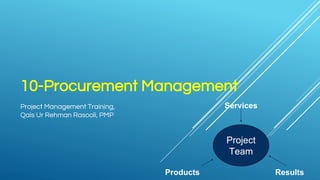
Project
Team
Products
Services
Results
Procurement Management
Project Procurement Management Includes;
• Processes necessary to purchase or acquire products
,services and result from outside the project team,
• Contract Management and Change control processes
• Controlling any contract issued by outside org acquiring
deliverables from the project team
• Administering contractual obligation placed on the project
team by the contract.
• Procurement management process includes; Plan
Procurement management, Conduct, Control, Close
Procurements
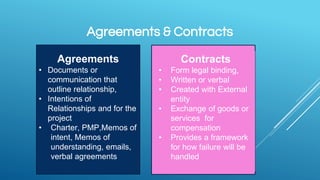
Agreements & Contracts
Agreements
• Documents or
communication that
outline relationship,
• Intentions of
Relationships and for the
project
• Charter, PMP,Memos of
intent, Memos of
understanding, emails,
verbal agreements
Contracts
• Form legal binding,
• Written or verbal
• Created with External
entity
• Exchange of goods or
services for
compensation
• Provides a framework
for how failure will be
handled
Overview of Procurement
Management Process
• Outputs of Procurement management include, Procurement
MP, Procurement SOW, Procurement Documentation, change
requests,
• Procurement process for Government and Private entities are
different,
• Procurement Departments,
• Make or buy decisions identify any procurement needs,
Overview of Procurement
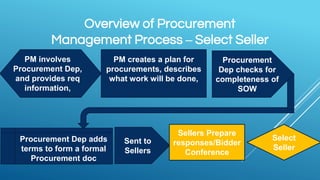
Management Process – Select Seller
PM involves
Procurement Dep,
and provides req
information,
PM creates a plan for
procurements, describes
what work will be done,
Procurement
Dep checks for
completeness of
SOW
Sent to
Sellers
Procurement Dep adds
terms to form a formal
Procurement doc
Sellers Prepare
responses/Bidder
Conference
Select
Seller
Tricks to answer Procurement
questions on the exam
• Contracts require formality, in case of arbitration, mediation, or
litigation, formal written communications will be enforceable
• All product and PM requirements to be mentioned in the
contract
• If its not in the contract , it can only be done for a formal signed
change order,
• Changes to contracts must be submitted and approved in
writing
• Contracts are legal binding, seller should perform according to
the contract or else face the consequences of the breach
PM’s role in the Procurement
Process
• Know the procurement process, plan for it!
• Understand the contract terms and conditions, helps plan and
manage the M&C of procurements,
• Make sure the contract includes product and PM scope to
minimize misunderstandings, miscommunications,
• Identify risks, and incorporate mitigation and transfer or risks in
the contract
• Include time required to complete procurement process in
project schedule,
• Make sure all the work mentioned in the contract is done
• Work with the procurement manager to manage any changes
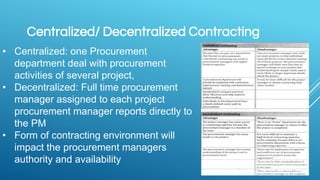
Centralized/ Decentralized Contracting
• Centralized: one Procurement
department deal with procurement
activities of several project,
• Decentralized: Full time procurement
manager assigned to each project
procurement manager reports directly to
the PM
• Form of contracting environment will
impact the procurement managers
authority and availability
1. Plan Procurement Management,
2. Conduct Procurements
3. Control Procurements
4. Close Procurements
Plan Procurement Management
• What goods or services need to procured and how can we procure them
efficiently
• Plan Procurement management includes;
1. Performing make-or-buy analysis
2. Creating a Procurement MP,
3. Creating a Procurement SOW,
4. Selecting a the contract type,
5. Creating the procurement documents
6. Determining Source selection criteria
Inputs include; PMP, Req Documentation, Activity resources req,
EEF,OPA,Risk register, Stakeholder Reg, Any other procurement, project
schedule and initial cost estimates for work to be performed
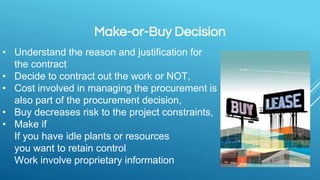
Make-or-Buy Decision
• Understand the reason and justification for
the contract
• Decide to contract out the work or NOT,
• Cost involved in managing the procurement is
also part of the procurement decision,
• Buy decreases risk to the project constraints,
• Make if
If you have idle plants or resources
you want to retain control
Work involve proprietary information
Procurement Management Plan
• How procurement will be planned , executed and controlled?
• EEF & OPA; governing approach to procurement, current procedure
and policies,
• How to perform make-or-buy analysis
• Process of creating procurement docs and SOW,
• Terms and conditions for the contract,
• Standards for selecting the correct contract type,
• Guidelines of establishing selection criteria,
• Roles and responsibilities for the team related to procurement,
• Rules for bidder conference,
• Guidelines for resolving disputes, process of accepting deliverables
• How are payments to be made?
Procurement Statement of Work
• What needs to be procured? SOW to be done on procurement
• Work done on each procurement is “Procurement SOW ”
• Include all the work and activities the seller is required to
complete
• To prevent contract problems, complete procurement SOW,
• Types depend on the nature of work, industry, amount of detail;
Performance : What the final product should be able to
accomplish/perform?
Functional; End purpose or result, minimum essential
characteristics of the product
Design: What work is to be done and materials to be used?
Contracts & Contract Types
• Contract: Represents a mutually binding agreement.
• Select based on;
What is being purchased,
The completeness of the procurement SOW,
The allowable management time available for the seller,
Do incentives come into play,
Marketplace or economy,
Industry standard for the type of contract used
• Three broad categories;
Fixed Price (FP), Time and Material (T&M), Cost Reimbursable
(CR)
Fixed Price Contracts
• Used for acquiring goods, product or services with well defined
specifications or requirements,
• If cost are more than what's agreed, seller bears it,
• Seller is most concerned with procurement statement of work,
• Sellers may not have a database of past costs or buyer may not
be able to create a complete Procurement SOW, THIS AVOIDS
THE USE OF FIXED PRICE CONTRACTS,
• Types; fixed price, fixed price incentive fee, fixed price award
fee, Fixed price economic price adjustment, purchase orders,
Time and Material (per hour or per item based, Simple terms
and conditions)
Cost Reimbursable Contracts
• When exact SOW is uncertain
• An alternative for FP contracts
• Buyer pays the seller allowable incurred costs
• Seller to have an accounting system – traceable costs
• Buyer has most cost risk – total cost is UNKNOWN
• R&D and technology project usually use this type of contract,
• Types; Cost contract, Cost plus percentage of costs, Cost plus
fixed fee, Cost plus incentive fee, Cost plus Award fee
• Payment timing is important (as work is completed, cost is
incurred, according to payment schedule, after successful
Time & Material Contracts
• Buyer pay per hour or unit based,
• Used for services of undefinable LOE,
• Mix of fixed price and cost plus
• Best used for work valued small dollar amounts and short in
duration,
• Not to Exceed clause needs to be added to the contract,
• Buyer has a medium cost risk compared to CR and FP.
Advantages and Disadvantages of
Fixed Price Contracts
Advantages and Disadvantages of
T&M and CR Contracts
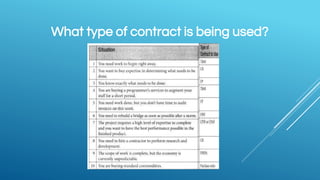
What type of contract is being used?
Risk with each type of contract
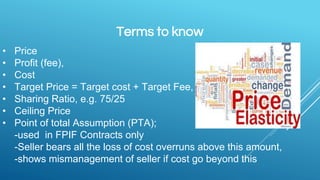
Terms to know
• Price
• Profit (fee),
• Cost
• Target Price = Target cost + Target Fee,
• Sharing Ratio, e.g. 75/25
• Ceiling Price
• Point of total Assumption (PTA);
-used in FPIF Contracts only
-Seller bears all the loss of cost overruns above this amount,
-shows mismanagement of seller if cost go beyond this
Procurement Documents
• Request for proposal
• Invitation for bid
• Request for quotation
Source Selection Criteria
• Included in the procurement documents
• Basis for the buyer to use in evaluating the bids or proposals
• When purchasing commodity, lowest price required quality,
• When buying services look for experience;
Number of years in business,
Financial stability, Understanding of need,
Technical ability,
Quality of past performance
Ability to complete work on time
• Change Requests;
• Nondisclosure Agreement
• Standard Contract
• Special Provisions
additions, changes ,deletions
Term and Conditions
• Understand the contract language so you can enforce it,
• If equipment is procured, T&C should mentioned ownership of
equipment and insurance of damages in transit,
Noncompetitive Procurement
Use noncompetitive procurement when;
• The project is under extreme schedule pressure,
• Seller unique in the services they provide,
• There is only one seller available who can do the job,
• Seller has patent of the item you need,
• Two types; Single source, Sole source
• Single source: Master service contract holders, previous
experience,
• Sole source; only one company available to do the type of
work you want
1. Plan Procurement Management,
2. Conduct Procurements
3. Control Procurements
4. Close Procurements
Conduct procurements
• Get procurement documents to prospective sellers
• Answer seller’s questions,
• Having sellers submit their responses,
• Review sellers responses,
• Select seller,
• Inputs include; procurement SOW, Procurement MP, Source
selection criteria, seller proposals, OPAs
Tool & Techniques include:
• Bidder conferences, Sellers proposals evaluation, Weighting
systems, independent estimates, screening system,
presentations, negotiations (scope , schedule, price)
Some Negotiation Tactics
• Attacks,
• Personal insults,
• Good guy/bad guy,
• Deadline,
• Lying,
• Limited Authority,
• Missing Man
• Fair and reasonable,
• Delay,
• Extreme demands,
• Withdrawal and Fait Accompli
Output Conduct procurements
• Selected sellers
• Agreements
• Resource Calendars
• Change requests
• Project management plan updates,
• Project document updates
1. Plan Procurement Management,
2. Conduct Procurements
3. Control Procurements
4. Close Procurements
Control Procurements
• Manage procurement relationships,
• Monitor contract performance
• Make changes and corrections to contracts as appropriate
• Protect legal rights
• Make sure payments are good compared to work completed
• PM must know what kind of problems to watch for in different kinds
of contracts,
• All work and legal requirement in the contract is to be completed
• PM must uphold all part of the contract not only the scope
• Capture necessary details , may be used for termination of contract
• Amendment – can be made prior to contract closure by mutual
consent
Control Procurements - Actions
• Review invoices for accuracy, timeliness
• Authorize payment/Request of further information on disputed
areas,
• Document all seller interactions /Communications
• Interpret contract
• Make sure authorized people communicate with sellers
• Hold procurement performance review meetings
• Understand legal implications of action taken,
• Issue/Review Claims,
• Coordinate sellers work with the overall project work,
• Manage interface among all sellers on the project
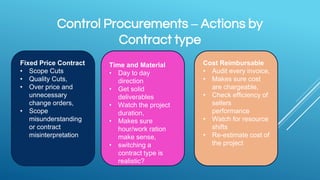
Control Procurements – Actions by
Contract type
Fixed Price Contract
• Scope Cuts
• Quality Cuts,
• Over price and
unnecessary
change orders,
• Scope
misunderstanding
or contract
misinterpretation
Time and Material
• Day to day
direction
• Get solid
deliverables
• Watch the project
duration,
• Makes sure
hour/work ration
make sense,
• switching a
contract type is
realistic?
Cost Reimbursable
• Audit every invoice,
• Makes sure cost
are chargeable,
• Check efficiency of
sellers
performance
• Watch for resource
shifts
• Re-estimate cost of
the project
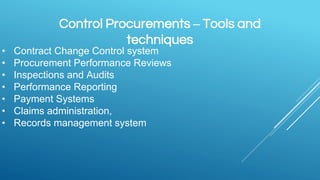
Control Procurements – Tools and
techniques
• Contract Change Control system
• Procurement Performance Reviews
• Inspections and Audits
• Performance Reporting
• Payment Systems
• Claims administration,
• Records management system
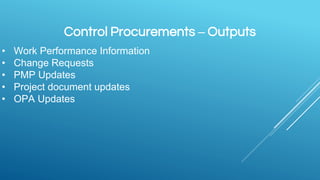
Control Procurements – Outputs
• Work Performance Information
• Change Requests
• PMP Updates
• Project document updates
• OPA Updates
Contract Interpretation
• What does the
contract really say
and/or mean?
• Who is responsible for
what part of the
procurement SOW?
• Contract supersedes
any memos ,
conversations or
discussions before the
contract is signed
What takes Precedence
or
Contract Language A memo drafted by one of the parties and
expected to be signed after the contract
Contract Language A memo signed by both parties before the
contract is signed that describes was agreed
during negotiations
Common definition Intended meaning ( without supplying a
definition)
Common use of Term Industry use of Term
Typed over wording in
the contract
A hand written comment on the contract that is
initialed
Words Numbers
Contract Term and
Conditions
Procurement statement of work
1. Plan Procurement Management,
2. Conduct Procurements
3. Control Procurements
4. Close Procurements
Close Procurements
• Close project procurement if the procurement objectives are
met,
• Close procurement if the procurement is terminated (T4C,T4D),
• Helps make sure all responsibilities for the company regarding
procurement are taken care of,
• Inputs are PMP, Procurement Documents
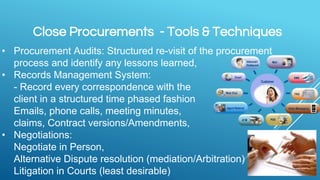
Close Procurements - Tools & Techniques
• Procurement Audits: Structured re-visit of the procurement
process and identify any lessons learned,
• Records Management System:
- Record every correspondence with the
client in a structured time phased fashion
Emails, phone calls, meeting minutes,
claims, Contract versions/Amendments,
• Negotiations:
Negotiate in Person,
Alternative Dispute resolution (mediation/Arbitration)
Litigation in Courts (least desirable)
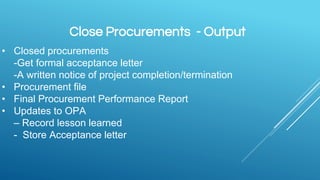
Close Procurements - Output
• Closed procurements
-Get formal acceptance letter
-A written notice of project completion/termination
• Procurement file
• Final Procurement Performance Report
• Updates to OPA
– Record lesson learned
- Store Acceptance letter
The Active PMP Learner
Find the difference between Solicited and non-
solicited request for proposals.
PM Quote of the day
It takes me a long time to make a big purchase
~ Jessica Chastain

11- PMP Training - Procurement Management

  • 1.
    10-Procurement Management Project ManagementTraining, Qais Ur Rehman Rasooli, PMP Project Team Products Services Results
  • 2.
    Procurement Management Project ProcurementManagement Includes; • Processes necessary to purchase or acquire products ,services and result from outside the project team, • Contract Management and Change control processes • Controlling any contract issued by outside org acquiring deliverables from the project team • Administering contractual obligation placed on the project team by the contract. • Procurement management process includes; Plan Procurement management, Conduct, Control, Close Procurements
  • 3.
    Agreements & Contracts Agreements •Documents or communication that outline relationship, • Intentions of Relationships and for the project • Charter, PMP,Memos of intent, Memos of understanding, emails, verbal agreements Contracts • Form legal binding, • Written or verbal • Created with External entity • Exchange of goods or services for compensation • Provides a framework for how failure will be handled
  • 4.
    Overview of Procurement ManagementProcess • Outputs of Procurement management include, Procurement MP, Procurement SOW, Procurement Documentation, change requests, • Procurement process for Government and Private entities are different, • Procurement Departments, • Make or buy decisions identify any procurement needs,
  • 5.
    Overview of Procurement ManagementProcess – Select Seller PM involves Procurement Dep, and provides req information, PM creates a plan for procurements, describes what work will be done, Procurement Dep checks for completeness of SOW Sent to Sellers Procurement Dep adds terms to form a formal Procurement doc Sellers Prepare responses/Bidder Conference Select Seller
  • 6.
    Tricks to answerProcurement questions on the exam • Contracts require formality, in case of arbitration, mediation, or litigation, formal written communications will be enforceable • All product and PM requirements to be mentioned in the contract • If its not in the contract , it can only be done for a formal signed change order, • Changes to contracts must be submitted and approved in writing • Contracts are legal binding, seller should perform according to the contract or else face the consequences of the breach
  • 7.
    PM’s role inthe Procurement Process • Know the procurement process, plan for it! • Understand the contract terms and conditions, helps plan and manage the M&C of procurements, • Make sure the contract includes product and PM scope to minimize misunderstandings, miscommunications, • Identify risks, and incorporate mitigation and transfer or risks in the contract • Include time required to complete procurement process in project schedule, • Make sure all the work mentioned in the contract is done • Work with the procurement manager to manage any changes
  • 8.
    Centralized/ Decentralized Contracting •Centralized: one Procurement department deal with procurement activities of several project, • Decentralized: Full time procurement manager assigned to each project procurement manager reports directly to the PM • Form of contracting environment will impact the procurement managers authority and availability
  • 9.
    1. Plan ProcurementManagement, 2. Conduct Procurements 3. Control Procurements 4. Close Procurements
  • 10.
    Plan Procurement Management •What goods or services need to procured and how can we procure them efficiently • Plan Procurement management includes; 1. Performing make-or-buy analysis 2. Creating a Procurement MP, 3. Creating a Procurement SOW, 4. Selecting a the contract type, 5. Creating the procurement documents 6. Determining Source selection criteria Inputs include; PMP, Req Documentation, Activity resources req, EEF,OPA,Risk register, Stakeholder Reg, Any other procurement, project schedule and initial cost estimates for work to be performed
  • 11.
    Make-or-Buy Decision • Understandthe reason and justification for the contract • Decide to contract out the work or NOT, • Cost involved in managing the procurement is also part of the procurement decision, • Buy decreases risk to the project constraints, • Make if If you have idle plants or resources you want to retain control Work involve proprietary information
  • 12.
    Procurement Management Plan •How procurement will be planned , executed and controlled? • EEF & OPA; governing approach to procurement, current procedure and policies, • How to perform make-or-buy analysis • Process of creating procurement docs and SOW, • Terms and conditions for the contract, • Standards for selecting the correct contract type, • Guidelines of establishing selection criteria, • Roles and responsibilities for the team related to procurement, • Rules for bidder conference, • Guidelines for resolving disputes, process of accepting deliverables • How are payments to be made?
  • 13.
    Procurement Statement ofWork • What needs to be procured? SOW to be done on procurement • Work done on each procurement is “Procurement SOW ” • Include all the work and activities the seller is required to complete • To prevent contract problems, complete procurement SOW, • Types depend on the nature of work, industry, amount of detail; Performance : What the final product should be able to accomplish/perform? Functional; End purpose or result, minimum essential characteristics of the product Design: What work is to be done and materials to be used?
  • 14.
    Contracts & ContractTypes • Contract: Represents a mutually binding agreement. • Select based on; What is being purchased, The completeness of the procurement SOW, The allowable management time available for the seller, Do incentives come into play, Marketplace or economy, Industry standard for the type of contract used • Three broad categories; Fixed Price (FP), Time and Material (T&M), Cost Reimbursable (CR)
  • 15.
    Fixed Price Contracts •Used for acquiring goods, product or services with well defined specifications or requirements, • If cost are more than what's agreed, seller bears it, • Seller is most concerned with procurement statement of work, • Sellers may not have a database of past costs or buyer may not be able to create a complete Procurement SOW, THIS AVOIDS THE USE OF FIXED PRICE CONTRACTS, • Types; fixed price, fixed price incentive fee, fixed price award fee, Fixed price economic price adjustment, purchase orders, Time and Material (per hour or per item based, Simple terms and conditions)
  • 16.
    Cost Reimbursable Contracts •When exact SOW is uncertain • An alternative for FP contracts • Buyer pays the seller allowable incurred costs • Seller to have an accounting system – traceable costs • Buyer has most cost risk – total cost is UNKNOWN • R&D and technology project usually use this type of contract, • Types; Cost contract, Cost plus percentage of costs, Cost plus fixed fee, Cost plus incentive fee, Cost plus Award fee • Payment timing is important (as work is completed, cost is incurred, according to payment schedule, after successful
  • 17.
    Time & MaterialContracts • Buyer pay per hour or unit based, • Used for services of undefinable LOE, • Mix of fixed price and cost plus • Best used for work valued small dollar amounts and short in duration, • Not to Exceed clause needs to be added to the contract, • Buyer has a medium cost risk compared to CR and FP.
  • 18.
    Advantages and Disadvantagesof Fixed Price Contracts
  • 19.
    Advantages and Disadvantagesof T&M and CR Contracts
  • 20.
    What type ofcontract is being used?
  • 21.
    Risk with eachtype of contract
  • 22.
    Terms to know •Price • Profit (fee), • Cost • Target Price = Target cost + Target Fee, • Sharing Ratio, e.g. 75/25 • Ceiling Price • Point of total Assumption (PTA); -used in FPIF Contracts only -Seller bears all the loss of cost overruns above this amount, -shows mismanagement of seller if cost go beyond this
  • 23.
    Procurement Documents • Requestfor proposal • Invitation for bid • Request for quotation
  • 24.
    Source Selection Criteria •Included in the procurement documents • Basis for the buyer to use in evaluating the bids or proposals • When purchasing commodity, lowest price required quality, • When buying services look for experience; Number of years in business, Financial stability, Understanding of need, Technical ability, Quality of past performance Ability to complete work on time
  • 25.
    • Change Requests; •Nondisclosure Agreement • Standard Contract • Special Provisions additions, changes ,deletions
  • 26.
    Term and Conditions •Understand the contract language so you can enforce it, • If equipment is procured, T&C should mentioned ownership of equipment and insurance of damages in transit,
  • 27.
    Noncompetitive Procurement Use noncompetitiveprocurement when; • The project is under extreme schedule pressure, • Seller unique in the services they provide, • There is only one seller available who can do the job, • Seller has patent of the item you need, • Two types; Single source, Sole source • Single source: Master service contract holders, previous experience, • Sole source; only one company available to do the type of work you want
  • 28.
    1. Plan ProcurementManagement, 2. Conduct Procurements 3. Control Procurements 4. Close Procurements
  • 29.
    Conduct procurements • Getprocurement documents to prospective sellers • Answer seller’s questions, • Having sellers submit their responses, • Review sellers responses, • Select seller, • Inputs include; procurement SOW, Procurement MP, Source selection criteria, seller proposals, OPAs Tool & Techniques include: • Bidder conferences, Sellers proposals evaluation, Weighting systems, independent estimates, screening system, presentations, negotiations (scope , schedule, price)
  • 30.
    Some Negotiation Tactics •Attacks, • Personal insults, • Good guy/bad guy, • Deadline, • Lying, • Limited Authority, • Missing Man • Fair and reasonable, • Delay, • Extreme demands, • Withdrawal and Fait Accompli
  • 31.
    Output Conduct procurements •Selected sellers • Agreements • Resource Calendars • Change requests • Project management plan updates, • Project document updates
  • 32.
    1. Plan ProcurementManagement, 2. Conduct Procurements 3. Control Procurements 4. Close Procurements
  • 33.
    Control Procurements • Manageprocurement relationships, • Monitor contract performance • Make changes and corrections to contracts as appropriate • Protect legal rights • Make sure payments are good compared to work completed • PM must know what kind of problems to watch for in different kinds of contracts, • All work and legal requirement in the contract is to be completed • PM must uphold all part of the contract not only the scope • Capture necessary details , may be used for termination of contract • Amendment – can be made prior to contract closure by mutual consent
  • 34.
    Control Procurements -Actions • Review invoices for accuracy, timeliness • Authorize payment/Request of further information on disputed areas, • Document all seller interactions /Communications • Interpret contract • Make sure authorized people communicate with sellers • Hold procurement performance review meetings • Understand legal implications of action taken, • Issue/Review Claims, • Coordinate sellers work with the overall project work, • Manage interface among all sellers on the project
  • 35.
    Control Procurements –Actions by Contract type Fixed Price Contract • Scope Cuts • Quality Cuts, • Over price and unnecessary change orders, • Scope misunderstanding or contract misinterpretation Time and Material • Day to day direction • Get solid deliverables • Watch the project duration, • Makes sure hour/work ration make sense, • switching a contract type is realistic? Cost Reimbursable • Audit every invoice, • Makes sure cost are chargeable, • Check efficiency of sellers performance • Watch for resource shifts • Re-estimate cost of the project
  • 36.
    Control Procurements –Tools and techniques • Contract Change Control system • Procurement Performance Reviews • Inspections and Audits • Performance Reporting • Payment Systems • Claims administration, • Records management system
  • 37.
    Control Procurements –Outputs • Work Performance Information • Change Requests • PMP Updates • Project document updates • OPA Updates
  • 38.
    Contract Interpretation • Whatdoes the contract really say and/or mean? • Who is responsible for what part of the procurement SOW? • Contract supersedes any memos , conversations or discussions before the contract is signed What takes Precedence or Contract Language A memo drafted by one of the parties and expected to be signed after the contract Contract Language A memo signed by both parties before the contract is signed that describes was agreed during negotiations Common definition Intended meaning ( without supplying a definition) Common use of Term Industry use of Term Typed over wording in the contract A hand written comment on the contract that is initialed Words Numbers Contract Term and Conditions Procurement statement of work
  • 39.
    1. Plan ProcurementManagement, 2. Conduct Procurements 3. Control Procurements 4. Close Procurements
  • 40.
    Close Procurements • Closeproject procurement if the procurement objectives are met, • Close procurement if the procurement is terminated (T4C,T4D), • Helps make sure all responsibilities for the company regarding procurement are taken care of, • Inputs are PMP, Procurement Documents
  • 41.
    Close Procurements -Tools & Techniques • Procurement Audits: Structured re-visit of the procurement process and identify any lessons learned, • Records Management System: - Record every correspondence with the client in a structured time phased fashion Emails, phone calls, meeting minutes, claims, Contract versions/Amendments, • Negotiations: Negotiate in Person, Alternative Dispute resolution (mediation/Arbitration) Litigation in Courts (least desirable)
  • 42.
    Close Procurements -Output • Closed procurements -Get formal acceptance letter -A written notice of project completion/termination • Procurement file • Final Procurement Performance Report • Updates to OPA – Record lesson learned - Store Acceptance letter
  • 43.
    The Active PMPLearner Find the difference between Solicited and non- solicited request for proposals.
  • 44.
    PM Quote ofthe day It takes me a long time to make a big purchase ~ Jessica Chastain