









Project Resource
Management
Knowledge Area
Resource Management
Knowledge Area is
concerned with all the
processes that organize
and manage the project
team and associated
resources
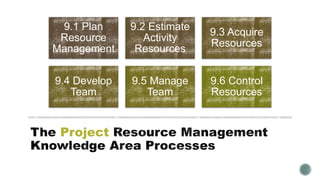
Project
9.1 Plan
Resource
Management
9.2 Estimate
Activity
Resources
9.3 Acquire
Resources
9.4 Develop
Team
9.5 Manage
Team
9.6 Control
Resources
Roles
The Resources on a Project
Team
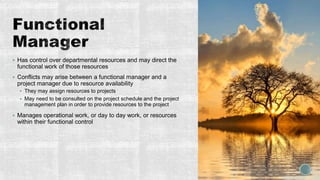
 Has control over departmental resources and may direct the
functional work of those resources
 Conflicts may arise between a functional manager and a
project manager due to resource availability
 They may assign resources to projects
 May need to be consulted on the project schedule and the project
management plan in order to provide resources to the project
 Manages operational work, or day to day work, or resources
within their functional control
 A stakeholder is anyone who
is impacted by a project or can
influence a project
 May fill roles on the project
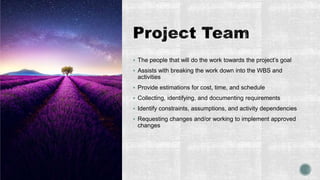
 The people that will do the work towards the project’s goal
 Assists with breaking the work down into the WBS and
activities
 Provide estimations for cost, time, and schedule
 Collecting, identifying, and documenting requirements
 Identify constraints, assumptions, and activity dependencies
 Requesting changes and/or working to implement approved
changes
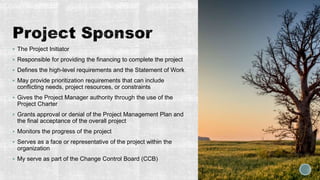
 The Project Initiator
 Responsible for providing the financing to complete the project
 Defines the high-level requirements and the Statement of Work
 May provide prioritization requirements that can include
conflicting needs, project resources, or constraints
 Gives the Project Manager authority through the use of the
Project Charter
 Grants approval or denial of the Project Management Plan and
the final acceptance of the overall project
 Monitors the progress of the project
 Serves as a face or representative of the project within the
organization
 My serve as part of the Change Control Board (CCB)
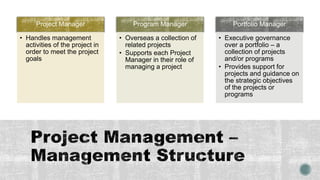
Project Manager
• Handles management
activities of the project in
order to meet the project
goals
Program Manager
• Overseas a collection of
related projects
• Supports each Project
Manager in their role of
managing a project
Portfolio Manager
• Executive governance
over a portfolio – a
collection of projects
and/or programs
• Provides support for
projects and guidance on
the strategic objectives
of the projects or
programs
Resource
Part of the Planning Process Group
 Part of the Planning Process
Group
 Process involved with
identifying the required roles on
the project, the responsibilities
of the roles, and the skills
needed.
 It builds the project roles and
responsibilities
 Identifies any training that may
be needed
 Outputs
 Resource Management Plan
 Staffing Management Plan
Major output of the Plan Resource Management Process and
is part of the Project Management Plan
Provides instructions on defining project resources
Includes the projects roles and responsibilities
Instructs on the needed skills to fill a role
Matrix charts show responsibility for an activity
 Responsible, Accountable, Consulted, Informed Matrix (RACI)
 Responsibility Assignment Matrix (RAM)
Hierarchical charts show positions and relationships in a
top-down structure
 Organizational Breakdown Structure
 Resource Breakdown Structure
Textual formats are more detailed descriptions of
responsibilities
Defines how staff will be brought into the project
Handles resource availability and release of staff resources
The Staffing Management Plan is part of the Resource
Management Plan
Should include any needed or anticipated training for the
project staff
Laws, local regulations, and company policies should be
researched and noted in the Staffing Management Plan
Charts the required
hours from each
staffing resource
Part of the Staffing
Management Plan
Resources
Part of the Planning Process Group
 Part of the Planning Process Group
 An estimate of all the resources (human,
materials, supplies) needed to perform each
activity
 Requires identifying and ensuring that resources
are available to fill needed roles or plans for
bringing those resources onboard
 Understanding organizational processes on
requesting resources and policies on their
proper usage
 Create the Resource Breakdown Structure
(RBS)
Acquire
Part of the Executing Process Group
 Part of the Executing Process Group
 The process of bringing on the project team who will
perform the project work
 Relies on the Resource Management Plan, Enterprise
Environmental Factors, and Organizational Process
Assets
 May involve hiring new employees or bringing in
temporary workers if required skills are not present
within the organization
 Manages the risks if resources are not available
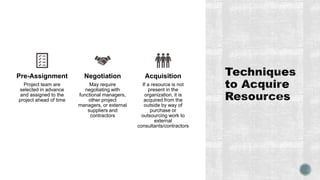
Pre-Assignment
Project team are
selected in advance
and assigned to the
project ahead of time
Negotiation
May require
negotiating with
functional managers,
other project
managers, or external
suppliers and
contractors
Acquisition
If a resource is not
present in the
organization, it is
acquired from the
outside by way of
purchase or
outsourcing work to
external
consultants/contractors
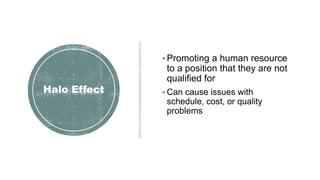
Halo Effect
Promoting a human resource
to a position that they are not
qualified for
 Can cause issues with
schedule, cost, or quality
problems
Team
Part of the Executing Process Group
 Part of the Executing Process Group
 The process of working to improve the overall
performance of the team by enhancing skills,
team collaboration, and team environment
 Requires many soft skills such as coaching,
mentoring, and servant-leadership
 Collaborate with the team, have open
communication, and provide an encouraging
and trustful environment
Working to create a more
cohesive team that will
enhance the overall
performance of the project
team
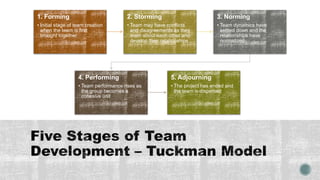
1. Forming
• Initial stage of team creation
when the team is first
brought together
2. Storming
• Team may have conflicts
and disagreements as they
learn about each other and
develop their relationships
3. Norming
• Team dynamics have
settled down and the
relationships have
normalized
4. Performing
• Team performance rises as
the group becomes a
cohesive unit
5. Adjourning
• The project has ended and
the team is dispersed
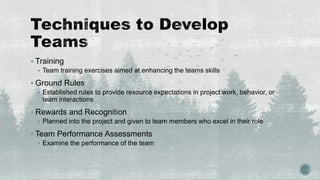
 Training
 Team training exercises aimed at enhancing the teams skills
 Ground Rules
 Established rules to provide resource expectations in project work, behavior, or
team interactions
 Rewards and Recognition
 Planned into the project and given to team members who excel in their role
 Team Performance Assessments
 Examine the performance of the team
9.5
Part of the Executing Process Group
 Part of the Executing Process
Group
 This process is concerned with
every day management of the team
in the project
 Lead the team and keep an eye out
for conflicts
 ensure conflicts get resolved to the
satisfaction of those involved
 Observation and Conversation
 Keep informed on the status of the work of each team resource and their attitudes,
impediments, and successes
 Engage in regular conversation with team members
 Project Performance Appraisals
 A method of evaluating a project resource
 Issue Logs
 Keep track of issues that need to be resolved and track them to completion
Understanding
 Projects may have conflicting
requirements
 Project Managers may have limited
power
 Project have competing needs with
functional managers
 Team member conflicts when it
comes to group interactions or
disagreements
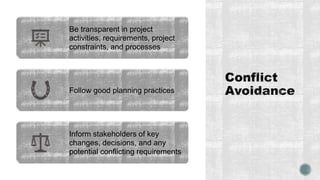
Be transparent in project
activities, requirements, project
constraints, and processes
Follow good planning practices
Inform stakeholders of key
changes, decisions, and any
potential conflicting requirements
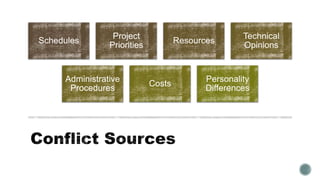
Schedules
Project
Priorities
Resources
Technical
Opinions
Administrative
Procedures
Costs
Personality
Differences
Arbitration  A neutral viewpoint is brought in to help
resolve conflicts
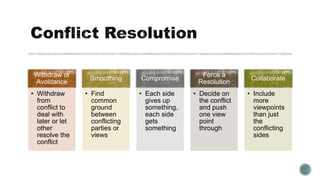
Withdraw or
Avoidance
• Withdraw
from
conflict to
deal with
later or let
other
resolve the
conflict
Smoothing
• Find
common
ground
between
conflicting
parties or
views
Compromise
• Each side
gives up
something,
each side
gets
something
Force a
Resolution
• Decide on
the conflict
and push
one view
point
through
Collaborate
• Include
more
viewpoints
than just
the
conflicting
sides
Concepts
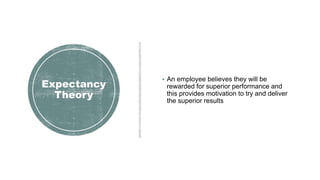
Expectancy
Theory
 An employee believes they will be
rewarded for superior performance and
this provides motivation to try and deliver
the superior results
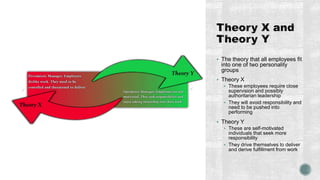
 The theory that all employees fit
into one of two personality
groups
 Theory X
 These employees require close
supervision and possibly
authoritarian leadership
 They will avoid responsibility and
need to be pushed into
performing
 Theory Y
 These are self-motivated
individuals that seek more
responsibility
 They drive themselves to deliver
and derive fulfillment from work
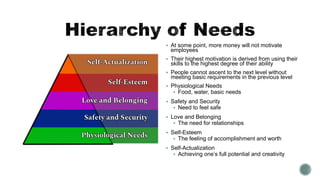
 At some point, more money will not motivate
employees
 Their highest motivation is derived from using their
skills to the highest degree of their ability
 People cannot ascent to the next level without
meeting basic requirements in the previous level
 Physiological Needs
 Food, water, basic needs
 Safety and Security
 Need to feel safe
 Love and Belonging
 The need for relationships
 Self-Esteem
 The feeling of accomplishment and worth
 Self-Actualization
 Achieving one’s full potential and creativity
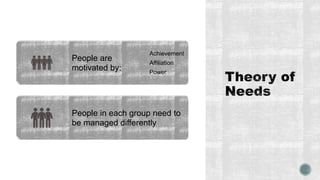
People are
motivated by:
Achievement
Affiliation
Power
People in each group need to
be managed differently
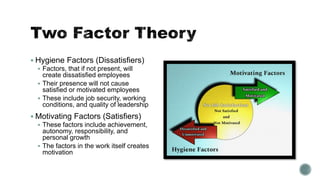
 Hygiene Factors (Dissatisfiers)
 Factors, that if not present, will
create dissatisfied employees
 Their presence will not cause
satisfied or motivated employees
 These include job security, working
conditions, and quality of leadership
 Motivating Factors (Satisfiers)
 These factors include achievement,
autonomy, responsibility, and
personal growth
 The factors in the work itself creates
motivation
Control
Part of the Monitoring & Controlling Process Group
 Part of the Monitoring & Controlling
Process Group
 Verify that the planned resources
needed and/or allocated are still
available to work
 Monitoring the utilization of
resources and comparing the
planned utilization to the actual
utilization
 A Guide to the Project
Management Body of Knowledge –
PMBOK 6th Edition
 https://www.pmi.org/
Joshua Render
https://agile-mercurial.com

Resource Management Knowledge Area

  • 1.
  • 2.
    Resource Management Knowledge Areais concerned with all the processes that organize and manage the project team and associated resources
  • 3.
    Project 9.1 Plan Resource Management 9.2 Estimate Activity Resources 9.3Acquire Resources 9.4 Develop Team 9.5 Manage Team 9.6 Control Resources
  • 4.
    Roles The Resources ona Project Team
  • 5.
     Has controlover departmental resources and may direct the functional work of those resources  Conflicts may arise between a functional manager and a project manager due to resource availability  They may assign resources to projects  May need to be consulted on the project schedule and the project management plan in order to provide resources to the project  Manages operational work, or day to day work, or resources within their functional control
  • 6.
     A stakeholderis anyone who is impacted by a project or can influence a project  May fill roles on the project
  • 7.
     The peoplethat will do the work towards the project’s goal  Assists with breaking the work down into the WBS and activities  Provide estimations for cost, time, and schedule  Collecting, identifying, and documenting requirements  Identify constraints, assumptions, and activity dependencies  Requesting changes and/or working to implement approved changes
  • 8.
     The ProjectInitiator  Responsible for providing the financing to complete the project  Defines the high-level requirements and the Statement of Work  May provide prioritization requirements that can include conflicting needs, project resources, or constraints  Gives the Project Manager authority through the use of the Project Charter  Grants approval or denial of the Project Management Plan and the final acceptance of the overall project  Monitors the progress of the project  Serves as a face or representative of the project within the organization  My serve as part of the Change Control Board (CCB)
  • 9.
    Project Manager • Handlesmanagement activities of the project in order to meet the project goals Program Manager • Overseas a collection of related projects • Supports each Project Manager in their role of managing a project Portfolio Manager • Executive governance over a portfolio – a collection of projects and/or programs • Provides support for projects and guidance on the strategic objectives of the projects or programs
  • 10.
    Resource Part of thePlanning Process Group
  • 11.
     Part ofthe Planning Process Group  Process involved with identifying the required roles on the project, the responsibilities of the roles, and the skills needed.  It builds the project roles and responsibilities  Identifies any training that may be needed  Outputs  Resource Management Plan  Staffing Management Plan
  • 12.
    Major output ofthe Plan Resource Management Process and is part of the Project Management Plan Provides instructions on defining project resources Includes the projects roles and responsibilities Instructs on the needed skills to fill a role
  • 13.
    Matrix charts showresponsibility for an activity  Responsible, Accountable, Consulted, Informed Matrix (RACI)  Responsibility Assignment Matrix (RAM) Hierarchical charts show positions and relationships in a top-down structure  Organizational Breakdown Structure  Resource Breakdown Structure Textual formats are more detailed descriptions of responsibilities
  • 14.
    Defines how staffwill be brought into the project Handles resource availability and release of staff resources The Staffing Management Plan is part of the Resource Management Plan Should include any needed or anticipated training for the project staff Laws, local regulations, and company policies should be researched and noted in the Staffing Management Plan
  • 15.
    Charts the required hoursfrom each staffing resource Part of the Staffing Management Plan
  • 16.
    Resources Part of thePlanning Process Group
  • 17.
     Part ofthe Planning Process Group  An estimate of all the resources (human, materials, supplies) needed to perform each activity  Requires identifying and ensuring that resources are available to fill needed roles or plans for bringing those resources onboard  Understanding organizational processes on requesting resources and policies on their proper usage  Create the Resource Breakdown Structure (RBS)
  • 18.
    Acquire Part of theExecuting Process Group
  • 19.
     Part ofthe Executing Process Group  The process of bringing on the project team who will perform the project work  Relies on the Resource Management Plan, Enterprise Environmental Factors, and Organizational Process Assets  May involve hiring new employees or bringing in temporary workers if required skills are not present within the organization  Manages the risks if resources are not available
  • 20.
    Pre-Assignment Project team are selectedin advance and assigned to the project ahead of time Negotiation May require negotiating with functional managers, other project managers, or external suppliers and contractors Acquisition If a resource is not present in the organization, it is acquired from the outside by way of purchase or outsourcing work to external consultants/contractors
  • 21.
    Halo Effect Promoting ahuman resource to a position that they are not qualified for  Can cause issues with schedule, cost, or quality problems
  • 22.
    Team Part of theExecuting Process Group
  • 23.
     Part ofthe Executing Process Group  The process of working to improve the overall performance of the team by enhancing skills, team collaboration, and team environment  Requires many soft skills such as coaching, mentoring, and servant-leadership  Collaborate with the team, have open communication, and provide an encouraging and trustful environment
  • 24.
    Working to createa more cohesive team that will enhance the overall performance of the project team
  • 25.
    1. Forming • Initialstage of team creation when the team is first brought together 2. Storming • Team may have conflicts and disagreements as they learn about each other and develop their relationships 3. Norming • Team dynamics have settled down and the relationships have normalized 4. Performing • Team performance rises as the group becomes a cohesive unit 5. Adjourning • The project has ended and the team is dispersed
  • 26.
     Training  Teamtraining exercises aimed at enhancing the teams skills  Ground Rules  Established rules to provide resource expectations in project work, behavior, or team interactions  Rewards and Recognition  Planned into the project and given to team members who excel in their role  Team Performance Assessments  Examine the performance of the team
  • 27.
    9.5 Part of theExecuting Process Group
  • 28.
     Part ofthe Executing Process Group  This process is concerned with every day management of the team in the project  Lead the team and keep an eye out for conflicts  ensure conflicts get resolved to the satisfaction of those involved
  • 29.
     Observation andConversation  Keep informed on the status of the work of each team resource and their attitudes, impediments, and successes  Engage in regular conversation with team members  Project Performance Appraisals  A method of evaluating a project resource  Issue Logs  Keep track of issues that need to be resolved and track them to completion
  • 30.
  • 31.
     Projects mayhave conflicting requirements  Project Managers may have limited power  Project have competing needs with functional managers  Team member conflicts when it comes to group interactions or disagreements
  • 32.
    Be transparent inproject activities, requirements, project constraints, and processes Follow good planning practices Inform stakeholders of key changes, decisions, and any potential conflicting requirements
  • 33.
  • 34.
    Arbitration  Aneutral viewpoint is brought in to help resolve conflicts
  • 35.
    Withdraw or Avoidance • Withdraw from conflictto deal with later or let other resolve the conflict Smoothing • Find common ground between conflicting parties or views Compromise • Each side gives up something, each side gets something Force a Resolution • Decide on the conflict and push one view point through Collaborate • Include more viewpoints than just the conflicting sides
  • 36.
  • 37.
    Expectancy Theory  An employeebelieves they will be rewarded for superior performance and this provides motivation to try and deliver the superior results
  • 38.
     The theorythat all employees fit into one of two personality groups  Theory X  These employees require close supervision and possibly authoritarian leadership  They will avoid responsibility and need to be pushed into performing  Theory Y  These are self-motivated individuals that seek more responsibility  They drive themselves to deliver and derive fulfillment from work
  • 39.
     At somepoint, more money will not motivate employees  Their highest motivation is derived from using their skills to the highest degree of their ability  People cannot ascent to the next level without meeting basic requirements in the previous level  Physiological Needs  Food, water, basic needs  Safety and Security  Need to feel safe  Love and Belonging  The need for relationships  Self-Esteem  The feeling of accomplishment and worth  Self-Actualization  Achieving one’s full potential and creativity
  • 40.
    People are motivated by: Achievement Affiliation Power Peoplein each group need to be managed differently
  • 41.
     Hygiene Factors(Dissatisfiers)  Factors, that if not present, will create dissatisfied employees  Their presence will not cause satisfied or motivated employees  These include job security, working conditions, and quality of leadership  Motivating Factors (Satisfiers)  These factors include achievement, autonomy, responsibility, and personal growth  The factors in the work itself creates motivation
  • 42.
    Control Part of theMonitoring & Controlling Process Group
  • 43.
     Part ofthe Monitoring & Controlling Process Group  Verify that the planned resources needed and/or allocated are still available to work  Monitoring the utilization of resources and comparing the planned utilization to the actual utilization
  • 44.
     A Guideto the Project Management Body of Knowledge – PMBOK 6th Edition  https://www.pmi.org/ Joshua Render https://agile-mercurial.com