GEOMETRIC
SEQUENCES
and
GEOMETRIC
MEANS
GEOMETRIC SEQUENCE
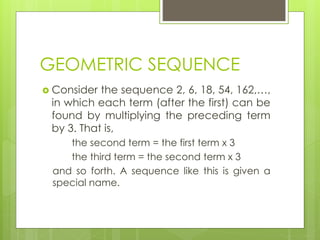
 Consider the sequence 2, 6, 18, 54, 162,…,
in which each term (after the first) can be
found by multiplying the preceding term
by 3. That is,
the second term = the first term x 3
the third term = the second term x 3
and so forth. A sequence like this is given a
special name.
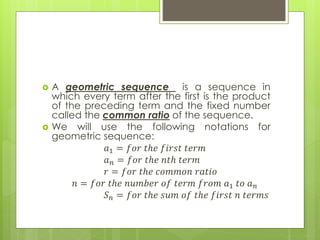
 A geometric sequence is a sequence in
which every term after the first is the product
of the preceding term and the fixed number
called the common ratio of the sequence.
 We will use the following notations for
geometric sequence:
𝑎1 = 𝑓𝑜𝑟 𝑡ℎ𝑒 𝑓𝑖𝑟𝑠𝑡 𝑡𝑒𝑟𝑚
𝑎 𝑛 = 𝑓𝑜𝑟 𝑡ℎ𝑒 𝑛𝑡ℎ 𝑡𝑒𝑟𝑚
𝑟 = 𝑓𝑜𝑟 𝑡ℎ𝑒 𝑐𝑜𝑚𝑚𝑜𝑛 𝑟𝑎𝑡𝑖𝑜
𝑛 = 𝑓𝑜𝑟 𝑡ℎ𝑒 𝑛𝑢𝑚𝑏𝑒𝑟 𝑜𝑓 𝑡𝑒𝑟𝑚 𝑓𝑟𝑜𝑚 𝑎1 𝑡𝑜 𝑎 𝑛
𝑆 𝑛 = 𝑓𝑜𝑟 𝑡ℎ𝑒 𝑠𝑢𝑚 𝑜𝑓 𝑡ℎ𝑒 𝑓𝑖𝑟𝑠𝑡 𝑛 𝑡𝑒𝑟𝑚𝑠
 For example, the geometric sequence 1, ½, ¼, 1/8,
1/16,…, where 𝑎1 = 1 and 𝑟 = 1/2 (to obtain each
succeeding term multiply the preceding one by ½.
Thus,
𝑎2 = 𝑎1 ∙ 𝑟 = 1 ∙
1
2
=
1
2
𝑎3 = 𝑎2 ∙ 𝑟 =
1
2
∙
1
2
=
1
4
𝑎4 = 𝑎3 ∙ 𝑟 =
1
4
∙
1
2
=
1
8
𝑎5 = 𝑎4 ∙ 𝑟 =
1
8
∙
1
2
=
1
16
and so on. Notice that if we divide any term by the
preceding one, the quotient or ratio is always ½. This is
why we call 𝑟 as the common ratio of the sequence
FORMULA FOR THE nth TERM
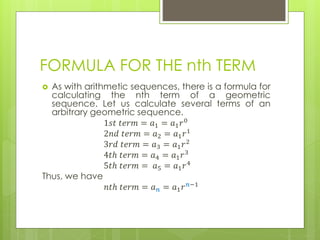
 As with arithmetic sequences, there is a formula for
calculating the nth term of a geometric
sequence. Let us calculate several terms of an
arbitrary geometric sequence.
1𝑠𝑡 𝑡𝑒𝑟𝑚 = 𝑎1 = 𝑎1 𝑟0
2𝑛𝑑 𝑡𝑒𝑟𝑚 = 𝑎2 = 𝑎1 𝑟1
3𝑟𝑑 𝑡𝑒𝑟𝑚 = 𝑎3 = 𝑎1 𝑟2
4𝑡ℎ 𝑡𝑒𝑟𝑚 = 𝑎4 = 𝑎1 𝑟3
5𝑡ℎ 𝑡𝑒𝑟𝑚 = 𝑎5 = 𝑎1 𝑟4
Thus, we have
𝑛𝑡ℎ 𝑡𝑒𝑟𝑚 = 𝑎 𝑛 = 𝑎1 𝑟 𝑛−1
Sample Problem
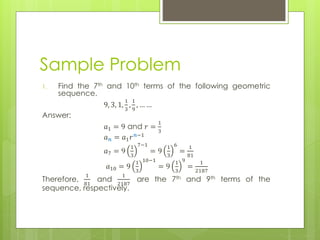
1. Find the 7th and 10th terms of the following geometric
sequence.
9, 3, 1,
1
3
,
1
9
, … …
Answer:
𝑎1 = 9 and 𝑟 =
1
3
𝑎 𝑛 = 𝑎1 𝑟 𝑛−1
𝑎7 = 9
1
3
7−1
= 9
1
3
6
=
1
81
𝑎10 = 9
1
3
10−1
= 9
1
3
9
=
1
2187
Therefore,
1
81
and
1
2187
are the 7th and 9th terms of the
sequence, respectively.
SUM OF THE FIRST n TERMS
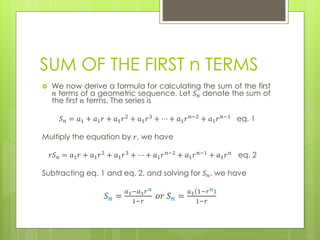
 We now derive a formula for calculating the sum of the first
𝑛 terms of a geometric sequence. Let 𝑆 𝑛 denote the sum of
the first 𝑛 terms. The series is
𝑆 𝑛 = 𝑎1 + 𝑎1 𝑟 + 𝑎1 𝑟2 + 𝑎1 𝑟3 + ⋯ + 𝑎1 𝑟 𝑛−2 + 𝑎1 𝑟 𝑛−1 eq. 1
Multiply the equation by 𝑟, we have
𝑟𝑆 𝑛 = 𝑎1 𝑟 + 𝑎1 𝑟2 + 𝑎1 𝑟3 + ⋯ + 𝑎1 𝑟 𝑛−2 + 𝑎1 𝑟 𝑛−1 + 𝑎1 𝑟 𝑛 eq. 2
Subtracting eq. 1 and eq. 2, and solving for 𝑆 𝑛, we have
𝑆 𝑛 =
𝑎1−𝑎1 𝑟 𝑛
1−𝑟
𝑜𝑟 𝑆 𝑛 =
𝑎1 1−𝑟 𝑛
1−𝑟
Sample Problem
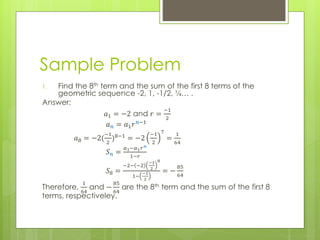
1. Find the 8th term and the sum of the first 8 terms of the
geometric sequence -2, 1, -1/2, ¼… .
Answer:
𝑎1 = −2 and 𝑟 =
−1
2
𝑎 𝑛 = 𝑎1 𝑟 𝑛−1
𝑎8 = −2(
−1
2
)8−1
= −2
−1
2
7
=
1
64
𝑆 𝑛 =
𝑎1−𝑎1 𝑟 𝑛
1−𝑟
𝑆8 =
−2− −2
−1
2
8
1−
−1
2
= −
85
64
Therefore,
1
64
and −
85
64
are the 8th term and the sum of the first 8
terms, respectiveley.
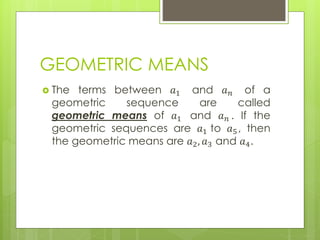
GEOMETRIC MEANS
 The terms between 𝑎1 and 𝑎 𝑛 of a
geometric sequence are called
geometric means of 𝑎1 and 𝑎 𝑛 . If the
geometric sequences are 𝑎1 to 𝑎5, then
the geometric means are 𝑎2, 𝑎3 and 𝑎4.
Sample Problem
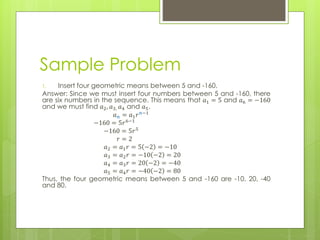
1. Insert four geometric means between 5 and -160.
Answer: Since we must insert four numbers between 5 and -160, there
are six numbers in the sequence. This means that 𝑎1 = 5 and 𝑎6 = −160
and we must find 𝑎2, 𝑎3, 𝑎4 and 𝑎5.
𝑎 𝑛 = 𝑎1 𝑟 𝑛−1
−160 = 5𝑟6−1
−160 = 5𝑟5
𝑟 = 2
𝑎2 = 𝑎1 𝑟 = 5 −2 = −10
𝑎3 = 𝑎2 𝑟 = −10 −2 = 20
𝑎4 = 𝑎3 𝑟 = 20 −2 = −40
𝑎5 = 𝑎4 𝑟 = −40 −2 = 80
Thus, the four geometric means between 5 and -160 are -10, 20, -40
and 80.
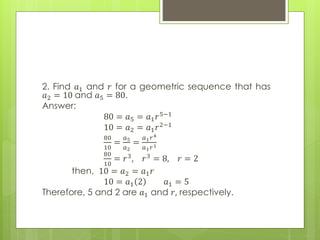
2. Find 𝑎1 and 𝑟 for a geometric sequence that has
𝑎2 = 10 and 𝑎5 = 80.
Answer:
80 = 𝑎5 = 𝑎1 𝑟5−1
10 = 𝑎2 = 𝑎1 𝑟2−1
80
10
=
𝑎5
𝑎2
=
𝑎1 𝑟4
𝑎1 𝑟1
80
10
= 𝑟3
, 𝑟3
= 8, 𝑟 = 2
then, 10 = 𝑎2 = 𝑎1 𝑟
10 = 𝑎1 2 𝑎1 = 5
Therefore, 5 and 2 are 𝑎1 and 𝑟, respectively.
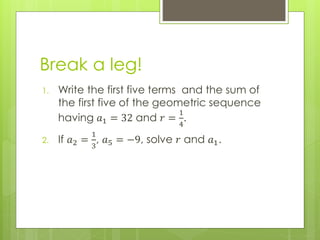
Break a leg!
1. Write the first five terms and the sum of
the first five of the geometric sequence
having 𝑎1 = 32 and 𝑟 =
1
4
.
2. If 𝑎2 =
1
3
, 𝑎5 = −9, solve 𝑟 and 𝑎1.
THANK YOU VERY MUCH!!!
PROF. DENMAR ESTRADA MARASIGAN

Geometric sequences and geometric means

  • 1.
  • 2.
    GEOMETRIC SEQUENCE  Considerthe sequence 2, 6, 18, 54, 162,…, in which each term (after the first) can be found by multiplying the preceding term by 3. That is, the second term = the first term x 3 the third term = the second term x 3 and so forth. A sequence like this is given a special name.
  • 3.
     A geometricsequence is a sequence in which every term after the first is the product of the preceding term and the fixed number called the common ratio of the sequence.  We will use the following notations for geometric sequence: 𝑎1 = 𝑓𝑜𝑟 𝑡ℎ𝑒 𝑓𝑖𝑟𝑠𝑡 𝑡𝑒𝑟𝑚 𝑎 𝑛 = 𝑓𝑜𝑟 𝑡ℎ𝑒 𝑛𝑡ℎ 𝑡𝑒𝑟𝑚 𝑟 = 𝑓𝑜𝑟 𝑡ℎ𝑒 𝑐𝑜𝑚𝑚𝑜𝑛 𝑟𝑎𝑡𝑖𝑜 𝑛 = 𝑓𝑜𝑟 𝑡ℎ𝑒 𝑛𝑢𝑚𝑏𝑒𝑟 𝑜𝑓 𝑡𝑒𝑟𝑚 𝑓𝑟𝑜𝑚 𝑎1 𝑡𝑜 𝑎 𝑛 𝑆 𝑛 = 𝑓𝑜𝑟 𝑡ℎ𝑒 𝑠𝑢𝑚 𝑜𝑓 𝑡ℎ𝑒 𝑓𝑖𝑟𝑠𝑡 𝑛 𝑡𝑒𝑟𝑚𝑠
  • 4.
     For example,the geometric sequence 1, ½, ¼, 1/8, 1/16,…, where 𝑎1 = 1 and 𝑟 = 1/2 (to obtain each succeeding term multiply the preceding one by ½. Thus, 𝑎2 = 𝑎1 ∙ 𝑟 = 1 ∙ 1 2 = 1 2 𝑎3 = 𝑎2 ∙ 𝑟 = 1 2 ∙ 1 2 = 1 4 𝑎4 = 𝑎3 ∙ 𝑟 = 1 4 ∙ 1 2 = 1 8 𝑎5 = 𝑎4 ∙ 𝑟 = 1 8 ∙ 1 2 = 1 16 and so on. Notice that if we divide any term by the preceding one, the quotient or ratio is always ½. This is why we call 𝑟 as the common ratio of the sequence
  • 5.
    FORMULA FOR THEnth TERM  As with arithmetic sequences, there is a formula for calculating the nth term of a geometric sequence. Let us calculate several terms of an arbitrary geometric sequence. 1𝑠𝑡 𝑡𝑒𝑟𝑚 = 𝑎1 = 𝑎1 𝑟0 2𝑛𝑑 𝑡𝑒𝑟𝑚 = 𝑎2 = 𝑎1 𝑟1 3𝑟𝑑 𝑡𝑒𝑟𝑚 = 𝑎3 = 𝑎1 𝑟2 4𝑡ℎ 𝑡𝑒𝑟𝑚 = 𝑎4 = 𝑎1 𝑟3 5𝑡ℎ 𝑡𝑒𝑟𝑚 = 𝑎5 = 𝑎1 𝑟4 Thus, we have 𝑛𝑡ℎ 𝑡𝑒𝑟𝑚 = 𝑎 𝑛 = 𝑎1 𝑟 𝑛−1
  • 6.
    Sample Problem 1. Findthe 7th and 10th terms of the following geometric sequence. 9, 3, 1, 1 3 , 1 9 , … … Answer: 𝑎1 = 9 and 𝑟 = 1 3 𝑎 𝑛 = 𝑎1 𝑟 𝑛−1 𝑎7 = 9 1 3 7−1 = 9 1 3 6 = 1 81 𝑎10 = 9 1 3 10−1 = 9 1 3 9 = 1 2187 Therefore, 1 81 and 1 2187 are the 7th and 9th terms of the sequence, respectively.
  • 7.
    SUM OF THEFIRST n TERMS  We now derive a formula for calculating the sum of the first 𝑛 terms of a geometric sequence. Let 𝑆 𝑛 denote the sum of the first 𝑛 terms. The series is 𝑆 𝑛 = 𝑎1 + 𝑎1 𝑟 + 𝑎1 𝑟2 + 𝑎1 𝑟3 + ⋯ + 𝑎1 𝑟 𝑛−2 + 𝑎1 𝑟 𝑛−1 eq. 1 Multiply the equation by 𝑟, we have 𝑟𝑆 𝑛 = 𝑎1 𝑟 + 𝑎1 𝑟2 + 𝑎1 𝑟3 + ⋯ + 𝑎1 𝑟 𝑛−2 + 𝑎1 𝑟 𝑛−1 + 𝑎1 𝑟 𝑛 eq. 2 Subtracting eq. 1 and eq. 2, and solving for 𝑆 𝑛, we have 𝑆 𝑛 = 𝑎1−𝑎1 𝑟 𝑛 1−𝑟 𝑜𝑟 𝑆 𝑛 = 𝑎1 1−𝑟 𝑛 1−𝑟
  • 8.
    Sample Problem 1. Findthe 8th term and the sum of the first 8 terms of the geometric sequence -2, 1, -1/2, ¼… . Answer: 𝑎1 = −2 and 𝑟 = −1 2 𝑎 𝑛 = 𝑎1 𝑟 𝑛−1 𝑎8 = −2( −1 2 )8−1 = −2 −1 2 7 = 1 64 𝑆 𝑛 = 𝑎1−𝑎1 𝑟 𝑛 1−𝑟 𝑆8 = −2− −2 −1 2 8 1− −1 2 = − 85 64 Therefore, 1 64 and − 85 64 are the 8th term and the sum of the first 8 terms, respectiveley.
  • 9.
    GEOMETRIC MEANS  Theterms between 𝑎1 and 𝑎 𝑛 of a geometric sequence are called geometric means of 𝑎1 and 𝑎 𝑛 . If the geometric sequences are 𝑎1 to 𝑎5, then the geometric means are 𝑎2, 𝑎3 and 𝑎4.
  • 10.
    Sample Problem 1. Insertfour geometric means between 5 and -160. Answer: Since we must insert four numbers between 5 and -160, there are six numbers in the sequence. This means that 𝑎1 = 5 and 𝑎6 = −160 and we must find 𝑎2, 𝑎3, 𝑎4 and 𝑎5. 𝑎 𝑛 = 𝑎1 𝑟 𝑛−1 −160 = 5𝑟6−1 −160 = 5𝑟5 𝑟 = 2 𝑎2 = 𝑎1 𝑟 = 5 −2 = −10 𝑎3 = 𝑎2 𝑟 = −10 −2 = 20 𝑎4 = 𝑎3 𝑟 = 20 −2 = −40 𝑎5 = 𝑎4 𝑟 = −40 −2 = 80 Thus, the four geometric means between 5 and -160 are -10, 20, -40 and 80.
  • 11.
    2. Find 𝑎1and 𝑟 for a geometric sequence that has 𝑎2 = 10 and 𝑎5 = 80. Answer: 80 = 𝑎5 = 𝑎1 𝑟5−1 10 = 𝑎2 = 𝑎1 𝑟2−1 80 10 = 𝑎5 𝑎2 = 𝑎1 𝑟4 𝑎1 𝑟1 80 10 = 𝑟3 , 𝑟3 = 8, 𝑟 = 2 then, 10 = 𝑎2 = 𝑎1 𝑟 10 = 𝑎1 2 𝑎1 = 5 Therefore, 5 and 2 are 𝑎1 and 𝑟, respectively.
  • 12.
    Break a leg! 1.Write the first five terms and the sum of the first five of the geometric sequence having 𝑎1 = 32 and 𝑟 = 1 4 . 2. If 𝑎2 = 1 3 , 𝑎5 = −9, solve 𝑟 and 𝑎1.
  • 13.
    THANK YOU VERYMUCH!!! PROF. DENMAR ESTRADA MARASIGAN