8/15/2014 1
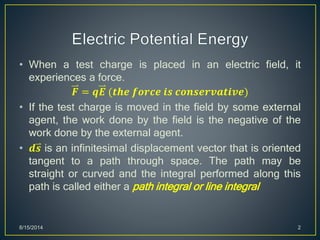
• When a test charge is placed in an electric field, it
experiences a force.
𝑭 = 𝒒𝑬 (𝒕𝒉𝒆 𝒇𝒐𝒓𝒄𝒆 𝒊𝒔 𝒄𝒐𝒏𝒔𝒆𝒓𝒗𝒂𝒕𝒊𝒗𝒆)
• If the test charge is moved in the field by some external
agent, the work done by the field is the negative of the
work done by the external agent.
• 𝒅𝒔 is an infinitesimal displacement vector that is oriented
tangent to a path through space. The path may be
straight or curved and the integral performed along this
path is called either a path integral or line integral
8/15/2014 2
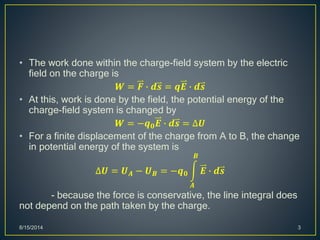
• The work done within the charge-field system by the electric
field on the charge is
𝑾 = 𝑭 ∙ 𝒅𝒔 = 𝒒𝑬 ∙ 𝒅𝒔
• At this, work is done by the field, the potential energy of the
charge-field system is changed by
𝑾 = −𝒒 𝟎 𝑬 ∙ 𝒅𝒔 = ∆𝑼
• For a finite displacement of the charge from A to B, the change
in potential energy of the system is
∆𝑼 = 𝑼 𝑨 − 𝑼 𝑩 = −𝒒 𝟎
𝑨
𝑩
𝑬 ∙ 𝒅𝒔
- because the force is conservative, the line integral does
not depend on the path taken by the charge.
8/15/2014 3
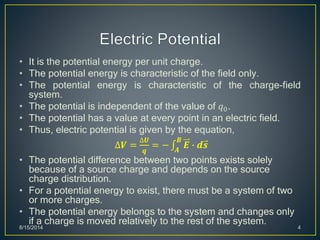
• It is the potential energy per unit charge.
• The potential energy is characteristic of the field only.
• The potential energy is characteristic of the charge-field
system.
• The potential is independent of the value of 𝑞0.
• The potential has a value at every point in an electric field.
• Thus, electric potential is given by the equation,
∆𝑽 =
∆𝑼
𝒒
= − 𝑨
𝑩
𝑬 ∙ 𝒅𝒔
• The potential difference between two points exists solely
because of a source charge and depends on the source
charge distribution.
• For a potential energy to exist, there must be a system of two
or more charges.
• The potential energy belongs to the system and changes only
if a charge is moved relatively to the rest of the system.
8/15/2014 4
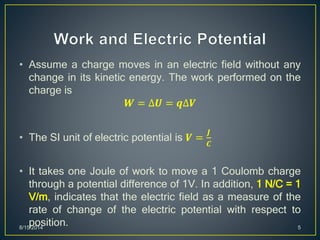
• Assume a charge moves in an electric field without any
change in its kinetic energy. The work performed on the
charge is
𝑾 = ∆𝑼 = 𝒒∆𝑽
• The SI unit of electric potential is 𝑽 =
𝑱
𝑪
• It takes one Joule of work to move a 1 Coulomb charge
through a potential difference of 1V. In addition, 1 N/C = 1
V/m, indicates that the electric field as a measure of the
rate of change of the electric potential with respect to
position.8/15/2014 5
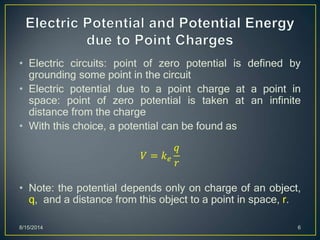
• Electric circuits: point of zero potential is defined by
grounding some point in the circuit
• Electric potential due to a point charge at a point in
space: point of zero potential is taken at an infinite
distance from the charge
• With this choice, a potential can be found as
𝑉 = 𝑘 𝑒
𝑞
𝑟
• Note: the potential depends only on charge of an object,
q, and a distance from this object to a point in space, r.
8/15/2014 6
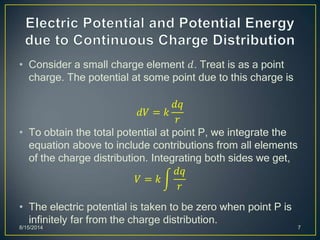
• Consider a small charge element 𝑑. Treat is as a point
charge. The potential at some point due to this charge is
𝑑𝑉 = 𝑘
𝑑𝑞
𝑟
• To obtain the total potential at point P, we integrate the
equation above to include contributions from all elements
of the charge distribution. Integrating both sides we get,
𝑉 = 𝑘
𝑑𝑞
𝑟
• The electric potential is taken to be zero when point P is
infinitely far from the charge distribution.
8/15/2014 7
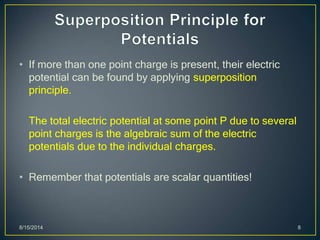
• If more than one point charge is present, their electric
potential can be found by applying superposition
principle.
The total electric potential at some point P due to several
point charges is the algebraic sum of the electric
potentials due to the individual charges.
• Remember that potentials are scalar quantities!
8/15/2014 8
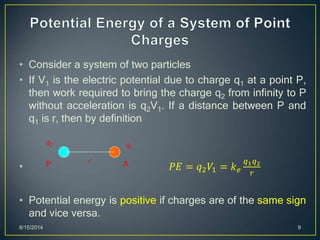
• Consider a system of two particles
• If V1 is the electric potential due to charge q1 at a point P,
then work required to bring the charge q2 from infinity to P
without acceleration is q2V1. If a distance between P and
q1 is r, then by definition
• 𝑃𝐸 = 𝑞2 𝑉1 = 𝑘 𝑒
𝑞1 𝑞2
𝑟
• Potential energy is positive if charges are of the same sign
and vice versa.
8/15/2014 9
P A
q1
q2
r
8/15/2014 10
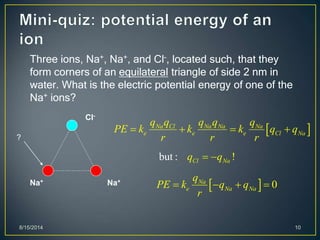
Three ions, Na+, Na+, and Cl-, located such, that they
form corners of an equilateral triangle of side 2 nm in
water. What is the electric potential energy of one of the
Na+ ions?
Cl-
Na+ Na+
?
 Na Cl Na Na Na
e e e Cl Na
q q q q q
PE k k k q q
r r r
   
but : !Cl Naq q 
  0Na
e Na Na
q
PE k q q
r
   
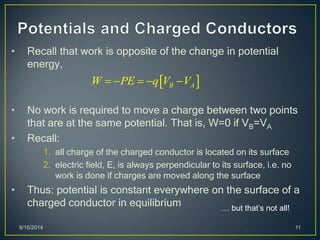
• Recall that work is opposite of the change in potential
energy,
• No work is required to move a charge between two points
that are at the same potential. That is, W=0 if VB=VA
• Recall:
1. all charge of the charged conductor is located on its surface
2. electric field, E, is always perpendicular to its surface, i.e. no
work is done if charges are moved along the surface
• Thus: potential is constant everywhere on the surface of a
charged conductor in equilibrium
8/15/2014 11
 B AW PE q V V    
… but that’s not all!
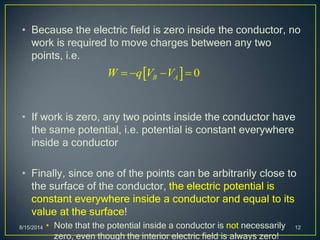
• Because the electric field is zero inside the conductor, no
work is required to move charges between any two
points, i.e.
• If work is zero, any two points inside the conductor have
the same potential, i.e. potential is constant everywhere
inside a conductor
• Finally, since one of the points can be arbitrarily close to
the surface of the conductor, the electric potential is
constant everywhere inside a conductor and equal to its
value at the surface!
• Note that the potential inside a conductor is not necessarily
zero, even though the interior electric field is always zero!
8/15/2014 12
  0B AW q V V   
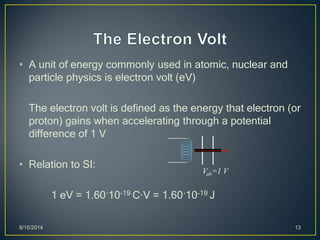
• A unit of energy commonly used in atomic, nuclear and
particle physics is electron volt (eV)
The electron volt is defined as the energy that electron (or
proton) gains when accelerating through a potential
difference of 1 V
• Relation to SI:
1 eV = 1.60´10-19 C·V = 1.60´10-19 J
8/15/2014 13
Vab=1 V
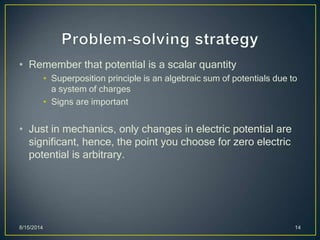
• Remember that potential is a scalar quantity
• Superposition principle is an algebraic sum of potentials due to
a system of charges
• Signs are important
• Just in mechanics, only changes in electric potential are
significant, hence, the point you choose for zero electric
potential is arbitrary.
8/15/2014 14
8/15/2014 15
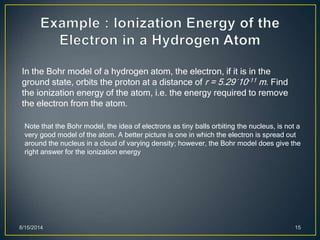
In the Bohr model of a hydrogen atom, the electron, if it is in the
ground state, orbits the proton at a distance of r = 5.29´10-11 m. Find
the ionization energy of the atom, i.e. the energy required to remove
the electron from the atom.
Note that the Bohr model, the idea of electrons as tiny balls orbiting the nucleus, is not a
very good model of the atom. A better picture is one in which the electron is spread out
around the nucleus in a cloud of varying density; however, the Bohr model does give the
right answer for the ionization energy
8/15/2014 16
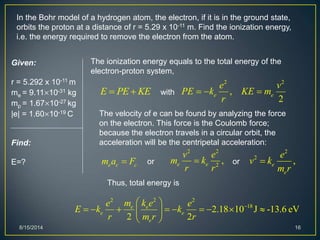
In the Bohr model of a hydrogen atom, the electron, if it is in the ground state,
orbits the proton at a distance of r = 5.29 x 10⁻¹¹ m. Find the ionization energy,
i.e. the energy required to remove the electron from the atom.
Given:
r = 5.292 x 10⁻¹¹ m
me = 9.1110-31 kg
mp = 1.6710-27 kg
|e| = 1.6010-19 C
Find:
E=?
The ionization energy equals to the total energy of the
electron-proton system,
E PE KE 
22 2
18
2.18 10 J -13.6 eV
2 2
e e
e e
e
m k ee e
E k k
r m r r
 
         
 
The velocity of e can be found by analyzing the force
on the electron. This force is the Coulomb force;
because the electron travels in a circular orbit, the
acceleration will be the centripetal acceleration:
e c cm a F
2 2
,
2
e e
e v
PE k KE m
r
  with
or
2 2
2
,e e
v e
m k
r r
 or
2
2
,e
e
e
v k
m r

Thus, total energy is
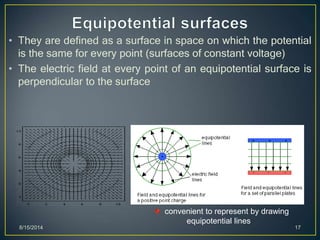
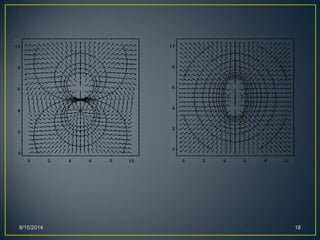
• They are defined as a surface in space on which the potential
is the same for every point (surfaces of constant voltage)
• The electric field at every point of an equipotential surface is
perpendicular to the surface
8/15/2014 17
convenient to represent by drawing
equipotential lines
8/15/2014 18
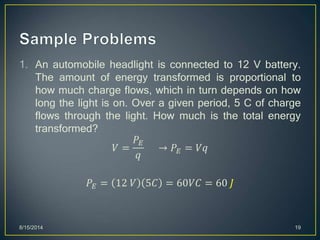
1. An automobile headlight is connected to 12 V battery.
The amount of energy transformed is proportional to
how much charge flows, which in turn depends on how
long the light is on. Over a given period, 5 C of charge
flows through the light. How much is the total energy
transformed?
𝑉 =
𝑃𝐸
𝑞
→ 𝑃𝐸 = 𝑉𝑞
𝑃𝐸 = 12 𝑉 5𝐶 = 60𝑉𝐶 = 60 𝐽
8/15/2014 19
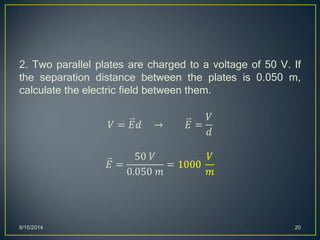
2. Two parallel plates are charged to a voltage of 50 V. If
the separation distance between the plates is 0.050 m,
calculate the electric field between them.
𝑉 = 𝐸𝑑 → 𝐸 =
𝑉
𝑑
𝐸 =
50 𝑉
0.050 𝑚
= 1000
𝑉
𝑚
8/15/2014 20
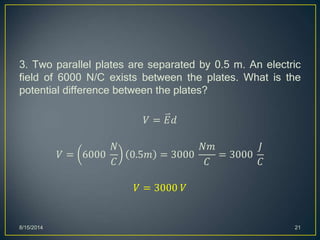
3. Two parallel plates are separated by 0.5 m. An electric
field of 6000 N/C exists between the plates. What is the
potential difference between the plates?
𝑉 = 𝐸𝑑
𝑉 = 6000
𝑁
𝐶
0.5𝑚 = 3000
𝑁𝑚
𝐶
= 3000
𝐽
𝐶
𝑉 = 3000 𝑉
8/15/2014 21
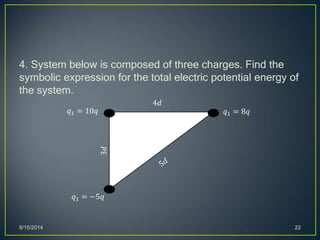
4. System below is composed of three charges. Find the
symbolic expression for the total electric potential energy of
the system.
8/15/2014 22
𝑞1 = 10𝑞
𝑞1 = −5𝑞
𝑞1 = 8𝑞
4𝑑3𝑑
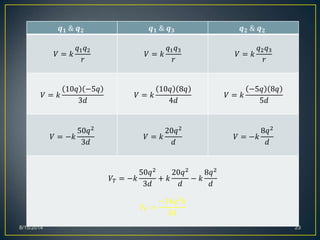
8/15/2014 23
𝒒 𝟏 & 𝒒 𝟐 𝒒 𝟏 & 𝒒 𝟑 𝒒 𝟐 & 𝒒 𝟐
𝑉 = 𝑘
𝑞1 𝑞2
𝑟
𝑉 = 𝑘
𝑞1 𝑞3
𝑟
𝑉 = 𝑘
𝑞2 𝑞3
𝑟
𝑉 = 𝑘
10𝑞 −5𝑞
3𝑑
𝑉 = 𝑘
10𝑞 8𝑞
4𝑑
𝑉 = 𝑘
−5𝑞 8𝑞
5𝑑
𝑉 = −𝑘
50𝑞2
3𝑑
𝑉 = 𝑘
20𝑞2
𝑑
𝑉 = −𝑘
8𝑞2
𝑑
𝑉𝑇 = −𝑘
50𝑞2
3𝑑
+ 𝑘
20𝑞2
𝑑
− 𝑘
8𝑞2
𝑑
𝑉𝑇 =
−14𝑞2 𝑘
3𝑑
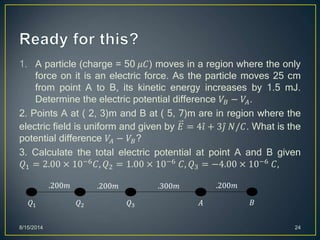
1. A particle (charge = 50 𝜇𝐶) moves in a region where the only
force on it is an electric force. As the particle moves 25 cm
from point A to B, its kinetic energy increases by 1.5 mJ.
Determine the electric potential difference 𝑉𝐵 − 𝑉𝐴.
2. Points A at ( 2, 3)m and B at ( 5, 7)m are in region where the
electric field is uniform and given by 𝐸 = 4 𝑖 + 3 𝑗 𝑁/𝐶. What is the
potential difference 𝑉𝐴 − 𝑉𝐵?
3. Calculate the total electric potential at point A and B given
𝑄1 = 2.00 × 10⁻⁶ 𝐶, 𝑄2 = 1.00 × 10⁻⁶ 𝐶, 𝑄3 = −4.00 × 10⁻⁶ 𝐶,
8/15/2014 24
𝑄1 𝐴𝑄3𝑄2 𝐵
.200𝑚 .200𝑚 .300𝑚 .200𝑚
• Physics 2 – Calculus Based Physics by Stewart
• Lecture Guide Calculus Based Physics
8/15/2014 25
GROUP 1 GROUP 2 GROUP 3
CLASS # 1-5 CLASS # 6-10 CLASS # 11-15
GROUP 4 GROUP 5 GROUP 6
CLASS 16-20 CLASS 21-25 CLASS # 26-31
8/15/2014 26
1. COPY THIS LECTURE.
2. STUDY!!!
3. PER GROUP: PLEASE BRING MANILA PAPER, PENTEL PEN
NEXT MEETING AND READY FOR “READY FOR THIS” 
GROUP 1 Group 2
Ausan, Tantiongco, Mendros,
Limtuico, Anacito
Dingalan, Decierdo, Baguhin,
Villanueva, Cruz
Group 3 Group 4
Estrella, Esguerra, Estrada, Dupaya,
Nonsol
Campos, Quintil, Nunez, Zabala,
Teves
Group 5 Group 6
Bibat, Alcaide, Albaniel, Gargar,
Gonzales
Dela Cruz, Peredo, Ogania, Toledo,
Soriano
8/15/2014 27
1. COPY THIS LECTURE.
2. STUDY!!!
3. PER GROUP: PLEASE BRING MANILA PAPER, PENTEL PEN NEXT
MEETING AND READY FOR “READY FOR THIS” 
GROUP 1 GROUP 2
Acotanza, Calingasan, Canezal,
Perolina, Rivera
Morga, Opog, Pontemayor, Roadiel,
Tolentino
GROUP 3 GROUP 4
Balde, Castillo, Castro, Cruz,
Dumaguit
Amlon, Anduque, Fadri, Micua, Morillo
GROUP 5 GROUP 6
Mendez, Pagdanganan, Panol,
Peralta, Santos
Gatchalian, Narvacan, Ratin, Sibuan,
Simon
8/15/2014 28
1. COPY THIS LECTURE.
2. STUDY!!!
3. PER GROUP: PLEASE BRING MANILA PAPER, PENTEL PEN NEXT
MEETING AND READY FOR “READY FOR THIS” 

Work and electric potential lecture # physics 2

  • 1.
  • 2.
    • When atest charge is placed in an electric field, it experiences a force. 𝑭 = 𝒒𝑬 (𝒕𝒉𝒆 𝒇𝒐𝒓𝒄𝒆 𝒊𝒔 𝒄𝒐𝒏𝒔𝒆𝒓𝒗𝒂𝒕𝒊𝒗𝒆) • If the test charge is moved in the field by some external agent, the work done by the field is the negative of the work done by the external agent. • 𝒅𝒔 is an infinitesimal displacement vector that is oriented tangent to a path through space. The path may be straight or curved and the integral performed along this path is called either a path integral or line integral 8/15/2014 2
  • 3.
    • The workdone within the charge-field system by the electric field on the charge is 𝑾 = 𝑭 ∙ 𝒅𝒔 = 𝒒𝑬 ∙ 𝒅𝒔 • At this, work is done by the field, the potential energy of the charge-field system is changed by 𝑾 = −𝒒 𝟎 𝑬 ∙ 𝒅𝒔 = ∆𝑼 • For a finite displacement of the charge from A to B, the change in potential energy of the system is ∆𝑼 = 𝑼 𝑨 − 𝑼 𝑩 = −𝒒 𝟎 𝑨 𝑩 𝑬 ∙ 𝒅𝒔 - because the force is conservative, the line integral does not depend on the path taken by the charge. 8/15/2014 3
  • 4.
    • It isthe potential energy per unit charge. • The potential energy is characteristic of the field only. • The potential energy is characteristic of the charge-field system. • The potential is independent of the value of 𝑞0. • The potential has a value at every point in an electric field. • Thus, electric potential is given by the equation, ∆𝑽 = ∆𝑼 𝒒 = − 𝑨 𝑩 𝑬 ∙ 𝒅𝒔 • The potential difference between two points exists solely because of a source charge and depends on the source charge distribution. • For a potential energy to exist, there must be a system of two or more charges. • The potential energy belongs to the system and changes only if a charge is moved relatively to the rest of the system. 8/15/2014 4
  • 5.
    • Assume acharge moves in an electric field without any change in its kinetic energy. The work performed on the charge is 𝑾 = ∆𝑼 = 𝒒∆𝑽 • The SI unit of electric potential is 𝑽 = 𝑱 𝑪 • It takes one Joule of work to move a 1 Coulomb charge through a potential difference of 1V. In addition, 1 N/C = 1 V/m, indicates that the electric field as a measure of the rate of change of the electric potential with respect to position.8/15/2014 5
  • 6.
    • Electric circuits:point of zero potential is defined by grounding some point in the circuit • Electric potential due to a point charge at a point in space: point of zero potential is taken at an infinite distance from the charge • With this choice, a potential can be found as 𝑉 = 𝑘 𝑒 𝑞 𝑟 • Note: the potential depends only on charge of an object, q, and a distance from this object to a point in space, r. 8/15/2014 6
  • 7.
    • Consider asmall charge element 𝑑. Treat is as a point charge. The potential at some point due to this charge is 𝑑𝑉 = 𝑘 𝑑𝑞 𝑟 • To obtain the total potential at point P, we integrate the equation above to include contributions from all elements of the charge distribution. Integrating both sides we get, 𝑉 = 𝑘 𝑑𝑞 𝑟 • The electric potential is taken to be zero when point P is infinitely far from the charge distribution. 8/15/2014 7
  • 8.
    • If morethan one point charge is present, their electric potential can be found by applying superposition principle. The total electric potential at some point P due to several point charges is the algebraic sum of the electric potentials due to the individual charges. • Remember that potentials are scalar quantities! 8/15/2014 8
  • 9.
    • Consider asystem of two particles • If V1 is the electric potential due to charge q1 at a point P, then work required to bring the charge q2 from infinity to P without acceleration is q2V1. If a distance between P and q1 is r, then by definition • 𝑃𝐸 = 𝑞2 𝑉1 = 𝑘 𝑒 𝑞1 𝑞2 𝑟 • Potential energy is positive if charges are of the same sign and vice versa. 8/15/2014 9 P A q1 q2 r
  • 10.
    8/15/2014 10 Three ions,Na+, Na+, and Cl-, located such, that they form corners of an equilateral triangle of side 2 nm in water. What is the electric potential energy of one of the Na+ ions? Cl- Na+ Na+ ?  Na Cl Na Na Na e e e Cl Na q q q q q PE k k k q q r r r     but : !Cl Naq q    0Na e Na Na q PE k q q r    
  • 11.
    • Recall thatwork is opposite of the change in potential energy, • No work is required to move a charge between two points that are at the same potential. That is, W=0 if VB=VA • Recall: 1. all charge of the charged conductor is located on its surface 2. electric field, E, is always perpendicular to its surface, i.e. no work is done if charges are moved along the surface • Thus: potential is constant everywhere on the surface of a charged conductor in equilibrium 8/15/2014 11  B AW PE q V V     … but that’s not all!
  • 12.
    • Because theelectric field is zero inside the conductor, no work is required to move charges between any two points, i.e. • If work is zero, any two points inside the conductor have the same potential, i.e. potential is constant everywhere inside a conductor • Finally, since one of the points can be arbitrarily close to the surface of the conductor, the electric potential is constant everywhere inside a conductor and equal to its value at the surface! • Note that the potential inside a conductor is not necessarily zero, even though the interior electric field is always zero! 8/15/2014 12   0B AW q V V   
  • 13.
    • A unitof energy commonly used in atomic, nuclear and particle physics is electron volt (eV) The electron volt is defined as the energy that electron (or proton) gains when accelerating through a potential difference of 1 V • Relation to SI: 1 eV = 1.60´10-19 C·V = 1.60´10-19 J 8/15/2014 13 Vab=1 V
  • 14.
    • Remember thatpotential is a scalar quantity • Superposition principle is an algebraic sum of potentials due to a system of charges • Signs are important • Just in mechanics, only changes in electric potential are significant, hence, the point you choose for zero electric potential is arbitrary. 8/15/2014 14
  • 15.
    8/15/2014 15 In theBohr model of a hydrogen atom, the electron, if it is in the ground state, orbits the proton at a distance of r = 5.29´10-11 m. Find the ionization energy of the atom, i.e. the energy required to remove the electron from the atom. Note that the Bohr model, the idea of electrons as tiny balls orbiting the nucleus, is not a very good model of the atom. A better picture is one in which the electron is spread out around the nucleus in a cloud of varying density; however, the Bohr model does give the right answer for the ionization energy
  • 16.
    8/15/2014 16 In theBohr model of a hydrogen atom, the electron, if it is in the ground state, orbits the proton at a distance of r = 5.29 x 10⁻¹¹ m. Find the ionization energy, i.e. the energy required to remove the electron from the atom. Given: r = 5.292 x 10⁻¹¹ m me = 9.1110-31 kg mp = 1.6710-27 kg |e| = 1.6010-19 C Find: E=? The ionization energy equals to the total energy of the electron-proton system, E PE KE  22 2 18 2.18 10 J -13.6 eV 2 2 e e e e e m k ee e E k k r m r r               The velocity of e can be found by analyzing the force on the electron. This force is the Coulomb force; because the electron travels in a circular orbit, the acceleration will be the centripetal acceleration: e c cm a F 2 2 , 2 e e e v PE k KE m r   with or 2 2 2 ,e e v e m k r r  or 2 2 ,e e e v k m r  Thus, total energy is
  • 17.
    • They aredefined as a surface in space on which the potential is the same for every point (surfaces of constant voltage) • The electric field at every point of an equipotential surface is perpendicular to the surface 8/15/2014 17 convenient to represent by drawing equipotential lines
  • 18.
  • 19.
    1. An automobileheadlight is connected to 12 V battery. The amount of energy transformed is proportional to how much charge flows, which in turn depends on how long the light is on. Over a given period, 5 C of charge flows through the light. How much is the total energy transformed? 𝑉 = 𝑃𝐸 𝑞 → 𝑃𝐸 = 𝑉𝑞 𝑃𝐸 = 12 𝑉 5𝐶 = 60𝑉𝐶 = 60 𝐽 8/15/2014 19
  • 20.
    2. Two parallelplates are charged to a voltage of 50 V. If the separation distance between the plates is 0.050 m, calculate the electric field between them. 𝑉 = 𝐸𝑑 → 𝐸 = 𝑉 𝑑 𝐸 = 50 𝑉 0.050 𝑚 = 1000 𝑉 𝑚 8/15/2014 20
  • 21.
    3. Two parallelplates are separated by 0.5 m. An electric field of 6000 N/C exists between the plates. What is the potential difference between the plates? 𝑉 = 𝐸𝑑 𝑉 = 6000 𝑁 𝐶 0.5𝑚 = 3000 𝑁𝑚 𝐶 = 3000 𝐽 𝐶 𝑉 = 3000 𝑉 8/15/2014 21
  • 22.
    4. System belowis composed of three charges. Find the symbolic expression for the total electric potential energy of the system. 8/15/2014 22 𝑞1 = 10𝑞 𝑞1 = −5𝑞 𝑞1 = 8𝑞 4𝑑3𝑑
  • 23.
    8/15/2014 23 𝒒 𝟏& 𝒒 𝟐 𝒒 𝟏 & 𝒒 𝟑 𝒒 𝟐 & 𝒒 𝟐 𝑉 = 𝑘 𝑞1 𝑞2 𝑟 𝑉 = 𝑘 𝑞1 𝑞3 𝑟 𝑉 = 𝑘 𝑞2 𝑞3 𝑟 𝑉 = 𝑘 10𝑞 −5𝑞 3𝑑 𝑉 = 𝑘 10𝑞 8𝑞 4𝑑 𝑉 = 𝑘 −5𝑞 8𝑞 5𝑑 𝑉 = −𝑘 50𝑞2 3𝑑 𝑉 = 𝑘 20𝑞2 𝑑 𝑉 = −𝑘 8𝑞2 𝑑 𝑉𝑇 = −𝑘 50𝑞2 3𝑑 + 𝑘 20𝑞2 𝑑 − 𝑘 8𝑞2 𝑑 𝑉𝑇 = −14𝑞2 𝑘 3𝑑
  • 24.
    1. A particle(charge = 50 𝜇𝐶) moves in a region where the only force on it is an electric force. As the particle moves 25 cm from point A to B, its kinetic energy increases by 1.5 mJ. Determine the electric potential difference 𝑉𝐵 − 𝑉𝐴. 2. Points A at ( 2, 3)m and B at ( 5, 7)m are in region where the electric field is uniform and given by 𝐸 = 4 𝑖 + 3 𝑗 𝑁/𝐶. What is the potential difference 𝑉𝐴 − 𝑉𝐵? 3. Calculate the total electric potential at point A and B given 𝑄1 = 2.00 × 10⁻⁶ 𝐶, 𝑄2 = 1.00 × 10⁻⁶ 𝐶, 𝑄3 = −4.00 × 10⁻⁶ 𝐶, 8/15/2014 24 𝑄1 𝐴𝑄3𝑄2 𝐵 .200𝑚 .200𝑚 .300𝑚 .200𝑚
  • 25.
    • Physics 2– Calculus Based Physics by Stewart • Lecture Guide Calculus Based Physics 8/15/2014 25
  • 26.
    GROUP 1 GROUP2 GROUP 3 CLASS # 1-5 CLASS # 6-10 CLASS # 11-15 GROUP 4 GROUP 5 GROUP 6 CLASS 16-20 CLASS 21-25 CLASS # 26-31 8/15/2014 26 1. COPY THIS LECTURE. 2. STUDY!!! 3. PER GROUP: PLEASE BRING MANILA PAPER, PENTEL PEN NEXT MEETING AND READY FOR “READY FOR THIS” 
  • 27.
    GROUP 1 Group2 Ausan, Tantiongco, Mendros, Limtuico, Anacito Dingalan, Decierdo, Baguhin, Villanueva, Cruz Group 3 Group 4 Estrella, Esguerra, Estrada, Dupaya, Nonsol Campos, Quintil, Nunez, Zabala, Teves Group 5 Group 6 Bibat, Alcaide, Albaniel, Gargar, Gonzales Dela Cruz, Peredo, Ogania, Toledo, Soriano 8/15/2014 27 1. COPY THIS LECTURE. 2. STUDY!!! 3. PER GROUP: PLEASE BRING MANILA PAPER, PENTEL PEN NEXT MEETING AND READY FOR “READY FOR THIS” 
  • 28.
    GROUP 1 GROUP2 Acotanza, Calingasan, Canezal, Perolina, Rivera Morga, Opog, Pontemayor, Roadiel, Tolentino GROUP 3 GROUP 4 Balde, Castillo, Castro, Cruz, Dumaguit Amlon, Anduque, Fadri, Micua, Morillo GROUP 5 GROUP 6 Mendez, Pagdanganan, Panol, Peralta, Santos Gatchalian, Narvacan, Ratin, Sibuan, Simon 8/15/2014 28 1. COPY THIS LECTURE. 2. STUDY!!! 3. PER GROUP: PLEASE BRING MANILA PAPER, PENTEL PEN NEXT MEETING AND READY FOR “READY FOR THIS” 