ARITHMETIC SEQUENCE
JOEY F. VALDRIZ
Arithmetic Sequence
• a sequence of numbers where each term after
the first term is obtained by adding the same
constant to the preceding term
The constant is called a common difference,
denoted as 𝒅.
Examples of
Arithmetic Sequence
1. 6, 10, 14, 18, 22, 26, … 𝑑 = 4
2. 20, 17, 14, 11, 8, 5, … 𝑑 = −3
3.
1
4
,
1
2
,
3
4
, 1,
5
4
, … 𝑑 =
1
4
4.
11
3
,
35
12
,
13
6
,
17
12
,
2
3
, … 𝑑 = −
3
4
2, 4, 6, 8, 10, ....
15, 12, 9, 6, 3, ....
-5, -4,-3, -2, -1....
6, 6, 6, 6, 6, 6, ....
𝒅 =?
𝒅 =?
𝒅 =?
𝒅 =?
Find the common difference for each arithmetic
sequence.
1) 23, 38, 53, __ , 83, 98
2) 45, 37, __ , 21, 13, 5
3) -13, -6, __ , 8, 15, 22
27 28 29 30
0 1 -2 -3
63 68 73 78
Identify the missing term in the given arithmetic
sequence.
4) __ , 23, 32, 41, 50, 59
5) -12, -7, -2, 3, 8, ___
6) 10, __ , 32, 43, 54, 65
10 11 12 13
21 23 25 27
10 12 14 16
Identify the missing term in the given arithmetic
sequence.
Insert the arithmetic mean(s) between the given
terms of an arithmetic sequence.
1. 2, ___, 20
2. 5, ___, ___, 14
3. 9, ___, ___, ___, 25
4. 8, ___, ___, ___, ___, 33
5. 3, ___, ___, ___, ___, ___, 45
Arithmetic Means
1. 2, 11, 20 𝑑 = 9
2. 5, 8, 11, 14 𝑑 = 3
3. 9, 13, 17, 21, 25 𝑑 = 4
4. 8, 13, 18, 23, 28, 33 𝑑 = 5
5. 3, 10, 17, 24, 31, 38, 45 𝑑 = 7
Arithmetic Means
Question: What is 𝑎5 in the arithmetic sequence
5, 9, 13, 17, …?
Answer: It is 21. Add 4 to 17 (𝑎4) since 𝑑 = 4.
How about 𝑎199?
Finding the 𝑛th Term of an
Arithmetic Sequence
Finding the 𝑛th Term of an
Arithmetic Sequence
𝑎𝑛 = 𝑎1 + 𝑛 − 1 𝑑
where:
𝑎𝑛 is the 𝑛th term / last term
𝑎1 is the first term
𝑛 is the number of terms
𝑑 is the common difference
𝑎𝑛 = 𝑎1 + 𝑛 − 1 𝑑
Question 1: What is 𝑎199 in the arithmetic
sequence 5, 9, 13, 17, …?
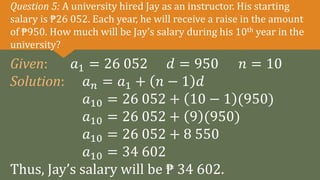
Given: 𝑎1 = 5 𝑑 = 4 𝑛 = 199 𝑎199 =?
Solution: 𝑎199 = 5 + 199 − 1 (4)
𝑎199 = 5 + 198 (4)
𝑎199 = 5 + 792
𝑎199 = 𝟕𝟗𝟕 ∴ 797 is 𝒂𝟏𝟗𝟗
𝑎𝑛 = 𝑎1 + 𝑛 − 1 𝑑
Question 2: In the arithmetic sequence 5, 9, 13,
17, …, what term is 105?
Given: 𝑎? = 105 𝑎1 = 5 𝑑 = 4 𝑛 =?
Solution: 105 = 5 + 𝑛 − 1 (4)
105 = 5 + 4𝑛 − 4
105 − 5 + 4 = 4𝑛
104 = 4𝑛 ∴ 105 is 𝒂𝟐𝟔.
𝟐𝟔 = 𝒏
𝑎𝑛 = 𝑎1 + 𝑛 − 1 𝑑
Question 3: What is the first term of the
arithmetic sequence with 𝑑 = 4 and 𝑎40 = 161?
Given: 𝑎40 = 161 𝑑 = 4 𝑛 = 40 𝑎1 =?
Solution: 161 = 𝑎1 + 40 − 1 (4)
161 = 𝑎1 + (39)(4)
161 = 𝑎1 + 156
161 − 156 = 𝑎1 ∴ 𝒂𝟏 is 5.
𝟓 = 𝒂𝟏
𝑎𝑛 = 𝑎1 + 𝑛 − 1 𝑑
Question 4: In an arithmetic sequence, 𝑎1 = 5
and 𝑎20 = 81, what is the common difference?
Given: 𝑎1 = 5 𝑎20 = 81 𝑛 = 20 𝑑 =?
Solution: 81 = 5 + 20 − 1 (𝑑)
81 = 5 + (19)(𝑑)
81 = 5 + 19𝑑
81 − 5 = 19𝑑 ∴ The 𝒅 is 4.
76 = 19𝑑
𝟒 = 𝒅
Finding the 𝑛th Term of an
Arithmetic Sequence
𝑎𝑛 = 𝑎1 + 𝑛 − 1 𝑑
“What is the 𝑛th term… ?” : 𝒂𝒏 = 𝒂𝟏 + 𝒏 − 𝟏 𝒅
“What term is … ?” / “How many terms … ?”
: 𝒏 =
𝒂𝒏−𝒂𝟏
𝒅
+ 𝟏
“What is the first term… ?” : 𝒂𝟏 = 𝒂𝒏 − 𝒏 − 𝟏 𝒅
“What is the common difference… ?”: 𝒅 =
𝒂𝒏−𝒂𝟏
𝒏−𝟏
Given: 𝑎1 = 26 052 𝑑 = 950 𝑛 = 10
Solution: 𝑎𝑛 = 𝑎1 + 𝑛 − 1 𝑑
𝑎10 = 26 052 + 10 − 1 (950)
𝑎10 = 26 052 + 9 (950)
𝑎10 = 26 052 + 8 550
𝑎10 = 34 602
Thus, Jay’s salary will be ₱ 34 602.
Question 5: A university hired Jay as an instructor. His starting
salary is ₱26 052. Each year, he will receive a raise in the amount
of ₱950. How much will be Jay’s salary during his 10th year in the
university?
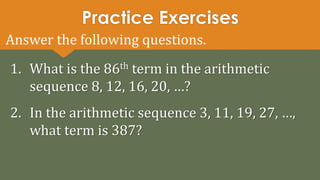
1. What is the 86th term in the arithmetic
sequence 8, 12, 16, 20, …?
2. In the arithmetic sequence 3, 11, 19, 27, …,
what term is 387?
Answer the following questions.
Practice Exercises
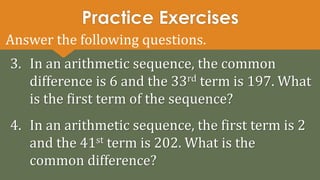
3. In an arithmetic sequence, the common
difference is 6 and the 33rd term is 197. What
is the first term of the sequence?
4. In an arithmetic sequence, the first term is 2
and the 41st term is 202. What is the
common difference?
Answer the following questions.
Practice Exercises
5. A spacious hall has 25 rows of seats. The last
row has 94 seats. If each row contains two
fewer seats than the row behind it. How
many seats are there in the first row?
Answer the following questions.
Practice Exercises
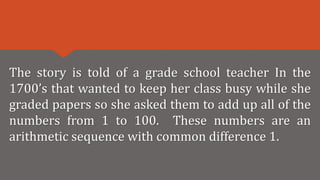
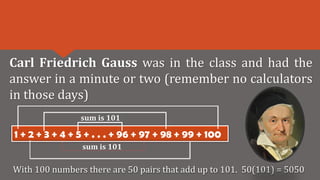
The story is told of a grade school teacher In the
1700’s that wanted to keep her class busy while she
graded papers so she asked them to add up all of the
numbers from 1 to 100. These numbers are an
arithmetic sequence with common difference 1.
Carl Friedrich Gauss was in the class and had the
answer in a minute or two (remember no calculators
in those days)
1 + 2 + 3 + 4 + 5 + . . . + 96 + 97 + 98 + 99 + 100
sum is 101
sum is 101
With 100 numbers there are 50 pairs that add up to 101. 50(101) = 5050
Arithmetic Series
• is the sum of the first 𝑛 terms of an arithmetic
sequence
• denoted as 𝑺𝒏
Example: What is the sum of the first 5 terms of
the arithmetic sequence 3, 10, 17, 24, …?
𝑺𝟓 = 𝟑 + 𝟏𝟎 + 𝟏𝟕 + 𝟐𝟒 + 𝟑𝟏
𝑺𝟓 = 𝟖𝟓
Arithmetic Series
How about finding the sum of the first 86 terms
of the arithmetic sequence 3, 10, 17, 24, …?
𝑺𝟖𝟔 = 𝟑 + 𝟏𝟎 + 𝟏𝟕 + 𝟐𝟒 + 𝟑𝟏 + ⋯ + 𝒂𝟖𝟔
𝑺𝟖𝟔 =?
Finding the Sum of the First 𝑛 Terms
of an Arithmetic Sequence
𝑆𝑛 =
𝑛
2
2𝑎1 + 𝑛 − 1 𝑑
where:
𝑆𝑛 is the sum of the first 𝑛 term
𝑎1 is the first term
𝑛 is the number of terms
𝑑 is the common difference
𝑆𝑛 =
𝑛
2
2𝑎1 + 𝑛 − 1 𝑑
Question 1: What is the sum of the first 86 terms
of the arithmetic sequence 3, 10, 17, 24, …?
Given: 𝑛 = 86 𝑎1 = 3 𝑑 = 7
Solution: 𝑆86 =
86
2
2 3 + (86 − 1)(7)
𝑆86 = 43 6 + (85)(7)
𝑆86 = 43(6 + 595)
𝑆86 = 43(601)
𝑺𝟖𝟔 = 𝟐𝟓 𝟖𝟒𝟑
Finding the Sum of the First 𝑛 Terms
of an Arithmetic Sequence
𝑆𝑛 =
𝑛
2
𝑎1 + 𝑎𝑛
where:
𝑆𝑛 is the sum of the first 𝑛 term
𝑛 is the number of terms
𝑎1 is the first term
𝑎𝑛 is the last term
𝑆𝑛 =
𝑛
2
𝑎1 + 𝑎𝑛
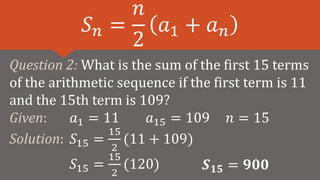
Question 2: What is the sum of the first 15 terms
of the arithmetic sequence if the first term is 11
and the 15th term is 109?
Given: 𝑎1 = 11 𝑎15 = 109 𝑛 = 15
Solution: 𝑆15 =
15
2
(11 + 109)
𝑆15 =
15
2
(120) 𝑺𝟏𝟓 = 𝟗𝟎𝟎
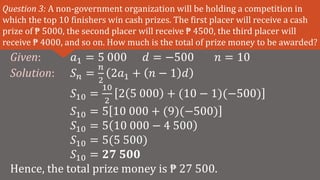
Given: 𝑎1 = 5 000 𝑑 = −500 𝑛 = 10
Solution: 𝑆𝑛 =
𝑛
2
2𝑎1 + 𝑛 − 1 𝑑
𝑆10 =
10
2
2 5 000 + (10 − 1)(−500)
𝑆10 = 5 10 000 + (9)(−500)
𝑆10 = 5 10 000 − 4 500
𝑆10 = 5(5 500)
𝑆10 = 𝟐𝟕 𝟓𝟎𝟎
Hence, the total prize money is ₱ 27 500.
Question 3: A non-government organization will be holding a competition in
which the top 10 finishers win cash prizes. The first placer will receive a cash
prize of ₱ 5000, the second placer will receive ₱ 4500, the third placer will
receive ₱ 4000, and so on. How much is the total of prize money to be awarded?
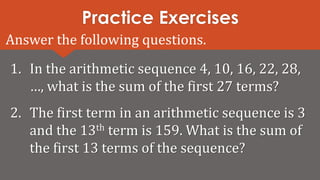
1. In the arithmetic sequence 4, 10, 16, 22, 28,
…, what is the sum of the first 27 terms?
2. The first term in an arithmetic sequence is 3
and the 13th term is 159. What is the sum of
the first 13 terms of the sequence?
Answer the following questions.
Practice Exercises
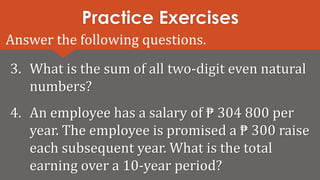
3. What is the sum of all two-digit even natural
numbers?
4. An employee has a salary of ₱ 304 800 per
year. The employee is promised a ₱ 300 raise
each subsequent year. What is the total
earning over a 10-year period?
Answer the following questions.
Practice Exercises
1. What are the 9 arithmetic means between 12
and 92?
2. What is 𝑎37 in the arithmetic sequence -9, -2,
5, 12, 19, … ?
Answer the following questions.
Activity
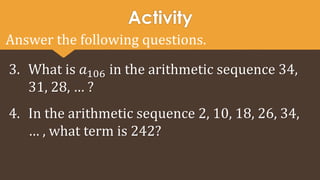
3. What is 𝑎106 in the arithmetic sequence 34,
31, 28, … ?
4. In the arithmetic sequence 2, 10, 18, 26, 34,
… , what term is 242?
Answer the following questions.
Activity
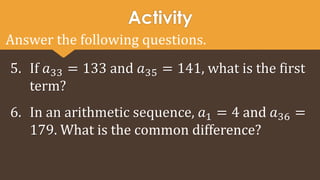
5. If 𝑎33 = 133 and 𝑎35 = 141, what is the first
term?
6. In an arithmetic sequence, 𝑎1 = 4 and 𝑎36 =
179. What is the common difference?
Answer the following questions.
Activity
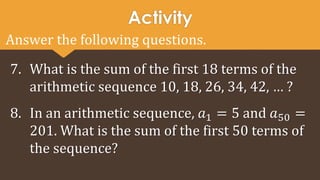
7. What is the sum of the first 18 terms of the
arithmetic sequence 10, 18, 26, 34, 42, … ?
8. In an arithmetic sequence, 𝑎1 = 5 and 𝑎50 =
201. What is the sum of the first 50 terms of
the sequence?
Answer the following questions.
Activity
9. What is the sum of all the odd integers from
1 to 99?
10.In a classroom of 40 students, each student
counts off by fours (i.e. 4, 8, 12, 16, …). What
is the sum of the students’ numbers?
Answer the following questions.
Activity