Semiconductor Fundamentals
Dr. M. Yousuf Soomro
Semiconductors Fundamentals
Course Outline
To understand the semiconductor materials that are
suitable for electronic devices
To study the properties of materials for electronic
devices
Semiconductor devices are fabricated using
specific materials has the desired physical
properties
Solid State Materials
Metals (conductor)
Insulators
Semiconductors
Superconductors
Metals
Materials with zero bandgap are metals
A metal has a partially filled conduction band, so there is
no energy gap between filled and unfilled regions.
A significant number of electrons can be excited by heat
into empty energy levels and move easily throughout the
material, allowing the material to conduct electricity
Insulators
Materials with an energy gap larger than 3 eV
An insulator possesses a considerable energy gap
between the valence band and the conduction band
It is difficult to excite electrons from the valence band to
the conduction band. As a result an insulator does not
conduct electricity
Semiconductor
Special class of materials having conductivity b/w that of
a good conductor and that of an insulator
A material with electrical resistivity lying in the range of
10-2 – 109 Ω.cm
Material whose energy gap for electronic excitations lies
between zero and about 4 electron volts (eV).
a small number of electrons from the valence band can be
promoted to the conduction band by an energy input (e.g.
thermal energy from heat)
Semiconductor
Classification of Semiconductor materials
oElemental semiconductor
oCompound semiconductor
oNarrow band-gap semiconductor
oWide band-gap semiconductor
oOxide semiconductor
oMagnetic semiconductor
oOrganic semiconductor
oLow dimension semiconductor
Semiconductor
Elemental semiconductor
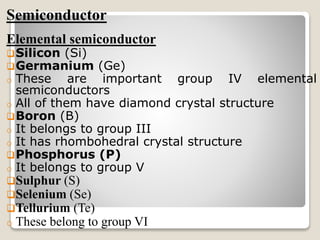
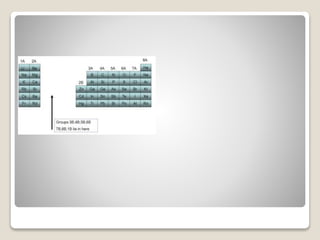
Silicon (Si)
Germanium (Ge)
o These are important group IV elemental
semiconductors
o All of them have diamond crystal structure
Boron (B)
o It belongs to group III
o It has rhombohedral crystal structure
Phosphorus (P)
o It belongs to group V
Sulphur (S)
Selenium (Se)
Tellurium (Te)
o These belong to group VI
Semiconductor
 Elemental semiconductor
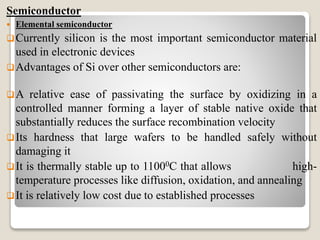
Currently silicon is the most important semiconductor material
used in electronic devices
Advantages of Si over other semiconductors are:
A relative ease of passivating the surface by oxidizing in a
controlled manner forming a layer of stable native oxide that
substantially reduces the surface recombination velocity
Its hardness that large wafers to be handled safely without
damaging it
It is thermally stable up to 11000C that allows high-
temperature processes like diffusion, oxidation, and annealing
It is relatively low cost due to established processes
Semiconductor
 Elemental semiconductor
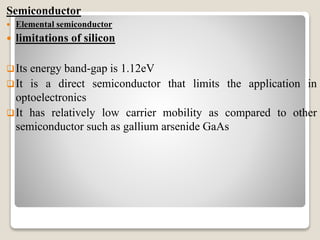
 limitations of silicon
Its energy band-gap is 1.12eV
It is a direct semiconductor that limits the application in
optoelectronics
It has relatively low carrier mobility as compared to other
semiconductor such as gallium arsenide GaAs
Semiconductor
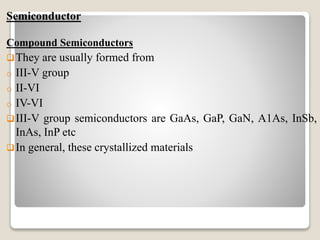
Compound Semiconductors
They are usually formed from
o III-V group
o II-VI
o IV-VI
III-V group semiconductors are GaAs, GaP, GaN, A1As, InSb,
InAs, InP etc
In general, these crystallized materials
Semiconductor
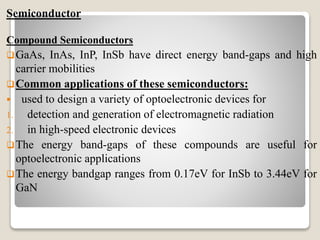
Compound Semiconductors
GaAs, InAs, InP, InSb have direct energy band-gaps and high
carrier mobilities
Common applications of these semiconductors:
 used to design a variety of optoelectronic devices for
1. detection and generation of electromagnetic radiation
2. in high-speed electronic devices
The energy band-gaps of these compounds are useful for
optoelectronic applications
The energy bandgap ranges from 0.17eV for InSb to 3.44eV for
GaN
Semiconductor
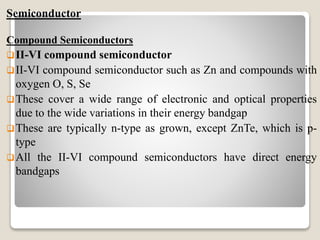
Compound Semiconductors
II-VI compound semiconductor
II-VI compound semiconductor such as Zn and compounds with
oxygen O, S, Se
These cover a wide range of electronic and optical properties
due to the wide variations in their energy bandgap
These are typically n-type as grown, except ZnTe, which is p-
type
All the II-VI compound semiconductors have direct energy
bandgaps
Semiconductor
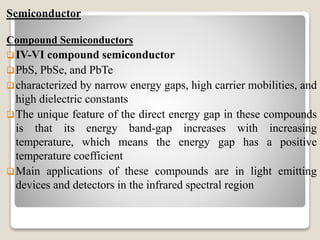
Compound Semiconductors
IV-VI compound semiconductor
PbS, PbSe, and PbTe
characterized by narrow energy gaps, high carrier mobilities, and
high dielectric constants
The unique feature of the direct energy gap in these compounds
is that its energy band-gap increases with increasing
temperature, which means the energy gap has a positive
temperature coefficient
Main applications of these compounds are in light emitting
devices and detectors in the infrared spectral region
Semiconductor
Narrow Band-gap Semiconductor
 InSb
 InAs
 PbSe
 PbTe
 PbS
They have the energy band-gap below about 0.5eV
they are direct semiconductor materials
extensively employed in:
infrared optoelectronic device applications as detectors and
diode lasers
Semiconductor
Wide Band-gap Semiconductor
 SiC
 II-V nitrides
high thermal conductivity
high saturation electron drift velocity
high breakdown electric field
superior chemical stability
physical stability
It has wide band-gap that enables detection and emission of light
in short-wavelength region likes blue and ultraviolet
Semiconductor
Oxide Semiconductor
 Cu2O
 Bi2O
 ZnO
These are also referred as semiconductor ceramics
They are used in electronic devices and sensors
Semiconductor
Magnetic Semiconductor
Semiconductor compound that contains magnetic ions such as
Cr, Mn, Fe, Co, Ni, may exhibit magnetic properties
Some oxides such as FeO and NiO exhibit antiferromagnetic
properties and oxide such as europium oxide EuO is
ferromagnetic properties
The semiconductor exhibits large magneto-optical effect that can
be used to design optical modulators
Semiconductor
Organic Semiconductor
 Anthracene CH14H10
 Polyacetylene (CH)n
 advantages of organic semiconductors
1. Diversity
2. relative ease of changing their properties to specific
application
Semiconductor
Organic Semiconductor
One of the promising applications of organi semiconductors is in
less iexpensive light emitting diode, covering whole the
spectrum of colors
The main advantages of organic materials in such applications
include
I. low operating voltages
II. color tunability
III. relative simplicity of device fabrication

Semiconductor fundamentals

  • 1.
    Semiconductor Fundamentals Dr. M.Yousuf Soomro Semiconductors Fundamentals
  • 2.
    Course Outline To understandthe semiconductor materials that are suitable for electronic devices To study the properties of materials for electronic devices Semiconductor devices are fabricated using specific materials has the desired physical properties
  • 3.
    Solid State Materials Metals(conductor) Insulators Semiconductors Superconductors
  • 4.
    Metals Materials with zerobandgap are metals A metal has a partially filled conduction band, so there is no energy gap between filled and unfilled regions. A significant number of electrons can be excited by heat into empty energy levels and move easily throughout the material, allowing the material to conduct electricity
  • 5.
    Insulators Materials with anenergy gap larger than 3 eV An insulator possesses a considerable energy gap between the valence band and the conduction band It is difficult to excite electrons from the valence band to the conduction band. As a result an insulator does not conduct electricity
  • 6.
    Semiconductor Special class ofmaterials having conductivity b/w that of a good conductor and that of an insulator A material with electrical resistivity lying in the range of 10-2 – 109 Ω.cm Material whose energy gap for electronic excitations lies between zero and about 4 electron volts (eV). a small number of electrons from the valence band can be promoted to the conduction band by an energy input (e.g. thermal energy from heat)
  • 7.
    Semiconductor Classification of Semiconductormaterials oElemental semiconductor oCompound semiconductor oNarrow band-gap semiconductor oWide band-gap semiconductor oOxide semiconductor oMagnetic semiconductor oOrganic semiconductor oLow dimension semiconductor
  • 8.
    Semiconductor Elemental semiconductor Silicon (Si) Germanium(Ge) o These are important group IV elemental semiconductors o All of them have diamond crystal structure Boron (B) o It belongs to group III o It has rhombohedral crystal structure Phosphorus (P) o It belongs to group V Sulphur (S) Selenium (Se) Tellurium (Te) o These belong to group VI
  • 10.
    Semiconductor  Elemental semiconductor Currentlysilicon is the most important semiconductor material used in electronic devices Advantages of Si over other semiconductors are: A relative ease of passivating the surface by oxidizing in a controlled manner forming a layer of stable native oxide that substantially reduces the surface recombination velocity Its hardness that large wafers to be handled safely without damaging it It is thermally stable up to 11000C that allows high- temperature processes like diffusion, oxidation, and annealing It is relatively low cost due to established processes
  • 11.
    Semiconductor  Elemental semiconductor limitations of silicon Its energy band-gap is 1.12eV It is a direct semiconductor that limits the application in optoelectronics It has relatively low carrier mobility as compared to other semiconductor such as gallium arsenide GaAs
  • 12.
    Semiconductor Compound Semiconductors They areusually formed from o III-V group o II-VI o IV-VI III-V group semiconductors are GaAs, GaP, GaN, A1As, InSb, InAs, InP etc In general, these crystallized materials
  • 13.
    Semiconductor Compound Semiconductors GaAs, InAs,InP, InSb have direct energy band-gaps and high carrier mobilities Common applications of these semiconductors:  used to design a variety of optoelectronic devices for 1. detection and generation of electromagnetic radiation 2. in high-speed electronic devices The energy band-gaps of these compounds are useful for optoelectronic applications The energy bandgap ranges from 0.17eV for InSb to 3.44eV for GaN
  • 14.
    Semiconductor Compound Semiconductors II-VI compoundsemiconductor II-VI compound semiconductor such as Zn and compounds with oxygen O, S, Se These cover a wide range of electronic and optical properties due to the wide variations in their energy bandgap These are typically n-type as grown, except ZnTe, which is p- type All the II-VI compound semiconductors have direct energy bandgaps
  • 15.
    Semiconductor Compound Semiconductors IV-VI compoundsemiconductor PbS, PbSe, and PbTe characterized by narrow energy gaps, high carrier mobilities, and high dielectric constants The unique feature of the direct energy gap in these compounds is that its energy band-gap increases with increasing temperature, which means the energy gap has a positive temperature coefficient Main applications of these compounds are in light emitting devices and detectors in the infrared spectral region
  • 16.
    Semiconductor Narrow Band-gap Semiconductor InSb  InAs  PbSe  PbTe  PbS They have the energy band-gap below about 0.5eV they are direct semiconductor materials extensively employed in: infrared optoelectronic device applications as detectors and diode lasers
  • 17.
    Semiconductor Wide Band-gap Semiconductor SiC  II-V nitrides high thermal conductivity high saturation electron drift velocity high breakdown electric field superior chemical stability physical stability It has wide band-gap that enables detection and emission of light in short-wavelength region likes blue and ultraviolet
  • 18.
    Semiconductor Oxide Semiconductor  Cu2O Bi2O  ZnO These are also referred as semiconductor ceramics They are used in electronic devices and sensors
  • 19.
    Semiconductor Magnetic Semiconductor Semiconductor compoundthat contains magnetic ions such as Cr, Mn, Fe, Co, Ni, may exhibit magnetic properties Some oxides such as FeO and NiO exhibit antiferromagnetic properties and oxide such as europium oxide EuO is ferromagnetic properties The semiconductor exhibits large magneto-optical effect that can be used to design optical modulators
  • 20.
    Semiconductor Organic Semiconductor  AnthraceneCH14H10  Polyacetylene (CH)n  advantages of organic semiconductors 1. Diversity 2. relative ease of changing their properties to specific application
  • 21.
    Semiconductor Organic Semiconductor One ofthe promising applications of organi semiconductors is in less iexpensive light emitting diode, covering whole the spectrum of colors The main advantages of organic materials in such applications include I. low operating voltages II. color tunability III. relative simplicity of device fabrication