SEMICONDUCTOR MATERIALS
Definition of semi-conductor:
“Semiconductors are the materials which have a conductivity between conductors
(generally metal) and insulators (such as ceramics).”
Semiconductors can be compounds such as gallium arsenide or pure elements such as
germanium or silicon.
Examples of semiconductors:
Gallium arsenide, germanium and silicon are some of the most commonly used
semiconductors.
Silicon is used in electronic circuit fabrication and gallium arsenide is used in solar cells, laser
diodes etc.
SEMICONDUCTOR MATERIALS
Holes & Electrons in semiconductors:
Holes and electrons are the types of charge carriers accountable for the flow of current in
semiconductors.
Holes (valence electrons) are the positively charged electric charge carrier whereas electrons
are the negatively charged particles.
Both electrons and holes are equal in magnitude but opposite in polarity.
SEMICONDUCTOR MATERIALS
Band Theory Of Semiconductors:
The introduction of band theory happened during the quantum revolution science. Walter
Heitler and Fritz London discovered the energy bands.
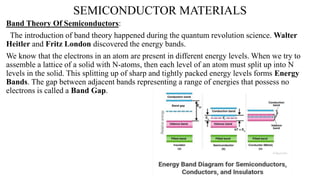
We know that the electrons in an atom are present in different energy levels. When we try to
assemble a lattice of a solid with N-atoms, then each level of an atom must split up into N
levels in the solid. This splitting up of sharp and tightly packed energy levels forms Energy
Bands. The gap between adjacent bands representing a range of energies that possess no
electrons is called a Band Gap.
SEMICONDUCTOR MATERIALS
Conduction Band & Valence Bond in Semiconductor:
1)Conduction Band:
It is the lowest unoccupied band that includes the energy levels of positive (holes) or negative
(free electrons) charge carriers. It has conducting electrons resulting in the flow of current.
The conduction band possess high energy level and are generally empty. The conduction band
in semiconductors accepts the electrons from the valence band.
2)Valence Band:
The energy band involving the energy levels of valence electrons is known as the valence
band. It is the highest occupied energy band. When compared with insulators, the bandgap in
semiconductors is smaller. It allows the electrons in the valence band to jump into the
conduction band on receiving any external energy.
SEMICONDUCTOR MATERIALS
Fermi Level in Semiconductors:
Fermi level denoted by EF is present between the valence band and conduction band. It is the
highest occupied molecular orbital at absolute zero. The charge carriers in this state have their
own quantum states and generally do not interact with each other. When the temperature rises
above absolute zero, these charge carriers will begin to occupy states above FERMI LEVEL.
In a p-type semiconductor, there is an increase in the density of unfiled states. Thus, more
electrons at the lower energy levels.
However, in an n-type semiconductors, the density of states increase, therefore,
accommodating more electrons at higher energy levels.
SEMICONDUCTOR MATERIALS
Types of Semiconductors:
Semiconductors can be classified as;
›Intrinsic Semiconductor
›Extrinsic Semiconductor
SEMICONDUCTOR MATERIALS
Intrinsic Semiconductor:
An intrinsic type of semiconductor material is made up of only a single type of element.
SEMICONDUCTOR MATERIALS
Germanium (Ge) and Silicon (Si) are the most common type of intrinsic semiconductor
material. They have 4-valence electrons (tetravalent). They are bound to the atom by covalent
bond at absolute zero temperature.
When the temperature rises, due to collisions, few electrons are unbounded and become free to
move through the lattice, thus creating an absence in its original position (hole). These free
electrons and holes contribute to the conduction of electricity in the semiconductor. The
negative and positive charge carriers are equal in number.
SEMICONDUCTOR MATERIALS
Energy diagram of intrinsic semiconductor:
The energy diagram of an intrinsic semiconductor is shown below. In intrinsic semiconductors,
current flows due to the motion of free electrons as well as
Holes. The total current is the sum of the electron current
𝐈𝐞 due to thermally generated electrons and the hole
current 𝐈𝐡. The total current (I)=𝐈𝐞 + 𝐈𝐡
For an intrinsic semiconductor at finite temperature, the
probability of electrons to exist in conduction band dec-
reases with increasing bandgap.
𝐧 = 𝐧𝟎𝐞
−𝐄𝐠
𝟐
.𝐊𝐛.𝐓
Where:
𝑬𝒈= Energy bandgap ; 𝑲𝒃= Boltzmann’s law
SEMICONDUCTOR MATERIALS
Extrinsic Semiconductor:
The conductivity of semiconductors can be greatly improved by introducing a small number of
suitable replacement atoms called impurities. The process of adding impurity atoms to the pure
semiconductor is called doping.
Usually only 1-atom in 𝟏𝟎𝟕 is replaced by a dopant atom in the doped semiconductor.
SEMICONDUCTOR MATERIALS
Extrinsic Semiconductor can be further classified into;
›N-type semiconductor
›P-type semiconductor
N-type semiconductor P-type semiconductor
Mainly due to electrons Mainly due to holes
𝐈 = 𝐈𝐡 & 𝐧𝐡 ≫ 𝐧𝐞 𝐈 = 𝐈𝐡 & 𝐧𝐡 ≫ 𝐧𝐞
Majority of electrons Majority of holes
Minority of holes Minority of electrons
SEMICONDUCTOR MATERIALS
Properties of Semiconductor:
i)Semiconductor can conduct electricity under preferable conditions.
ii)For unlike conductors, the charge carriers in semiconductors arise only because of external
energy.
iii)It causes a certain number of valence electrons to cross the energy gap and jump into the
conduction band, leaving an equal amount of unoccupied energy states, i.e holes.
iv)Semiconductor acts like an insulator at zero kelvin. On increasing the temperature, it works
as a conductor.
v)Due to exceptional electrical properties, semiconductors can be modified by doping to make
semiconductor device suitable for energy conversion, switches and amplifiers.
vi)Lesser power losses.
vii)The resistance of Semiconductor materials decreases with the increase in temperature and
vice-versa.
SEMICONDUCTOR MATERIALS
Resistivity of semiconductors go down with temperature why?
The difference in resistivity between conductors and semiconductors is due to their difference
in charge carrier density.
The resistivity of semiconductors decreases with temperature because the number of charge
carriers increases rapidly with increase in temperature, making the fractional change i.e. the
temperature coefficient negative.
SEMICONDUCTOR MATERIALS
Uses of semiconductors:
›Temperature sensors are made with semiconductor devices.
›They are used in 3D printing machines.
›Used in microchips and self driving cars.
›Used in calculators, solar plates, computer and other electronic devices.
›Transistors and MOSFET used as a switch in electrical circuits are manufacturing using in
semiconductors.

Semi conductor materials.pptx

  • 1.
    SEMICONDUCTOR MATERIALS Definition ofsemi-conductor: “Semiconductors are the materials which have a conductivity between conductors (generally metal) and insulators (such as ceramics).” Semiconductors can be compounds such as gallium arsenide or pure elements such as germanium or silicon. Examples of semiconductors: Gallium arsenide, germanium and silicon are some of the most commonly used semiconductors. Silicon is used in electronic circuit fabrication and gallium arsenide is used in solar cells, laser diodes etc.
  • 2.
    SEMICONDUCTOR MATERIALS Holes &Electrons in semiconductors: Holes and electrons are the types of charge carriers accountable for the flow of current in semiconductors. Holes (valence electrons) are the positively charged electric charge carrier whereas electrons are the negatively charged particles. Both electrons and holes are equal in magnitude but opposite in polarity.
  • 3.
    SEMICONDUCTOR MATERIALS Band TheoryOf Semiconductors: The introduction of band theory happened during the quantum revolution science. Walter Heitler and Fritz London discovered the energy bands. We know that the electrons in an atom are present in different energy levels. When we try to assemble a lattice of a solid with N-atoms, then each level of an atom must split up into N levels in the solid. This splitting up of sharp and tightly packed energy levels forms Energy Bands. The gap between adjacent bands representing a range of energies that possess no electrons is called a Band Gap.
  • 4.
    SEMICONDUCTOR MATERIALS Conduction Band& Valence Bond in Semiconductor: 1)Conduction Band: It is the lowest unoccupied band that includes the energy levels of positive (holes) or negative (free electrons) charge carriers. It has conducting electrons resulting in the flow of current. The conduction band possess high energy level and are generally empty. The conduction band in semiconductors accepts the electrons from the valence band. 2)Valence Band: The energy band involving the energy levels of valence electrons is known as the valence band. It is the highest occupied energy band. When compared with insulators, the bandgap in semiconductors is smaller. It allows the electrons in the valence band to jump into the conduction band on receiving any external energy.
  • 5.
    SEMICONDUCTOR MATERIALS Fermi Levelin Semiconductors: Fermi level denoted by EF is present between the valence band and conduction band. It is the highest occupied molecular orbital at absolute zero. The charge carriers in this state have their own quantum states and generally do not interact with each other. When the temperature rises above absolute zero, these charge carriers will begin to occupy states above FERMI LEVEL. In a p-type semiconductor, there is an increase in the density of unfiled states. Thus, more electrons at the lower energy levels. However, in an n-type semiconductors, the density of states increase, therefore, accommodating more electrons at higher energy levels.
  • 6.
    SEMICONDUCTOR MATERIALS Types ofSemiconductors: Semiconductors can be classified as; ›Intrinsic Semiconductor ›Extrinsic Semiconductor
  • 7.
    SEMICONDUCTOR MATERIALS Intrinsic Semiconductor: Anintrinsic type of semiconductor material is made up of only a single type of element.
  • 8.
    SEMICONDUCTOR MATERIALS Germanium (Ge)and Silicon (Si) are the most common type of intrinsic semiconductor material. They have 4-valence electrons (tetravalent). They are bound to the atom by covalent bond at absolute zero temperature. When the temperature rises, due to collisions, few electrons are unbounded and become free to move through the lattice, thus creating an absence in its original position (hole). These free electrons and holes contribute to the conduction of electricity in the semiconductor. The negative and positive charge carriers are equal in number.
  • 9.
    SEMICONDUCTOR MATERIALS Energy diagramof intrinsic semiconductor: The energy diagram of an intrinsic semiconductor is shown below. In intrinsic semiconductors, current flows due to the motion of free electrons as well as Holes. The total current is the sum of the electron current 𝐈𝐞 due to thermally generated electrons and the hole current 𝐈𝐡. The total current (I)=𝐈𝐞 + 𝐈𝐡 For an intrinsic semiconductor at finite temperature, the probability of electrons to exist in conduction band dec- reases with increasing bandgap. 𝐧 = 𝐧𝟎𝐞 −𝐄𝐠 𝟐 .𝐊𝐛.𝐓 Where: 𝑬𝒈= Energy bandgap ; 𝑲𝒃= Boltzmann’s law
  • 10.
    SEMICONDUCTOR MATERIALS Extrinsic Semiconductor: Theconductivity of semiconductors can be greatly improved by introducing a small number of suitable replacement atoms called impurities. The process of adding impurity atoms to the pure semiconductor is called doping. Usually only 1-atom in 𝟏𝟎𝟕 is replaced by a dopant atom in the doped semiconductor.
  • 11.
    SEMICONDUCTOR MATERIALS Extrinsic Semiconductorcan be further classified into; ›N-type semiconductor ›P-type semiconductor N-type semiconductor P-type semiconductor Mainly due to electrons Mainly due to holes 𝐈 = 𝐈𝐡 & 𝐧𝐡 ≫ 𝐧𝐞 𝐈 = 𝐈𝐡 & 𝐧𝐡 ≫ 𝐧𝐞 Majority of electrons Majority of holes Minority of holes Minority of electrons
  • 12.
    SEMICONDUCTOR MATERIALS Properties ofSemiconductor: i)Semiconductor can conduct electricity under preferable conditions. ii)For unlike conductors, the charge carriers in semiconductors arise only because of external energy. iii)It causes a certain number of valence electrons to cross the energy gap and jump into the conduction band, leaving an equal amount of unoccupied energy states, i.e holes. iv)Semiconductor acts like an insulator at zero kelvin. On increasing the temperature, it works as a conductor. v)Due to exceptional electrical properties, semiconductors can be modified by doping to make semiconductor device suitable for energy conversion, switches and amplifiers. vi)Lesser power losses. vii)The resistance of Semiconductor materials decreases with the increase in temperature and vice-versa.
  • 13.
    SEMICONDUCTOR MATERIALS Resistivity ofsemiconductors go down with temperature why? The difference in resistivity between conductors and semiconductors is due to their difference in charge carrier density. The resistivity of semiconductors decreases with temperature because the number of charge carriers increases rapidly with increase in temperature, making the fractional change i.e. the temperature coefficient negative.
  • 14.
    SEMICONDUCTOR MATERIALS Uses ofsemiconductors: ›Temperature sensors are made with semiconductor devices. ›They are used in 3D printing machines. ›Used in microchips and self driving cars. ›Used in calculators, solar plates, computer and other electronic devices. ›Transistors and MOSFET used as a switch in electrical circuits are manufacturing using in semiconductors.