
SEMICONDUCTORS
Rakesh Huike (7744)
Eric Paul (7745)
 Semiconductor is a material with controllable conductivities ,
intermediate between conductors and insulators.
 They conduct electricity better than insulators but not as well as
conductors.
 As the elctrons are in bound state at low temperatures the
semiconductors behave like insulators at absolute zero
temperature and develop significant conductivities at room
temperature.
 Semiconductors require energy less than insulators and more than
good conductors to remove an electron from the parent atom for
conductivity.
 The semiconductor materials contain limited number of free electrons
that can act as a negative charge carriers.
In addition, the vacancies left behind when electrons leave their
normal positions act as carriers of positive charge . These vacancies
are called holes.
Semiconductor material mostly used are :
1. Silicon (most common)
2. Germanium
3. Selenium
4. Indium
5. Gallium
some oxides like:
1. Gallium phosphide
2. Aluminium phosphide
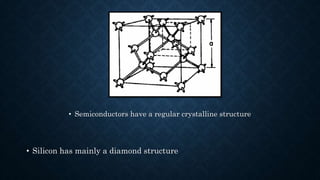
• Semiconductors have a regular crystalline structure
• Silicon has mainly a diamond structure
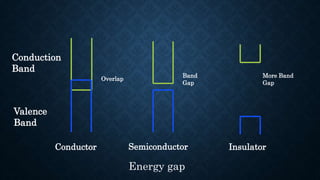
Conduction
Band
Valence
Band
Conductor Semiconductor Insulator
Overlap
Band
Gap
More Band
Gap
Energy gap
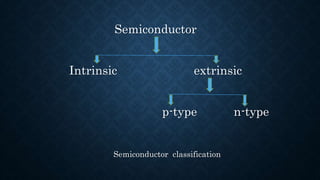
Semiconductor
Intrinsic extrinsic
p-type n-type
Semiconductor classification
• Intrinsic semiconductor
Intrinsic conductor is a conductor having conductivity caused due to ejection
of an electron from a covalent bond.
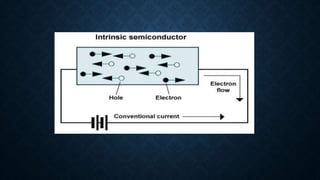
Ejected electrons leave holes (i.e vacancies) in the bond, both the electron
ejected and the vacancies contribute in conduction .
Intrinsic semiconductors are the pure type of semiconductors.
An intrinsic semiconductor has a filled valance band at about 0° k and
completely empty conduction band . As a result behaves like a insulator.
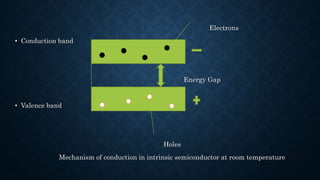
Electrons
• Conduction band
Energy Gap
• Valence band
Holes
Mechanism of conduction in intrinsic semiconductor at room temperature
Extrinsic semiconductor
 Extrinsic semiconductors are conductors which conduct due to excess or
conduction electron provided by an impurity added by DOPING .
 The impurities added provide an extra electron for conduction .
In extrinsic semiconductors there are 2 types ;
1. n-type extrinsic semiconductor
2. p-type extrinsic semiconductor
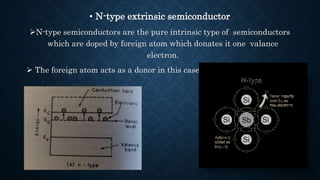
• N-type extrinsic semiconductor
N-type semiconductors are the pure intrinsic type of semiconductors
which are doped by foreign atom which donates it one valance
electron.
 The foreign atom acts as a donor in this case.
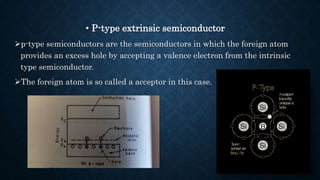
• P-type extrinsic semiconductor
p-type semiconductors are the semiconductors in which the foreign atom
provides an excess hole by accepting a valence electron from the intrinsic
type semiconductor.
The foreign atom is so called a acceptor in this case.
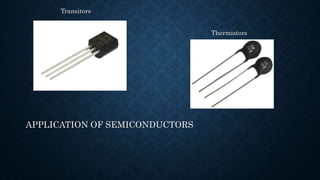
Transitors
Thermistors
APPLICATION OF SEMICONDUCTORS
CONCLUSION…..
• The semiconductors are totally temperature dependent .As
temperature decreases it looses its conductivity ( i.e behaves like a
insulator) and behaves like a conductor around the room
temperatures.
Needs to be operated nearly to room temperatures for good
conductivity more than the insulators.
REFERENCES….
Material Science And Technology……….By O.P. Khanna
Thank you..

Semiconductors

  • 1.
  • 2.
     Semiconductor isa material with controllable conductivities , intermediate between conductors and insulators.  They conduct electricity better than insulators but not as well as conductors.  As the elctrons are in bound state at low temperatures the semiconductors behave like insulators at absolute zero temperature and develop significant conductivities at room temperature.
  • 3.
     Semiconductors requireenergy less than insulators and more than good conductors to remove an electron from the parent atom for conductivity.  The semiconductor materials contain limited number of free electrons that can act as a negative charge carriers. In addition, the vacancies left behind when electrons leave their normal positions act as carriers of positive charge . These vacancies are called holes.
  • 4.
    Semiconductor material mostlyused are : 1. Silicon (most common) 2. Germanium 3. Selenium 4. Indium 5. Gallium some oxides like: 1. Gallium phosphide 2. Aluminium phosphide
  • 5.
    • Semiconductors havea regular crystalline structure • Silicon has mainly a diamond structure
  • 6.
  • 7.
  • 8.
    • Intrinsic semiconductor Intrinsicconductor is a conductor having conductivity caused due to ejection of an electron from a covalent bond. Ejected electrons leave holes (i.e vacancies) in the bond, both the electron ejected and the vacancies contribute in conduction . Intrinsic semiconductors are the pure type of semiconductors. An intrinsic semiconductor has a filled valance band at about 0° k and completely empty conduction band . As a result behaves like a insulator.
  • 9.
    Electrons • Conduction band EnergyGap • Valence band Holes Mechanism of conduction in intrinsic semiconductor at room temperature
  • 11.
    Extrinsic semiconductor  Extrinsicsemiconductors are conductors which conduct due to excess or conduction electron provided by an impurity added by DOPING .  The impurities added provide an extra electron for conduction . In extrinsic semiconductors there are 2 types ; 1. n-type extrinsic semiconductor 2. p-type extrinsic semiconductor
  • 12.
    • N-type extrinsicsemiconductor N-type semiconductors are the pure intrinsic type of semiconductors which are doped by foreign atom which donates it one valance electron.  The foreign atom acts as a donor in this case.
  • 13.
    • P-type extrinsicsemiconductor p-type semiconductors are the semiconductors in which the foreign atom provides an excess hole by accepting a valence electron from the intrinsic type semiconductor. The foreign atom is so called a acceptor in this case.
  • 14.
  • 15.
    CONCLUSION….. • The semiconductorsare totally temperature dependent .As temperature decreases it looses its conductivity ( i.e behaves like a insulator) and behaves like a conductor around the room temperatures. Needs to be operated nearly to room temperatures for good conductivity more than the insulators.
  • 16.
    REFERENCES…. Material Science AndTechnology……….By O.P. Khanna
  • 17.