E-COMMERCE
Electronic Payment System
Himadri Shekhar
BBA V
WARNING!
 Please maintain silence and decorum!
 Madam is here.
ELECTRONIC PAYMENT SYSTEM
CAN BE DEFINED AS:-
Electronic Payment system is a financial
exchange that takes place online between
buyers and sellers. The content of this
exchange is usually some form of digital
financial instrument {such as encrypted
credit card numbers, electronic cheques
or digital cash) that is backed by a bank or
an intermediary, or by a legal tender.
Why EPS:‐
• Reduced operational and processing cost.
• Technology facilitates real time settlements reducing the transit
time drastically.
• Increasing online commerce.
• Technology ensures utmost accuracy of amount as well as
beneficiary of the transactions.
• Reduced paper work.
• Technology makes life easy & hazard free.
• Security & safety.
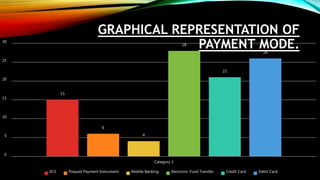
GRAPHICAL REPRESENTATION OF
PAYMENT MODE.
15
6
4
28
21
26
0
5
10
15
20
25
30
Category 1
ECS Prepaid Payment Instrument Mobile Banking Electronic Fund Transfer Credit Card Debit Card
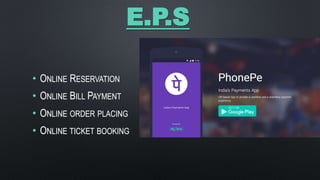
E.P.S
• ONLINE RESERVATION
• ONLINE BILL PAYMENT
• ONLINE ORDER PLACING
• ONLINE TICKET BOOKING
Two Storage Methods:
• On-line:-
1. Individual does not have possession personally of electronic
cash.
2. Trusted third party, e.g. online bank, holds customers’ cash
accounts.
• Off-line:-
1. Customer holds cash on smart card or software wallet.
2. Fraud and double spending require tamper-proof encryption.
The hackers way
• The hacker can impersonate the merchant or make a bogus Web site. The consumer
does not notice this and sends the order and credit information directly to the hacker.
• Another scenario exists where the hacker installs a key-logger on the device of the
consumer, logging all information typed on the keyboard, including account holder
information including the payment card number.
• The hacker observes the communication between the cardholder and the merchant.
Transmitting credit card information on the network without encryption, allows the hacker
to read this information.
• The hacker can penetrate the merchant’s e-commerce environment and steal
information in the database.
ADD A SLIDE TITLE - 3
E-Cash
1. A system that allows a person to pay for goods or services by
transmitting a number from one computer to another.
2. Like the serial numbers on real currency notes, the E-cash numbers
are unique.
3. This is issued by a bank and represents a specified sum of real
money.
4. It is anonymous and reusable.
E-Cash Security
 Complex cryptographic algorithms prevent double spending .
• Anonymity is preserved unless double spending is attempted .
 Serial numbers can allow tracing to prevent money laundering.
E-WALLET The E-wallet is another payment scheme that operates like a carrier of e-cash and
other information.
 The aim is to give shoppers a single, simple, and secure way of carrying currency
electronically.
 Trust is the basis of the e-wallet as a form of electronic payment.
Procedure for using an e-wallet
1. Decide on an online site where you would like to shop.
2. Download a wallet from the merchant’s website.
3. Fill out personal information such as your credit card number, name, address and
phone number, and where merchandise should be shipped.
4. When you are ready to buy, click on the wallet button, the buying process is fully
executed.
Smart Cards/ debit card
– A smart card, is any pocket-sized card with embedded
integrated circuits which can process data.
– This implies that it can receive input which is processed and
delivered as an output.
Smart Card Processing
– User opens account and receive smart card.
– User downloads token onto card.
– User inserts card in reader.
– Tokens are transferred from user card to vendor.
– Goods delivered.
– Vendor redeem tokens.
Credit cards
• It is a Plastic Card having a Magnetic Number and code on it.
• It has Some fixed amount to spend.
• Customer has to repay the spend amount after sometime.
Processing a Credit cards payment
Customer
Internet
Merchant website
Bank networks
Merchant bank
Risk in using Credit cards:
 Operational risk
 Credit risk
 Legal risk
Secure Electronic Transaction (SET) Protocol
 Jointly designed by MasterCard and Visa with backing of Microsoft, Netscape, IBM, GTE, SAIC,
and others.
 Designed to provide security for card payments as they travel on the Internet.
 Contrasted with Secure Socket Layers (SSL) protocol, SET validates consumers and merchants
in addition to providing secure transmission.
 SET specification
 Uses public key cryptography and digital certificates for validating both consumers and
merchants.
 Provides privacy, data integrity, user and merchant authentication, and consumer nonrepudiation
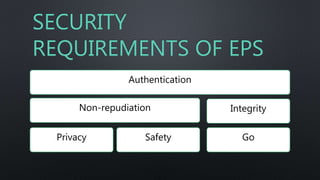
SECURITY
REQUIREMENTS OF EPS
Authentication
Non-repudiation
Privacy Safety
Integrity
Go
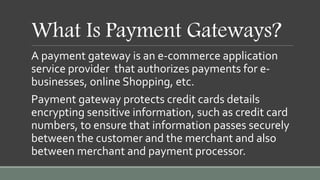
What Is Payment Gateways?
A payment gateway is an e-commerce application
service provider that authorizes payments for e-
businesses, online Shopping, etc.
Payment gateway protects credit cards details
encrypting sensitive information, such as credit card
numbers, to ensure that information passes securely
between the customer and the merchant and also
between merchant and payment processor.
E-PAYMENT SYSTEM
IN INDIA
I. Ever-increasing technology changes.
II. Growing Internet access and mobile subscriber base.
III. Rising consumer confidence.
IV. Convenient delivery/payment models.
V. India has been one of the fastest growing country for
payment cards in the Asia-Pacific region.
VI. India currently has approximately 130 million cards
(both debit and credit) in circulation.
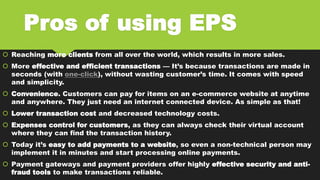
Pros of using EPS
 Reaching more clients from all over the world, which results in more sales.
 More effective and efficient transactions — It’s because transactions are made in
seconds (with one-click), without wasting customer’s time. It comes with speed
and simplicity.
 Convenience. Customers can pay for items on an e-commerce website at anytime
and anywhere. They just need an internet connected device. As simple as that!
 Lower transaction cost and decreased technology costs.
 Expenses control for customers, as they can always check their virtual account
where they can find the transaction history.
 Today it’s easy to add payments to a website, so even a non-technical person may
implement it in minutes and start processing online payments.
 Payment gateways and payment providers offer highly effective security and anti-
fraud tools to make transactions reliable.
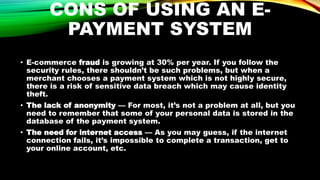
CONS OF USING AN E-
PAYMENT SYSTEM
• E-commerce fraud is growing at 30% per year. If you follow the
security rules, there shouldn’t be such problems, but when a
merchant chooses a payment system which is not highly secure,
there is a risk of sensitive data breach which may cause identity
theft.
• The lack of anonymity — For most, it’s not a problem at all, but you
need to remember that some of your personal data is stored in the
database of the payment system.
• The need for internet access — As you may guess, if the internet
connection fails, it’s impossible to complete a transaction, get to
your online account, etc.
KNOWLEDGE IS HAVING THE RIGHT ANSWER,
INTELLIGENCE IS ASKING THE RIGHT QUESTION.
Thank you.

E commerce

  • 1.
  • 2.
    WARNING!  Please maintainsilence and decorum!  Madam is here.
  • 3.
    ELECTRONIC PAYMENT SYSTEM CANBE DEFINED AS:- Electronic Payment system is a financial exchange that takes place online between buyers and sellers. The content of this exchange is usually some form of digital financial instrument {such as encrypted credit card numbers, electronic cheques or digital cash) that is backed by a bank or an intermediary, or by a legal tender.
  • 4.
    Why EPS:‐ • Reducedoperational and processing cost. • Technology facilitates real time settlements reducing the transit time drastically. • Increasing online commerce. • Technology ensures utmost accuracy of amount as well as beneficiary of the transactions. • Reduced paper work. • Technology makes life easy & hazard free. • Security & safety.
  • 5.
    GRAPHICAL REPRESENTATION OF PAYMENTMODE. 15 6 4 28 21 26 0 5 10 15 20 25 30 Category 1 ECS Prepaid Payment Instrument Mobile Banking Electronic Fund Transfer Credit Card Debit Card
  • 6.
    E.P.S • ONLINE RESERVATION •ONLINE BILL PAYMENT • ONLINE ORDER PLACING • ONLINE TICKET BOOKING
  • 7.
    Two Storage Methods: •On-line:- 1. Individual does not have possession personally of electronic cash. 2. Trusted third party, e.g. online bank, holds customers’ cash accounts. • Off-line:- 1. Customer holds cash on smart card or software wallet. 2. Fraud and double spending require tamper-proof encryption.
  • 8.
    The hackers way •The hacker can impersonate the merchant or make a bogus Web site. The consumer does not notice this and sends the order and credit information directly to the hacker. • Another scenario exists where the hacker installs a key-logger on the device of the consumer, logging all information typed on the keyboard, including account holder information including the payment card number. • The hacker observes the communication between the cardholder and the merchant. Transmitting credit card information on the network without encryption, allows the hacker to read this information. • The hacker can penetrate the merchant’s e-commerce environment and steal information in the database.
  • 9.
    ADD A SLIDETITLE - 3
  • 10.
    E-Cash 1. A systemthat allows a person to pay for goods or services by transmitting a number from one computer to another. 2. Like the serial numbers on real currency notes, the E-cash numbers are unique. 3. This is issued by a bank and represents a specified sum of real money. 4. It is anonymous and reusable. E-Cash Security  Complex cryptographic algorithms prevent double spending . • Anonymity is preserved unless double spending is attempted .  Serial numbers can allow tracing to prevent money laundering.
  • 11.
    E-WALLET The E-walletis another payment scheme that operates like a carrier of e-cash and other information.  The aim is to give shoppers a single, simple, and secure way of carrying currency electronically.  Trust is the basis of the e-wallet as a form of electronic payment. Procedure for using an e-wallet 1. Decide on an online site where you would like to shop. 2. Download a wallet from the merchant’s website. 3. Fill out personal information such as your credit card number, name, address and phone number, and where merchandise should be shipped. 4. When you are ready to buy, click on the wallet button, the buying process is fully executed.
  • 12.
    Smart Cards/ debitcard – A smart card, is any pocket-sized card with embedded integrated circuits which can process data. – This implies that it can receive input which is processed and delivered as an output. Smart Card Processing – User opens account and receive smart card. – User downloads token onto card. – User inserts card in reader. – Tokens are transferred from user card to vendor. – Goods delivered. – Vendor redeem tokens.
  • 13.
    Credit cards • Itis a Plastic Card having a Magnetic Number and code on it. • It has Some fixed amount to spend. • Customer has to repay the spend amount after sometime. Processing a Credit cards payment Customer Internet Merchant website Bank networks Merchant bank
  • 14.
    Risk in usingCredit cards:  Operational risk  Credit risk  Legal risk Secure Electronic Transaction (SET) Protocol  Jointly designed by MasterCard and Visa with backing of Microsoft, Netscape, IBM, GTE, SAIC, and others.  Designed to provide security for card payments as they travel on the Internet.  Contrasted with Secure Socket Layers (SSL) protocol, SET validates consumers and merchants in addition to providing secure transmission.  SET specification  Uses public key cryptography and digital certificates for validating both consumers and merchants.  Provides privacy, data integrity, user and merchant authentication, and consumer nonrepudiation
  • 15.
  • 16.
    What Is PaymentGateways? A payment gateway is an e-commerce application service provider that authorizes payments for e- businesses, online Shopping, etc. Payment gateway protects credit cards details encrypting sensitive information, such as credit card numbers, to ensure that information passes securely between the customer and the merchant and also between merchant and payment processor.
  • 17.
    E-PAYMENT SYSTEM IN INDIA I.Ever-increasing technology changes. II. Growing Internet access and mobile subscriber base. III. Rising consumer confidence. IV. Convenient delivery/payment models. V. India has been one of the fastest growing country for payment cards in the Asia-Pacific region. VI. India currently has approximately 130 million cards (both debit and credit) in circulation.
  • 18.
    Pros of usingEPS  Reaching more clients from all over the world, which results in more sales.  More effective and efficient transactions — It’s because transactions are made in seconds (with one-click), without wasting customer’s time. It comes with speed and simplicity.  Convenience. Customers can pay for items on an e-commerce website at anytime and anywhere. They just need an internet connected device. As simple as that!  Lower transaction cost and decreased technology costs.  Expenses control for customers, as they can always check their virtual account where they can find the transaction history.  Today it’s easy to add payments to a website, so even a non-technical person may implement it in minutes and start processing online payments.  Payment gateways and payment providers offer highly effective security and anti- fraud tools to make transactions reliable.
  • 19.
    CONS OF USINGAN E- PAYMENT SYSTEM • E-commerce fraud is growing at 30% per year. If you follow the security rules, there shouldn’t be such problems, but when a merchant chooses a payment system which is not highly secure, there is a risk of sensitive data breach which may cause identity theft. • The lack of anonymity — For most, it’s not a problem at all, but you need to remember that some of your personal data is stored in the database of the payment system. • The need for internet access — As you may guess, if the internet connection fails, it’s impossible to complete a transaction, get to your online account, etc.
  • 20.
    KNOWLEDGE IS HAVINGTHE RIGHT ANSWER, INTELLIGENCE IS ASKING THE RIGHT QUESTION. Thank you.