Secure Electronic Transaction
(SET)
Suraj Dhalwar
Sushant Todkar
Snehit Deokar
Chinta Yashwanth
Outline:
♦ History
♦ SET and Requirements
♦ Key Features
♦ SET Participants
♦ Events in SET
♦ Key Technologies in SET
♦ Dual Signature
♦ Conclusion
History/Background:
-Internet shopping didn’t quite pick
up as consumers considered financial
transactions over the internet, unsafe
-Lacks the one on one transaction
feeling.
-Visa & MC came up with the idea
what we call as SET.
What is SET?
♦ SET is an open encryption and security
specification designed to protect credit card
transactions on the Internet.
♦ SET is in effect a set of protocols for
ensuring security and confidentiality.
♦ SET is a relatively new standard. It was first
used in February 1996 and was proposed by
Visa and MasterCard.
Requirements That SET Must
Accomplish
♦ Provide confidentiality of ordering and payment
information.
♦ Ensure the integrity of all transmitted data
♦ Provide authentication that a cardholder is a
legitimate user of a credit card account.
♦ Provide authentication that a merchant can accept
credit card transactions through its relationship
with a financial institution.
Key Features of SET
♦ Confidentiality of information.
♦ Integrity of Data.
♦ Cardholder account authentication.
♦ Merchant authentication.
Confidentiality of Information
A credit card holder’s personal and
payment information is secured as it travels
across the network. An interesting feature
of SET is that the merchant /seller never
sees the credit card number; this is only
provided to the issuing bank. Conventional
encryption using DES is used to provide
confidentiality.
Integrity of Data
Payment information sent from cardholders
to merchants include order information,
personal information and payment
instructions. SET guarantees that these
message contents are not altered in transit.
RSA digital signatures, using SHA-1 hash
codecs, provide message integrity.
Cardholder Account
Authentication
SET enables merchants to verify that a
cardholder is legitimate user of a valid card
account number. SET uses X.509v3 digital
certificates with RSA signatures for this
purpose.
Merchant Authentication
SET enables cardholders to verify that a
merchant has a relationship with a financial
institution allowing it to accept payment
cards. SET uses X.509v3 digital certificates
with RSA signatures for this purpose.
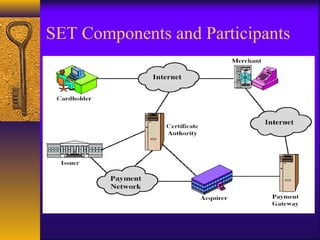
SET Participants
♦ Cardholder
♦ Merchant
♦ Issuer
♦ Acquirer
♦ Payment Gateway
♦ Certification Authority
SET Components and Participants
Cardholder & Merchant
♦ Cardholder
– This is an authorized holder of a payment card
(e.g, MasterCard, Visa) that has been issued by
an issuer.
♦ Merchant
– This is a person or organization who has things
to sell to the cardholder. A merchant that
accepts credit cards must have a relationship
with an acquirer
Issuer & Acquirer
♦ Issuer
– This is a financial institution such as a bank that
provides the card holder with the payment card.
♦ Acquirer
– This is a financial institution that establishes an account
with the merchant and processes credit card
authorizations and payments. The acquirer provides
authorization to the merchant that a given card account
is active and that the proposed purchase does not exceed
the credit limit. The Acquirer also provides electronic
payments transfers to the merchant’s account.
Payment Gateway
♦ This is a function that can be undertaken by
the acquirer or some third party that
processes merchant payment messages.
♦ The payment gateway interfaces between
SET and the existing bankcard payment
networks for authorization and payment
functions.
Certification Authority(CA)
♦ This is an entity that is entrusted to issue
X.509v3 public-key certificates for
cardholders, merchants, and payment
gateways.
X.509 Authentication Service
• X.509v3 – this is an authentication service
which includes a public – certificate
associated with each user. Certificates are
assumed to be created by some trusted
Certification Authority(CA), and then placed
in a directory that can be viewed by others
who need to verify the public-key of
someone. CA signs the certificate with its
private-key thereby authenticating the fact
that this key does indeed belong to a user A.
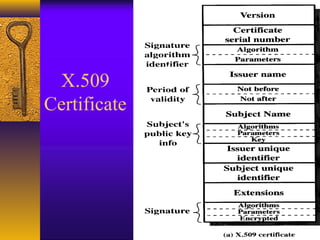
X.509
Certificate
X.509 Certificate
♦ Version: there are differences between
different versions of certificates.
♦ Serial Number: unique integer value.
♦ Issuer name: CA that created and signed the
certificate
♦ Period Of Validity: expiration date.
X.509 Certificate Cont’d
♦ Subject Name: The name of the user to
whom the certificate refers.
♦ Subjects Public-key Information: public-key
of the subject.
♦ Signature: Covers all other fields of the
certificate; it contains a hash code of all
other fields, encrypted with the CA’s
private key.
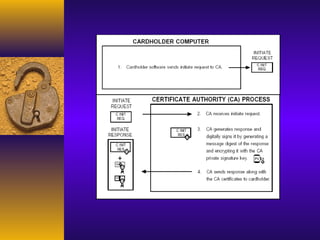
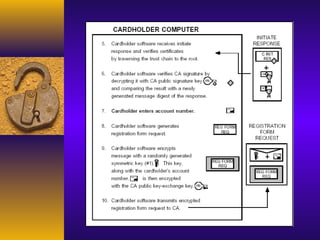
Events required for a Successful
SET Transaction
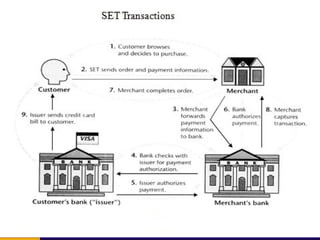
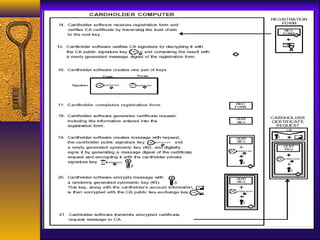
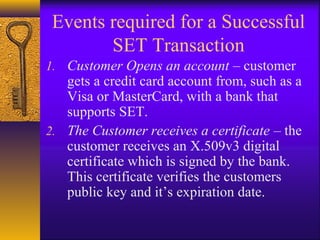
1. Customer Opens an account – customer
gets a credit card account from, such as a
Visa or MasterCard, with a bank that
supports SET.
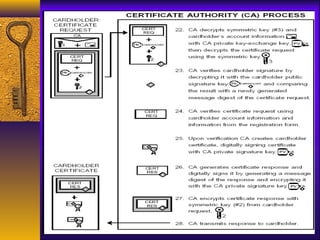
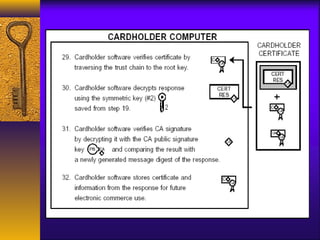
2. The Customer receives a certificate – the
customer receives an X.509v3 digital
certificate which is signed by the bank.
This certificate verifies the customers
public key and it’s expiration date.
3. Merchant Certificates – the merchant must
have two(2) certificates for the two public
keys it owns. One for signing messages
with and one for key exchange. The
merchant also needs a copy of the
payment gateway’s public-key certificate.
4. The customer places an order.
Events required for a Successful SET
Transaction Cont’d
Events required for a Successful
SET Transaction Cont’d
5. Merchant Verification – The merchant sends an
order form to the customer, as well as a copy of
the merchants certificate, so the customer can
verify that he/she is dealing with a valid store.
6. Order & Payment Sent – The customer sends
order information (OI) and payment
information(PI) to the merchant together with the
customers certificate so the merchant can verify
that he is dealing with a valid customer. The PI is
encrypted in such a way that the merchant cannot
read it.
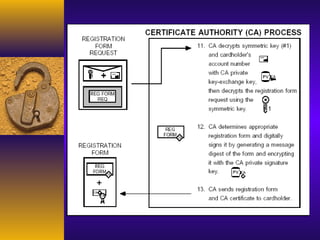
Events required for a Successful
SET Transaction Cont’d
7. Merchant Requests PI authorization – The
merchant forwards the PI to the payment
gateway, to determine whether the customer has
sufficient funds/credit for the purchase.
8. Merchant Confirms the order – merchant sends
confirmation of the order to the customer.
9. Merchant ships goods and services.
10. Merchant requests payment – this request for
payment is sent to the payment gateway, which
handles payment processing
Key Technologies of SET
♦ Confidentiality of information: DES
♦ Integrity of data: RSA digital signatures
with SHA-1 hash codes
♦ Cardholder account authentication:
X.509v3 digital certificates with RSA
signatures
♦ Merchant authentication: X.509v3 digital
certificates with RSA signatures
♦ Privacy: separation of order and payment
information using dual signatures
♦ Concept: Link Two Messages Intended for Two Different
Receivers:
– Order Information (OI): Customer to Merchant
– Payment Information (PI): Customer to Bank
♦ Goal: Limit Information to A “Need-to-Know” Basis:
– Merchant does not need credit card number.
– Bank does not need details of customer order.
– Afford the customer extra protection in terms of privacy by
keeping these items separate.
♦ This link is needed to prove that payment is intended for this
order and not some other one.
SET’s Dual Signature
Why Dual Signature?
♦ Suppose that customers send the merchant two messages:
• The signed order information (OI).
• The signed payment information (PI).
• In addition, the merchant passes the payment information
(PI) to the bank.
♦ If the merchant can capture another order information (OI) from
this customer, the merchant could claim this order goes with the
payment information (PI) rather than the original.
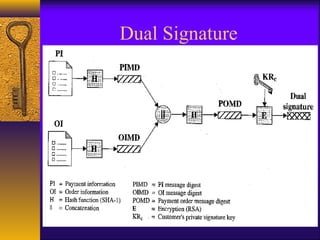
Dual Signature
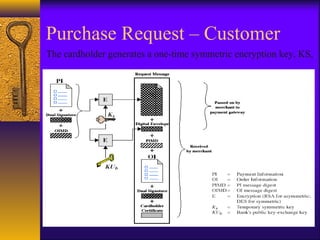
Purchase Request – Customer
The cardholder generates a one-time symmetric encryption key, KS,
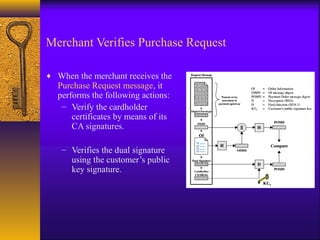
Merchant Verifies Purchase Request
♦ When the merchant receives the
Purchase Request message, it
performs the following actions:
– Verify the cardholder
certificates by means of its
CA signatures.
– Verifies the dual signature
using the customer’s public
key signature.
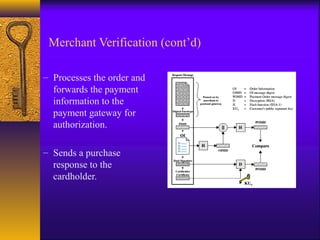
Merchant Verification (cont’d)
– Processes the order and
forwards the payment
information to the
payment gateway for
authorization.
– Sends a purchase
response to the
cardholder.
Payment Gateway Authorization
1. verifies all certificates
2. decrypts digital envelope of authorization block to obtain
symmetric key & then decrypts authorization block
3. verifies merchant's signature on authorization block
4. decrypts digital envelope of payment block to obtain
symmetric key & then decrypts payment block
5. verifies dual signature on payment block
6. verifies that transaction ID received from merchant
matches that in PI received (indirectly) from customer
7. requests & receives an authorization from issuer
8. sends authorization response back to merchant
Payment Capture
♦ merchant sends payment gateway a
payment capture request
♦ gateway checks request
♦ then causes funds to be transferred to
merchants account
♦ notifies merchant using capture response
SET Overhead
Simple purchase transaction:
♦ Four messages between merchant and customer
♦ Two messages between merchant and payment gateway
♦ 6 digital signatures
♦ 9 RSA encryption/decryption cycles
♦ 4 DES encryption/decryption cycles
♦ 4 certificate verifications
Scaling:
♦ Multiple servers need copies of all certificates
Advantages:
-Privacy: Uses 1024 bit public key
cryptography which renders the
intercepted message unreadable !
-Integrity: Hashing & signing ensures
message sent is unaltered.
-Authentication: Uses digital
certificates to ensure the parties are
really who they claim to be.
CONCLUSION
-Uses 1024–bit cipher keys, making it
one of the strongest encryption
applications.
-If we use 100 computers each
processing 10 MIPS, it would take
2.8 x 10 11
years to break just ONE
encrypted message !!!!
Source: http://www.rsa.com/set/html/howstrong.html
Set Secure Electronic Transaction(SET)

Set Secure Electronic Transaction (SET)

  • 1.
    Secure Electronic Transaction (SET) SurajDhalwar Sushant Todkar Snehit Deokar Chinta Yashwanth
  • 2.
    Outline: ♦ History ♦ SETand Requirements ♦ Key Features ♦ SET Participants ♦ Events in SET ♦ Key Technologies in SET ♦ Dual Signature ♦ Conclusion
  • 3.
    History/Background: -Internet shopping didn’tquite pick up as consumers considered financial transactions over the internet, unsafe -Lacks the one on one transaction feeling. -Visa & MC came up with the idea what we call as SET.
  • 4.
    What is SET? ♦SET is an open encryption and security specification designed to protect credit card transactions on the Internet. ♦ SET is in effect a set of protocols for ensuring security and confidentiality. ♦ SET is a relatively new standard. It was first used in February 1996 and was proposed by Visa and MasterCard.
  • 5.
    Requirements That SETMust Accomplish ♦ Provide confidentiality of ordering and payment information. ♦ Ensure the integrity of all transmitted data ♦ Provide authentication that a cardholder is a legitimate user of a credit card account. ♦ Provide authentication that a merchant can accept credit card transactions through its relationship with a financial institution.
  • 6.
    Key Features ofSET ♦ Confidentiality of information. ♦ Integrity of Data. ♦ Cardholder account authentication. ♦ Merchant authentication.
  • 7.
    Confidentiality of Information Acredit card holder’s personal and payment information is secured as it travels across the network. An interesting feature of SET is that the merchant /seller never sees the credit card number; this is only provided to the issuing bank. Conventional encryption using DES is used to provide confidentiality.
  • 8.
    Integrity of Data Paymentinformation sent from cardholders to merchants include order information, personal information and payment instructions. SET guarantees that these message contents are not altered in transit. RSA digital signatures, using SHA-1 hash codecs, provide message integrity.
  • 9.
    Cardholder Account Authentication SET enablesmerchants to verify that a cardholder is legitimate user of a valid card account number. SET uses X.509v3 digital certificates with RSA signatures for this purpose.
  • 10.
    Merchant Authentication SET enablescardholders to verify that a merchant has a relationship with a financial institution allowing it to accept payment cards. SET uses X.509v3 digital certificates with RSA signatures for this purpose.
  • 11.
    SET Participants ♦ Cardholder ♦Merchant ♦ Issuer ♦ Acquirer ♦ Payment Gateway ♦ Certification Authority
  • 12.
    SET Components andParticipants
  • 13.
    Cardholder & Merchant ♦Cardholder – This is an authorized holder of a payment card (e.g, MasterCard, Visa) that has been issued by an issuer. ♦ Merchant – This is a person or organization who has things to sell to the cardholder. A merchant that accepts credit cards must have a relationship with an acquirer
  • 14.
    Issuer & Acquirer ♦Issuer – This is a financial institution such as a bank that provides the card holder with the payment card. ♦ Acquirer – This is a financial institution that establishes an account with the merchant and processes credit card authorizations and payments. The acquirer provides authorization to the merchant that a given card account is active and that the proposed purchase does not exceed the credit limit. The Acquirer also provides electronic payments transfers to the merchant’s account.
  • 15.
    Payment Gateway ♦ Thisis a function that can be undertaken by the acquirer or some third party that processes merchant payment messages. ♦ The payment gateway interfaces between SET and the existing bankcard payment networks for authorization and payment functions.
  • 16.
    Certification Authority(CA) ♦ Thisis an entity that is entrusted to issue X.509v3 public-key certificates for cardholders, merchants, and payment gateways.
  • 19.
    X.509 Authentication Service •X.509v3 – this is an authentication service which includes a public – certificate associated with each user. Certificates are assumed to be created by some trusted Certification Authority(CA), and then placed in a directory that can be viewed by others who need to verify the public-key of someone. CA signs the certificate with its private-key thereby authenticating the fact that this key does indeed belong to a user A.
  • 20.
  • 21.
    X.509 Certificate ♦ Version:there are differences between different versions of certificates. ♦ Serial Number: unique integer value. ♦ Issuer name: CA that created and signed the certificate ♦ Period Of Validity: expiration date.
  • 22.
    X.509 Certificate Cont’d ♦Subject Name: The name of the user to whom the certificate refers. ♦ Subjects Public-key Information: public-key of the subject. ♦ Signature: Covers all other fields of the certificate; it contains a hash code of all other fields, encrypted with the CA’s private key.
  • 29.
    Events required fora Successful SET Transaction 1. Customer Opens an account – customer gets a credit card account from, such as a Visa or MasterCard, with a bank that supports SET. 2. The Customer receives a certificate – the customer receives an X.509v3 digital certificate which is signed by the bank. This certificate verifies the customers public key and it’s expiration date.
  • 30.
    3. Merchant Certificates– the merchant must have two(2) certificates for the two public keys it owns. One for signing messages with and one for key exchange. The merchant also needs a copy of the payment gateway’s public-key certificate. 4. The customer places an order. Events required for a Successful SET Transaction Cont’d
  • 31.
    Events required fora Successful SET Transaction Cont’d 5. Merchant Verification – The merchant sends an order form to the customer, as well as a copy of the merchants certificate, so the customer can verify that he/she is dealing with a valid store. 6. Order & Payment Sent – The customer sends order information (OI) and payment information(PI) to the merchant together with the customers certificate so the merchant can verify that he is dealing with a valid customer. The PI is encrypted in such a way that the merchant cannot read it.
  • 32.
    Events required fora Successful SET Transaction Cont’d 7. Merchant Requests PI authorization – The merchant forwards the PI to the payment gateway, to determine whether the customer has sufficient funds/credit for the purchase. 8. Merchant Confirms the order – merchant sends confirmation of the order to the customer. 9. Merchant ships goods and services. 10. Merchant requests payment – this request for payment is sent to the payment gateway, which handles payment processing
  • 33.
    Key Technologies ofSET ♦ Confidentiality of information: DES ♦ Integrity of data: RSA digital signatures with SHA-1 hash codes ♦ Cardholder account authentication: X.509v3 digital certificates with RSA signatures ♦ Merchant authentication: X.509v3 digital certificates with RSA signatures ♦ Privacy: separation of order and payment information using dual signatures
  • 34.
    ♦ Concept: LinkTwo Messages Intended for Two Different Receivers: – Order Information (OI): Customer to Merchant – Payment Information (PI): Customer to Bank ♦ Goal: Limit Information to A “Need-to-Know” Basis: – Merchant does not need credit card number. – Bank does not need details of customer order. – Afford the customer extra protection in terms of privacy by keeping these items separate. ♦ This link is needed to prove that payment is intended for this order and not some other one. SET’s Dual Signature
  • 35.
    Why Dual Signature? ♦Suppose that customers send the merchant two messages: • The signed order information (OI). • The signed payment information (PI). • In addition, the merchant passes the payment information (PI) to the bank. ♦ If the merchant can capture another order information (OI) from this customer, the merchant could claim this order goes with the payment information (PI) rather than the original.
  • 36.
  • 37.
    Purchase Request –Customer The cardholder generates a one-time symmetric encryption key, KS,
  • 38.
    Merchant Verifies PurchaseRequest ♦ When the merchant receives the Purchase Request message, it performs the following actions: – Verify the cardholder certificates by means of its CA signatures. – Verifies the dual signature using the customer’s public key signature.
  • 39.
    Merchant Verification (cont’d) –Processes the order and forwards the payment information to the payment gateway for authorization. – Sends a purchase response to the cardholder.
  • 40.
    Payment Gateway Authorization 1.verifies all certificates 2. decrypts digital envelope of authorization block to obtain symmetric key & then decrypts authorization block 3. verifies merchant's signature on authorization block 4. decrypts digital envelope of payment block to obtain symmetric key & then decrypts payment block 5. verifies dual signature on payment block 6. verifies that transaction ID received from merchant matches that in PI received (indirectly) from customer 7. requests & receives an authorization from issuer 8. sends authorization response back to merchant
  • 41.
    Payment Capture ♦ merchantsends payment gateway a payment capture request ♦ gateway checks request ♦ then causes funds to be transferred to merchants account ♦ notifies merchant using capture response
  • 42.
    SET Overhead Simple purchasetransaction: ♦ Four messages between merchant and customer ♦ Two messages between merchant and payment gateway ♦ 6 digital signatures ♦ 9 RSA encryption/decryption cycles ♦ 4 DES encryption/decryption cycles ♦ 4 certificate verifications Scaling: ♦ Multiple servers need copies of all certificates
  • 43.
    Advantages: -Privacy: Uses 1024bit public key cryptography which renders the intercepted message unreadable ! -Integrity: Hashing & signing ensures message sent is unaltered. -Authentication: Uses digital certificates to ensure the parties are really who they claim to be.
  • 44.
    CONCLUSION -Uses 1024–bit cipherkeys, making it one of the strongest encryption applications. -If we use 100 computers each processing 10 MIPS, it would take 2.8 x 10 11 years to break just ONE encrypted message !!!! Source: http://www.rsa.com/set/html/howstrong.html

Editor's Notes

  • #13 Stallings Fig 17-8.
  • #35 SET Transaction: Order and Payment are Sent: Customer sends both order and payment information to merchant along with customer’s certificate. The order confirms the purchase of items in the order form. The payment contains credit card details. The payment information is encrypted so that it cannot be read by the merchant. The customer’s certificate enables the merchant to verify the customer. Merchant Requests Payment Authorization: Merchant sends the payment information to the payment gateway. This requests authorization that the customer’s available credit is sufficient for this purchase. Merchant Confirms Order: Merchant sends a confirmation of the order to the customer. Merchant Provides Goods or Service: Merchant ships the goods or provides the service to the customer. Merchant Requests Payment: Request is sent to payment gateway to handle payment processing

  • #36 SET Transaction: Order and Payment are Sent: Customer sends both order and payment information to merchant along with customer’s certificate. The order confirms the purchase of items in the order form. The payment contains credit card details. The payment information is encrypted so that it cannot be read by the merchant. The customer’s certificate enables the merchant to verify the customer. Merchant Requests Payment Authorization: Merchant sends the payment information to the payment gateway. This requests authorization that the customer’s available credit is sufficient for this purchase. Merchant Confirms Order: Merchant sends a confirmation of the order to the customer. Merchant Provides Goods or Service: Merchant ships the goods or provides the service to the customer. Merchant Requests Payment: Request is sent to payment gateway to handle payment processing
  • #38 Stallings Fig 17-10.
  • #39 Merchant Handles Purchase Request Message: When Merchant receives the Purchase Request Message: Verifies the Cardholder Certificate using its CA Signatures Verifies the Dual Signature using the customer’s public signature key. This ensures that the order has not been tampered with in transit and that it was signed using the cardholder’s private key. Process the order and forward the payment information to the payment gateway for authorization. Send a purchase response to cardholder.
  • #40 Merchant Handles Purchase Request Message: When Merchant receives the Purchase Request Message: Verifies the Cardholder Certificate using its CA Signatures Verifies the Dual Signature using the customer’s public signature key. This ensures that the order has not been tampered with in transit and that it was signed using the cardholder’s private key. Process the order and forward the payment information to the payment gateway for authorization. Send a purchase response to cardholder.