DIGITAL SIGNATURES
By:-
Ishwar Dayal
9/17/2013DepartmentOfInformationTechnology,GoB
1
WHY DIGITAL SIGNATURES?
9/17/2013DepartmentOfInformationTechnology,GoB
 To provide Authenticity, Integrity
and Non -repudiation to electronic
documents
 To use the Internet as the safe and
secure medium for e-Governance
and e-Commerce
2
WHAT IS DIGITAL SIGNATURE?
 A digital signature is an electronic signature that can
be used to authenticate the identity of the sender of a
message or the signer of a document, and possibly to
ensure that the original content of the message or
document that has been sent is unchanged.
 Digital signatures are easily transportable, cannot be
imitated by someone else, and can be automatically
time-stamped. The ability to ensure that the original
signed message arrived means that the sender can
not easily repudiate it later.
 The originator of a message uses a signing key
(Private Key) to sign the message and send the
message and its digital signature to a recipient
 The recipient uses a verification key (Public Key) to
verify the origin of the message and that it has not
been tampered with while in transit
9/17/2013DepartmentOfInformationTechnology,GoB
3
Digital signatures employ a type of Asymmetric
Cryptography. The Scheme typically consists of
three Algorithms
 A key generation algorithm that selects a private key
uniformly at random from a set of possible private keys.
The algorithm outputs the private key and a
corresponding public key.
 A signing algorithm that, given a message and a private
key, produces a signature.
 A signature verifying algorithm that, given a message,
public key and a signature, either accepts or rejects the
message's claim to authenticity
9/17/2013DepartmentOfInformationTechnology,GoB
Hash value of a message when encrypted with the
private key of a person is his digital signature on that
e-Document
4
DIGITAL SIGNATURES
9/17/2013DepartmentOfInformationTechnology,GoB
Each individual generates his own key pair
[Public key known to everyone
&
Private key only to the owner]
Private Key – Used for making Digital Signature
Public Key – Used to verify the Digital Signature
5
HARDWARE TOKENS
9/17/2013DepartmentOfInformationTechnology,GoB
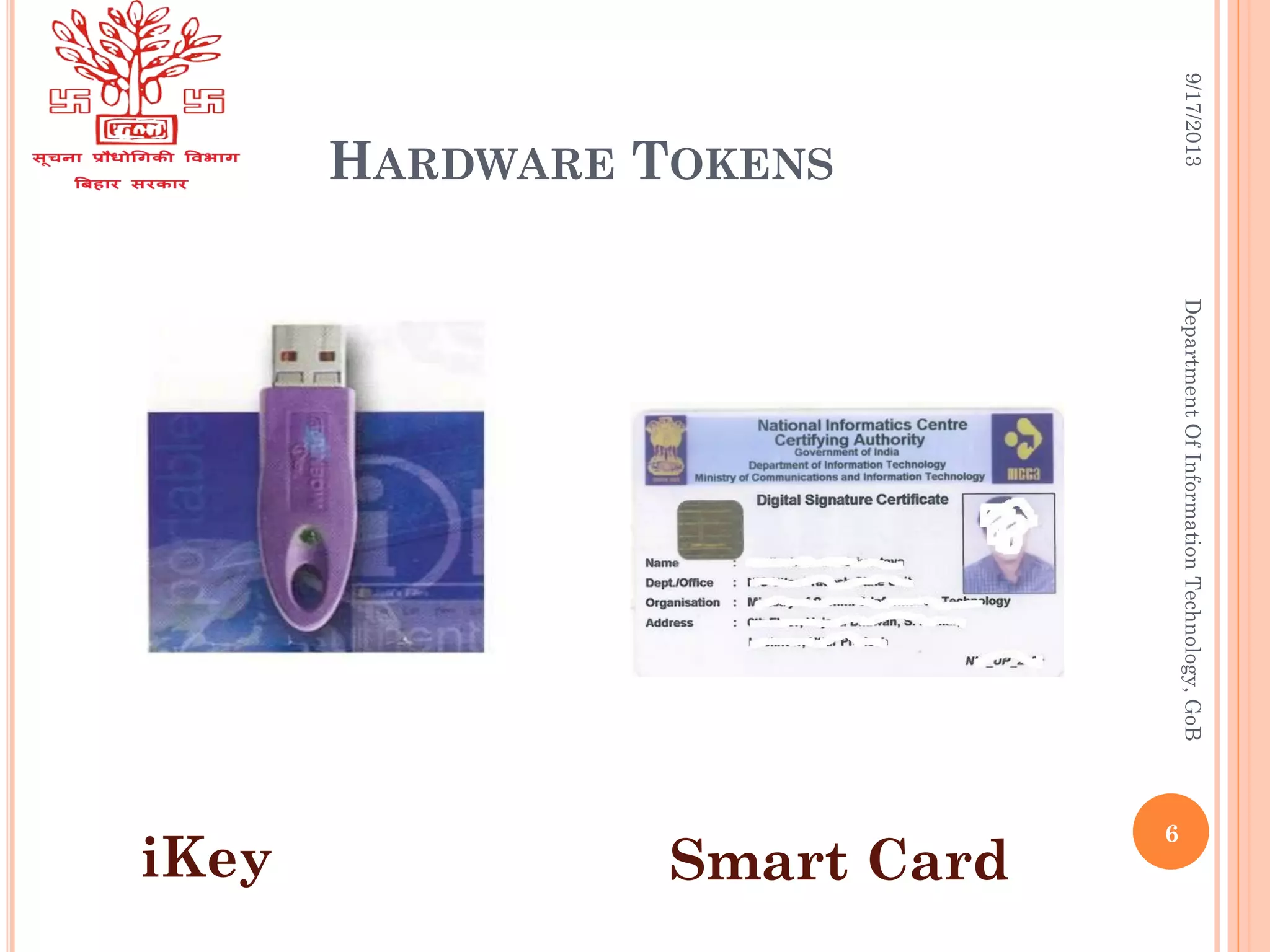
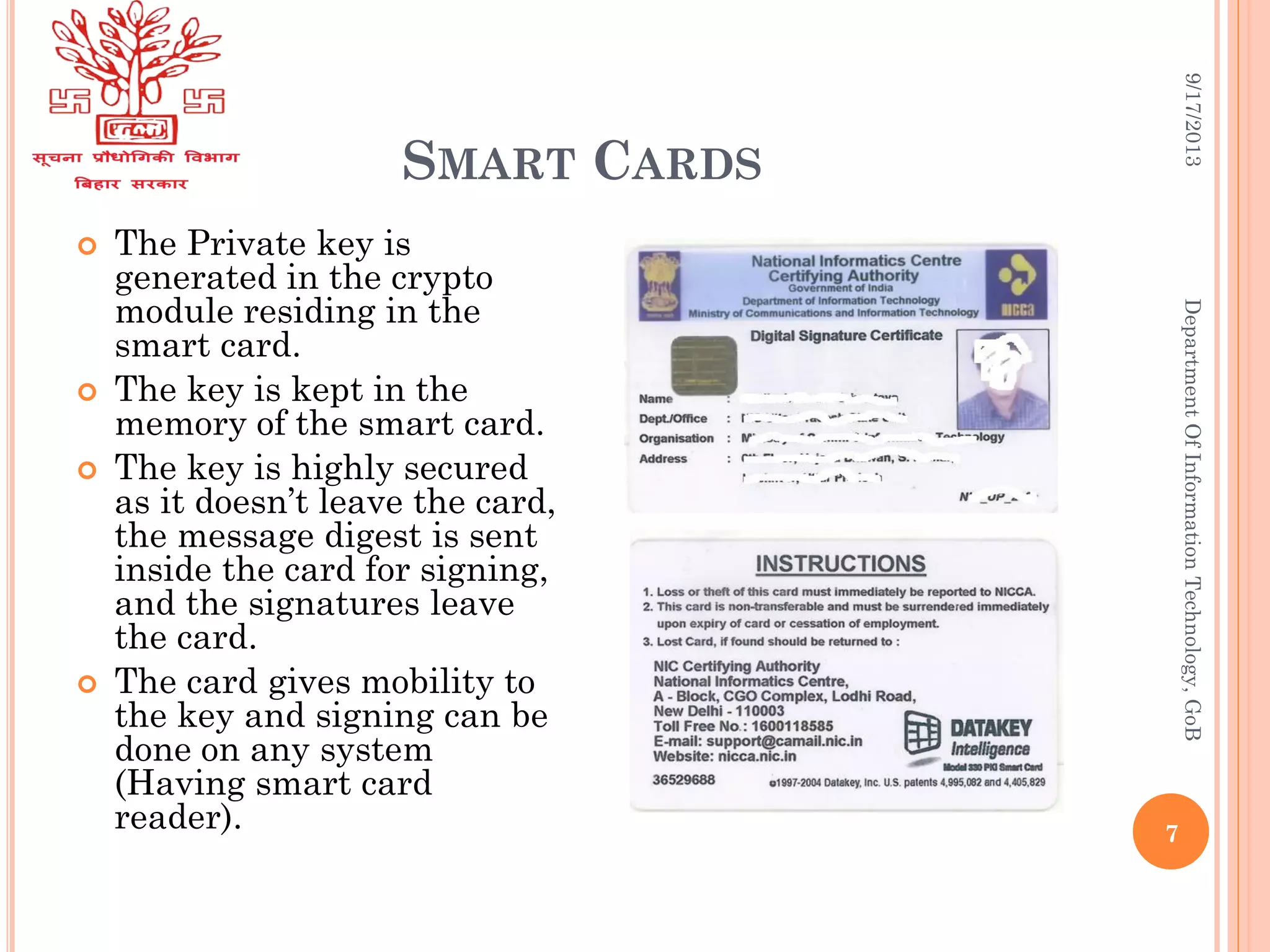
iKey Smart Card
6
SMART CARDS
9/17/2013DepartmentOfInformationTechnology,GoB
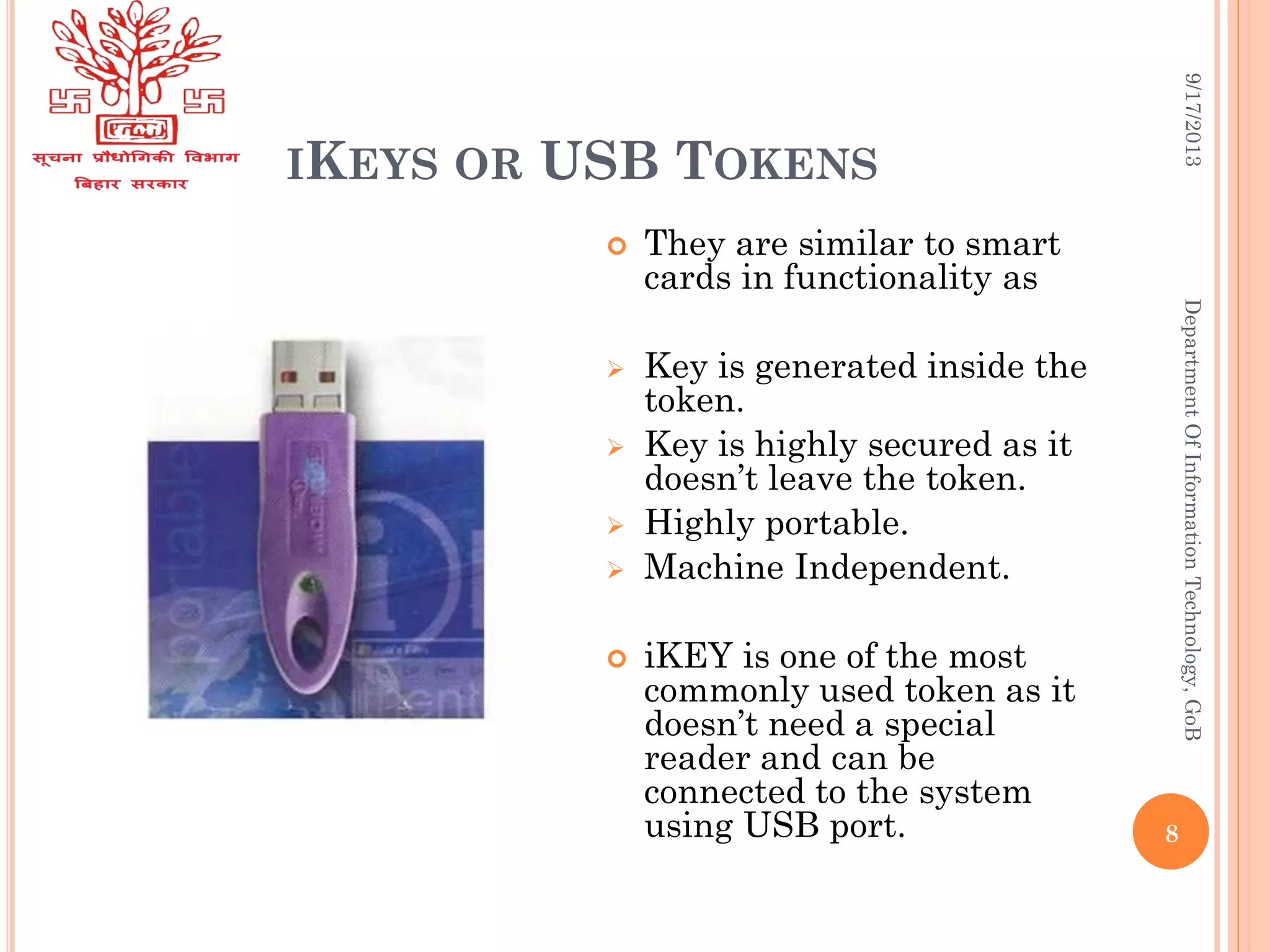
 The Private key is
generated in the crypto
module residing in the
smart card.
 The key is kept in the
memory of the smart card.
 The key is highly secured
as it doesn’t leave the card,
the message digest is sent
inside the card for signing,
and the signatures leave
the card.
 The card gives mobility to
the key and signing can be
done on any system
(Having smart card
reader). 7
IKEYS OR USB TOKENS
9/17/2013DepartmentOfInformationTechnology,GoB
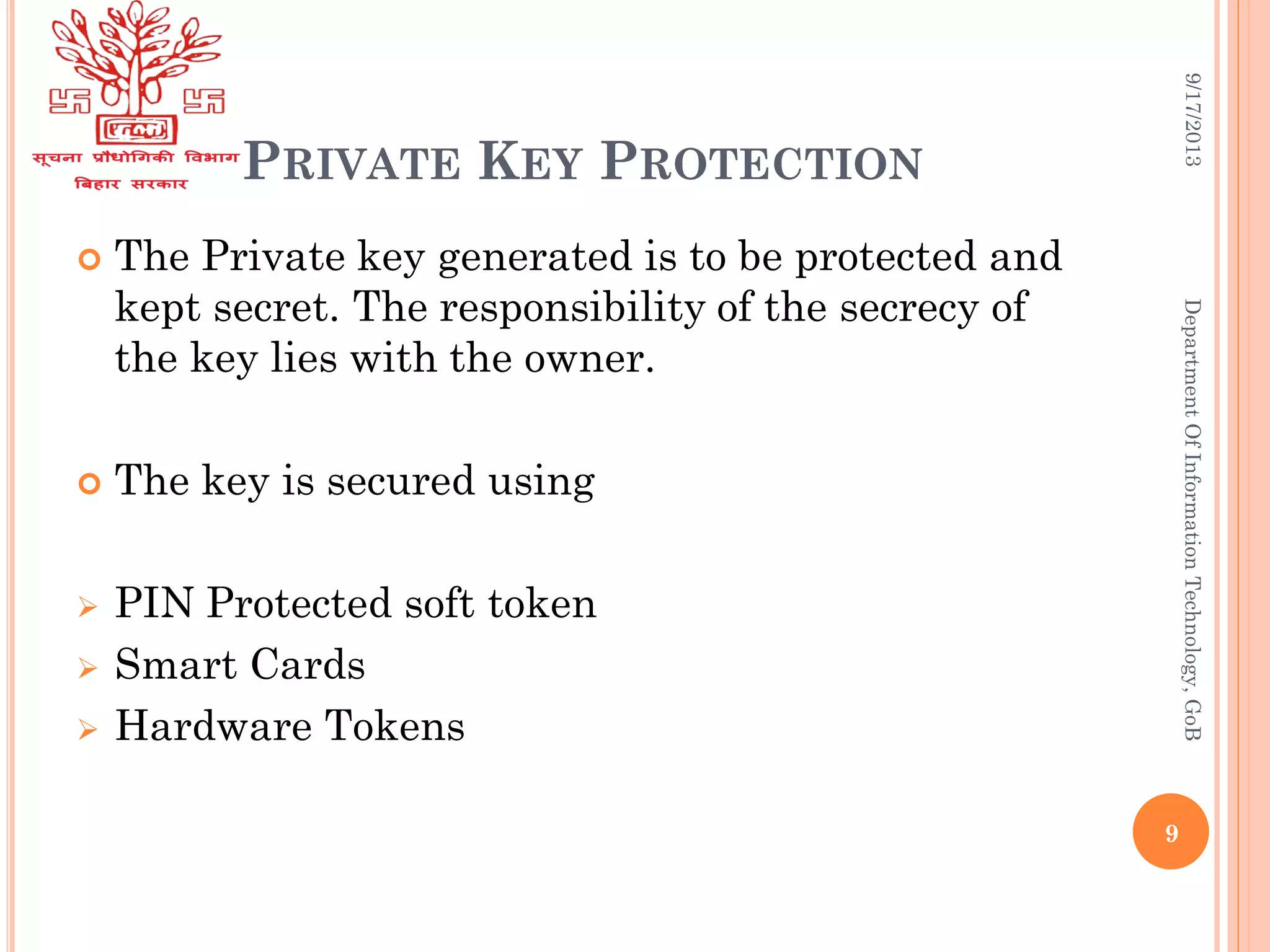
 They are similar to smart
cards in functionality as
 Key is generated inside the
token.
 Key is highly secured as it
doesn’t leave the token.
 Highly portable.
 Machine Independent.
 iKEY is one of the most
commonly used token as it
doesn’t need a special
reader and can be
connected to the system
using USB port. 8
PRIVATE KEY PROTECTION
 The Private key generated is to be protected and
kept secret. The responsibility of the secrecy of
the key lies with the owner.
 The key is secured using
 PIN Protected soft token
 Smart Cards
 Hardware Tokens
9/17/2013DepartmentOfInformationTechnology,GoB
9
DIGITAL SIGNATURES
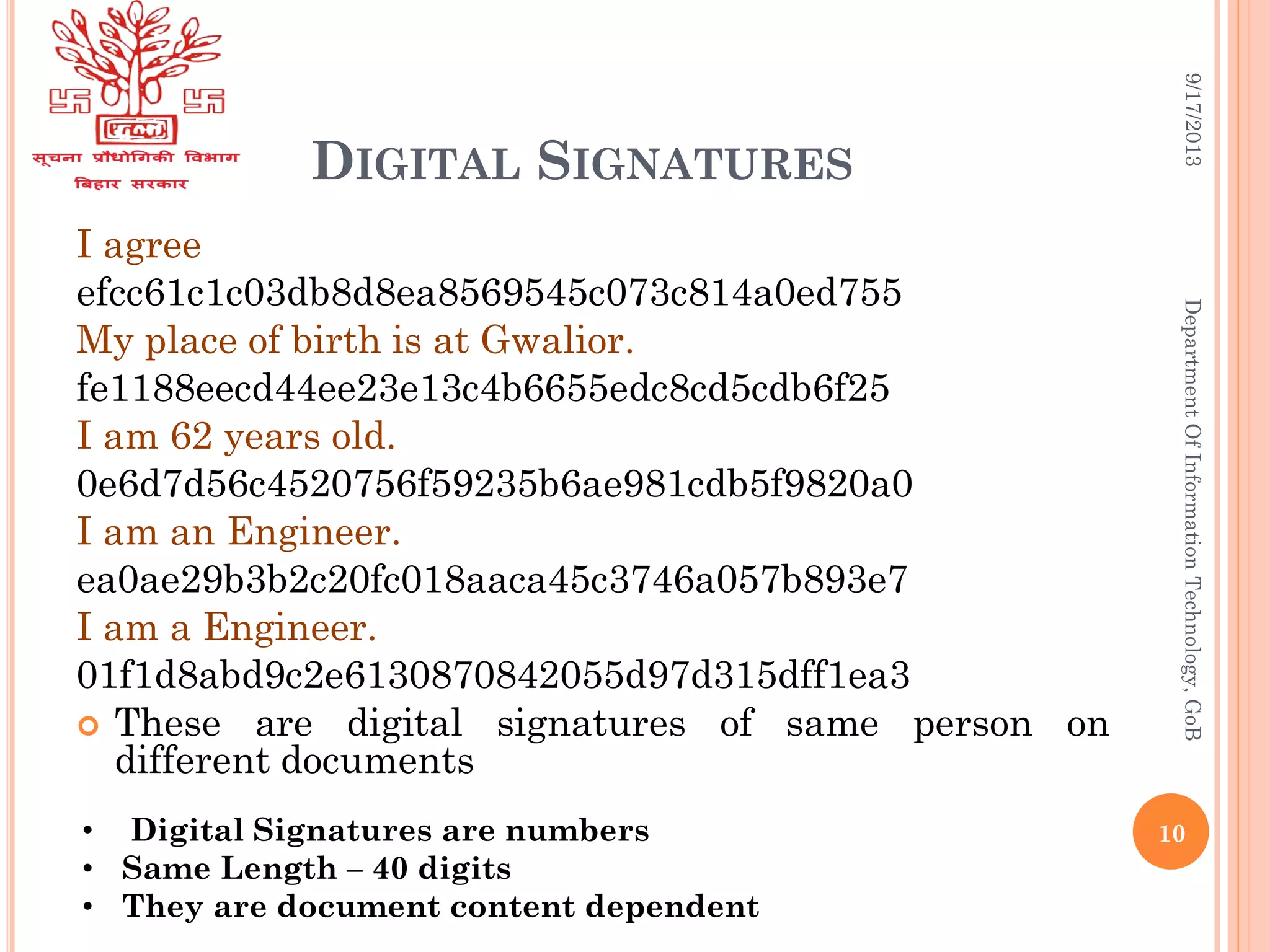
I agree
efcc61c1c03db8d8ea8569545c073c814a0ed755
My place of birth is at Gwalior.
fe1188eecd44ee23e13c4b6655edc8cd5cdb6f25
I am 62 years old.
0e6d7d56c4520756f59235b6ae981cdb5f9820a0
I am an Engineer.
ea0ae29b3b2c20fc018aaca45c3746a057b893e7
I am a Engineer.
01f1d8abd9c2e6130870842055d97d315dff1ea3
 These are digital signatures of same person on
different documents
9/17/2013DepartmentOfInformationTechnology,GoB
• Digital Signatures are numbers
• Same Length – 40 digits
• They are document content dependent
10
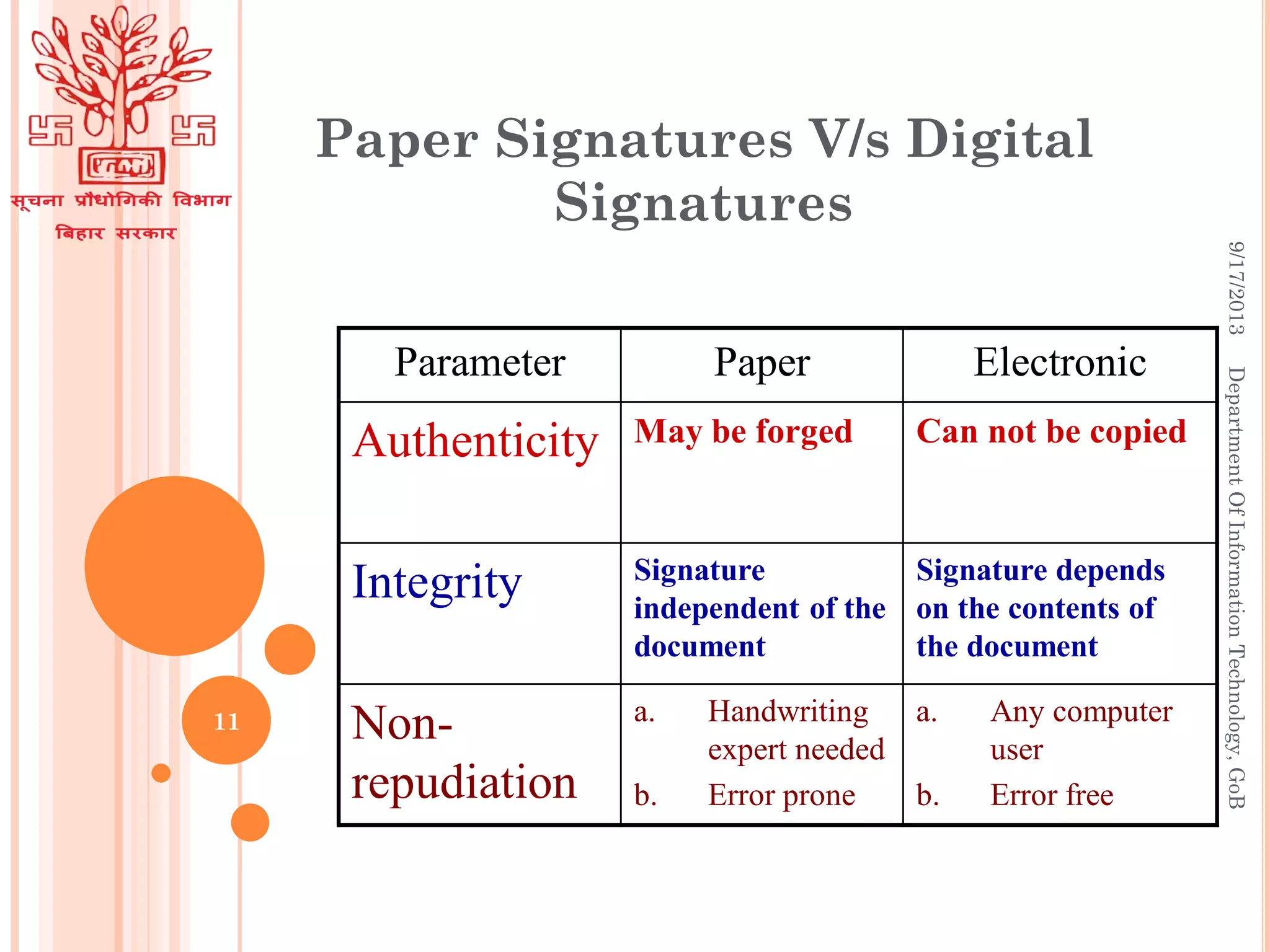
Paper Signatures V/s Digital
Signatures
Parameter Paper Electronic
Authenticity May be forged Can not be copied
Integrity Signature
independent of the
document
Signature depends
on the contents of
the document
Non-
repudiation
a. Handwriting
expert needed
b. Error prone
a. Any computer
user
b. Error free
9/17/2013DepartmentOfInformationTechnology,GoB
11
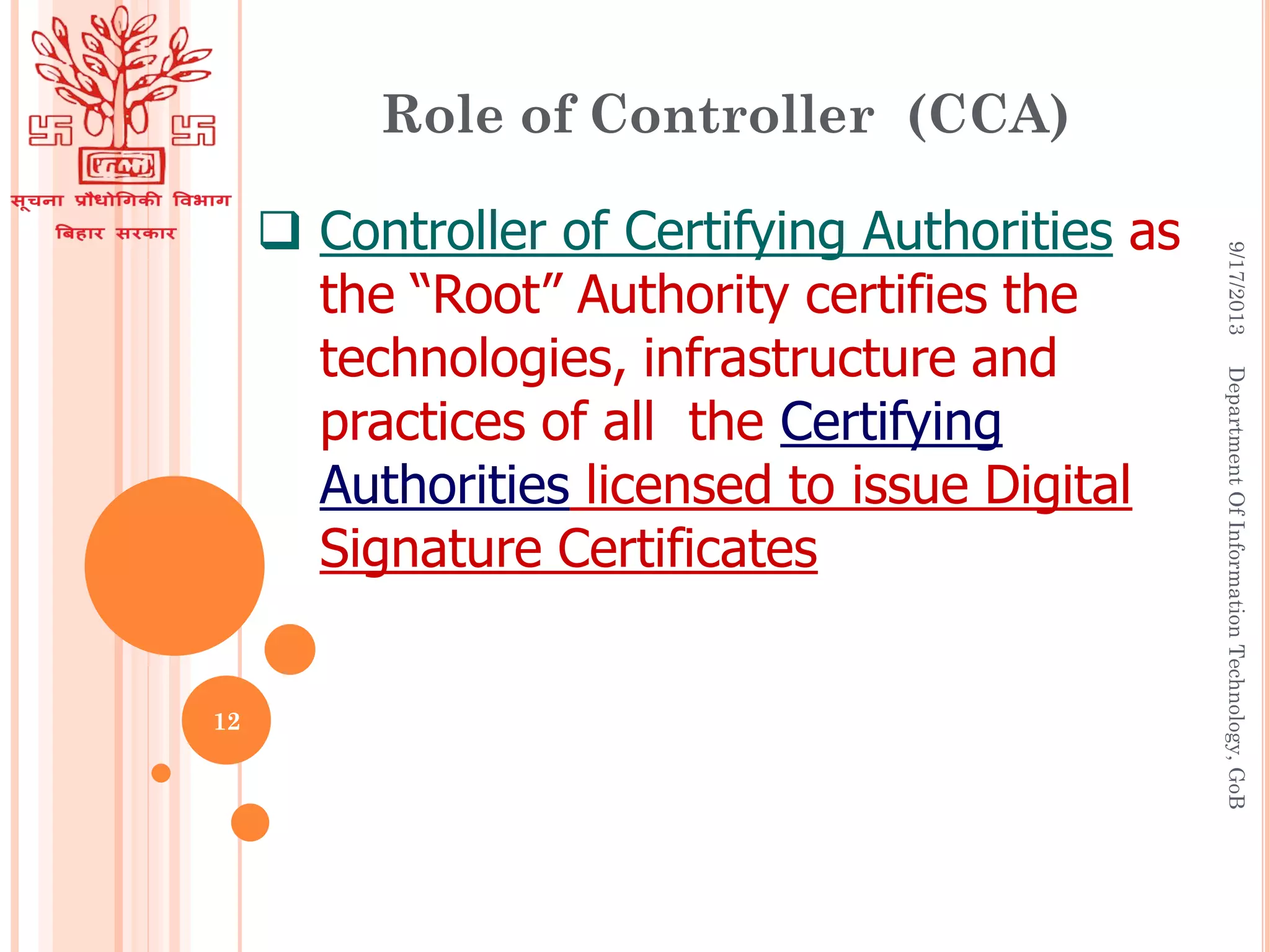
 Controller of Certifying Authorities as
the “Root” Authority certifies the
technologies, infrastructure and
practices of all the Certifying
Authorities licensed to issue Digital
Signature Certificates
Role of Controller (CCA)
9/17/2013DepartmentOfInformationTechnology,GoB
12
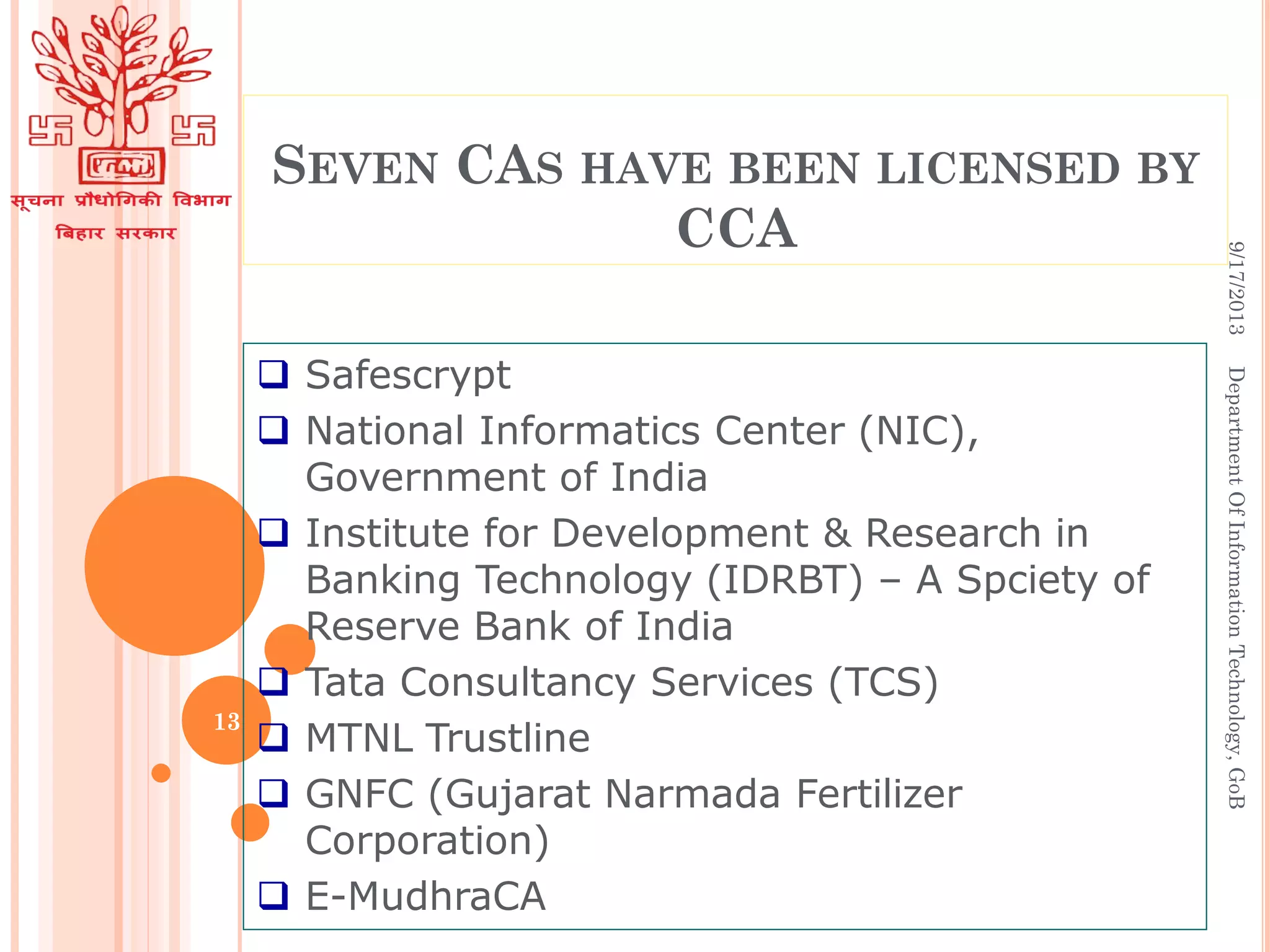
SEVEN CAS HAVE BEEN LICENSED BY
CCA
 Safescrypt
 National Informatics Center (NIC),
Government of India
 Institute for Development & Research in
Banking Technology (IDRBT) – A Spciety of
Reserve Bank of India
 Tata Consultancy Services (TCS)
 MTNL Trustline
 GNFC (Gujarat Narmada Fertilizer
Corporation)
 E-MudhraCA
9/17/2013DepartmentOfInformationTechnology,GoB
13
Prevention From Misuse
 Do’t Hand over you DSC Media
USB/Card to any one
 Do’t tell your PIN to anyone
 Document Digitally Signed carries
same legal status as manually
signing as per the IT Act
9/17/2013DepartmentOfInformationTechnology,GoB
14
THANK YOU
9/17/2013DepartmentOfInformationTechnology,GoB
15

Digital signatures

  • 1.
  • 2.
    WHY DIGITAL SIGNATURES? 9/17/2013DepartmentOfInformationTechnology,GoB To provide Authenticity, Integrity and Non -repudiation to electronic documents  To use the Internet as the safe and secure medium for e-Governance and e-Commerce 2
  • 3.
    WHAT IS DIGITALSIGNATURE?  A digital signature is an electronic signature that can be used to authenticate the identity of the sender of a message or the signer of a document, and possibly to ensure that the original content of the message or document that has been sent is unchanged.  Digital signatures are easily transportable, cannot be imitated by someone else, and can be automatically time-stamped. The ability to ensure that the original signed message arrived means that the sender can not easily repudiate it later.  The originator of a message uses a signing key (Private Key) to sign the message and send the message and its digital signature to a recipient  The recipient uses a verification key (Public Key) to verify the origin of the message and that it has not been tampered with while in transit 9/17/2013DepartmentOfInformationTechnology,GoB 3
  • 4.
    Digital signatures employa type of Asymmetric Cryptography. The Scheme typically consists of three Algorithms  A key generation algorithm that selects a private key uniformly at random from a set of possible private keys. The algorithm outputs the private key and a corresponding public key.  A signing algorithm that, given a message and a private key, produces a signature.  A signature verifying algorithm that, given a message, public key and a signature, either accepts or rejects the message's claim to authenticity 9/17/2013DepartmentOfInformationTechnology,GoB Hash value of a message when encrypted with the private key of a person is his digital signature on that e-Document 4
  • 5.
    DIGITAL SIGNATURES 9/17/2013DepartmentOfInformationTechnology,GoB Each individualgenerates his own key pair [Public key known to everyone & Private key only to the owner] Private Key – Used for making Digital Signature Public Key – Used to verify the Digital Signature 5
  • 6.
  • 7.
    SMART CARDS 9/17/2013DepartmentOfInformationTechnology,GoB  ThePrivate key is generated in the crypto module residing in the smart card.  The key is kept in the memory of the smart card.  The key is highly secured as it doesn’t leave the card, the message digest is sent inside the card for signing, and the signatures leave the card.  The card gives mobility to the key and signing can be done on any system (Having smart card reader). 7
  • 8.
    IKEYS OR USBTOKENS 9/17/2013DepartmentOfInformationTechnology,GoB  They are similar to smart cards in functionality as  Key is generated inside the token.  Key is highly secured as it doesn’t leave the token.  Highly portable.  Machine Independent.  iKEY is one of the most commonly used token as it doesn’t need a special reader and can be connected to the system using USB port. 8
  • 9.
    PRIVATE KEY PROTECTION The Private key generated is to be protected and kept secret. The responsibility of the secrecy of the key lies with the owner.  The key is secured using  PIN Protected soft token  Smart Cards  Hardware Tokens 9/17/2013DepartmentOfInformationTechnology,GoB 9
  • 10.
    DIGITAL SIGNATURES I agree efcc61c1c03db8d8ea8569545c073c814a0ed755 Myplace of birth is at Gwalior. fe1188eecd44ee23e13c4b6655edc8cd5cdb6f25 I am 62 years old. 0e6d7d56c4520756f59235b6ae981cdb5f9820a0 I am an Engineer. ea0ae29b3b2c20fc018aaca45c3746a057b893e7 I am a Engineer. 01f1d8abd9c2e6130870842055d97d315dff1ea3  These are digital signatures of same person on different documents 9/17/2013DepartmentOfInformationTechnology,GoB • Digital Signatures are numbers • Same Length – 40 digits • They are document content dependent 10
  • 11.
    Paper Signatures V/sDigital Signatures Parameter Paper Electronic Authenticity May be forged Can not be copied Integrity Signature independent of the document Signature depends on the contents of the document Non- repudiation a. Handwriting expert needed b. Error prone a. Any computer user b. Error free 9/17/2013DepartmentOfInformationTechnology,GoB 11
  • 12.
     Controller ofCertifying Authorities as the “Root” Authority certifies the technologies, infrastructure and practices of all the Certifying Authorities licensed to issue Digital Signature Certificates Role of Controller (CCA) 9/17/2013DepartmentOfInformationTechnology,GoB 12
  • 13.
    SEVEN CAS HAVEBEEN LICENSED BY CCA  Safescrypt  National Informatics Center (NIC), Government of India  Institute for Development & Research in Banking Technology (IDRBT) – A Spciety of Reserve Bank of India  Tata Consultancy Services (TCS)  MTNL Trustline  GNFC (Gujarat Narmada Fertilizer Corporation)  E-MudhraCA 9/17/2013DepartmentOfInformationTechnology,GoB 13
  • 14.
    Prevention From Misuse Do’t Hand over you DSC Media USB/Card to any one  Do’t tell your PIN to anyone  Document Digitally Signed carries same legal status as manually signing as per the IT Act 9/17/2013DepartmentOfInformationTechnology,GoB 14
  • 15.