WelcomeWelcome
ToTo
My Presentation.
Syed Maniruzzaman Pabel
ID:142-15-4186
Daffodil International University
Our Topic :
E-Commerce Security
2
What is E-Commerce Security
E-commerce security is the protection of e-
commerce assets from unauthorized access, use,
alteration, or destruction.
3
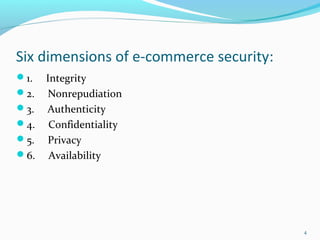
Six dimensions of e-commerce security:
1. Integrity
2. Nonrepudiation
3. Authenticity
4. Confidentiality
5. Privacy
6. Availability
4
The Continuing Need for E-Commerce Security:
Computer Security Institute (CSI)
Nonprofit organization located in San Francisco,
California, that is dedicated to serving and training
information, computer, and network security
professionals
Computer Emergency Response Team (CERT)
Group of three teams at Carnegie Mellon University
that monitor the incidence of cyber attacks, analyze
vulnerabilities, and provide guidance on protecting
against attacks
5
Basic Security Issues:
Authentication
Authorization
Auditing
6
Nontechnical attack:
An attack that uses chicanery to trick people into
revealing sensitive information or performing actions
that compromise the security of a network
7
Technical attack:
An attack perpetrated using software and systems
knowledge or expertise
8
Types of technical attack:
common (security) vulnerabilities and
exposures (CVEs
National Infrastructure Protection Center
(NIPC)
denial-of-service (DoS) attack
distributed denial-ofservice (DDoS) attack
9
Malware:
A generic term for malicious software
Example:
10
Virus and Worm:
virus
A piece of software code that inserts itself into a host,
including the operating systems, in order to propagate;
it requires that its host program be run to activate it
worm
A software program that runs independently, consuming
the resources of its host in order to maintain itself, that
is capable of propagating a complete working version of
itself onto another machine
11
Common mistakes in managing
security risks:
 Undervalued information
 Narrowly defined security boundaries
 Reactive security management
 Dated security management processes
 Lack of communication about security
responsibilities
12
Security Risk Management:
A systematic process for determining the likelihood
of various security attacks and for identifying the
actions needed to prevent or mitigate those attacks
13
Security risk management consists of three
phases:
 Asset identification
 Risk assessment
 Implementation
14
passive tokens and active tokens:
passive tokens
Storage devices (e.g., magnetic strips) that contain a
secret code used in a two-factor authentication
system
active tokens
Small, stand-alone electronic devices that generate
one-time passwords used in a two-factor
authentication system
15
Symmetric (Private) Key
Encryption:
16
Public (Asymmetric) Key Encryption:
public key encryption
Method of encryption that uses a pair of
matched keys—a public key to encrypt a
message and a private key to decrypt it, or
vice versa
public key
Encryption code that is publicly available to
anyone
17
virtual private network (VPN):
A network that uses the public Internet to carry
information but remains private by using
encryption to scramble the communications,
authentication to ensure that information has not
been tampered with, and access control to verify
the identity of anyone using the network
18
Honeynet and Honeypots:
honeynet
A way to evaluate vulnerabilities of an organization
by studying the types of attacks to which a site is
subjected using a network of systems called
honeypots
honeypots
Production systems (e.g., firewalls, routers, Web
servers, database servers) designed to do real work
but that are watched and studied as network
intrusions occur
19
Thank You
 Every Body
20

E-Commerce Security

  • 1.
    WelcomeWelcome ToTo My Presentation. Syed ManiruzzamanPabel ID:142-15-4186 Daffodil International University
  • 2.
  • 3.
    What is E-CommerceSecurity E-commerce security is the protection of e- commerce assets from unauthorized access, use, alteration, or destruction. 3
  • 4.
    Six dimensions ofe-commerce security: 1. Integrity 2. Nonrepudiation 3. Authenticity 4. Confidentiality 5. Privacy 6. Availability 4
  • 5.
    The Continuing Needfor E-Commerce Security: Computer Security Institute (CSI) Nonprofit organization located in San Francisco, California, that is dedicated to serving and training information, computer, and network security professionals Computer Emergency Response Team (CERT) Group of three teams at Carnegie Mellon University that monitor the incidence of cyber attacks, analyze vulnerabilities, and provide guidance on protecting against attacks 5
  • 6.
  • 7.
    Nontechnical attack: An attackthat uses chicanery to trick people into revealing sensitive information or performing actions that compromise the security of a network 7
  • 8.
    Technical attack: An attackperpetrated using software and systems knowledge or expertise 8
  • 9.
    Types of technicalattack: common (security) vulnerabilities and exposures (CVEs National Infrastructure Protection Center (NIPC) denial-of-service (DoS) attack distributed denial-ofservice (DDoS) attack 9
  • 10.
    Malware: A generic termfor malicious software Example: 10
  • 11.
    Virus and Worm: virus Apiece of software code that inserts itself into a host, including the operating systems, in order to propagate; it requires that its host program be run to activate it worm A software program that runs independently, consuming the resources of its host in order to maintain itself, that is capable of propagating a complete working version of itself onto another machine 11
  • 12.
    Common mistakes inmanaging security risks:  Undervalued information  Narrowly defined security boundaries  Reactive security management  Dated security management processes  Lack of communication about security responsibilities 12
  • 13.
    Security Risk Management: Asystematic process for determining the likelihood of various security attacks and for identifying the actions needed to prevent or mitigate those attacks 13
  • 14.
    Security risk managementconsists of three phases:  Asset identification  Risk assessment  Implementation 14
  • 15.
    passive tokens andactive tokens: passive tokens Storage devices (e.g., magnetic strips) that contain a secret code used in a two-factor authentication system active tokens Small, stand-alone electronic devices that generate one-time passwords used in a two-factor authentication system 15
  • 16.
  • 17.
    Public (Asymmetric) KeyEncryption: public key encryption Method of encryption that uses a pair of matched keys—a public key to encrypt a message and a private key to decrypt it, or vice versa public key Encryption code that is publicly available to anyone 17
  • 18.
    virtual private network(VPN): A network that uses the public Internet to carry information but remains private by using encryption to scramble the communications, authentication to ensure that information has not been tampered with, and access control to verify the identity of anyone using the network 18
  • 19.
    Honeynet and Honeypots: honeynet Away to evaluate vulnerabilities of an organization by studying the types of attacks to which a site is subjected using a network of systems called honeypots honeypots Production systems (e.g., firewalls, routers, Web servers, database servers) designed to do real work but that are watched and studied as network intrusions occur 19
  • 20.