A
Colloquium
On
DIGITAL SIGNATURE
Submitted By:
PRASHANT SHEKHAR
Roll No.1573713024
Under the supervision of:
MISS. ANAMIKA SHRIVATSVA
Department of Information Technology
Rajkiya Engineering College, Ambedkar Nagar (UP)-224122
Submitted to:
MISS. ANAMIKA SHRIVATSVA
CONTENTS
Introduction
Motivation
How does it work?
Application
Advantages
Disadvantages
Conclusion
Reference
2
INTRODUCTION
A digital signature is a mathematical scheme that is used to
authenticate the sender of an electronic document .
A digital signature is nothing but an attachment to any
piece of electronic information, which represents the
content of the document and the identity of the owner of
that document uniquely
3
4
Motivation
To provide Authenticity, Integrity and Non-repudiation to electronic
documents.
To use the Internet as the safe and secure medium for e-Commerce
and e-Governance
Basic requirements
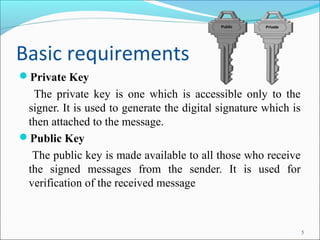
Private Key
The private key is one which is accessible only to the
signer. It is used to generate the digital signature which is
then attached to the message.
Public Key
The public key is made available to all those who receive
the signed messages from the sender. It is used for
verification of the received message
5
Digital certificate
A subscriber of the private key and public key pair makes
the public key available to all those who are intended to
receive the signed messages from the subscriber.[1]
But in case of any dispute between the two sides, there
must be some entity with the receiver which will allow the
receiver of the message to prove that the message was sent
by the subscriber of the key pair. This can be done with the
Digital Signature Certificate.[1]
6
7
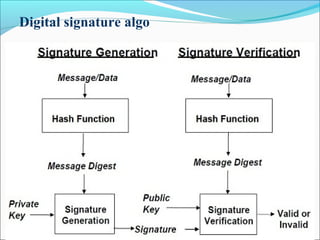
Digital signature algo
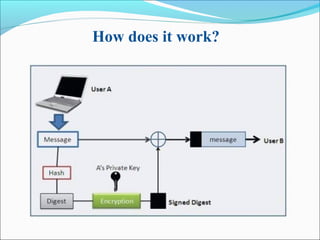
How does it work?
Application
Electronic Mail
Data storage
Electronic funds transfer
Software Distribution
Smart Cards
ISDN
Time Stamped Signature
Blind Signatures
9
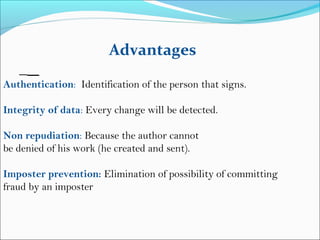
Authentication: Identification of the person that signs.
Integrity of data: Every change will be detected.
Non repudiation: Because the author cannot
be denied of his work (he created and sent).
Imposter prevention: Elimination of possibility of committing
fraud by an imposter
Advantages
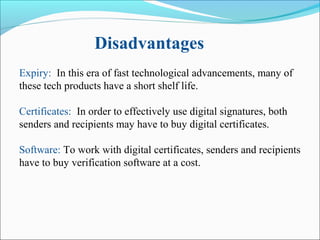
Expiry: In this era of fast technological advancements, many of
these tech products have a short shelf life.
Certificates: In order to effectively use digital signatures, both
senders and recipients may have to buy digital certificates.
Software: To work with digital certificates, senders and recipients
have to buy verification software at a cost.
Disadvantages
CONCLUSION
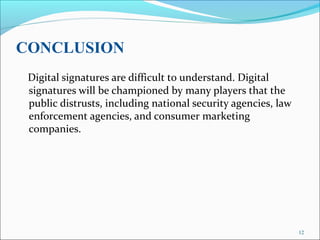
Digital signatures are difficult to understand. Digital
signatures will be championed by many players that the
public distrusts, including national security agencies, law
enforcement agencies, and consumer marketing
companies.
12
References
 http://en.wikipedia.org/wiki/
 Applied Cryptography by Bruce Schneider; 10th
Anniversary edition
 FIPS PUB 186-3; FEDERAL INFORMATION PROCESSING
STANDARDS PUBLICATION
14

Digital Signature

  • 1.
    A Colloquium On DIGITAL SIGNATURE Submitted By: PRASHANTSHEKHAR Roll No.1573713024 Under the supervision of: MISS. ANAMIKA SHRIVATSVA Department of Information Technology Rajkiya Engineering College, Ambedkar Nagar (UP)-224122 Submitted to: MISS. ANAMIKA SHRIVATSVA
  • 2.
    CONTENTS Introduction Motivation How does itwork? Application Advantages Disadvantages Conclusion Reference 2
  • 3.
    INTRODUCTION A digital signatureis a mathematical scheme that is used to authenticate the sender of an electronic document . A digital signature is nothing but an attachment to any piece of electronic information, which represents the content of the document and the identity of the owner of that document uniquely 3
  • 4.
    4 Motivation To provide Authenticity,Integrity and Non-repudiation to electronic documents. To use the Internet as the safe and secure medium for e-Commerce and e-Governance
  • 5.
    Basic requirements Private Key Theprivate key is one which is accessible only to the signer. It is used to generate the digital signature which is then attached to the message. Public Key The public key is made available to all those who receive the signed messages from the sender. It is used for verification of the received message 5
  • 6.
    Digital certificate A subscriberof the private key and public key pair makes the public key available to all those who are intended to receive the signed messages from the subscriber.[1] But in case of any dispute between the two sides, there must be some entity with the receiver which will allow the receiver of the message to prove that the message was sent by the subscriber of the key pair. This can be done with the Digital Signature Certificate.[1] 6
  • 7.
  • 8.
  • 9.
    Application Electronic Mail Data storage Electronicfunds transfer Software Distribution Smart Cards ISDN Time Stamped Signature Blind Signatures 9
  • 10.
    Authentication: Identification ofthe person that signs. Integrity of data: Every change will be detected. Non repudiation: Because the author cannot be denied of his work (he created and sent). Imposter prevention: Elimination of possibility of committing fraud by an imposter Advantages
  • 11.
    Expiry: In thisera of fast technological advancements, many of these tech products have a short shelf life. Certificates: In order to effectively use digital signatures, both senders and recipients may have to buy digital certificates. Software: To work with digital certificates, senders and recipients have to buy verification software at a cost. Disadvantages
  • 12.
    CONCLUSION Digital signatures aredifficult to understand. Digital signatures will be championed by many players that the public distrusts, including national security agencies, law enforcement agencies, and consumer marketing companies. 12
  • 13.
    References  http://en.wikipedia.org/wiki/  AppliedCryptography by Bruce Schneider; 10th Anniversary edition  FIPS PUB 186-3; FEDERAL INFORMATION PROCESSING STANDARDS PUBLICATION
  • 14.