Harry Hess
Recall:
 Scientists know Earth’s interior is made
mostly of layers of _______________.
 Some layers, like the center part, called the
______are hard and______.
 Other layers are not. The layer next to the
center, called the_________, is _______.
Both parts of the core are made
of___________.
inner core; liquid ; rock
iron and nickel; outer core;
solid
Recall:
 The largest layer inside Earth is called the
_____. It’s neither completely solid nor
completely liquid, but_____. It’s
extremely______.
 Earth’s outermost layer is the______ . This
layer is about 5 km thick under the_______
and up to 35 km thick under the______.
 On top of the outer layer is the weathered
rock called______.
continents ; mantle; plastic like
crust; oceans; soil; hot
Despite the evidences
presented by Wegener, WHY
was his idea that the
continents were once joined
together was not accepted by
the scientific society?
This made scientists conduct
further studies in search for the
answer.
1950s and 1960s- new
techniques and modern
gadgets
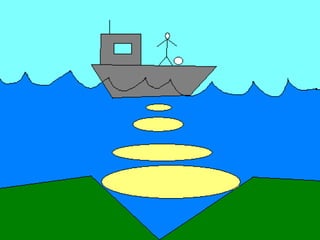
sonars and submersibles
scientists had a clearer view of
the ocean floors
discovered underwater
features deep within the ocean
a system of ridges or
mountains in the seafloor
similar to those found in the
continents (mid-ocean ridges)
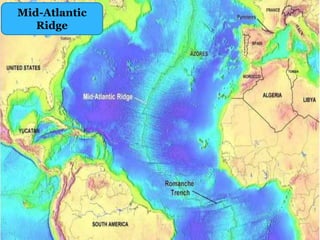
Mid-Atlantic Ridge: an undersea
mountain chain in the Atlantic
Ocean
a gigantic cleft about 32-48 km
long and 1.6 km deep
Mid-Atlantic
Ridge
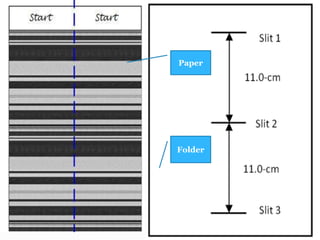
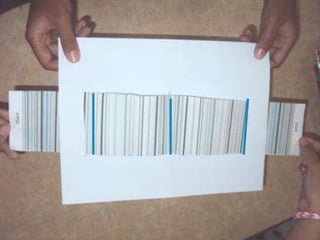
Activity 5: Split and Separate!
Simulate and describe the
seafloor spreading process.
• Realize the importance of the
seafloor spreading process
relative to the Continental Drift
Theory.
Paper
Folder
Answer:
Q22-27
Describe and explain
each
diagram/illustration.
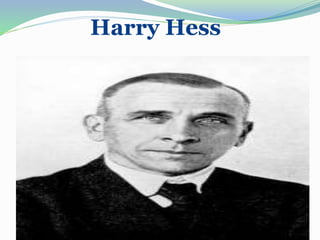
Harry Hess
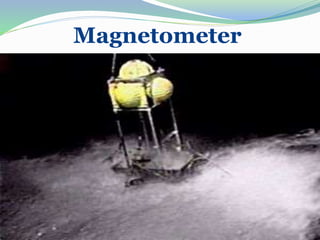
Magnetometer
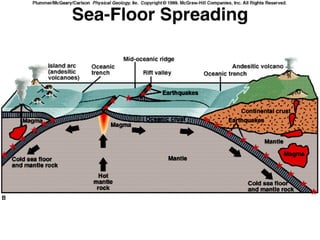
Sea Floor Spreading
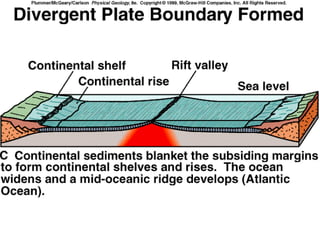
 early 1960’s- Harry Hess, together with
Robert Dietz
 Seafloor Spreading Theory
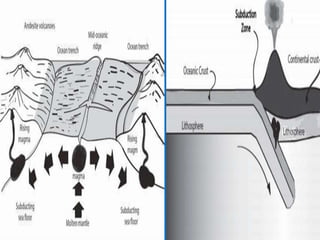
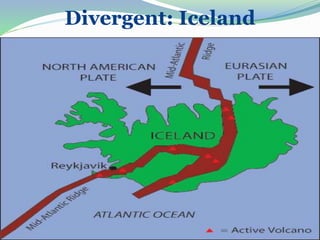
 hot, less dense material from below the earth’s
crust rises towards the surface at the mid-ocean
ridge
 material flows sideways carrying the seafloor
away from the ridge, and creates a crack in the
crust
 magma flows out of the crack, cools down and
becomes the new seafloor
Sea Floor Spreading
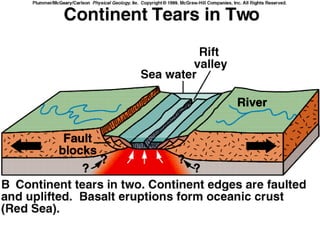
 allowed the creation of new bodies of water
 the Red Sea -African plate and the
Arabian plate diverged
 pulling Australia, South America, and
Antarctica away from each other in the
East Pacific Rise
 The East Pacific Rise -the most active
sites of seafloor spreading, more than
14 cm/yr
SFS
 rate of formation of a new seafloor is not always
as fast as the destruction of the old seafloor at
the subduction zone
 explains why the Pacific Ocean is getting
smaller and why the Atlantic Ocean is getting
wider
 If subduction is faster than seafloor spreading,
the ocean shrinks
 When the seafloor spreading is greater than the
subduction, then the ocean gets wider
The SFS contradicts a part of the
CDT
CDT- continents moved through
unmoving oceans and that larger,
sturdier continents broke through the
oceanic crust
Whereas, the seafloor spreading
shows that the ocean is the actual
site of tectonic activity
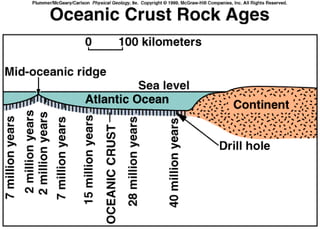
Findings that support Seafloor Spreading Theory:
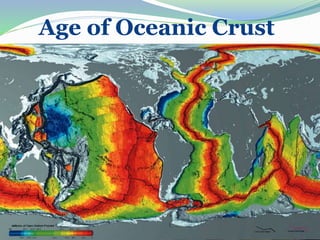
Rocks are younger at the mid-ocean
ridge.
Rocks far from the mid-ocean ridge
are older.
Sediments are thinner at the ridge.
Rocks at the ocean floor are younger
than those at the continents.
Bring the ff:
 Pencil
 Ruler
Activity 6: How fast does it go!
Objectives:
• Analyze a magnetic polarity
map.
• Use legends and scales of the
map properly.
• Calculate the rate of seafloor
spreading using magnetic clues.
VISIT, EXPLORE, ANSWER
 http://www.montereyinstitute.org/noaa/lesson02/l
2la1.htm
 http://earthguide.ucsd.edu/eoc/teachers/t_tectonic
s/p_seafloorspreading.html
Answer:
 Q28-29
Magnetic Reversal
magnetic ‘flip’ of the Earth
the North Pole is transformed into
a South Pole and the South Pole
becomes the North Pole
due to the change in the
direction of flow in the outer
core
Magnetic Reversal
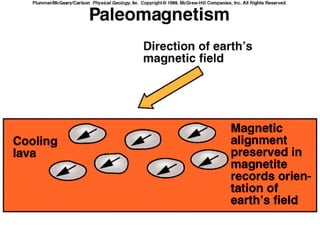
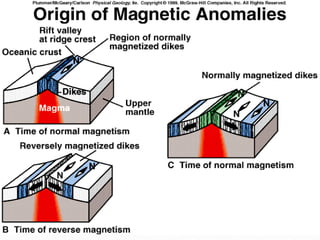
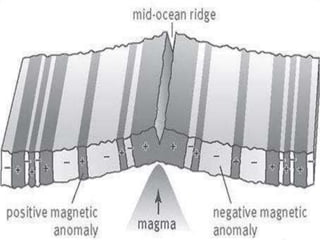
 explained through the magnetic patterns
in magnetic rocks, especially those found
in the ocean floor
 When lava solidifies, iron bearing
minerals crystallize
 the minerals behave like tiny compasses
and align with the Earth’s magnetic
field so when magnetic reversal occurs,
there is also a change in the polarity of
the rocks
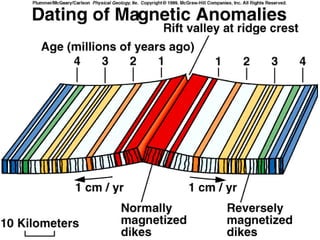
Describe and explain each
diagram/illustration.
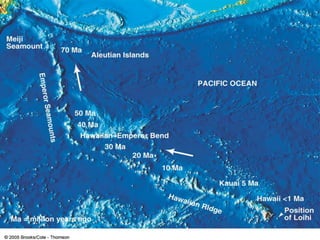
Age of Oceanic Crust
Divergent: Iceland
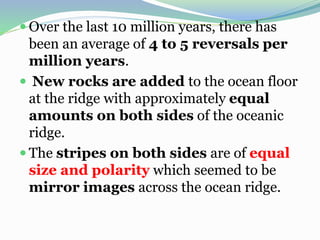
 Over the last 10 million years, there has
been an average of 4 to 5 reversals per
million years.
 New rocks are added to the ocean floor
at the ridge with approximately equal
amounts on both sides of the oceanic
ridge.
 The stripes on both sides are of equal
size and polarity which seemed to be
mirror images across the ocean ridge.
What does this
indicate?
It indicates that
indeed, the seafloor
is spreading.
NET RESULTS
 Spreading rates at transform faults
 Pacific plate moves NW at 8 cm/yr
 N American plate moves W at 2 cm/yr
 Indian plate moves NE at 12 cm/yr
 Pacific Ocean is shrinking and Atlantic
is growing
 Atlantic opened about 200 MY ago so there
should be no rocks older than this in the
Atlantic
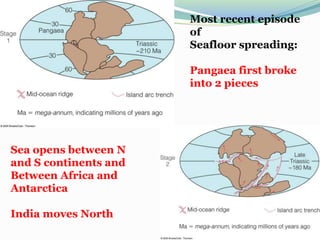
Most recent episode
of
Seafloor spreading:
Pangaea first broke
into 2 pieces
Sea opens between N
and S continents and
Between Africa and
Antarctica
India moves North
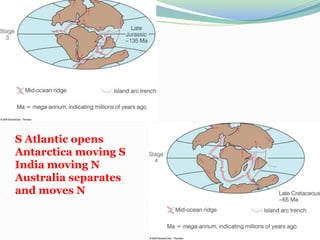
S Atlantic opens
Antarctica moving S
India moving N
Australia separates
and moves N
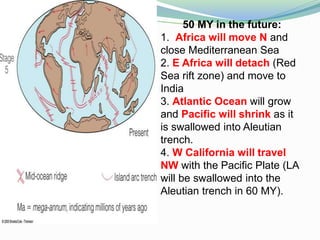
50 MY in the future:
1. Africa will move N and
close Mediterranean Sea
2. E Africa will detach (Red
Sea rift zone) and move to
India
3. Atlantic Ocean will grow
and Pacific will shrink as it
is swallowed into Aleutian
trench.
4. W California will travel
NW with the Pacific Plate (LA
will be swallowed into the
Aleutian trench in 60 MY).
Bring the ff: (by group)
dropper
food color
3-5 small / light wood
blocks
(or sponge cut into thin and
small blocks)

Sea Floor spreading

  • 1.
  • 2.
    Recall:  Scientists knowEarth’s interior is made mostly of layers of _______________.  Some layers, like the center part, called the ______are hard and______.  Other layers are not. The layer next to the center, called the_________, is _______. Both parts of the core are made of___________. inner core; liquid ; rock iron and nickel; outer core; solid
  • 3.
    Recall:  The largestlayer inside Earth is called the _____. It’s neither completely solid nor completely liquid, but_____. It’s extremely______.  Earth’s outermost layer is the______ . This layer is about 5 km thick under the_______ and up to 35 km thick under the______.  On top of the outer layer is the weathered rock called______. continents ; mantle; plastic like crust; oceans; soil; hot
  • 4.
    Despite the evidences presentedby Wegener, WHY was his idea that the continents were once joined together was not accepted by the scientific society? This made scientists conduct further studies in search for the answer.
  • 5.
    1950s and 1960s-new techniques and modern gadgets sonars and submersibles scientists had a clearer view of the ocean floors discovered underwater features deep within the ocean
  • 6.
    a system ofridges or mountains in the seafloor similar to those found in the continents (mid-ocean ridges) Mid-Atlantic Ridge: an undersea mountain chain in the Atlantic Ocean a gigantic cleft about 32-48 km long and 1.6 km deep
  • 7.
  • 8.
    Activity 5: Splitand Separate! Simulate and describe the seafloor spreading process. • Realize the importance of the seafloor spreading process relative to the Continental Drift Theory.
  • 9.
  • 11.
  • 12.
  • 13.
  • 15.
  • 18.
    Sea Floor Spreading early 1960’s- Harry Hess, together with Robert Dietz  Seafloor Spreading Theory  hot, less dense material from below the earth’s crust rises towards the surface at the mid-ocean ridge  material flows sideways carrying the seafloor away from the ridge, and creates a crack in the crust  magma flows out of the crack, cools down and becomes the new seafloor
  • 21.
    Sea Floor Spreading allowed the creation of new bodies of water  the Red Sea -African plate and the Arabian plate diverged  pulling Australia, South America, and Antarctica away from each other in the East Pacific Rise  The East Pacific Rise -the most active sites of seafloor spreading, more than 14 cm/yr
  • 22.
    SFS  rate offormation of a new seafloor is not always as fast as the destruction of the old seafloor at the subduction zone  explains why the Pacific Ocean is getting smaller and why the Atlantic Ocean is getting wider  If subduction is faster than seafloor spreading, the ocean shrinks  When the seafloor spreading is greater than the subduction, then the ocean gets wider
  • 24.
    The SFS contradictsa part of the CDT CDT- continents moved through unmoving oceans and that larger, sturdier continents broke through the oceanic crust Whereas, the seafloor spreading shows that the ocean is the actual site of tectonic activity
  • 25.
    Findings that supportSeafloor Spreading Theory: Rocks are younger at the mid-ocean ridge. Rocks far from the mid-ocean ridge are older. Sediments are thinner at the ridge. Rocks at the ocean floor are younger than those at the continents.
  • 26.
    Bring the ff: Pencil  Ruler
  • 27.
    Activity 6: Howfast does it go! Objectives: • Analyze a magnetic polarity map. • Use legends and scales of the map properly. • Calculate the rate of seafloor spreading using magnetic clues.
  • 28.
    VISIT, EXPLORE, ANSWER http://www.montereyinstitute.org/noaa/lesson02/l 2la1.htm  http://earthguide.ucsd.edu/eoc/teachers/t_tectonic s/p_seafloorspreading.html
  • 29.
  • 30.
    Magnetic Reversal magnetic ‘flip’of the Earth the North Pole is transformed into a South Pole and the South Pole becomes the North Pole due to the change in the direction of flow in the outer core
  • 31.
    Magnetic Reversal  explainedthrough the magnetic patterns in magnetic rocks, especially those found in the ocean floor  When lava solidifies, iron bearing minerals crystallize  the minerals behave like tiny compasses and align with the Earth’s magnetic field so when magnetic reversal occurs, there is also a change in the polarity of the rocks
  • 32.
    Describe and explaineach diagram/illustration.
  • 40.
  • 41.
  • 42.
     Over thelast 10 million years, there has been an average of 4 to 5 reversals per million years.  New rocks are added to the ocean floor at the ridge with approximately equal amounts on both sides of the oceanic ridge.  The stripes on both sides are of equal size and polarity which seemed to be mirror images across the ocean ridge.
  • 43.
    What does this indicate? Itindicates that indeed, the seafloor is spreading.
  • 44.
    NET RESULTS  Spreadingrates at transform faults  Pacific plate moves NW at 8 cm/yr  N American plate moves W at 2 cm/yr  Indian plate moves NE at 12 cm/yr  Pacific Ocean is shrinking and Atlantic is growing  Atlantic opened about 200 MY ago so there should be no rocks older than this in the Atlantic
  • 45.
    Most recent episode of Seafloorspreading: Pangaea first broke into 2 pieces Sea opens between N and S continents and Between Africa and Antarctica India moves North
  • 46.
    S Atlantic opens Antarcticamoving S India moving N Australia separates and moves N
  • 47.
    50 MY inthe future: 1. Africa will move N and close Mediterranean Sea 2. E Africa will detach (Red Sea rift zone) and move to India 3. Atlantic Ocean will grow and Pacific will shrink as it is swallowed into Aleutian trench. 4. W California will travel NW with the Pacific Plate (LA will be swallowed into the Aleutian trench in 60 MY).
  • 48.
    Bring the ff:(by group) dropper food color 3-5 small / light wood blocks (or sponge cut into thin and small blocks)