Sea-Floor Spreading
Standard Explain how constructive and destructive forces (e.g. continental drift, earthquakes, volcanoes, weathering, erosion) change the Earth’s surface.
Essential Question Is the Earth getting bigger or smaller?
What caused Wegener’s theory to be accepted? Evidence of sea-floor spreading New technology called sonar  Sonar allowed sea floor mapping  Huge crack discovered in the middle of the Atlantic Ocean
There is a chain of submerged mountains running through the center of the Atlantic Ocean. This chain is called the Mid-Atlantic Ridge. This ridge is part of a system of ocean ridges. Mid-ocean ridges are underwater mountain chains that run through Earth’s ocean basins.
The Earth’s longest  mountain range is underwater  Mid-Ocean Ridge https://www.ocean.udel.edu/extreme2004/geology/mission/divelocation/ridge.html
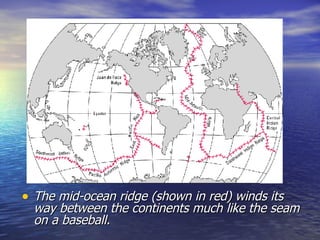
The mid-ocean ridge (shown in red) winds its way between the continents much like the seam on a baseball.
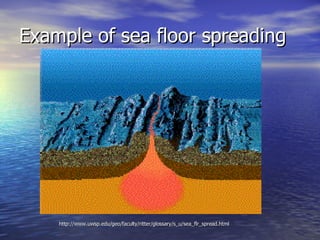
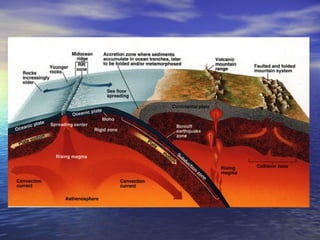
Mid Ocean Ridges are where sea floor spreading occurs. Sea floor spreading is the process by which new oceanic lithosphere is created as older materials are pushed away. As tectonic plates move away from each other, the sea floor spreads apart and magma rises to fill the gap.
 
Example of sea floor spreading http://www.uwsp.edu/geo/faculty/ritter/glossary/s_u/sea_flr_spread.html
Evidence of sea-floor spreading New Molten Material
Evidence of sea-floor spreading Magnetic stripes
 
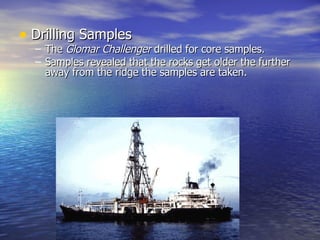
Drilling Samples The  Glomar Challenger  drilled for core samples. Samples revealed that the rocks get older the further away from the ridge the samples are taken.
The crust increases in age the farther it moves away from the mid-ocean ridge. What does this mean exactly? It means that newer rock is closest to the ridge and older rock is farther away. The oldest crust in the Atlantic Ocean is found near the edges of the continents.
Why doesn’t the Earth get bigger? Subduction
 
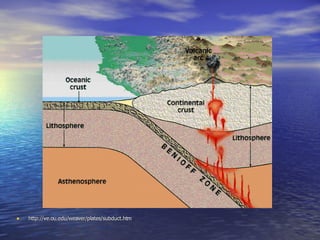
http://ve.ou.edu/weaver/plates/subduct.htm
Oceanic crust is denser than continental crust causing it to subduct under the continental crust when plates converge. When oceanic plates converge, the older and denser plate subducts under the younger and less dense plate. Continental plates converging create mountains.
Subduction is causing the Pacific ocean to get smaller. The Atlantic ocean has few subduction zones and is therefore getting larger.
The theory of Plate Tectonics The proof of sea-floor spreading supported Wegener’s idea that continents move. Both oceanic and continental crust appear to move, so a new theory was devised to explain both continental drift and sea-floor spreading: The Theory of Plate Tectonics.
Major Tectonic Plates
Plate tectonics is the theory that Earth’s lithosphere is divided into tectonic plates that move around on top of the asthenosphere. Scientists have theorized that there are three different ways plates are able to move: convection, slab pull, and ridge push.
Convection In the process of convection, hot material from deep within the Earth rises while cooler material near the surface sinks. When the warmer material cools, it becomes denser and begins to sink back down. The motion of convecting mantle material drags tectonic plates sideways.
 
Ridge Push At mid-ocean ridges, the oceanic lithosphere is higher than it is where it sinks beneath continental lithosphere. Ridge push is the process by which an oceanic plate slides down the lithosphere-asthenosphere boundary.
 
Slab Pull Because oceanic lithosphere is denser than the asthenosphere, the edge of the oceanic plate sinks and pulls the rest of the tectonic plate with it in a process called slab pull.
 

Sea Floor Spreading

  • 1.
  • 2.
    Standard Explain howconstructive and destructive forces (e.g. continental drift, earthquakes, volcanoes, weathering, erosion) change the Earth’s surface.
  • 3.
    Essential Question Isthe Earth getting bigger or smaller?
  • 4.
    What caused Wegener’stheory to be accepted? Evidence of sea-floor spreading New technology called sonar Sonar allowed sea floor mapping Huge crack discovered in the middle of the Atlantic Ocean
  • 5.
    There is achain of submerged mountains running through the center of the Atlantic Ocean. This chain is called the Mid-Atlantic Ridge. This ridge is part of a system of ocean ridges. Mid-ocean ridges are underwater mountain chains that run through Earth’s ocean basins.
  • 6.
    The Earth’s longest mountain range is underwater Mid-Ocean Ridge https://www.ocean.udel.edu/extreme2004/geology/mission/divelocation/ridge.html
  • 7.
    The mid-ocean ridge(shown in red) winds its way between the continents much like the seam on a baseball.
  • 8.
    Mid Ocean Ridgesare where sea floor spreading occurs. Sea floor spreading is the process by which new oceanic lithosphere is created as older materials are pushed away. As tectonic plates move away from each other, the sea floor spreads apart and magma rises to fill the gap.
  • 9.
  • 10.
    Example of seafloor spreading http://www.uwsp.edu/geo/faculty/ritter/glossary/s_u/sea_flr_spread.html
  • 11.
    Evidence of sea-floorspreading New Molten Material
  • 12.
    Evidence of sea-floorspreading Magnetic stripes
  • 13.
  • 14.
    Drilling Samples The Glomar Challenger drilled for core samples. Samples revealed that the rocks get older the further away from the ridge the samples are taken.
  • 15.
    The crust increasesin age the farther it moves away from the mid-ocean ridge. What does this mean exactly? It means that newer rock is closest to the ridge and older rock is farther away. The oldest crust in the Atlantic Ocean is found near the edges of the continents.
  • 16.
    Why doesn’t theEarth get bigger? Subduction
  • 17.
  • 18.
  • 19.
    Oceanic crust isdenser than continental crust causing it to subduct under the continental crust when plates converge. When oceanic plates converge, the older and denser plate subducts under the younger and less dense plate. Continental plates converging create mountains.
  • 20.
    Subduction is causingthe Pacific ocean to get smaller. The Atlantic ocean has few subduction zones and is therefore getting larger.
  • 21.
    The theory ofPlate Tectonics The proof of sea-floor spreading supported Wegener’s idea that continents move. Both oceanic and continental crust appear to move, so a new theory was devised to explain both continental drift and sea-floor spreading: The Theory of Plate Tectonics.
  • 22.
  • 23.
    Plate tectonics isthe theory that Earth’s lithosphere is divided into tectonic plates that move around on top of the asthenosphere. Scientists have theorized that there are three different ways plates are able to move: convection, slab pull, and ridge push.
  • 24.
    Convection In theprocess of convection, hot material from deep within the Earth rises while cooler material near the surface sinks. When the warmer material cools, it becomes denser and begins to sink back down. The motion of convecting mantle material drags tectonic plates sideways.
  • 25.
  • 26.
    Ridge Push Atmid-ocean ridges, the oceanic lithosphere is higher than it is where it sinks beneath continental lithosphere. Ridge push is the process by which an oceanic plate slides down the lithosphere-asthenosphere boundary.
  • 27.
  • 28.
    Slab Pull Becauseoceanic lithosphere is denser than the asthenosphere, the edge of the oceanic plate sinks and pulls the rest of the tectonic plate with it in a process called slab pull.
  • 29.