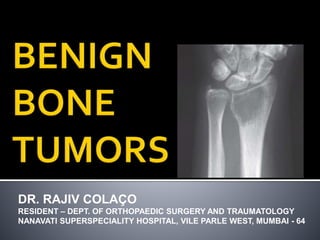
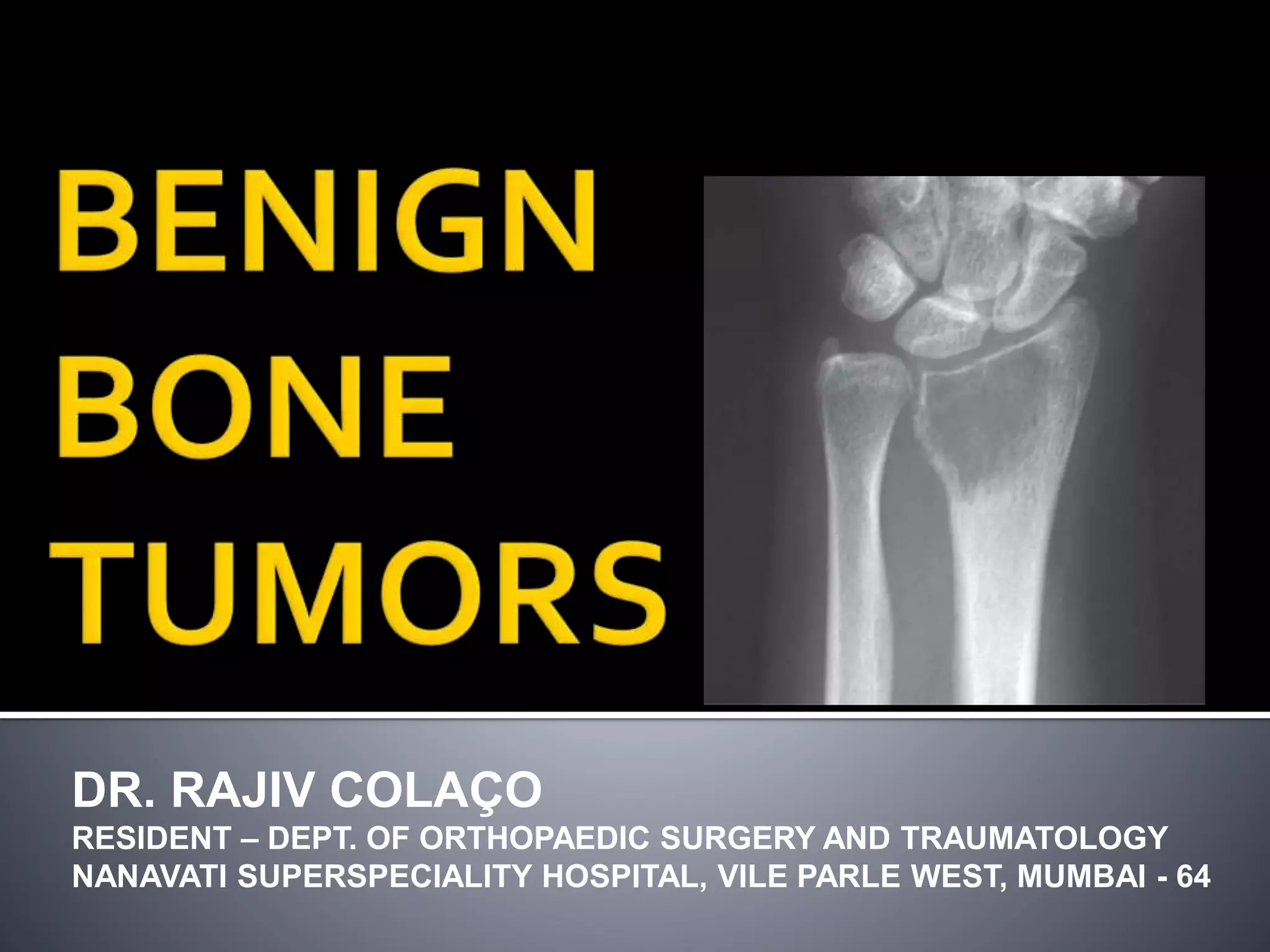
DR. RAJIV COLAÇO
RESIDENT – DEPT. OF ORTHOPAEDIC SURGERY AND TRAUMATOLOGY
NANAVATI SUPERSPECIALITY HOSPITAL, VILE PARLE WEST, MUMBAI - 64
 BONE FORMINGTUMORS
- Osteoid Osteoma
- Bone Island
 CARTILAGINOUSTUMORS
-Chondroma
-Osteochondroma
 FIBROUS LESIONS
- Non-ossifying fibroma
- Cortical Desmoid
- Benign Fibrous Histiocytoma
- Fibrous Dysplasia
- Osteofibrous Dysplasia
- Desmoplastic Fibroma
 CYSTIC LESIONS
- Unicameral Bone Cyst
- Aneurysmal Bone Cyst
 FATTYTUMORS
- Lipoma
 VASCULARTUMORS
- Haemangioma
 NON-NEOPLASTIC CONDITIONS MIMICKING BONE
TUMORS
- Pagets’ Disease
- BrownTumor
- Bone infarct, osteomyelitis, stress fracture, post-
traumatic osteolysis
 BENIGN/AGGRESSIVETUMORS
- Giant CellTumor
- Chondroblastoma
- Chondromyxoid Fibroma
- Osteoblastoma
- Langerhans’Cell Histiocytosis
 FATTY
- Lipoma
 NERVE SHEATHTUMORS
- Neurilemmoma (Schwannoma)
- Neurofibroma
 SYNOVIAL LESIONS
- Synovial chondromatosis
- PigmentedVillonodular Synovitis
- Germ CellTumor ofTendon Sheath
 VASCULAR
- Intramuscular haemangioma
- GlomusTumor
 FIBROUS LESIONS
- Nodular Fascitis
- Desmoid tumors
 Common in 2nd-3rd decades
 M:F – 3:1
 Common sites – Lower extremities – long
bones, Spine
 Typical pain – worse at night, relieved by
NSAIDS.
 Joint – Stiffness, swelling, contracture
Spine – Scoliosis
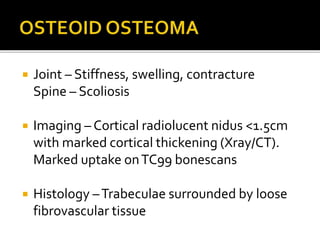
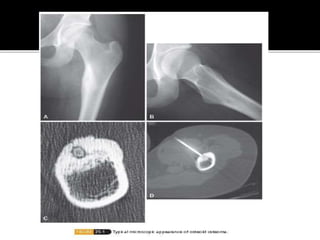
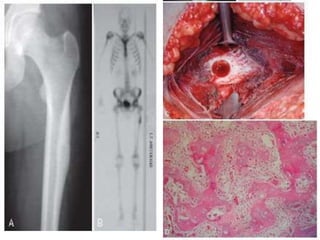
 Imaging – Cortical radiolucent nidus <1.5cm
with marked cortical thickening (Xray/CT).
Marked uptake onTC99 bonescans
 Histology –Trabeculae surrounded by loose
fibrovascular tissue
 Treatment
- NSAIDS
- Burr DownTechnique
- RF ablation
 A.K.A “Enostoses”
 Benign lesions of cancellous bone
 Common in adults, sites – Pelvis, femur
 Usually asymptomatic
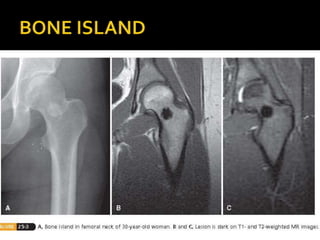
 Imaging studies - Small round area of
increased density in cancellous bone with
radiating spicules at periphery.
 Mature bone with thickened trabeculae that
merge with normal bone at the periphery
 Treatment – Observation.
 If patient experiences pain and lesion grows,
biopsy done to rule out more aggressive
lesions such as sclerosing osteosarcoma,
blastic metastasis or a sclerotic myeloma.
 Benign lesions of hyaline cartilage
 Common in adults; M=F
 Common sites – Phalanges of the hand, small
bones of hand and feet
 Asymptomatic usually, discovered
incidentally/after a pathologic fracture
 Intramedullary canal – “Enchondroma”
 Olliers’ Disease – Multiple enchondromatosis
– cartilaginous tumors appear in the large and
small tubular bones and in flat bones – due to
failure of normal enchondral ossification.
 Olliers’ + Haemangiomas = Maffucci
syndrome
 Imaging - Lobulated areas of stippled
calcification (Popcorn/punctate calcification),
Minimal cortical erosion (except in hand).
 Histology - Benign-appearing hyaline
cartilage.
 Solitary Enchondromas – Observation with
serial radiographs. If stable radiographically,
no further intervention is indicated.
 Symptomatic – Curretage
 Multiple enchondromatoses – Deformities
treated by osteotomy
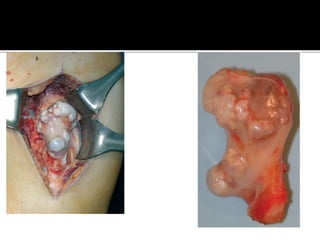
 More developmental malformations than true
neoplasms
 Originate within the periosteum as small
cartilaginous models
 Slight male predominance. 2nd-3rd decade.
Metaphysis of long bones
 Multiple hereditary exostoses (MHE) is
autosomal dominant —mutation of EXT1 or
EXT2
 Presentation - Mass; may be painful
secondary to irritation of soft tissue
structures, fracture, or overlying bursa.
 Two types – Pedunculated or Sessile.
Pedunculated more common.
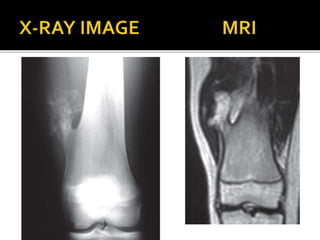
 Imaging studies – Plain radiograph/CT/MRI
(Confirmatory) – Pedunculated or sessile
bone lesion that communicates with the
intramedullary canal of the host bone +
Cartilage cap
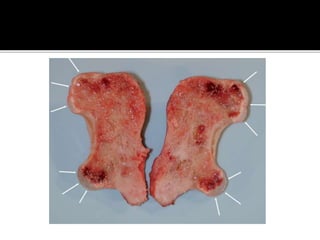
 Histological features – Similar to epiphysis of
the bone which undergoes enchondral
ossification
 Treatment – Observation if asymptomatic
En bloc resection – if symptomatic, with
removal of the cartilage cap.
 Malignant degeneration – rare – 1% solitary,
5% in multiple hereditary exostoses.
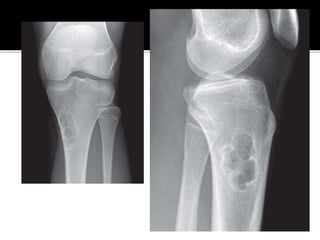
 AKA – metaphyseal fibrous defects, fibrous
cortical defects and fibroxanthomas
 Common developmental abnormalities – 1st-
2nd decade
 Site – Metaphyseal region of long bones;
mostly in distal femur, tibia and fibula
 Radiology –Well defined lobulated lesion
located eccentrically in the metaphysis with
sclerotic margins
 Presentation – Incidental finding on xrays /
pathological fracture at the site of lesion
 Histology – Bland appearing spindle cells
arranged in a storiform pattern within a
collagenous matrix. Fibroblastic proliferation
is present.
 Jaffe-Campanacci syndrome – Multiple non-
ossifying fibromas with café-au-lait spots.
 Treatment – Observation, curettage if large
Fractures are usually treated non-operatively.
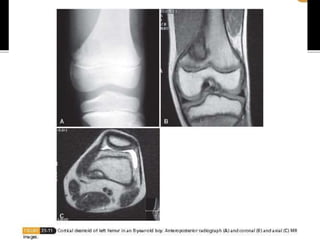
 Irregularity in the posteromedial aspect of
the distal femoral epiphysis, possibly a
reaction to the pull of adductor magnus
 2nd decade of life. Males.
 Usually asymptomatic. Xray shows erosion of
the posteromedial distal femoral cortex with
a sclerotic base. Best seen with LL externally
rotated 20-45 degrees.
 Histology – Fibrous tissue with collagenous
stroma. Similar to NOF.
 Treatment - Observation
 Dahlin in 1978
 Common in 4th – 5th decades. Equal predilection
in both sexes.
 More common in soft tissues than bone. Pelvis,
femur
 Histologically similar to non-ossifying fibroma
but much more aggressive in behaviour and
radiological characteristics.
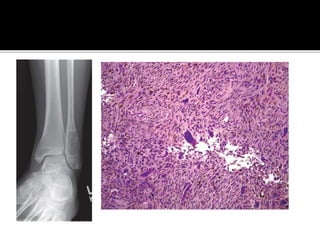
 Presentation – progressive pain
 Xray – Lytic, expanding lobulated centrally
lucent lesion with sclerotic rim with little
periosteal reaction.
 Treatment – Curretage – extended or wide
resection d/t local recurrence.
 Replacement of normal bone and marrow by
fibrous tissue and small, woven spicules of
bone. Monostotic/Polyostotic.
 Common – 1st to 3rd decades. M=F
Can occur in the epiphysis, metaphysis or
diaphysis
 Presentation – Pain, deformity, cutaneous
pigmentation and endocrine abnormalities
(McCune Albright Syndrome), sexual
precocity, intramuscular myxoma
(Mazabraud syndrome) and thyroid disease.
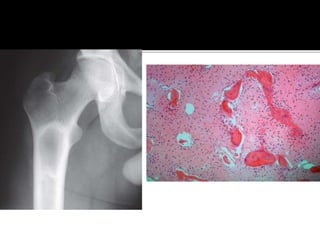
 Histology – Irregularly woven bone spicules
with a fibrous stroma
 Imaging – Ground glass appearance, granular
with a well-defined sclerotic rim. Small areas
of cartilaginous metaplasia and cystic
changes may be present
 Treatment – Surgical treatment – significant
deformity or pathological fracture or pain –
intramedullary fixation/osteotomy.
Treatment with bisphosphonates for
extensive disease
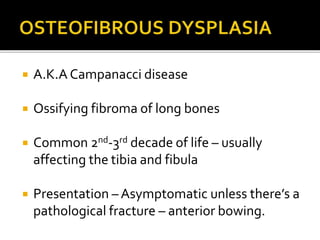
 A.K.A Campanacci disease
 Ossifying fibroma of long bones
 Common 2nd-3rd decade of life – usually
affecting the tibia and fibula
 Presentation – Asymptomatic unless there’s a
pathological fracture – anterior bowing.
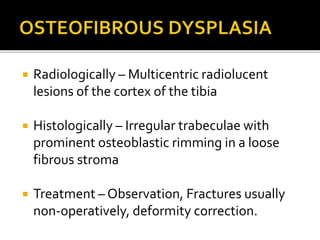
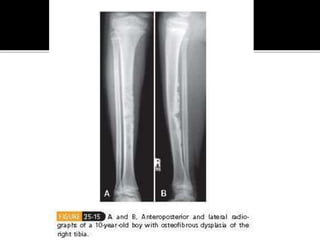
 Radiologically – Multicentric radiolucent
lesions of the cortex of the tibia
 Histologically – Irregular trabeculae with
prominent osteoblastic rimming in a loose
fibrous stroma
 Treatment – Observation, Fractures usually
non-operatively, deformity correction.
 Extremely rare, locally aggressive benign bone
tumor – bony counterpart of the desmoid tumor.
 All age groups – comm0n in 2nd and 3rd decade
 Long tubular bones most often involved apart
from skull, mandible, pelvis and spine
 Pain is the chief complaint + Pathological
fracture
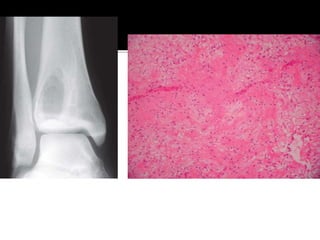
 Radiological – Radiolucent lesion with cortical
erosion; may have septations; soft tissue
mass
 Histologically – Fibroblastic, hypocellular,
much collagen and few mitoses
 Treatment options – extended curettage,
wide resection. Adjuvant treatments –
radiation, anti-inflammatory agents,
tamoxifen and cytotoxic agents.
 Developmental/reactive lesion
 1st – 2nd decades. M:F = 2:1
 Any extremity; most common – proximal
humerus and femur. Ilium and calcaneum.
 Active during skeletal growth and heal
spontaneously at maturity
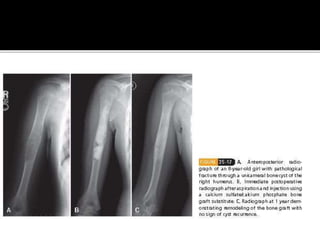
 Asymptomatic unless pathological fracture
 Radiologically – Centrally located, purely
radiolucent lesion which concentrically
expands the cortex. No cortical destruction
 Cyst filled with straw colored fluid.Thin
fibrovascular lining.
 Observation
 Aspiration
 Injection of steroids/bone marrow/bone graft
substitutes
 Curretage
 Locally destructive, blood filled reactive
lesions of bone.
 Any bone. Most commonly proximal
humerus, distal femur, proximal tibia and
spine – 15% (posterior elements)
 Common in 1st-2nd decade, female
predominance.
 Presentation – Pain. Rapid growth can mimic
a malignancy. Spinal lesions – neurological
deficits.
 Radiology – Eccentric, expansile radiolucent
lesion, thin cortical shell. Fluid levels evident
on MRI
 Histology – Haemorrhagic cavernous spaces,
septae of fibroblasts, histiocytes,
haemosiderin laden macrophages and giant
cells.
 Solid variant of aneurysmal bone cyst – “giant
cell reparative granuloma”
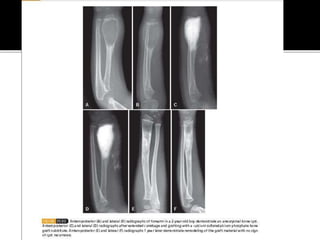
 Surgical treatment – extended curretage and
grafting with a bone graft substitute under
tourniquet control.
 Spine/Pelvic lesions – Preoperative
embolization.
 Low dose radiation – associated with
malignant transformation.
 Occur in the ends of long bones of middle aged
men – particularly distal tibia.
 Intraosseous extensions of ganglia of local soft
tissues
 Xray/MRI – uniloculated or multiloculated, well
demarcated with a rim of sclerotic bone.
 Treatment 0 Local excision of overlying soft
tissue and curretage
 Cysts filled with keratinous material
 Histologically lined with squamous
epithelium.
 Resemble epidermal inclusion cysts of the
skin.
 Rarefied defects surrounded by sclerotic
bone
 Relatively rare
 Adults, M=F
 Asymptomatic, discovered as incidental
findings.
 Radiology –Well defined lucencies with a thin
rim of reactive bone.
 Histologically – Fatty tissue with focal areas
of necrosis.
 Surgery – only if symptomatic – simple
curretage
 Common benign bone lesion. 10% population
has asymptomatic lesions in vertebral bodies.
 Skull, long bones uncommon.
 Usually incidental findings.
 Rarely symptomatic unless there is vertebral
collapse or nerve root or cord compression.
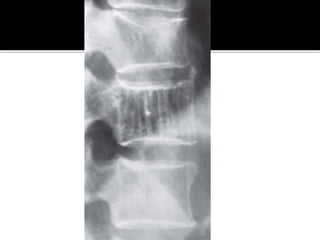
 Radiographic appearance – Characteristic
thickened vertically oriented trabeculae –
“Jailhouse” appearance
Cross section – “Polka-dot” pattern
 MRI – bright onT1 andT2 weighted images.
 Asymptomatic – no treatment required
 Vertebral collapse with neurological deficit –
decompression with spinal stabilization.
Long bones – extended curretage
Pre-op embolization to prevent blood loss.
Low dose radiation – risk of malignant
transformation
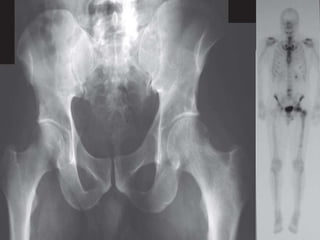
 Disorder of unregulated bone turnover
 Common in 5th-8th decades
 Slight male predominance
 Common sites – vertebral body, pelvis,
proximal femur
 Pathophysiology – excessive osteoclastic
resorption followed by increased osteoblastic
activity. Early lytic phase followed by
excessive bone production with cortical and
trabecular thickening
 Radiographically – depending on the stage of
the disease
Lytic phase – Bone resorption – “Blade of
grass” or “Flame” appearance from end of
bone towards diaphysis.
Later – bony sclerosis, thickened cortices and
trabeculae
 Bone scan - increased uptake, MRI
 Biopsy – Mosaic pattern with widened
lamellae, irregular cement lines and
fibrovascular connective tissue.
 1% - bone sarcoma - osteosarcoma
 Treatment – NSAIDS, Calcitonin or
bisphosphonates.
Activity – monitored by S. ALP and urine
pyridinium crosslinks.
 Surgical correction of deformity and
pathological fracture.
 Common in adults, M=F
 Can affect any bone
 Hyperparathyoridism
1 – Adenoma
2 – Patients with CRF
 Focal demineralization – “BrownTumor”
 Presentation – Asymptomatic, a/w
pathological fracture and symptoms of
hypercalcemia (nausea, vomiting, weakness,
headaches, generalized bone pain)
 Radiology – Diffuse osteopenia, multifocal
radiolucent lesions with surrounding reactive
bone
 Histology – Giant cells, increased osteoclastic
activity, marrow fibrosis.
 Diagnosis – S. Ca( ),P, ALP( ), PTH
 Medical Management – Secondary
Hyperparathyoridism –Treat CRF/VitD
deficiency
 Surgical Management – Parathyroid
adenoma excision
Treating actual/impending pathological
fractures
Benign tumors in orthopaedics

Benign tumors in orthopaedics

  • 1.
    DR. RAJIV COLAÇO RESIDENT– DEPT. OF ORTHOPAEDIC SURGERY AND TRAUMATOLOGY NANAVATI SUPERSPECIALITY HOSPITAL, VILE PARLE WEST, MUMBAI - 64
  • 2.
     BONE FORMINGTUMORS -Osteoid Osteoma - Bone Island  CARTILAGINOUSTUMORS -Chondroma -Osteochondroma
  • 3.
     FIBROUS LESIONS -Non-ossifying fibroma - Cortical Desmoid - Benign Fibrous Histiocytoma - Fibrous Dysplasia - Osteofibrous Dysplasia - Desmoplastic Fibroma
  • 4.
     CYSTIC LESIONS -Unicameral Bone Cyst - Aneurysmal Bone Cyst  FATTYTUMORS - Lipoma  VASCULARTUMORS - Haemangioma  NON-NEOPLASTIC CONDITIONS MIMICKING BONE TUMORS - Pagets’ Disease - BrownTumor - Bone infarct, osteomyelitis, stress fracture, post- traumatic osteolysis
  • 5.
     BENIGN/AGGRESSIVETUMORS - GiantCellTumor - Chondroblastoma - Chondromyxoid Fibroma - Osteoblastoma - Langerhans’Cell Histiocytosis
  • 6.
     FATTY - Lipoma NERVE SHEATHTUMORS - Neurilemmoma (Schwannoma) - Neurofibroma  SYNOVIAL LESIONS - Synovial chondromatosis - PigmentedVillonodular Synovitis - Germ CellTumor ofTendon Sheath  VASCULAR - Intramuscular haemangioma - GlomusTumor  FIBROUS LESIONS - Nodular Fascitis - Desmoid tumors
  • 7.
     Common in2nd-3rd decades  M:F – 3:1  Common sites – Lower extremities – long bones, Spine  Typical pain – worse at night, relieved by NSAIDS.
  • 8.
     Joint –Stiffness, swelling, contracture Spine – Scoliosis  Imaging – Cortical radiolucent nidus <1.5cm with marked cortical thickening (Xray/CT). Marked uptake onTC99 bonescans  Histology –Trabeculae surrounded by loose fibrovascular tissue
  • 9.
     Treatment - NSAIDS -Burr DownTechnique - RF ablation
  • 12.
     A.K.A “Enostoses” Benign lesions of cancellous bone  Common in adults, sites – Pelvis, femur  Usually asymptomatic
  • 13.
     Imaging studies- Small round area of increased density in cancellous bone with radiating spicules at periphery.  Mature bone with thickened trabeculae that merge with normal bone at the periphery
  • 14.
     Treatment –Observation.  If patient experiences pain and lesion grows, biopsy done to rule out more aggressive lesions such as sclerosing osteosarcoma, blastic metastasis or a sclerotic myeloma.
  • 16.
     Benign lesionsof hyaline cartilage  Common in adults; M=F  Common sites – Phalanges of the hand, small bones of hand and feet  Asymptomatic usually, discovered incidentally/after a pathologic fracture
  • 17.
     Intramedullary canal– “Enchondroma”  Olliers’ Disease – Multiple enchondromatosis – cartilaginous tumors appear in the large and small tubular bones and in flat bones – due to failure of normal enchondral ossification.  Olliers’ + Haemangiomas = Maffucci syndrome
  • 18.
     Imaging -Lobulated areas of stippled calcification (Popcorn/punctate calcification), Minimal cortical erosion (except in hand).  Histology - Benign-appearing hyaline cartilage.
  • 19.
     Solitary Enchondromas– Observation with serial radiographs. If stable radiographically, no further intervention is indicated.  Symptomatic – Curretage  Multiple enchondromatoses – Deformities treated by osteotomy
  • 21.
     More developmentalmalformations than true neoplasms  Originate within the periosteum as small cartilaginous models  Slight male predominance. 2nd-3rd decade. Metaphysis of long bones  Multiple hereditary exostoses (MHE) is autosomal dominant —mutation of EXT1 or EXT2
  • 22.
     Presentation -Mass; may be painful secondary to irritation of soft tissue structures, fracture, or overlying bursa.  Two types – Pedunculated or Sessile. Pedunculated more common.
  • 23.
     Imaging studies– Plain radiograph/CT/MRI (Confirmatory) – Pedunculated or sessile bone lesion that communicates with the intramedullary canal of the host bone + Cartilage cap
  • 27.
     Histological features– Similar to epiphysis of the bone which undergoes enchondral ossification  Treatment – Observation if asymptomatic En bloc resection – if symptomatic, with removal of the cartilage cap.  Malignant degeneration – rare – 1% solitary, 5% in multiple hereditary exostoses.
  • 28.
     AKA –metaphyseal fibrous defects, fibrous cortical defects and fibroxanthomas  Common developmental abnormalities – 1st- 2nd decade  Site – Metaphyseal region of long bones; mostly in distal femur, tibia and fibula
  • 29.
     Radiology –Welldefined lobulated lesion located eccentrically in the metaphysis with sclerotic margins  Presentation – Incidental finding on xrays / pathological fracture at the site of lesion
  • 30.
     Histology –Bland appearing spindle cells arranged in a storiform pattern within a collagenous matrix. Fibroblastic proliferation is present.  Jaffe-Campanacci syndrome – Multiple non- ossifying fibromas with café-au-lait spots.
  • 31.
     Treatment –Observation, curettage if large Fractures are usually treated non-operatively.
  • 33.
     Irregularity inthe posteromedial aspect of the distal femoral epiphysis, possibly a reaction to the pull of adductor magnus  2nd decade of life. Males.  Usually asymptomatic. Xray shows erosion of the posteromedial distal femoral cortex with a sclerotic base. Best seen with LL externally rotated 20-45 degrees.
  • 34.
     Histology –Fibrous tissue with collagenous stroma. Similar to NOF.  Treatment - Observation
  • 36.
     Dahlin in1978  Common in 4th – 5th decades. Equal predilection in both sexes.  More common in soft tissues than bone. Pelvis, femur  Histologically similar to non-ossifying fibroma but much more aggressive in behaviour and radiological characteristics.
  • 37.
     Presentation –progressive pain  Xray – Lytic, expanding lobulated centrally lucent lesion with sclerotic rim with little periosteal reaction.  Treatment – Curretage – extended or wide resection d/t local recurrence.
  • 39.
     Replacement ofnormal bone and marrow by fibrous tissue and small, woven spicules of bone. Monostotic/Polyostotic.  Common – 1st to 3rd decades. M=F Can occur in the epiphysis, metaphysis or diaphysis
  • 40.
     Presentation –Pain, deformity, cutaneous pigmentation and endocrine abnormalities (McCune Albright Syndrome), sexual precocity, intramuscular myxoma (Mazabraud syndrome) and thyroid disease.  Histology – Irregularly woven bone spicules with a fibrous stroma
  • 41.
     Imaging –Ground glass appearance, granular with a well-defined sclerotic rim. Small areas of cartilaginous metaplasia and cystic changes may be present  Treatment – Surgical treatment – significant deformity or pathological fracture or pain – intramedullary fixation/osteotomy. Treatment with bisphosphonates for extensive disease
  • 43.
     A.K.A Campanaccidisease  Ossifying fibroma of long bones  Common 2nd-3rd decade of life – usually affecting the tibia and fibula  Presentation – Asymptomatic unless there’s a pathological fracture – anterior bowing.
  • 44.
     Radiologically –Multicentric radiolucent lesions of the cortex of the tibia  Histologically – Irregular trabeculae with prominent osteoblastic rimming in a loose fibrous stroma  Treatment – Observation, Fractures usually non-operatively, deformity correction.
  • 46.
     Extremely rare,locally aggressive benign bone tumor – bony counterpart of the desmoid tumor.  All age groups – comm0n in 2nd and 3rd decade  Long tubular bones most often involved apart from skull, mandible, pelvis and spine  Pain is the chief complaint + Pathological fracture
  • 47.
     Radiological –Radiolucent lesion with cortical erosion; may have septations; soft tissue mass  Histologically – Fibroblastic, hypocellular, much collagen and few mitoses
  • 49.
     Treatment options– extended curettage, wide resection. Adjuvant treatments – radiation, anti-inflammatory agents, tamoxifen and cytotoxic agents.
  • 50.
     Developmental/reactive lesion 1st – 2nd decades. M:F = 2:1  Any extremity; most common – proximal humerus and femur. Ilium and calcaneum.  Active during skeletal growth and heal spontaneously at maturity
  • 51.
     Asymptomatic unlesspathological fracture  Radiologically – Centrally located, purely radiolucent lesion which concentrically expands the cortex. No cortical destruction  Cyst filled with straw colored fluid.Thin fibrovascular lining.
  • 52.
     Observation  Aspiration Injection of steroids/bone marrow/bone graft substitutes  Curretage
  • 54.
     Locally destructive,blood filled reactive lesions of bone.  Any bone. Most commonly proximal humerus, distal femur, proximal tibia and spine – 15% (posterior elements)  Common in 1st-2nd decade, female predominance.
  • 55.
     Presentation –Pain. Rapid growth can mimic a malignancy. Spinal lesions – neurological deficits.  Radiology – Eccentric, expansile radiolucent lesion, thin cortical shell. Fluid levels evident on MRI
  • 56.
     Histology –Haemorrhagic cavernous spaces, septae of fibroblasts, histiocytes, haemosiderin laden macrophages and giant cells.  Solid variant of aneurysmal bone cyst – “giant cell reparative granuloma”
  • 57.
     Surgical treatment– extended curretage and grafting with a bone graft substitute under tourniquet control.  Spine/Pelvic lesions – Preoperative embolization.  Low dose radiation – associated with malignant transformation.
  • 59.
     Occur inthe ends of long bones of middle aged men – particularly distal tibia.  Intraosseous extensions of ganglia of local soft tissues  Xray/MRI – uniloculated or multiloculated, well demarcated with a rim of sclerotic bone.  Treatment 0 Local excision of overlying soft tissue and curretage
  • 60.
     Cysts filledwith keratinous material  Histologically lined with squamous epithelium.  Resemble epidermal inclusion cysts of the skin.  Rarefied defects surrounded by sclerotic bone
  • 61.
     Relatively rare Adults, M=F  Asymptomatic, discovered as incidental findings.  Radiology –Well defined lucencies with a thin rim of reactive bone.
  • 62.
     Histologically –Fatty tissue with focal areas of necrosis.  Surgery – only if symptomatic – simple curretage
  • 63.
     Common benignbone lesion. 10% population has asymptomatic lesions in vertebral bodies.  Skull, long bones uncommon.  Usually incidental findings.  Rarely symptomatic unless there is vertebral collapse or nerve root or cord compression.
  • 64.
     Radiographic appearance– Characteristic thickened vertically oriented trabeculae – “Jailhouse” appearance Cross section – “Polka-dot” pattern
  • 66.
     MRI –bright onT1 andT2 weighted images.  Asymptomatic – no treatment required  Vertebral collapse with neurological deficit – decompression with spinal stabilization. Long bones – extended curretage Pre-op embolization to prevent blood loss. Low dose radiation – risk of malignant transformation
  • 67.
     Disorder ofunregulated bone turnover  Common in 5th-8th decades  Slight male predominance  Common sites – vertebral body, pelvis, proximal femur
  • 68.
     Pathophysiology –excessive osteoclastic resorption followed by increased osteoblastic activity. Early lytic phase followed by excessive bone production with cortical and trabecular thickening
  • 69.
     Radiographically –depending on the stage of the disease Lytic phase – Bone resorption – “Blade of grass” or “Flame” appearance from end of bone towards diaphysis. Later – bony sclerosis, thickened cortices and trabeculae
  • 70.
     Bone scan- increased uptake, MRI  Biopsy – Mosaic pattern with widened lamellae, irregular cement lines and fibrovascular connective tissue.  1% - bone sarcoma - osteosarcoma
  • 71.
     Treatment –NSAIDS, Calcitonin or bisphosphonates. Activity – monitored by S. ALP and urine pyridinium crosslinks.  Surgical correction of deformity and pathological fracture.
  • 73.
     Common inadults, M=F  Can affect any bone  Hyperparathyoridism 1 – Adenoma 2 – Patients with CRF
  • 74.
     Focal demineralization– “BrownTumor”  Presentation – Asymptomatic, a/w pathological fracture and symptoms of hypercalcemia (nausea, vomiting, weakness, headaches, generalized bone pain)
  • 75.
     Radiology –Diffuse osteopenia, multifocal radiolucent lesions with surrounding reactive bone  Histology – Giant cells, increased osteoclastic activity, marrow fibrosis.  Diagnosis – S. Ca( ),P, ALP( ), PTH
  • 76.
     Medical Management– Secondary Hyperparathyoridism –Treat CRF/VitD deficiency  Surgical Management – Parathyroid adenoma excision Treating actual/impending pathological fractures