CONGENITAL
PSEUDARTHROSIS OF TIBIA
Dr. Sidharth Yadav
Orthopaedic Dept.
N.K.P.SIMS
DEFINITION
 Pseudarthrosis is a
false joint associated
with abnormal
movements at the site
INTRODUCTION
 Congenital pseudarthrosis of tibia refers to nonunion of
tibial fracture that develops spontaneously or after trival
trauma in a dysplastic bone segment of tibia diaphysis.
 CPT is rare & Usually develops in first 2 yrs of life.
 Etiology is unclear.
 Incidence is 1: 250,000
 There is a strong association of CPT with
neurofibromatosis type 1.
CLINICAL FEATURES
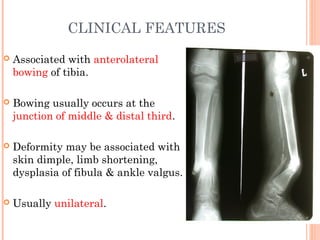
 Associated with anterolateral
bowing of tibia.
 Bowing usually occurs at the
junction of middle & distal third.
 Deformity may be associated with
skin dimple, limb shortening,
dysplasia of fibula & ankle valgus.
 Usually unilateral.
NEUROFIBROMATOSIS
 NF-1 occurs due to mutation on the gene coding for
NEUROFIBROMIN on chromosome 17.
 Neurofibromin is expressed in a broad range of cells & tissue
type.
 It negatively regulates Ras activity ( cell proliferation &
function)
 It’s deficiency leads to increased Ras activity.
 Affects Ras-dependent MAPK( mitogen activated protein
kinase) activity which is essential for osteoclast function &
survival.
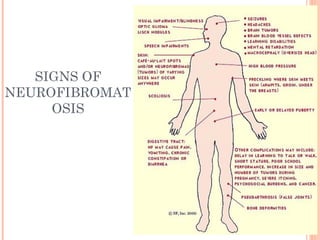
SIGNS OF
NEUROFIBROMAT
OSIS
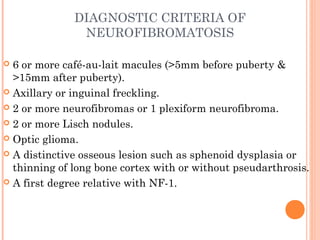
DIAGNOSTIC CRITERIA OF
NEUROFIBROMATOSIS
 6 or more café-au-lait macules (>5mm before puberty &
>15mm after puberty).
 Axillary or inguinal freckling.
 2 or more neurofibromas or 1 plexiform neurofibroma.
 2 or more Lisch nodules.
 Optic glioma.
 A distinctive osseous lesion such as sphenoid dysplasia or
thinning of long bone cortex with or without pseudarthrosis.
 A first degree relative with NF-1.
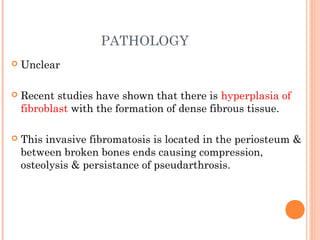
PATHOLOGY
 Unclear
 Recent studies have shown that there is hyperplasia of
fibroblast with the formation of dense fibrous tissue.
 This invasive fibromatosis is located in the periosteum &
between broken bones ends causing compression,
osteolysis & persistance of pseudarthrosis.
PATHOLOGY
 Paley et al theorized that pathology of pseudarthrosis is not
bony but rather its periosteal in origin.
 This theory was also considered by CODAVILLA a century
ago.
 This theory is supported by following observation :-
 Thickening with hamartomatous transformation of periosteum.
 Appearance of strangulation of bone with atrophic changes
followed by avascular changes.
 Failure of remodelling of pin tracts leading to stress fractures.
PATHOLOGY
 Pathologic analysis of HERMANNS-SACHWEB et al
confirmed that pathologic periosteum is the cause of
CPT.
 There finding was :-
 Neural cells form a tight sheath around the periosteal
vessels.
 Peiosteum undergoes hypoxemic changes resulting in the
formation of a thick fibrous cuff.
 Leads to impaired oxygen & nutrient supply to the
subperiosteal bone & atrophic changes are observed.
CLASSIFICATION
 There is no universally agreed system based on both
clinical features & radiographic findings.
 CAMURATI - 1930
 ADGLEY - 1952
 BOYD - 1958
 APOIL - 1970
 ANDERSEN - 1973
 CRAWFORD - 1986
 CRAWFORD - 1999
 BOYD & ANDERSEN are commonly used.
BOYD CLASSIFICATION
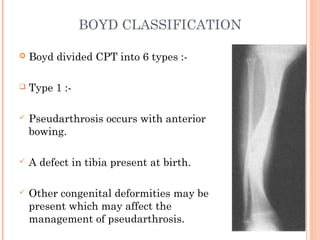
 Boyd divided CPT into 6 types :-
 Type 1 :-
 Pseudarthrosis occurs with anterior
bowing.
 A defect in tibia present at birth.
 Other congenital deformities may be
present which may affect the
management of pseudarthrosis.
BOYD CLASSIFICATION
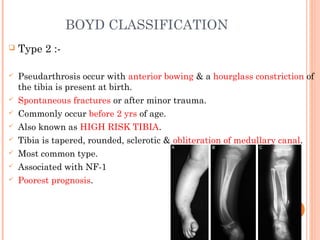
 Type 2 :-
 Pseudarthrosis occur with anterior bowing & a hourglass constriction of
the tibia is present at birth.
 Spontaneous fractures or after minor trauma.
 Commonly occur before 2 yrs of age.
 Also known as HIGH RISK TIBIA.
 Tibia is tapered, rounded, sclerotic & obliteration of medullary canal.
 Most common type.
 Associated with NF-1
 Poorest prognosis.
BOYD CLASSIFICATION
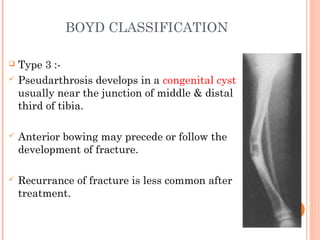
 Type 3 :-
 Pseudarthrosis develops in a congenital cyst
usually near the junction of middle & distal
third of tibia.
 Anterior bowing may precede or follow the
development of fracture.
 Recurrance of fracture is less common after
treatment.
BOYD CLASSIFICATION
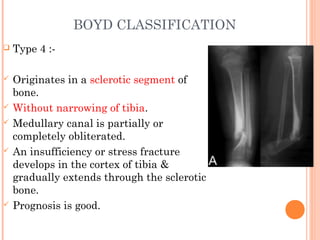
 Type 4 :-
 Originates in a sclerotic segment of
bone.
 Without narrowing of tibia.
 Medullary canal is partially or
completely obliterated.
 An insufficiency or stress fracture
develops in the cortex of tibia &
gradually extends through the sclerotic
bone.
 Prognosis is good.
BOYD CLASSIFICATION
 Type 5 :-
 Pseudarthrosis of tibia occurs with a dysplastic fibula.
 Pseudarthrosis of both bone may develop.
 Prognosis is good if the lesion is confined to fibula.
 If the lesion progress to tibia then the natural h/o usually
resembles type 2.
 Type 6 :-
 Occurs as an intraosseous neurofibroma or schwannoma
 Extremely rare.
CRAWFORD CLASSIFICATION
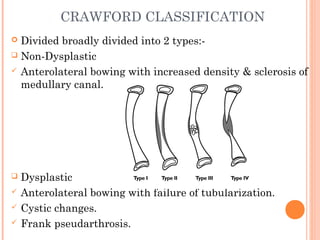
 Divided broadly divided into 2 types:-
 Non-Dysplastic
 Anterolateral bowing with increased density & sclerosis of
medullary canal.
 Dysplastic
 Anterolateral bowing with failure of tubularization.
 Cystic changes.
 Frank pseudarthrosis.
ANDERSEN CLASSIFICATION
 Also divided into 6 types :-
 Club foot
 Cystic
 Late
 Fibular
 Dysplastic
 Angulated
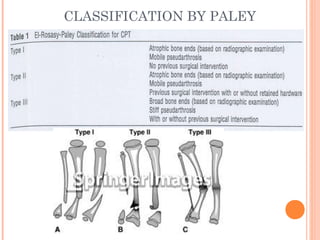
CLASSIFICATION BY PALEY
TREATMENT
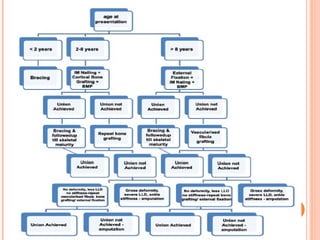
 Treatment of CPT depends upon age of the patient & type of
pseudarthrosis.
 Decision has to be taken whether to attempt to secure union
or amputation is the treatment of choice.
 No single treatment approach has proven ideal .
 True pseudarthrosis does not heal when treated with casting
alone.
TREATMENT
 Goals of treatment :-
 Complete excision of the soft tissue fibromatosis at the
site of pseudarthrosis.
 Correction of angular deformity.
 Stimulation of bone healing.
 Proper fixation of bone fragments.
 Postoperative protection .
TREATMENT
 Is divided into 2 types :-
 Prophylactic :-
 Decreased activity.
 Orthotics or cast.
 Curettage with bone grafting.
 Active :-
 Surgical treatment
TREATMENT
 Bone grafting
 IM fixation
 Ilizarov fixation
 Free vascularized fibular grafting
 Amputation
 Bmp(bone morphogenic proteins).
 Electric stimulation.
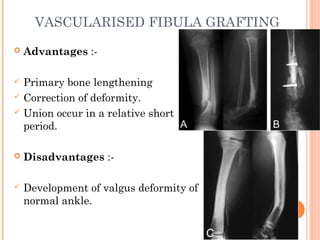
VASCULARISED FIBULA GRAFTING
 Advantages :-
 Primary bone lengthening
 Correction of deformity.
 Union occur in a relative short
period.
 Disadvantages :-
 Development of valgus deformity of
normal ankle.
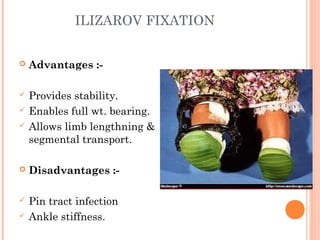
ILIZAROV FIXATION
 Advantages :-
 Provides stability.
 Enables full wt. bearing.
 Allows limb lengthning &
segmental transport.
 Disadvantages :-
 Pin tract infection
 Ankle stiffness.
AMPUTATION
 Anticipated shortening of more then 2 or 3 inches.
 Multiple failed surgical procedure.
 Stiffness & decreased function of the limb that will be
more useful after amputation & fitting with prosthesis.
BONE MORPHOGENIC PROTEIN
 16 different BMP have been identified.
 BMP-2 & BMP -7 are the only current available for the
clinical use in non-union & paeudarthrosis.
 Clinical studies have shown that BMP-2,6,9 plays an
important role in early differentiation of mesenchymal
progenitor cells to preosteblasts.
 BMP-7 promotes early differentiaiton of preosteoblast to
osteoblast.
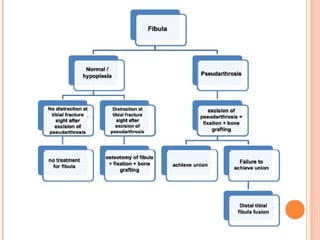
PSEUDARTHROSIS OF FIBULA
 Pseudarthrosis of fibula often precedes or
accompanies the same condition in ipsilateral tibia.
 Several grades are seen :-
 Bowing of fibula without pseudarthrosis.
 Pseudarthrosis without ankle deformity.
 With ankle deformity.
 Fibular pseudarthrosis with latent tibia pseudarthrosis.
 Progressive valgus deformity is developed.
TREATMENT
 Until skeletal maturity –ankle foot orthosis.
 At maturity :- supramalleolar osteotomy
 Langenskiöld has devised an operation for children to
prevent valgus deformity & halt its progression—
SYNOSTOSIS.
THANK YOU…

Congenital pseudarthrosis of tibia

  • 1.
    CONGENITAL PSEUDARTHROSIS OF TIBIA Dr.Sidharth Yadav Orthopaedic Dept. N.K.P.SIMS
  • 2.
    DEFINITION  Pseudarthrosis isa false joint associated with abnormal movements at the site
  • 3.
    INTRODUCTION  Congenital pseudarthrosisof tibia refers to nonunion of tibial fracture that develops spontaneously or after trival trauma in a dysplastic bone segment of tibia diaphysis.  CPT is rare & Usually develops in first 2 yrs of life.  Etiology is unclear.  Incidence is 1: 250,000  There is a strong association of CPT with neurofibromatosis type 1.
  • 4.
    CLINICAL FEATURES  Associatedwith anterolateral bowing of tibia.  Bowing usually occurs at the junction of middle & distal third.  Deformity may be associated with skin dimple, limb shortening, dysplasia of fibula & ankle valgus.  Usually unilateral.
  • 5.
    NEUROFIBROMATOSIS  NF-1 occursdue to mutation on the gene coding for NEUROFIBROMIN on chromosome 17.  Neurofibromin is expressed in a broad range of cells & tissue type.  It negatively regulates Ras activity ( cell proliferation & function)  It’s deficiency leads to increased Ras activity.  Affects Ras-dependent MAPK( mitogen activated protein kinase) activity which is essential for osteoclast function & survival.
  • 6.
  • 7.
    DIAGNOSTIC CRITERIA OF NEUROFIBROMATOSIS 6 or more café-au-lait macules (>5mm before puberty & >15mm after puberty).  Axillary or inguinal freckling.  2 or more neurofibromas or 1 plexiform neurofibroma.  2 or more Lisch nodules.  Optic glioma.  A distinctive osseous lesion such as sphenoid dysplasia or thinning of long bone cortex with or without pseudarthrosis.  A first degree relative with NF-1.
  • 8.
    PATHOLOGY  Unclear  Recentstudies have shown that there is hyperplasia of fibroblast with the formation of dense fibrous tissue.  This invasive fibromatosis is located in the periosteum & between broken bones ends causing compression, osteolysis & persistance of pseudarthrosis.
  • 10.
    PATHOLOGY  Paley etal theorized that pathology of pseudarthrosis is not bony but rather its periosteal in origin.  This theory was also considered by CODAVILLA a century ago.  This theory is supported by following observation :-  Thickening with hamartomatous transformation of periosteum.  Appearance of strangulation of bone with atrophic changes followed by avascular changes.  Failure of remodelling of pin tracts leading to stress fractures.
  • 11.
    PATHOLOGY  Pathologic analysisof HERMANNS-SACHWEB et al confirmed that pathologic periosteum is the cause of CPT.  There finding was :-  Neural cells form a tight sheath around the periosteal vessels.  Peiosteum undergoes hypoxemic changes resulting in the formation of a thick fibrous cuff.  Leads to impaired oxygen & nutrient supply to the subperiosteal bone & atrophic changes are observed.
  • 12.
    CLASSIFICATION  There isno universally agreed system based on both clinical features & radiographic findings.  CAMURATI - 1930  ADGLEY - 1952  BOYD - 1958  APOIL - 1970  ANDERSEN - 1973  CRAWFORD - 1986  CRAWFORD - 1999  BOYD & ANDERSEN are commonly used.
  • 13.
    BOYD CLASSIFICATION  Boyddivided CPT into 6 types :-  Type 1 :-  Pseudarthrosis occurs with anterior bowing.  A defect in tibia present at birth.  Other congenital deformities may be present which may affect the management of pseudarthrosis.
  • 14.
    BOYD CLASSIFICATION  Type2 :-  Pseudarthrosis occur with anterior bowing & a hourglass constriction of the tibia is present at birth.  Spontaneous fractures or after minor trauma.  Commonly occur before 2 yrs of age.  Also known as HIGH RISK TIBIA.  Tibia is tapered, rounded, sclerotic & obliteration of medullary canal.  Most common type.  Associated with NF-1  Poorest prognosis.
  • 15.
    BOYD CLASSIFICATION  Type3 :-  Pseudarthrosis develops in a congenital cyst usually near the junction of middle & distal third of tibia.  Anterior bowing may precede or follow the development of fracture.  Recurrance of fracture is less common after treatment.
  • 16.
    BOYD CLASSIFICATION  Type4 :-  Originates in a sclerotic segment of bone.  Without narrowing of tibia.  Medullary canal is partially or completely obliterated.  An insufficiency or stress fracture develops in the cortex of tibia & gradually extends through the sclerotic bone.  Prognosis is good.
  • 17.
    BOYD CLASSIFICATION  Type5 :-  Pseudarthrosis of tibia occurs with a dysplastic fibula.  Pseudarthrosis of both bone may develop.  Prognosis is good if the lesion is confined to fibula.  If the lesion progress to tibia then the natural h/o usually resembles type 2.  Type 6 :-  Occurs as an intraosseous neurofibroma or schwannoma  Extremely rare.
  • 18.
    CRAWFORD CLASSIFICATION  Dividedbroadly divided into 2 types:-  Non-Dysplastic  Anterolateral bowing with increased density & sclerosis of medullary canal.  Dysplastic  Anterolateral bowing with failure of tubularization.  Cystic changes.  Frank pseudarthrosis.
  • 19.
    ANDERSEN CLASSIFICATION  Alsodivided into 6 types :-  Club foot  Cystic  Late  Fibular  Dysplastic  Angulated
  • 20.
  • 21.
    TREATMENT  Treatment ofCPT depends upon age of the patient & type of pseudarthrosis.  Decision has to be taken whether to attempt to secure union or amputation is the treatment of choice.  No single treatment approach has proven ideal .  True pseudarthrosis does not heal when treated with casting alone.
  • 22.
    TREATMENT  Goals oftreatment :-  Complete excision of the soft tissue fibromatosis at the site of pseudarthrosis.  Correction of angular deformity.  Stimulation of bone healing.  Proper fixation of bone fragments.  Postoperative protection .
  • 23.
    TREATMENT  Is dividedinto 2 types :-  Prophylactic :-  Decreased activity.  Orthotics or cast.  Curettage with bone grafting.  Active :-  Surgical treatment
  • 24.
    TREATMENT  Bone grafting IM fixation  Ilizarov fixation  Free vascularized fibular grafting  Amputation  Bmp(bone morphogenic proteins).  Electric stimulation.
  • 26.
    VASCULARISED FIBULA GRAFTING Advantages :-  Primary bone lengthening  Correction of deformity.  Union occur in a relative short period.  Disadvantages :-  Development of valgus deformity of normal ankle.
  • 27.
    ILIZAROV FIXATION  Advantages:-  Provides stability.  Enables full wt. bearing.  Allows limb lengthning & segmental transport.  Disadvantages :-  Pin tract infection  Ankle stiffness.
  • 28.
    AMPUTATION  Anticipated shorteningof more then 2 or 3 inches.  Multiple failed surgical procedure.  Stiffness & decreased function of the limb that will be more useful after amputation & fitting with prosthesis.
  • 29.
    BONE MORPHOGENIC PROTEIN 16 different BMP have been identified.  BMP-2 & BMP -7 are the only current available for the clinical use in non-union & paeudarthrosis.  Clinical studies have shown that BMP-2,6,9 plays an important role in early differentiation of mesenchymal progenitor cells to preosteblasts.  BMP-7 promotes early differentiaiton of preosteoblast to osteoblast.
  • 30.
    PSEUDARTHROSIS OF FIBULA Pseudarthrosis of fibula often precedes or accompanies the same condition in ipsilateral tibia.  Several grades are seen :-  Bowing of fibula without pseudarthrosis.  Pseudarthrosis without ankle deformity.  With ankle deformity.  Fibular pseudarthrosis with latent tibia pseudarthrosis.  Progressive valgus deformity is developed.
  • 32.
    TREATMENT  Until skeletalmaturity –ankle foot orthosis.  At maturity :- supramalleolar osteotomy  Langenskiöld has devised an operation for children to prevent valgus deformity & halt its progression— SYNOSTOSIS.
  • 33.

Editor's Notes

  • #4 5.7% of pt. with NF-1 develops CPT whereas 40% pt’s of CPT found to have NF-1.
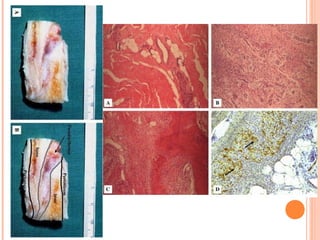
  • #10 Macroscopy :-  Aspect of the pseudarthrosis of the tibia. At the site of insufficient bone healing, white fibrous tissue substitutes the bone. A thickened cuff of periosteum and interruption of the bone compacta are noted. Microscopy :- Histologic section of the periosteum of the control case with some vessels and small nerves, H&E, 40×. (B) By contrast, the periosteum of CPT patients shows a lot of small blood vessels embedded in proliferating fibrous tissue, H&E, 40×. (C) In the area of pseudarthrosis, cellular proliferating fibrous tissue with immature bone is observed, H&E, 40×. (D) Proliferating fibrous tissue of the periosteum.
  • #11 The anterolateral bowing is due to the dominant muscular forces on the leg from the posterolateral compartment.
  • #13 Various classification system based on radiographic & morphology exist.
  • #21 Patient with type 1 CPT usually presents early in life , before 2 years of age & have a good prognosis with treatment. Type 2 presents usually in older childern after experiencing the failed surgical t/t, refracture or an osteotomy to correct a bowed tibia. Type 2 have a relative poor prognosis. Type 3 cases are usually of late onset type which develops as a stress fracture of congenital dysplastic tibia or in a healed tibia after previous bone grafting & has the best prognosis. The siginificant feature of type 2 is there is presem=nce of dead bone coz of the previous sx.
  • #24 Prophylactic :- pt. with anterolateral bowing of the tibia at the junction of middle & distal third of diaphysis or beyond ,particularly when accompanied by narrowing ,sclerosis & loss of defination of the medullary canal are considered high risk for developing pathological fractures & nonunion. The extremity is protracted by an orthosis & the child is guarded against excess activity. as the longitudinal growth takes places , there is a tendency towards the correction of the deformity though it can take a long time. The threat of the fractures is ever present untill skeletal maturity. Ostetomy are prohibited. If fracture & pseudarthrosis apperas imminent eg. In presence of cyst then curettage & filling with bone grafts.
  • #31 Sometimes it develop bet. The time of sucessful bone grafting of tibia & skeletal maturity. Lateral malleolus is shifted proximally so valgus deformity develops.